Getting the transcript
Reading the captions from YouTube. A video nobody has opened here before takes 10 to 30 seconds; this page fills in on its own.
Getting the transcript
Reading the captions from YouTube. A video nobody has opened here before takes 10 to 30 seconds; this page fills in on its own.
Kun Chen · @kunchenguid
Where viewers went back to watch this video again, from YouTube's public Most replayed graph, lined up with what was said at that moment.
Most replayed moment #1
7:154.7x the video's typical replay level
AI can do their job. This is AI becoming a more important strategic priority, and not everyone has the right skill sets to contribute to it. But do we also see people who are actually replaced by AI? Yes, we do. This was a real story from
Said at 7:08
Most replayed moment #2
7:344.2x the video's typical replay level
1 month. And someone actually came here to clarify it wasn't a refactor, it's a rewrite. A distinguished engineer and eight principal engineers from EC2 rewrote Bedrock. It's not the entire back end,
Said at 7:29
Most replayed moment #3
9:052.7x the video's typical replay level
reimagining what the new way of working looks like. We can see the amount of layoffs happening because of AI is on the rising trend, and I suspect this will continue for the next couple of years. So with the understanding of everything that happened, let's talk about what should we do.
Said at 8:58
The graph counts replays. It does not show where viewers stopped watching.
Words
1,853
Runtime
10:48
Speaking pace
172wpm
Reading time
8min
172 words per minute, between the 160 25th percentile and the 181 median of 349 measured videos. That distribution comes from the 349-video hook study.
Opening (first 30 seconds)
Meta just started another round of layoff of over 8,000 people today. It's one of the biggest this year next to many other high-profile layoffs from LinkedIn, Cisco, Cloudflare, PayPal, Snap, Oracle, and many other tech companies. And this is a continuation of a multi-year non-stop series of layoffs in the tech industry. You must be wondering, what the hell is happening? What is the real reason behind these layoffs? Is it really AI? How were these decisions made? And what should I do about it?
86 words, the words spoken in the first 30 seconds at 172 words per minute.
Free, no signup. See how the first 30 seconds hold attention, with rewrites.
Sentence shape
| Measure | This transcript |
|---|---|
| Sentences | 135 |
| Average words per sentence | 13.7 |
| Longest sentence | 35 words |
| Questions asked | 10 |
| Sentences containing a number | 20 |
Most used terms
Filler phrases
15 in total: like 6 · kind of 5 · actually 4.
A literal whole-word count of the same phrase list the Prepublish browser extension uses, so a phrase inside another word is not counted and a phrase used in its ordinary sense still is. It is a count and not a judgement.
What this transcript is
Every word below is the caption track YouTube publishes for this video, pulled from the video itself and reproduced unchanged. It is not Prepublish's writing, not a summary, and not a re-transcription: it is the video's own published captions. English captions, generated automatically by YouTube, in the video’s original language. Source: the video on YouTube. A channel that would rather this page did not exist can ask for its removal through the contact page, and it is removed.
Meta just started another round of layoff of over 8,000 people today. It's one of the biggest this year next to many other high-profile layoffs from LinkedIn, Cisco, Cloudflare, PayPal, Snap, Oracle, and many other tech companies. And this is a continuation of a multi-year non-stop series of layoffs in the tech industry. You must be wondering, what the hell is happening? What is the real reason behind these layoffs? Is it really AI?
How were these decisions made? And what should I do about it? I was previously an L8 engineer at Meta, Microsoft, and Atlassian. I had a front-row seat in how AI was transforming these organizations and what their responses to that was. In this video, I'll try my best to explain everything you want to know about these tech layoffs. First, I want to make sure everyone understands what really happened. And I think the best way to explain that is to walk you through this timeline.
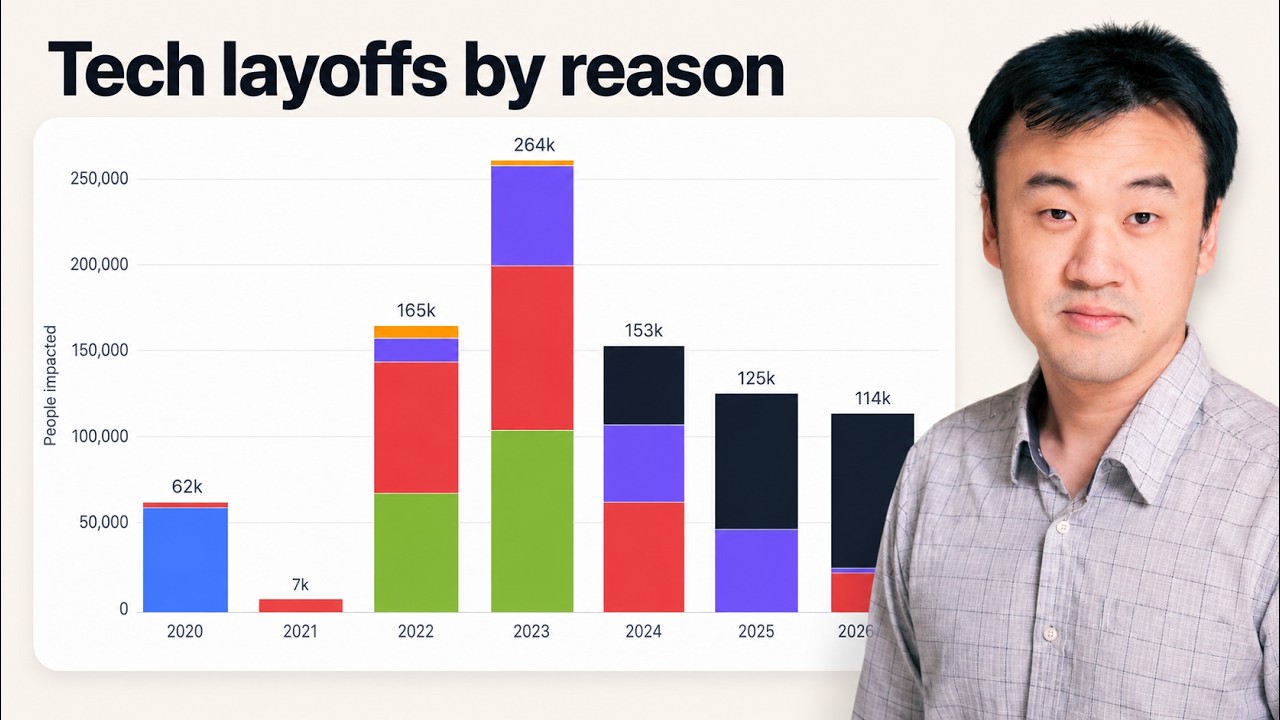
This is data from layoff.fyi. They have collected really useful data about every layoff that happened since 2020. And I analyzed all this data and I put them into a better visualization, which I'll show you here. Let's start with 2020. I think we all knew what happened around then. It was COVID-19. The pandemic sent us into a lockdown and it had two effects. One was that the demand for travel decreased significantly.
So, we saw companies like Uber, OYO, which is a hotel company, Groupon, Airbnb, all taking a hit. This is a direct result from COVID-19. The other effect was that online activities all increased a lot. Because we were staying at home, we spent more time on social media, entertainment, e-commerce, etc. So, all the companies whose primary business was to support these online activities all saw very strong growth. And when they saw this growth, they thought it's never going to end.
They built their business projections based on the assumption that the growth will sustain. And they hired a lot of people to support that growth. But as we all knew, the growth did not sustain. Shopify's layoff announcement in 2022 explained this really well. They talked about their decision to layoff and how we got there. And they talked about their assumption that e-commerce would permanently leap ahead by five or even 10 years.
And we all knew that's not what happened. The growth pretty much reverted to pre-COVID level. The other interesting thing we must understand is interest rate. This is data about interest rate directly from the Federal Reserve website. And we can see here in 2020, the interest rate was almost zero. And it started to rise in the middle of 2022. And it stayed at a pretty high level after that. So when interest rate was low, what happens is that there is almost no cost to borrow money.
It's very easy to get money as long as you can eventually pay it back. In this kind of a scenario, people will make their investment decisions more based on the long-term outlook of their bet. But when the interest rate is high, people cannot do that because until you can pay back the loan, you have to keep paying the interest every single year. And that is a lot of cost. In this kind of a scenario, people will have a stronger pressure to create profit.
And they often cannot wait for a long-term bet to pay off eventually. If we come back to this timeline and we overlay interest rate data on top of the layoff chart, we can see there is a very direct correlation. When interest rate was almost zero, there's a very low amount of layoffs happening. But when the interest rate started to rise, we can see the layoff started to surge as well. This is also around the same time as many companies started to talk about efficiency because they have to.
They have to control their cost. They have to maintain a healthy margin. They have to create profits in order to sustain themselves during a high interest rate phase. Okay, so far we have identified two big reasons of layoffs. One was a correction of over-hiring during the pandemic. The other was the rising interest rate pushing for more efficiency. But, does that explain everything? If we look at 2024, we'll see something very interesting.
The companies that laid off people during that year were Intel, Dell, Cisco. What do they have in common? I actually analyzed every layoff to figure out what is their primary reason. And when we group by the categories, we realize there's a big category called hardware downturn. What happened here was that at the beginning of the pandemic, because of us changing how we work, we had to buy new devices as well. A lot of people bought a PC for working from home.
A lot of companies also changed their devices to fit better with remote work. And what happens after you buy devices is that you stop buying new devices. So, in the subsequent years, we saw a big slow down in hardware demand, which was causing trouble for these hardware companies, and they had to lay off people to stay sustainable. Something else that's interesting that started in 2024 was that we have a new category of reasons for layoff, and this category is on a rising trend.
And that is AI. Before 2024, we also saw some companies talk about AI in their layoffs. And I think they were using AI as an excuse, as a tool to demonstrate they are able to improve their efficiency. Only starting from 2024, AI is becoming a real thing. To understand AI's impact on layoffs, we must start from Meta's hiring spree. In late 2025, Meta spent over $14 to acquire a part of this company called Scale AI. And got their CEO, Alexander Wang, to leave Scale AI and join Meta to run their AI organization.
Around the same time, they also started to hire AI researchers from Frontier Labs. OpenAI was accusing Meta of trying to poach staff with over a hundred million dollars sign-on bonus. That is a crazy amount of spend on AI talent, and that is only a part of the spending. Meta also announced their plan to spend as much as 65 billion dollars for AI, and a big part of that will be building an AI data center to run the compute for their AI.
Now, that gave us a very clear picture. Meta believes AI is the future, but to win in AI, they have to put in a massive investment in both AI talent and compute. Where do they get so much money to do that with such a high interest rate? They have to reallocate. They can do that in two ways. They can move people who can do AI to work on AI, and that's exactly what they did with the 7,000 people reassignment. They can also lay off people who cannot do AI to reallocate the money to hire AI talent and buy more AI compute, and that's exactly what's happening as well.
This is not AI replacing people because AI can do their job. This is AI becoming a more important strategic priority, and not everyone has the right skill sets to contribute to it. But do we also see people who are actually replaced by AI? Yes, we do. This was a real story from the Amazon employees subreddit. AWS Bedrock entirely refactored by AI in 1 month. And someone actually came here to clarify it wasn't a refactor, it's a rewrite.
A distinguished engineer and eight principal engineers from EC2 rewrote Bedrock. It's not the entire back end, but the routing and load balancing layer. This layer was maintained by over a thousand engineers in an organization, now done by a small team with AI in just over a month. That speaks to an organizational shift we are starting to see. Small teams with AI can move a lot faster than a large organization. So now a lot of companies started to rethink how they should be structured.
Previously, the most typical engineering unit is an engineering manager supporting a bunch of ICs as a team. The engineering manager needs to do things like recruiting, coordination, and performance reviews. As the complexity grows, they will just put in more engineering managers and supporting more units like that under someone like a director. But now people are seeing a new kind of unit starting to emerge, which looks something like this.
An IC developer or a very small amount of IC developers, they can form a pod and manage a large amount of AI. And AI agents don't need recruiting or performance reviews. So now the directors are asking, "If this is the new unit, do we still need so many engineering managers?" And that is why middle management is taking such a big hit in recent layoffs. It's because these companies are reimagining what the new way of working looks like.
We can see the amount of layoffs happening because of AI is on the rising trend, and I suspect this will continue for the next couple of years. So with the understanding of everything that happened, let's talk about what should we do. My biggest advice here is to start learning how to work with AI now and take it very very seriously because the rest of your career very much depends on it. And this is nothing new. It happened over and over again during industrial revolutions.
It happened when factories changed how we were handcrafting tools. It happened when tractors changed how we do farming. It happened when spreadsheets changed how we do accounting. A new technology platform is here. We must embrace it. You can do this in two ways. You can get into machine learning, AI training, or AI inference stack, or even the hardware of making chips, or you can learn to use AI to do your work better and faster.
Be the most AI native person on your team and stand out. When you first try AI, you may find that it sucks and makes all kind of mistakes. But, that's the same with adopting any kind of new technology. There's a learning curve. Many people who have gone through the learning curve can tell you that the gain is real and is already here. For those of you who worded off, I encourage you to take control of what you can control.
Take this as an opportunity to rethink your career next steps. Use the time to learn something new. Play with things. Find things that excites you and brings you energy. I say this as a person who proactively quit my career as an L8 engineer just about a month ago, and I don't regret it at all. If you're interested in my journey, I actually made a video that shared my experience. Thank you for watching. Good luck and have fun.
The words are the caption track's own and nothing is reworded or re-transcribed. Paragraph breaks are placed between sentences so the text reads as prose.
Free tools for your own script. No signup, no login.
Paste your draft and see where viewers are likely to drop off, with a rewrite for each weak line.
Paste the first 30 seconds of your own draft for a hook score and rewrites.
Check your draft against YouTube's advertiser-friendly guidelines before you record it.
Read this channel's public videos and transcripts, and download a writing brief for it.