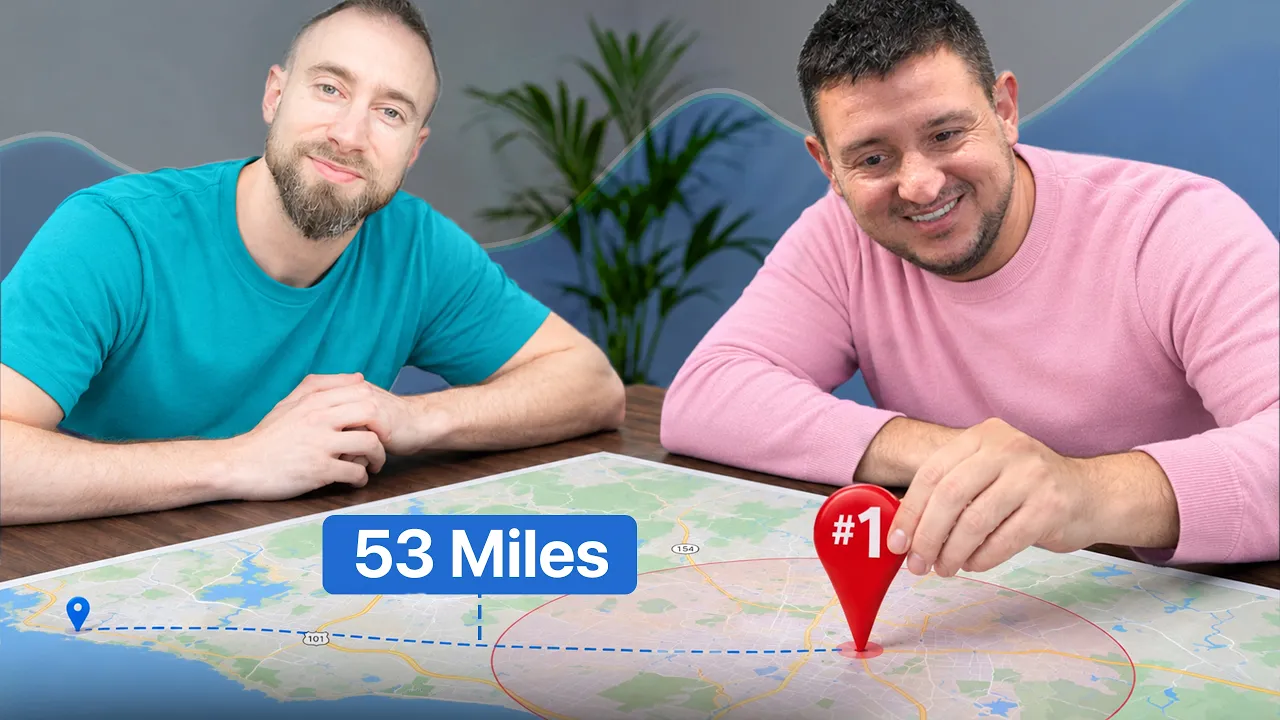
How He Ranks #1 in Google Maps From 53 Miles Away | Mike Martin transcript
Edward Sturm · @buildinpublic
Words
15,613
Runtime
1:11:58
Speaking pace
217wpm
Reading time
65min
217 words per minute, above the 201 75th percentile of 349 measured videos. That distribution comes from the 349-video hook study.
Opening (first 30 seconds)
We're talking about Google business profile and local search engine optimization on this episode of the show. We're joined by Mike Martin. Mike, you're a listener of the podcast, too. >> Certainly am. Yes, I watch it daily because you do it every single day. >> Let's go. That's amazing. And um Yeah. And you're friends with a lot of people who've been on the show. James Douly was on yesterday. You're good friends with him. And uh >> been mates with James for six maybe in fact longer than six years. I've known Casra six years. his business partner, but I've known James a lot longer back in
109 words, the words spoken in the first 30 seconds at 217 words per minute.
Sentence shape
| Measure | This transcript |
|---|---|
| Sentences | 936 |
| Average words per sentence | 16.7 |
| Longest sentence | 218 words |
| Questions asked | 88 |
| Sentences containing a number | 101 |
Most used terms
- gt242
- business183
- google125
- gt gt121
- um93
- profile90
- google business75
- client55
- business profile52
- people50
- yeah40
- uh37
Filler phrases
395 in total: like 170 · um 93 · uh 37 · kind of 23 · right? 23 · actually 13 · you know 13 · basically 9 · I mean 7 · literally 5 · sort of 2.
A literal whole-word count of the same phrase list the Prepublish browser extension uses, so a phrase inside another word is not counted and a phrase used in its ordinary sense still is. It is a count and not a judgement.
What this transcript is
Every word below is the caption track YouTube publishes for this video, pulled from the video itself and reproduced unchanged. It is not Prepublish's writing, not a summary, and not a re-transcription: it is the video's own published captions. English captions, generated automatically by YouTube, in the video’s original language. Source: the video on YouTube. A channel that would rather this page did not exist can ask for its removal through the contact page, and it is removed.
Transcript
We're talking about Google business profile and local search engine optimization on this episode of the show. We're joined by Mike Martin. Mike, you're a listener of the podcast, too. >> Certainly am. Yes, I watch it daily because you do it every single day. >> Let's go. That's amazing. And um Yeah. And you're friends with a lot of people who've been on the show. James Douly was on yesterday. You're good friends with him.
And uh >> been mates with James for six maybe in fact longer than six years. I've known Casra six years. his business partner, but I've known James a lot longer back in the magic page plug-in days. >> Amazing. Okay, this is going to be a great episode. Can you um and yeah, you're going to be sharing some crazy stuff. Can you uh talk about your background really fast? >> So, I started out as I'll I'll take you right back.
So, I started out as a locksmith. Um so, I let me I taught myself to pick my brother was supposed to get a record deal. We moved to London. It fell through. We moved back to Manchester and I'd sold me business to go to London. So, I um I I decided I wanted to start a company. I had no idea what I was going to do. And I met a guy at a party and this guy at the party says to me, "I've done 700 quid today." And I was like, "How how have you done that?" And he told me about uh he's a locksmith and I was like, "What's a locksmith?" I had no idea what it was.
No idea about picking locks breaking into houses. And he he explained it to me and I was like, "Wow, I want to do that." So I taught myself to pick locks on YouTube. And then once I once I taught myself to pick the locks off off YouTube, I started advertising to try and get business. Um and very quickly realized there's a lot more involved than just picking locks. Anyway, um, paid ads, Google ads as you know, gets deer and deer and deer.
It's a race to the bottom and the cost per click increases. So, I started to learn SEO back in 2009, 2010. And I over a 2-year period, I built one of the largest independently owned locksmith companies in the UK with just lead generation and building mass page style websites, radius targeting, and building what we class as single niche PBNs. And over the last few years, because we we had thousands and thousands of websites, we've noticed that the traffic, even though the sites are still ranking, is is gradually decreasing and decreasing and decreasing.
And all you big lead genen guys will tell you the same thing. The traffic's decreasing. It's going over to AI. It's going to um Google properties, so to speak. And so we we moved heavily then into Google business profiles. We noticed that a lot of the traffic was in not necessarily increasing but because Gemini feeds Google business profiles sorry other way around Google business profiles feeds Gemini that goes into AI you get the overviews and also you get above the websites on Google um and we've never looked back we we we've kind of built a product around that and we've focused now 100% we give away eight or nine of our software products um to our our business partners involved in those so we could focus 100% of our effort on GBPs Dude, that's crazy.
One of my one of my close friends uh was a locksmith in Missouri for a while uh here in the US and he shared like the craziest stories about like the the places that he goes out to to to break into homes like you said to unlock cars and he he was he got into garage door repair as well and he was also sharing how abysmal a lot of the SEO is in that. And uh yeah, this is going to be a cool local SEO episode. So, let me ask you, what's the fastest way you've seen a business go from invisible in the top three in the map pack?
Um, sorry, go from invisible to the top three in the map pack. And what do they do in the first 30 days? >> I wasn't expecting that as a question. Um, well, Google Business Profile, I think it was about 2022, probably around November 2022, Google Business Profiles went from being Google My Business, which was was pretty much a static listing to Google Business Profile, which which now kind of reacts better to what we would call social media.
Um, I I'd call it, it's kind of like social media. So, for example, you've got a YouTube channel. Your YouTube channel when you first started, it was probably very slow, nobody listening, nobody paying attention. But what you do is you focus on consistent daily activities. So with with regards to Google business profiles then the the the modern strategy I call it a GBP loop and the modern strategy is profile completeness/mirroring.
So what we mean by that is completely fill out the profile. Forget about keywords, keyword stuffing and all the rest of that stuff. The like leave the SEO for the websites. Just fill out exactly who the business is. As soon as you give them your category and your location, Google knows who you are, what you do and everything. it doesn't need all of that additional information. And and don't get me wrong, they do work, but it's not necessary.
And then when I say mirroring, what I mean is the Google business profile mirrors the website. So, not just like back in the day, everyone talked about nap. It's obviously it's your categories, it's your working hours, it's your prices, it's all the rest of that stuff. And then mirroring the mentions of your business all over the internet. So, if if I I can't really give an example of the fastest I've seen it work, but I'll give you an example of what you should be doing in month number one.
So month number one would be complete the profile in full. Make sure it mirrors your Google business profile. Make sure that all your citations on the internet uh match. And then it's about pictures slash videos posts and then praise which is reviews slash um review responses. And what what we do with a with a with a client or what the agencies I work with do is they focus on on what we call the GBP loop. So it's profile completeness/mirroring. get all that up to place and then find all the images they've got inside of the organization that they can post on a schedule to keep it going consistently.
Then posts. So these these are not designed to rank, but what they are designed to do is let's say an image puts a face on the business and you want to you want your business to look like what it looks like now, not what it looked like 6 months ago or 3 months ago or even 3 weeks ago. So you want a consistent flow of media going up onto the profile. You want a consistent flow of uh posts. But when when we're doing posts, a lot of people are like, "Yeah, but they don't affect rankings." It's not necessarily about that.
You're trying to give information. You're trying to build relationships, the same as anything you would be doing on on social media, and you're trying to convert a prospect to a customer. This method of marketing is so effective, I had to make sure it wasn't against Google's rules before I kept using it. It's a form of SEO I call compact keywords. Whereas most SEO focuses on putting up articles to answer questions, how, what, when, compact keywords focuses on putting up dozens of pages that sell to searchers who are actually looking to buy.
These pages rank on Google and convert so much better than normal that when I discovered this years ago, I couldn't believe this was allowed. It's less work, too. The average compact keywords landing page is only 415 words. Compact Keywords is a 13-hour deep course on getting sales with SEO. A customer said, "We spent nearly 18,000 in the last year and a half on marketing and SEO through different agencies locally, and that did nothing.
We decided to take the leap on the compact keywords course. We're now getting about 6 to eight calls per day on a good day, which is just unheard of." Another customer said, "Give it to a junior employee. Have them follow it exactly as Edwards laid out. You don't have to do anything, and you're going to gain a six-figure SEO level employee just by having them go through this course." Compact Keywords is about setting up an SEO funnel that brings you sales for years and years and years.
It works with AI. It's less work than traditional SEO and it makes way more money. You can get it now at compact keywords.com. Back to the podcast. The same as you want on social media. You're trying to get someone to like, follow, subscribe, and it's the same sort of thing. What you're trying to do is turn them from a prospect to a customer or a prospect to a hot lead then to a customer. And then after that is your reviews and your review responses.
That is the only thing that really Google does say to us this increases visibility. This does work and we have seen it massively. But what we've seen work better is not necessarily going and getting 500 reviews all at once and then getting nothing for two to three months. I'd rather get 10 reviews a week or even 10 reviews a month and then 10 reviews the next month and the next month. And then what we call the Google business profile loop is four Ps and then times 1 C, which is profile completeness, post, pictures, praise, times consistency, and then you li loop back to the beginning again.
Make sure that your profile's complete. Check that the mirroring is in place. Post, pictures, praise, back to the beginning. And you just do that monthly. And the agencies that are doing that are absolutely smashing it out the park. So, for example, my Google business profile, my my own personal coaching business. Um, I was on with one of my agencies the other day and he's he's 53 miles in in probably that direction.
I don't know which one, but it lives about 53 miles away from me. And he's like, "So, this really works and what you're saying works." And I was like, "Okay, type in business coaching." And so, he went, "All right." And he gets his phone and he went, "Holy shit." And I was like, "What is that your first?" He's like, "You're right above all the websites." And I was like, "Exactly." And that's not me website. And that's not business coaching location.
That's just business coaching. 53 miles away from my Google business profile and I'm ranking number one every area within a 25 mile radius of where I am for business coaching, business coaching near me and business coaching location. I'm the number one Google business profile and I don't do anything special. I literally just follow that thing. That's it. Just follow that loop and it just works. Um, and and we kind of found it out by when we first started trying to rank Google business profiles, we did what everybody was saying, "Oh, you should be doing this.
You should be doing this. You should be doing this." And and we tried absolutely everything. And the results was just mediocre. And I went to my business partner. I'm like, "This doesn't work." I was like, "You just can't rank them the way that we can with websites." Um, and he said, "Leave it with me." And he goes away and he starts reading through all of Google's documentation. And it's about four weeks later, we come back and he's like, "I know exactly how to do it." And when he first gave it me, we didn't call it the GBP loop, but he gave me the process.
He's like, "Just do this, then do this, then do this, then do this, then loop back, then do this, then." And I was like, "Oh my god." And we started testing it. And within 4 to 6 weeks, we was number one everywhere within a 2 and a half mile radius. Then within about 8 weeks, we had um an 8 mile, not an 8 mile, I think it was a 10 mile radius. And then after that, we was a 20 m, which means it's 40 mile across. And we were number one everywhere.
And we still are to this day. And we've not just got that with ours, we've now got that with hundreds of clients and I work with hundreds of different agencies now on basically. So, so I do a monthly training with the agencies and I I'll go in and look at what they're doing, how they're doing it, and it nearly always just comes back to one word, consistency. Every single time it comes back to that one word, consistency.
It just works because your link building, your keywords, your content, your contextual relevance, and your your everything else comes from the mirroring over of the website. And if you're trying to really push it a little bit further, you can use something called uh well schema. You'll know what schema is. And what we do is we put the business in the schema and then we use the CD in the same as and then we use that as a service area and we create service area pages around the business and that gives us a little bit of a boost um if if we need it.
Most times you don't need it though with 99% of businesses you don't need it cuz nobody's being consistent. >> That make sense? >> It Yeah. We're going to break this down. I want to break this down into like step one, two, three. I think that'll make it especially easy. But I I I also want to ask I try to ask questions that listeners might be thinking. So how come you can't say the fastest that you've seen a business go from invisible to top three? because most businesses have been up maybe 6 12 18 months before we've before we've started doing anything with them.
So if >> Yeah. But I mean like when you start when you start doing something with them. >> Well that business coaching one I I just told you about that one in four weeks we was number one everywhere within a 2 and a half mile radius. But if we was to try if I'm to try and say from zero, if you just set up a Google business profile now like and and if you're let's say you're dealing with divorce lawyers versus dealing with candle makers.
Yeah. Then your candle makers is going to hit number one everywhere or say it's going to it's going to get a much bigger visibility in the in the radius area of where people are searching from much much faster than if somebody who's going after a divorce lawyer and they've already got 600 Google business profiles. They got thousands of clients. They've got hundreds if not thousands of citations all over from legitimate places, not just from from from spammy crappy ones that people throw up.
Like all of a sudden, it's a whole different ballgame. Um, but what we've seen even in those situations is the consistency is not always there. The requesting a review from every single client isn't there. The responding to the reviews isn't there. If it is there, it's usually there. It's a canned response. Thanks for the review. Lovely working with you. Thanks. and everyone's getting the same response and it's like okay and so that's kind of what we've built into the process is a way of automating rec review requests and then we have AI that writes the response but the client has to then verify and edit it so that there's no actual just AI slop going up so nothing can be put up automatically it has to be put up um it has to be verified reviewed and verified by a real human before it ever goes live >> and what what's step one for let's say somebody who hasn't really worked on their Google business profile at all.
What's step one? >> So step one, right? So if you if you're a GBP expert, then step one's profile completeness straight away. It's the foundation. Um inside of our software, we have something called a GBP expert because this is where most people fall down. So what we what we enable them to do is they upload their Google business profile and GBP expert will will scan it. We'll scan your website. will scan everything that to do with your business and it will come back and tell you exactly what steps you need to do to get to as close to a 100 score as possible.
So, profile completeness and then mirroring. So, before you start putting up loads of posts, putting up images, and doing all that, if you're working on a bad foundation, profile completeness is step number one. And then mirroring is again is just look side by side. This is the website. This is the Google business profile. the business name is identical because people tend to stuff keywords into business names when it's on a Google business profile which is against the terms anyway.
Um then you've got so you'll check the name, you'll check the the the locations the same, our business hours are the same. You'd be surprised to find how many people have got 9 to5 Monday to Friday on on their website and that's not their working hours and they're open seven days a week. And so so it's important to make sure that everything mirrors. And then again, you can go to something like chatbt and you can say chatbt, go and find all the mentions of my business on the internet and put in a load of information about your business and find me everywhere that this doesn't match.
And then that that's not it's not completely foolproof, but it's the most cost effective way for a business to do it. And then they can just click the links from chat dbt and go and find the citations where things are not matching. Like we've got an example where we've ranked one of our Google business profiles and we can't hit number one. Okay. And the reason we can't hit number one is we've purposely created citations with different opening hours.
So on on the website it's got something like 9 to5 Monday to Friday. And then over on the citations we've got 10 toil uh 10il 2 I think Monday to Friday. And we've done it purposely to show that actually having these citations over here make a difference if you've got even something like your working hours is incorrect. Now, we are ranking in the top three for a lot of areas and number one in some areas, but we're nowhere near hitting that 25 mile radius that we want to potentially get for a Google business profile.
That's kind of the aim. If if you get everything right, you should be able to hit that radius quite consistently on the first page of Google. >> And what happens when when external websites that aren't your own are saying different things about your business? >> Yeah. Well, the the the thing is is what you want to do is try and get all of your citations as accurate as possible as in in everywhere that you physically can do it.
Um, now we used to have a lot of directories cuz we did the mass page sites and we'd pulled all the directory information from Google business profiles and we built out these mass page directories and was ranking for everybody's brand names and keywords and all sorts of crazy stuff like tens of thousands of pages. And we were getting hundreds and hundreds and hundreds of businesses contact us saying this is incorrect.
And that's what you have to do unfortunately. You have to get in touch with these these website owners and like look you've got the wrong information about my business. Can you please take it down? And it can be quite laborous, but it's worth it. Especially if those websites are something that's got a lot of a good solid footprint online. Like if it's just some crappy little onepage website somewhere that's not really indexing properly, not ranking, you can almost ignore it.
But the bigger citations are more important. Um, and the more powerful a website, the more effort you want to put into. >> And how much does that affect your Google business profile performance when you when you fix a citation? when you fix like an external citation >> again like like we said earlier it doesn't it depends on the industry and the competition that's in there and how well everything else is in place already.
So it's not necessarily that you're going to change a citation and it's going to push you up to the number one or you're going to get all your citations correct. But the the key is is if you've got citations all over that are referring to your I think I think I think the best way to look at it is if you make Google think or even look and say is this the same business it will pretend to ignore it'll tend to ignore it.
It's like if you put two pages on a website um and and you've got one that and this one that's both trying to rank for the same page for the same keyword like Google tends to ignore them both. it some most of the time it'll choose one but it can ignore them both and you're cannibalizing it and it doesn't work. So obviously what you do is you tear the the linking and and link them all through to one and do it correctly.
But it's kind of like the same thing is it's it's more about because obviously if you've got a business that's 15 years old, they might have changed address. They might have changed working hours. They might have there'll be a ton of of services they do now they never used to do back in the day. And so, but all that is we get it as close as we possibly can and then from that point forward we focus on consistency, pictures, post and praise and consistency over time.
But then we keep looping back every month to the profile completeness and mirroring. So every month you're going to recont the places that you you can to try and get all your information accurate. And I think that's the key. It's not about getting everything 100% straight away. It's about being consistent and it's seeing things happen and then you move back down the list and then it comes back and it happens again and you move back down the list and it happens again and eventually you'll get things to you probably never get everything 100%.
But the the great thing about Google business profiles is is that 50% of people that do them profile completeness they'll go off and they will maybe fix the website and some of the citations. They'll put a batch of images up that they'll maybe do a few posts. they'll get past 10 links because there's this myth online that uh sorry 10 reviews there's this myth online it gives you a massive boost and I've not seen any proof of that so I won't say it is or it isn't I just don't necessarily I've not seen it um and then they won't do anything it'll sit there so it's completely useless so probably 80% of Google business profiles are not even optimized and then the ones that do get optimized they're not staying consistent the key is that consistency Yeah, it's it's and and uh what you're saying about mirroring with the website is super cool.
Darren Shaw, he's been on the podcast many times, super wellknown in local SEO, Darren Shaw of White Spark, in his first time on the show, he he said he said like they looked at the crawl logs of a uh of a a website when they made a change to the corresponding Google business profile. and he saw that Google crawled they made like the most minor change to the GBP and Google crawled literally every page on the website.
Every single page Google crawled to to verify the change and um Google can see that because it's part of Google. So so so so it's it's it's much quicker than than anything else. I mean, I don't know if if you were if you've done lead generation and things like that when we all used to um create a Google doc and make it public and put all of your and it doesn't work the same anymore. Put all of your URLs into it and it' get you indexed really really quickly and then we'd stack all the Google properties and things like that to try and it doesn't work anywhere near as well anymore because AI is kind of filtered through to the point where it understands exactly what it is you're doing.
What should what should what should uh a local business have on their site >> on their website? >> Yeah. >> I mean, so so a lot of people are like you've there's a list of thing. I mean, you obviously want your terms of service and your privacy policy and things like that, but it's it's more about matching. So from a website perspective, from a local SEO perspective, that's where you're going to do all of your content.
That's where you're going to that's where all the technical work belongs. Okay? So, so, so from a website perspective, they can do a Google business profile themselves. A a business can do it themselves. It's just very very very time consuming and that's why we create softwares that takes away the time. But, but from from a from a website perspective, local SEO is not very difficult. There's very few businesses even now that are doing it right.
So I I always say to a business don't try to like get content's nowhere near as valuable as it used to be. Like content some content is nowhere near as valuable. Data is very very valuable. So for for example uh from a content perspective I can put 500 pages of content super super quick using AI and you can go through and mess around with it and make it but so can everybody else. But if I if I go into my software and pull back data from 500 different Google business profiles and say, "Okay, I can see that if you put up images twice a week and if you do this many posts and you do this and then I publish that data, that one piece of content is way more valuable than a 100 pages of so-called SEO optimized AI slop because it's it's brand new.
It's unique. It's it's real data that you you you you're bringing that doesn't exist anywhere online before. It's not something that's been regurgitated from something that already exists, which is kind of what your your AI does. Um, and we're finding that that type of content ranks better than content that is just we are the best plumber in location type of that we've been doing since 200 probably before I did it, 2009, 2010 when I started.
But before that, people were doing it as well, weren't they? We I don't know if you was in SEO back then, but what we used to do is we we'd get white content on a white background and you'd put in like keyword location a thousand times on the page and then you'd have a little bit of text at the top and you'd have a white background with white text and you publish it and you'd hit number one in Google. It was awesome.
It was so easy. Um like we made so much money back in the day from the lead genen stuff, but obviously Google's got on to all that now. >> Yeah. with um the content like not all content is as valuable. Completely agree. I for me it's uh I I think I think top ofunnel content which I talk about all the time on the show is generally like don't focus on that if you're a business. Focus on that if you have all the bottom ofunnel stuff nailed down.
And with a local business like you're saying it's super it's super easy to do to do content on a site. Focus on the the bottom of funnel stuff. Most people don't even know how to do relevance. Most local businesses don't properly know how to do relevance. I was looking at um one of the top one of the top uh one of the top law firms that in SEO within New York City and there was a lot that they were doing right, but there was a ridiculous amount that they were doing wrong where they can easily be overturned in their SEO.
And it's um yeah, a a lot of people don't know how to do um SEO the right way. uh you see that you see the um what you're talking about there law firm in the United States do you know what a practitioner profile is basically and the reason I'm bringing up is because you've said the law firms and law firms is the perfect example right so so most and I'm not saying all law firms but most law firms for example might be a law firm based in the United States uh based in New York we use New York right and then let's say they've got 20 partners right all partners one does divorce one does some sort of finance crap and all sorts of stuff that they do all these different types of law right each one of those lawyers lawyers might actually be eligible for what's called an individual practitioner profile, right?
So then what you do is your website would be um abcaw.com. Yeah. Then you'd have abcaw.com/mike Martin. Then we might have Edward Sturm and and so on and so forth. Yeah. And and we're both lawyers. And then what you can do is I can go and create. Right. So, as long as I'm contactable at the at the business during my selected working hours and as long as I'm a a um I forgot how so I can be contacted at the verified place and I'm a public facing professional.
So, you can't have receptionist and people like that, right? So, it's it's your lawyers. But, let's say I'm a divorce lawyer. Mike Martin's a divorce lawyer. So, what I could potentially do is I can build a practitioner profile for Mike Martin as a let's say I'm a doctor, Dr. Mike Martin, but we'll go back to law now just because I don't know the titles of lawyers. Um, so I I I can be Mike Martin, the the the divorce lawyer based in New York at the at the business and I can have my own individual practitioner profile.
Okay. So it then becomes a specialist practitioner profile because it's only going to be based around divorce lawyer, right? And then I can build out my own um my own client base. I can build out my own prof pictures post pro pro uh pictures, post and praise. But then let's say I've got a practitioner profile with 240 uh fivestar reviews. Now imagine that I'm going looking for a job and I'm going up against three other right more experienced lawyers for this divorce lawyer practitioner.
But I walk in there and because if you move address or you move business, you can transfer your Google business profile practitioner profile across to where you've moved address as a business. Well, it's the same thing for these individual practitioners right now. Imagine I walk in and they've seen three people that are more experienced. They're like, "Oh, see this last guy anyway? He's he's he's he's not as experienced.
We're probably not going to pick him. And he walks in and he says, "Right, but what and I've got this and I've got this and I've got this and I've had about a book of business, but I've also got an individual practitioner profile, right? And it gets 39 incoming calls every single month, right? And now imagine each one of those leads is worth, I don't know, between 20 maybe 20 to 150,000 for a for for a divorce. All of a sudden does that and he can take that with him." And so so lawyers can build what's called individual practitioner profiles and so can doctors, so can dentists, so can can um insurance brokers, so can real estate.
So you can go like a lot of people are spending a ton of time trying to pitch businesses on Google business profile optimization, but you can go into LinkedIn and you could potentially go and pick um professionals, experts, and and like you're not trying to sell them. You're like, I'd love to sit down and speak to you and see if you qualify for an individual practitioner profile. And if you explain it the way I've just explained it to you, let's say you're earning six figures and you want to go and get another job and you've got that on your CV.
Nobody else has got that because nobody's doing it, right? And you can do this for surgeons. You can do you can do it for real estate um one that actually does seem to use it quite a bit. real realtors tend to use it, but it it's such a it's one of the biggest opportunities in my opinion um for people doing Google business profile optimization right now and and then from an upsell from inside an organization perspective, you you could be the the law firm.
If you contact the law firm and say, "Do you realize that we could have maybe 5, 10, 15 different Google business profiles from inside your organization? All I want to do is sit down, interview each one of your your experts, see if they qualify for it. If they do, we'll build out the profiles. And because you're already spending 15, 20 grand a month with us, we'll only charge you two grand per profile per month. Let's say you get 10 and you put an extra 20 grand a month in recurring revenue straight into your business with an upsell that's going to one one new client through one of those practitioner profiles will cover the cost of that anyway, for for these lawyers. and and it's it's it's it's it's such a big opportunity that nobody's taking advantage of. >> It's cool.
Super cool. Um I want to go back to your method, too. So, okay. So, step one is just profile completeness and mirroring. >> Yep. >> And and Okay. Step two, >> uh pictures and and videos. So, so profile completeness pictures. And when I say pictures, videos, it's just a media me. You need a media strategy because it's not necessar like Google's not going to say to us put upload three or five or seven images every single week.
Okay? And and there's not even any proof that they the effect ranking. But the whole point of of using having a media strategy, there's the consistency so Google can see movement. So it knows that you're still active, you're still doing what you do, but not not only that, it puts a face on the organization right now face. Like most profiles you'll see the images are 2 3 4 5 years old >> and it doesn't take much effort to be uploading pictures on a regular basis.
Like even if you're a lawyers firm, it's like you've got people joining and leaving all the time. There's new legislations coming out which you can put into post or images. There's all sorts of stuff that's happening that if you treat it more like social media, your consistent daily uploads, consistent daily manual actions rather than um trying to be super technical because leave that to the website, leave that to the SEO organ agency, the the Google business profile, that consistency.
So the then yeah pictures >> yeah most people just don't want to be consistent. So how about people who are trying to use AI images in their GBP? So, what we were doing for a while and what I've been doing is I would avoid completely AI generated, especially now, you know, that they've got the little thing that they've got to put in the images so that they can tell it's an AI image straight away. But what so what I used to do is I used to go to my website and I'd take a screenshot of of a call to action, right?
And then I'd get that screenshot of that call to action and then I'd go over to Canva and I'd make like an 18 um what's it called? 19 1820. I can't remember what they call it. You know, you know the shapes 1920 by um 1080p. >> It's 1920 pixels by 10 by 10,80 pixels. It's like a standard slide shape. So I' I'd create one of them. I'd drop it in the middle. Then I'd say office staff and I'd get images from Canva and I'd drop behind the call to action the office staff and then I'd duplicate it and I'd switch the image from the background.
So you're getting 100% unique images. It's got call to action and and information from your website. It's got writing in the image. The background isn't generated using AI because it's generated straight from Canva, which is from the stock images, but you're not using stock images. You're using a call to action that cuts out the middle square. We've done that quite a bit, but I would I would focus more on using real images. if you can get a client. >> What type what type of images should people be putting?
Because imagine like some some people they hear that and they're just like, "Okay, I'm just going to do exactly that call to action button over a blurred background and I'm just going to keep changing the background and that's all they're going to do." So like >> no, chase your clients. So for example, this is so one of the biggest problems an agency has with Google business profile management is all the back and forth.
So if you imagine right we we we need images from the client. So the client sends them your WhatsApp. They put them you put them into Google Drive. You can't schedule them. So you have to upload one at a time. You have to you have to focus on that. Then you've got the back and forth as we write the post. We send them to the client. The client um edits and approves them. Sends them back. And then we have to publish them.
The same with the reviews. We're chasing the reviews. We're going to respond to the reviews. The client has to um has to approve it. And because of that process that that it's really really manual like an average agency spends um close to if they do it manually up five to 10 hours a month per client on Google business profile if you're doing a proper job right so we created something called the client portal which is a white label client portal and what happens is every single week the system will automatically go and look dynamically at what's outstanding on the client's profile do we need images do we need post to be approved do we do do we need client contact information like emails and phone numbers and it will send an email to the client and it'll tell them exactly what we need and then there's a link to what's called the client portal and the client can then open the client portal and they can upload their images and it'll put them straight into the schedule.
They can approve posts and and the system will write your posts automatically based on the client's website every single week, push them into the client portal. They can look, edit, approve, publish and then the same thing with the reviews. It'll chase the reviews and then it'll the client can oneclick respond to a review but it writes three options with AI. they select one and then they have to edit and approve it before they can publish it.
So, we've kind of made that back and forth completely disappear. But still, going back to images, I would focus massively on trying to get real images from the organization. Like, you don't need to upload hundreds and hundreds and hundreds of images. The key is staying consistent and requesting them from the client on a regular basis and at least getting the client to put some in. You said how many how many images and videos a week? >> There isn't a number.
There is no there's no specific number. Like if let's say let's say I was working with a um a car showroom. >> Like I I would potentially me personally would say to the car showroom, every time you get a new car in, take a photograph and put it on the Google business profile, put it on the client portal and we'll just post them all. We'll just keep it going. It's not going to cause any harm. But then let's let's say let's say you're you're a funeral parlor.
Like a funeral parlor, you're not going to be taking pictures of people letting you do you know what I mean? So, and so Google like like you'll know Google has got let's say it's got 200,000 of every business and it's got it knows what they do. It's not about do this many images and do this many posts. It's like just just be as consistent as you possibly can because we what we don't want to do is upload 50 and then nothing for six months.
Then upload 50 and then nothing for six months. Then up we don't want that up and down. What we want is to say to Google, you can see this is a consistently active business that's got consistent action going on all the time. Like on average, they upload three images a week. On average, they upload three to four posts a week. On average, they get a review every single week, right? Then let's let's not change it. And then what we do is we we we monitor, we measure, and we repeat.
Or we monitor, we measure, we adjust, and then we repeat. So if we can see that it's not helping, like we'll look at where we're going wrong. It's it's usually it's nearly always something to do with profile completeness/mirroring. We're not uploading images or the the images are all out of date. We're not getting any interaction at all on the post because with a post it should do really one of three things. It should provide information.
Yeah. To people. It should try to build a relationship or it should try to convert a prospect into a customer. That's it. That's really it. If if it does one of those three things, put it on the profile. If it doesn't do any of those things, then don't do it. It's as simple as that. And it's like, don't write it for the sake of writing it. So, that's kind of what we do is we try to focus on those three areas when we're creating using AI, but we scan the website, we scan the thing, we create them with AI, they go into the client portal.
Once the clients seen them, either edited them, and then approved them, then they go into the publishing schedule automatically. So, there's no real work to do. >> Does that make sense? >> So, yeah. So, so step two, images and video, consistent images and video. Step three, >> yes. uh post regular post so yes just just regular post >> and then step >> is there you don't have any cadence for posts >> well we don't have a specific cadence for post because I've tested this on hundreds of Google business profiles now and on some of them I'm publishing 14 posts a week on others I'm publishing four posts a week >> and what what is a post and just like give an okay let's say you're a locksmith business give an example of post that you would do >> well I might I might say I might I might do a post to say we've Just like I'll give you an example of when I was a locksmith.
Like I might do a post on there that's information is like um I went to a house once and this girl had somebody had had broke into a house through the bottom of a front door because they wanted to nick a car keys to steal a car off the drive. And I'd gone to to to fix the front door, change the locks and and so on and so forth. But what happened is her and her four-year-old daughter had been hid under the bed upstairs.
And because they couldn't find the car keys, they went upstairs, kicked the bedroom door open, threw the bed out of the way, grabbed the woman, give her a bit of a a thing, and and like something like that. I would definitely post that onto my Google business profile. I wouldn't say specifics and names. It's like, guys, you need to pay attention to your security. This is something that we've seen recently, like, and I was at an address in this location, blah, blah, blah.
You don't put names. You don't put phone numbers in because they won't get it won't get published anymore. But then that's the type of thing that I would put up. But then also, I I would be I would be notifying that we've got new members of staff starting. I'll be notifying we've got events coming up. I'm notifying we're going to do special offers. I would be notifying we've got OAP special offers, especially around the winter time when it gets really really cold and and and and and OAP's night need special treatment for stuff.
So, it's not about trying to do things for an SEO perspective. It's it's trying to do things that will help the community. Like the first thing you said to me when I was coming on your podcast, is the information going to help my users? Because if it's not, not interested. Which is the best way to run a podcast? But it's the same. It's the best way to run a business. Don't run a business for Google. Run a business for the customer.
And and Google understands the business. Like you you you'll understand that 99% of businesses that run everything for the customer, they grow like that. Whereas the businesses that are more focused on Google and rankings and SEO and link building and citations and everything else, they they don't get the same they don't get the same results because they're always trying to find the next little hack that's going to give them that slight boost that then three months later is going to give them that drop and then they're chasing the hack and then they're chasing the boost.
I did it for years with with with local SEO, with mass page, with with single niche PBNs. I used to create these these single H PBNs where I'd go off and I'd scrape yellow pages and I'd find every single um one that had a a a dead link on it. So I'd scrape it. I think it was Rune was the tool I used to use. I'd scrape um every every locksmith in say Manchester or Olden or Rodale. And any that had a dead link so I knew it had a citation on on um yellow pages and and the domain had expired, I'd go and buy it.
I'd turn it into a locksmith site. I'd build out all the pages on it. I'd create a radius. I'd do everything I do with a normal money site and then what I do is I create a triangle where I'd link them all together and then what I do is I'd watch the traffic and then one of them might pop. I never knew why. So let's say I built 12 sites. Site number seven might pop. When that that site pops and the other load don't they become supporting sites for the single niche PBN and the site that pops gets its own triangles underneath it of new domains being bought pointing up to it.
And then if any of the let's say I built three triangles, we say 36 sites and there's three links to the site and then they all in batches of 12. And then if any of those individual sites started to pop, I didn't care why. Like right that one's popped. Put it at the top. Let's build three triangles underneath it. Let's create a single next PVN under it with all these domain names that were were not costing me any money.
And I used to do things like that all the time. And that was kind of our our local SEO strategy. That that that took us from from doing almost nothing to 100 grand a month in in a in an industry where you don't get any repeat business. And that that was what was was amazing because that was why I stopped doing the locksmithing because everyone's like to me why would you walk away from that? And it's like because you start from zero every single month.
Like do you realize you've got a mountain to climb? If I do 100 grand this month and then I do 30 grand the following month I feel like killing myself because it's like ah what's going on? And it's like every month, every month, every month. So we got I I got into then software and started creating software which is recurring revenue software which means you never go back to zero at the start of every month. Step I think we're on step four or five.
We had uh we had Okay. Step one is is profile completeness and mirroring. Step two is images and videos. Step three is posts. So step four >> is uh praise. We call I call it praise but it's basically reviews and review responses. >> Um and we have seen I can actually actively say we have seen reviews and review responses showing up in the AI overviews in 24 48 hours. We do know that that reviews help with with with visibility and we do know that mo the more reviews you get real genuine reviews from people within the location where you're working and where you're trying to rank because obviously you'll know that that um distant relevance and prominence is the is the three key things for for for them to rank and and so so we have seen um Google business profiles uh sorry reviews and review responses pushing it into the AI they do push up the site but again I would I would I would say don't focus on So, for example, if you put in a 100 clients this month into my software, I won't send out a review request to 100 clients.
Our system won't. It drips out your review requests over a 30-day period, right? And you put 100 phone numbers, 100 thingies, um 100 emails. And the reason it does it that way is so what we're trying to do is drip out your review requests over over a period so you get the consistency. So we focus on then getting them. >> What does a review request look like? >> So it'll be an email that goes out to a client.
It will be a a text that goes out to a client automatically from within the system. And then we do we do other things like we have little uh you can create flyers. You can put QR codes that you can print off and you can put in your packaging, put on your packaging. We have little like the little poster that we create which can sit next to somebody's checkout system. We have an API system that basically connects to, let's say you use Stripe to take payments off a customer, right?
Well, if you're taking payments off a customer and you take their email address, you can connect to the API and as soon as you take that payment, it'll automatically send them an email requesting a review. So, you're requesting reviews as the clients are coming in. But because businesses don't want to give you the client's information at one at a time when if we ask for them at the end of each month or at the end of each week, we'll then drip those requests out over a 30-day period so that we're not getting a ton of reviews and then nothing.
Ton of reviews and then nothing. And then the the system will email the client once a week saying, "This is everything we've done for you. This is what's outstanding that we need from you so that we can carry on doing the same next week." And the system will keep on top of your clients for you doing it that way. So that's kind of so so it's it's it's all about >> So your system your system reminds the clients or your system messages the customers of the business to to to leave reviews. >> So the system reminds the business owners.
So so so the system so let's say you've done 14. >> So what what are the business owners doing? So they'll then drop the information into the client portal and once the information goes into the client portal, the client portal will then put it into your publishing schedules. So you don't have So So what'll happen is what once a week a client will get an email that says right, you've we've done 14 posts. Those posts will have been written by AI put into the client portal.
The client portal have been sent to the the client. So let's say it says you've had 14 posts, you've had four image uploads, you've had five reviews that's come in, you've had >> but I want to I want to go back to the fundamentals of getting the reviews of actually getting the reviews. like you need a review strategy. >> Yes. >> Yeah. >> So, so we have a review strategy inside of the client portal and inside of the system.
So, every week the system will email the client the the business owner and say, "Please put your customer information into the client portal." So, then what they'll do is they let's say they've got a list of email addresses or phone numbers. they can drop those into the client portal and then the client portal will write an email or or a text request and send it to each of the clients of the business but it's white label so it sends it to each of the clients of the business when they respond with a review respon when they put up a review because it gives them the click link that takes them straight to the Google business profile soon as they get a review the next time it sends them an email it'll say right add your client information and you've also got three reviews you need to respond to inside the client portal so when they go into the client portal this is this is the agency say uh sorry when the when the business owner goes into the client portal they'll be able to click uh suggest with AI that'll write three responses to the review because the the software crawls the website and the GBP writes three responses the client can choose their favorite the business can choose their favorite select it edit it click submit >> does the does does the system send follow-ups to customers of the business >> no not as yet no it will only send one one request per customer.
Um, now the client, they can upload more client emails going forward, but we we don't want to be getting you look turned into a spammer. So, for example, if you're sending out three emails to a client for requesting a review, there's a much higher chance they're going to give you a one-star review because you're stalking them. So, we send out one email requesting a review. If they ignore it, we don't stalk them. And we do exactly the same.
And the only reason we do that is because we we try to avoid negative reviews at all costs. Like inside the email, it'll say um if you had a great experience, click here and leave us a review. If you had a bad experience, this is our support email and it gives the support email from the website so they can email your support team and hopefully you can help them out and you don't get a bad review. So there's a lot of little things we do to try and not not coax them into giving positive reviews, but obviously avoid negative reviews at all costs. >> Yeah. the uh the rules around reviews on on Google business profile.
Pretty crazy. >> Yes. Yes. And even silly little things like phone numbers and things like that or or certain mentions in there now can have them have them restricted. And Google do take down a lot of reviews now. They take take down a ton of reviews and that's my technical team. My my technical team go through and they check absolutely everything to make sure that we follow 100% of the rules. like the silly little things like there's certain tools out there goo like big tools okay that send you these oneclick um add a client with one click and they send an email to you and then when you click that email it automatically adds your client inside your system but it opens your it opens the business owner so they can see the name of the company inside of the oorthth because they have to by law and if they're if they're kind of distorting that or hiding it then they're breaking Google's terms and could potentially get you get it shut down, but it's also it's supposed to be white label.
It's opening up whereas we follow every single rule to the letter, which I think you have to nowadays. There's little things that work, but you can look at at what works and um kind of it's like the best example is email opt-ins. It's like you're better off asking people to tick a box to say that you're all right to market to them and then deleting the ones that don't completely deleting them from your system than than taking a chance of sending out loads of these these.
And it's the same with Google business profiles. It works if if you if we follow the rules and and and decide not to like try to try to bend it a little bit to get that tiny little bit of a boost quicker. It's like explain to a business, look, we do it this way. It might take it might take you a month longer or two months longer, but it's going to stick and stay long term and you know that you're building on a solid foundation.
So that's kind of >> So you're So you're this like old school black hat who's now completely white hat. >> Not completely white hat. It's just right black hat with my own lead generation websites was only going to take my business out. Yeah. It wasn't going to take anything from any anybody. When you're dealing with Google business profiles, then you don't own them all. they belong to a business. Now, now imagine imagine you've got a plumber that's getting 150 leads a month from his from his Google business profile.
He does nothing else, right? He's got a website that might rank for one keyword in one location, but he's not getting full-on visibility from it, right? And then all of a sudden in October, you the guy that's not doing everything correct gets his Google business profile suspended. And what's he going to do for Christmas for his kids? Like that's kind of how you've got to look at it when you're talking about Google business profiles.
It's not it's not a lead generation. So, black hat lead generation. I would still be black hat to death, right? If I was doing lead generation. >> What are some What are some black hat things that you still do? >> I don't I've focused 100% on Google business profiles now. I really don't. We've literally this year we've got about two and a half thousand domain names that are expiring that we've had built in into sites over the years.
We've literally w like I I don't do anything other than Google business profile optim. I spend more time now. I probably have four or five meetings a day with agency owners where whenever whenever somebody joins our our our software. I basically speak to the I I I I give them the opportunity to have a meeting with me, a one-on-one, not with one of my team, not with one of my staff. They'll sit down with me and I will look at their business.
I'll look at what they're doing and I will help them whether I can help them. Like for example, the individual practitioner profiles. I know for a fact if an agency joins me and they're working with doctors, they're working with dentists, they're working with lawyers, I can double the size of their agency pretty easy by just giving these tiny little bits of advice. So I I'll sit down and do a 30-minute meeting with every single agency that joins us, the ones that want to book it, and they'll get a one-to-one meeting with me and then I'll go through.
So I spend more of my time doing that than doing anything else. So I'm not building any lead generation stuff anymore. I'm not like we've completely walked away from it. the these softwares because I I I was the owner and creator of Magic Page Plug-in, Lead Simplify, Local Content Engine, and a bunch of other ones. There's about eight of them. And I had a business partner that owned 20% of Magic Page Plug-in. I gave him all the softwares, and I could have sold them, but I gave them with no cash down.
And I said to him, "Look, all you got to do, one of my friends had a bad experience. He sold a business and most of his clients got the piss took out of him." And I was like, I don't want a chance selling this and ruining what's what's like the guys that got lifetime licenses and all that. So I gave them to this person, all of them, and said, and he'd worked me with me for 11 years. So he he knew what he was doing. All you got to do is look after the customers.
Don't any money, do anything. I'll help you market to the new customers to transition from where the subscriptions are now over to you. Here's the software, here's the products, is everything you've got. and I gave them all to him and I've helped him transition the majority of the customers across to to new subscriptions and stuff like that. Um, and and and that was rather than like don't get me wrong, it wasn't worth multiple seven figures, but I could have easily got half a million to to to maybe low seven figures for the for these softwares and the products and everything we had in place.
But I didn't want to do that cuz I knew every client that's been with me a decade would have got the piss taken out of them or could have. but with somebody buy coming in buying it who doesn't know what they're doing. So we gave them to him and we just focused 100% on GBP. Now >> what do you recommend to businesses for answering the phone? Anything special? >> Um but are you talking about answering the phone as regards to lead generation answering the phone? not like um like you have like a phone number in Google business profile, somebody clicks somebody clicks call um or or now Google's AI will go and call businesses for the customers. >> Well, it's always been my belief and and I've got no no proof of this, but it's always been my belief that there is a negative signal from Google.
So, so for for example, right, I I've I I've always looked at at at Google from the perspective of of what logically makes sense, right? So, imagine somebody comes to your website, they click on your website, they ring your business, they don't get an answer. Yeah. Then they go they go back to Google, make the same search, click the business that's underneath you, they ring, and they don't go back to Google and make that search again.
I believe that if that is consistently happening, I believe that that is a negative signal to Google and that eventually it's going to start pushing the websites that are answering the phones up above you because all Google want Google back in the day before AI was the only was the only website on the internet that wanted to get businesses off Google as fast as possible. Yeah. It wanted to send you somewhere else everywhere.
Um, so with with regards to to to to phone number, I don't like the idea of having AI phone answers. I don't like the idea of having AI phone responders and I don't like I don't mind for outreach, but if you're not, >> will you will you outsource? Will you hire people um in very far away places >> that's less expensive >> to answer the phone? >> No. No. If if I'm if I'm in the UK, I'd want someone speaking first language, English.
Um I I it's all about the customer experience for me even back when so what what I used to this is this is actually really good um people might like this people especially in lead generation so what I used to do is I used to have I I created what's called the fastest finger first system and I used to use lead simplify for it and the fastest finger first system what it used to do is is all the phones would ring simultaneously we actually built lead simplify for this it's still running it's still a software uh my old business partner now owns it Um, and what happened?
So, I had, let's say I had six people answering the phones, right? And those six people that answer the phones, they wouldn't make a penny for answering the phones. So, if they didn't answer the phone, they didn't get paid, right? And they, but they got 20% of revenue generated from the calls they answered. So, I'd have six phones ringing all at once. And the person that could answer the phone the fastest, get it. And then what they do, for example, on the on the lead gen, and we had lots of different strategies, but one that that was my one of my favorites was, "We need a full addressing postcode and a credit or a debit card security appointment.
Is that okay?" They'd be like, "Yeah." and they be like, "Right, where are you? What's happening? Who do you need?" Right? And they tell them and they be like, "Right, we need 60 booking fee, okay, to secure your appointment." And then we'll have somebody with you within the hour and they'll break into your house, break into your car, do whatever. We'd take that 60 booking fee via a Stripe payment over the phone, you know, over the over the phone payment or we'd send them a link and they'd pay it.
Then we'd ring the locksmiths in the local area, right? And say, "I've got a job here. 100 quid to collect. Do you want it for free?" Right? We've just made 60. So we quote 160 quid. We take 60 quid. We'd phone a locksmith and say, "I've got a job here. You can have it for free." And if they said yes, I'd be like, "Right, you have to join our lead simplified system. We'll send you loads of work for free." So, we were giving work away to businesses and taking a booking fee from the client.
Um, and then my teley sales staff, the way I ran the teles sales system was you get 20% of revenue generated. So, if I made if I had if I had 500 phone calls a day coming in, let's say 10% converted to leads, I'd have 50 leads converting at that every single day. 80% went in my pocket, 20% paid the teley sales team, and I didn't have to I didn't it didn't cost me a penny just for the phone calls. And that was kind of we built a massive massive lead genen network across the UK using that exact strategy.
And I used to do the single niche PBM websites and then the single niche PBN websites was built of my my money sites would build themselves. I'd go and buy 12x domains, do the exact same thing to all of them. Whichever one popped, I'd then start creating pyramids under it. if none of them popped, they became a supporting site in a single niche PBN. And and we just did that and we just kept building and building and building.
So all I was doing was building consistently and then bringing in new telly sales people that could answer the phones. every single person that answered the phone always had to have English as their first first language because if somebody rings up and and and I don't want to say anything that's going to get me get me completely canled, but if if if you if you if you phone somebody up and you hear a foreign accent when you're in the and and and you're phoning for a local locksmith in in a local area, like instantly there's that trusting there and then straight away it's like okay and now he wants me card details over the phone.
That's why we created the the link. we could send you the link and you can do your car details yourself, but as soon as it's like and you want me car detail and it's like nah, forget that. We'll phone somebody else like we're not and and obviously my business relied on call out fee or booking booking fee to book the appointment, secure the appointment. But that we we did that really really well. But that was one of those those strategies that that probably equated that little strategy probably equated to about 25 grand a month of our revenue um from from that one little strategy.
And then obviously I had guys going out doing jobs and they get a percentage of every job. So the same situation. I never paid the locksmith any money. I take them on. They buy their own insurance. I had to take bits of money out of what I p paid them to go with to the tax man and then they'd use my invoice system. Uh sorry, my invoice books and we'd take either 40 or 50 or or 60% of the profit of the job and they'd go out and do the job.
So they'd only ever get paid if they went out and did the work. So we kind of had a lead genen network business that was zero outlay. cost us nothing to run it except for me doing the websites and the lead genen strategies >> for businesses that serve multiple towns but only have one address. What's your playbook? >> So I'll go back to Google business profiles for that. Yeah. >> Yeah. Yeah. Yeah. >> So obviously you you can have service area.
Okay. So a lot of people don't quite understand the difference between a service area business, storefront business and a hybrid. So service area business is if you are use locksmith as an example locksmith nobody comes you haven't got a shop you work from home you've got a van and you go and visit people in a local area right then you're a service area business okay so you don't show your address on the profile and this is where a lot of people make the mistake they show their address thinking we're going to get more leads because they can see where we are but then they can't pass verification so they get suspended because when Google wants to see a video walkthrough of the business it doesn't exist so that's a service area business.
Then we've got a storefront business, which is basically, let's say you run a a locksmithing shop and you don't go out and do emergency callouts. That's a storefront business. Then let's say you have a locksmith shop and you do emergency call outs, that's a hybrid business. People come to you. So it's it's all about where you meet the customer in the physical world. So you have to to to to qualify for a Google business profile, meet the customer in a physical location, whether it's at your premises or at their premises.
And that's the difference between the hybrid, the the storefront or the service area. Now, that's important for what you've just said to me because strictly speaking, right, if if I've got me based at my house and I I live in Manchester, I can have a a Google business profile that's a service area profile and good luck getting it for a locksmith. But let's say you're doing plumber, electrician, roof, something like that.
It's a lot easier, right? And we only go to third parties. They don't come to us. Okay? So, you're a service area business. So, let's say I'm I'm Mike the locksmith lives in Manchester and my service area is Manchester. I can have a Google um business profile, a service area, Google business profile for that. If I then take on a member of staff that's based in Liverpool, right? And he's going to be doing a service area in Liverpool for me.
Strictly speaking, he can h I can have another service area, Google business profile from his address in Liverpool as long as I don't show the address and then he can verify it by walking out onto his drive when they send him and say well give video verification and saying this is the van, this is the sign written van opening the back, this is all the tools, this is our our invoice box, this is everything. So you can actually have multiple locations service area businesses without officially having a a location that customers have to come to.
Okay, it's a little bit more difficult. So if I was building a multilocation service area business only type strategy, that is exactly what I'd do. I' I I'd actually build my Manchester business to the point where it's doing say 10 or 12 grand a month. And then they'd be like, "Right, I'll give this guy in Liverpool a basic, let's say 1,500 a month basic and a percentage of every job he does for me. Then I've got him as a member of staff.
I've got his location. I can set up the GBP with the service area and I'm going to use the GBP in Liverpool to generate all my leads, which so it's going to pay for itself." And let's say the first two months you might not make any revenue. Yeah. because you're building out the GBP. You're staying consistent. You're doing what you're doing. You're sending him jobs. You might even be sending him to Manchester for jobs because he's in Liverpool, but his service area is Liverpool and you're using the jobs he's going to Manchester.
So, he's all uploading images to start working the GBP in Liverpool for you and you're building what's classed as a service area business. So, when you've got multiple locations, it is possible. And a lot of people try to do it like a lot of people that are creating Google business profiles are displaying the address because they don't understand the difference between a service area business and a a storefront business and that's why they can't get um approved.
They they can't get them reprove and they're getting suspended because as soon as Google comes to you and says like here's a video shows your business you can't cuz it doesn't exist. But if you're completely honest and then you focus on profile completeness, post pictures and praise times consistency, you're going to win a lot more often than you're not >> beyond reviews. Is there anything we're missing? >> We've done we've gone we've gone through everything, made it up to reviews.
Is there anything after that? >> Not really. No, it's just consistency. There's a lot of things that people tell you to do. So my my attitude towards that has always been right. There's this one thing that somebody tells you over here that that they say you should do, but it's a test that somebody did that seems like it might work, but it's still just a guess. It's still ju it's an educated guess, but it's still just a guess.
So, from a short-term strategy point, it's like you can dig in to a million different strategies that might work, that might give you this tiny boost, that might do this, but you might as well be spending your time on profile completeness, post, pictures, praise, times, consistency, coming back and running through it again, coming back, running through it again, and staying on top of the loop. If you just focus on those steps and those four things, five things if you inclass consistency as one, it's just a loop.
You just keep following the GBP loop. We've actually got a book coming out at 30th September which is all about it. Um, and it teaches the profile. It teaches absolutely everything. Verification processes, the lot. Um, but but that's the that's >> the name of the book, >> believe it or not, Google business profile management for agencies. >> Okay. >> And then it's how to scale your agency with the GBP loop.
And this goes through absolutely everything. So if if I look in here and pull up one of the chapters, it's like >> it's a thick book. It's nearly 300 pages. >> Oh, wow. >> Um, it's nearly 300 pages and it takes you through absolutely everything. >> Can you open it up? Show Show. Let's see. Let's see what's inside it. >> All right. Let me >> show it to the camera. >> There's some of the content section. >> Okay. >> And then So, this is this is just going through the chapters and the content sections.
Same situation. And >> let's go to the middle of the book. Just like a random area in the middle of the book. >> Look at that. You want me to tell you what's in it? So, it says there, "Create one source of truth. Mirroring keeps the facts aligned." Um, I won't go in and read it because I'm not the best at reading. >> Well, no, you've been describing it on this podcast >> pretty much. Yes. There's a ton of stuff I've not gone into, which is is most of the boring stuff which you need to know to do it right.
But >> like what? Like what? >> Like what what haven't you what what are the goods that you haven't shared on the podcast? >> The stuff that will make everybody turn off. >> M. So, >> and is it like obvious stuff that people would know to do anyway? >> Um, I mean like things like what we've just gone through with the three different types of of business model, the hybrid, the the service area and and and the thing people >> Okay, I want to I want to ask you this.
I want to ask you this. How can anybody change somebody's Google business profile without their permission if the business isn't paying attention? >> Um, yes. Beautiful question. So, so basically, right, I don't you've got some on on all Google business profiles. If you go and search for any Google business profile, you you can go search now and you can look for something called suggest and edit. So suggest an edit is where you can go in and you can suggest a new phone number.
You can suggest a new a new location. You can go in and make changes to the Google business profile. And if if if the business or the agency is not paying attention and they miss the email, let's say enough people suggest an edit. So let's say um in fact, you did a post today or yesterday about the guy with the the the hundred phones in the car. Yeah. Um I I looked at it this morning. It was on it was on LinkedIn that one was it?
And um when I seen that straight away that that kind of came to me that thought because this guy could go in and suggest a 100 edits and if you don't pay attention to that 100 edits kind of like on Google Maps when you're driving along and it says to your are the police still at the side of the road. It allows the community to join in. People can actually suggest edits to your Google business profile. Now imagine somebody goes and says, "Let's change this phone number." >> And what if you don't respond to the edits that it just they they >> not necessarily always, but if enough people suggest it, then yes, it can. >> Uh-huh.
And so if you're if you're a business owner, how do you prevent this? >> Well, we we have something in our system which basically tracks every tiny little change. And then as soon as somebody suggests an edit or an edit is made, Google will it basically it'll flag it up in your system and say to you straight away um that >> but yeah, let's just even for like the standard for the standard business owner, somebody who's not even using your system, how do they how >> they have to look they have to keep track of their emails.
They have to keep track of the email that's connected to the Google business profile, not necessarily their personal email. So, it might be like, I've got an email that I never >> So, they could set up a filter in Gmail to look for specific words. What would those words be? >> I have no idea. >> Um, it depends what's changed. So, it be letting you know that your phone number's changed. It might be letting you know that your working hours have changed.
It might be letting you know that. So, so, so we could be it could be anything. It could be letting you know that this has changed. And if and and like Google business profiles, they now rank based on your working hours. So, if I've got working hours of 9 to5 Monday to Friday and then my competitors got their working hours of 12 till 7 Monday to Friday and I'm outranking them between 9 and 5 Monday to Friday, after 5:00 their Google business profile will jump above mine.
That's how that's how dynamic it is now. That's how how quick the changes happen. So, we call it profile guard and a profile guard is designed to make sure that people don't come and make changes to your Google business profile. Now, we used to do this like back in the day, a long long time ago, where we'd go and try and claim people's Google business profiles. And then what what you could also do is back in the day, you could go to somebody's Google business profile and if they if their website had expired, okay, their domain name had expired, you could go in and buy the domain name, set up the email address info@url.com, right?
And then you could go and claim the Google business profile that was already ranking in in the area and get their Google business profile from their business. And people do that all the time. Like let's say you're you're a nontechnical plumber. You buy a domain, you get a website built, you're getting all your traffic from your Google business profile, and you forget to renew your domain name. Then some little smart ale turns up, buys your domain name, sets up info at location, claims the um and I think Google's plugged it now.
We've not done it for years. And then and then you literally have got their their old website, you've built it and set it up, and then you've nicked their Google business profile as well. Um, and that's kind of another strategy that black hat strategy we used to use back in the day. But it's the same situation. If somebody wants to to make changes to your Google profile and you're not paying attention, that's why all businesses need an agency looking after the Google profile.
They've not got an agency looking after it and they're not paying attention. Like people can make changes to your business and not not necessarily changes that's going to send the leads to them, but changes that's going to break the mirror in. >> Yeah. But how common is that actually? Well, I with regards to commonness, I don't know. Only Google knows the answer to that. But what I do know is is it's very simple to do.
You go to any Google business profile. There's a thing on there that says suggest and edit. And right next to that, it's something like own this business. Uh so you can click the own business and you can send a message to the owner to ask them to make you a manager or an owner. But also the suggest and edit. You can suggest an edit to pretty much anything on the profile. So, I don't know how often it happens, but it's it is a dodgy.
It is something that we've seen that you need to keep on track of and and that's why we created it so that you can just one click revert back to normal. >> Um, so yeah, it's it's a problem. >> Yeah. Uh, before we go, is there anything else that we haven't talked about? >> Um, no. I think I think we've gone through the loop. We've gone through um absolutely everything. We've got the book. I can I can I can mention the book again. >> Yeah.
Well, where should everybody find you? Find you and your business and your software. What should people do? >> Uh, gbple.net. But what I could potentially do is is give you a discount link for the people watching your podcast and at least that way anybody who grabs it via your podcast, they can grab a discount link that we'll put into the chat. So, but my business >> Yeah. Mike Martin.uk is me personally.
That's my private blog. But obviously we we can put something in in in the description and then your guys can find that. >> Yeah. Yeah, sounds great. Um, all right, Mike, thank you. So, thank you for Thank you for listening to the pod. Thank you for coming on the pod. >> This is a lot of fun and you shared you shared some crazy stuff. >> Yeah, it's it's been awesome. It's been brilliant. I think it's all about the questions, isn't it?
The questions you ask kind of >> they they they keep it going because you don't ask questions. Like you go to some podcast and it's like why did they ask that question? Like I have no makes no sense. So that's why yours has exploded so quickly over the last few years though I'm assuming. Uh yeah, and the and well the consistency to your point because I show up every day. >> Yes. Show up every day. That that's the social media strategy.
That's what I tried to say to people is treat your Google business profile like it's your social media. It's it's the it's one of the biggest I don't know if it's bigger than LinkedIn, but I'm assuming it is. It's one of the biggest business social media platforms on the planet that nobody treats like social media. And it's not about technical. It's not about it's not about SEO. It's about consistent daily actions in the right place doing the right actions every single day.
And if a business can't keep on top of this when we're trying when we were trying to come sell to businesses direct to businesses this as a service. We never sold to a business that you're going to rank here or you're going to get this or you're going to do this. It's like look we can build the visibility but it's going to take you 5 to 10 hours a month. We'll walk you through the process. We'll tell you exactly what you need to do yourself.
And if you can't do it consistently, then pay us to do it for you. And you take a business on a 30-minute call telling them exactly what they need to do every day. And business is like, I can't do that. And it's like, exactly. Now pay us 500 or a,000 or 2,000 a month. We'll do it for you. And that's the best way to close a business. You don't try and sell them. You give them a free training call that explains to the business owner, this we're going to teach you how to do it yourself.
And if you want to go and do it yourself, knock yourself out. And the ones that go away and say, "You know what? I'm going to try and do it myself." Phone them up two weeks later and see if they've been consistent. And they haven't. 4 weeks later, they definitely haven't. And then you then they're going to move it over to you cuz you always let them know being consistent and then stopping is worse than never doing it at all. >> Mike Martin, thanks for coming on the pod. >> Thank you very much, mate.
Cheers. >> This is episode 1,172 of the podcast. 1,172 days in a row doing this show. If you watch this on YouTube, thank you so much for watching. If you listened on Spotify or Apple Podcasts, thank you so much for listening and I will talk to you again tomorrow. Bye now.
The words are the caption track's own and nothing is reworded or re-transcribed. Paragraph breaks are placed between sentences so the text reads as prose.
Use this transcript
Three free tools that work on the material around a video like this one. No signup, no login.
Hook Analyzer
Paste the first 30 seconds of your own draft for a hook score and rewrites.
Policy Pre-Flight
Check your draft against YouTube's advertiser-friendly guidelines before you record it.
Channel Skill Generator
Read this channel's public videos and transcripts, and download a writing brief for it.