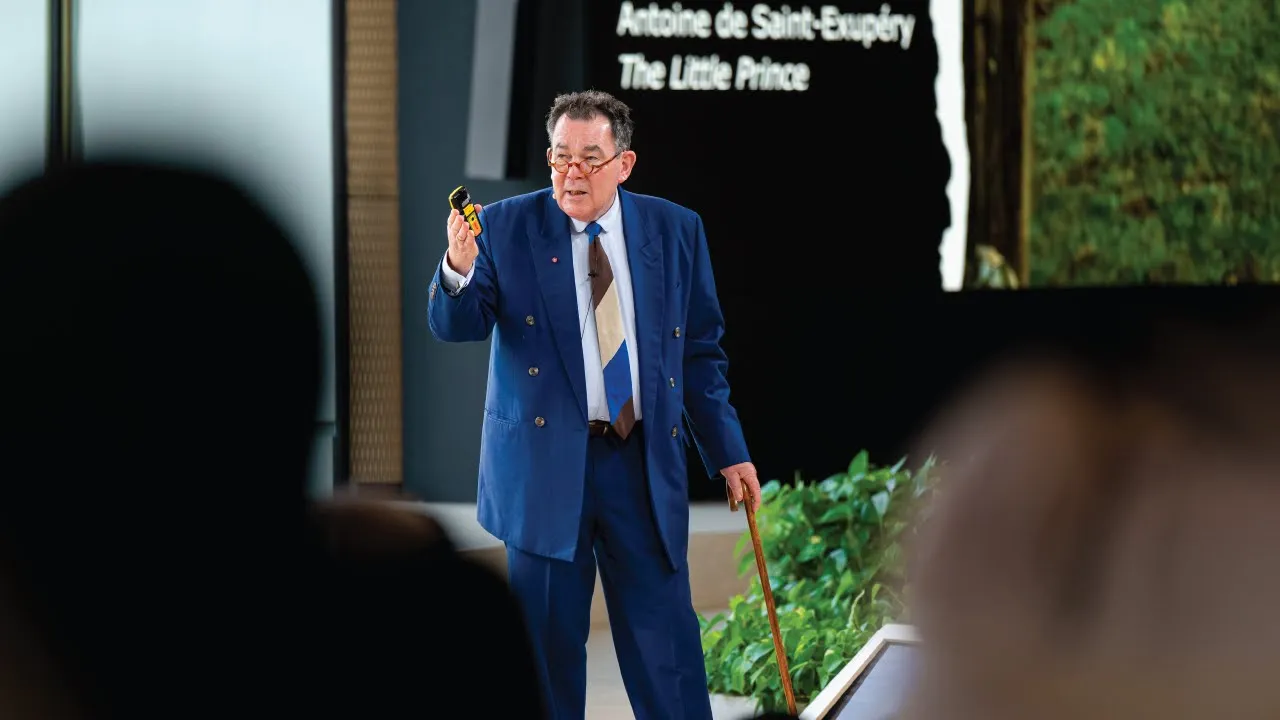
إعادة تصور التعليم المبكر | Reimagining Early Childhood Education transcript
Majlis Mohamed Bin Zayed · @MajlisMohamedbinZayed
Words
605
Runtime
39:27
Speaking pace
15wpm
Reading time
3min
15 words per minute, below the 160 25th percentile of 349 measured videos. That distribution comes from the 349-video hook study.
Opening (first 30 seconds)
Schools today have become well-equipped for a knowledge-based
8 words, the words spoken in the first 30 seconds at 15 words per minute.
Sentence shape
| Measure | This transcript |
|---|---|
| Sentences | 31 |
| Average words per sentence | 19.5 |
| Longest sentence | 45 words |
| Questions asked | 0 |
| Sentences containing a number | 3 |
Most used terms
- children7
- education6
- educational6
- today5
- experience4
- learning4
- play4
- students4
- al3
- child3
- early3
- group3
Filler phrases
1 in total: like 1.
A literal whole-word count of the same phrase list the Prepublish browser extension uses, so a phrase inside another word is not counted and a phrase used in its ordinary sense still is. It is a count and not a judgement.
What this transcript is
Every word below is the caption track YouTube publishes for this video, pulled from the video itself and reproduced unchanged. It is not Prepublish's writing, not a summary, and not a re-transcription: it is the video's own published captions. English captions, published by the channel, in the video’s original language. Source: the video on YouTube. A channel that would rather this page did not exist can ask for its removal through the contact page, and it is removed.
Transcript
Schools today have become well-equipped for a knowledge-based society through specialised academic programmes, careers guidance, and by providing access to technology and resources that help to develop students' skills, such as communication skills, leadership skills, and many others, which prepare students for their working lives. There is also hands-on or practical education. For example, group science projects which require students to carry out research, planning, execution, and evaluation.
Furthermore, there are field trips and visits to museums, nature reserves, factories, workshops, and community partnerships. In 2018, we had a somewhat unusual experience. We were aiming to teach children about the dangers of the internet in a novel and creative way through play. Part of this involved electronic programming, where a group of children were tasked with programming a video game, they were aged 7 to 12. The surprise came when the children successfully designed and programmed the entire game.
This remarkable success motivated us to continue exploring innovative ways to teach the children in a unique and fun way. The museum can be considered a school for the eyes, and this is something important for Louvre Abu Dhabi. To stimulate and encourage children's participation and engagement in the experience, the interactive stations primarily rely on a technique known as gamification. All interactions are designed as games or visual challenges encouraging children to closely examine and explore the artworks on display to find answers that enable them to solve the puzzles and complete the games while they continue playing.
In the name of Allah, the Most Gracious, the Most Merciful. Your Highness Sheikh Hamed bin Zayed Al Nahyan, Your Highnesses, Excellencies, and Honoured Guests, Peace be upon you, and Allah's mercy and blessings. Allow me to start by introducing myself. I am Mariam Omran Al Hallami. Advisor at the Department of Education and Knowledge in Abu Dhabi and responsible for early education affairs in the department. I am a PhD student at the University of Bath in the UK working on research focused on understanding the educational journey and its challenges for low-income students.
I hold a Master's degree in Philosophy and Education Policy and a Master's degree in Educational Leadership from University College London in the United Kingdom. It is an honour for me today to take on the task of moderating this discussion which revolves around reimagining early childhood education. This is the most crucial stage in a child's development. Today's lecture will discuss the importance of learning through play and experiential learning to enrich the educational experience to suit the needs and interests of the child at this stage.
Today, we are hosting the world-renowned expert in early childhood education Professor Ger Graus. The professor focuses in his work on the role of play in all educational stages from birth to age 99, and exploring how to make educational systems more creative to meet the interests and aspirations of learners. Please note that the lecture will be in English. You can use the headsets to listen to the instant translation.
And now, allow me to speak in English. In conclusion, today's lecture addressed the importance of learning through play and learning through experience in enriching the child's educational process and the importance of understanding our children to provide them with a more suitable curriculum. We thank the professor for enriching us with valuable information and the esteemed audience for your attentive listening. And now, I would like to invite His Highness Sheikh Hamed bin Zayed Al Nahyan and the participants in the introductory video to come up to the stage for a group photo.
Peace be upon you, and God's mercy and blessings.
The words are the caption track's own and nothing is reworded or re-transcribed. Paragraph breaks are placed between sentences so the text reads as prose.
Use this transcript
Three free tools that work on the material around a video like this one. No signup, no login.
Hook Analyzer
Paste the first 30 seconds of your own draft for a hook score and rewrites.
Policy Pre-Flight
Check your draft against YouTube's advertiser-friendly guidelines before you record it.
Channel Skill Generator
Read this channel's public videos and transcripts, and download a writing brief for it.