Getting the transcript
Reading the captions from YouTube. A video nobody has opened here before takes 10 to 30 seconds; this page fills in on its own.
Getting the transcript
Reading the captions from YouTube. A video nobody has opened here before takes 10 to 30 seconds; this page fills in on its own.
Mr. Finance · @misterfinanceyt
This video has no Most replayed graph yet: YouTube shows one only once a video has enough views. These are the moments viewers replayed most in Mr. Finance's most watched videos.
Most replayed moment at 11:12
4.0x that video's typical replay level
the ambient conditions you've engineered. And the evidence is in how they behave. They will spend 45 minutes choosing a coffee at home, drive 15 minutes to your store, pay $5.50 for a drink they could have made for 60, and
Said at 11:06
The graph counts replays. It does not show where viewers stopped watching.
Words
4,301
Runtime
23:26
Speaking pace
184wpm
Reading time
18min
184 words per minute, just over the 181 median of 349 measured videos. That distribution comes from the 349-video hook study.
Opening (first 30 seconds)
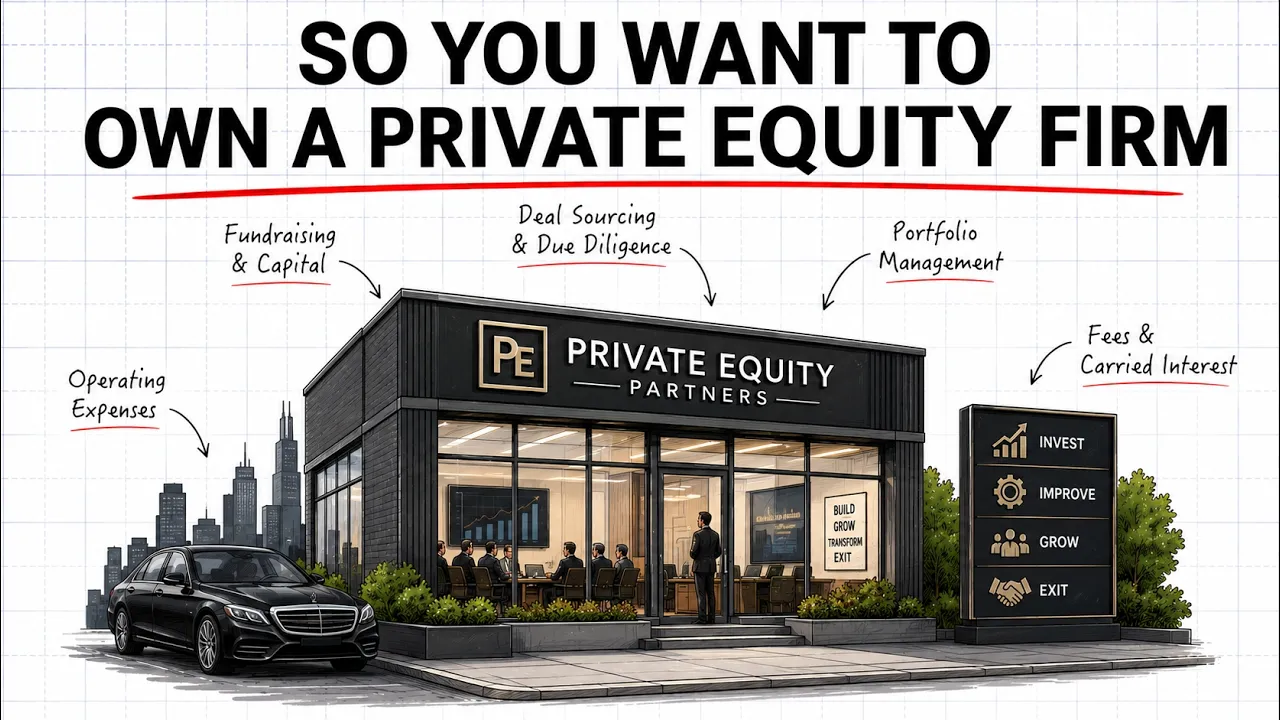
Okay, so you want to own a private equity firm. Raise a big pool of money, buy some companies, sell them a few years later for more than you paid. Simple enough on paper, except almost none of that sentence is true to how the business actually works. The money you raise mostly isn't yours. The companies you buy are barely paid for with your own cash, and the profit you're chasing isn't really a return on an investment at all. It's a performance bonus on a bet made almost entirely with
92 words, the words spoken in the first 30 seconds at 184 words per minute.
Free, no signup. See how the first 30 seconds hold attention, with rewrites.
What this transcript is
Every word below is the caption track YouTube publishes for this video, pulled from the video itself and reproduced unchanged. It is not Prepublish's writing, not a summary, and not a re-transcription: it is the video's own published captions. English captions, generated automatically by YouTube, in the video’s original language. Source: the video on YouTube. A channel that would rather this page did not exist can ask for its removal through the contact page, and it is removed.
Okay, so you want to own a private equity firm. Raise a big pool of money, buy some companies, sell them a few years later for more than you paid. Simple enough on paper, except almost none of that sentence is true to how the business actually works. The money you raise mostly isn't yours. The companies you buy are barely paid for with your own cash, and the profit you're chasing isn't really a return on an investment at all.
It's a performance bonus on a bet made almost entirely with somebody else's money. Understanding that one distortion is the whole key to understanding why this is one of the most lucrative businesses on the planet and why almost nobody who tries it actually gets rich doing it. Let's start with the part that confuses most people from the outside. A private equity firm can take full control of a company worth hundreds of millions, sometimes billions of dollars, without the firm itself putting up anywhere close to that amount from its own pocket.
So where does the fortune actually come from? If the firm isn't the one risking the big money, there are three engines running underneath this business and they run at the same time. The first is a flat management fee paid every year no matter what happens in the markets. The second is a share of the profits but only once the fund clears a performance bar. This is called carried interest and it's where the real money lives.
The third is leverage meaning debt which multiplies whatever gains the underlying companies produce. Put those three together and you get a business that can generate extraordinary personal wealth for the people who run it. Even in years where the fund's actual investments are doing nothing special. Here's the first thing people get wrong. A private equity firm doesn't manufacture anything, doesn't sell a product off a shelf.
What it sells is a promise. A promise to sophisticated investors that it can take their money, lock it away for around a decade, and hand it back multiplied by more than the stock market would have given them. To understand how the money actually flows, you need four separate players. Because private equity is built almost like a legal fortress with different rooms that don't touch each other. Room one is the firm itself, the actual company owned by the founding partners that collects fees and carry.
Room two is the fund, a separate legal entity, usually structured so that if something inside it goes bankrupt, the damage stays contained inside that one wall. Room three is the limited partners, pension funds, university endowments, sovereign wealth funds, insurance companies, wealthy families, the people who actually supply the cash. And room four is the portfolio companies themselves, the actual businesses that get bought, restructured, and eventually sold, this separation matters enormously.
If one company the fund owns collapses into bankruptcy, that loss is walled off. It doesn't take down the fund. It doesn't take down the other companies the fund owns, and it definitely doesn't touch the private equity firm's own balance sheet. The people running the show are structurally insulated from the worst outcomes in a way that almost nobody else in the business world is. None of this works without limited partners willing to hand over enormous checks and then wait.
We're talking about pension funds managing retirement money for teachers and firefighters, university endowments trying to fund scholarships 100 years from now, sovereign wealth funds recycling a country's oil revenue, insurance companies that need long-dated assets to match longdated liabilities, and family offices for the ultra wealthy looking for returns the public markets can't offer. Here's the obvious question.
Why would any of these institutions agree to lock up tens or hundreds of millions of dollars for 10 to 12 years with almost no ability to get it back early? Three reasons. First, the iliquidity premium. Historically, private markets have targeted annual returns that beat public stock markets by somewhere around 2 to 4 percentage points, precisely because investors are compensated for giving up access to their own cash.
Second, control. A pension fund that owns share of Apple gets to vote at a shareholder meeting once a year and that's about it. A private equity firm that owns a company outright can replace the entire management team on a Tuesday morning if it wants to. Third, freedom from the pressure of quarterly earnings reports. A public company that tries to spend heavily on a multi-year turnaround gets punished by its stock price the very next quarter.
A private company owned by a private equity fund can absorb years of short-term pain in service of a longerterm plan because there's no public stock price reacting to it in real time. That decade-long lockup is the foundation everything else in this business is built on. It's what lets a private equity firm promise its investors a predictable stream of income year after year, regardless of what the broader economy is doing.
The most basic and most reliable source of income for a private equity firm is the management fee. Historically, this has sat somewhere around 1 and a half to 2% of the total capital investors have commit to the fund charged every single year during the fund's active investing period, which usually runs about the first 5 years of a roughly 10-year fund life. And here's the part that surprises people. That fee is charged on the total amount committed, not on the amount actually invested.
So, if a firm raises a fund worth $1 billion, a 2% fee generates $20 million a year in fee income for the management company, even if the deal team has only actually put, say, $100 million to work buying companies so far. The fee shows up whether the year was good or bad, whether a single deal closed or a dozen did. As the fund matures and moves into its later years, that fee typically steps down, either dropping by a small number of percentage points or shifting its calculation base from total committed capital to the money still actually invested.
That step down matters because it means the fee income shrinks precisely as the fund winds down and starts returning cash to investors. Now, where does that fee money actually go? It's not sitting in a vault. It pays salaries for the partners, directors, and junior analysts. It pays outside lawyers, accountants, and consultants for every deal the firm looks at, whether or not that deal ever closes. It pays for operational specialists who get parachuted into portfolio companies to fix things.
It pays the rent on the office, the travel budget, the compliance staff, the fund administrators. For most firms, the management fee is essentially break even money. It keeps the lights on. It is not by itself how anyone becomes a billionaire in this industry. If you're finding this useful so far, this is a good moment to hit subscribe and like the video. It genuinely helps the channel. And we've still got the part where the real money gets made.
The actual wealth creation engine in private equity is something called carried interest. And it's almost always structured as a 20% share of the fund's profits. This is the industry's classic shortorthhand. 2 and 20, 2% management fee, 20% of the upside. But that 20% doesn't just start flowing the moment a deal makes money. It follows a strict order of payments, usually called the waterfall, and it has four steps. Step one, return of capital.
Every dollar that comes back from selling a company goes straight back to the limited partners first until they've gotten back 100% of what they originally put in. Step two, the preferred return, also called the hurdle. The limited partners keep receiving all the cash until they've earned a minimum annual return on their money, typically around 8% a year. This is the floor. If the fund doesn't clear this bar, the general partner earns no carry at all.
Full stop, no matter how hard anyone worked. Step three, the catchup. Once that 8% hurdle has been cleared, the cash flow flips almost entirely to the general partner for a stretch until the firm's share of total profits reaches that 20% target. Dar four, the final split. From that point forward, every remaining dollar splits 80% to the limited partners and 20% to the general partner. There are two different ways firms calculate this waterfall, and the difference matters a lot.
Under what's called a European or whole fund waterfall, the general partner doesn't see a dollar of carry until the entire fund's capital has been returned to investors. Losses on one deal get netted against gains on another before any carry gets paid. Under an American or Dealby deal waterfall, the general partner can collect carry on an early winning deal immediately, even if a later deal in the same fund turns into a disaster.
Roughly three out of four major institutional investors now insist on the European structure because the alternative creates a real risk. If a firm collects carry early on a winning deal and then a subsequent deal loses money, the firm may legally owe some of that carry back. That's called a clawback. and trying to claw money back from partners who've already spent it or paid taxes on it is a legal nightmare. So sophisticated investors would rather avoid the mess entirely and demand the whole fund structure upfront.
Numbers make more sense with a real example. So let's build one. Picture a mid-sized industrial parts manufacturer generating $10 million a year in earnings before interest, taxes, depreciation, and amortization. The standard profitability measure buyers use, usually just called Ibida. A private equity firm agrees to buy this company at a multiple of 10 times that IBITa figure, which puts the purchase price at $100 million.
Now, here's the part that makes this business so different from ordinary investing. The firm doesn't write a check for $100 million out of the fund. It borrows most of it. Say the firm arranges $60 million in debt from a group of lenders and only puts up $40 million of the fund's actual equity to close the deal. This is leverage, and it's the single biggest lever in the entire private equity playbook. Here's why it matters so much.
Imagine the company's value rises 50% over the next several years from 100 million to $150 million. If the firm had bought the whole thing with cash, no debt at all, that $50 million gain on a $100 million investment gives a return of one half times the money put in. Not bad. But because the deal was financed with $60 million in debt, that same $150 million sale price first pays off the $60 million loan, leaving $90 million in proceeds against an original equity check of only $40 million.
That's a return of 2 and a4 times the money invested. The exact same 50% rise in the underlying business turned into something like a 125% gain for the equity holders. That's the multiplier effect of leverage. But, and this is the part every good private equity story eventually gets to, leverage cuts both ways with exactly the same force, if that same company's value falls 40% instead, dropping from 100 million to $60 million, the $60 million in debt swallows the entire remaining value, the equity holders are left with nothing.
A 40% decline in the underlying business turns into a full total wipeout of the equity check. Debt doesn't create value. It just makes whatever happens to the underlying business happen much harder to the people who put in the equity. A fair criticism of this industry is that firms just pile on debt and coast. In practice, that alone almost never produces the 20% plus annual returns these funds are chasing. So firms lean on a handful of operational levers to actually grow the business they've bought.
They grow revenue, better pricing, new sales channels, expansion into new markets. They cut costs, renegotiating supplier contracts, automating processes, trimming overhead. They buy smaller competitors at cheaper valuations and bolt them onto the platform, a strategy known as buy and build. They swap out founder-led leadership for professional executives whose pay is tied directly to the eventual sale price. And if they execute well enough, they can sell the improved business at a higher valuation multiple than they paid for it.
Buying at 10 times earnings and selling at 11 times earnings, for instance, which adds a layer of gain on top of whatever the earnings themselves grew by. Let's run our example company through 5 years of this. It starts at $10 million in EBITa on $50 million of revenue. New sales leadership, better pricing, and international expansion grow revenue to $72 million. Margin improvements from procurement and automation lift the profit margin from 20% to a little over 22%.
Pushing organic EBIDA to about $16 million. Then in year three, the firm buys a smaller competitor generating $2 million in EBITa for a cheaper price. Five times earnings instead of the 10 times the platform itself trades at, bringing total EBITa to $18 million once the two businesses are combined. And through all of this, the company's own cash flow is used to pay down $25 million of that original $60 million loan, leaving $35 million still outstanding by the end of year 5.
None of this matters. Not the revenue growth, not the margin improvement, not the debt payown until the company actually gets sold. Paper gains don't pay pension checks. A private equity firm's carried interest only becomes real cash once a portfolio company is liquidated. There are basically four ways out. selling to a larger company in the same industry who's often willing to pay a premium because they can eliminate duplicate costs and plug the business straight into their existing distribution network.
Selling to an even bigger private equity firm in what's called a secondary buyout. Taking on new debt to pay the fund an early dividend called a dividend recapitalization, which lets the fund get some cash back early without giving up control. Or taking the company public through an initial public offering, though this one comes with a catch. Public market rules typically prevent early investors from selling their shares for around six months after listing.
And even after that, funds usually have to sell their stake gradually, which exposes them to whatever the stock market happens to be doing at the time. Back to our example, after 5 years, the company's EITa has grown from 10 million to $18 million, and the market is now willing to pay 11 times earnings instead of the original 10 because the business is bigger, more diversified, and better run. That puts the exit value at just under $200 million, specifically $198 million.
Subtract the $35 million of debt still outstanding, and the fund walks away with $163 million in proceeds. Compare that to the original $40 million equity check, and you get a gross profit of $123 million, a return of just over four times the money invested. Run that over five years and the annual rate of return works out to somewhere around 32% a year. That is an exceptional outcome, the kind of deal that makes careers.
Now, run it through the waterfall. The first $40 million goes back to investors to return their original capital. Next, investors collect their 8% annual preferred return, which on this deal works out to somewhere around $18 and 3/4 of a million. Then comes the general partner catchup. The firm collects roughly $4 and23 million here to bring its share up toward the 20% target. What's left after that roughly $99.5 million splits 8020 about $79.5 million to the limited partners and about $20 million to the general partner.
Add it all up and the general partner's total take from this single deal. The catch-up plus its share of the final split comes to roughly $24.5 million in pure carried interest on an equity check of $40 million. That's the entire private equity business model in one deal. But here's the problem. That $24.5 million payday is one successful outcome out of a much larger, much more brutal pipeline. A typical firm might review a hundred potential deals in a year, sign confidentiality agreements on maybe 20 of them, submit serious offers on perhaps five, and actually close on one.
Every deal that gets serious, even the ones that ultimately fall apart, costs real money. Due diligence alone, meaning the outside accountants, lawyers, tax advisers, and industry consultants who dig through a target company's books before a deal closes, can run anywhere from around $150,000 for a small transaction to close to a million for a large one. And if the deal collapses at the last minute, say because diligence turns up an environmental liability or a customer concentration problem, nobody caught earlier.
Those advisory bills typically can't be passed on to the funds investors. They hit the management company's own bottom line directly. Lepers on top of that the cost of actually raising a new fund in the first place, which can run into the low millions of dollars in legal and marketing costs, plus ongoing compliance and investor relations expenses. And you start to see why the 2% management fee exists in the first place.
It's there to absorb exactly this kind of overhead, not to make anyone rich. Every mechanism that makes a great deal spectacular works in reverse, just as powerfully on a bad one. And there's no better real world example of this than what happened to the American toy retailer Toys R Us. In 2005, a group of investors, the private equity firms KKR and Bane Capital, along with the real estate firm Vornnado, bought Toys R Us for 6610 billion.
The buyers put up only around 160 billion of their own equity. The rest, more than $5 billion, came from debt loaded directly onto the company itself. For over a decade, Toys R Us kept operating, kept selling toys, kept holding roughly 1/5if of the entire American toy market. But it was paying somewhere around $400 million a year just to service that debt. Money that in a company without that debt burden could have gone toward building a real e-commerce operation to compete with Amazon or modernizing its stores or simply lowering prices.
Instead, nearly all of it went straight to creditors. By 2017, the company filed for bankruptcy. 6 months later, it announced it was closing all 800 of its American stores. Around 33,000 people lost their jobs. Here's the part that should stop you. Toys R Us in its final years wasn't even losing that much money on an operating basis. Its actual business losses had shrunk to around $36 million a year. A number of healthy univered retailer could likely have absorbed and worked through.
It was the debt payments, not the retail business itself, that ultimately sank the company. Meanwhile, the private equity firms and the real estate firm that engineered the deal had already collected several hundred million in fees and interest payments over the years they controlled the company, largely insulated from the losses their own capital structure had created. Keep this in mind anytime someone tells you leverage is a purely mathematical risk-free tool.
It only multiplies. It doesn't discriminate between multiplying gains and multiplying disasters. Given the 10-year lockups, the fees, broken deal costs, and stories like Toys R Us. Why do pension funds and endowments keep pouring money into this asset class year after year? Because the dispersion between good managers and bad managers in private equity is enormous, far wider than in public stock markets, where an index fund gets you the market average, whether you like it or not.
Top performing private equity firms have historically delivered net annual returns. somewhere in the high 20s to mid-30s percent range with total returns of 3 and 12 to 4 and a half times the money invested or more. Median firms deliver something more like 11 to 14% a year. Still solid but a completely different business. And bottom quartile firms often deliver next to nothing, sometimes barely returning investors original capital after a decade of being locked up.
That gap is why institutional investors work so hard to get access to the top tier firm specifically and why a firm's own long-term track record becomes its most valuable asset. More valuable in a sense than any single deal it does. For the founders and senior partners running one of these firms, personal income comes from four separate layers. A base salary funded by the management fee. a share of the management company's own profit margin, which at large firms can run somewhere between 30 and 50% of fee revenue once salaries and overhead are covered.
Returns on the firm's own co-investment because limited partners typically require the general partner to personally invest somewhere around 1 to 5% of the total fund alongside everyone else. So, the partners have real skin in the game. And finally, carried interest, which is where the truly outsized numbers show up. On a $1 billion fund that triples investors money, a limited partner who put in $20 million walks away with a profit of around $40 million.
Solid. But the partners who own the firm collect a return on their own required co-investment plus their share of the management company's profit margin plus their piece of the fund's total carried interest pool which on a fund that size with that kind of performance can run into the hundreds of millions of dollars split among a relatively small number of senior partners. That gap between what a passive investor earns and what the people who own the firm earn is the entire reason this business exists in its current form.
If a firm consistently performs, meaning it delivers top tier returns fund after fund, decade after decade, it is genuinely one of the best business models in modern finance. The management fee covers the overhead and removes existential risk. The 10-year lockups mean there's no possibility of a sudden run on the firm's capital the way there is with a bank or a hedge fund with daily withdrawal rights. and carried interest lets the owners participate in enormous equity gains across billions of dollars of assets without ever having to put up anywhere near that amount of their own money.
But flip the performance around and the entire model runs in reverse. A firm that fails to clear its hurdle rate earns no carry at all for years. Broken deal costs eat directly into management fee profits. And investors who talk to each other constantly and compare notes across every fund they're in simply stop committing capital to firms with a weak track record. There is no fallback revenue stream to lean on. A private equity firm that can't keep raising new funds doesn't slowly decline.
It essentially runs out the clock on its last existing portfolio, and quietly disappears. Optimistically, picture a firm that raises a healthy fund, executes clean deals like the Apex example we walked through, avoids a Toys R Us style disaster, and clears its hurdle comfortably across multiple funds in a row. That firm's partners are looking at generational wealth built on management fees that cover the lights and carried interest that does the rest.
Realistically, picture a firm that overpays for one deal, gets hit with an interest rate spike or a demand shock on another, and spends 2 or 3 years collecting management fees just to stay solvent while investors quietly decide not to commit to the next fund. The difference between those two outcomes isn't a rounding error. It's the difference between one partner walking away with tens of millions of dollars in carry and that same partner's firm never raising another fund again.
That's the real shape of this business. It isn't a steady paycheck. It's a small fixed fee that keeps the doors open, sitting on top of an enormous all or nothing bet on whether a small group of people can actually make a company worth more than they paid for it using borrowed money that punishes every mistake as hard as it rewards every win. And that's really the whole trick hiding underneath the glamorous headlines about billiondollar buyouts.
From the outside, this looks like a business about picking winning companies. From the inside, it's actually a business about structuring risk, deciding how much of a bet gets funded with the fund's own money, how much gets funded with someone else's debt, and how much time you get before that debt has to be repaid, regardless of how the underlying business is actually performing. Get that structuring right again and again across dozens of deals over multiple decades and you end up owning one of the most powerful wealth machines in modern capitalism.
Get it wrong even once on a big enough deal and the very same mechanics that were supposed to make you rich can just as easily wipe out years of careful work in a single bad quarter. Before we wrap up, if you want to go deeper on how deals like this actually get structured and financed, there's a detailed business guide covering exactly this. You'll find the link in the description and pinned in the first comment. If this video helped you actually understand how this industry works, do consider liking it and subscribing to the channel.
And thank you for watching.
The words are the caption track's own and nothing is reworded or re-transcribed. Paragraph breaks are placed between sentences so the text reads as prose.
Free tools for your own script. No signup, no login.
Paste your draft and see where viewers are likely to drop off, with a rewrite for each weak line.
Paste the first 30 seconds of your own draft for a hook score and rewrites.
Check your draft against YouTube's advertiser-friendly guidelines before you record it.
Read this channel's public videos and transcripts, and download a writing brief for it.
Sentence shape
| Measure | This transcript |
|---|---|
| Sentences | 237 |
| Average words per sentence | 18.1 |
| Longest sentence | 63 words |
| Questions asked | 4 |
| Sentences containing a number | 64 |
Most used terms
Filler phrases
31 in total: actually 18 · like 9 · kind of 3 · basically 1.
A literal whole-word count of the same phrase list the Prepublish browser extension uses, so a phrase inside another word is not counted and a phrase used in its ordinary sense still is. It is a count and not a judgement.