Getting the transcript
Reading the captions from YouTube. A video nobody has opened here before takes 10 to 30 seconds; this page fills in on its own.
Getting the transcript
Reading the captions from YouTube. A video nobody has opened here before takes 10 to 30 seconds; this page fills in on its own.
AI Engineer · @aiDotEngineer
This video has no Most replayed graph yet: YouTube shows one only once a video has enough views. These are the moments viewers replayed most in AI Engineer's most watched videos.
Most replayed moment at 18:45
4.8x that video's typical replay level
that they're they're changing they're changing things in the database not yet. You want to run them through the ontology first and make sure that works. Okay. I only got an I've got I've got another I've just a short time. I'm going to try to show you some of the things that um that you can
Said at 18:37
Most replayed moment at 16:13
3.6x that video's typical replay level
method signatures, the program layout and the call stacks. So here's some examples. I don't think you'll be able to read this one, but this is like the level of abstraction we're at. It's how we're actually going to lay this stuff out and how these systems are going to interact. Dylan Mulroy from Cloudflare talks a
Said at 16:06
Most replayed moment at 6:57
5.9x that video's typical replay level
do light mode. It's I It's not my nature, but sometimes. That's better, yeah? Okay. So we have we have a model and we're trying an old LG Sorry. We We shouldn't have seen that. No, we'll
Said at 6:50
The graph counts replays. It does not show where viewers stopped watching.
Words
1,000
Runtime
5:55
Speaking pace
169wpm
Reading time
4min
169 words per minute, between the 160 25th percentile and the 181 median of 349 measured videos. That distribution comes from the 349-video hook study.
Opening (first 30 seconds)
Hey everyone, my name is Eric Hanchett. I am a senior developer advocate at AWS and I'm going to talk to you about how you can save on token costs. Now, I'm going to show you five ways that you can reduce your token costs while using and creating agents. So, the first way you can do that is to cache your system prompt. Let me show you some code. Now, I'm using AWS's Strands agents. This works with all different providers. This is a
85 words, the words spoken in the first 30 seconds at 169 words per minute.
Free, no signup. See how the first 30 seconds hold attention, with rewrites.
Sentence shape
| Measure | This transcript |
|---|---|
| Sentences | 64 |
| Average words per sentence | 15.6 |
| Longest sentence | 47 words |
| Questions asked | 0 |
| Sentences containing a number | 2 |
Most used terms
Filler phrases
6 in total: like 2 · uh 2 · kind of 1 · sort of 1.
A literal whole-word count of the same phrase list the Prepublish browser extension uses, so a phrase inside another word is not counted and a phrase used in its ordinary sense still is. It is a count and not a judgement.
What this transcript is
Every word below is the caption track YouTube publishes for this video, pulled from the video itself and reproduced unchanged. It is not Prepublish's writing, not a summary, and not a re-transcription: it is the video's own published captions. English captions, generated automatically by YouTube, in the video’s original language. Source: the video on YouTube. A channel that would rather this page did not exist can ask for its removal through the contact page, and it is removed.
Hey everyone, my name is Eric Hanchett. I am a senior developer advocate at AWS and I'm going to talk to you about how you can save on token costs. Now, I'm going to show you five ways that you can reduce your token costs while using and creating agents. So, the first way you can do that is to cache your system prompt. Let me show you some code. Now, I'm using AWS's Strands agents. This works with all different providers.
This is a little bit of pseudo code, but the idea is that you can add cache prompt equals default. And what that'll do is on the first call of your agent, it will send the full system prompt over and then on every subsequent call, it will have a much reduced system prompt being sent over. So, it'll be cached. You can also cache the tool prompts and messages as well. This may sound obvious, but you want to look into routing your different messages based on the difficulty.
So, here's a code example. Let's imagine that you have a task that's very difficult. You may want to use one of the newer frontier models. However, if it's something simpler, you want to use a cheaper model. In this case, maybe we use Claude Haiku for a cheap something cheap and then use Claude Sonnet for something a little bit more difficult. And then you can use an if statement. You can even have another model that's very cheap decide which model to use.
So, you can play around with this, but I highly recommend don't use the most expensive model for everything you're doing. You want to use multiple different models based on the use case. And then try to route to it inside your agent. Another good tip is to offload the tool result. Let me show you some code on here. Once again, I'm using strands agents. This is a a manual way to do it. There is some additional APIs that the strands agents offers to do this.
If you have a large tool result that's coming back, you can store it locally or in the cloud and then use some kind of summarization that saves on tokens. So that way when it's being called over and over again, the tool result isn't added into the context every time every time the tool loops or every time the agent loops. So if you can find any way that where you have this tool result that you don't necessarily send it on every single call back to the large language model, that will save a lot of tokens for you.
And like I said, there's a few APIs to do this, but it essentially you can do the summarization technique. You can also cap your tool loops. So when you're dealing with the agent loop and it decides to do a tool call, I've had this happen often where it calls the tool over and over and over again. And if you don't cap that tool call, then it might run 10, 20 times. It might get into an infinite loop, which would be very bad for your token usage.
So always set a max iterations of how many times it will loop. A good thing you can do before you deploy your agent is to run some observability tools and take a look at the tool call use for every single tool and then see how long each one of them is running and how many times they're looping. And that way you can get an idea of how efficient the tool call is. Last but not least, we can trim the history. So if we're using a multi-turn agent and we are talking back and forth, you will find at times that the conversation history will get very large on every single call, that whole conversation history will be sent back to the large language model.
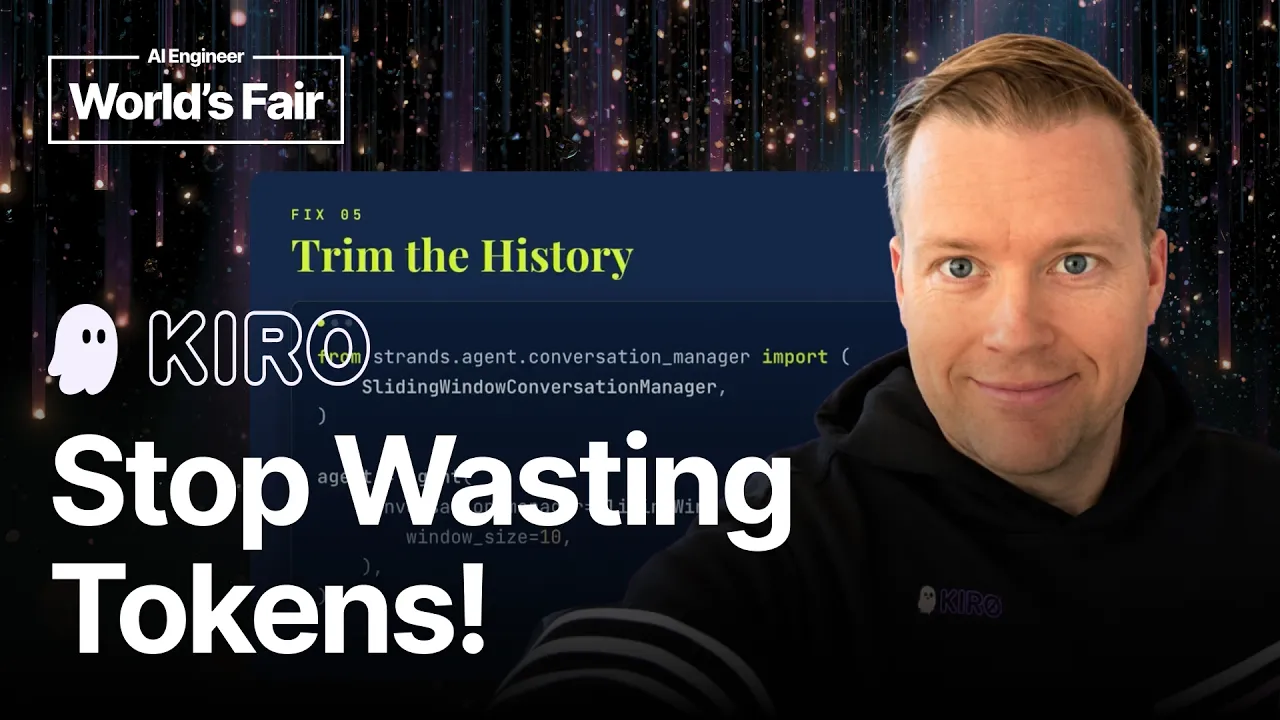
And this can eat through hundreds, if not thousands, of tokens. In Strand's agents, we have something called sliding window conversation manager, which which this does is it looks back at the last 10 messages and only sends those back. And you can set this to whatever you want. And that way you're not sending these huge message histories back to the agent every single time a new message comes in. The downfall of this, or the trade-off of this, I should say, is that you will lose the message history from the beginning.
The way you want to deal with that is you can use uh some sort of summarization of the history and then put that into the context window. So, rather than sending all of it, you may send a small amount once you hit this sliding window. Uh this will save you a lot of tokens. So, in conclusion, we have five things. Cache the system prompt. And if you can, maybe the tool prompt and messages. Route by difficulty. Don't use the same expensive model for everything you're doing, for every single task.
Offload these big tool results. So, if you have a large tool result, you can summarize it and not have it being sent in the agent loop and overloading your context. You can cap those tool loops. Make sure you use observability tools to see how long tool calls are taking and how many loops they're they're doing and and then try to iterate over that. And then, of course, trim the history if you're using a multi-turn conversation with your agent, so that way the whole conversation isn't being sent over and over again for very long conversations.
Thank you for listening to my very quick, almost lightning talk today. If you like to go deeper, find me on LinkedIn at Eric Hanchett. I also blog at programwitheric.com. And then you can find me on social media at EricCH. Love to talk to you guys more. Thanks.
The words are the caption track's own and nothing is reworded or re-transcribed. Paragraph breaks are placed between sentences so the text reads as prose.
Free tools for your own script. No signup, no login.
Paste your draft and see where viewers are likely to drop off, with a rewrite for each weak line.
Paste the first 30 seconds of your own draft for a hook score and rewrites.
Check your draft against YouTube's advertiser-friendly guidelines before you record it.
Read this channel's public videos and transcripts, and download a writing brief for it.