Getting the transcript
Reading the captions from YouTube. A video nobody has opened here before takes 10 to 30 seconds; this page fills in on its own.
Getting the transcript
Reading the captions from YouTube. A video nobody has opened here before takes 10 to 30 seconds; this page fills in on its own.
Skates & Scars · @skates_scars
Words
2,861
Runtime
16:55
Speaking pace
169wpm
Reading time
12min
169 words per minute, between the 160 25th percentile and the 181 median of 349 measured videos. That distribution comes from the 349-video hook study.
Opening (first 30 seconds)
The weirdest thing about this whole story is everything tells us we don't know what's truth, what's truth in his brain, what what is reality. >> They took him first overall in 1986 and by 22 he had a Stanley Cup ring on a career that looked like it would run for another decade without slowing down. >> makes his play and here's a CHANCE FOR MURPHY. SHOT, SCORE! MURPHY GOT THE REBOUND AND IT'S FOUR NOTHING >> 28 years later a TSN reporter found
85 words, the words spoken in the first 30 seconds at 169 words per minute.
Free, no signup. See how the first 30 seconds hold attention, with rewrites.
Sentence shape
| Measure | This transcript |
|---|---|
| Sentences | 185 |
| Average words per sentence | 15.5 |
| Longest sentence | 53 words |
| Questions asked | 4 |
| Sentences containing a number | 33 |
Most used terms
Filler phrases
12 in total: like 11 · kind of 1.
A literal whole-word count of the same phrase list the Prepublish browser extension uses, so a phrase inside another word is not counted and a phrase used in its ordinary sense still is. It is a count and not a judgement.
What this transcript is
Every word below is the caption track YouTube publishes for this video, pulled from the video itself and reproduced unchanged. It is not Prepublish's writing, not a summary, and not a re-transcription: it is the video's own published captions. English captions, generated automatically by YouTube, in the video’s original language. Source: the video on YouTube. A channel that would rather this page did not exist can ask for its removal through the contact page, and it is removed.
No Script X-ray for this video: YouTube shows a Most replayed graph only once a video has enough views.
The weirdest thing about this whole story is everything tells us we don't know what's truth, what's truth in his brain, what what is reality. >> They took him first overall in 1986 and by 22 he had a Stanley Cup ring on a career that looked like it would run for another decade without slowing down. >> makes his play and here's a CHANCE FOR MURPHY. SHOT, SCORE! MURPHY GOT THE REBOUND AND IT'S FOUR NOTHING >> 28 years later a TSN reporter found him living in the bush outside Kenora, Ontario.
Every system that was supposed to catch him existed. None of them did. >> Well, I I I just feel that the people in climate I don't I'm not that type of person that takes those things. >> [sighs] >> What happened eight months after that cup that nobody wrote down? When a team uses the first pick in the draft, they're not buying a player. They're buying a forecast, a projected return, the centerpiece of a rebuilding plan a general manager is staking his own job on.
The whole operation reorganizes around one assumption, that this person will produce. Ticket sales, television contracts, the depth chart, all of it adjusts to match. He's an asset and the organization that owns him measures his value in goals, points and playoff rounds. Never once in what the game might be doing to the thing between his ears. Detroit took Joe Murphy first in the 1986 draft and the pick carried a weight that nobody in the building fully appreciated at the time.
He was the first NCAA college player in the history of the league to go first overall coming out of Michigan State where he had just helped the Spartans win the national championship as a freshman. He put up 61 points in 35 games that season, a number almost unheard of for a freshman at any level. And by the time draft day arrived at the Montreal Forum that June, there was no debate about who was going at the top. The scouting reports read like a finished product, not a project.
And Detroit believed they were getting a franchise forward who could anchor their top six for the next decade. It didn't work out that way in the short term. Murphy landed in a Red Wings organization that already had Steve Yzerman handling the first line center duties and Adam Oates running the second line, and there was simply nowhere for a young winger to get the ice time he needed to develop at the NHL level. He bounced between Detroit and their AHL affiliate in Adirondack, and the bust label started showing up in newspaper columns the way it always does when a first overall pick doesn't light up the scoreboard immediately.
The patience ran out after three seasons, and in November of 1989, the Red Wings moved Murphy to Edmonton in a blockbuster trade that sent him, Adam Graves, and Peter Klima to the Oilers in exchange for Jimmy Carson, Kevin McClelland, and a fifth round pick. It was one of those deals where the hockey world argued about it for years afterward because the players involved on both sides went on to have dramatically different careers depending on which jersey they put on.
Edmonton is where Murphy became the player everyone had expected him to be. Coach John Muckler put him on a line with Graves and a 19-year-old Martin Gelinas about three games before the start of the 1990 playoffs. And the three of them clicked in a way that nobody saw coming. They called it the kid line because Graves was 21, Gelinas was still a teenager, and what they gave that Oilers team was a secondary scoring punch that let the veterans focus on the heavy lifting while the kids ran through every shift like they had nothing to lose.
Murphy finished those playoffs with six goals and 14 points in 22 games and the Oilers rolled through Winnipeg, Los Angeles, and Chicago before closing it out against Boston in five games at the Garden on May 24th, 1990. That was Edmonton's fifth Stanley Cup in seven years and it was also the last one they would win for a very long time. It was the first cup without Gretzky, the one that proved the franchise could still win after losing the greatest player in the history of the sport and the kid line was a central reason it happened.
Murphy was 22 years old, a Stanley Cup champion, and he had what looked like 10 prime years ahead of him. He said afterward that he would cherish the moment forever. There was no reason for anyone listening to doubt it. He had a ring and a full decade of prime left. So, the question that sits underneath everything that follows is a simple one. Why does the record of his career stop making sense in 1991? Let's stop here because the version of this story that most people have heard runs in the wrong direction.
The standard telling goes something like this. Murphy was a talented [music] player who got into drugs and alcohol, his career declined because of it, and eventually the lifestyle caught up with him. It's a clean narrative and it's wrong. The drugs came after. The decline came after. What came first was a body check in a January game that nobody in the league was required to document. You have to know what the NHL looked like in January of 1991 to understand why this matters.
There was no concussion protocol. There was no baseline testing. There was no independent spotter watching from above to pull a player off the ice. There was no mandatory reporting system that required a team to record when a player sustained a head injury. A concussion was a ding. It was getting your bell rung. The return to play process was a conversation between a player who wanted to keep playing [music] and a coach who wanted him out there.
And the conversation almost always ended the same way. On January 9th, 1991 at Joe Louis Arena in Detroit, Murphy was carrying the puck behind his own net when Shawn Burr, a Red Wings left winger, hit him. Murphy went airborne and his head hit the boards at the point where the glass meets the dasher. That sharp 90° angle that leaves no room for the skull to absorb anything. He was helped off the ice and in a later interview with Jeff Seidel of the Detroit Free Press, he described it as debilitating.
Said he fractured his skull. Said he couldn't believe he made it to the dressing room. >> I couldn't believe I made it off the ice. And in effect, man, I think I I think I played concussed my whole career, man. >> He names this as his first serious concussion. And this is where you have to reverse the sequence that everyone assumes. The people closest to Murphy, the ones who knew him before and after the hit, all describe the same thing.
Headaches that wouldn't go away. Mood swings that came out of nowhere. A personality change that started gradually and accelerated over the following seasons. A drift toward fighting, which wasn't part of his game before. And then, somewhere in the middle of all that, alcohol and drugs entered the picture. Not as the cause of the decline, but as a response to symptoms that nobody around him had the vocabulary or the medical framework to identify.
The trap was that he kept scoring. In 1991-92, the season after the Burr hit, Murphy put up 35 goals and 82 points in 80 games for Edmonton. That was the best year of his career. And that fact explains [music] everything about why nobody intervened. Productive players don't get flagged. A man who's putting the puck in the net every other night doesn't get pulled aside and asked whether he's feeling right because the scoreboard says he's fine.
And the scoreboard is the only diagnostic tool that matters. A contract dispute moved him to Chicago in the fall of 1993, and he scored 31 goals in his first full season with the Blackhawks. Then St. Louis, then San Jose, where he bounced back for a 48-point year. Then a tryout with the Rangers that went nowhere before Boston signed him in November of 1999. By this point, the behavior that had been building for years was impossible to ignore, and he clashed with Bruins coach Pat Burns badly enough that the team suspended him indefinitely for insubordination in February of 2000.
A December 1999 collision with Bob Boughner added another concussion to a list that nobody in the league was keeping. Boston placed him on waivers, Washington claimed him, and he played 48 more NHL games across two seasons before the career ended for good. He was 33. Six different organizations watched the same man change in front of them over the course of a decade. Chicago saw it, St. Louis saw it, San Jose, Boston, Washington, all of them saw it.
Every single one filed it under attitude and moved on because there was no system in place that required any of them to do anything else. Which raises the question that this story keeps circling back to. Which one of those six organizations was required to write it down? In 2018, Rick Westhead of TSN went looking for Joe Murphy. What he found was a former first overall pick and Stanley Cup champion who is living in a local homeless shelter, sleeping on the Canadian Tire property, and spending nights in a stretch of bush along Highway 17, the Trans-Canada Highway, just outside a city of about 15,000 people near the Manitoba border.
This is not a story about a man who fell through the cracks. The cracks had guardrails. All of them existed. The NHL and the NHLPA jointly operate an emergency assistance funds. There is a substance abuse and behavioral health program. There is an alumni association with a president, a staff, and a mandate to help former players. There's a pension. All of this is real. All of it is funded. And every single one of these programs [music] is opt-in.
That means that the former player has to identify that he has a need. He has to initiate contact. [music] He has to consent to treatment. And he has to keep a schedule of appointments and check-ins. That list of requirements is a precise description of the exact cognitive faculties that a brain injury takes away. The door exists, but the handle is on the inside. And the person who needs to reach it is the one whose ability to reach for anything has been compromised.
The proof that this design doesn't work showed up in September of 2018 when Glenn Healy, the president of the NHL Alumni Association, and Adam Graves, Murphy's former teammate on the Oilers, flew to Winnipeg, rented a car, and drove 2 hours to Kenora to sit with him. They stayed awake for 27 hours. They brought bags of clothing. They arranged an apartment. They furnished it. And for a while it looked like it worked. Murphy stood there with two thumbs up and said he was thankful.
The apartment failed. He left after a few months. A source told TSN that officials who administer the emergency assistance fund agreed to pay for a room in a local motel. He stayed for a while, then he went back to the bush. Nobody who is involved in any of this did anything wrong. That's what makes it so difficult to look at. The system functioned exactly the way it was designed to function. It offered help, the help was refused, and the file stayed open.
The problem is that the system was designed for a person who can evaluate an offer of help and make a rational decision about whether to accept it. And Murphy isn't that person anymore. And this is the part that removes the easiest explanation. Murphy earned more than $15 million during his playing career. His NHL pension pays roughly $1,100 a month. Nobody stole the money. It wasn't a Ponzi scheme. It wasn't a crooked financial advisor.
Murphy himself told the Detroit Free Press that 40% went to taxes, then an agent, then a divorce, then investments that didn't work, then Blackjack and Johnny Walker and generosity that had no off switch. He bought a house for a man he knew. He bought a house for his parents. He gave until there was nothing left to give. >> He's a good human being. He doesn't deserve to live like this. >> The money is beside the point because [music] no amount of money is a treatment plan, and $15 million can't make a man who's sleeping in the bush walk into a clinic and ask for help.
The NHL declined to comment on Murphy's situation. The NHLPA said it wouldn't comment on any individual player, and then described the programs that exist in general terms. The fund existed. The men who run it knew which stretch of highway he slept on. So, what was the rule that stopped them from doing anything more? Murphy joined the concussion class action that more than 100 former players filed against the NHL. And what the league argued in its filings tells you everything about the structural position it has chosen to occupy.
On one hand, the NHL argued that former players lacked the mental capacity to have written their own published accounts of their injuries and were being steered by lawyers who were exploiting their condition. On the other hand, the league argued that those same players should have connected the dots on brain trauma themselves, that they were aware of the risks of playing professional hockey, and assumed them voluntarily.
Look at the shape of that argument for a moment. Too impaired to be believed, but sharp enough to be held at fault. Both of those positions can't be true at the same time, and the league has never been forced to reconcile them because the litigation settled for $18.9 million across more than 300 players, which works out to about $22,000 per person. The structural reality that makes all of this possible is the simplest and cruelest fact in the entire story.
Chronic traumatic encephalopathy, CTE, can only be confirmed after death. There's no scan, no blood test, no clinical exam that can produce a definitive diagnosis while the patient is still alive. So, while Joe Murphy is breathing and sleeping in the bush outside Kenora, the league's position that the science connecting repeated head trauma to long-term neurological damage is unsettled cannot be tested against him specifically.
The one living case that could settle the argument most definitively is the one case that can't be entered into evidence until he's gone. That is not a scientific limitation that the league stumbled across. It is one the league can afford to wait out. His ex-wife Julie, in an interview with TSN, said he was not like this when she knew him. No unusual eccentric behavior, no warning signs, just a man who changed after his career ended.
A journalist from the Detroit Free Press sat with Murphy and watched him lose the thread of a sentence halfway through, pivot without warning into a completely different subject, and then insist with total conviction that he had brain tumors he was never diagnosed with. Down the right side of his neck, there's a scar near the jugular where he says he was knifed. His sister, his daughter, and his ex-wife all declined further interviews with the Free Press.
The family stopped talking. The answer to the question that opened the episode, what happened eight months after that cup, is that it was a routine body check in a January game at Joe Louis Arena, and nobody in the building was required to record a thing. The footage of that 1990 Cup celebration still runs every spring during the playoffs. The kind of montage the league puts together when it wants to sell the romance of the game.
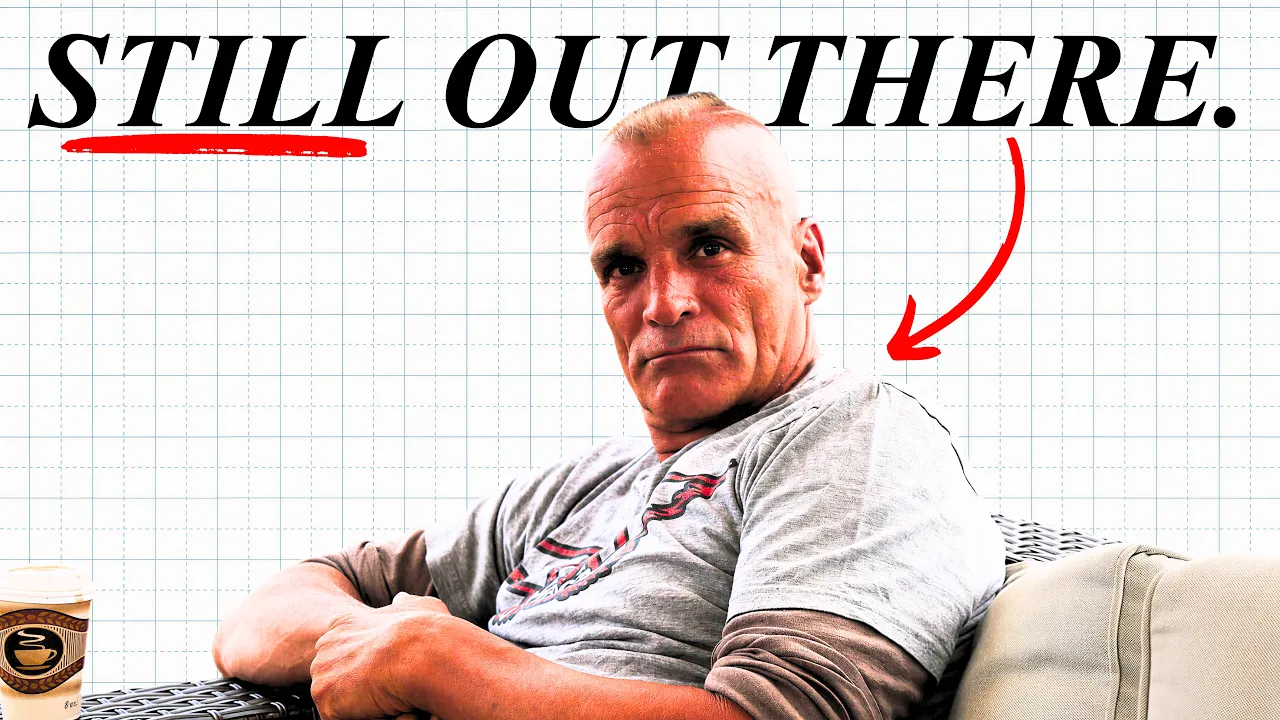
Joe Murphy is in it. He's 22 years old. He's drinking from the cup, and nobody watching has any idea what's about to happen to him. Most stories like this one have an ending, a diagnosis, a memorial, a settlement that closes the file and lets everyone move on. This one doesn't. As of the most recent reporting, Joe Murphy is still out there. The absence of an ending is what separates this from every other case in the file.
Nothing here is sealed. It's just unattended. This channel runs on the people who decide it should. That's what Healthy Scratch is. Early access to every video, a free ebook, and the reason stories like Joe Murphy's get made at all. Link below or scan the code on the screen. Next episode is already in the works. Subscribe so you're here when it drops.
The words are the caption track's own and nothing is reworded or re-transcribed. Paragraph breaks are placed between sentences so the text reads as prose.
Free tools for your own script. No signup, no login.
Paste your draft and see where viewers are likely to drop off, with a rewrite for each weak line.
Paste the first 30 seconds of your own draft for a hook score and rewrites.
Check your draft against YouTube's advertiser-friendly guidelines before you record it.
Read this channel's public videos and transcripts, and download a writing brief for it.