Getting the transcript
Reading the captions from YouTube. A video nobody has opened here before takes 10 to 30 seconds; this page fills in on its own.
Getting the transcript
Reading the captions from YouTube. A video nobody has opened here before takes 10 to 30 seconds; this page fills in on its own.
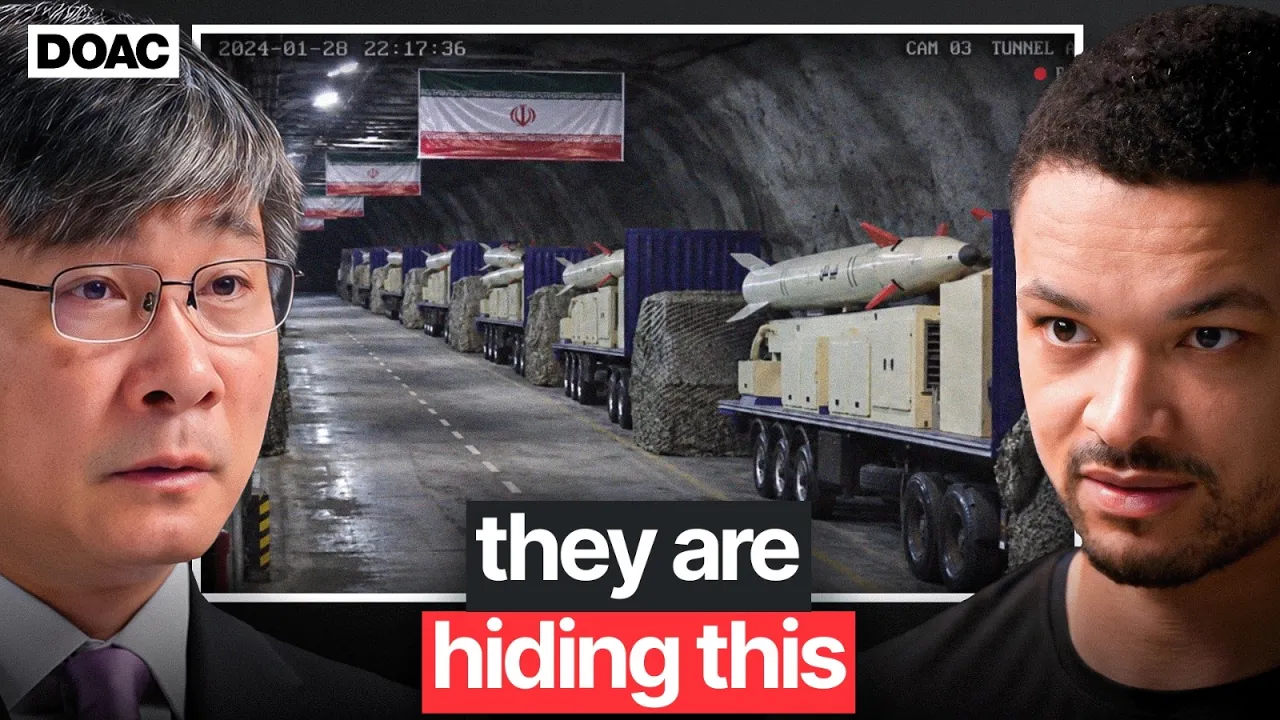
The Diary Of A CEO Clips · @TheDiaryOfACEOClips
Words
2,529
Runtime
17:34
Speaking pace
144wpm
Reading time
11min
144 words per minute, below the 160 25th percentile of 349 measured videos. That distribution comes from the 349-video hook study.
Opening (first 30 seconds)
So this is a summary of the global supply chain network and we can see how it involves the entire world. You are not able to build semiconductors unless you have a globalized economy. So there's been a lot of talk about China controlling the elements, right? So, China manufactures about uh 70% of the world's silicon and rare earths. China controls about 70% of rare earths. What people don't appreciate is
72 words, the words spoken in the first 30 seconds at 144 words per minute.
Free, no signup. See how the first 30 seconds hold attention, with rewrites.
Sentence shape
| Measure | This transcript |
|---|---|
| Sentences | 195 |
| Average words per sentence | 13.0 |
| Longest sentence | 51 words |
| Questions asked | 31 |
| Sentences containing a number | 9 |
Most used terms
What this transcript is
Every word below is the caption track YouTube publishes for this video, pulled from the video itself and reproduced unchanged. It is not Prepublish's writing, not a summary, and not a re-transcription: it is the video's own published captions. English captions, generated automatically by YouTube, in the video’s original language. Source: the video on YouTube. A channel that would rather this page did not exist can ask for its removal through the contact page, and it is removed.
No Script X-ray for this video: YouTube shows a Most replayed graph only once a video has enough views.
So this is a summary of the global supply chain network and we can see how it involves the entire world. You are not able to build semiconductors unless you have a globalized economy. So there's been a lot of talk about China controlling the elements, right? So, China manufactures about uh 70% of the world's silicon and rare earths. China controls about 70% of rare earths. What people don't appreciate is it works both ways.
Okay. So, China does export a lot of silicon and rare earths, but it also needs to import a lot of helium in order to sustain its semiconductor manufacturing process. The reason why is helium cools the semiconductors in a way um to to allow it for to be manufactured. Okay, so helium is a cooling agent. Another thing that people don't appreciate is people think that China has monopoly on rare earths but America in a place called spruce pine spruce pine North Carolina.
This area has monopoly on high quality courts. It controls about 90% of the world's high quality quarts which you need in the silicon manufacturing process as well. Okay. So if these nations start to stop trading with each other technology would cease to progress. Now something to keep in mind is it's not just semiconductors are dependent on the global supply chain. Food is also very dependent on the glo global supply chain.
So what we're seeing is a stark contrast between the north and the south. So the north, okay, produces most of the world's fertilizer. And the south, okay, primarily Africa, the Middle East and South America, they import a lot of the fertilizer. This map shows it much more clearly. Okay, so ammonia is a very important component of fertilizer. And as you can see, most of the ammonia production plants are actually in the north of the world.
Canada, United States, Europe, China, Russia. So the south, the global south is dependent on the north for food. In a time of war, when global supply chains break down, the north might lose access to fancy wireless smartphones. The south will face famine. Okay? Why is this important? Because the world is rife with conflict. The main issue that we're we will face next 20 years is not oil. It's actually water. All right.
So this map that we're seeing right now is actually telling us where the next major geopolitical flash points are. So basically if you see red on the map it means this place has water scarcity issues and the red issues tells exactly where wars will erupt. Okay. So even the United States, if you look at the western part of United States, they do have water scarcity issues. And actually, if you go to uh the western United States, Colorado, California, Arizona, these places, they're fighting over the Colorado River because the Colorado River is what supplies most of their water.
You go to the Middle East and you know that the Middle East is almost like a dynamite ready to explode. And what this war will do is aggravate all the tensions in the Middle East. India itself is facing water shortages which brings it into conflict with China. Okay. So this one map if you can just see it, it basically tells you um where the next geopolitical flash points will be. It means a place that is most likely to go to war or have conflict or political violence in the next 20 years.
Okay. But also here is north uh east Asia, Japan is here, North Korea is here. Okay, so that's another major flash point. So this is what over the next 20 years where war is most likely to break out. Okay, but what's important to appreciate is once war breaks out, there are third order effects um causing conflict to spread around the world. Okay, this is a really important map for us to appreciate as well. This map tells us fertility rates around the world.
As you can see, Africa has the world's highest fertility rate, followed by the Middle East. Okay. >> So, they're having the most children per couples. >> That's right. Why is this a problem? Because if you go back to the previous map, this area is also where there is the most cubical tension. And so if there are more and more children, young people being born here, they have no choice but to migrate. And where will they migrate?
Probably to Europe. And you're like, well, okay, well then what Europe should do is turtle up. Europe should build walls and prevent these migrants from reaching Europe. But Europe has its own problem, which is the aging crisis. Okay. So, look at what's happening where the fastest aging populations are in fact in the most developed nations including Japan, Europe, and North America. So, if you have an aging population, you need to provide cheap health care, nursing.
What What does that mean? It means you have to let in more immigrants like the surface, the aging population. And what will happen then is domestic conflict where you have more migration into western societies which brings them into conflict with the native populations and therefore it is possible you have civil war as well as political violence and even the possibility of revolution. Okay. So these maps collectively paint a very grim picture of the world that we're we're living in. >> On this page here about immigration causing civil war, political violence, revolution, would it just be the case as we're seeing that these western societies will increas right-wing political parties, which is kind of what we're seeing.
We're seeing, you know, parties in the UK like reform surge. I think there was news yesterday in Germany of the the political party there. We're seeing I mean we're seeing the same in the United States as well. >> That that's a fantastic point. That's that's exactly what we're seeing. We're seeing the AFD surge in Germany. You know, MAGA being very dominant in the United States. We're seeing Vox in Spain. So, in theory, what's going to happen is these countries become much more right-wing and then they block out immigration because that that is their main policy platform.
And that should stop the civil war. >> The problem is what do you do about your aging population? >> Robots. >> Exactly. Right. That's what you would think. But what we're seeing is a breakdown in global supply chains. Robots depend on copper, right? Which you get from Chile, Peru, China, Australia. These are pretty far away places from Europe and United States, right? You also need lithium which you get from the lithium triangle again pretty far away.
You also need silicon which is u mainly manufactured in China. You need rare earths which again is really manufactured in China. So this you have this huge issue where in theory you could use robots but in a but when global supply chain breaks down you have to figure out the cheapest way to resolve the labor issue and the cheapest solution is immigration. Right? People I had to say this, but people are much cheaper and much more expendable than robots.
So, I know this is a bit scary. I know this is really depressing, okay? But what if the United States were able to win this war in Iran and conduct regime change? Then our problems are solved. Right now Iran is under the control of the United States and we're back to globalization where oil is able to flow to South uh Asia to East Asia and then they manufacture goods and then recycle their profits into the economy. And with all this money, AI is able to innovate to a point where we achieve AGI and then we solve all the world's problems.
Okay. So what happens next with this whole Iran situation? >> So unfortunately it has now its own momentum. All right. So let me explain what is most likely to happen. Okay. So you have Iran and you are now controlling the Shamus, right? You have the Houthis and they control the Bao and Mandad Strait. You have Hezbollah which can threaten the Suez Canal. You have the Shia militias that can also threaten the Mediterranean.
Right? From a game theory perspective, what Iran should do next is take the initiative and disrupt all global trade. And the reason why is the US empire is based on a petro dollar. It's based on global trade. When you disrupt global trade at the same time, there's no way for the United States to respond. >> How could they disrupt global trade? what they can do is start to attack randomly. Okay. So what who who's who can do is attack Saudi Arabia.
Um Iraq can um attack Israel, Iran can attack the moves. Uh Hezbollah can attack the Swiss canal. Okay? And why you do that is you're creating uncertainty and chaos in the global trade system. Why is that important? Because the global trade system is built on confidence and that's what drives insurance. Okay? So if you're an insurance company, you're like, "Oh my god, these countries are sorry, these actors are completely out of control.
The United States has lost control over the situation." You can no longer ensure global shipping. If you can't ensure global shipping, global shipping ceases to work. All right? So this is a madman theory and this is Iran's best play moving forward. And the reason why is the United States does not have the military capacity to respond to a coordinated random strike across the Middle East. >> So is this your prediction?
Is this what happens next? >> I don't want to make this prediction just because there are lots of factors I do not know. Okay. So, so first of all, I don't know politically what the situation is in Iran. Certainly, the IRGC would want to do this, but there are political factions within Iran who would think this is too provocative and it's possible the entire world would unite against Iran if Iran were to do this. >> So, what is your prediction in terms of Iran and what happens next? >> My prediction is this will only escalate.
How it will escalate, I don't know. Okay. But the trump card to use a pun for Iran is to start to disrupt global trade. But United States has a response and this response is to attack Iran's critical civil infrastructure which includes dissalation plants and power plants. And this would be worse than using a nuclear weapon on Iran because without power plants, the people in Tran, a city of about 10 million people, they face starvation because a lot of this food is refrigerated.
This is how the war becomes almost civilization destroying. If Iran were to completely disrupt global trade and if the United States were to destroy the power plants of Iran, >> obviously that would be horrific and uh sort of inconceivably horrifying for the people that live in Iran, the innocent people that are caught in the middle of this. You don't think that the US will actually do that though, right? >> I think the United States will be forced to do it. >> You think they'll be forced to do it? >> Yes.
According to game theory, they will be forced to behave like this because we need to appreciate this formula where the more power you have, the less imagination, empathy you have, you and so the idea is you don't think killing millions of Iranians is a too heavy a price. It's all worth it if you can maintain the empire. The hubris leads you to believe that the gods favor you and you ultimately win and triumph in this great struggle. >> Don't you create a huge migration crisis where people start fleeing from Iran up into Europe because they are starving. >> Exactly.
Right. Not just Iran, but Africa as well because they've lost access to cheap energy and fertilizer. So you have all this migration into Europe which would overwhelm European the European social fabric which would overwhelm the European state. But unfortunately, this has been happening at a much slower pace ever since 2014 when for whatever reason the United States chose to destroy Libya and cause civil war in Syria which caused millions to migrate into Europe.
And as you remember the Europeans in the generosity accepted all these migrants which is leading which has led to tremendous social friction and political tension in Europe today. >> So your prediction here if we conclude then is that the US won't win this quote unquote war in the Middle East because they can't defeat Iran and its proxies. But also your conclusion is that this is going to continue to escalate in the Middle East. >> Yes.
And already what we're seeing are other actors being drawn into the war. So the so the most recent news is South Korea has authorized a naval contingent to go and try to secure the ship of moves. >> What would you do if you were Donald Trump? >> I mean um what would I do if I were Donald Trump? I would push all in. I would start attacking power plants in uh Iran because if I take any half measures, I would just look weak and I'm only going to create more problems.
I would only incentivize Iran and its allies to be more provocative, to be more aggressive. So, if I'm Donald Trump and I'm in this situation, I would just push all in. You would end up killing millions of Iranians theoretically. >> Well, I start this war, right? Then I have to win this war because I can't lose this war. I refuse to lose this war. I mean, again, I I understand the concerns. Okay? But if you want to understand how these leaders leaders think, this formula gives you the best window into into the psychology, which is because of so much power, they lose the capacity to imagine different possibilities and have empathy for the suffering of the people in the world. >> Couldn't they just back out?
Couldn't they just couldn't Donald Trump just say do a big press conference where he says, "We won this war in Iran. We've destroyed their military, their naval bases. It's done. and Iran will no longer have a nuclear weapons. >> The entire petro dollar system is premised on two things. The US dollar as the world reserve currency and the aura of inevitability and invincibility of the US military. >> If they look like they are beatable, then the the US as its image is sufficiently tarnished. >> Right?
If you love the Driver CEO brand and you watch this channel, please do me a huge favor. Become part of the 15% of the viewers on this channel that have hit the subscribe button. It helps us tremendously.
The words are the caption track's own and nothing is reworded or re-transcribed. Paragraph breaks are placed between sentences so the text reads as prose.
Free tools for your own script. No signup, no login.
Paste your draft and see where viewers are likely to drop off, with a rewrite for each weak line.
Paste the first 30 seconds of your own draft for a hook score and rewrites.
Check your draft against YouTube's advertiser-friendly guidelines before you record it.
Read this channel's public videos and transcripts, and download a writing brief for it.
Filler phrases
45 in total: right? 10 · like 7 · uh 7 · um 6 · actually 5 · I mean 3 · you know 3 · basically 2 · kind of 1 · sort of 1.
A literal whole-word count of the same phrase list the Prepublish browser extension uses, so a phrase inside another word is not counted and a phrase used in its ordinary sense still is. It is a count and not a judgement.