Getting the transcript
Reading the captions from YouTube. A video nobody has opened here before takes 10 to 30 seconds; this page fills in on its own.
Getting the transcript
Reading the captions from YouTube. A video nobody has opened here before takes 10 to 30 seconds; this page fills in on its own.
AI Engineer · @aiDotEngineer
Words
8,734
Runtime
40:46
Speaking pace
214wpm
Reading time
36min
214 words per minute, above the 201 75th percentile of 349 measured videos. That distribution comes from the 349-video hook study.
Opening (first 30 seconds)
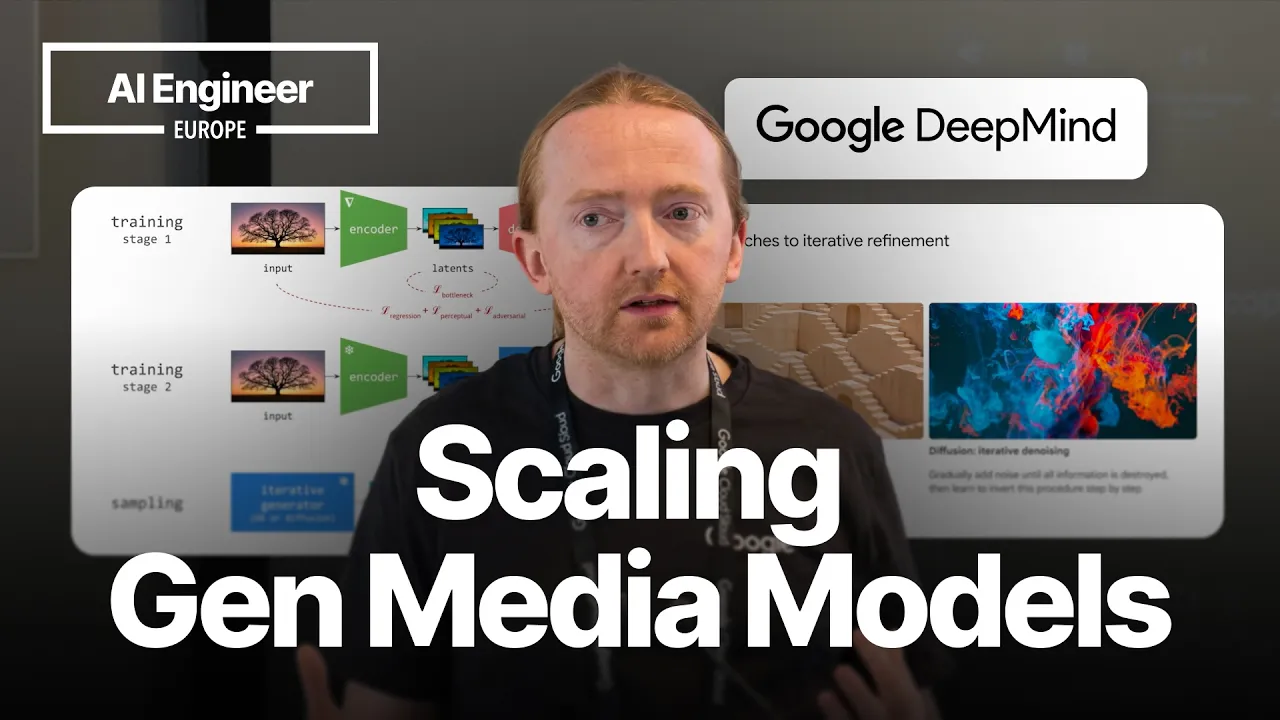
Cool. I'm going to get started. That sounds all right. Okay, I can I can hear myself. Okay, great. Uh thanks for coming everyone. I'm Sander. I'm a research scientist at Google DeepMind. I've been there for over a decade now. Uh I'm on the generative media team. So, we work on models like VEO and NanoBanana. And I want to This talk is kind of a bit of a behind-the-scenes perspective on like everything that goes into training these models at scale. Um and so, it's going to be focused on diffusion models because that's sort of the modeling paradigm that at least nowadays people tend
107 words, the words spoken in the first 30 seconds at 214 words per minute.
Free, no signup. See how the first 30 seconds hold attention, with rewrites.
Sentence shape
| Measure | This transcript |
|---|---|
| Sentences | 506 |
| Average words per sentence | 17.3 |
| Longest sentence | 80 words |
| Questions asked | 93 |
| Sentences containing a number | 19 |
Most used terms
Filler phrases
687 in total: uh 161 · sort of 132 · like 113 · um 84 · right? 72 · actually 66 · kind of 21 · you know 19 · basically 17 · I mean 2.
A literal whole-word count of the same phrase list the Prepublish browser extension uses, so a phrase inside another word is not counted and a phrase used in its ordinary sense still is. It is a count and not a judgement.
What this transcript is
Every word below is the caption track YouTube publishes for this video, pulled from the video itself and reproduced unchanged. It is not Prepublish's writing, not a summary, and not a re-transcription: it is the video's own published captions. English captions, generated automatically by YouTube, in the video’s original language. Source: the video on YouTube. A channel that would rather this page did not exist can ask for its removal through the contact page, and it is removed.
No Script X-ray for this video: YouTube shows a Most replayed graph only once a video has enough views.
Cool. I'm going to get started. That sounds all right. Okay, I can I can hear myself. Okay, great. Uh thanks for coming everyone. I'm Sander. I'm a research scientist at Google DeepMind. I've been there for over a decade now. Uh I'm on the generative media team. So, we work on models like VEO and NanoBanana. And I want to This talk is kind of a bit of a behind-the-scenes perspective on like everything that goes into training these models at scale.
Um and so, it's going to be focused on diffusion models because that's sort of the modeling paradigm that at least nowadays people tend to use for generating audio-visual data, which is a bit different from the language modeling situation where we primarily rely on auto-regression, although of course not exclusively these days. Um so, yeah, I have this kind of a whirlwind tour of everything that goes into it. So, I have eight sections, which is quite a lot to get through.
Um they're not all equally long. They I have more to say about some things than others. So, I have more to say about the modeling and the and the sampling side of things, for example. But, I'll just try to cover a little bit of everything and then hopefully leave enough time for questions as well at the end about any of these things. So, the topics I want to cover are data curation, representation, also because you don't necessarily just shove pixels into a transformer, right?
You might use a more advanced representation to sort of simplify things. Modeling is going to be sort of about the core mechanism behind diffusion models. I just like to explain that in an intuitive way, and I think that's that's kind of useful to understand why these models are able to work as well as they do for for audio-visual data generation. We'll talk a little bit about architecture as well, like the the core neural network architecture that's that's behind all this.
Uh and then uh very briefly uh some things about training at scale. I'll talk a bit more about sampling as well because uh diffusion models have sort of a very flexible um uh sampling regime. Like there's there's there's sort of more stuff you can do with diffusion models than you can do with autoregressive models. So, I'll talk a little bit about that. Uh I'll talk about distillation, which in the context of diffusion is uh not so much about making the model smaller, but more about reducing the number of steps that you need to get a good sample.
And then finally talk about control, like the various control signals that we want to use to actually make the models do our bidding and make it make them do what we want them to do. All right. Uh before I start with that, I have a blog. Um you don't have to remember all these individual URLs. Just go to sander.ai. You can find all my blog posts there. They're mostly about diffusion these days, but in general I like to talk about sort of the the intuition behind how generative uh models actually work.
Cool. So, let's talk a little bit about data first. Um I think uh it's really important to emphasize just how important data curation is in training these these large-scale models. Um it's really really essential for high-quality results. And like for me, coming from a research background, it's actually something like when I was doing my PhD, it's not something that's incentivized. Like you're not incentivized to look at your data because you're actually incentivized to use a predefined data set that everyone else uses so that you can compare your results to the state of the art.
Um and so that's sort of something that we are sort of collectively having to unlearn in this area cuz you really just have to look at your data to the point where I think time spent on improving the data is sometimes a better investment of that time than actually sort of trying to tweak the model and trying to make it optimize it better or things like that. Uh I think this is still sort of an an even even today is still sort of an underrated aspect of of uh training these models.
Um but yeah, I'm I'm I'm I'm not going to say too much more about that because this it's a topic that you won't find a lot of publications on and it's also a topic that uh you won't find I won't be able to share a lot of details on because obviously it's it's also part of the secret sauce of the what makes the models good. So let's talk about representation next. So this is a typical digital representation of audio visual data, oh sorry, of visual data I should say is pixels, right?
Grids of pixels. You get a 2D grid for images, you get a 3D pixel grid for for video and you could actually just shove that into a diffusion model as is and that's what we did at the start you know when diffusion sort of um started being a thing that's what people were doing were sort of directly training on pixels and it worked remarkably well. But that's not actually what people do nowadays because once you sort of start scaling up the the size of the objects that you're modeling like the resolution or the duration in the case of video, these pixel tensors in memory get very very large.
Right? You you have like Okay, let's let's say you have a 1080p video, right? 30 seconds of 1080p video at 30 FPS. We're talking many like several gigabytes of of data, right? To store that in memory. That's that's one training example. So that's just not feasible. So what we end up doing is we actually use compressed representations, right? Well, we're not just going to use a sort of pre-existing compressed representations.
You know, there's there's many sort of like video codecs out there. You know, there's the JPEG standard for for images. We tend not to use those representations because those are really focused on making things small and in the process they actually obscure the structure of the data to a degree that generative modeling becomes really hard. So what typically happens in this context is we actually learn our own compressor.
We and and we do that based on autoencoders. So this is like the the top the top row on this slide is basically a neural network that consists of an encoder and a decoder and the task of this neural network is just like reproduce your input, right? You put an image in, you want to the same image out. But you know, you're sort of forcing it through a bottleneck in the middle and that bottleneck is going to learn what what's typically called a latent representation.
So, it's like a more compact uh representation uh of the data. And that is then the representation that we're actually going to use as a basis for uh diffu- like for training our diffusion model. So, in the second stage, we take these latent representations, we extract them from our uh inputs. I I usually use images as examples uh because obviously that's easier to show on a slide, but you can imagine this is a video as well.
It's It's basically the the exact same procedure. Um uh so, we extract the latent representations, and then we train on top of that a generative model, which could actually be an autoregressive model or a diffusion model. Um sort of doesn't really matter, but people have found in general for audiovisual data, um uh diffusion sort of has the edge in terms of uh being able to get good results with uh certain parameter budget.
So, that's what we mostly tend to use nowadays. Uh and then once you've trained your your generative model in latent space, of course, once if you sample from that model, you're going to get a sample in latent space. Uh so, it's a compressed sample, so you still want to uh use the decoder that you trained before to bring that back to pixel space um as well. And so, what does that actually look like in practice? So, I have this sort of concrete example here, and this is actually I think these dimensions sort of correspond to what the autoencoder in the original Stable Diffusion uh model does.
So, the Stable Diffusion is also a latent diffusion model. Uh let's say you have like an an RGB image, uh 256 by 256 pixels. If you represent that as a ten- as a 3D tensor uh on the left, so these are the uh dimensions that you get. And then when we extract our latent representation with our encoder, so one thing that's worth noticing is it still has the same spatial structure. It still has the same topology, but the resolution is greatly reduced, right?
So, now we have 32 by 32 latent grid, and we sort of compensate for that reduction by adding a few extra channels so that we can encode some of the information that would get lost if you were to just uh resize the image, right? If you just take the original image and resize it to 32 by 32, you lose a lot of high-frequency detail. And these uh latent representations sort of try to hold on to that a little bit by adding by using these extra channels to encode that information.
Of course, it's still lossy compression because if you look at the total sort of tensor size of the latents versus the original image, it's still much, much smaller, right? And that's the key idea. That's the point. We want to make this smaller, and especially for video also where you have this extra time dimension, you have even more redundancy, right? You can you're often able to reduce the size of these tensors that you have to work with by by two orders of magnitude.
And that's the difference between like being able to fit your data in memory and and just not being able to do anything at all, right? Um but so one thing to to note about these compression mechanisms is they're actually sort of slightly more primitive than sort of the you know, like the H.265 or like the other sort of codecs that people tend to use these days. And that's actually by design cuz um you kind of want to preserve a lot of the topological structure of the original uh pixel representation because uh our neural network architectures that we use to build these models, they kind of rely on the structure being present, right?
They have these strong inductive biases. And so we we end up with these latent representations that are still that still have the same grid structure as the original uh pixels, but sort of at a at a more um coarse-grained scale, right? And and the image that I'm showing here is actually from a paper called EQ-VAE. It's a paper about like improving the training of these autoencoders. And they did a really nice thing. They sort of tried to visualize the latent space by taking uh the principal components of the across the latent channels and then uh mapping that onto RGB so that you can actually visualize what these are.
And you can kind of see looking at these uh latent visualizations, you can still tell what animal is in the image, right? So the latents are not really making abstraction of any semantic content of the image. They're They're basically just sort of um abstracting the local texture and very fine-grained structure, right? That's sort of the information that's sort of compressed and that's removed to some degree. And everything else is just preserved as in uh the original uh pixel space.
And that's that's kind of by design. All right. So, once we have our latent representation, we can start doing some generative modeling. Uh, I've already mentioned you could do that either with auto regression or with diffusion. With auto regression, you sort of have to turn everything into a sequence and then you predict the sequence step by step. That's a very natural thing to do for language, which is already kind of sequence structured.
Slightly less na- less natural to do for an image, right? Cuz an image is sort of a 2D pixel grid. So, you have to sort of decide an arbitrary sequence order in which to uh, generate uh, the pixels. Um, w- diffusion is kind of a different approach to achieving a very similar thing, which is sort of this iterative refinement, right? You generate something not in one go, but step by step. And diffusion does that uh, in a slightly different way, which is by first defining a corruption process, uh, sort of destroying information in the image or in the video by adding noise gradually, so adding more and more noise.
And then you learn a denoiser model that tries to remove that noise. Um, and then you can use that denoiser, as we'll as we'll show, you can use that denoiser to sort of generate images or videos step by step. So, uh, yeah, just to visualize what that looks like. So, I have an example image here on the left. If you gradually add more and more Gaussian noise to that image, uh, one thing to note is that eventually, when you add a lot of noise, you can't see the image anymore, right?
So, it's sort of destroyed all the structure. But sort of in the intermediate stages, you can see that if I add a little bit of noise, it's sort of removing the detail, right? Cuz for example, you might not be able to make out the whiskers anymore of of this bunny, but you can still see the silhouette. So, you can still tell that it's a bunny, right? So, you're sort of losing fine-grained detail uh, initially, but not the global structure.
And only when you add more noise, that global structure also uh, starts to fade. So, that's the corruption process. And then I'm going to try and explain to you how we can use a denoiser that tries to reverse this process to do generative modeling, right? So, sort of an an intuitive view of how diffusion models actually do this. So, I I like to do this with uh, with a 2D diagram. So, images are and video are actually high-dimensional objects, right?
They have If you sort of flatten an image into a single vector, it's very high-dimensional. Um I'm going to reduce that down to two dimensions so that I can actually plot it on a slide. It's a slightly risky thing to do, like generalizing from low dimensions to high dimensions, but in this case it's it's actually quite instructive. So, I'm going to try to explain how this backward process in the in the fusion actually works.
So, we start here with a clean image from our data set. So, that's what I'm going to call X0. Uh put that in the bottom left corner on the slide there. And um and then I'm going to add some amount of noise to it. So, I'm actually going to sort of simulate simulate this corruption process and add some amount of noise to it. And then we end up in an arbitrary uh uh step of this corruption process. We're going to call that XT.
T is like a time step that's indexing the the corruption process. And so, that's a noisy version of our image in the top right corner. So, what's going to happen in diffusion sampling is we're going to start from noise, right? But uh I'm just going to uh sort of zoom in on a particular step in the process where we've sort of already partially denoised the image. So, we might end up at something like XT. And then I'm going to tell you like how does the how does the process continue from there?
So, uh the first thing that our diffusion model is going to do, as I said, it's a denoiser, right? So, it's going to try to predict a clean version of the image given the noisy version. Like it observes the noisy version, that's all it gets, and then we ask the model where could this have come from, right? What image could have given rise to this particular noisy observation? And that's actually an ill-posed problem cuz, as I just said, the noise actually removes information, right?
So, there's actually many different images that could have given rise to this particular noisy observation. And so, what ends up happening is the model just doesn't know which one to predict. And it has to make a single prediction. So, it's just going to predict the average of all of them. And that's why you get a blurry prediction out of a diffusion model. Like if you just ask a diffusion model to do a one-step prediction, you're going to get a very blurry image that looks sort of like this.
And the way to think about this is that it's not predicting a particular image per se, but rather it's sort of predicting a region of image space. What the direction that we roughly want to go in. And so that's what I'm trying to visualize here with these with these circles is that there's sort of a region of images that all potentially could have given rise to this noisy observation, and that's sort of roughly the direction that we want to go in.
And so how does sampling work then? Well, we we predict that direction, and then we take a small step in that direction. We don't make a big jump all the way to our predicted X0 because obviously then we would just end up with a blurry image. That's not what we want. So we're only going to take a small step and then ask the model again, basically, right? You can compare this to how optimization of neural networks works, right?
When you're doing optimization, of course that's happening in parameter space. Here we're we're working in in pixel space or in in latent space, but when you're doing optimization in parameter space, you're doing something very similar. Like the optimizer gives you an update direction. You don't want to take a step that's too large because actually this update direction is only valid locally. And it's it's the exact same thing here.
Um one thing that's a bit different from a typical optimization algorithm is that after we've done this small denoising step, uh in many diffusion sampling algorithms, you actually add a little bit of the noise back. And this is this is new noise. This is not sort of like the noise that you just removed, but you just add a little bit of new noise. Obviously less than the amount that you just removed, right? Cuz otherwise you wouldn't make any progress.
And the reason you do that is often to sort of avoid accumulation of errors along the process. Because obviously this denoiser that we've trained is a neural network, so its predictions are not perfect. So it's going to make mistakes. And if you keep feeding the network its own mistakes back, um you're going to go off the rails, right? And so what it turns out that this is actually a useful trick to uh to greatly reduce the risk of that.
Like you add a bit a little bit of new noise, and it sort of obscures the the mistakes that the denoiser is making. Not all diffusion sampling algorithms use this trick, but many do. Um and then yeah, as I said, the process just repeats. So, we're now in a new iterate. We're in in XT - 1, which is basically a slightly less slightly less noisy version of the image cuz we've partially denoised it. And we're just going to ask our denoiser to make a new prediction.
And that's going to be different this time, right? It's still trying to predict where we came from, but now it has a little bit more information because there's less noise in the image. So, that corresponds to a new prediction, and that new prediction corresponds to a smaller region of input space, right? And so, that region is going to just going to sort of continually shrink as we go along until it sort of collapses to a single point.
And at that point, we've sampled an image from the distribution that we're trying to generate. Um, yeah, so this kind of continues as I said, like sort of exactly the same procedure. Denoise, add a little bit of noise back. Um, and so on and so on. And that's how we sample from a diffusion model. Um, so I want to now take a slightly different perspective to try and explain why doing this particular thing works so well for images and video.
Uh, and for that, we're going to bring out Fourier analysis. We're going to do um, frequency analysis of what's actually happening in a diffusion model. So, I have here um, four images from the ImageNet dataset. Uh, and what I've done is I've taken their Fourier transforms. And a Fourier transform is a of an image is a 2D object, right? An image is a 2D object, so you also get a 2D Fourier transform, and it's a complex valued thing.
Uh, so I'm going to pull that apart into the magnitude and the phase. So, the magnitude is the middle row, and then the phase is the bottom row. The phase is kind of hard to work with. We're going to ignore that for now. We're just going to look at the magnitude spectrum. And then, to make this even more convenient, we're going to summarize the magnitude spectrum into like a 1D uh, plot. And we're going to do that by radial averaging.
So, we're just going to sort of take these radial slices and and sort of um, uh, see what they are, and then just average them all together. And if you do that, and you plot that on a log-log plot, uh, here's what you get for these images. So, what's very interesting about this, I think, is they look like straight lines, right? And this is a log-log plot. So, if you're familiar with scaling laws in language models, this says power law, right?
There is a power law relationship in the spectra. And this is sort of a natural phenomenon with with images and also with video. Like, if you if you take a photo, you calculate the spectrum, you'll typically get this this power law relationship between the uh frequencies and then the corresponding uh power uh or energy of those frequencies. So, what does that mean for diffusion? Well, um if you add noise to an image, here's what that looks like on the spectrum.
So, uh the spectrum of Gaussian noise is basically such that it contains all frequencies in in equal measure in expectation, right? So, it's sort of flat in the frequency domain. So, you can see that here, like this is this is a spectrum of actual Gaussian noise, uh this this blue line, right? So, you get sort of this this horizontal line. And then for an image, you're going to get this power law spectrum, so you get this downward sloping line.
Now, if I add both of them together, if I add the noise to the image, I can again calculate the spectrum, and what you get then is the green line. So, you can kind of see that it's uh following the image spectrum uh up to the point where the noise starts to drown it out, right? And then it just follows the noise spectrum. So, what does that mean concretely for our corruption process? It means that the more noise you add, the more of the high-frequency components you're starting to obscure, right?
So, you add a little bit of noise, you only obscure the highest-frequency components. If you add a bit more noise, then you're actually obscuring more of the lower and lower-frequency components until eventually, if you add a lot of noise, you're obscuring all the frequency components in the signal, and and they're they're completely indistinguishable. Um and so, that observation, I've sort of summarized that myself as diffusion is basically spectral auto-regression, right?
Because it's essentially allowing you to generate images from coarse to fine. Right, you start with the low frequencies and then you gradually add higher and higher frequencies and that corresponds to coarse grain features and fine grain features. Um Then of course yeah, this is it's it's it's it's an approximation, right? It's not the same as hard auto regression, but it is sort of in in principle it's it's doing a very similar thing just in a in a representation space that makes more sense for for image generation where you can sort of go coarse to fine, which typically means that you can sort of sketch out the semantics of your image before you add all the details, which is a very natural way uh to do uh image generation.
And it also means that when we train these models, we can actually put more weight on the frequencies on the on the on the scales that matter more uh perceptually. And that's a that's a very important aspect of this as well. All right. So, uh let me now talk a little bit about uh network architectures uh for these denoisers. Like it's a it's the network itself is very simple, right? It's just doing denoising. You feed in a noisy image and you ask it like what is the what is the clean version of this image?
Uh and so people initially started using U-Nets for this. So, U-Nets are convolutional neural networks uh that are sort of designed They were originally designed for for things like image segmentation, uh but you can also use them for any sort of image uh restoration task or whatever. Anything where the where the output dimension is the same as the input dimension basically. Um and yeah, they work they worked really well for for this particular use case as well.
So, people sort of adopted them or at least stable diffusion models are are U-Net based as well. Uh but then people figured out actually, can we use a transformer for this? Um and the answer is yes, of course you can. Um there's uh you know, you you you obviously don't use the sort of exact recipe that you would use for a large language model. Uh you don't use a causal mask for example because you're not going to you know, it it's okay for attention to be fully bidirectional in this context.
So, it's actually slightly more expressive than than a typical LLM transformer. Uh but yeah, it works it works just fine with transformers. And because we've learned so much about how to scale transformers from the LLM side, it just makes practical sense to also use this uh for diffusion models because we can reuse a lot of that knowledge. Um one more architectural aspect that I want to talk about in the context of video generation is sort of the tension between auto regression and uh diffusion.
So, you can train a fully auto regressive video model, but it would mean that you have to take this sort of height times width times time cube and then flatten it out into a sequence, right? And then generate a token by token. You can also treat this whole uh 3D volume of the video, this 3D pixel volume, as a thing that you just jointly noise and denoise, and that's what most modern uh video generation models do. So, they're sort of adding noise across the whole uh time dimension as well as the spatial dimensions.
Um that works pretty well, but there's actually uh it's it's not a dichotomy. Like, it's not a binary choice. There's actually an intermediate uh sort of a setup where you do auto regression in time, so you generate frame by frame, but you use uh diffusion to generate each of the frames. And that's actually a really nice sort of hybrid setup for for many applications, um especially when you don't want to do things like real-time video generation, for example.
You kind of have to do auto regression in time, right? So, like uh Genie is a good example of sort of this this uh this compromise. Um cool. All right. I'll I'll talk very briefly about sort of what goes into actually training a model. Like, it's, you know, we we we scale these things up, right? More parameters is better. Um I would say that probably not at the scale where large language models are today. They just they tend to still be a a little bit smaller.
Uh I'll also uh explain a little bit why that might be. Uh but, you know, we still scale them to to to reasonable sizes, and so it's it's very important to figure out how to do parallelism and and sharding across many chips. Um so, up to a certain scale you can rely on data parallelism, right? Just split up your batch across many chips uh for training. But, at some point you just need to go into model parallelism as well, so you actually need to start sort of spreading your model across uh different chips.
Um we tend to use JAX to build these models. JAX has some really good tooling that sort of does that for you, right? So, you you can you can use JAX to basically basically ask it to you know, uh to shard the model in a way that's going to be uh ideally close to optimal. And it sort of automatically minimizes communication between the chips for you, so you don't have to do that manually. Cool. Uh yeah, I think that's that's all I'll say about that for now.
Uh move on to sampling, cuz I want to talk a little bit more about sort of this contrast between stochastic and deterministic sampling. So, um I already mentioned that some of these algorithms add a little bit of noise back after every step. Other algorithms do not. This has different tradeoffs. Um uh we'll talk about distillation a bit later in that context. It's actually really useful to have a deterministic sampling algorithm, cuz you sort of have a one-to-one mapping between initial noise and and uh samples from your uh data distribution.
Um but still as I said, stochastic algorithms can be a bit more robust uh to accumulation of errors. So, there's like interesting tradeoffs there. Uh the main thing I want to talk about in context of sampling is this idea of guidance, right? This is something um it's commonly associated with diffusion models, but you can actually also do it for autoregression autoregressive models. It just seems to work exceptionally well for uh diffusion models specifically.
So, what guidance enables you to do is sort of tradeoff sample quality for diversity. So, if you crank up what's called the guidance scale, if you crank up this hyperparameter, um diversity of your samples is going to greatly reduce. They're going to start looking more alike. Uh but, the quality is going to is going to massively improve to the point where these models are punching well above their weight. And this is what I what I was saying earlier, why these models why I think these diffusion models tend to still be a bit smaller than their sort of LLM counterparts is that they have this very powerful trick that really allows them to to punch above their weight.
I'll show you some examples in a bit. But first, I want to explain what guidance actually does. So, I'm going to go back to this diagram that I had before, and I'm going to show you how guidance actually modifies the the sampling procedure. So, we're going to start the exact same way. We're just going to try and predict where we came from. It's going to be a blurry prediction, but now we're going to make a second prediction as well, because we're going to have trained our model with a conditioning signal.
So, this could be a text prompt, for example, and we can basically sample from the model by giving it a text prompt, and also without a text prompt. So, if this the prediction is it the prediction without the text prompt, then I can make another prediction with the text prompt. And typically, what's going to happen is that's going to be a slightly less blurry prediction, because obviously the number of images that this noisy observation could have come from is greatly restricted by what's described in the prompt, right?
If the if the prompt says this is an image of a of a of a rabbit, and it gives you some details and stuff, then obviously you you know a bit more about what the original image might have been. So, there's a difference between these two predictions, and it's precisely that difference that we're interested in. So, we're going to call this delta. And and then we're going to basically amplify this. We're going to say, "Okay, if this is the delta between not having the prompt and having the prompt, what if we just uh scale this up, and then we we say this is our new direction that we're going to actually denoise in?" It turns out this is super powerful.
It seems like it seems almost childish, like it seems so simple, but actually there's sort of like a Bayesian reasoning type thing behind this that makes this work really well. Um and then um yeah, so this is actually basically the only change that we make to the sampling algorithm. So, everything else proceeds as normal. Again, we might add a little bit of noise back, and then we just take uh the steps as normal. So, you do need to do two model evaluations per step, but you get a huge increase in sort of sample quality from that.
In fact, let me show you. So, um so, this is a comparison of some samples from a model without guidance and with guidance. Um this is from a 2021 paper, so positively ancient in AI, right? Because things move pretty fast. But this is one of the last sort of papers where they trained diffusion models at scale, where they actually showed a difference between not using guidance and using guidance. After this paper, everyone just always uses guidance.
Like nobody ever turns it off anymore cuz it's so essential to getting good samples from these models. And the differences, as you can see here, are sort of you can see that reduction in the diversity, right? Like from the from the left to the right, you can see the samples from uh uh from on the right are actually much less diverse, but also individually they're much higher quality with respect to the prompt. And so you get this straight off.
And if you only want one sample, why would you even care about diversity, right? So you can sort of use this or you can even uh you know, reintroduce diversity in different ways if you wanted to. Uh but yeah, basically uh guidance is sort of a a no-brainer these days. So everyone just always leaves it on. And I think a lot of people would be surprised at how bad today's models are if you take guidance away. Like just if you use them um as they are.
Another example here from the same paper. So this is a GLIDE paper from OpenAI, uh one of the first sort of pixel-space diffusion models at scale. Cool. Right, let me talk briefly about distillation. Uh so sort of to speed up uh the sampling procedure, what we're going to try is we're not going to try and make the the model smaller, which is usually what distillation refers to in the context of large language models, but here what we're actually going to try and do is uh reduce the number of steps that we require.
So uh sampling from a diffusion model, you could say is sort of tracing out this non-linear path through input space, right? I've showed you a few steps before. Now here I'm sort of trying to interpolate that path with this dashed red line. I'm sort of trying to show like this is the trajectory that we might follow through input space during sampling. And it's a non-linear trajectory. Uh and what a diffusion model does, it sort of gives you at each point on the trajectory it gives you the direction that you should move in next, right?
So it it predicts a tangent to this path, basically. Um and then a question that arises is, okay, once we know what this path is, especially if if we have like a deterministic sampling algorithm, there's like one path between a particular noise sample and a particular data point. Once we know that path, um, why are we predicting the tangent to this path? Why can't we just predict where we're going to end up? Right? Just like where we are, let's just try to predict where this path is going to end up when all the noise is gone, and then we can just sample in one step, right?
And this is exactly what consistency models do. So, you can take a diffusion model and then distill it into a consistency model, and this is just one of the many ways that people have developed uh to uh reduce the number of steps that are required to sample from diffusion models. Now, in practice, when you do try to do this uh and try to sample in one step from a consistency model, it usually won't work that well, and it's most it's mostly because like you're you're asking uh the neural network to do in a single pass what it did before in like 50 passes or something like that, right?
So, like that that's a tall order. So, usually that's not going to work super well out of the box. Um, but so one one uh trade-off that you can sort of make is you can basically say, I'm going to do consistency modeling, but only for like certain intervals of my sampling path, so that I can still sample in like maybe three steps, and maybe then I'm going to get uh better results. This is just one of the one of the many ways uh to achieve this, but I just wanted to kind of show this uh uh intuitively what this is actually doing.
All right. Let's talk briefly about uh control. This is the last thing I want to talk about. So, these models only are as useful as um our ability to actually influence uh at sort of uh semantically semantically high level um what they actually produce, right? And so, there's a canonical way that we've been doing this with these models is to give them a text prompt. Like, you give them a text prompt, and then that describes what the image should look like, what the video should look like.
That's great. That works pretty well. But more and more we're starting to see that people want more than that, right? They don't just want to try to uh oh Lost my slide. They don't just want to try and um uh is this on my side or is this It's back. Oh, it's back. Awesome. Yeah. Um They don't just want to try and describe everything in in in great detail in in language. They you want to be able to do reference-based generation, for example.
You want to you know, you want to be able to generate a video and put yourself in it, right? And you're not going to do that by describing what you look like in intricate detail. You're going to do that by taking a photo or a short video of yourself and then conditioning the model on that. So, we want these other types of conditioning signals as well. Uh in video generation specifically, we might want to sort of explicitly control camera motion, the speed of events happening, like the specific timing of events.
That's not something that you should sort of try to shoehorn into a textual representation, right? So, you need sort of more advanced conditioning signals. And then a big question that arises is when should we introduce these conditioning signals to the model? Cuz often you don't have this kind of conditioning information for most of your pre-training data set. So, it can actually be quite useful to do that in post-training.
Pre-train a model with with just the text prompts and then maybe add some of these extra conditioning signals in a post-training phase. And of course, other things we can do in post-training are like preference tuning based on based on human evaluations, like you using reinforcement learning or a direct preference optimization. All right. That was sort of a whirlwind overview of all eight of these things. Um I am going to stop there so we have some time for questions.
Um all right. Thank you very much for listening. >> You said that how you increase guidance with increase policies. Is that kind of why a lot of these models have a certain style? Like you can look at a man in a banana image and >> Um that's part of it. I mean, I think part of it is the probably the post-training recipe that tends to sort of make these models a lot more opinionated. I like to think of post-training as sort of taking like pre-training sort of models the distribution of images, let's say, and then post-training is more about like which sliver of that distribution am I actually interested in?
And that's a very opinionated type of thing. So, that's playing a big role in that. I think there's specific effects though that you can observe that are easily attributed to guidance. Like if you get images that are that look sort of very saturated uh that's usually a sign that the guidance scale is too high, right? It's it's like uh because the guidance scale is sort of amplifying this um this difference between the unconditional and the conditional prediction, but it's doing that at every noise level.
And so, um if you do that at depending on which noise level you're sort of manipulating this this direction at, you sort of get these different effects. So, what people have often started doing is like varying the this the scale of the guidance across the sampling procedure. Like it often there's a there's a paper that says it's actually best to not do guidance at the very start and at the very end, but you should sort of ramp it up in the middle, and that tends to give you the best sort of trade-off.
Um but yeah, it's definitely playing a role, but I think probably a bigger role in that is played by the post-training. Yeah. >> Yes. >> How does the guidance for the conditional work for text diffusion? >> Sorry, could you please repeat that again? >> Hi. Um how would you do this guidance or like us conditional sampling for text diffusion? Let's say. >> Um it you could use exactly the same uh procedure um provided that you have you know you have a sort of uh prompt that you that you're giving the model, right?
You can you can treat that prompt as a conditioning signal, and then you could apply guidance to that. How well that's going to work is is sort of an open question. Like it it clearly is applicable to the setting as well, but I think uh typically what we found is that guidance tends to work best when there is sort of um a bit of a semantic gap between the thing that you're guiding with and the thing that you're generating.
And so, that's why it works so exceptionally well with this sort sort prompting setup. Like if you guide on a text prompt, text prompt tends to capture sort of the high-level semantics of what's in an image. And and that seems to be like a really good way to sort of steer the model in a sort of semantic space, so to speak. But if you're if you're guiding like this is you have the same problem in image generation. Like if you do guidance on like let's say you provide a segmentation mask and you want the model to fill in this the the the different parts of the segmentation mask, right?
Actually, guidance will work a lot less well for that because it's sort of a low-level conditioning signal that's sort of at the same level of abstraction as the the pixels that you're trying to generate. And seems like guidance just works better when you have that gap. I think that's also why people don't typically use it as much for language models. Um even though it's perfectly applicable to uh auto-regressive models as well.
Um over there. >> I have a question back here. Hi. Uh you mentioned uh JAX is better suited for uh model sharding and parallelism. Uh is there any particular reason for that, especially compared to PyTorch? Um >> Um okay. I have to caveat my answer with the fact that I've been at Google for over a decade. So that you know, PyTorch didn't exist when I joined Google, right? So I've never had a lot of hands-on experience with uh with PyTorch.
I think it's JAX JAX is just kind of designed with that in mind from from the get-go because uh you know, we've we've had TPUs for a while at Google and it was really just um I think conceived to try and make make that as easy as possible, right? To to to make using TPUs as easy as possible. And with TPUs like you very rarely use just one chip, right? You kind of want to take advantage of the fact that they have the this really fast interconnect and sort of scale up uh pretty quickly.
Um so yeah, I think it was sort of designed with this in mind from the get-go, but you know, PyTorch can do these things as well, right? Yeah. It's not it's not unique to JAX. >> Thank you uh for your presentation. If you slow down the process of denoising and noising, do you get better images or >> Slow down as in take more steps? >> Yes, take take more steps. >> Up to a point. Yeah, cuz it as I said you're sort of you're approximating this non-linear path through input space, right?
So you're and you're approximating that by taking finite steps. So that means you're actually approximating that with sort of a a piecewise linear path through input space, right? And so the more that path that piecewise linear path starts to deviate from your true non-linear pathway, the worse your samples are going to get. But there is obviously a limit and and there's also been a lot of research on like how can we train diffusion models or like models like this that actually produce straighter paths from the get-go so that you can actually get a more accurate approximation with fewer steps.
This is something called rectified flow re-flow that that sort of tries to dig into this. So yeah, so up to a point is is the answer. Yeah. >> Thanks. >> I um I was wondering if you could maybe talk a little bit more about how you could get these other types of control signals in for like a special camera movement. Is this something that you would do like with a simulator or something where you can like actually control all the parameters or like how >> That's a very good question.
Um I Well, obviously I can't can't comment on what we actually do. I can sort of speculate. I That's actually like I don't actually know the details about this because the team at this point is quite large and like there's there's like people working specifically on what we call capabilities, you know, like endowing the model with this ability to for example be conditioned on on on a camera control signal and things like that.
I'm not actually actively involved in that part of the work. But yeah, it's like it's it's very um as I said it's sort of like it's quite important to have these conditioning signals that are sort of semantically abstract. So you kind of have to find the right representation that makes the most sense to condition a model on. I think also what's very important is um you are sort of, you know, if you if if if your model is a transformer, you actually have quite a few ways to insert conditioning information.
Like you could add a bunch of extra tokens. That's one way to do it. Sometimes you might rather sort of broadcast the conditioning information to all the tokens. Like for example, if we if we the the the noise level input that we give to the diffusion model like to tell it how much noise there is in it. Uh we're going to typically broadcast that to all the tokens. We're not going to just add a a single token for that.
I mean that's that's that's that's and then there's um Uh I think there's like a third way that people have started doing conditioning. But yeah, this these are these are all things that you have to think about when you sort of try to figure out how to introduce a new conditioning signal. Um yeah. I think we have time for maybe one more. >> Thanks for the really really nice talk. Uh just to understand uh in the denoising part, if you didn't add that error in each step, would it be fully deterministic? >> From around here? >> Yes. >> Okay. >> Yeah.
So there's there's basically when when you once you have a denoiser, there's sort of two different types of generative models that you can construct. One of them is stochastic and the other is fully deterministic, right? And it it it's kind of a magical uh feat. Like I still don't really believe that this works, but it really does. Uh so you can kind of yeah, you can have a deterministic model. And as I said, this can be useful in many applications like especially if you wanted sort of go both ways.
Like if you want to go from your data distribution to your noise distribution and back, it's really useful. And then also for many distillation techniques, it's a requirement for the teacher to be deterministic. So that's the case with these consistency models for example. Um you need you need a a a deterministic sampling algorithm to start from. Yeah. >> Thanks. >> Cheers. All right. Thank you everyone. I have a longer version of this talk on YouTube.
Like if you want a bit more detail for some of these sections, you can check that out as well. Cool. Thank you.
The words are the caption track's own and nothing is reworded or re-transcribed. Paragraph breaks are placed between sentences so the text reads as prose.
Free tools for your own script. No signup, no login.
Paste your draft and see where viewers are likely to drop off, with a rewrite for each weak line.
Paste the first 30 seconds of your own draft for a hook score and rewrites.
Check your draft against YouTube's advertiser-friendly guidelines before you record it.
Read this channel's public videos and transcripts, and download a writing brief for it.