Getting the transcript
Reading the captions from YouTube. A video nobody has opened here before takes 10 to 30 seconds; this page fills in on its own.
Getting the transcript
Reading the captions from YouTube. A video nobody has opened here before takes 10 to 30 seconds; this page fills in on its own.
Professor Historian · @TheHistorianProfessor
Where viewers went back to watch this video again, from YouTube's public Most replayed graph, lined up with what was said at that moment.
Most replayed moment #1
5:115.1x the video's typical replay level
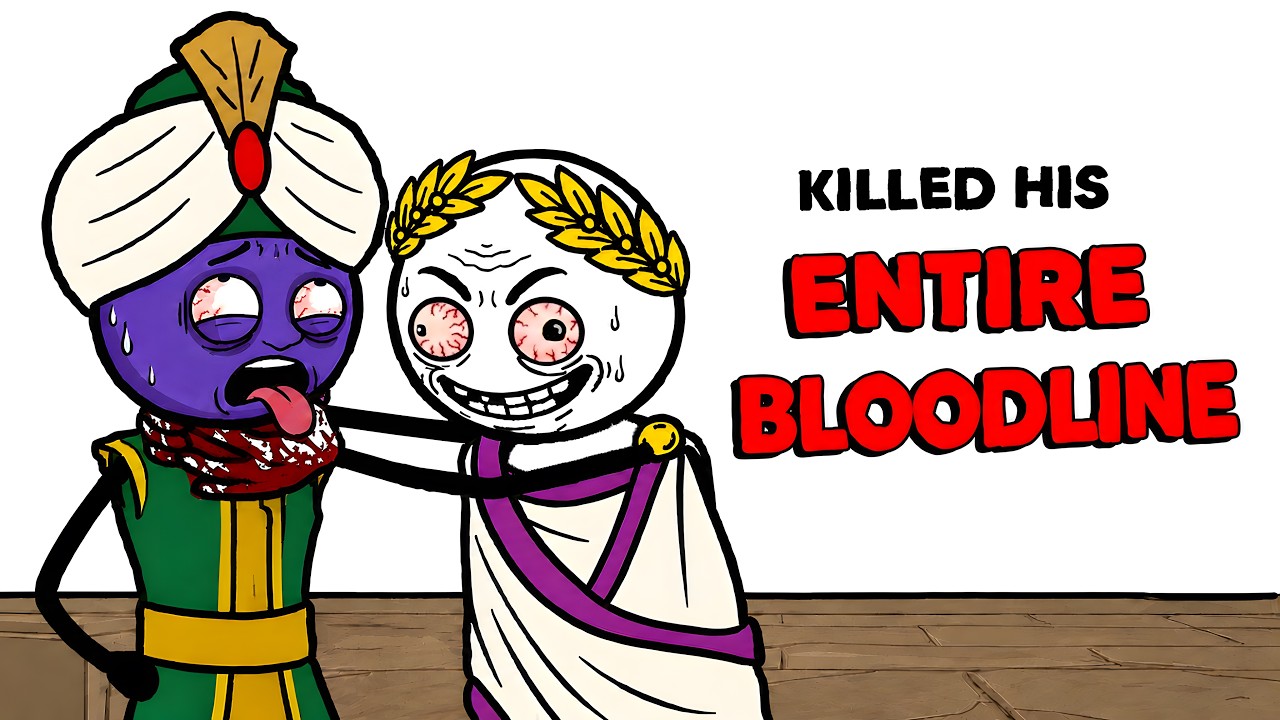
Augustus reportedly says about him, "It is better to be Herod's pig than his son." The joke works because Herod, as a nominal Jew, won't kill a pig. His sons get no such protection. Herod rules by terror, and his terror eats his own
Said at 5:05
Most replayed moment #2
10:574.6x the video's typical replay level
is invited to a friendly dinner shortly after the victory, gets drunk, falls asleep, and wakes up in chains. He's executed in 1661 on a technical charge of murder from years earlier. Shah Shuja, the Bengal
Said at 10:51
Most replayed moment #3
16:093.7x the video's typical replay level
chamber in Moscow. A philosopher prince's head on a platter in Agra. A woman walking silently to the executioner in Jerusalem. A young man strangled in a tent in Anatolia while his father listens through the canvas. In every one of these stories, the man
Said at 16:01
The graph counts replays. It does not show where viewers stopped watching.
Words
9,333
Runtime
57:38
Speaking pace
162wpm
Reading time
39min
162 words per minute, between the 160 25th percentile and the 181 median of 349 measured videos. That distribution comes from the 349-video hook study.
Opening (first 30 seconds)
Kings who killed their own families. One, Ivan the Terrible. It's November 1581 and Ivan IV is in his private chambers at the Alexandra of Kremlin, 60 miles north of Moscow, gripping a heavy iron-tipped staff. He's 51 years old and the last decade has hollowed him out. He's massacred the city of Novgorod. He's executed his own Oprichniki. He sees plots everywhere. And now he's looking at his daughter-in-law, Yelena, who is pregnant and she is dressed wrong. That's it.
81 words, the words spoken in the first 30 seconds at 162 words per minute.
Free, no signup. See how the first 30 seconds hold attention, with rewrites.
Sentence shape
| Measure | This transcript |
|---|---|
| Sentences | 751 |
| Average words per sentence | 12.4 |
| Longest sentence | 59 words |
| Questions asked | 6 |
| Sentences containing a number | 100 |
Most used terms
Filler phrases
21 in total: actually 7 · like 5 · kind of 4 · literally 3 · basically 2.
A literal whole-word count of the same phrase list the Prepublish browser extension uses, so a phrase inside another word is not counted and a phrase used in its ordinary sense still is. It is a count and not a judgement.
What this transcript is
Every word below is the caption track YouTube publishes for this video, pulled from the video itself and reproduced unchanged. It is not Prepublish's writing, not a summary, and not a re-transcription: it is the video's own published captions. English captions, generated automatically by YouTube, in the video’s original language. Source: the video on YouTube. A channel that would rather this page did not exist can ask for its removal through the contact page, and it is removed.
Kings who killed their own families. One, Ivan the Terrible. It's November 1581 and Ivan IV is in his private chambers at the Alexandra of Kremlin, 60 miles north of Moscow, gripping a heavy iron-tipped staff. He's 51 years old and the last decade has hollowed him out. He's massacred the city of Novgorod. He's executed his own Oprichniki. He sees plots everywhere. And now he's looking at his daughter-in-law, Yelena, who is pregnant and she is dressed wrong.
That's it. That's the spark. In Ivan's court, a pregnant woman is supposed to wear three layers. Yelena is wearing one. Maybe it's hot, maybe she's tired. Ivan beats her with the staff anyway. She miscarries that night. His son, Tsarevich Ivan, 27 years old and the heir to all of Russia, hears about it and walks into his father's room ready to fight. He's the only person in the empire who can yell at Ivan the Terrible and survive.
Usually, the argument escalates fast. the father of murdering his unborn grandchild. The father accuses the son of treason. The staff is still in Ivan's hand. He swings. The point connects with his son's temple. Tsarevich Ivan goes down. Blood spreads across the floor. Ivan drops the staff and starts screaming cradling his son's head, kissing his face. He sends for every physician in Moscow. He prays for four straight days at the boy's bedside.
He doesn't sleep. He doesn't eat. He just kneels there whispering. On the fifth day, Tsarevich Ivan dies. The empire's strongest, smartest, most capable heir is gone. Killed by his own father over an argument about clothing. What's left is Fyodor, Ivan's middle son, a man so passive and gentle that historians later call him Fyodor the Bell Ringer because he prefers churches to politics. After Fyodor comes Dmitri, a toddler who will be found with his throat cut in a courtyard before he turns 10.
Ivan the Terrible dies 3 years later in 1584 playing chess. The dynasty he built lasts exactly 14 more years before it collapses into the Time of Troubles, a period of famine, civil war, foreign invasion, and false tsars that nearly destroys Russia. He swings a staff at his son's head. The cost is the country. Some rulers kill in a single moment of rage. Some kill on a schedule. Two. Herod the Great. It's 29 BC and Mariamne is on her knees in Jerusalem in front of a tribunal hand-picked by her own husband.
The husband is Herod the Great, king of Judea, client to Rome, and the most paranoid man in the Eastern Mediterranean. The charge is adultery. The evidence is whatever a court official with a sword wants the evidence to be. She is the love of his life. Herod met Mariamne when she was a teenager. She's a Hasmonean princess, royal blood from the old Jewish dynasty Herod is replacing. He marries her partly for love and partly because her bloodline makes him look legitimate to the Jews who hate him for being half Idumaean.
He covers her in gold. He builds her palaces and he kills her family one by one because every member of it threatens his throne. He drowns her 17-year-old brother Aristobulus III in a swimming pool in Jericho dressed up as a horseplay accident. He executes her grandfather. By the time she figures out the pattern, Mariamne is sleeping next to the man who's killing her relatives and she stops hiding her hatred. Herod's sister Salome, who hates Mariamne, tells Herod his wife has been cheating on him.
There's no evidence, there doesn't need to be. He puts her on trial. He condemns her. When the guards lead her out to be executed, she walks to the block in silence, refusing to give him the satisfaction of a single tear. After she's dead, Herod completely loses it. He wanders the palace at night calling her name. He orders servants to bring food and drink to her empty rooms. He gets sick. He nearly dies. And then he comes back.
And he gets worse. Their two sons, Alexander and Aristobulus, grow up watching their father pace. They're handsome, well-educated, popular with the people, and full of grudges about their mother. Salome whispers in Herod's ear for two decades that they're plotting against him. By 7 BC, Herod believes her. He has both sons strangled in the city of Sebaste. That leaves Antipater, his oldest son from another marriage, who has spent his entire life setting up his brothers to die so he can inherit.
Antipater succeeds at the killing part. He fails at the patience part. In 4 BC, with Herod dying of kidney disease, Antipater is caught trying to poison him. Herod, on his deathbed, signs the execution order. His son is killed 5 days before he is. Augustus reportedly says about him, "It is better to be Herod's pig than his son." The joke works because Herod, as a nominal Jew, won't kill a pig. His sons get no such protection.
Herod rules by terror, and his terror eats his own bloodline first. The next king on this list isn't killing out of paranoia. He's killing because the math of his empire demands it. Three. Suleiman the Magnificent. It's October 15, '53, and Sehzade Mustafa is riding into his father's military camp in the Anatolian town of Eregli. He is 38 years old. He is the most popular prince in the Ottoman Empire. The Janissaries, the elite imperial soldiers, openly say they would die for him.
People in the markets sing about him. He is the eldest son of Suleiman the Magnificent and he is going to be the next Sultan. He thinks. His father has been on the throne for 33 years. The empire stretches from Hungary to Yemen. Suleiman has captured Belgrade, crushed the Hungarians at Mohacs, besieged Vienna, taken Baghdad. He is, by most measures, the most powerful man on earth. He is also being whispered to by his wife, Hurrem Sultan, born a Ukrainian slave girl who history will remember as Roxelana, has spent decades climbing from the harem to the palace to the throne room.
She is the only woman Suleiman has ever loved. She is not Mustafa's mother. She has sons of her own and she wants the empire for them. Mustafa is the obstacle. She doesn't push the knife. She talks. She tells Suleiman the army loves Mustafa more than him. She tells him Mustafa is corresponding with the Shah of Persia. She tells him there's going to be a coup if Suleiman doesn't act first. The Grand Vizier, Rustem Pasha, who happens to be married to Suleiman's daughter, backs her every word.
The whisper works. When Mustafa enters his father's tent in Ereğli, he expects a routine briefing. Suleiman is not there. Seven mutes are. Mutes are servants whose tongues have been cut out, kept around specifically for executions where no scream can reach anyone outside. You're Mustafa. You see the mutes. You understand instantly. You try to fight. You're a strong man trained in combat your entire life and you almost get to the tent flap before they pull you down.
The bowstring goes around your neck. The last thing you think about is your father sitting in another tent 50 yards away listening for it to be over. Outside, the army hears the news and almost mutinies. Janissaries openly weep. They demand the head of Rustem Pasha. Suleiman gives them Rustem's office to calm them down, then quietly reinstates him 2 years later. Mustafa's body is laid out on a rug in front of the Imperial tent.
Suleiman, the great lawgiver, the Magnificent, does not come to see it. The empire never quite forgets. Selim II, the son Hurrem wanted on the throne, takes power 11 years later. He's known to history as Selim the Sot, a drunk who can barely stay upright on a horse. Ottoman decline doesn't start with him exactly, but it starts close enough to him that historians draw a straight line. Suleiman trades the son who could have been a great sultan for the son his wife wants.
Then he rules for another 13 years and dies on campaign in Hungary, an old man in a tent. If killing one heir is a calculation, the next king makes a career of it. Four, Aurangzeb. It's 1657 in Agra, India, and Shah Jahan, the Mughal emperor who built the Taj Mahal for his dead wife, is suddenly very sick. He recovers, but the rumor that he's dying has already traveled to his four adult sons, and the rumor is enough.
The Mughal empire has no rule of primogeniture. The throne goes to whichever son wins. Win means kill. Shah Jahan has four sons. Three of them are about to die. The favorite is Dara Shikoh, the oldest. He's a mystic, a translator of the Upanishads, a man who believes Hinduism and Islam are two languages saying the same thing. Shah Jahan loves him. The court loves him. The problem is that his three younger brothers love power more.
The youngest is Murad Bakhsh, a drinker, a fighter, easy to manipulate. The second youngest is Shah Shuja, governor of Bengal, ambitious but isolated. And the third son is Aurangzeb. Aurangzeb is cold. Aurangzeb is patient. Aurangzeb has been waiting for this his entire life. He plays it perfectly. He allies with Murad, promises him half the empire, and they crush Dara's army at the Battle of Samugarh in May 1658. Dara flees west toward Persia with his teenage son.
Aurangzeb hunts him for 9 months across India, finally catching him in Sind when a chieftain Dara trusted hands him over for a bag of gold. Dara is brought back to Delhi in chains, paraded through the streets on a filthy elephant so people can see the philosopher prince humiliated. Aurangzeb's clerics conveniently declare him a heretic for studying Hindu texts. He's beheaded in August 1659. Aurangzeb has his brother's head washed, placed on a platter, and delivered to their father in Agra Fort, where Shah Jahan, very much still alive, is now a prisoner.
Shah Jahan opens the platter and screams. Aurangzeb is just getting started. Murad, the brother who helped him win, is invited to a friendly dinner shortly after the victory, gets drunk, falls asleep, and wakes up in chains. He's executed in 1661 on a technical charge of murder from years earlier. Shah Shuja, the Bengal brother, loses a battle, flees to Burma, and disappears forever. Possibly killed by local kings, possibly drowned in a river, possibly torn apart in the jungle.
His family is never seen again. Dara's surviving son, Suleiman Shikoh, is captured and slowly poisoned with daily doses of opium until he becomes a vegetable and dies. Shah Jahan, the father, the emperor, the man who built the most beautiful building on earth for his dead wife, spends the last eight years of his life locked in a single tower of Agra Fort. From his window, he can see the Taj Mahal. He stares at it every day.
He dies in 1666, and Aurangzeb has him buried next to the woman he built it for. Aurangzeb rules for 49 years. He doubles the size of the empire. He also nearly destroys it, draining the treasury on endless wars in the Deccan, alienating the Hindu subjects who had been loyal to his ancestors, and leaving behind a system so brittle that within 30 years of his death, the Mughal emperors are puppets in their own palace.
He kills his way to the throne. The throne never forgives him for it. The last king on this list doesn't pick off rivals one by one. He kills them all in a single afternoon. Five, Mehmed the third. It's January 28th, 1595 in the Topkapi Palace in Istanbul. Sultan Murad the third is dead. His 28-year-old son, Mehmed, has just been belted with the sword of Osman and proclaimed sultan of the Ottoman Empire. There is a tradition that needs to be observed.
He has 19 younger brothers. The oldest is 11. The youngest is still nursing. The law of fratricide was written down by Mehmed the second, the conqueror of Constantinople, more than a century earlier. It says, "Whichever son of mine takes the throne is permitted to kill all his brothers for the order of the world. It is not metaphor. It is procedure." Mehmed the third issues the order on his first day. The boys are summoned one by one to his presence in the palace.
Each is told his father has died and his brother is now sultan and would like to see him. The oldest, who already understands, walks in crying. Mehmed kisses him on the forehead, then nods to the deaf-mute executioners waiting behind the curtain. The silk bowstring goes around the boy's neck. Silk is used because spilling royal blood is forbidden by tradition. Strangling is considered clean. This happens 19 times. The youngest brothers, some of whom are toddlers, are carried in by their nursemaids.
The nursemaids are told to leave the room. They know what comes next. There is no record of any of them refusing. After the brothers, Mehmed orders seven women in his late father's harem who are currently pregnant to be drowned. He cannot risk one of them giving birth to another son who might one day make a claim. They are tied in sacks weighted with stones and rowed out into the Bosphorus. At night, the boatmen never speak of it.
The bodies of the 19 princes are laid out in small coffins in the courtyard the next morning. The people of Istanbul come to look. There is no rebellion. There is barely even shock. Everyone understands that this is what stability costs. You are one of the few servants left in the empty wing of the palace where the princes used to live. You walk through their rooms. You can still smell their food on the plates. There are unfinished schoolbooks open on the desks, a wooden horse on the floor of one of the smaller bedrooms.
The palace cats are wandering around looking for someone to feed them. You are not allowed to talk about any of this, ever. The European ambassadors in Istanbul write home in horror. The Venetian envoy calls it the most lamentable spectacle ever witnessed in the empire. The Ottoman court calls it Tuesday. Mehmed III rules for eight years. He turns out to be a mediocre sultan, mostly hiding in the palace while his mother runs the government.
He dies of a stroke in 1603, possibly poisoned, almost certainly assisted into the next world by someone in his own court. He is succeeded by his 13-year-old son, Ahmed I, who looks at his own newborn brother and decides he can't do it. Ahmed abolishes the law of fratricide. In its place, he creates the Kaves, the Cage, a gilded set of rooms inside Topkapi where Ottoman princes are imprisoned for life, kept alive, but kept away from power.
Generations of princes grow up in those rooms, never learning to read maps or command armies or speak to anyone outside the walls. When one of them is occasionally pulled out to become sultan, he is often half-mad from isolation. The Ottomans stopped killing their princes. They just lock them in a beautiful room and let them rot. 19 small coffins in a row in a courtyard in Istanbul. A father weeping over his son in a chamber in Moscow.
A philosopher prince's head on a platter in Agra. A woman walking silently to the executioner in Jerusalem. A young man strangled in a tent in Anatolia while his father listens through the canvas. In every one of these stories, the man who gives the order is the same man who once held these people as babies, shared meals with them, watched them learn to walk and ride and read. And then one morning he does the math, and the math comes out the same way every time.
Family is the closest thing to a king, and the closest thing to a king is the most dangerous thing in the world. Leaders who died in the dumbest ways possible. History has no shortage of leaders who died gloriously, on battlefields, in palace coups, surrounded by weeping heirs. These five are not those leaders. These five are the men who commanded empires, fought wars, and shaped continents, and then died in ways that would embarrass a toddler.
One, Qin Shi Huang. It's 210 BCE, and the most powerful man on Earth is drinking poison on purpose. His name is Ying Zheng, though he calls himself Qin Shi Huang, the first emperor. He has unified seven warring states into a single empire. He has standardized the currency, the written language, and the axle widths of carts because chariots kept breaking wheels on roads built for different wagons. He has built a wall across the entire north of the country to keep out horseback raiders.
He has commissioned a silent army of 8,000 clay soldiers to guard his tomb. He is, by any reasonable measure, the most accomplished ruler in Chinese history. And he is slowly killing himself with mercury. The problem is simple. He does not want to die. Ever. He has ordered his court alchemists to find him the elixir of life. And those alchemists have been working on the problem with the focused enthusiasm of men who understand that failure means execution.
What they eventually deliver is a formula of mercury, jade powder, and cinnabar. They tell him it is the drink of the gods. It is, in fact, liquid metal. Mercury poisoning does not kill quickly. It eats the nervous system. It scrambles the brain. By his late 40s, Qin Shi Huang is paranoid, rage-prone, and shaking. He sleeps in a different palace every night because he is convinced someone is trying to assassinate him.
He orders 460 scholars buried alive for speaking against him. He refuses to name a successor because naming one would mean admitting he is going to die, which is not the plan. In the summer of 210 BCE, he is touring the eastern provinces when he collapses in his carriage. He is 49 years old. The mercury has won. And here is where it gets worse. His chief eunuch Zhao Gao and his prime minister Li Si realize they are traveling weeks away from the capital with a dead emperor, no named heir, and a political situation that will explode the moment the news gets out.
So, they do not tell anyone. They keep bringing meals to the carriage, they keep delivering reports to the curtain, and because it is late summer in northern China and the body is rotting fast, they order wagons full of salted fish to travel alongside the imperial procession so that no one notices the smell of the decomposing emperor over the stench of rotting fish. They forge a letter in his name ordering his firstborn son Fusu to commit suicide.
Fusu obeys, they install his younger, easier to manipulate son Huhai on the throne. Within 3 years, the dynasty collapses into open rebellion. The empire Qin Shi Huang spent his entire life building lasts 15 years from start to finish. The man who wanted to live forever is remembered mostly for the way he went, buried under a hill of packed earth, guarded by clay soldiers in a tomb whose central chamber is rumored to contain rivers of flowing mercury, the same poison that killed him.
Still pooled there 2,000 years later. Two, Valentinian the First. It's November 17th, 375 CE, and the emperor of the Western Roman Empire is about to yell himself to death. Valentinian the First is 54 years old. He is a competent soldier, a decent administrator, and a man with a temper so extreme that his own court historians write about it like it is a weather event. He keeps two bears near his bedroom named Goldflake and Innocence, and he feeds prisoners to them for fun.
He once beat a servant to death for handing him the wrong hunting dog. People who work for him describe him as a good emperor who loses his mind when contradicted. On this particular morning in the Roman border fort of Brigetio on the Danube, he loses his mind one last time. The Quadi are a Germanic tribe living on the other side of the river. They have sent a delegation of envoys to apologize. The Romans have been building forts on their land.
The Quadi have been raiding in response. People on both sides are dead. The envoys arrive hoping to negotiate a peace. Valentinian receives them in his audience chamber. They speak respectfully. They offer apologies for the raids. They suggest, very carefully, that perhaps the Roman forts inside their ancestral territory had something to do with the trouble. This is the wrong thing to say to Valentinian. He starts screaming.
His face goes red. Spit flies. He is shrieking about their insolence, their ingratitude, the sheer unbelievable nerve of barbarians suggesting that Rome is ever at fault for anything. The envoys stand there in frozen silence while the emperor of half the known world has a full public meltdown at them. And then something pops in his head. Witnesses describe him breaking off mid-sentence. His mouth keeps moving. No sound comes out.
He collapses back into his throne and starts choking on his own tongue. Physicians rush in. They try to bleed him, which was the Roman medical answer to absolutely every problem. Nothing works. Within minutes, he is dead. A cerebral hemorrhage, almost certainly. A blood vessel in his brain torn open by the strain of screaming at men who had come to say sorry. The envoys presumably do not know what to do. They are standing in a room where the ruler of the Western Roman Empire has just killed himself in front of them with pure rage.
History does not record whether they were allowed to leave the building. Valentinian's death leaves the empire to his 16-year-old son Gratian and his 4-year-old son Valentinian II. Three years later, Rome loses the Battle of Adrianople to the Goths, a disaster that historians later point to as the beginning of the Western Empire's long collapse. The emperor who could have steered Rome through any of it chose instead to yell until his brain broke.
Three, Charles the VIII. It's April 7th, 1498, and the King of France is in a hurry to watch some men play tennis. Charles the VIII is 27 years old. He is not a physically impressive king. He is short. He has six toes on one foot. His head is described by contemporaries as disproportionately large from his body, which is not the kind of description you want from your own court. But, he is king of the most powerful country in Europe.
He has just invaded Italy and briefly taken Naples. He is married to Anne of Brittany, which is the diplomatic maneuver that puts Brittany inside France for the first time in history. And on this afternoon, at the Château d'Amboise in the Loire Valley, he wants to watch a game of jeu de paume. It is the ancestor of tennis, played in the castle's dry moat. He takes Anne by the hand. He leads her through a gallery toward the viewing balcony.
The gallery has a low stone doorway. Charles, in his hurry, does not duck. He slams his forehead directly into the lintel. He laughs it off. Medieval kings bumped their heads. He keeps walking. He watches the tennis match. He chats with his courtiers. He walks back through the same doorway, presumably more careful this time. And then, sometime that evening in that same gallery, he collapses. He cannot speak. He cannot move the right side of his body.
The courtiers do not want to move him, so they lay him down on a straw mattress right there on the stone floor of the passageway. He lies there for 9 hours, conscious but silent, while his doctors try to figure out what is happening inside his head. He dies a little before midnight. The likely cause is a subdural hematoma, a slow bleed on the brain that started when he hit the lintel and took the rest of the afternoon to kill him.
Modern doctors reading the accounts believe he would have survived with basic neurosurgery. In 1498, the best France can do is pray. He has no surviving sons. His oldest, also named Charles, died at age 3. His second son died at 25 days. His third died at 1 month. His daughter died at 1 month. The entire direct royal line of Charles VIII runs out because a man in a hurry to watch a tennis match does not duck under a doorway.
The crown passes to his cousin Louis XII, who immediately annuls his own marriage so he can marry Charles's widow Anne, purely to keep Brittany inside France. The family drama alone is worth its own script. Four. Pyrrhus of Epirus. It's 272 BCE and one of the greatest generals of the ancient world is being killed by an old woman's roof. Pyrrhus of Epirus is a cousin of Alexander the Great. He has fought Romans, Macedonians, Carthaginians, and Spartans.
His name is the origin of the phrase Pyrrhic victory because after defeating the Romans at the Battle of Asculum in 279 BCE and losing most of his own army in the process, he reportedly turns to an officer and says, "One more victory like this and we are finished." He is the kind of man who is always finishing. He cannot sit still. The moment one war ends, he finds another. In 272 BCE, he is in the Peloponnese fighting inside the streets of the city of Argos because an internal Argive faction has invited him to take the city from a rival.
It is going badly. The streets of Argos are narrow. His war elephants, his signature weapon, are useless in tight alleys and right now they are panicking and trampling his own men. His army is fragmented. The Argives are picking off his soldiers from rooftops with rocks, tiles, and anything heavy enough to fall. Pyrrhus is mounted, fighting his way down one of these alleys, when a young Argive soldier charges at him.
Pyrrhus drives a spear through the boy's chest. The boy drops. The boy's mother is on the roof of a house just above, and she has been hurling tiles at invaders all morning. She sees her son die. She lifts the heaviest roof tile she can carry. She aims at the man on the horse. She throws. The tile catches Pyrrhus at the base of the neck, in the gap between his helmet and his shoulder armor. It stuns him. He slumps forward.
His horse carries him a few more steps, and he slides off into the dirt of the street, paralyzed or unconscious. Sources disagree. A Macedonian soldier named Zopyrus finds him lying there. He does not recognize who it is at first. When he realizes he is standing over Pyrrhus of Epirus, cousin to Alexander, scourge of Rome, conqueror of kings, he hesitates. Then he draws his sword and starts sawing through the neck. He does it badly.
The head is eventually brought to King Antigonus II of Macedon. Antigonus is reportedly disgusted, throws his own cloak over it, and orders it buried with honor. A man who survived charging elephants and Roman legions and Spartan phalanxes, killed because a grieving mother on a roof picked up a rock. His body is burned. His army scatters. The kingdom of Epirus never recovers, and within a generation it is swallowed whole by Rome, the same Rome that Pyrrhus once nearly broke.
Five. Adolf Frederick. It's February 12th, 1771, and the king of Sweden is about to eat himself into a coffin. Adolf Frederick is 60 years old. He has been king of Sweden for 20 years. He is not a strong king. The Swedish parliament has stripped most of his real power during what Swedes call the Age of Liberty. And Adolf Frederick spends his days doing what disempowered monarchs tend to do. He eats. He hunts. He handcrafts snuff boxes.
He reportedly makes hundreds of snuff boxes over his reign. They are, by all accounts, pretty good snuff boxes. On this evening, Shrove Tuesday, he sits down to dinner at the Royal Palace in Stockholm. The menu is actually recorded. It goes like this. Lobster, caviar, smoked herring, sauerkraut, champagne, and then, for dessert, a traditional Swedish dish called hetvägg. It is a sweet almond paste-filled bun called a semla, served in a deep bowl of warm milk.
A delicacy. Rich, filling, normally eaten one at a time. Adolf Frederick eats 14 of them. 14 servings of sweet buns and hot milk on top of a meal that was already lobster, caviar, smoked herring, pickled cabbage, and champagne. He finishes the last bun. He stands up. He collapses. The official cause of death is listed as digestive issues. Modern historians suspect a combination of stroke and catastrophic gastrointestinal failure in a 60-year-old body that simply could not process the volume and richness of what had just been shoveled into it.
He goes down in Swedish textbooks, without irony, as the king who ate himself to death. His son, Gustav III, who is out of the country at the time, races home and takes the throne. Gustav is a very different kind of king. Ambitious, theatrical, a patron of the arts. Within a year, he stages a bloodless coup and takes back most of the power that parliament had stripped from his father. Adolf Frederick dies a soft king whose death accidentally hands his son the keys to an absolute monarchy.
He is buried with full honors. Somewhere in the Royal Palace, his collection of hand-carved snuff boxes still exists. They outlasted the man who made them by about 250 years. The buns did not. Five men, five empires, one drinks metal. One screams until he bursts. One gets to duck. One gets beaned by a grandmother. One orders a 14th dessert. Power, it turns out, does not protect anyone from the oldest joke in history, which is that bodies are fragile and pride is heavier than a roof tile.
Today we're going over the most unhinged kings in history. And I don't mean rulers who were a little eccentric or had some weird hobbies. I'm talking about kings who were so completely out of their minds that their own advisers, families, and entire countries had to figure out how to survive a leader who had genuinely lost the plot. Let's get into it. Number one, Emperor Justin II, the one who ate people. It's 565 AD and Justin II has just become emperor of the Eastern Roman Empire.
He inherits the throne from his uncle Justinian the Great, one of the most accomplished rulers in Roman history. Big shoes to fill. And to his credit, Justin starts off fine. He's sharp, ambitious, and immediately begins trying to restore the empire's military strength. Then his mind breaks. By around 573, the stress of running an empire under constant attack begins to take its toll. The Persians are invading from the east.
The Lombards are rampaging through Italy. The treasury is empty because Justinian spent all the money on building projects and wars. Justin starts hearing voices. He starts screaming at people who aren't there. His behavior becomes erratic and violent to the point where his own palace guards are afraid of him. According to the historian John of Ephesus, who was actually present at the court during this time, Justin had to be physically restrained by attendants.
He would bite people. Not metaphorically, he would literally try to eat his servants. The palace staff reportedly wheeled him around on a small cart to keep him contained, and they would play organ music to calm him down because, for whatever reason, that was the only thing that worked. When music wasn't available, his attendants would try to distract him by rolling him past windows while they ran alongside making funny faces.
The Empress Sophia eventually convinced him to appoint a general named Tiberius as co-emperor to actually run things. In one of his rare moments of lucidity, Justin supposedly told Tiberius, "May God be with you. I myself am nothing now." He died in 578, having spent the last 5 years of his reign as a restrained, biting, screaming man being wheeled around a palace on a cart. The organ music thing is somehow the detail that makes it most sad.
Number two. Charles the VI of France, the Glass King. It's 1392, and 23-year-old King Charles the VI of France is riding through a forest with his men when a barefoot man suddenly appears on the road and grabs his horse's bridle. The man screams at the king, "Stop, noble king. You are betrayed." Charles' guards shove the man away, and the party continues. But something has shifted inside Charles. He's agitated. His eyes are darting.
His hands are trembling. A few hours later, one of his pages accidentally drops a lance, and it clangs against a helmet. The noise triggers something. Charles draws his sword, spins his horse around, and begins attacking his own men. He kills four of his own knights before his companions can wrestle him to the ground. When they finally subdue him, Charles has no memory of what just happened. This was the first major episode in what would become a 30-year descent into madness.
Charles became convinced that he was made of glass. Not metaphorically, he genuinely believed his body was constructed of glass and that if anyone touched him, he would shatter. He refused to let people near him. He had iron rods sewn into his clothing to prevent his glass body from breaking. He would stand perfectly still for hours, terrified that any movement would crack him. He also forgot who he was repeatedly. He would look at his own coat of arms and not recognize it.
He didn't recognize his wife. He didn't recognize his children. He would wander the hallways of the palace screaming that he was not the king and demanding to know who all these people were. During his rare periods of sanity, which could last anywhere from a few weeks to a few months, Charles would be horrified by what he'd done during his episodes. He'd apologize to everyone, try to govern responsibly, and desperately pray that the madness wouldn't return.
It always did. His illness created a power vacuum in France that his relatives immediately began fighting over. His brother, the Duke of Orléans, and his cousin, the Duke of Burgundy, waged what was essentially a civil war for control of the kingdom while the king wandered around the palace convinced he was made of glass. This internal chaos is what allowed Henry V of England to invade France and win the Battle of Agincourt in 1415.
If Charles had been sane, the Hundred Years' War might have gone very differently. Charles died in 1422, having been king for 42 years, most of which he spent in a state of complete disconnection from reality. The Glass King. It would be funny if it hadn't destroyed an entire country. Number three, Emperor Zhengde of China, the emperor who played pretend. It's 1505 and 13-year-old Zhu Houzhao has just become Emperor Zhengde of the Ming Dynasty.
He has absolute power over the largest empire on Earth. He could do literally anything. Build monuments, conquer nations, reform society. Instead, he built himself a fake city inside the palace grounds so he can play shopkeeper. Zhengde had a building constructed called the leopard quarter, a mini town complete with fake shops, fake restaurants, and fake market stalls. He would wander around this pretend city dressed as a commoner, haggling over prices with eunuchs who were forced to pretend to be merchants.
He'd buy things with fake money and then congratulate himself on getting a good deal. His officials would watch this grown man, the ruler of 100 million people, pretending to buy vegetables from his own servants, and they just had to nod and smile. But it got weirder. Zhengde decided that being emperor was boring, and what he really wanted was to be a military general. So he gave himself a fake military rank under a false name, Zhu Shou, and began issuing orders to himself.
He'd write official documents from General Zhu Shou requesting permission from Emperor Zhengde to do various things. Then he'd switch hats and approve his own requests. His ministers had to process these documents through the actual imperial bureaucracy. A real empire's paperwork being consumed by one man's elaborate game of pretend. When an actual military campaign against Mongol raiders presented itself in 1517, Zhengde was thrilled.
He personally rode out to fight, and to everyone's genuine surprise, he actually wasn't terrible at it. He killed at least one enemy soldier in close combat, a fact he bragged about for the rest of his life. But the battle itself was basically a skirmish, and Zhengde reported it as a massive victory with inflated casualty numbers. He also kept a private zoo filled with exotic animals, including the leopards that gave the leopard quarter its name.
He reportedly tried to wrestle a tiger at one point, which went about as well as you'd expect. He survived, but was badly injured, and his officials nearly had heart attacks. Zhengde died in 1521 at age 29 after falling off a boat while drunk. He had been emperor for 16 years. The Ming Dynasty survived him, but his reign is basically a case study in what happens when you give unlimited power to someone who would rather play dress-up.
Number four, Ibrahim I of the Ottoman Empire, the Mad Sultan. It's 1640, and Ibrahim has been locked inside the kafes, a gilded cage within the Topkapi Palace, for 22 years. The kafes was where the Ottoman Empire kept spare princes. Rather than executing all potential rivals to the throne, the Ottomans would just lock them in a luxurious prison for their entire lives. Ibrahim had watched from inside his cage as his brothers were strangled one by one.
When his brother, Sultan Murad IV, died, Ibrahim was the last surviving male of the Ottoman Dynasty. The doors of the kafes opened, and Ibrahim was told he was now the sultan. He refused to come out. He was convinced it was a trick to get him out so they could kill him. His mother, Kosem Sultan, had to physically bring his brother's dead body to the door to prove Murad was actually dead. Only then did Ibrahim cautiously step out. 22 years of isolation had not been kind to Ibrahim's mental health.
Within months of taking the throne, his behavior became increasingly bizarre. Ibrahim developed an obsession with fur, not a preference, an obsession. He had his entire palace draped in fur, walls, floors, ceilings. He demanded that his concubines wear nothing but fur. He had a fur-lined room where he would spend hours rolling around by himself. According to some accounts, he became sexually obsessed with a particular cow because he thought its body resembled a woman's, and he had someone search the empire for a woman who matched the cow's proportions.
They allegedly found one, a woman of enormous size from Armenia, and she became one of his favorites at court. He would throw gold coins into fish ponds and watch them sink. He'd pour expensive perfumes into fountains. When his advisers told him the treasury was running low, he responded by demanding more gold from the provinces to dump into more ponds. The breaking point came when one of his concubines was rumored to have been unfaithful.
Ibrahim's response was to have 280 of his concubines bound, loaded into weighted sacks, and thrown into the Bosphorus Strait to drown. 280 women because one might have been unfaithful. Only one reportedly survived by escaping her sack. By 1648, Ibrahim's own mother, the same Kösem Sultan who had freed him from the kafes, agreed that he had to go. She authorized a coup. Ibrahim was seized, thrown back into the kafes that had been his prison for 22 years, and strangled with a bowstring 10 days later.
He'd been sultan for 8 years. The Ottoman court moved on like nothing had happened. Number five. King Christian the Seventh of Denmark. The king who couldn't stop. It's 1766, and 17-year-old Christian the Seventh becomes king of Denmark and Norway. He's intelligent, well-educated, charming when he wants to be, and absolutely everyone in the Danish court has high hopes for his reign. Those hopes last about 6 months. Christian begins exhibiting behavior that alarms everyone around him.
He bangs his head against walls until he bleeds. He slaps people in the face mid-conversation for no reason. Dignitaries, servants, his own advisers. He runs through the streets of Copenhagen at night with his friends smashing windows and getting into fights with random strangers. He visits brothels so frequently that it becomes a diplomatic incident. When he's married to Caroline Matilda, the 15-year-old sister of King George III of England, he treats her terribly.
He ignores her, insults her publicly, and continues his nightly rampages through the city. He develops a compulsive habit of self-harm. He mutilates his own hands to the point where they're permanently scarred. His most persistent delusion was that he was being controlled by invisible forces and that his real self was trapped somewhere else. He would stare at his own reflection for hours trying to find the real Christian.
He would also fall into states of complete catatonia, sitting motionless and unresponsive for days at a time, only to suddenly snap back and resume slapping people. Into this mess walks Johann Friedrich Struensee, a German physician who is brought in to treat the king. Struensee quickly realizes that Christian is never going to be able to actually rule. So, he does something audacious. He befriends the king, gains his trust, and gradually takes over the entire Danish government.
For about 16 months in 1770 to 1772, Struensee was the de facto ruler of Denmark, issuing over 1,000 royal decrees in Christian's name while the king wandered the palace in a daze. Struensee also began an affair with Queen Caroline Matilda, and the two of them had a daughter together while the king was too mentally absent to notice or care. When the Danish nobility found out, they staged a coup. Struensee was arrested, tried, and publicly executed.
His right hand was cut off first, then he was beheaded, and his body was drawn and quartered. Caroline Matilda was exiled. And Christian? He remained king for another 36 years. He never recovered his sanity, but nobody bothered to officially remove him. He just existed in the palace as a figurehead, slowly deteriorating, occasionally slapping someone, while a series of regents ran the country around him. He died in 1808 at age 59, having been nominally king for 42 years and actually in charge for approximately zero of them.
So, there you have it. Five kings and emperors who proved that absolute power doesn't just corrupt absolutely, sometimes it just goes completely off the rails. Justin the Second tried to eat his staff. Charles the Sixth thought he was made of glass. Zhengde played shopkeeper with his own servants. Ibrahim drowned 280 women because of a rumor. And Christian the Seventh spent 42 years as king while being incapable of doing literally anything except slap people and stare at mirrors.
The next time someone says they wish they were born into royalty, maybe show them this video first. The most evil experiments ordered by kings. Most rulers in history wanted power, land, or money. A few wanted something stranger. They wanted answers. They wanted to know what language God speaks, whether the human body can be made immune to poison, what happens to a man's stomach when he runs after eating. They had access to prisoners, condemned men, infants with no one to protect them, and the absolute authority to do whatever they decided science required.
These are the experiments they ordered and the people who paid for them. One, Frederick the Second and the language deprivation experiment. In the early 13th century, Frederick II, Holy Roman Emperor and King of Sicily, decided to answer one of the oldest questions in medieval scholarship. If a child was raised from birth without hearing a single word of human language, what would it eventually speak? Latin? Greek? Hebrew?
Some scholars argued the answer was Hebrew, the language of God, the original tongue of Adam. Frederick wanted proof. He selected a group of newborn infants, most of them children of poor families who had no means to refuse the emperor's interest. He assigned them to wet nurses with strict instructions. The nurses were to feed the children, clothe them, keep them clean, and never speak to them. No lullabies, no murmuring, no words of comfort when the child cried in the night, no human voice ever.
The experiment would run until the children were old enough to begin producing language on their own, and then Frederick would have his answer. The children died, all of them. Not quickly, and not from any obvious physical cause. The chronicler Salimbene de Adam, a Franciscan friar who documented Frederick's reign, wrote that the children perished because they could not live without the petting and the joyful faces and loving words of their foster mothers.
They were fed, they were warm, they had no infection, no injury, no disease. They had no human contact beyond the mechanical, and their bodies gave out anyway. Frederick never got his answer. What he got instead was one of the earliest documented cases of what modern medicine calls failure to thrive, the phenomenon in which infants deprived of emotional stimulation and human interaction fail to develop normally and, in severe cases, die.
The science behind it would not be formally understood for another seven centuries. The emperor moved on to his next question. He always had another question. Two, Frederick II and the digestion experiment. Frederick II comes up twice on this list because he was genuinely and relentlessly curious about how human bodies worked and he had no ethical framework that would have stopped him from finding out. Sometime in the mid-13th century, Frederick ordered an experiment on two prisoners under his authority.
Both of them condemned men with no appeal left. He fed them an identical meal. Then he split them into two groups. One man was sent to bed to rest. The other was sent out to hunt on horseback riding and moving for hours after eating. When Frederick decided enough time had passed, both men were killed. Their stomachs were cut open and examined side by side. The question was simple. Which process aided digestion better, rest or exercise?
The results, according to accounts that survived the period, suggested that the resting man had digested his food more completely. Frederick reportedly concluded that rest after eating was superior to exertion. Medieval physicians had debated this for years based on theory alone. Frederick settled it the way he settled most things, by removing the uncertainty. No record survives of who the two men were, what they had eaten, or how long they rode before they were killed.
They appear in the historical record only as the subjects of an experiment. Two bodies that a curious emperor used to answer a question that could have waited. The conclusion he reached was not wrong, by the way. Rest does aid digestion. Frederick was ahead of his time in his methods and his findings and entirely indifferent to the cost of getting there. Some kings experiment out of curiosity. Some out of fear. Three, Mithridates VI and the poison immunity trials.
In the 1st century BC, Mithridates the Sixth, king of Pontus on the southern coast of the Black Sea, was afraid of being poisoned. This was not an irrational fear. His father had been poisoned. Several of his siblings had died in suspicious circumstances. He had grown up in a court where the safest way to remove a king was to put something in his wine, and he had watched it work up close. He decided he would make himself immune.
Mithridates began taking small, sub-lethal doses of various poisons every day, gradually increasing the amounts over time to build up his body's resistance. This practice, now called mithridatism after him, is the earliest documented deliberate attempt at poison immunity. He also became obsessed with developing a universal antidote, a compound that would neutralize any toxin regardless of the source. To test his formulas, he needed subjects.
He used condemned prisoners. The procedure was methodical. A man would be given a controlled dose of poison measured by whatever standard Mithridates had available. Then, he would be given the antidote being tested. If the antidote worked, the prisoner survived. If it did not, Mithridates adjusted the compound and tried again with the next available subject. He ran these trials continuously, accumulating years of data on dosages, reaction times, and survival rates.
Ancient sources describe the antidote he eventually developed as containing more than 65 ingredients, including various plant extracts, minerals, dried blood, and small quantities of the poisons themselves. The formula became known as mithridatism. Roman physicians used versions of it for centuries after his death. The irony is that when Mithridates was finally defeated by Rome and tried to poison himself rather than be captured, the poison did not work.
He had made himself too resistant. He had to ask a soldier to stab him instead. The king, who had spent his life testing antidotes on others, could not kill himself with the tools he had mastered. He had become the experiment, and the experiment had run too well. Four. James the Fourth of Scotland and the isolated island language test. In 1493, James the Fourth of Scotland conducted his own version of Frederick the Second's language experiment, apparently unaware of or untroubled by how Frederick's version had ended.
James was young, educated, and genuinely interested in science and medicine, in a Renaissance prince kind of way. He wanted to know what language children would speak if raised without human speech. His answer to the methodology problem was slightly different from Frederick's. He sent two children to the island of Inchkeith, a small uninhabited rock in the Firth of Forth, along with a mute woman who was instructed to raise them in complete silence.
The woman could feed them, care for them, and keep them alive. She could not speak. No one else would visit. The children would grow up in isolation, and eventually, the theory went, produce whatever language was natural to human beings. The chronicler, Robert Lindsay of Pitscottie, wrote that the children, when eventually retrieved, were reported to have spoken good Hebrew. This detail is almost certainly invented, inserted by scribes who wanted the experiment to confirm the theological expectation that Hebrew was humanity's first language.
James had no way of verifying it, and most historians treat the outcome as fabricated. What is not fabricated is that James ran the experiment at all. He sent children to a rock in the middle of a Scottish estuary with a woman who could not speak, and waited to see what would emerge. The children survived, which distinguishes his experiment from Frederick's. Whether they spoke anything coherent when they came back, whether they were psychologically whole, whether anyone thought to ask what the mute woman's experience had been, none of this is recorded.
James went on to become one of the more active patrons of medicine in Scottish history. He pulled teeth on his own court physicians, not as punishment, but out of professional curiosity. He was interested in how things worked. He was less interested in what the things he was working on experienced in the process. Some experiments are about fear of death. Some are about outsmarting it. Five, Qin Shi Huang and the immortality elixir program.
By 210 BC, Qin Shi Huang, the first emperor of a unified China, was the most powerful man in the world and terrified of dying. He had spent his reign building walls, burning books, burying scholars alive to suppress dissent, and conquering six rival kingdoms to forge a single empire. He was not finished. He needed more time. He needed to live forever. He tasked his court alchemists and scholars with the problem. The result was not one experiment, but an entire program running for years in which various formulas were developed, tested, and administered in search of the elixir of immortality.
The alchemists had theories. Certain minerals, certain compounds, certain combinations of refined substances were believed to carry the essence of longevity. Cinnabar, the red ore of mercury, was considered particularly promising. Red was the color of vitality. Mercury was strange, liquid, and metallic at the same time, unlike any natural substance. Surely something that strange was powerful. Mercury is, of course, a devastating neurotoxin.
The elixirs that Qin Shi Huang's court produced and fed to the emperor almost certainly contained significant quantities of it. Historians examining the ancient records have noted the progressive deterioration in the emperor's behavior and judgment in in final years. The paranoia, the erratic decisions, the suspicion of everyone around him, these symptoms are consistent with chronic mercury poisoning. The man who had unified China and built one of the most sophisticated administrative systems in the ancient world was being slowly destroyed by the medicine he believed would save him.
The alchemists were not experimenting on prisoners in this case. They were eventually experimenting on the emperor himself, though they did not know it, and neither did he. Several of them were executed when their formulas failed to produce results. Others fled. At least one group of scholars was reportedly sent on a sea voyage to find the islands of the immortals in the eastern ocean and simply never came back, whether because they drowned or because they understood what happened to people who returned to Qin Shi Huang's court with empty hands.
The emperor died in 210 BC on a tour of his empire in a carriage attended by a small number of officials who concealed his death for weeks to prevent a power struggle from erupting before they reached the capital. His body was transported back to his tomb accompanied by cartloads of rotting fish to disguise the smell of decomposition. The man who was trying to live forever was smuggled home as a corpse past the kingdom he had spent his life building.
The elixir was in his blood the whole time and it was killing him. Every one of these kings had access to absolute power and a question they decided was worth any cost to answer. None of them found what they were looking for. Frederick never learned what language God speaks. Mithradates made himself immune to everything except his own army. James the Fourth got a result he couldn't verify and a woman's silence no one thought to document.
Qin Shi Huang drank mercury and called it medicine and died convinced he was on the edge of a breakthrough. The experiments ended. The questions didn't. They just got passed on to next person with enough power to decide that other people's suffering was an acceptable price for an answer.
The words are the caption track's own and nothing is reworded or re-transcribed. Paragraph breaks are placed between sentences so the text reads as prose.
Free tools for your own script. No signup, no login.
Paste your draft and see where viewers are likely to drop off, with a rewrite for each weak line.
Paste the first 30 seconds of your own draft for a hook score and rewrites.
Check your draft against YouTube's advertiser-friendly guidelines before you record it.
Read this channel's public videos and transcripts, and download a writing brief for it.