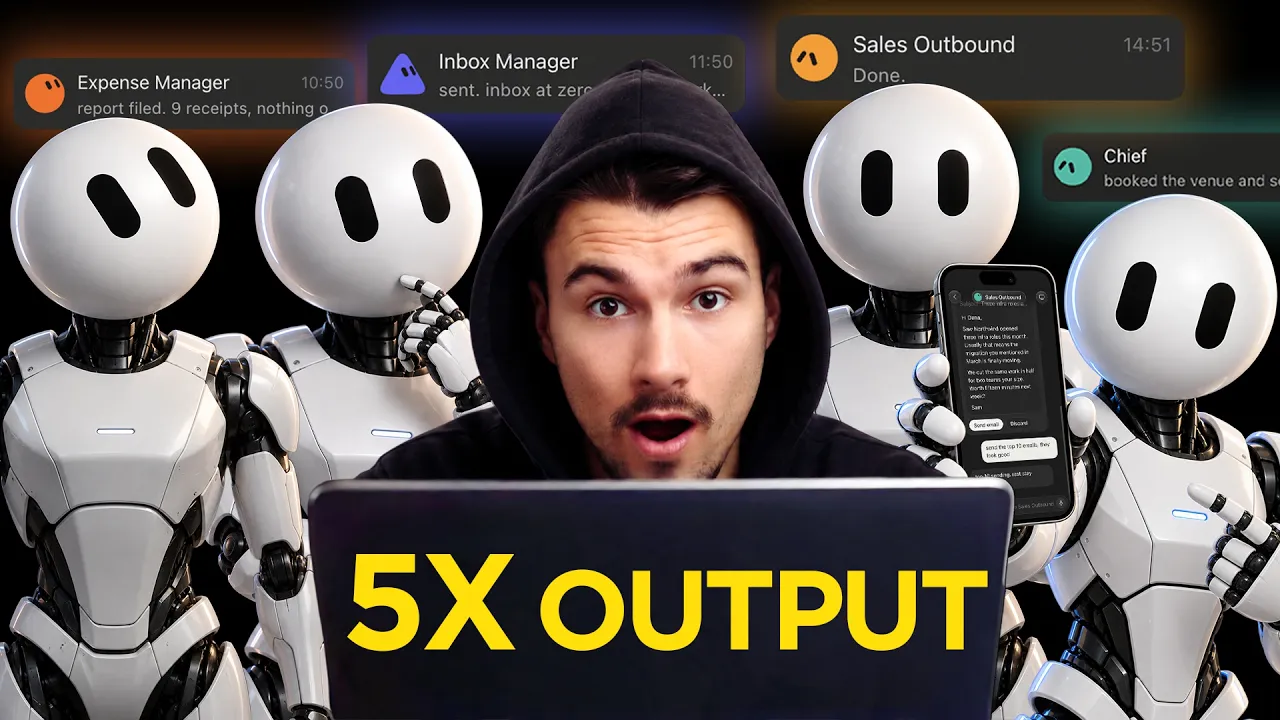
The Chatbot Era Is Ending. Your AI Team Is Next. transcript
The AI Advantage · @aiadvantage
Words
3,203
Runtime
15:07
Speaking pace
212wpm
Reading time
13min
212 words per minute, above the 201 75th percentile of 349 measured videos. That distribution comes from the 349-video hook study.
Opening (first 30 seconds)
This chatbot era in AI that we've been living in for the past 3 years is ending. But here are the receipts. Grok is building AI co-workers instead of Grokbot. Meta launched an agent that keeps working on your goals after you close the app. Instinct is a personalized agent that talks to you like a friend would inside of a iMessage conversation. And Claude can now, or very soon, manage parallel workers like a chief of staff would. Give it a goal and it spawns all these sub-agents to get you there. You don't have to worry about the how. So, this is no longer
106 words, the words spoken in the first 30 seconds at 212 words per minute.
Sentence shape
| Measure | This transcript |
|---|---|
| Sentences | 186 |
| Average words per sentence | 17.2 |
| Longest sentence | 78 words |
| Questions asked | 11 |
| Sentences containing a number | 18 |
Most used terms
- people28
- chat17
- ai16
- work12
- lot10
- claude9
- systems8
- bot7
- day7
- open7
- week7
- basically6
Filler phrases
65 in total: like 34 · you know 10 · basically 6 · kind of 5 · I mean 4 · actually 2 · um 2 · literally 1 · right? 1.
A literal whole-word count of the same phrase list the Prepublish browser extension uses, so a phrase inside another word is not counted and a phrase used in its ordinary sense still is. It is a count and not a judgement.
What this transcript is
Every word below is the caption track YouTube publishes for this video, pulled from the video itself and reproduced unchanged. It is not Prepublish's writing, not a summary, and not a re-transcription: it is the video's own published captions. English captions, generated automatically by YouTube, in the video’s original language. Source: the video on YouTube. A channel that would rather this page did not exist can ask for its removal through the contact page, and it is removed.
Transcript
This chatbot era in AI that we've been living in for the past 3 years is ending. But here are the receipts. Grok is building AI co-workers instead of Grokbot. Meta launched an agent that keeps working on your goals after you close the app. Instinct is a personalized agent that talks to you like a friend would inside of a iMessage conversation. And Claude can now, or very soon, manage parallel workers like a chief of staff would.
Give it a goal and it spawns all these sub-agents to get you there. You don't have to worry about the how. So, this is no longer about better answers. It's about building a team and very soon you will be the boss of that team. My worry is that most people know how to ask questions and communicate, but they don't really know how to manage a team or be a boss. And if currently a billion people are using chatbots and this is the next evolution of AI, I'm not exactly sure what this means for most people.
So, I wanted to make this video today to discuss this change in product that we see everywhere. These announcements and slight shifts are happening everywhere. And usually on this channel I would go ahead and, you know, break it down and show you a workflow that is useful. But today I think it's really important to discuss the shift in product. Because ever since Open Clock came out in spring, the most sophisticated AI user experience looks more like managing a team rather than talking to a chatbot that also does things.
I mean, I said it the second this came out and I'll say it again. My personal Open interface looks like this. It's a bunch of chats just like iMessage. And then Grokbot looks like this. It's a bunch of chats just like iMessage with one chief of staff running all the other agents. Here it would be my Igor OS fat cat. Great. Over here it's Alfredo. My guy. And then Alfredo 2 and 3 are all these other subgroups that contain smaller pockets of context, but they can and collaborate.
And then as I mentioned, Claude just announced their version of this where projects will now run from one conversation. So there's a Claude code thing for now, but basically what they're saying is you're going to open one chat, type everything you need in there, and it by itself is going to spin up sub-chats and projects as they call them. And then the AI is going to do the work in those projects and bring the work back to the main chat where you started things.
So how does that differ from the experience that you might be used to or most people, like the billion users that have AI accounts are used to? Well, in ChatGPT or Claude, you basically go in and you know, you start a chat and you do your task and then you start another chat and you maybe have complete the task and then you start another chat in parallel and then you finish that and then you finish your first task and you move on.
Now let's say you start a fourth chat and all of a sudden you're like, "Yeah, I remember when I was working on the first thing 2 days ago, which would, you know, be this one." Then this chat is most likely going to be like, um well, um no. Or even if it says yes, it's just going to get a compacted version, basically a summary of that first chat into here, which is really like a little piece of this. And God forbid you want to do something like, "Remember all the things we worked on yesterday?
Can you pick that back up and can we continue?" It's not going to be able to do that. Whereas this architecture that really started to become useful since Open Claude and then Hermes and now Grok Bot, Muse, Instinct, Claude Threads, and next week we'll probably get a version of this from OpenAI, something like Code X Bot during Dev Day that is coming next week. So we'll talk about that next week. Subscribe if you want a discussion on that.
But all of these products, it's a different idea. It's basically you work on topic number one inside of this chat and then inside of the same chat you work on topic number two or three and you kind of can keep stacking things and can keep working in one chat because the architecture of it works in a way that, "Hey, if you say I need tasks one, two, three, four." It will just go ahead and spin up some of these other chats where maybe two happens here, three happens here.
So, now we did one and four in here, but it brings two and free into this main chat. And I'm not talking about a small piece. I'm talking about this entire context, all of the work that happens in this separate project or thread coming back because these standalone projects or threads or whatever you want to call them, they remember. And there's different memory systems behind this and each one of these apps has kind of a different one.
This is not going to be a deep dive on memory systems, but basically for a smart combination of multiple technologies like vector databases or just keeping log files or compacting the current context window, but keeping snapshots separately so you can return to the full context if you want to. All of this in combination basically means that as a user your experience changes from, you know, multiple chats to one chat with your boss AI, your chief of staff, your orchestrator, whatever you want to call it.
It's all the same idea. It's just one chat where you talk to it, you tell it the goal of the thing that you want to do and it figures out what needs to happen on the side and it orchestrates it all and it comes back to your chief. So, why does that matter? Well, one, it's a more natural way of interacting with this and I find it more intuitive. But I speak from a place of being used to working with people and managing teams.
And also, I personally have developed the skill of managing context. I realize what it means for a chat when it's compacting. I realize how each one of these threads is structured, that there's a rag based memory layer here that might lose some small details, but when I look for the big ideas it will always find them. And then I get the benefits of being able to work with a system like this right now where, you know, it's not super intuitive, which is I can start multiple projects from one chat, routed to multiple agents, and work on five things in parallel.
I don't think I'm overestimating the fact that I think in the last month my output was somewhere from four to six times higher than it would have usually been on all of this knowledge work and basic development that I'm doing. Heck, just inside of this open claw system, I have 60 scheduled tasks running on a daily basis that create value in some form, otherwise I would have killed them by now. And in our education business, we're teaching people how to set up scheduled tasks for themselves that take things like, you know, managing their email inbox, their calendar off their table first, and then they continue and they set up more.
They automate more and they learn how to coexist with these systems as a thought partner and develop custom skills and flesh out their ideas. Unbelievable. But what is my larger point here? Well, it's that there's a shift happening right now. And you know, if you're on the forefront of this, then you've already been using Claude code and pushing it to its edges and maxing out your open AI subscription, and maybe you have multiple $200 subscriptions.
Well, good. Great. You're understanding what's happening. My point is that most people are not in that boat. Now, if you look at the fact that the data from a few months ago suggest that only 1% of the working population has a paid AI plan. It's around 40 million users. Then how many of these people are really pushing the capabilities and tinkering and failing on a daily basis like the people who use Codex or Claude code with their own second brains and connectors, and they have a knowledge base that is synced in the cloud.
Maybe they're playing with Cloudflare or Vercel hosting, and they're breaking things on a daily basis and failing their way through this on a daily basis without being technical. Well, I think that's just a fraction of those paid plans. Like I didn't find any official numbers on this. If you have any, I would be super curious. But my guess estimate would be what? Is that going to be like 5% maybe? Which is what? Like 2 million people worldwide?
I think that's actually being generous. If you look at the social media attention that posts on this type of topic get, well, on the high end, they get like, I don't know, 200,000 views on YouTube. That's not even unique viewers all of that, right? Twitter, same thing. Sure, there's some overlap there, but honestly, I think the number of people like really pushing the capabilities of AI right now is probably in the low millions versus the billions of people that are on free accounts.
Even though I teach this stuff for a living and I play with it every day, most of my family, they're on a free chat GPT account, maybe on a $20 plan, kind of using it four times a week, you solving some issues, replying to some emails, you know, maybe creating some PowerPoints, but not dealing with, you know, four agents running things at the same time, really building systems where it manages their calendar. And I think this shift is ultimately not going to benefit the people who have not been pushing it before.
Because while this interface shift that I pointed out in the beginning might be intuitive to a person who just is using this and pushing this every day. And when somebody sits down and joins our educational program like the ones we run or just goes out there and consumes a lot of videos on the internet. Like this is all figure-outable, but most people don't have the mindset of, "Okay, I'll just figure this out." Most people are already stretched.
And I see this every day. People have a lot on their plate. They're already stressed and stretched, and they don't have the will to fail their way through a new application. It also takes a toll on your psyche. And you need to be in a particular place in life where you can expend that extra energy to learn something new, especially if in the past you've had negative experiences with technology. And maybe you even consider yourself somebody who's not good with tech.
Well, I've been blessed enough to partner with Dean Antonio over the last year to uplift so many people, tens of thousands of people, from a place of like being scared of this stuff into being fluent with it and using it day-to-day. But that's tens of thousands of people. That's not enough. I just keep thinking like, how do we help people in this transition on a scale of tens of millions of people? And as of right now, I'm not entirely sure, but it's going to be necessary because you watching this channel this deep into a video of me ranting about this technological change and how these interfaces are changing, how memory systems are changing.
You most likely are going to be fine. You're staying out here. You're going to use all these capabilities. You're going to be all over Claude code with Fred's. Or maybe you'll be using Grok bot that comes out from OpenAI. Amazing, and I'll be on this channel be covering it. I'll be showing you the different use cases that I have, what's possible. Look, I mean, check this out. I built a Grokbot use case scanner to kind of prepare for all this madness.
Let me just give you a peek into this. This is pretty cool. And it surfaces all the stuff that is happening. So, look, this is the development over the past week. These are the top use cases that people have been talking about online. This is based on 868 sources just over the last 7 days. I've had this running for like 2 months. And the top one is still this chief of staff agent teams where one manager bot routes the work across various sub agents.
Some new examples include 10 to 25 agent teams. Also increasingly popular is this use case where you teach by demonstration. And I'm pretty sure that's referring to the fact that you can go into this bot's computer. And then by hitting this button out here, teach a task, you can literally perform a task by hand, click your way through it, I don't know, logging into the sub-a-base account or whatever. And as I kind of do these things and fill it out, it records everything, and then I can save it as a routine that it can then run on a schedule.
Inbox calendar management is still a big one. There you go. I guess this is the practical part of the video where you get to take away some ideas. So, got a few more. End-to-end media operations like creating and publishing faceless videos. Oh, yeah, we see that slop everywhere. I hate it. But let me tell you, except for this one, what I see across many of these use cases, and this is my larger point, a lot of what this does is very different from what we hear in the news, which is, "Oh my god, you know, like all this uncertainty and all of these sci-fi scenarios that make a really good story, but there's not really a lot of hard evidence or data to base them on." Now, I'm not hand-waving and just dismissing it.
I think there's value to having these discussions, but a lot of what I hear is just people worrying about things that, one, are out of their control, and two, aren't based on facts, and three, and I think this is the worst one of them all, if you compare the amount of worrying that people are doing versus the amount of responsibility and action they are taking, it's like this. My hand is not large enough. There's so many things you can do.
You can become fluent with this technology. You can learn how to apply the judgment that your lived experience gives you to the outputs of these tools. You can get better at systems thinking and building systems. You can get better at directing systems like this to empower yourself, to give yourself more leverage in your life so you can do what you're very best at. I truly believe that every human has a unique, God-given, or whatever you want to call it ability to do something better than anybody else.
And I would like to believe, or I guess I choose to believe that AI is here and is giving us the opportunity to lean more into that unique thing we're really good at. As I told you my last month's output was five times what it was meant to be. It is ridiculous how many things I created, how many plans I created, how many things I implemented, how many programs I designed, how many webinars, meetings, classes I attended and held.
Over the last week, I think I did a total seven hours of teaching, which excludes the 20 onboarding course videos that I designed that I'm going to record this weekend. I stood up another six cron jobs or scheduled tasks inside of Alfredo. I made somewhere between 10 and 12 websites to support a lot of those activities and output like 12 Google documents. And none of that is AI slop. You'll know that if you ever worked with me.
I don't just create things and move them on. A lot of it involves AI asking me 30 to 50 questions before I finish one of those documents. And that's my work. It's decision-making. It's judgment. I empower what I'm naturally good at with this technology. And I hope you do that, too. And I hope you see this product shift for in a light that you see this potential, this leverage that you can get. And then furthermore, I hope that you forward the message and the love towards other people because a lot of people are choosing to see the easy narratives that are available here.
And by easy, I mean the ones where they don't have to take any responsibility whatsoever. Now, I'm not dismissing that. I don't think we should be blindly optimistic about AI. But my point though was has been and remains, let's become relentlessly practical about what AI can do for you next. Because it's changing. It's evolving. It's becoming so much more than has been possible for the common consumer just a few weeks ago.
And what I'm seeing is the best people who are already high agency and high output becoming absolute superheroes with this technology. While a lot of other people who are still sitting on the fence cornering themselves into a position that I don't know how you're going to navigate out of a few years from now. Heck, maybe even a few months from now at this rate. And there it is. That's a little news roundup for this week.
I mean, it is a special time, so I wanted to make this different style video. I'm patiently waiting for the Open AI release of something like a Grok bot from them. I don't know if it's going to be called Codex bot, but I believe we'll have that within 7 to 10 days, and you can expect a lot of videos on how to actually put that to work for yourself, so you can do your best work. That's what this channel is about. And meanwhile, yeah, take the risk seriously, but also build human capability.
Cuz that's what we're uniquely good at. And that's why you're here, too. Your ancestors managed to adapt, figured things out, and thrived. And look at this incredible world that we live in. And we got to the point where we are now. And I don't think paralysis is the answer there. It's building capability, as it always has been. All right. I hope you have a good day, and I'll see you soon.
The words are the caption track's own and nothing is reworded or re-transcribed. Paragraph breaks are placed between sentences so the text reads as prose.
Use this transcript
Three free tools that work on the material around a video like this one. No signup, no login.
Hook Analyzer
Paste the first 30 seconds of your own draft for a hook score and rewrites.
Policy Pre-Flight
Check your draft against YouTube's advertiser-friendly guidelines before you record it.
Channel Skill Generator
Read this channel's public videos and transcripts, and download a writing brief for it.