Getting the transcript
Reading the captions from YouTube. A video nobody has opened here before takes 10 to 30 seconds; this page fills in on its own.
Getting the transcript
Reading the captions from YouTube. A video nobody has opened here before takes 10 to 30 seconds; this page fills in on its own.
Agent Flappy · @AgentFlappy
Words
4,495
Runtime
28:47
Speaking pace
156wpm
Reading time
19min
156 words per minute, below the 160 25th percentile of 349 measured videos. That distribution comes from the 349-video hook study.
Opening (first 30 seconds)
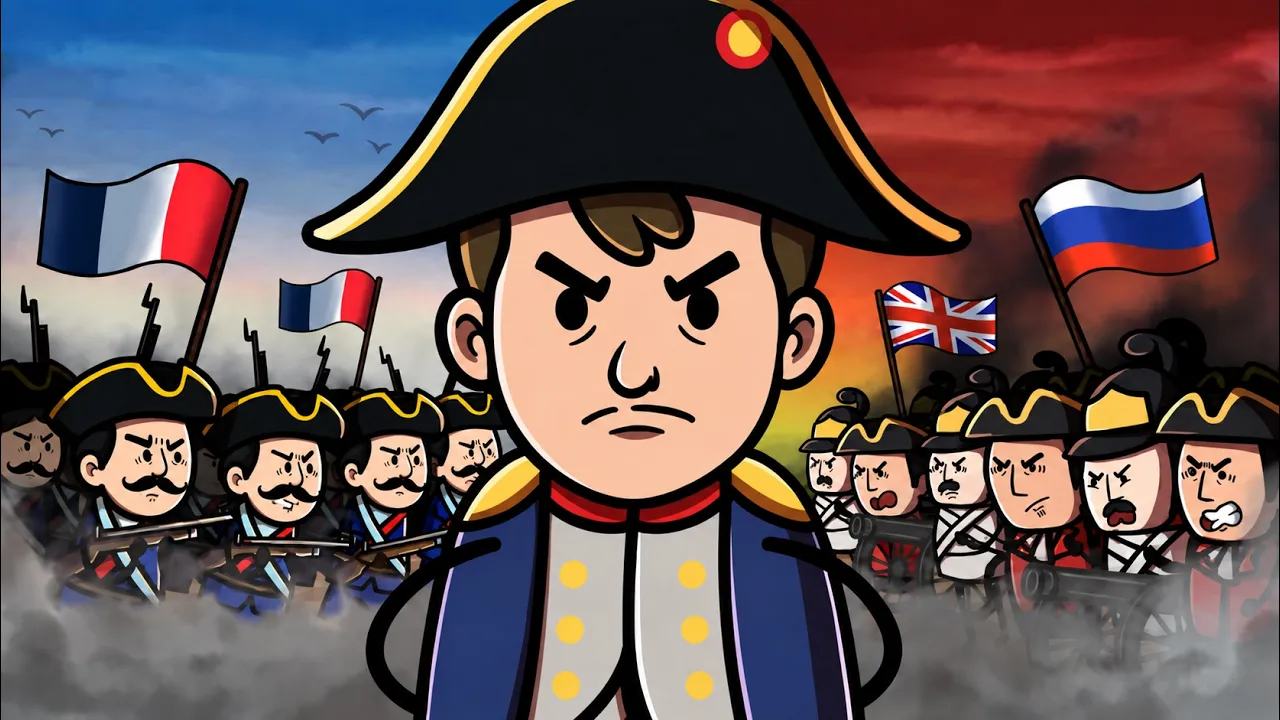
From a man who single-handedly took over most of Europe to shooting a frozen lake to drown the enemy to walking in front of a firing squad and telling them to shoot you in the chest. This is the Napoleonic Wars explained. And it all comes from one kid on an island with a funny accent who decided he was going to be the next Julius Caesar. But first, we got to go back to 1793 cuz that's
78 words, the words spoken in the first 30 seconds at 156 words per minute.
Free, no signup. See how the first 30 seconds hold attention, with rewrites.
Sentence shape
| Measure | This transcript |
|---|---|
| Sentences | 332 |
| Average words per sentence | 13.5 |
| Longest sentence | 38 words |
| Questions asked | 8 |
| Sentences containing a number | 87 |
Most used terms
Filler phrases
6 in total: actually 3 · like 2 · right? 1.
A literal whole-word count of the same phrase list the Prepublish browser extension uses, so a phrase inside another word is not counted and a phrase used in its ordinary sense still is. It is a count and not a judgement.
What this transcript is
Every word below is the caption track YouTube publishes for this video, pulled from the video itself and reproduced unchanged. It is not Prepublish's writing, not a summary, and not a re-transcription: it is the video's own published captions. English captions, generated automatically by YouTube, in the video’s original language. Source: the video on YouTube. A channel that would rather this page did not exist can ask for its removal through the contact page, and it is removed.
No Script X-ray for this video: YouTube shows a Most replayed graph only once a video has enough views.
From a man who single-handedly took over most of Europe to shooting a frozen lake to drown the enemy to walking in front of a firing squad and telling them to shoot you in the chest. This is the Napoleonic Wars explained. And it all comes from one kid on an island with a funny accent who decided he was going to be the next Julius Caesar. But first, we got to go back to 1793 cuz that's the year France put its own king on trial. found him guilty and cut off his head.
And every other king in Europe watched that and had the exact same thought. What if I'm next? So Austria, Prussia, Britain, and Spain came for France. But France didn't back down cuz they weren't fighting for a king anymore. They were fighting for themselves. And it turns out that works really well. And somewhere in that mess was a 24year-old artillery officer from Corsica. His name was Napoleon Bonabart and he wasn't really French.
Not to the French anyway, cuz he grew up on Corsica, an island France bought from Italy the year before he was born. And he had an accent his classmates made fun of him for. When France went to war, his family was too broke to buy him a spot in the cavalry, so they stuck him in the artillery. And while the rich kids were out riding horses, Napoleon was in his room reading the same books over and over. Plutarch's parallel lives, 2,000-year-old biographies of the greatest men of Greece and Rome.
And the one he couldn't put down was Julius Caesar, a guy from a fancy old family with no money who took command of an army and then an empire. So, a poor kid with a funny accent, decided that's who he was going to be. And people noticed cuz the leader of Corsica, Pasqual Pioli, once told him, "There's nothing modern in you. you're entirely out of Plutarch. And Napoleon bragged about that line for the rest of his life.
Oh, sir, you do know how Caesar's story ends, right? So, keep that in mind cuz Napoleon was never chasing land. He was chasing a name in the history books. But first, he had to learn how to actually win a battle. And artillery is where he figured out strategy. Because in December of 1793, France's biggest naval port on the Mediterranean, a city called Tulon, had been taken by the British, and every French commander wanted to storm the walls headon.
But Napoleon looked at the map and noticed a hill everyone else ignored. Cuz whoever held that hill could shell the harbor, and if the harbor wasn't safe, the fleet had to leave. And a city that can't be supplied will eventually starve to death. So he took the hill and Tulon fell almost immediately. All right. So looks like we're going to take the ocean first, right, sir? Oh, the hill. Yeah. No, I saw it. By 1796, Napoleon had command of the French army in Italy, which was the worst army France had.
Oh, and two days before he left for it, he married a widow named Josephine. 6 years older, way better connected, and the one person he'd be thinking about on the day he died. Remember her? Anyways, these guys were unpaid, unfed, and losing badly. But he transformed the army, beat Austria, and took back northern Italy. But then he got a little greedy cuz in 1798, he sailed to Egypt with 35,000 men to cut off Britain's road to India.
And it started off pretty great. But then he ran into a British admiral named Horatio Nelson, missing an arm, blind in one eye, and the most aggressive man who ever commanded a British fleet. You see, Nelson found the French fleet anchored in Abuir Bay and destroyed it in one night. 11 of 13 ships were gone. So Napoleon had an entire army stranded on the wrong continent with no way home. So what did he do? He got on a boat, left them there, and sailed home alone.
Sir, where are you going? But news traveled slow. So by the time he walked into Paris, nobody knew he just abandoned an entire army in Egypt. All they knew was that the hero who won Italy was home. So on November 9th, 1799, Napoleon walked into the French legislature with soldiers and walked back out running the entire country. And 5 years later on December 2nd, 1804, he stood inside Notradam in front of the Pope, took the crown out of the Pope's hands and put it on his own head.
And look at what he walked into that cathedral wearing. Not a king's crown, but a wreath of golden laurel leaves. The exact thing his hero Caesar wore. 10 years before, he'd been an outof work officer with no command and no money. Now he was 35 years old and the emperor of France. But he had one problem and it's the one he'd spend his life failing to solve. Cuz every enemy Napoleon had could be reached by road. Every single one except Britain.
And between him and Britain sat 21 mi of water in the best navy that has ever existed. So he decided to cross it. By 1803, roughly 150,000 men were camped on the cliffs at Bologn with 2,000 flat bottom boats built for one job, getting an army onto the English beach. Napoleon said it himself, "Let us be masters of the channel for 6 hours, and we are masters of the world." But to get 6 hours, he had to move the Royal Navy out of the way.
So he sent Admiral Pierre Charles Vil Nev running for the West Indies to get the British to chase after him, then double back and hold the channel. And at first it worked. But then Vil Nev lost his nerve, ran south to Katis and sat there. So Napoleon, furious, ordered him back out to sea. And on October 21st, 1805, off a Cape in southern Spain called Trafalar, Vilv came out with 33 ships and found 27 British ships waiting for him.
And in command of those 27 was Nelson. The same onearmed admiral who wrecked his fleet in Egypt. You see, back then, two fleets lined up side by side and hammered each other for hours. It was slow, and it almost never actually sank anything. But Nelson had zero interest in that. He sent out a signal to every sailor in the fleet. England expects that every man will do his duty. Translation: We fight or we die. So he split his fleet into two columns and drove them front first straight at the middle of the enemy line.
Which meant for close to an hour his lead ship sailed right into the enemy's guns with no way to shoot back. Then the columns hit and the enemy line came apart into pieces. Nelson's flagship victory locked holes with the French ship redoubtable. Close enough that the two crews were throwing grenades into each other's rigging. And that's when a French marksman up in the rigging spotted Nelson on the deck and fired. The ball went through Nelson's shoulder and into his spine.
So they carried him below. And for 3 hours, while the battle finished above his head, his officers kept coming down to give him the count. 12 enemy ships taken, then 14, then more. He died around half past 4. And when the smoke cleared, the Royal Navy had captured or destroyed 18 enemy ships and lost zero. Then they put Nelson's body in a cask of spirits to preserve it for the trip home. Gone too soon, sir. Thirsty anybody?
And that was the end of it. The French invasion of Britain wasn't delayed. It was over. But Napoleon didn't find out in time to care cuz weeks before Trafalgar, he had broken camp at Bologn, turned all 150,000 men around, and marched them east cuz Austria and Russia had just declared war on him. So now it was time for Napoleon to put his battle genius to the test. And what he did next is still taught in every military school on the planet.
On December 2nd, 1805, exactly one year to the day since he crowned himself, Napoleon met the combined armies of Russia and Austria near a Moravian village called Osteritz. He had around 68,000 men. They had close to 85,000 and the French held the high ground, a long ridge called the Pratzen Heights. But he pulled his own men off those heights and let the enemy stroll up and take it for free. Then he stretched his right flank thin and weak on purpose.
And to sell it, he sent an envoy asking about peace terms so the two emperors watching would think he was scared. and Zar Alexander I, 28 years old and desperate to be the man who finally beat Napoleon, totally bought it. So at dawn, the Allies came pouring down off the heights to crush the weak flank in fog so thick they could barely see. But Napoleon had already sent for Marshall Louis Nicholas Dvau, whose core covered 70 mi in 2 days to get there.
They walked off the road straight into the fighting and held the flank barely. As the sun burned through the fog, Napoleon saw the Pratzen Heights standing wide open, marched his army on top of it, and chopped the Allied army in half. But the coldest move of the whole day came at the very end. Cuz once the French punched through at Slnits, the entire Allied left wing was cut off with the French army between them and every friend they had.
So the only way out was south over a chain of frozen ponds. And Napoleon saw it coming. So he hauled his guns onto a nearby hill, looked down at thousands of men picking their way across the ice, and told his gunners to fire at the ground. The frozen ponds collapsed underneath an entire wing of the Allied army. Dozens of Russian cannons went straight to the bottom. By the end of the day, French losses came to around 8,500.
Russian and Austrian losses landed between 27,000 and 36,000 counting prisoners. But the numbers weren't the real damage cuz Austria quit leaving the Russians to fight on their own. So then Prussia who sat out oustitess decided it was their turn. But on October 14th, 1806, Napoleon wrecked half the Prussian army at Yaina, while Dvau, badly outnumbered, wrecked the other half at ourstat the same day. The best army in Europe was finished in 6 hours.
And on June 14th, 1807, Napoleon beat the Russians at Freedelland and Sar Alexander asked for peace. From Spain to Poland, the continent now belonged to Napoleon. But Britain was still out there, still untouchable, still writing checks to everybody who fought the French. So Napoleon came up with a new plan. If he couldn't invade Britain, he'd bankrupt it. On November 21st, 1806, he issued the Berlin Decree, creating what became known as the Continental System. every port in Europe slams shut to British goods.
But there was a catch cuz to close every port in Europe, you have to control every country in Europe. And two of them were about to fight back. The first one was Spain, which is hilarious cuz Spain was Napoleon's ally. But Portugal wouldn't shut its ports. So in 1807, Napoleon marched an army through Spain and took Lisbon. Then in 1808, he shoveed the Spanish king off the throne and put his brother Joseph Bonapart on it.
And he honestly expected the Spanish people to just be fine with that. So on May 2nd, 1808, Madrid rioted. Regular people with kitchen knives and paving stones against the French cavalry. It was a massacre. The number of Madrid citizens killed is unknown. And the next morning, the French marched the men they'd rounded up to a hill outside the city and shot them in batches through the night. But Spain didn't break. It did the exact opposite.
Cuz on July 19th, 1808 at Bilen, a Spanish army surrounded a French core in open country and forced 18,000 men to surrender. A French army under Napoleon had never surrendered in the field ever. News of the defeat spread all over Europe. So then the rest of Spain did something Napoleon had no answer for. Small groups of local men hitting couriers, supply wagons, and stragglers, then vanishing into the hills before anybody could catch them.
The Spanish called it Gera, the little war, and as a result, messages stopped arriving and wounded men stopped being found. A French soldier in Spain was never safe anywhere for six straight years. And then Britain landed an army in Portugal under a man Napoleon's marshals would spend the next 6 years underestimating. Arthur Welsley, later the Duke of Wellington, had made his name waging war in India. He was cold, blunt, and obsessed with victory.
But the men he brought were not gentlemen. They came out of the poorest corners of Britain and Ireland and Plenty signed up to get away from a jail cell or worse. And Wellington knew exactly what he had. I don't know what effect these men will have upon the enemy, but by God they terrify me. Me too, sir. But in 1810, Wellington pulled off the most patient thing anybody did in this entire war. Because over one winter he had thousands of Portuguese laborers secretly build the lines of Torres Vadras.
They cut away hillsides, blocked roads and damn streams and created a 30-m long wall across the front of Lisbon. Then he pulled his army in behind it and stripped every field out front bare. So when Marshall Andre Masenna's army came up that road, they found a wall nobody in France knew existed and nothing to eat for a 100 miles. They starved in front of it for months. Then they turned around and walked home. Over 350,000 French troops ended up down there and roughly 200,000 of them did nothing but guard roads.
Napoleon even had a name for it. He called Spain the ulcer. But while that ulcer was quietly bleeding him out, he looked east and made the worst decision anybody has ever made with an army. Cuz by now, Napoleon's ego was out of control. In 1810, he divorced Josephine cuz she couldn't give him a son and married an 18-year-old Austrian princess instead. And when the boy finally arrived in March 1811, Napoleon gave a newborn baby a title, the king of Rome.
Sir, the Caesar thing is getting a little on the nose. He had a dynasty, a continent, and just one problem left. Sar Alexander had quit the continental system, and Russian ports were wide open to British goods again. So on June 24th, 1812, Napoleon crossed the Neman with more than 450,000 men drawn from around 20 nations, the largest force Europe had ever put in one place. And the plan was simple. Find the Russian army, destroy it in one battle, make Alexander sign.
But the Russians wouldn't fight. They just walked east. And as they went, they burned their own grain, their own barns, and their own villages. Anything a French soldier could eat or sleep in, gone. So the Grand Army marched into a country emptied on purpose. And in the summer heat with dirty water and no shelter, typhus and dysentery tore through the ranks. Tens of thousands were gone before either side fired a shot.
The Russians were commanded by grizzled veteran Mikail Cutazovv, 66 years old, a man who had taken a musk ball clean through his head twice and lived. And the only Russian general willing to trade cities for time. And even he knew he had to make a stand somewhere. So he picked a stretch of farmland near a village called Borodino about 70 mi from Moscow and dug in. Arrow-shaped earthworks on his left called the Bgratian flesh and an openbacked ford in the center holding 19 heavy guns, the Ryvki Redout.
And on September 7th, 1812, roughly 250,000 men fought in a space just a few miles wide. This time, Napoleon, who was sick with fever, didn't have a clever move. He stayed back and sent men straight into the earthworks. The flesh changed hands over and over. The redout was taken, lost, then taken again. By afternoon, the Russian line was bent almost to snapping, and Napoleon's marshals begged him to send in the Imperial Guard, the best infantry on Earth, untouched in reserve.
But Napoleon said no. nearly 2,000 mi from home. He wasn't spending his last reserve. So, the Russian line held. And when it was over, the two armies had lost around 72,000 men in one day. That would be the bloodiest day of any war on Earth until 1914. 72,000. In one day. And it didn't even decide anything. Then on September 14th, 1812, Napoleon rode up to Moscow and waited outside the gates for the city officials to hand him the keys.
And nobody came cuz Moscow was empty. Out of roughly 270,000 people, nearly all had already gone. He had taken the second city of the Russian Empire, and there was nobody in it to surrender. Then that night, the fire started. The governor Theodore Rusttopin had lit the city on fire. So over 4 days about 3/4 of Moscow burned and Napoleon rode out of the Kremlin through streets in flames. So he sat in the wreckage for 5 weeks riding to Alexander waiting for a peace offer and thesar never even answered him.
On October 19th, 1812, the army left Moscow, and Curazzovv made sure they went home the same way they'd come. Back down the road, they had already stripped bare. Then the temperature dropped. Men froze. Horses dropped and were eaten where they fell. Cussix rode the edges of the column day and night, picking off anybody who lagged behind. And between November 26th and 29th, 1812, what was left of that army reached the Barazina River and found it unfrozen and the bridges gone.
So French engineers went in chest deep in the ice, building two bridges by hand out of whatever they could tear down. Most were dead within weeks, but it worked. Tens of thousands got across. Then on December 5th, 1812, Napoleon handed over command, climbed into a sleigh, and rode for Paris. And the last organized force out of Russia was the rear guard under Marshall Michelle Nay, an inkeeper's son, the army called the bravest of the brave.
His men swore Nay was the last Frenchman offrussian soil, walking out with a musket like a private. And out of the more than 450,000 who crossed that river in June, roughly 380,000 never came back. But here's the insane part. Napoleon wasn't done. Cuz by the spring of 1813, the emperor had raised another army out of teenagers called up years early. The veterans nicknamed them the Marie Louisus after the young empress, and he won battles with them.
But he couldn't replace the 100,000 horses he lost in Russia. So he didn't have cavalry to chase a beaten army, meaning he couldn't deliver the killing blow. And on the flip side, everybody he had ever beaten was lining up at once. Russia, Prussia, Austria, Sweden, and Britain together for the first time. So from October 16th to 19th, 1813, they met at Leif and what people now call the Battle of the Nations. more than half a million men on one field in the biggest battle in Europe until the First World War.
After 3 days, Napoleon had to pull his army back out through the city over one bridge. But a corporal guarding that bridge panicked and blew it early while it was still packed with French troops. So around 30,000 men were stranded on the wrong bank and captured. Men even drowned trying to swim it. After that, it was just a matter of time. On March 31st, 1814, the Allies rode into Paris. And on April 6th, 1814, Napoleon formally stepped down from power.
But they didn't kill him. They gave him Elba, a small island off Italy, and let him keep the title of emperor. Emperor of 12,000 people. Hey, it's something, sir. And for 10 months, he actually ran it. He reorganized the roads, the mines, and the schools until one day he picked up a French newspaper and found out Josephine was dead. Nobody had even bothered to tell him. The man who had stared down two emperors at Ostitz walked into his room, shut the door, and didn't come out for 2 days.
Man, I'm so sorry, sir. But after some time to think, Napoleon kicked open the door and walked out with a vengeance. On February 26th, 1815, Napoleon loaded roughly a thousand men onto a few boats and sailed back to France. And the king sent the fifth regiment to stop him. On a road near Lafrey, a line of French soldiers with loaded musketss faced the man they used to call emperor. So Napoleon walked out in front of them alone and opened his coat.
If there's any man among you who would kill his emperor, here I am. The entire regiment refused to kill him. He was in Paris on March 20th, 1815 without having to fire a shot. The king ran for it and Europe declared war on one man by name. Which brings us to a muddy field in Belgium. On June 18th, 1815, Napoleon had about 73,000 men facing Wellington's roughly 68,000. and Marshall Ghard von Blucer's Prussians, another 50,000 were marching hard to join him from the east.
So Napoleon had to break Wellington before Blucer arrived. But it had poured all night and the ground was soup. Cannonballs buried themselves in mud instead of skipping through infantry. So he waited until noon for it to dry out. But those few hours cost him everything. The battle opened at a walled farm called Hugamont, which was only meant to be a distraction. Instead, it swallowed up 33 French battalions in a day.
French troops smashed through the north gate, and a handful of Cold Stream guards shoved it shut with enemy soldiers already inside. Wellington said the whole battle turned on closing that gate. In the center, the farmhouse of Leia Sun was held by the king's German legion until they ran out of cartridges. And when it fell, a hole opened in Wellington's line. And that's when Nay, the bravest of the brave, saw British troops shifting behind the ridge and decided they were running.
But they weren't. Nay threw roughly 9,000 cavalry at the British center with no infantry behind them. So the red coats packed into tight squares, bayonets out on every side, stopping the horses in their tracks. Meanwhile, the Prussians slammed into the French right at Plans and would not stop coming. So around 7 in the evening, Napoleon played his last card and sent in the Imperial Guard. In 20 years of war, they had never been broken.
But British and Dutch troops lying flat in the wheat stood up at close range and fired into them. And the guard stopped then stepped backwards and a shout went down the French line that nobody in that army had ever heard. Lag guard rau. The guard is falling back. The army came apart in minutes. When it was done, Wellington had around 17,000 casualties. Blucer about 7,000 and the French north of 25,000 with tens of thousands more scattered or captured.
And Wellington, who never handed out compliments, called it the nearest run thing you ever saw in your life. Translation: That was close. But this time, nobody was giving Napoleon a comfortable little island off the coast of Italy. So they put him on St. Helena, a volcanic rock in the South Atlantic, more than a thousand miles from the nearest mainland, a damp house with rats in the walls, a garrison of soldiers, and a governor who refused to call him emperor.
But was Napoleon sorry? Not even a little. He blamed the British, his marshals, and even wrote in his will that the English had murdered him. So Napoleon spent 6 years dictating his life story to anyone who'd hold a pen. And one of the very last things he worked on was a book about Julius Caesar. Every campaign, every battle, right down to the assassination with notes on what Caesar should have done. A dying man on a rock at the end of the world. grading his hero's homework.
Talk about a full circle moment. Then, too weak to stand, he wrote his will by hand. And the first thing he asked for wasn't a statue. It was to be buried on the banks of the sane with the French people he loved. And on May 5th, 1821, at 51 years old, he died. His last words, according to the people in the room, were France, the army, head of the army, and then one more. Josephine Nay didn't even get that long. He was tried for treason and shot by a firing squad.
Then came the bill. Across roughly 20 years of fighting, close to 2 million soldiers were killed. And once you count the civilians who died in the sieges, the famines, and the disease that followed the armies, the real number runs into the millions on top of that. Man, that's a whole generation of Europe gone. But here's the thing, he lost and the world kept his ideas anyway cuz the Napoleonic Code is still the backbone of the law in dozens of countries.
And he made careers open to talent instead of birth. Europe was so wrecked that the power sat down at the Congress of Vienna and built a peace so careful and so paranoid that the continent went 99 years without another general war. One man cost them a generation. And the peace they built out of the wreckage outlived every man who signed it. But while the British were defeating Napoleon in Europe, they were also waging war on the United States at the same time.
From watching the White House burn to the ground to a naval commander who refused to surrender to a battle so legendary it was fought after the war was already over. This is the War of 1812 explained and it starts with the exact mess you just watched. So click right here and let's go see what the emperor's temper tantrum cost us. Flappy out.
The words are the caption track's own and nothing is reworded or re-transcribed. Paragraph breaks are placed between sentences so the text reads as prose.
Free tools for your own script. No signup, no login.
Paste your draft and see where viewers are likely to drop off, with a rewrite for each weak line.
Paste the first 30 seconds of your own draft for a hook score and rewrites.
Check your draft against YouTube's advertiser-friendly guidelines before you record it.
Read this channel's public videos and transcripts, and download a writing brief for it.