Getting the transcript
Reading the captions from YouTube. A video nobody has opened here before takes 10 to 30 seconds; this page fills in on its own.
Getting the transcript
Reading the captions from YouTube. A video nobody has opened here before takes 10 to 30 seconds; this page fills in on its own.
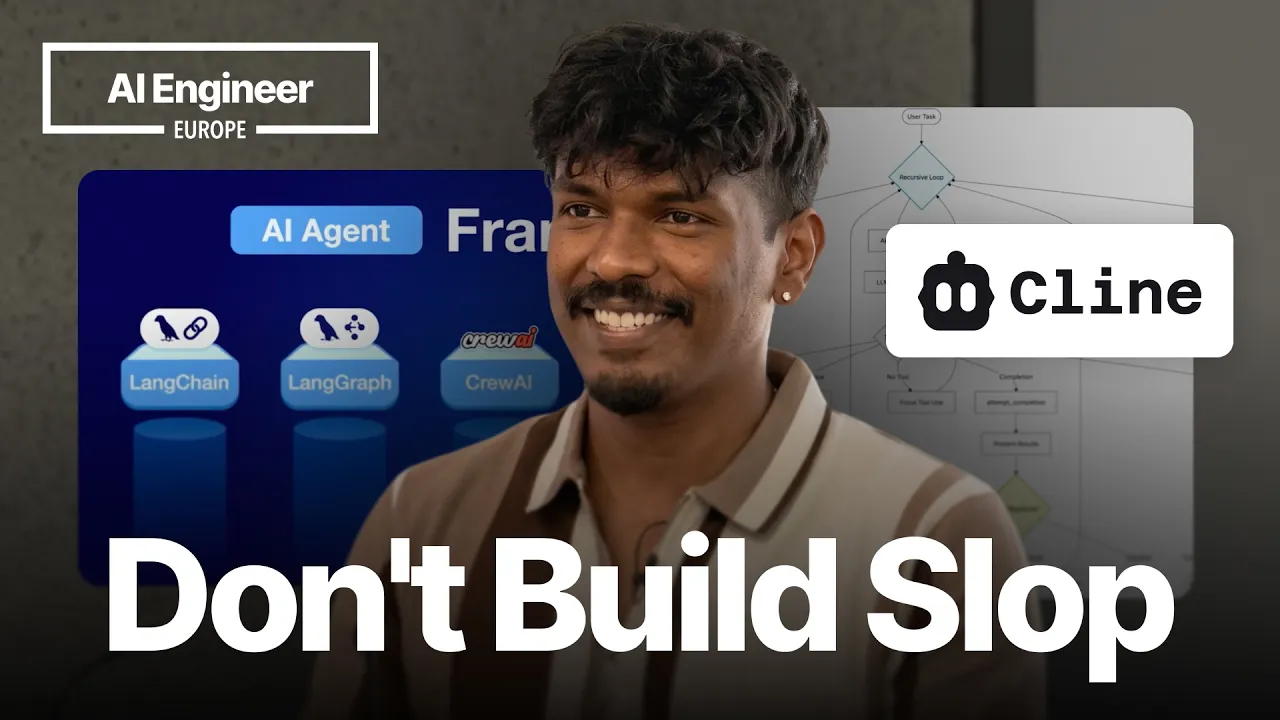
AI Engineer · @aiDotEngineer
This video has no Most replayed graph yet: YouTube shows one only once a video has enough views. These are the moments viewers replayed most in AI Engineer's most watched videos.
Most replayed moment at 18:45
4.8x that video's typical replay level
that they're they're changing they're changing things in the database not yet. You want to run them through the ontology first and make sure that works. Okay. I only got an I've got I've got another I've just a short time. I'm going to try to show you some of the things that um that you can
Said at 18:37
Most replayed moment at 16:13
3.6x that video's typical replay level
method signatures, the program layout and the call stacks. So here's some examples. I don't think you'll be able to read this one, but this is like the level of abstraction we're at. It's how we're actually going to lay this stuff out and how these systems are going to interact. Dylan Mulroy from Cloudflare talks a
Said at 16:06
Most replayed moment at 13:49
2.3x that video's typical replay level
Fable uh and it runs into an unknown, ask it to log it, right? So that um you uh you can see where the deviations happened and then you can sort of figure out why as well, you know? It will usually give you some context about what happened.
Said at 13:43
The graph counts replays. It does not show where viewers stopped watching.
Words
4,044
Runtime
18:51
Speaking pace
215wpm
Reading time
17min
215 words per minute, above the 201 75th percentile of 349 measured videos. That distribution comes from the 349-video hook study.
Opening (first 30 seconds)
All right. Hi there. Um very nice to see you guys. Um it's it's like it's so interesting to see like it's been such a long day and you guys still showed up and uh I'm always very flattered when like I'm trying to present something and like people are there. It just uh I I if it makes you feel like you what what you do matters. So, today the topic that I want to talk about is like don't build slop, four levels of AI agent maturity. And what I'm trying to do here is that I want to I want to talk about something that
108 words, the words spoken in the first 30 seconds at 215 words per minute.
Free, no signup. See how the first 30 seconds hold attention, with rewrites.
Sentence shape
| Measure | This transcript |
|---|---|
| Sentences | 189 |
| Average words per sentence | 21.4 |
| Longest sentence | 70 words |
| Questions asked | 13 |
| Sentences containing a number | 12 |
Most used terms
Filler phrases
332 in total: like 218 · um 38 · uh 33 · actually 11 · basically 11 · kind of 7 · you know 6 · right? 4 · literally 2 · sort of 2.
A literal whole-word count of the same phrase list the Prepublish browser extension uses, so a phrase inside another word is not counted and a phrase used in its ordinary sense still is. It is a count and not a judgement.
What this transcript is
Every word below is the caption track YouTube publishes for this video, pulled from the video itself and reproduced unchanged. It is not Prepublish's writing, not a summary, and not a re-transcription: it is the video's own published captions. English captions, generated automatically by YouTube, in the video’s original language. Source: the video on YouTube. A channel that would rather this page did not exist can ask for its removal through the contact page, and it is removed.
All right. Hi there. Um very nice to see you guys. Um it's it's like it's so interesting to see like it's been such a long day and you guys still showed up and uh I'm always very flattered when like I'm trying to present something and like people are there. It just uh I I if it makes you feel like you what what you do matters. So, today the topic that I want to talk about is like don't build slop, four levels of AI agent maturity.
And what I'm trying to do here is that I want to I want to talk about something that like a lot of people brought this up to me and there's like a mass psychosis problem. So, basically it's something like it's like every person feels like um there's like these like giant set of robots around all of you that are just like kind of like breezing through doing a lot of things and and you're like in the middle and you're so confused.
You're so confused of like what is it what what should I do? Should I have like 15 agents like ripping through all the time and I'm just like live in or or should I just be like a peasant and just like read through every line of code? And it's it's very hard to like make up your mind. I feel like you come to a place like this and you're always like the formal just like gets to you. You get like a panic attack or something.
But like I think I think I want to I kind of want to pull back out of this and I'm going to be like, "Guys, let's slow down. Let's just slow down. And let's think through like what are the problems that we can like actually solve and I will like actually help you build like really useful agents. And I want to take care of like every end of the spectrum of like your necessity to build things really fast, but at the same time like your necessity to at a certain point build things slow and take things to production.
So, that that's basically um the goal. To give you an example of like mass psychosis, like there's a lot of things that are very similar. So, I'll give you give you an example of like three UIs. And these are three Frontier Labs and I guarantee you not one of you can predict which one is which. Uh one of them is factory, one of them is Codex, and one of them is Cursor. I I'm positive none of you know which one is which.
Even I don't know which one is which. But yeah, so that's basically the point. Like everything is same. You you want to do your own thing. So, to build agents in particular, uh here's what here's here's what I would have would have present here. That I want to break down this problem of building agents into like four different parts. The first part is just like kind of somehow figured a way to like see if this even makes sense, like this even works.
That's like where you use a framework. Second part is like when you actually are serious, like, "Okay, I actually want to do something here." Now you build things by yourself, like as like a state machine, like building an actual agent. The third part is like the UX workflow, where you use Kanban, which I suggest is like a great uh form factor to be able to work with agents. And the fourth part would be like shipping to cloud.
So, this is like mostly out outline read of like how we want to be able to uh work with agents. But I think it will give you a good heuristics of like how you how you would uh solve this problem. So, level one of building agents is like literally just like just you just use a framework. And I I think there's like a couple different frameworks uh like LangChain, LangGraph. Like I I wouldn't I don't use them. I I I work at like client.
I I I'm supposed to like write all the agentic experience stuff by myself. So, why would I use a framework? So, I won't be the best person to give you advice, but I do think that if you're trying to find PMF, if you have a problem that's like, "Hey, I have this problem where I want to be able to I don't know aggregate emails or do something like rudimentary, and I think that like an AI agent would probably be helpful here.
I probably don't care about the best model. I just I just want something that works." Any of the agent frameworks can give you something that just works in like half an hour. You can just write code this. It It It's It's a great thing to get started. It's a great thing to see that agents actually do work and that you can build them yourself. There are a lot of pitfalls with uh using frameworks. And one of the biggest ones that I think is that like if you really want to take things to production, if you really want to build something serious, very quickly you would learn that like the level of customizability, the level of like futuristicness, the level of um modularity that you need, you just you won't find them in a framework.
I know a lot of people who disagree with me and a lot of those people are wrong. Anyway, um so level two is like building building your agents yourself, right? So here's how you here's how you build you like I feel like I feel like this is like a very intricate problem like I can't sum this down. So I'll I'll just like give you like five rules of like when you actually write code to build your agents, like there there are five rules that you could use.
Um and these rules will like give you a rough outline of like how to how to build and write write code for your own agent. So the first one is like you always want to think of every agent as like a state machine. Um state machine is like a sophomore year freshman year topic, but like state machine is basically like every agent is at the end of the day is like a recursive loop. It's that's basically like every every every hype cycle, whatever you think, it's at the end of the it's all the recursive while loop.
It's a while loop with a few conditions. And no matter what your agent is doing, it it always it doesn't matter it's cursor clock or whatever, it is a while loop with a few conditions and a few end states. And what you want to be able to do is that at any point of time, you want to be able to have like a mental model of which point in the state it is. So let's say you want to be able to like say um okay, so let's say you want to be able to uh I guess read a few files and explain them uh through clock code.
So it starts from the user task at the top where you ask it like read a few files. It goes to the state of like reading a few files and like the action tool where it reads the file, then it realizes oh, I have read the file, it makes sense. And then it'll call the completion tool and just like complete and the the right right thing at the bottom task complete is when the state machine finishes. Uh you can take this in a very complex way where you can like rip through the whole state machine for like 8 to 10 minutes or even like hours if you wanted to.
Uh but essentially every agent is a state machine. If you can visualize that as a mental model, then every time you're building an agent it would be so much easier for you to think through that. Um the second rule is that every single thing you add to an agent risks making it worse. I think this is the hardest thing that we've learned and this has been a very bitter lesson that a lot of agent builders have learned, which is that large system prompts, lots of different edge cases, lots of different like fancy if else logic, all of that for frontier models just just makes them worse.
Just like just just get out of the way of the model is the is the lesson that we learned, which is that like frontier models are so good at their job that the less instructions you give them, they actually perform better. A classic example is if you go through the Codex repo, the prompt for GPT-5 versus the prompt for GPT-5.3 is 1/3 of the size. Uh part of the reason for that is that the newer models are so good at their job that giving them too many instructions and longer system prompts leads to a sensory overload where they get so many instructions that they get overwhelmed and can't figure out the right thing to do.
Um so I think the simpler it is, it's always better and it's like you have to think that like every single thing I'm adding, I I'll be very careful that I'm I I hope to God I'm not making it worse and just always try to prune it down. We we took it so far where we literally rewrote the entirety of client because we realized there was so much uh junk from the older older versions of client. Client code has been written I think at at least seven times from scratch, I think.
Um but again, um the the the people on the team might know better. Um the third rule is that you want to be able to make agent an easy part of a pseudo RL pipeline. And this is a tricky one, but basically what this means is that anytime you're building an agent, you want to be able to have some sort of like a CLI kind of a thing. The reason for that is that as long as you have something that can build and test the agent really well in the form of a CLI, um you want to be able to build things that are very easy to build and test with other coding agents.
So, right now there's this thing there's this like interactive dance that's happening between AI and humans where and in the back in the day humans used to like guide AI like do this and I think at this point we're at the point where humans are being guided by AI. And this is I think is a part of that where like if you're as a human you want to be able to build things in such a way that like the AI can work very easily through it.
So, that might entail writing a writing you know agents.md where you're using the right skills. And building like a CI CI or CD such that like the agent other coding agents can easily build your agent, test it, make changes to it and then test it end to end is a very critical part because that way if you want to make changes you can just let let a long running agent run through in a parallel thread. It'll make all those changes, test it, and you have the whole thing running.
But, if it's harder to build and test it would also be harder for you to like use agents to work on your agent. Super meta. Um Rule number four, don't be a slob. Guys, don't please for the love of God don't don't don't build slob, please. I thinks that I think that there's there's like there's so much like throughput that you can get and so much tokens that can go through really really fast. I think that the best lessons that we've learned as like real engineers is that like it's really worth spending some time just like thinking through the architecture, thinking through the design, and the outline of what your agent supposed to do, making sure that it actually makes sense, and and just like actually at least spend some time reading the code even if you don't write everything by hand.
I think that that is like for us we found that that to be super critical because I think that it it's at least the architecture point of building an agent has to be done by a human and has to be done like very thoughtfully. Even if you're using like an agent to have a conversation with it, spend a lot of time like try to think through like what the architecture, what the state machine is going to be. Don't don't just let like uh other models like rip through the code.
Um and then the rule 50 is Frontier Labs kind of want to lock you down. And this is a tricky one. A lot of people will disagree, but basically what's happening is that a lot of times when you are working with the APIs of Frontier Labs, the APIs are trying to lock you down, and they make the interchangeability harder. So, to give a very precise example, the new set of models that have come out, say Opus 4.6, uh Gemini 1.5 1 Pro, 5.3 They have this thing called reasoning traces, and reasoning traces are um a part of the cache, and they're also the part of the reasoning uh uh test time compute loop that the model does.
And when you have conversations and back-and-forth conversations with those models, you want to send the reasoning traces in the exact precise format that is expected. If you don't, the response would still work, except that the performance would be degraded, and you would have no way of knowing. And a lot of people are kind of missing on the massive performance gains that are coming from the new models, because they're just like not using the APIs in the exact precise way that they're supposed to be used.
Um and there are asymmetries in the API. So, some would argue that, "Hey, maybe you could use Open Router." But I don't think that's enough. I think you really want to be careful that like if you're using different Frontier Labs and different uh Frontier Lab APIs, like they they have you very carefully thought through uh if the API is working correctly, and you actually tested it. Um so, the form factor is like the next step is like the form factor of like how do you like how do you visualize the agents, right?
So, I think originally I came back to like in the one of the previous slides, I tried to show you guys like the thing where like Codex and uh Cursor and others, they were all looking the same. And I think I have a different claim. So, for this uh uh on March 26th, I made a tweet uh where I said we people should use Kanban. So, Kanban boards, I think if anyone has used Linear, whatever, I'm I'm all of you are familiar with Kanban boards.
So, my argument is that Kanban boards are the thing to use. Hans in in the audience was gracious enough to offer me his thoughts as well. So, thank you so much. So, Kanban boards are are are this idea that like if you're working through an agent, you're always inference bound. A lot of you are working through like Kodak's or Alpha's and it's working for 8 to 10 minutes at a time. Well, one of the agent is working for 8 to 10 minutes.
What do you do? You could doomscroll, but you can only doomscroll scroll long. So, then you run another agent, right? So, that way you have at least like two or three agents running in parallel at all times because you're inference bound. And they're all like mutating the same source potentially. So, you want to isolate the thing that they're mutating to take care of that like the isolation of state and then the inference bounding, the best UX form factor to me is Kanban board mainly because it takes care of it gives you like it makes you like an engineering manager which can look at all your agents.
And you gives you like a headline level view of what they are and it also helps you build like flows with them that like okay, if these two tasks finish first, then I'll do the other task. And that helps you like become like you you basically become like an engineering manager and all your agents are your ICs and and you can look at them through this. So, I was making this claim on March 26th and 10 hours ago Clock Code came out with the same thing.
So, I believe I was right. Um Um okay. So, Yeah, you can use that through Clock Code client wherever you can use client as well, whatever whatever works for you. Um So, yeah, so you want to think of like Kanban is basically like an engineering manager which you would be. Then there's like a final step of like okay, you have you have like an agent, you've tested it, you've made it, and you you have a good UX form factor to be able to like interface with it and look at it.
What do you what do you do then? Like how do you how do you how do you how do you have an agent that's just like useful, it works well, but it it scales. It really scales for like millions of tasks, millions of users. If you're working for a company which has So, 8,000 people, how do you like how do you make sure that like all of them can like very easily interface with this? And I think that rather than rather than like making people install and like, you know, having these complex workflows in the machines and stuff is just is just so much junk and it's so hard just like take it all take it all out.
Put put the hard work once. Just take it all on the cloud. Um So, there are many benefits of cloud agents, but the primary one is that like you can completely paralyze and have like a separate machine for each of them. There are like no local dependencies like in the cloud like the agent can set up the environment, do all the UX tasks, because right now one of the most missing pieces, the thing that a lot of people are not using, that I use fairly extensively, is cloud agents, because they can really run really long.
So, I I on my phone often would send tasks that would run on a cloud agent for like 15 to 20 minutes. So, let's say it's like a UX change of like um go build this VS Code extension. And this VS Code extension I want you sign in here. I want you click on settings. I want to change the settings to um uh pick this team. And then I want you to test this thing in the terminal. And the cloud agents are so good that they will actually manually do all the clicks of the Q&A testing that I just described on their own.
Figure out if they work. And if they didn't work, it will just keep iterating, keep trying. And this thing could easily take like 50 to 60 minutes. But if you send like a lot of these tasks in parallel through your phone or through your laptop or whatever whatever, um I think you you have like you have this like really easy customizable, extensible thing. And it helps you scale really fast. And then you could send it these tasks like running in like the like the cloud machine, like you know, like a messiah and you could come back to your laptop and then it's like, oh, you can just pull down the PR and then you got the whole thing going.
Um the other aspect of like cloud cloud agents is that like if you're working with a lot of different people um I think that it's just like it helps you build like a common set up that like so many other people can share and so many people can mutate. Um so I think bringing that together, I think would be like the final form factor. So my my claim is that like there exists a future where um most of the UX of working with agents would be Can Man and then most of the actual compute uh that's involved with uh with agents would be on the on the cloud.
Um I think these four levels of frameworks are just like some the last part of like, you know, Can Man and shipping to cloud. Like those things are very difficult and very intricate problems. And I think that if I were you, I would just like use this like as like rough heuristics and start with like, okay, let me just like let me just do the bare minimum easy thing and then just like depending on how much effort I want to put in, I will like slide up and down um up and down these levels.
So yeah, so that's it for me and yeah, so um I I made a lot of hot takes. I feel like I think I left a lot of like open-ended questions here. If you have any questions, if you have any thoughts, this might hurt you, you're very welcome to reach out to me, send me any questions and uh yeah, um it was very very kind of you guys to give me your time. Uh thank you so much. May I take a photo of you? All right. Okay. All right, thank you.
And do you guys have any questions? It's like I've got a minute. All right, this is Oh. Yeah. How do you do planning inside of a Can Man? Uh like I I I find the sort of like back and forth requirements gathering, you know, the the getting the agent to figure out what it wants from me to be the most useful part of it. Oh, yeah, yeah, yeah, yeah. Oh, yeah, let me let me show you. Let me show you. So, basically like I think my interpretation of of of Kanban is that like it's just like if you see the screen, like you can go into any task and it will give you like the entire trace of the task.
Uh and that point it's like the So, this this interface that you're looking at is basically like um the actual CLI of Codex. And I think I would I would I what I usually do is just like have a conversation here and then I know at a certain point that like, bro, you can go out on your own, do your thing. At that point, I'll just pull out and just focus on other things. And then does does it transition state when it either needs your review or asks you to >> Yes.
Yes. Yes. So, So, initially that is like it's like let's say I would say like if I say read a few files or whatever, right? Um so, it would be like initially it's in in the in progress state and then when it's uh when it's like it needs my input, it will go through review. Um yeah. All right. Thank you.
The words are the caption track's own and nothing is reworded or re-transcribed. Paragraph breaks are placed between sentences so the text reads as prose.
Free tools for your own script. No signup, no login.
Paste your draft and see where viewers are likely to drop off, with a rewrite for each weak line.
Paste the first 30 seconds of your own draft for a hook score and rewrites.
Check your draft against YouTube's advertiser-friendly guidelines before you record it.
Read this channel's public videos and transcripts, and download a writing brief for it.