Getting the transcript
Reading the captions from YouTube. A video nobody has opened here before takes 10 to 30 seconds; this page fills in on its own.
Getting the transcript
Reading the captions from YouTube. A video nobody has opened here before takes 10 to 30 seconds; this page fills in on its own.
AI Engineer · @aiDotEngineer
This video has no Most replayed graph yet: YouTube shows one only once a video has enough views. These are the moments viewers replayed most in AI Engineer's most watched videos.
Most replayed moment at 18:45
4.8x that video's typical replay level
that they're they're changing they're changing things in the database not yet. You want to run them through the ontology first and make sure that works. Okay. I only got an I've got I've got another I've just a short time. I'm going to try to show you some of the things that um that you can
Said at 18:37
Most replayed moment at 16:13
3.6x that video's typical replay level
method signatures, the program layout and the call stacks. So here's some examples. I don't think you'll be able to read this one, but this is like the level of abstraction we're at. It's how we're actually going to lay this stuff out and how these systems are going to interact. Dylan Mulroy from Cloudflare talks a
Said at 16:06
Most replayed moment at 6:57
5.9x that video's typical replay level
do light mode. It's I It's not my nature, but sometimes. That's better, yeah? Okay. So we have we have a model and we're trying an old LG Sorry. We We shouldn't have seen that. No, we'll
Said at 6:50
The graph counts replays. It does not show where viewers stopped watching.
Words
1,856
Runtime
10:53
Speaking pace
171wpm
Reading time
8min
171 words per minute, between the 160 25th percentile and the 181 median of 349 measured videos. That distribution comes from the 349-video hook study.
Opening (first 30 seconds)
So, if you've ever created content, you know it could be hard. And what's often most hard is choosing a medium for how you'd like to communicate. Do you write a blog post? Do you create a video? Do you go out and speak at a conference? And even of these things, you're likely to select something that you're good at or you have experience doing. But the idea I want to present to you today is that increasingly code is becoming the way that we
86 words, the words spoken in the first 30 seconds at 171 words per minute.
Free, no signup. See how the first 30 seconds hold attention, with rewrites.
Sentence shape
| Measure | This transcript |
|---|---|
| Sentences | 121 |
| Average words per sentence | 15.3 |
| Longest sentence | 54 words |
| Questions asked | 23 |
| Sentences containing a number | 5 |
Most used terms
Filler phrases
48 in total: like 14 · right? 14 · um 9 · you know 5 · I mean 2 · actually 2 · basically 1 · kind of 1.
A literal whole-word count of the same phrase list the Prepublish browser extension uses, so a phrase inside another word is not counted and a phrase used in its ordinary sense still is. It is a count and not a judgement.
What this transcript is
Every word below is the caption track YouTube publishes for this video, pulled from the video itself and reproduced unchanged. It is not Prepublish's writing, not a summary, and not a re-transcription: it is the video's own published captions. English captions, generated automatically by YouTube, in the video’s original language. Source: the video on YouTube. A channel that would rather this page did not exist can ask for its removal through the contact page, and it is removed.
So, if you've ever created content, you know it could be hard. And what's often most hard is choosing a medium for how you'd like to communicate. Do you write a blog post? Do you create a video? Do you go out and speak at a conference? And even of these things, you're likely to select something that you're good at or you have experience doing. But the idea I want to present to you today is that increasingly code is becoming the way that we communicate.
Now, this might seem obvious in 2026, but I want to point out that even a couple years ago, this was wild because the only people that were writing code to create content were professional software engineers. And often professional software engineers are spending their time doing mostly engineering and are not getting that deep on content. Now, what do I mean when I say content? Well, I'm talking mostly about technical communication.
That could be documentation, it could be things like change logs, emails, product marketing, it could be video, which I create a lot of. Um, and it could be other things associated with a typical DevRel motion, but it's not restricted to DevRel, right? Content or technical communication is the act of communicating what a what problem a product really solves. And that can be done by anybody. That might mean really complete, accurate documentation that covers every part of the Deta X this framework.
It could be change logs shipped timely um with robust assets that cover all areas of a product. This is something that's often overlooked. This is actually really hard because to have an accurate change log, you have to have an accurate diff of your product. Or you could just have someone that spends a lot of their time combing through PRs to try to figure out what was shipped. It could be things like timely product updates, emails, which kind of follow from a change log, right?
If you understand what changed, you can then summarize that over time for your users. It could be something as simple as a home page product tour instead of a static screenshot. These are all ways that we're communicating products, we're communicating what this thing does or how it's changed via either written content free via code via distinct assets. It could also be something like video overlays, right? Something like adding a bit of engaging material to the content that you create, but increasingly where I think this is headed is entire product surfaces and entire videos generated via code.
And in front of me, I have a product tour for Conductor that was built entirely with React and Remotion. So, basically, I recreated the product surface. I used a Remotion scene to recreate the product and do a full walk-through of a sample user flow. Now, it's not perfect. It's a little buggy and the flows aren't quite there yet, if I'm being honest, but I think we're moving towards a world where this is normal. So, my name is Matt.
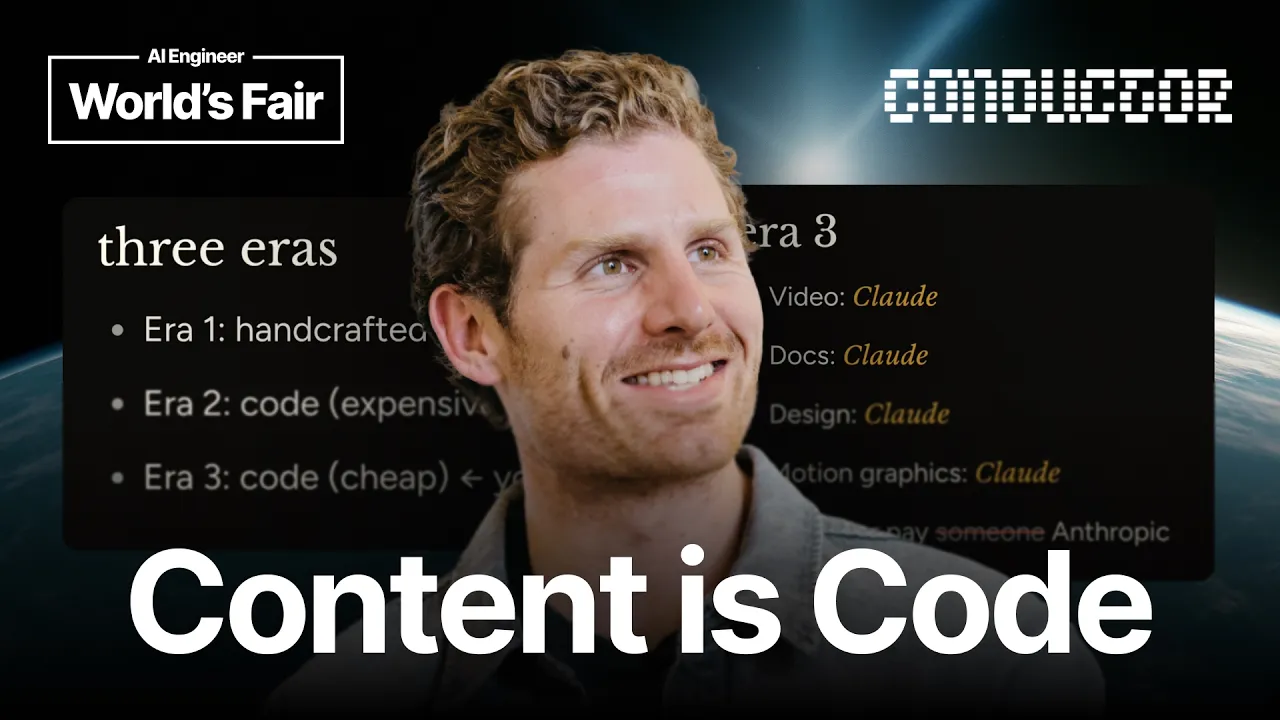
I was previously a data engineer, then I led DevRel at Replit, and now I lead developer experience at Conductor. And today I want to talk about how content is shifting left to code as the source of truth. And so, I think there are three distinct eras we can think about here. Era one, the handcrafted era of content. Era two, an era where code existed, but it was quite expensive. And era three, where code exists, but it's very cheap.
And that's where we are today with AI. So, in the handcrafted era, right? Everything is manual. The only levers we really have are time and money and skill. And so, if I want something, I either need to create it myself, but there are only 24 hours in a day, so likely I'm going to go out and seek an expert, someone that does know how to create this thing. Maybe that's an agency or someone who creates these assets professionally.
If I'm thinking about like motion graphics, for example. Now, post era one, when we had expensive code, code and cloud are mature assets. These are things that have existed for a while, and most professional software engineers know how to use. Engineering is now the bottleneck. This is like Serp era, everybody's paying a lot for engineers, and to get anything done, you really need professional software engineers. So, you'd better pay someone, maybe not an agency, but an engineer.
And that included things like, you know, um robust documentation, or even just a website, right? You Back in the day, it's hard to imagine before AI, you wanted a website, a good website, you needed a front-end engineer, or like a low-code website service, but those weren't any good to begin with. So, you needed a professional engineer to have a really nice website. And what that meant was that content is really not the priority, right?
Because if you're a professional engineer, you have better ways of spending your time. And I think this is reflected by um libraries like Remotion, frameworks like Remotion, um not proliferating the way that they are today. Because, really, who has the time and energy to put into these things? There aren't a ton of what I'd call content engineers. Now, in era three, most of these things, you're not paying a human, you're paying Anthropic, or OpenAI, or whoever, right?
You can create videos with Claude. You can create documentation with Claude. You can design websites with Claude, and you can create motion graphics with Claude. Now, the problem is that not all of the all of these things are good, right? We'll talk about that later, but if you know what you're doing, if you have an engineering mindset, if you understand the systems, you can create high-quality assets with these systems.
And I'm going to talk about how to do that in the rest of this presentation. So, today, code is cheap. And we talk about code as communication. So, code is communication. The fastest way to build an asset today is through code. And it's not just to build software, right? It's really to build anything. If I want a prototype a video, a website, slides, um I mean really any asset, any creative thing that I can think of, images, video, the fastest way to do that is going to be through code or code generation.
And I was thinking about this presentation, I was thinking about how I was going to create all the assets for this presentation, and I realized that my favorite medium is actually TypeScript. Aside from recording myself talk or writing, every ancillary asset is React or TypeScript. And I just want to take a moment because that is the most insane statement to hear myself say if I was thinking about this two or three years ago, right?
I don't even really know how to write that good of TypeScript, you know? My background's in data engineering, I come from Python land. Well, I better learn TypeScript, I better learn React because the best way for me to get these high-fidelity assets is React, TypeScript, CSS, um and HTML. And that's wild. That's wild to say. So, if code is inexpensive, what is the expensive thing? Now, you might think I'm going to say taste here.
I'm not going to say taste because everybody says taste. Structure is expensive. This is maybe a bit of a contrarian sta- statement here because the hard thing is maintaining a very structured code base, maintaining brand guidelines and keeping those guidelines consistent, keeping design tokens in your project, separating even front-end code from back-end code from these design tokens. Merging really clean PRs, which like nobody does, right?
Tagging PRs, PR descriptions, knowing what's a feature and what's a bug fix, knowing if you reverted a PR. How many organizations do this? I've worked at a number of organizations, none, right? And maintaining accurate internal documentation so that anybody can accomplish anything. Even if you have really good agents, they're not going to know how to solve these problems if they don't have documentation or skills, right?
And so, structure often is the difference between AI purple gradient slop, right? And something that looks professional and polished. And I would even go a little bit further, and I would say that this is conscientiousness. And the dictionary definition for conscientiousness is the quality of being meticulous, careful, and guided by a strong sense of moral or professional duty. And so, it's less about comp- like software engineering skill today.
It's less about the skill of being able to create this these assets, and more about the meticulousness and care given to making sure that an outcome matches your expectations. And that, you know, increasingly with each model generation is not predicated on being the smartest person in the room, or being this the person in the room with the most technical skill. So, what does AI reward? AI rewards conscientiousness. AI rewards organizational excellence.
AI rewards structure. And ultimately, these are the things that go into good AI skills. There's a lot of like not very good AI skills out there. Um and most of them are just generated without any regard for what's in their contents or how they're structured. And so, all the assets that I showed you at the beginning of this video are a byproduct of design tokens, structured code, um structured assets. And they get exponentially harder to create when we lack those things.
And so, code, again, is communication. And we're seeing a shift left movement for content, where content is moving to code. And if code, right, is the source of truth, if our code base is the source of truth, we have to have a structured source of truth in order to create content from code. In order to communicate, we need structure and conscientiousness around the way that we create code. And again, this only works with organizational excellence.
And so, I think what we'll see in 2026 and the years beyond is that the highest performing the best communicating teams are the ones that are able to instill discipline and rigor into the process of creating software and then shift their content left towards the code through content engineering. And so, 2026, I think was the year of the creative technologist, at least in the DevRel space. This is the term that got thrown around a lot.
I think 2027 is the year of the content engineer. And I'll close on that because I think what we're going to see next year are declarative and robust content pipelines capable of producing content walkthroughs, capable of producing documentation, screenshots, product updates, all of the things that were really manual can now be created through code, through React, and ultimately because of AI. Again, I'm Matt with Conductor.
Thanks for sticking around for my talk. I'll catch you next time. Peace.
The words are the caption track's own and nothing is reworded or re-transcribed. Paragraph breaks are placed between sentences so the text reads as prose.
Free tools for your own script. No signup, no login.
Paste your draft and see where viewers are likely to drop off, with a rewrite for each weak line.
Paste the first 30 seconds of your own draft for a hook score and rewrites.
Check your draft against YouTube's advertiser-friendly guidelines before you record it.
Read this channel's public videos and transcripts, and download a writing brief for it.