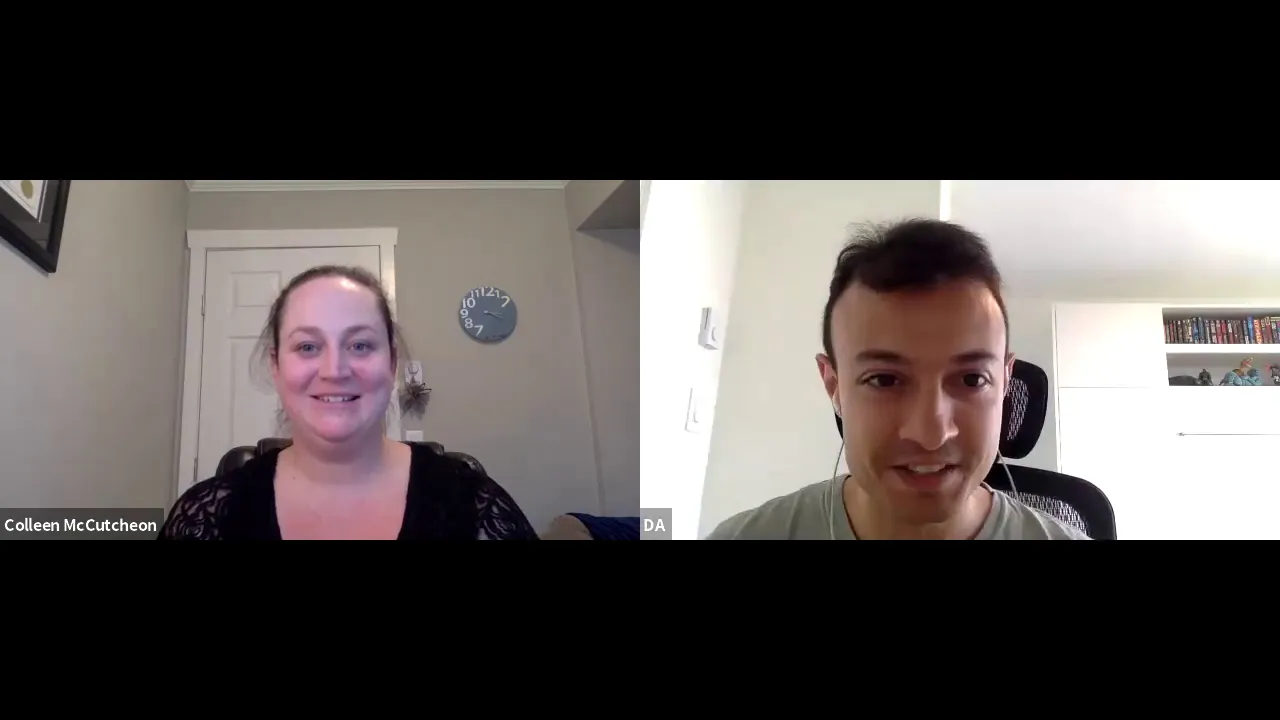
GMT20201005 221427 Colleen Mc gvo 1280x720 transcript
Moving Forward Family Services · @movingforwardfamilyservice5873
Words
2,991
Runtime
18:26
Speaking pace
162wpm
Reading time
12min
162 words per minute, between the 160 25th percentile and the 181 median of 349 measured videos. That distribution comes from the 349-video hook study.
Opening (first 30 seconds)
all right well thank you very much for uh coming and joining us today my name is colleen mccutchen i'm a first year social justice uh practicum intern um in the city program at adler and today i'm interviewing daniel daniel do you want to introduce yourself sure thank you colleen um my name is daniel assadolahi and i am a fifth year psy student in the clinical psychology program at adler university vancouver hi thank you so daniel i just
81 words, the words spoken in the first 30 seconds at 162 words per minute.
Sentence shape
| Measure | This transcript |
|---|---|
| Sentences | 1 |
| Average words per sentence | 2991.0 |
| Longest sentence | 2,991 words |
| Questions asked | 0 |
| Sentences containing a number | 1 |
Most used terms
- uh87
- mental60
- health34
- um34
- illness26
- mental health25
- mental illness23
- actually22
- people22
- social22
- psychological17
- important15
Filler phrases
204 in total: uh 87 · um 34 · you know 28 · actually 22 · kind of 16 · like 10 · basically 6 · sort of 1.
A literal whole-word count of the same phrase list the Prepublish browser extension uses, so a phrase inside another word is not counted and a phrase used in its ordinary sense still is. It is a count and not a judgement.
What this transcript is
Every word below is the caption track YouTube publishes for this video, pulled from the video itself and reproduced unchanged. It is not Prepublish's writing, not a summary, and not a re-transcription: it is the video's own published captions. English captions, generated automatically by YouTube, in the video’s original language. Source: the video on YouTube. A channel that would rather this page did not exist can ask for its removal through the contact page, and it is removed.
Transcript
all right well thank you very much for uh coming and joining us today my name is colleen mccutchen i'm a first year social justice uh practicum intern um in the city program at adler and today i'm interviewing daniel daniel do you want to introduce yourself sure thank you colleen um my name is daniel assadolahi and i am a fifth year psy student in the clinical psychology program at adler university vancouver hi thank you so daniel i just want to ask you a few questions um the first being what are your thoughts around mental illness uh well i i think uh mental illness is a is an issue that human beings have historically experienced for for a long time you know uh even in i believe there's uh uh yeah there's evidence of mental illness you know going back to thousands of years you know probably from the beginning of human history on the planet and it's been something that's been with us for for again generations and um i think mental illness is a is a phenomenon is an issue rather that causes social problems as well as personal problems and interpersonal problems and it has uh genetic and environmental origins we know that for example there are certain genes that we can inherit from our parents and our family that predispose us to uh that give us a vulnerability to developing disorders like depression anxiety uh schizophrenia and so on and so there are genetic there's a genetic component to mental illness but there is also environmental uh origins like environmental stress so if uh you know it's possible that a person i believe in my understanding is that even though if even if you've inherited a certain genetic predisposition to a disorder it might not actually become become that mental illness or give rise to that mental illness if the environment that you live in or that you grow up in is is uh is a healthy and nurturing one and a and a kind of a low stress one whereas you know uh whereas an environment that a family environment or a social environment that has a lot of stress in it has a lot of kind of uh adversity in it those things can actually interact with the genetic vulnerabilities and then give rise to a mental disorder right so um and um yeah so uh that's kind of um what i think about mental illness uh in a nutshell thank you um what about stigma what what are some of your thoughts around the stigma related to mental illness uh i think the stigma uh around mental illness is something that's a very negative phenomenon i think it's uh something that from my own personal observations it seems are actually is actually decreasing uh you know in different societies um you know some societies i think have historically had a lot of stigma towards attached a lot of stigma towards mental mental illness however because of uh i think increasing education and kind of uh people becoming more familiar with what mental illnesses are and uh you know how they can be treated and all of those things people are becoming are reducing or are we are seeing a reduction of that stigma attached to mental illness and that's um a very good thing and um and it's important to remember that uh anybody in their life may experience uh some some mental difficulty or psychological difficulty that they need help with and uh one should feel totally free to seek help with those issues right and uh you know we have a similar approach when it comes to medical problems and physical problems we might any of us might experience one of those problems in our lifetimes and we go to the doctor for it we try to get help for it and i think it would really be helpful to take the very same approach towards mental illnesses you know any one of us might develop a mental issue during our lifetime the statistics show that you know that depression can happen at any point anxiety issues might come up anger issues might come up other mental issues might come up and so uh to feel free to to seek help for each of these these things is a very good thing because it ultimately means that we'll be healthier as individuals our family lives will be healthier our our social lives will be healthier and society as a whole will be healthier so the sooner we can we can get rid of and reduce the stigma attached to mental illness the better it is and i think my personal experience tells me that slowly but purely societies around the globe are starting to change their views of mental illness and are coming and are kind of beginning to reduce that stigma yeah i've noticed that as well it's definitely not um where it could be in terms of stigma but compared to things 20 30 years ago there's there's been significant steps i think taken to reduce some of that stigma right right exactly and that's a very positive development yeah so what what do you think about when you think about people getting psychological health yeah um i i see getting psychological help as basically getting self-help it's like it's like helping yourself helping improve yourself and improving your life and as well as helping uh and kind of improving the lives of people around you important people in your life like family members friends loved ones because often what happens when we have when we're dealing with a mental illness is that that might that illness might actually affect our relationships negatively it might affect our family members and friends negatively so you know getting psychological help is not only helping ourselves not only helping improve ourselves and make us healthier but it's also helping our loved ones perhaps because it's improving our relationships with them it's uh making us have it's allowing us to have healthier relationships with them so that's how i view that and i also think of getting psychological help as basically a process that involves relying on empirically supported techniques to support uh or to improve our own health right because in modern psychology today and in modern kind of therapy today what happens is that most of the time and this should be the case you know we're relying on the the therapists involved are providing treatments that are empirically supported these are these are treatments that are actually supported by scientific research and so for me getting psychological help means going to somebody who a therapist who can provide us with empirically validated treatments and that's very important because that's how we know these treatments actually work and are actually beneficial to our health thank you um um what brought you to this field um that's a that's a very a good question i'm sure everybody has their own unique answer to that there'll be some overlap probably between our answers uh for me um one of them was of course uh kind of uh and this is kind of a one of the kind of a simpler reason it's it's the need for or my interest in having a professional career and this field you know mental health certainly offers that kind of opportunity but i also have a strong scientific interest i think i'm a very science oriented person i think that science is the best way of understanding the world and a different phenomena in it and so psychology and and mental health research is a great are great scientific fields so i was drawn to them because of my scientific interest also i have an interest in just helping other human beings because i think that's a it's a value that i hold that i think human beings should help one another and that we should try to um you know reduce one another's difficulties and and and and suffering if we can and so certainly psychology and mental health fields offer that kind of opportunity uh i also have a an interest in social justice and in building us more socially just societies and uh thankfully what we see in modern psychology and in modern mental health fields is that there is attention being paid to social justice issues and it's always and now there's you know psychologists getting involved and for a number of actually for for decades i think psychologists have and other mental health professionals have been getting involved in social justice promotion so that's something that's very important to me as well and i have an interest in that and uh that's why you know i'm throughout my studies i've tried to um develop this social justice uh lens through which to look through which to look at society pro societal problems and to see what i can do as a mental health professional in training and also as a mental health professional eventually to create a more socially just society thank you um yeah and um so why what do you think is most important about having mental health yeah uh mental health uh is important because uh mental illness is something that can actually affect multiple life areas you know uh when we develop depression for example just to take one common mental disorder uh we might uh find that multiple areas of our life is being negatively affected right so this could be our relationships with friends and family members it could be our jobs our work lives it could be our hobbies it could be we could miss opportunities as a result of of having this kind of mental difficulty and so uh because of the fact that you know mental illnesses can have such a huge negative effect on multiple life areas of a human being its mental health is important because mental health means that you wouldn't be facing so many difficulties in all these different areas also we know that mental illnesses are actually related to physical illnesses so again to take one good example depression is actually related to you know cardiovascular disease risk and other physical illnesses and so on and so uh one reason that may be the case one potential reason is that when we're depressed we're not uh we're not being as active as we were before we're not as physically active and you know that could result in in developing physical illnesses as well in addition to the to the depression which is a mental illness and so another reason why mental illness is important mental health is important is that basically uh you know mental illness uh would could contribute to physical illness as well so it's of course important to have mental health in place of that uh because it reduces our chances of developing uh or it's uh it's less associated with physical illness um and also another reason why mental health is important is because of the fact that in some uh in some cases um an absence of mental health uh and the presence of some sort of mental illness can actually result in harm to other human beings so for example we know from the research that's been done that there are personality disorders which are considered a kind of psychological disorder like for example antisocial personality disorder or borderline personality disorder which can in fact result in harm to other human beings because the persons who are diagnosed with these disorders might engage in violence potentially or might uh might engage in like exploitative behaviors towards other human beings especially in the case of anti-social personality disorder and so some kinds of mental illness could potentially lead to harm to other human beings and so another reason why it's it's better to have mental health than mental illness because uh again disorders like antisocial personality disorder could end up harming society and harming other human beings another thing to keep in mind is that when when people are mentally healthy they are more likely to treat themselves better in some ways you know because we know that people for example who have depression might not be as active as physically active as they can be they might not care or take care of their health as much as they can be and so um uh men having um disorders like depression could actually uh uh you know reduce uh basically um reduce the amount of care that you take of yourself and so uh having mentally healthy people would mean having people who are who take care who take better care of themselves and that contributes to a healthier human society overall and lastly something that should be taken into consideration is that mental health can either contribute to or it can be a or it can include happiness which is a which is something it's a goal that human beings everywhere or or many human beings uh try to seek you know we want to be happy we want to have happy lives and i think a big part of happening having a happy life is actually being mentally healthy because if we're mentally unwell if we have psychological difficulties that might reduce our happiness in life right because uh we can easily imagine people struggling with depression or anxiety or psychosis or other issues and that we can see how that can reduce their happiness and so another final reason mental health is is important is because it can contribute to our happiness in life great well thank you very much for for those answers i really appreciate you taking the time to meet with me today um and talk about all this such important information um yeah no problem and there was a i believe there was also one final question uh about uh uh social justice was there okay yeah yeah so um why do you think social justice is important uh yeah so that's uh uh that's a question that's very much relevant to uh to mental health i think because social justice or having a socially just human society can actually contribute to mental health we know from research that's been done that people of low socioeconomic status people who are uh of uh in terms of economically or or economic wealth or economic position they are on the lower rungs uh you know there's that low socioeconomic status is actually associated with psychological difficulties and so another example of how basically uh social justice factors could contribute to mental health is uh or mental illness is that when we have wars when we have uh global wars and conflicts uh these kinds of events can actually cause trauma they can cause you know uh those kinds of psychological issues and that can of course uh result in a reduction of mental health so social justice which can include reducing poverty which can include promoting world peace that kind of a thing uh having socially just societies can actually reduce uh the chances that people will develop psychological issues or will we will reduce or will improve our mental health because you know we wouldn't have to worry about uh war-related traumas for example or we wouldn't have to worry about people being stuck in in poverty and then developing um difficult psychological difficulties as a result and so um and in a in an article uh by a scholar named raphael which came out in 2009 he talks about in that article he talks about something called the social determinants of psychological health and these social determinants of psychological health include things like as i mentioned peace it also includes housing education access to food a stable income and a healthy ecosystem now these are some of the social determinants of psychological health because these are factors that can actually contribute to a psychologically healthier societies we can imagine if people are living in peaceful conditions have housing have access to education have access to food and a stable income they're more likely to be healthier happier individuals and more mentally healthy individuals right and so uh it's important i think for psychologists and mental other mental health professionals to be aware of the social determinants of psychological health and then to try to um basically engage in activism or advocacy work or even peaceful activism work that can help bring these social determinants to the people of every society right so we can imagine psychologists getting involved in um in advocating for certain government policies that provide people with a stable income for example or provide people with housing for example and since you're providing people with the social determinants of psychological health you're increasing the chance that people will be psychologically healthier and you're also as you're also addressing social justice issues because you're giving people a roof over their heads you're giving people a stable income or access to food so again addressing social justice issues can actually address mental health issues as well because we can actually create mentally healthier societies by uh building more socially just societies right and uh yeah yeah great yeah that's it's it's interesting how it's all connected and all these things that can lead to prevention or um in some ways even treatment kind of all all together so that's right that's right yes yeah great all right well thank you so much for taking the time for meeting me today it was nice talking to you i appreciate all your insight and the information that you shared thank you for your time and for providing me with this opportunity thanks very much
The words are the caption track's own and nothing is reworded or re-transcribed. Paragraph breaks are placed between sentences so the text reads as prose.
Use this transcript
Three free tools that work on the material around a video like this one. No signup, no login.
Hook Analyzer
Paste the first 30 seconds of your own draft for a hook score and rewrites.
Policy Pre-Flight
Check your draft against YouTube's advertiser-friendly guidelines before you record it.
Channel Skill Generator
Read this channel's public videos and transcripts, and download a writing brief for it.