Getting the transcript
Reading the captions from YouTube. A video nobody has opened here before takes 10 to 30 seconds; this page fills in on its own.
Getting the transcript
Reading the captions from YouTube. A video nobody has opened here before takes 10 to 30 seconds; this page fills in on its own.
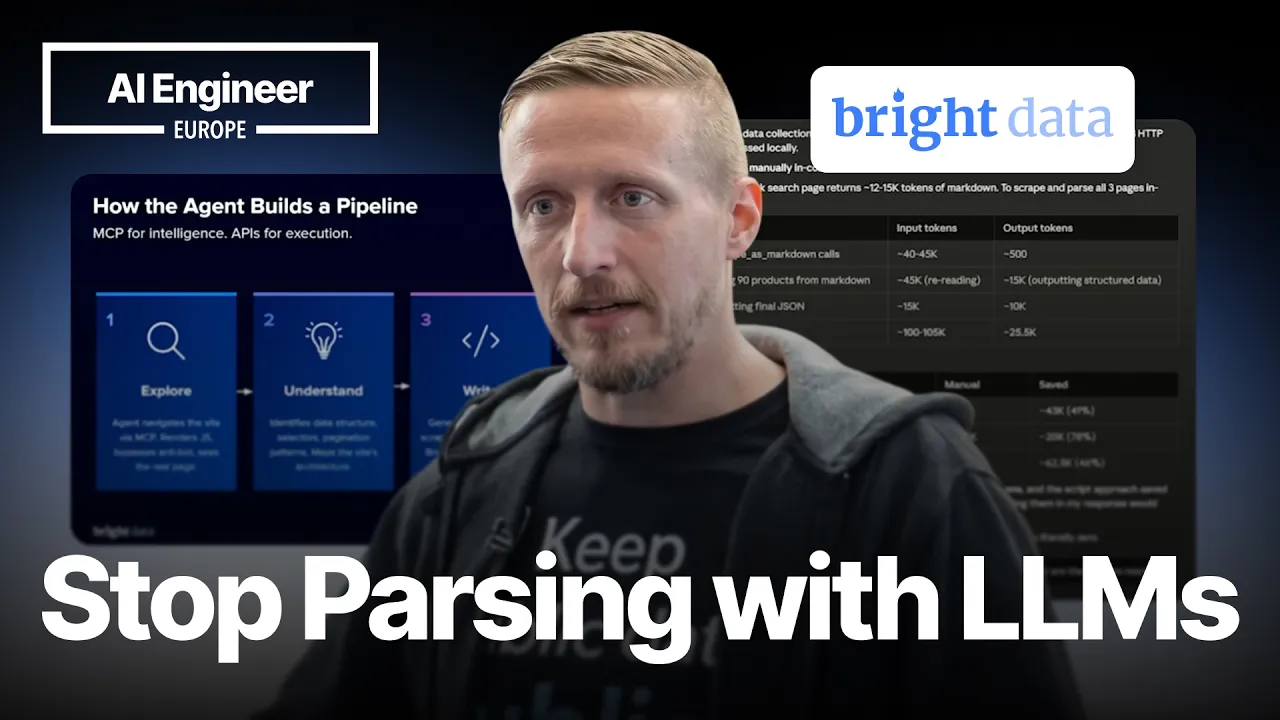
AI Engineer · @aiDotEngineer
This video has no Most replayed graph yet: YouTube shows one only once a video has enough views. These are the moments viewers replayed most in AI Engineer's most watched videos.
Most replayed moment at 18:45
4.8x that video's typical replay level
that they're they're changing they're changing things in the database not yet. You want to run them through the ontology first and make sure that works. Okay. I only got an I've got I've got another I've just a short time. I'm going to try to show you some of the things that um that you can
Said at 18:37
Most replayed moment at 16:13
3.6x that video's typical replay level
method signatures, the program layout and the call stacks. So here's some examples. I don't think you'll be able to read this one, but this is like the level of abstraction we're at. It's how we're actually going to lay this stuff out and how these systems are going to interact. Dylan Mulroy from Cloudflare talks a
Said at 16:06
Most replayed moment at 6:57
5.9x that video's typical replay level
do light mode. It's I It's not my nature, but sometimes. That's better, yeah? Okay. So we have we have a model and we're trying an old LG Sorry. We We shouldn't have seen that. No, we'll
Said at 6:50
The graph counts replays. It does not show where viewers stopped watching.
Words
3,959
Runtime
25:25
Speaking pace
156wpm
Reading time
17min
156 words per minute, below the 160 25th percentile of 349 measured videos. That distribution comes from the 349-video hook study.
Opening (first 30 seconds)
All righty, let's dive into it. So, uh in the previous session, I I don't know how many of you were here, but I talked about how MCP gives access to LLMs to websites that are behind uh CAPTCHA, bot detection systems, and so on. And in this session, I want to talk about um how do you actually collect data on scales with LLM? Because a lot of times I'm seeing on Reddit and other social media
78 words, the words spoken in the first 30 seconds at 156 words per minute.
Free, no signup. See how the first 30 seconds hold attention, with rewrites.
Sentence shape
| Measure | This transcript |
|---|---|
| Sentences | 382 |
| Average words per sentence | 10.4 |
| Longest sentence | 55 words |
| Questions asked | 80 |
| Sentences containing a number | 20 |
Most used terms
Filler phrases
207 in total: uh 44 · like 41 · right? 37 · um 29 · actually 18 · literally 12 · basically 10 · you know 10 · I mean 3 · kind of 3.
A literal whole-word count of the same phrase list the Prepublish browser extension uses, so a phrase inside another word is not counted and a phrase used in its ordinary sense still is. It is a count and not a judgement.
What this transcript is
Every word below is the caption track YouTube publishes for this video, pulled from the video itself and reproduced unchanged. It is not Prepublish's writing, not a summary, and not a re-transcription: it is the video's own published captions. English captions, generated automatically by YouTube, in the video’s original language. Source: the video on YouTube. A channel that would rather this page did not exist can ask for its removal through the contact page, and it is removed.
All righty, let's dive into it. So, uh in the previous session, I I don't know how many of you were here, but I talked about how MCP gives access to LLMs to websites that are behind uh CAPTCHA, bot detection systems, and so on. And in this session, I want to talk about um how do you actually collect data on scales with LLM? Because a lot of times I'm seeing on Reddit and other social media is like, "Oh, I need to scan 10,000 products, but that's so many tokens if I need to parse everything with LLM." So, obviously, you don't do that.
Right? So, the whole session is how do you build pipelines, right? With LLM. Instead of telling, "Hey, LLM, can you go and uh parse this for me?" build a scraper that's going to parse it for me, and I will demonstrate how easy it is uh with our skills, right? So, Bright Data has skill sets that actually teaches your LLM on how to build a pipeline. With our MCP, it can actually extract HTML so that it knows what are the selectors that it needs to parse, and so on.
So, um the scrape tags, right? Write the scraper. Uh I don't know how many of you actually wrote scrapers before. Okay, so you know the headache when all of a sudden things are missing, data is missing, you got to wake up. I don't know if you guys did it for clients, and clients are like, "Oh my god, there's no So, basically, that's what used to be. You write a scraper, and you maintain it. As a matter of fact, sometimes you maintain it more than it it it takes you to write it, right?
So, everything, especially if the website is constantly changing uh its selectors, or if it's a React website, it gets really complicated, right? So, an agent it it it solves all that headache, right? It can explore with our MCP, it understands what the data is needed. It writes the scraper and it actually runs it and executes it and maintains it. As a matter of fact, I do collections on the daily basis and I have every 30 minutes I have an LLM class pool spools up.
It checks what the data is collected, make sure that everything is fine. Everything is fine, it shuts down. If for this example, there's a always set a validation for data, right? Let's say the data point is uh missing some something. Your agent fix it. 5 minutes. You don't have to wake up in the middle of the night. Uh So, let me demonstrate. So, for this demo, I want to use Cloud Code. I don't know how many of you use Cloud.
If you're using Codex or whatever it is, I prefer Cloud Code. I like how it I like it. It does a great job. So, the way that you build scrapers now and it's ridiculous because, you know, back in the day it took weeks to set it up. We created a Bright Data like GitHub page, right? Bright Data skills. Here basically, your agent has everything that it might need, okay? Um scrape builders back practices, how to everything.
Everything that it needs in order to build a scraper. And what I want to show is uh first of all, let's I'm going to start simple. Go to build me a scraper and I wanted to record it because I thought it's going to take a long time, but now it takes a little like 3 minutes. Build me a scraper uh two inputs keyword search max pages for walmart.com. Everybody's familiar with Walmart. Walmart has a very aggressive anti-bot systems.
If anybody tried to scrape it, um it just doesn't work. But, through Bright Data, it will figure it out, but you're you're all right. Let's just correct that. walmart.com Um run a search for headphones, collect three pages. Uh so, what it's going to do right now is going to go to our GitHub, it's going to get all the skill set that it needs, how to build scrapers, then it's going to go uh with the MCP that's already connected to the cloud, it's going to extract the HTML from the page.
Uh it's going to find all the selectors that it needs, and it's going to build you a scraper, and uh So, right now you can see a scraper as a markdown, it's basically extracting the the the the text, right? So, for the skills, we don't need the HTML, we just need the text. Uh scraper as a markdown is a part of the MCP of Bright Data MCP. Uh the MCP has 5,000 requests for free, so if anybody wants to try it, you guys can try it for free.
Um You will need to just open an account with Bright Data, which doesn't cost you anything. And let it do its thing. So, why is this better than having an LLM parse every single page, every HTML? It's I'm I'm literally afterwards I'm going to ask it to tell you how many how much tokens it saves. So, for the three pages, I've done this before, it saves about a million tokens just to from building the scraper uh and using a script to parse the HTML.
And um even if you are not doing any scraping for production, but let's say that you want to find the best best headphones for the money, right? It used to be you go to Google, you go to some CNET where they uh compare everything, but here you can use the the marketplace reviews. So, I can tell it here like hey hey, um scan the five pages, find me the best uh review to headphones. So, it could be even useful for you as a personal in in a personal way, right?
So, instead of it getting blocked, it can actually find you things that you need on websites that are behind Cloudflare. Oh, I forgot to delete the old one. No. No, stop. Stop. Stop. Hold on a second. Delete the old scraper. Scraper. I totally I was testing it and I totally forgot to clean up. Uh, let's do a different website. Pick a website. What's a popular marketplace in uh that's aggressive in blocking in UK? >> Very. >> Amazon?
It's not that aggressive. You'll be surprised. I can scrape it with data center IPs. What's a popular website that everybody uses here? >> Very. Very. >> V- >> v e r y.com. >> V- Very? >> Very. >> Like that? >> y >> y.com? >> Yeah. >> Oh, that's the UK? Okay, perfect. So, this way I don't I don't want to Stop it. New session. Uh Let's do that. Where's the new session? Oh, there it is. Really? What is wrong with my paste?
Okay. Uh, it's clothing store? >> Uh, it's category. >> Okay, so let's do headphones again, the same thing, right? So, I don't know. I've never used this website. I've Look. Clean test. No cheating. Um So So, what else does this give you? So, again, market research. Um For example, I was looking for a new apartment, right? I would want to move a house. So, with a CloudCrawl, with BrightData, I set up a listener. Literally just telling Hey, listen.
Build me a scraper that will run every half an hour when in this area there's a a house, private house, under this price, notify me. That's all I did. In a few days, I got a notification and now I live there. So, these things are not only useful on a scale where, you know, oh, I need to scrape millions of records, but even for your personal use. It's so easy these days. CloudCrawl does an amazing job, right? I know Crawlera does a great job as well, but I prefer CloudCrawl because I don't know.
It just gives me less headache. Crawlera sometimes takes me on a wild goose chase. Um how many of you use VibeCode? It's It's amazing. Why not, right? Anybody can build anything now. Um So, did you build it? I've got the structure, the search patterns. I don't know what third party I'm going to build. Oh, okay. It's building a scraper. Um This used to take, I don't know. If you If you're having a good day, maybe a full day, maybe a day and a half, right?
You need to go check out the selectors, figure it out. It used to be interesting and fun, but you don't need to do that anymore. So, what I'm trying to show you guys is that with our MCP, with our infrastructure, we have over 150 million IPs. Uh with our unlocking technology where we even though if it needs to run a remote browser, so if you want to It can actually write you a browser automation. Uh Uh the browsers are running on our system.
So, I can literally right now open a thousand browsers on this laptop that are running on our servers. And they can go do things whatever you needed to. So, it already got 90 products. Okay, it just needs to fix the Unicode because it's in pounds. Almost done. >> Can you also go into details about the MCP or is that it? >> Sure, I did it in the previous session, but while it's loading, let me tell you. So, basically, the MCP gives you a agent 66 tools.
Uh some of them is basically uh we have a system where it can send a curl to any URL and our system will literally get the HTML back. It will solve a capture if needed and send it with a token. It will It knows exactly what headers and cookies the website needs. So, basically, it will make sure that the server thinks it's a browser and serve the HTML back. So, your agent can literally send curls, pull data without any questions.
It can pull a full HTML. It can pull just a scrape as a markdown. Markdown is It's to save tokens, right? You just want the text of the page. You don't care about the HTML tags. It doesn't like the pound. Come on, you can do it. Um so, that's number one. Second, we have about 500 different APIs pre-built for different domains. So, instead of actually getting markdown, you can actually get a JSON of the product. For example, for Amazon, we have pre-built API.
You can listen when you add your agent, it can be like, "Okay, go and check on Amazon something." It doesn't even need to build a scraper. It can literally just send the the request and get the data back. Um on top of that, remote browser infrastructure and the anything that needs anything that your agent needs to access the web. It has, right? So, you don't get blocked. While this is running, I want to show you for example uh tell one to Walmart do a search for headphones without MCP one So, I'm telling it go to Walmart, do a search for headphones, and tell me what is the first result.
Without the Bright Data MCP. Uh It's going to do a fetch, which is going to get blocked. Product security verification screen, robot or human, obviously, right? That's That's the first thing. Now, do the same with Bright Um Oh my god. So, now it's using Scrape as a markdown. It's doing a search. It's only pulling the text. It's not pulling the HTML, just the text itself. Always when you do a live, it's slows down. The time is like Oh, actually, it could be.
It could be opening a browser and actually holding the button. You know, the Walmart has like one of those click and hold, and it needs to hold it for like 30 seconds. So, it could be doing that right now. So, is it We have built to capture solving solutions. Like, we literally have in-house We have a AI solving capture. And moving, clicking things, and like what? It's perfect. So, it already got first result, blue headphones.
Oh, basically, there you go. It already has the results of the headphones without robot or human with full product listing name. Uh so, we here already have the output. Tell me if you were to do this manually, how many how much more tokens have you used? How many did you save? Let's just give it a breakdown, and this is probably the biggest issue, right? Tokens is expensive. I'm going through millions and millions of tokens a day.
I used to go more, but I I optimized it. So, um all of you are looking how do we save money on LM? How do we waste less tokens of web access and um Bright Data has the solution. Instead of parsing the full HTML, create a scraper. Uh instead of using um you know, okay, it pulls the HTML and then it extracts the data, it builds the the parser. But, it's working very slow right now. I feel like everybody's white coding.
So, basically, here's the breakdown, right? What do we have here? The big swings output parsing 90 products with input tokens, output tokens, total save. So, it's about a 62% save of tokens. This is not a high number. This website, I guess, uh has um maybe a structured um HTML. I'm not sure. But, this is what I wanted to show you. And the best thing about it is that it will maintain it. If it breaks it, it will fix it.
I can set up a loop, right? So, for example, in Cloud, I can set a schedule every 30 minutes you do and run and check something. And this is we are giving you guys, okay? With our MCP, your agent has access to all the web uh without getting blocked. No capture will stop it. No robots antibot systems will stop it. And uh you have no headaches of that. I don't know how many of you have You guys probably dealt with blocking, right?
When you build a scraper, it gets really complicated. So, this kind of removes all the headache for it. Um any questions? >> Where is the code? >> Excuse me? >> The code the code you generate a scraper, right? >> I can I If you you want to see the code? I mean, it's here. We have the scraper. Let's check it out. So, it's using API web unlocker. This is the same thing as a scraper as a markdown with an MCP. It sends a simple request and gets the data back.
This is the parser that it built. I mean, it looks pretty good. This is the the schema that it built for the output. It's doing a keyword search. It has the max page, right? So, I asked for two inputs, the keyword search and how many pages to scrape. And hold on. Let's see Let's see We can run it through here as well. Where is the variables? API key is on key. Let's run it. Do another run on laptops. What are the two pages results?
And now you kind of control it. Like you don't even need to run it, right? It will trigger it for you. It will maintain it for you. Um you can create a script that will automatically do all of this. I prefer the visual interface for the demonstration. Sometimes they you like looking at our code it's a little more complicated. But right now basically I can ask it any questions. It will actually run the script. So it's not wasting tokens to execute the script maybe like 60 tokens, right right now.
So it's going to literally get all this data for 100 tokens. And then you can do whatever you can ask it questions about it. But now we're working with a JSON and JSON is much more token efficient than any markdown or any other file, right? Still the usual. >> Can I ask can you can you do this on all the authorization sites as well? >> Uh no, we only talk we only deal with public data. So behind login it's um it's private data.
And and uh just you know just a heads-up. If you create an account, you accept terms and conditions of the website. Always check terms and conditions of the website. If they say don't scrape, don't use robots, and you do, then that company can actually sue you. And this is happening you probably heard it in the news all the time. LinkedIn is suing them. Everybody's suing each other because they the data right now is like the new gold the oil, right?
Everybody's trying to like oh this is my data. Elon Musk took over Twitter, locked it down. That's it. Literally like uh the it used to be so open and now it's all locked in a few accounts that you can actually scrape. So the we're seeing this on every single level. Very slow today. Um so yes, also same thing if you accept uh there's like terms and like if you do a search and there's a checkpoint, I accept terms and conditions, always be careful with that.
So we only deal with public data. So nothing behind login. We don't accept terms and conditions. And we actually won a few lawsuits. We were sued by Meta. We were so sued by Elon Musk a month after he took over. And uh the judge said it's very simple. Public data is public data. It doesn't matter how you collect it. Doesn't matter what you do with it. It's public. You know, it's like walking on the street, you write down the prices on the counter and then you sell it to somebody.
It's public data. It's available. You can do whatever you want with it. Okay? So, as usual, it gets stuck on a live demo, but we can we can run this manually. Oh my god. What the I'm setting a variable. It's doing this. No, it's not going to work. What am I missing? Still stuck? Oh, okay. It's done. Okay, so here we got we got Let's see. How many tokens? How many tokens did you spend on getting the these? So, even if you're not be able to building pipelines for any you know, big companies and you don't need to get for personal use, I always have the MCP connected.
I don't ask the you know, LLM to go do I always ask build a script that can later on be used by it. It's using its own script to save the tokens. >> Literally like we're talking about 1,000 tokens where if you know if if it needs to go through the JSON, it's like 10,000 tokens. We're talking about like literally pennies compared to what it would be to actually scrape it. Any more questions? How about this? Anybody has problems with actually getting data?
No, no question. Everybody is like I'm not sharing my problems. I have no problems. And they go home and like oh I do have a problem. But in any case, listen, we have a booth. If you don't if you want to talk in private and you have questions about data or access of LLM, feel free. I'm always willing to help. Um we can connect on LinkedIn by the way, guys, if you want. Let me just summarize a few things what we did here.
So um self-healing pipeline. When you have when your agent actually has access to a blocked website and you're working I mean, the MCP is mostly useful in about 20% of the of the domains, right? The ones that have Akamai, Data Dome, Cloudflare, those heavy protected domains. They're the usually the most juiciest one, right? Like real estate or uh big e-commerce places. Uh with our MCP, it has access to it. If it has access to it, it can build a scraper.
If it can build a scraper, it can maintain the scraper. This is basically the whole thing that I wanted to show you. That in Bright Data, we have all the tools that your agent might need to explore, to build and maintain uh a pipeline, right? So, if you want to set up a listener for an apartment and you're looking to move into a cheaper place or maybe you want to book a table in a restaurant where it's always packed.
And literally I I I have a listener right now. I'm waiting for 2 months already. Everybody is like booking right away. So, as soon as the spot opens, it will automatically book a spot for me. It can be very useful in just kind of like even even the small things, personal things, right? I'm not talking about just enterprise scale where I need to download a million records. Okay? But having access to all the websites is this is important. >> So, apart from scraping can you also do actions on the website? >> Yes, of course.
Fill up a form, submit it as well. Yes. The only thing you can't do is log in. Right? So, if you have let's say you need to perform a search, right? You cannot generate the URL, you need to click buttons. Let's say flights. You want to check flights availability, Skyscanner or something like that, right? The URL is usually a hash and you can't do anything with it. So, yes, LLM can spool a browser, remote browser, even if it's a geo-restricted site.
It can be like, "Okay, I want IP from the United States." So, it's open a browser with the United States IP and then it goes and clicks things, fills it up, and so on. The beauty of it is that our browser will mimic real human behavior. So, when your agent clicks, it's not a teleportation. There's a mouse pre-recorded like a real human being moving it. When it types, it will type a little slower, speed up, like maybe even mistake, and so on.
So, we have pre-recorded typing, we have pre-recorded mouse movements. So, if the website has a tracker that's constantly sending to the server what the user is doing, it will look like a real human being. Doesn't matter what your agent, even if it's a low like for browsing agents, I'm never used the top models, right? For example, if with Claude Haiku model is more than enough for browsing. If it's being masked that it's a real human, it works just fine.
And so, that's pretty much it. If you guys want to connect on LinkedIn, feel free. I'm always willing to help. If you have any questions regarding how to get data, if you have problems with accessing anything, feel free to message me. I feel like there's been so much more than 15 minutes. I love it. It's the second time I'm doing a speech and I got like half an hour instead of 15 minutes. It's amazing. Um Now's the time if you have any questions, discussions.
No, nothing? Great. Okay, guys, I guess I will conclude this session in this Feel free to come to the booth on the third floor if you have more questions and um let's keep the public data public. Thank you.
The words are the caption track's own and nothing is reworded or re-transcribed. Paragraph breaks are placed between sentences so the text reads as prose.
Free tools for your own script. No signup, no login.
Paste your draft and see where viewers are likely to drop off, with a rewrite for each weak line.
Paste the first 30 seconds of your own draft for a hook score and rewrites.
Check your draft against YouTube's advertiser-friendly guidelines before you record it.
Read this channel's public videos and transcripts, and download a writing brief for it.