Getting the transcript
Reading the captions from YouTube. A video nobody has opened here before takes 10 to 30 seconds; this page fills in on its own.
Getting the transcript
Reading the captions from YouTube. A video nobody has opened here before takes 10 to 30 seconds; this page fills in on its own.
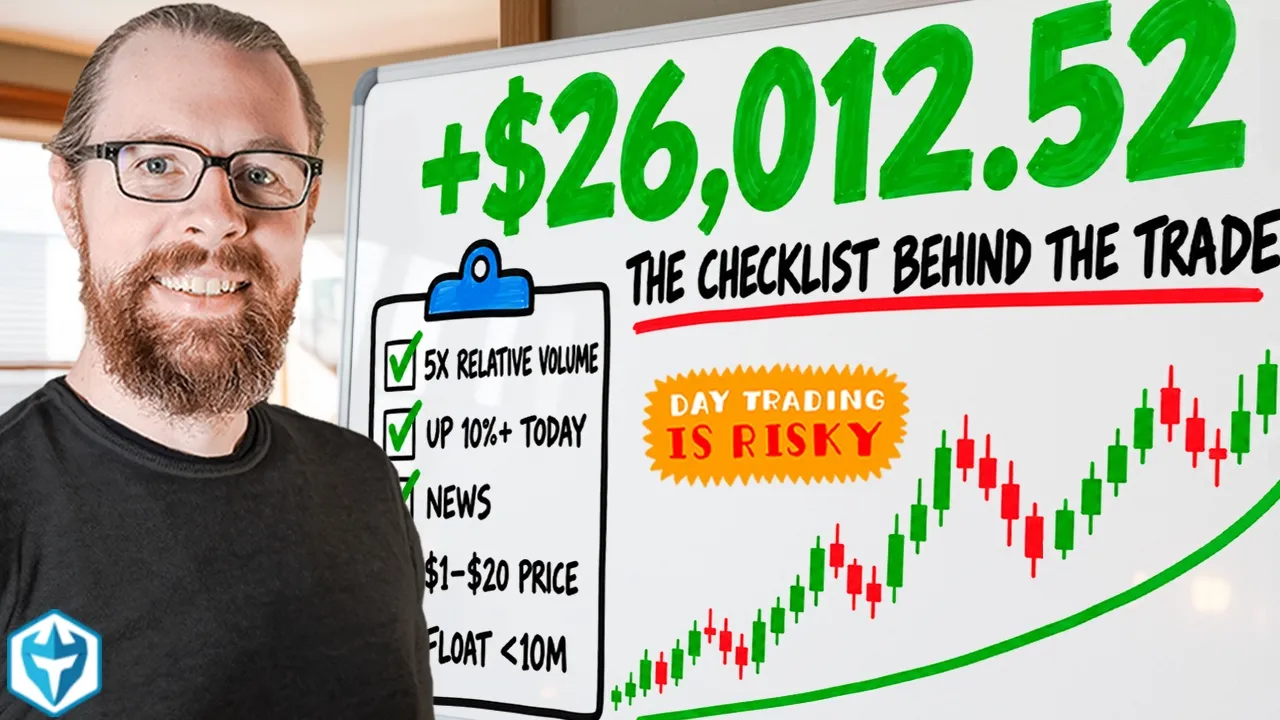
Ross Cameron - Warrior Trading · @DaytradeWarrior
Words
2,726
Runtime
13:59
Speaking pace
195wpm
Reading time
11min
195 words per minute, between the 181 median and the 201 75th percentile of 349 measured videos. That distribution comes from the 349-video hook study.
Opening (first 30 seconds)
What's up everyone? In today's episode, I'm going to break down my trades from the morning. But before I do, we've got an important topic to discuss. A member in the chat room this morning made a comment that I thought was very interesting. His name is Martin, and he said, "You know, I feel like you guys are jumping in anything that's moving, regardless of whether the stock meets our five pillars of stock selection." It's a good comment and the inspiration for what I'm about to share with you. So, our five pillars of stock selection
98 words, the words spoken in the first 30 seconds at 195 words per minute.
Free, no signup. See how the first 30 seconds hold attention, with rewrites.
Sentence shape
| Measure | This transcript |
|---|---|
| Sentences | 198 |
| Average words per sentence | 13.8 |
| Longest sentence | 66 words |
| Questions asked | 14 |
| Sentences containing a number | 47 |
Most used terms
Filler phrases
70 in total: you know 17 · like 16 · um 13 · uh 11 · kind of 5 · actually 3 · I mean 2 · sort of 2 · right? 1.
A literal whole-word count of the same phrase list the Prepublish browser extension uses, so a phrase inside another word is not counted and a phrase used in its ordinary sense still is. It is a count and not a judgement.
What this transcript is
Every word below is the caption track YouTube publishes for this video, pulled from the video itself and reproduced unchanged. It is not Prepublish's writing, not a summary, and not a re-transcription: it is the video's own published captions. English captions, generated automatically by YouTube, in the video’s original language. Source: the video on YouTube. A channel that would rather this page did not exist can ask for its removal through the contact page, and it is removed.
No Script X-ray for this video: YouTube shows a Most replayed graph only once a video has enough views.
What's up everyone? In today's episode, I'm going to break down my trades from the morning. But before I do, we've got an important topic to discuss. A member in the chat room this morning made a comment that I thought was very interesting. His name is Martin, and he said, "You know, I feel like you guys are jumping in anything that's moving, regardless of whether the stock meets our five pillars of stock selection." It's a good comment and the inspiration for what I'm about to share with you.
So, our five pillars of stock selection historically have helped me avoid unnecessary loss. The origins of it was my discovery early in my trading career that I didn't do well trading stocks that were over $20. So, that became kind of my first pillar of stock selection. Don't trade anything over $20. And then I realized don't trade anything with a float of over 20 million shares because even if it's under 20, like maybe Ford or something like that, but has a huge float, it doesn't trade very well.
So, no trading stocks over $20. no trading stocks with a float below 20 million shares. And then I further realized that I typically did the best when I traded the stock that was the leading gainer in the market. And that always means it's up a minimum of 10%. So minimum percentage change and typically it's up even higher. We've got our leading gainer right now at 223%. Number four, I do the best when I'm trading stocks.
I have five times higher volume today than the 50-day average. And that's typically because number five, they've got a fresh news catalyst. So those are the five pillars of stock selection. But how do we then interpret a stock like RETO from earlier this week? The stock has a float of 34 million shares. So it's too high and it has no catalyst. So it only meets three out of the five pillars of stock selection. Its price, float, sorry, its price, its rate of change, and its relative volume were correct.
So, is it worthy of trading with no news and a float that's too high? Well, the stock went from four bucks here to $18 a share. And you know what? You could also say, look at SpaceX. SpaceX went from, you know, $140 um or whatever it was down here up to 156. I mean, these are opportunities and opportunities will be present on higher price stocks, but will you be able to have an edge? Will you be able to read the time in sales?
Will predictable patterns resolve in predictable ways? In the case of RE RTO RETTO, it was trading like a small cap. So even though the float appears higher, being a Chinese stock, the float is always a little bit questionable. In any event, it was trading really well. So because the price action was clean, even though the float was a little higher, I was willing to trade it. So in this sense, I was able to disregard float because the price action showed me it was tradable.
Sometimes you'll have a stock that's the opposite. The float is really low, but the price action shows you it's not tradable. It's not clean. In which case you interpret the price action, not the listed float. So today we had another stock that popped up and it was meds mess and this is the one that prompted that comment. So as meds popped up it was up like 28%. Technically it's up more than 10%. But it's like our sixth leading gainer.
Is it really up enough that it's going to be obvious? What about the daily chart? it's already made a move and then it's selling off. It has, you know, unfortunately this this history where it makes big moves but then it gives back those gains. So, at the moment that we were looking at it, it felt like the stock wasn't really the most obvious in the market. And yet, traders were focusing on it and it did squeeze up here from $4 up to $7 a share.
So, here's what I'll say. In a hot market, what I find is that I can be a little bit more forgiving about my five pillars of stock selection because there's so much momentum. Now, it might not be a hot market, could just be a hot day, but on a hot day like the day that RTO went up 2,000%, any Chinese stock that was popping up was probably a worthy candidate to at least consider, even if it didn't have any news catalyst.
After all, RTO didn't have any news catalyst. But what you'll find is that you'll do well trading a little outside your fivepillar guard rails until the market cools off. And if you're not quick to take your foot off the gas, you're going to experience what often happens to me, which is that quick correction from the market that you got to get back in line, which is or the correction is in the form of taking a big loss because you got too aggressive on a stock that didn't really meet your five pillars.
And when you look back at the loss, you think to yourself, you know, I probably shouldn't have taken that trade in the first place. So the five pillars are uh can be a little flexible at times. Uh but for a beginner, black and white is a little bit easier than having this sort of gray area. And I do think it's better to follow at least four of the five with the fi the fifth one that is negotiable being breaking news.
Especially this year, we've had a lot of stocks this year that have made big moves without news. So I think for that reason it is it is still okay for me to trade something without news as long as it meets the other four pillars. Reto you know that was a tricky one because it only met three out of the five but clearly made a big move. So there will be some exceptions to that. GameStop obviously that made a big move. The price was too high.
The float was too high but it had the rate of change. It had the volume you know it was clearly moving. So, and the news catalyst, well, it was the short squeeze catalyst, so there was something there. In any case, uh you can be more flexible once you've got a cushion to tolerate the risk associated with taking some of those um higher risk positions. Okay, so this morning, let's look at the stocks that are leading the scanner.
GIPR is our leading gapper right now. It's currently halted up at $156. No interest in that for me. It's just a little too cheap. IMC, I was watching it this morning. It's up 145%. Sold off to three now rallying back up. These rallies are unbelievable. They're huge. And you never know which one's going to get a rally. So, you want to be careful holding something that's going deeper and deeper red, hoping it'll rally cuz it may not.
TNMG. This one popped up from three up to seven, now back at four. This one had breaking news. I locked up $17,119.38 trading it. the chart. Back this up on the one minute. We had this initial squeeze here from 350 up to 550. A big pullback and then a recovery right here. And I got in for the break through this level and we got this squeeze all the way to 7. We dip down, we pop up, we dip down, we pop up. I was looking for the breakthrough seven.
Gave back profit trying to time that breakout which never ended up happening. It started unwinding which was a little bit disappointing. Inverted head and shoulders pattern right here for a moment. Is it going to curl back to the upside? Nope, not really. Runs into the resistance to the VWAP and starts unwinding. And part of that was because P AI popped up on the scans. This stock squeezed up yesterday. Big move. And then was halted in the middle of the trading session.
That's scary. If you're short, you don't like to be holding a stock overnight. You're now going to pay double borrowing fees. You got to pay it for the two days you're holding, day one and day two. If you're long, you're stuck in something that's already up 100% or more. you're worried that it's halted pending news. The news is going to be that there's no fundamental uh reason for the stock to be up and it's going to resume down 50%.
In this case, they put out a news headline and it squeezed on the resumption here from 350 up to six. I locked in $8,993.14 of profit on it, putting my daily total in the Roth IRA at $26,000. Not bad. This is now a head and shoulders coming back down. No surprise there. What I will tell you is that um PII is actually halted right now and you can't see the resumption price because it's a nice MX listed stock. Only NASDAQ stocks show you resumption price.
So let's see what was the other one. Uh GIPR. I think that's a NASDAQ stock. We'll just double check. GIPR. Well, it's not halted right now. So, but we'll see if it halts. So, GIPR is a NASDAQ listed stock. So, if it does halt, you'll be able to see quotes while it's halted. So if it's going to suddenly resume at $2 or $3 a share, you'll know that before it halts or before it resumes. So right now it's about to halt up at 171.
Okay? So when it halts, the number will change and it'll move up a couple cents. So there's the stack of buyers. It's pinned at the halt level. And now the halt resumption is 187 180. It moves around a little bit. So P AI, however, you're flying blind. you have no idea what the halt resumption will be, which is one of the reasons I don't like trading NY and and um and MX listed securities during the market open when they're subject to halts because I'll be in a halt and I'll have no idea when it's going to resume.
The second reason I don't like trading them is that the exchange is more likely, far more likely than NASDAQ to halt trading in the security that's up 100 or 200% and ask the company to respond to why the stock is up that much. And while the stock is halted, clearly it takes the wind out of um you know the sales. This is an interesting technique because the idea is they want to prevent um investors from buying into the stock, moving up on maybe no news and getting hurt.
Well, what about all the investors that are already in the stock? Well, tough luck for them. So, to prevent other people from getting hurt, they they actually potentially hurt the people that are already in. It's kind of a funny concept, but NIC and AMX the exchange do it a lot. So, I'm very cautious trading those stocks after the open that are moving up a lot. um because we it's not the first time we've seen that by any means.
So this morning, SVRN moving a little bit higher, BIFF from the other day, IMCC, we've got a couple stocks that are moving. You know, again, these types of bounces are so interesting because you just, you know, why that one and not TNMG. Uh I I have no idea. You know, both of them are similar. Don't know. Not clear. You know, it's just the rhyme or the reason. So, when something starts moving, I look to buy the dips and ride the momentum higher.
Um, but obviously, if it's uh if it's just going sideways or down, then there's nothing to trade there. So, if you guys want to do a little uh deep dive over the weekend, I'm going to give you a link to the full length episode I taught earlier this week on how I turned my $2,000 account into over $100,000 in 46 days. Now, technically, I turned it into $100,000 on like day I can't remember what it was. It was like day 40, uh, maybe 41, and then I took another trade that same day and closed the day down below 100 grand.
Bummer. So, now I crossed over 105,000 and I stopped trading on that day. So, I marked it. Boom. Crossed $105,000. And I think that that was that was good. Um, today I actually had a hotkey issue where I bought TNMG in the small account and didn't realize it and took a loss. So now the small account has dipped back down, which is discouraging, but not really the end of the day. I crossed over the $105,000. We've donated the profit to charity.
And the question of what I was going to do with a small account after crossing 100 grand, you know, I hadn't I I'd sort of just thought I would reset it again back down to $2,000 because that's kind of what I've been doing. You know, if you really wanted to kind of talk about turning $100,000 into a bigger account, we could just go back to the beginning of this year. U I started this year, we'll scroll down here, um with $96,000 in my account.
Let's see. So this year, this is the starting balance, 96,000, right? And what's the balance in my account right now? Well, as of the end of August, I was at uh 2.1 million. And you could just see it's been growing every month. I haven't taken a penny out. It's just been growing. So, you know, I I don't think turning 100,000 into 2 million is as I mean, it's it's I'm I'm proud of it. I think I I did a great job, but I think that it's not as relatable because you got to have $100,000 in the first place.
So, continuing to grow the small account from 100,000 up to, you know, 200,000 or 500,000. Eh, I I I just I think that's kind of just back to trading my like a regular account. So, in fact, to be honest, really the only interesting part is probably 20 2,000 to maybe 25 grand or maybe maybe 50 grand because once you're above those levels, you're pretty much like I don't really need $2 million in my account to day trade.
I could easily be day trading with far far less. Especially if I had a margin account with four times leverage, I could be trading with a $50 $60,000 account most of the time and that would be fine. trading with, you know, the I just don't need the extra buying power. The only reason I've kept it in my account was so I could have this nice P&L through the year that just grows more and more and more and more and then I reset it January 1st.
That was that was just that's that's all. Um, but anyway, so the plan for the small account will be eventually to do a reset back down to $2,000 and um I'll do another episode probably uh asking for suggestions on brokers to use and so on and so forth, but um that'll probably not be for a couple more days. Maybe I'll do that next week. All right, so with that, I hope you guys have a great weekend. Check out the full length episode on the three steps I follow each day to turn 2,000 into 100 grand. and I'll see you back at it bright and early on Monday morning.
Reminder, as always, trading is risky. My results aren't typical, and there's no guarantee you'll find success whether you trade with me or you'll learn on your own. So, please manage your risk, take it slow, and I'll see you back at it on Monday.
The words are the caption track's own and nothing is reworded or re-transcribed. Paragraph breaks are placed between sentences so the text reads as prose.
Free tools for your own script. No signup, no login.
Paste your draft and see where viewers are likely to drop off, with a rewrite for each weak line.
Paste the first 30 seconds of your own draft for a hook score and rewrites.
Check your draft against YouTube's advertiser-friendly guidelines before you record it.
Read this channel's public videos and transcripts, and download a writing brief for it.