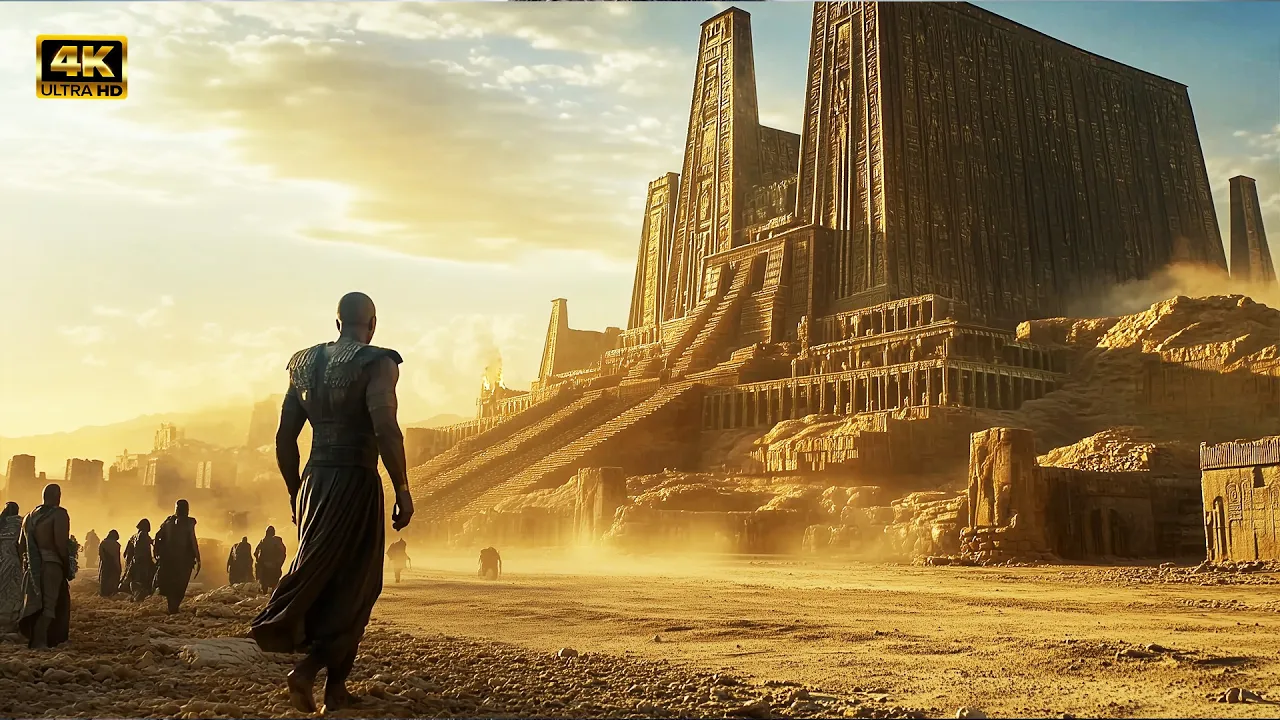
The Lost Golden Age: When Ancient Humanity Was Greater Than We Are Today transcript
Secret Origins · @secretoriginsofficial
Words
3,017
Runtime
23:54
Speaking pace
126wpm
Reading time
13min
126 words per minute, below the 160 25th percentile of 349 measured videos. That distribution comes from the 349-video hook study.
Opening (first 30 seconds)
Before there was history, there was a memory of something better. Every civilization that ever left a written record, and many that did not, preserved the same story. That long ago, in a time beyond the reach of living memory, humanity was different. Wiser. Longer-lived. More capable. More connected to something larger than itself. And that something went wrong. A fall happened. A
63 words, the words spoken in the first 30 seconds at 126 words per minute.
Sentence shape
| Measure | This transcript |
|---|---|
| Sentences | 250 |
| Average words per sentence | 12.1 |
| Longest sentence | 42 words |
| Questions asked | 9 |
| Sentences containing a number | 13 |
Most used terms
- age41
- golden19
- golden age19
- world19
- yuga17
- tradition14
- story13
- humanity12
- years12
- knowledge10
- ancient9
- civilization9
Filler phrases
7 in total: like 4 · kind of 2 · actually 1.
A literal whole-word count of the same phrase list the Prepublish browser extension uses, so a phrase inside another word is not counted and a phrase used in its ordinary sense still is. It is a count and not a judgement.
What this transcript is
Every word below is the caption track YouTube publishes for this video, pulled from the video itself and reproduced unchanged. It is not Prepublish's writing, not a summary, and not a re-transcription: it is the video's own published captions. English captions, published by the channel, in the video’s original language. Source: the video on YouTube. A channel that would rather this page did not exist can ask for its removal through the contact page, and it is removed.
Transcript
Before there was history, there was a memory of something better. Every civilization that ever left a written record, and many that did not, preserved the same story. That long ago, in a time beyond the reach of living memory, humanity was different. Wiser. Longer-lived. More capable. More connected to something larger than itself. And that something went wrong. A fall happened. A catastrophe, or a corruption, or a choice.
And the world that existed before was lost. The Greeks called it the Golden Age. The Hindus called it the Satya Yuga. The Hebrews remembered it as Eden. The Norse spoke of a time before Ragnarök when gods and humans shared the world in harmony. The Aztecs described four previous suns — four previous worlds — each greater than the last, each destroyed before ours. These cultures never met. They developed on opposite sides of the planet, in different climates, in different languages, with no demonstrated contact.
And they all remembered the same thing. The question this video asks is not whether the golden age is a nice story. The question is whether it is a true one. The most detailed account of the golden age in Western tradition comes from the Greek poet Hesiod, writing around 700 BCE. In his work Works and Days, Hesiod describes five successive ages of humanity, each one a decline from the last. The first age was the Golden Age.
The people of that time, Hesiod writes, lived like gods. They knew no toil, no grief, no old age. The earth gave them food freely. They lived in peace, without conflict, without the need to labor. When they died — and they lived for a very long time — they did not truly die. They became spirits, guardians of the living world, watchers over justice and human affairs. After them came the Silver Age. Less noble. Less long-lived.
Already quarrelsome. Then the Bronze Age. Men of terrible strength, given to violence, who destroyed themselves with their own hands. Then the Age of Heroes — a partial recovery, the age of the great myths. And finally, the Iron Age. Hesiod’s own time. An age of toil, injustice, and misery. An age where right is determined by force and fathers are not honored by their sons. Hesiod writes this not as mythology but as lament.
He is mourning a real loss. Something that was and is no longer. And the directionality is deliberate and important. This is not a story of progress. It is a story of decline. Of a humanity that began greater than it is now, and has been falling ever since. The mainstream interpretation is that this is a literary device — a nostalgic idealization of the past, the kind of backward-looking thinking common to cultures in periods of instability.
But Hesiod was not the only one who remembered it this way. In Hindu cosmology, time does not move in a straight line. It moves in a cycle. A vast, turning wheel of four ages called Yugas, each one shorter and darker than the one before, until the wheel completes and begins again. The first Yuga is the Satya Yuga, the Age of Truth. It lasts 1,728,000 years. During this age, righteousness stands on four legs. Humanity is spiritually complete.
There is no disease, no aging, no conflict. People live for extraordinary spans of time, possess abilities that later ages have lost, and exist in direct connection with the divine. The second Yuga, the Treta Yuga, sees righteousness reduced to three legs. Still a high civilization, but with the first shadows. The third, the Dvapara Yuga, sees it stand on two. The world is half what it was. And the fourth — the Kali Yuga, our current age — sees righteousness on one leg.
An age of spiritual darkness, materialism, moral confusion, shortened lifespans, and the progressive loss of higher faculties. The Hindu texts are specific about what humanity loses in each descending age. Not just virtue, but physical and mental capacity. Lifespan shortens dramatically from one Yuga to the next. Memory weakens. The ability to perceive spiritual reality diminishes. Powers that were natural in the Satya Yuga — healing, foresight, direct communication with higher intelligence — become first rare, then legendary, then lost entirely.
The numbers in the Hindu timeline are astronomical. The full Yuga cycle lasts over four million years by traditional reckoning. But some modern researchers have proposed a revised interpretation based on the precession of the equinoxes — the 26,000-year wobble of Earth’s axis — which produces a cycle of roughly 24,000 years, far closer to the scale of human history. On this revised reading, the golden age the Hindus describe was not four million years ago.
It was within the span of modern human existence. Within reach of archaeology. Within reach of evidence. The Hebrew story of Eden is so familiar that it is easy to miss how precisely it fits the global pattern. A perfect world. A direct relationship between humanity and the divine. Knowledge, ease, and a life uncomplicated by toil or death. Then a fall. A choice or a corruption. Expulsion from paradise. The beginning of labor, suffering, and mortality.
The structure of the Eden story is identical to the structure of the golden age story in every other tradition. A higher state. A transition. An irreversible fall into a lesser world. In Norse mythology, the world before Ragnarök is described as a time of harmony between gods and humans, when the divine was accessible, when wisdom flowed freely between the worlds. The coming destruction of Ragnarök is not the origin of evil — it is the end of a long decline that has already happened.
In the Aztec tradition, the current world is the Fifth Sun. Four previous suns — four previous worlds — existed before it, each populated by a different kind of humanity, each destroyed by a different catastrophe. The fourth sun ended in a great flood. The fifth sun, ours, is destined to end in earthquakes. In Zoroastrian tradition, the world was created perfect and has been corrupted progressively by the force of evil since the beginning of time.
In the traditions of the indigenous peoples of the American Southwest, the world has passed through multiple underworlds, each one a rebirth into a new age, but the original world — the first — was the purest. These are not the same story because they were copied from one another. The Greeks did not read the Hindu texts. The Aztecs did not consult the Norse. The patterns are too widespread, too consistent, and too independently expressed to be explained by cultural borrowing.
They are either all independently imagining the same thing. Or they are all independently remembering the same thing. The mythological case for a lost golden age is compelling. But mythology is not evidence. So what does the physical record say? It says something that mainstream archaeology has been struggling with for decades. That the conventional story of human progress — slow, linear, always moving upward — does not match the evidence on the ground.
Göbekli Tepe in southeastern Turkey was built approximately 11,600 years ago. It is the oldest monumental architecture on Earth. Massive carved stone pillars, up to six meters tall, arranged in precise circles, decorated with sophisticated relief carvings of animals and abstract symbols. The organization, the aesthetic sophistication, the engineering required to build it — none of it fits the stage of human development at that date.
By the conventional timeline, 11,600 years ago, humans were hunter-gatherers. No agriculture. No permanent settlements. No surplus production that would allow a workforce to be organized and fed for the years required to build something like Göbekli Tepe. And yet it is there. Not partially there. Not a rough early attempt. Fully realized. Built with a level of intentional artistic and architectural vision that appears in complete form, without any visible developmental sequence leading up to it.
Then, most strangely, it was buried. Deliberately covered over with tons of fill, sealed under the earth, preserved by whoever hid it. Civilizations bury things when they want to preserve them. Or when they want to hide them. Or when something catastrophic is coming and they want to protect what they have built from what is about to happen. Göbekli Tepe is not alone. The megalithic traditions of the ancient world — Stonehenge, Carnac, the structures of Malta, the Nuraghe of Sardinia, the Moai of Easter Island — all share a pattern.
Massive stone construction. Precise astronomical alignment. Skills and organizational capacity that appear without a traceable learning curve. These are not the works of a rising civilization learning as it goes. They are the works of a civilization that already knew. At Sacsayhuámán in Peru, stone blocks weighing up to 120 tons are fitted together with such precision that mortar was not used and a sheet of paper cannot pass between them.
The stones were quarried from a site 35 kilometers away, transported over mountain terrain, and assembled in configurations that modern engineers have said would challenge today’s best cranes and equipment. The builders left no record of how they did it. The Inca, who inherited the site, said it was built by a previous people — giants, in their tradition — who had the ability to move stone through sound. We dismiss that as myth.
But we have no better explanation. Beyond the physical structures, there is the question of knowledge. Ancient civilizations knew things they should not have known. We have explored this across multiple episodes — the Sumerian astronomical records, the impossible precision of Egyptian engineering, the Antikythera mechanism. But the golden age hypothesis adds a specific lens to these anomalies. What if these are not mysteries that require inventing ancient aliens or lost technologies?
What if they are simply the remnants of a world that was, by its own nature, more knowledgeable than ours? The Vedic texts of ancient India describe a form of knowledge called Akashic memory — the ability to access universal information directly, without the laborious process of empirical discovery. In the Satya Yuga, this access was natural. As the ages declined, it faded. The ancient Egyptians described a concept called the Duat — not simply the underworld, but a realm of pure knowledge and cosmic order from which the material world was derived.
The great priests and architects of Egypt drew from this realm in ways that later ages lost the ability to access. What if the Sumerians did not calculate the orbital periods of outer planets? What if they simply remembered them from a time when that knowledge was common? What if the builders of the megaliths did not discover the precise astronomical alignments that run through their structures? What if they inherited them from a tradition so old that the discovery had happened in a previous age?
This is not a claim that can be proven. But it is a claim that the physical evidence does not rule out. Consider the Baghdad Battery — clay jars from ancient Mesopotamia that, when reconstructed with an acidic solution, produce a measurable electric current. Consider the ancient Indian texts that describe surgical procedures, metallurgical processes, and astronomical instruments in detail that Western science would not independently develop for centuries.
Consider the mathematical precision embedded in the dimensions of the Great Pyramid — the ratio of its perimeter to its height encodes the value of π to several decimal places, a relationship that Greek mathematicians would not formally describe until millennia later. Individually, each of these can be argued away. Together, they form a pattern of knowledge that arrived without a visible source. And it is the claim that every golden age tradition is making — that the knowledge we marvel at as our ancestors’ greatest achievements was, to the people of the golden age, simply common understanding.
Every golden age tradition agrees that it ended. They disagree on how. The Greeks blame human hubris. The slow corruption of a race that forgot its divine nature and became greedy, violent, and small. The Hindus blame the nature of time itself. The wheel turns. The Kali Yuga arrives not because of any single catastrophe but because that is what the cycle does. The Hebrew tradition blames a specific transgression. The Norse, a specific battle.
The Aztecs, a specific celestial event. But underneath the moral and theological layers, many of these traditions converge on something physical. A catastrophe. An event from the sky or from the earth. A flood, a fire, a darkness. And the geological record of the end of the last ice age provides exactly this. The Younger Dryas, which began approximately 12,900 years ago, was a sudden plunge back into near-ice-age conditions after a warming trend.
It lasted 1,200 years. When it ended, around 11,700 years ago, it ended with a speed that climate science still cannot fully explain — temperature rises of 10 degrees Celsius in a decade, massive floods from collapsing glacial lakes, sea levels rising rapidly. The period immediately before the Younger Dryas is the same period that researchers identify as the most likely context for a pre-conventional civilization. A civilization that was thriving during the warmer, more stable period.
That was struck by the sudden catastrophe of the Younger Dryas onset. That spent 1,200 years surviving a collapsed world. And that emerged on the other side — in the aftermath, around 11,700 to 9,000 years ago — to begin rebuilding. Some researchers, including Graham Hancock, propose that the Younger Dryas was triggered by a comet impact. The Younger Dryas Impact Hypothesis points to a layer of microscopic diamonds and platinum-group metals in sediment layers at the exact date of the onset — the signature of a large extraterrestrial impact.
A civilization struck by catastrophe. A 1,200-year winter. A population reduced to scattered survivors. That is not mythology. That is how memory becomes myth. Göbekli Tepe was built right at this transition. At the moment when, if the golden age hypothesis is correct, survivors of the old world were preserving what they could of the knowledge they had carried through the catastrophe. The burial of Göbekli Tepe, then, takes on a different meaning.
Not the burial of something they wanted to hide. The burial of something they wanted to save — sealed under the earth against the chaos of a dying age, waiting for a future that could understand it again. Here is the part of the golden age tradition that gets almost no attention. None of the traditions describe the fall as permanent. The Greeks, following Hesiod, describe the ages as a cycle. After the Iron Age runs its course, a new Golden Age begins.
The wheel turns again. The Hindu Yuga cycle is explicit about this. The Kali Yuga ends. Destruction comes. And then the Satya Yuga begins again. A new golden age. A new humanity in a new world. The Aztec tradition describes the end of the Fifth Sun and the beginning of a sixth world — a return to something higher. The Norse Ragnarök is not simply the end. It is followed by Gimlé, a renewed Earth, green and fertile, where surviving gods and humans rebuild in peace.
Even in the Christian tradition, the fall of Eden is not the final word. The book of Revelation describes a new heaven and a new earth, a restored paradise, a return to the original condition. The golden age, in virtually every tradition, is not just a memory. It is a destination. Something to return to. Something that the arc of history, however long and dark the middle passage, is pointed toward. This changes the frame entirely.
If the standard story of history is a line moving upward — from primitive to advanced, from ignorant to knowing — the golden age tradition offers something different. A circle. A spiral. A humanity that was high, fell, endured the long passage through the lower ages, and is moving, however slowly, back toward the height. And if the Yuga cycle is calibrated to the precession of the equinoxes, as some researchers propose, then the cycle has a calculable position.
And on that calculation, we are currently in the ascending arc. The slow climb back toward the light. Which means the golden age is not only behind us. It may also be ahead. Every civilization that ever left a record looked back at the same distant light. A time when humanity was more than it is now. When knowledge was deeper, lifespans were longer, and the connection between human beings and the structure of the universe was something lived rather than theorized.
The physical evidence does not contradict this. Göbekli Tepe stands where it should not. The megalithic structures of the ancient world align with a precision that their supposed builders should not have possessed. The astronomical knowledge of the first civilizations is too detailed to have been built from scratch. Something was there before. Something more capable and more knowing than what came after. Whether you call it the golden age, the Satya Yuga, the Garden, or simply a civilization that preceded our own and was erased by catastrophe — the traces are there.
In the stone, in the texts, in the memory of every culture that survived whatever ended it. The story of humanity is not simply a story of progress. It is a story of a fall, a long survival, and a slow return. And if the traditions are right — if the cycle turns, if the wheel comes back around — then what we are building now is not the height of what we will ever be. It is the bottom of the arc. The turning point. The beginning of the climb back up to the height we have forgotten.
Do you believe humanity has fallen from a greater age? And what do you think that age actually looked like? Tell us in the comments below. Also, drop a like and subscribe to the channel for more ancient mysteries. Keep your minds open, and until we meet again.
The words are the caption track's own and nothing is reworded or re-transcribed. Paragraph breaks are placed between sentences so the text reads as prose.
Use this transcript
Three free tools that work on the material around a video like this one. No signup, no login.
Hook Analyzer
Paste the first 30 seconds of your own draft for a hook score and rewrites.
Policy Pre-Flight
Check your draft against YouTube's advertiser-friendly guidelines before you record it.
Channel Skill Generator
Read this channel's public videos and transcripts, and download a writing brief for it.