Getting the transcript
Reading the captions from YouTube. A video nobody has opened here before takes 10 to 30 seconds; this page fills in on its own.
Getting the transcript
Reading the captions from YouTube. A video nobody has opened here before takes 10 to 30 seconds; this page fills in on its own.
Danny Why · @danny_why
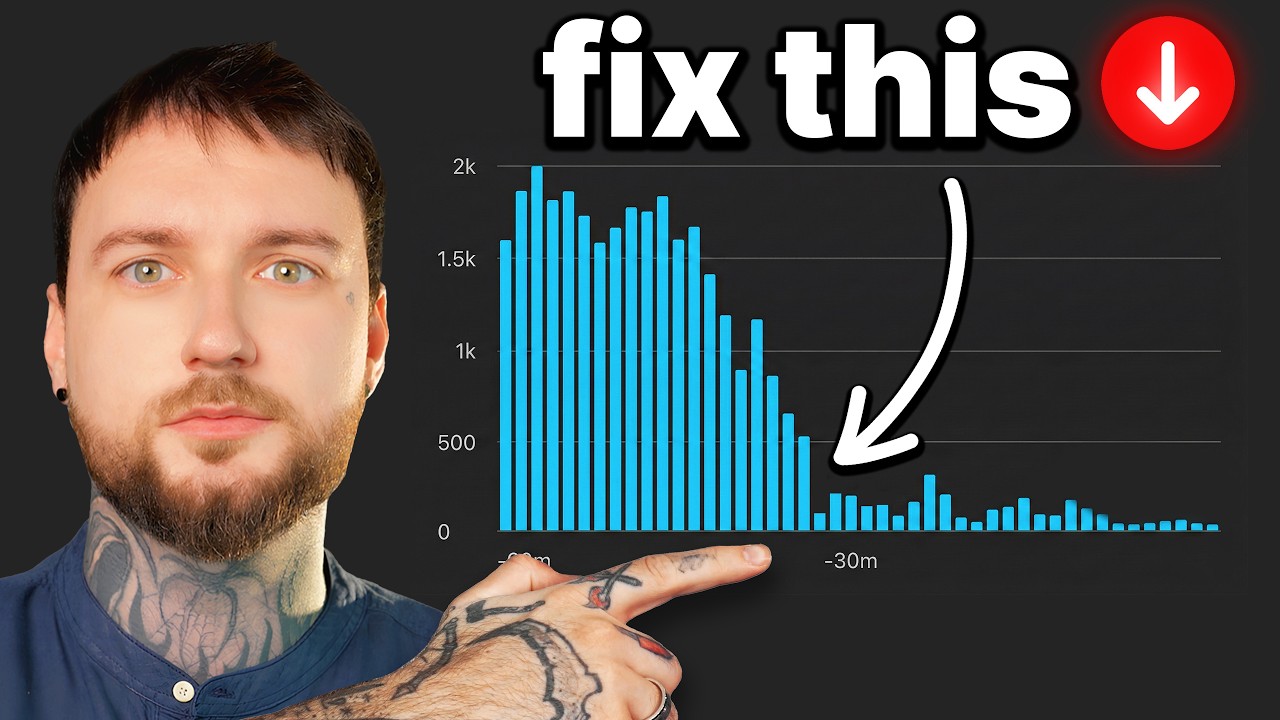
Where viewers went back to watch this video again, from YouTube's public Most replayed graph, lined up with what was said at that moment.
Most replayed moment #1
7:476.9x the video's typical replay level
don't post consistently. You upload one video, then disappear, then you upload again, then disappear for weeks or months. Viewers don't know when to expect your next upload, and YouTube doesn't either. That confusion hurts your channel. YouTube wants consistency.
Said at 7:40
Most replayed moment #2
8:016.9x the video's typical replay level
Viewers want consistency, not because it's fun, but because it builds trust. And I know staying consistent on YouTube is hard. Most people have a job, a personal life, and other responsibilities. Finding time to edit videos, especially shorts, can feel
Said at 7:55
Most replayed moment #3
5:004.0x the video's typical replay level
video, and then upload the next video and get almost nothing. This is where many creators get confused. Here's one of the biggest mistakes creators make. Let me simplify it for you. Let's say you upload a video about Minecraft. When you upload it, YouTube takes its time to understand it. It looks at the video,
Said at 4:52
The graph counts replays. It does not show where viewers stopped watching.
Words
2,229
Runtime
11:37
Speaking pace
192wpm
Reading time
9min
192 words per minute, between the 181 median and the 201 75th percentile of 349 measured videos. That distribution comes from the 349-video hook study.
Opening (first 30 seconds)
In the last 4 months, my YouTube channel gained over 70,000 new subscribers. These are my real analytics and they matter because they prove that growth is still possible right now. But before these 4 months, my channel was stuck for almost a year. During that time, I barely grew at all. Almost every video I uploaded would stop at around 2,000 views, no matter what I tried. If you clicked on this video, there's a good chance you're in the same situation. Your videos are not growing either. They get some views and then they
96 words, the words spoken in the first 30 seconds at 192 words per minute.
Free, no signup. See how the first 30 seconds hold attention, with rewrites.
Sentence shape
| Measure | This transcript |
|---|---|
| Sentences | 197 |
| Average words per sentence | 11.3 |
| Longest sentence | 33 words |
| Questions asked | 5 |
| Sentences containing a number | 17 |
Most used terms
Filler phrases
11 in total: actually 5 · like 4 · you know 2.
A literal whole-word count of the same phrase list the Prepublish browser extension uses, so a phrase inside another word is not counted and a phrase used in its ordinary sense still is. It is a count and not a judgement.
Run the check on the words above: where attention is likely to drop, with a rewrite for each weak line. The free check shows the scores and the one issue costing the most.
What this transcript is
Every word below is the caption track YouTube publishes for this video, pulled from the video itself and reproduced unchanged. It is not Prepublish's writing, not a summary, and not a re-transcription: it is the video's own published captions. English captions, generated automatically by YouTube, in the video’s original language. Source: the video on YouTube. A channel that would rather this page did not exist can ask for its removal through the contact page, and it is removed.
In the last 4 months, my YouTube channel gained over 70,000 new subscribers. These are my real analytics and they matter because they prove that growth is still possible right now. But before these 4 months, my channel was stuck for almost a year. During that time, I barely grew at all. Almost every video I uploaded would stop at around 2,000 views, no matter what I tried. If you clicked on this video, there's a good chance you're in the same situation.
Your videos are not growing either. They get some views and then they just stop. And you have probably watched many YouTube videos about growth. You have tried different titles, thumbnails, and ideas, but your channel still doesn't move forward. So, the real question is not whether YouTube still works. The real question is, why do some channels suddenly start growing while others stay stuck for months or even years? In this video, I'm going to show you how the YouTube algorithm works right now and the mistakes that keep most channels stuck.
I'll also show you what my own analytics made very clear because for months my channel didn't grow at all. And then something finally changed. There's something very important for growing on YouTube that almost nobody talks about anymore, especially YouTube gurus. Everyone talks about the algorithm and yes, I will talk about that in this video, too. But there's something else that matters even more than people think.
Years ago, YouTube even pushed this idea on the homepage. Creators talked about it all the time. Today, it feels like people forgot it exists. And here's the interesting part. This one thing can make your views move faster even before the algorithm fully understands your channel. Let me tell you a simple story so it makes sense. Imagine two people selling chocolate. The first person sells normal chocolate. People buy it, they enjoy it, and that's it.
The second person also sells chocolate, but one day they create a new version, chocolate with yogurt inside. At first, it's just a weird idea. A few people try it and they say, "Wait, this is actually good." But then, those people tell their friends. Their friends try it, too, and then they tell other people, too. Soon, people start talking about it like, "Hey, have you tried the chocolate with yogurt inside?" Now, more people want to try it, not because normal chocolate is bad, but because everyone is talking about this one new thing.
That talking creates attention. That attention creates curiosity, and that curiosity creates a trend. Once a trend starts, it grows by itself. People don't want to feel left out. People want to know what everyone else is talking about. They want to try it just so they can have an opinion about it, too. So, people who start selling yogurt chocolate start getting way more customers, not because they are a better seller, but because they are part of what people are already paying attention to.
They are riding a trend. That's the real lesson. Trends are not just random TikTok challenges. Trends are what happens when many people start caring about the same thing at the same time. And YouTube is full of trends, even today. The problem is most creators ignore them. They focus only on good content and the algorithm. Then they wonder why their videos keep stopping at the same view count. But when you understand trends, you can make videos that people click faster, and that gives the algorithm a much stronger signal to push your content.
Now, let me show you how this connects to my channel. Look at these two videos. Video A was posted 5 days ago. It has 150,000 views. Video B was posted almost 12 days ago. It has 43,000 views. Video A got more views in less time. That part makes sense, but here's where it gets strange. Video B actually had better numbers, higher click-through rate, higher average view duration. YouTube even showed a green arrow next to the statistics.
So, why did the video with worse statistics get triple the views? Think about that for a second. Most creators believe good numbers equals good views. I thought that, too, but I kept seeing these examples, videos with amazing click-through rate and amazing view duration that went nowhere. And then videos with okay-ish numbers that did very well. Almost went viral. It made no sense. So, I started looking for an answer.
What did the successful videos have? What was different? And I did notice something. The videos that did well were always about something current, something many people wanted to know about right now. This is why video A beat video B. Video A was on a trend. Video B was not. This is also why some creators get views with bad thumbnails. They're on a trend even if you don't notice it. Now, if you're wondering what the trend was for video A, it's actually quite simple.
The YouTube algorithm changed. YouTube started using more AI and suddenly a lot of people are talking about the YouTube algorithm. That's a trend. So, if you want to grow faster on YouTube, find a trend and jump on it. But, trends alone are not enough. You can join a trend, get views on one video, and then upload the next video and get almost nothing. This is where many creators get confused. Here's one of the biggest mistakes creators make.
Let me simplify it for you. Let's say you upload a video about Minecraft. When you upload it, YouTube takes its time to understand it. It looks at the video, the audio, the title, the thumbnail, and the description. Then it slowly starts showing it to people. The goal of the algorithm is simple. Find people who like Minecraft and show the video to them. And the most of the time it actually does this very well. Now, imagine you upload another video, but this time it's about Counter-Strike.
YouTube will first show that video to the same people who watched your Minecraft video. But, those people don't care about Counter-Strike, so they don't watch it. Because of that, your video gets low watch time and YouTube stops pushing it. Not because the video was bad, but because it was shown to the wrong people. This happens because YouTube keeps data about your channel. If you post Minecraft videos, YouTube thinks your channel is about Minecraft.
When you suddenly switch topics, YouTube gets confused. And so, the next video you upload will be shown to a mixed audience, and that can hurt your performance. This is why niches matter, especially for small creators. You're not helping the algorithm by changing topics. You are slowing it down. If you want YouTube to understand your channel faster, pick one topic and stick to it. Now, sticking to one topic is harder than it sounds.
This is where most small creators struggle. If you look at big channels, you can clearly see how this works. A big Roblox channel only uploads Roblox videos. A big Minecraft channel only uploads Minecraft videos. A big vlog channel only uploads vlogs. They do not mix everything together. This is not a coincidence. This is one of the main reasons they grow. YouTube understands exactly who their videos are for, and viewers know what to expect when they click.
But, even if you do those things, join trends, and stick to one topic, your videos can still stop growing if you're missing one more thing. And this is where a lot of creators fail. As usual, let me explain it with a simple story. Imagine when you were younger going to school every morning. Next to your school, there was a small store that sold food. Every morning before school, you would stop there and buy something to eat.
You knew the store was always open. You trusted it. Then one day, the store is closed. The next day, it's closed again. And a few days later, it opens, and you're happy about it. But, the next day, it's closed again. After that, it stays closed for many weeks. And because the store lacks consistency, you stop trusting it. You have no idea if today you're able to go to school and buy food or not. But, 3 minutes away from school, there's another store that is open every single day.
So, you go to that store because you know for sure that store is always open. You can always buy food. This is exactly what happens on YouTube when you don't post consistently. You upload one video, then disappear, then you upload again, then disappear for weeks or months. Viewers don't know when to expect your next upload, and YouTube doesn't either. That confusion hurts your channel. YouTube wants consistency. Viewers want consistency, not because it's fun, but because it builds trust.
And I know staying consistent on YouTube is hard. Most people have a job, a personal life, and other responsibilities. Finding time to edit videos, especially shorts, can feel overwhelming. They first start strong, but then they miss uploads, and then they stop posting because it takes too much time and energy. That's why I recommend Nexus Clips. It helps turn one long-form video into multiple short clips very fast. I don't spend hours creating shorts.
I just post my long-form videos inside Nexus Clips, create three shorts, and then I just schedule them on YouTube. So, if you want to save time and stay consistent, the link to try Nexus Clips is down in the description. You can also use code Daniel to get a 10% discount. Now, let me show you the most important thing I learned about YouTube. This was the moment when everything started to make sense for me. Not in theory, but in real life.
This is also the reason I can usually tell, just a few hours after uploading, if a video is going to grow or if it's going to stop. I want to be very clear before we start. This is not a rule that works the same for everyone. It depends on your niche, your video length, and even trends. But based on my own experience with this channel and my faceless channels, this pattern keeps repeating. So, I will use a simple example.
A 10-minute video. When I upload a 10-minute video, there's one main thing I look at first, average view duration. From my data, if that video does not reach at least 3 minutes of average view duration, it almost never grows. 3 minutes on a 10-minute video means about 30% retention. This is the baseline. If it goes higher, like 3 and 1/2 minutes or 4 minutes, YouTube starts pushing the video more and more. Then comes click-through rate.
At first, it's high because subscribers click, but as impressions grow, it drops. That is normal. From what I have seen, once a video reaches around 100,000 impressions, it needs to stay between 5% and 10% click through rate to keep growing. If it drops below that, the video usually slows down and then stops growing. When I don't hit these numbers, my videos get stuck. But when I do hit these numbers, my videos grow more and more.
So, if you're confused about average view duration and click through rate, now you know the minimum requirements for a 10-minute video. Now, I want to share the most important thing I learned about growing on YouTube. When I started this channel Danny Wyatt, I already had experience. I had built faces YouTube channels with millions of subscribers, as you can see in the background. I understood the algorithm. I thought this was going to be easy, but it was not.
For 9 months, nothing worked. My channel barely grew, and that messes with your head. I started asking myself if I actually knew what I was doing. Maybe I just got lucky before. Maybe YouTube with my face just doesn't work for me. And these emotions and this anxiety can be very hard for a person. But then, suddenly, my channel started growing. And what I learned is this: even if your videos are good, even if you do everything right, sometimes you just need time.
There are millions of videos uploaded every day, millions of creators. Sometimes YouTube just needs more data, more proof that you are serious or consistency. So, don't let emotions destroy you if things don't work out right away. I've been there, and I have data and the analytics to prove it. But if you're still feeling stuck, and you feel alone, or you just want direct help from me, this is why I built my private community.
Inside, you can chat with me and other creators. You can post your channel, and I will review your channel and tell you what to improve. So, if you're struggling to grow your YouTube channel and you need help, just join my private community. There's going to be a link down in the description. And also, if you want to learn more about the algorithm, you should also watch this video over here, because this video over here will help you understand the YouTube algorithm even better.
The words are the caption track's own and nothing is reworded or re-transcribed. Paragraph breaks are placed between sentences so the text reads as prose.
Free tools for your own script: paste a draft and see where it stands before you record it.
Paste your draft and see where viewers are likely to drop off, with a rewrite for each weak line.
Paste the first 30 seconds of your own draft for a hook score and rewrites.
Check your draft against YouTube's advertiser-friendly guidelines before you record it.
Read this channel's public videos and transcripts, and download a writing brief for it.