Getting the transcript
Reading the captions from YouTube. A video nobody has opened here before takes 10 to 30 seconds; this page fills in on its own.
Getting the transcript
Reading the captions from YouTube. A video nobody has opened here before takes 10 to 30 seconds; this page fills in on its own.
HealthyGamerGG · @HealthyGamerGG
Words
3,533
Runtime
16:57
Speaking pace
208wpm
Reading time
15min
208 words per minute, above the 201 75th percentile of 349 measured videos. That distribution comes from the 349-video hook study.
Opening (first 30 seconds)
If you ask the average woman, what do you lose when you get divorced? What they will say is I lost a relationship. If you ask a man, what did they lose? They will say, I lost a life. Right? This life is now gone. All right, chat. Today we're going to talk about how to successfully navigate a breakup. So, I've been meaning to make this video for a while because there's a lot of advice out there and a lot of the advice, I got to just be honest with you all, kind of like pisses me off. So, here's an example.
104 words, the words spoken in the first 30 seconds at 208 words per minute.
Free, no signup. See how the first 30 seconds hold attention, with rewrites.
Sentence shape
| Measure | This transcript |
|---|---|
| Sentences | 263 |
| Average words per sentence | 13.4 |
| Longest sentence | 65 words |
| Questions asked | 37 |
| Sentences containing a number | 12 |
Most used terms
Filler phrases
97 in total: like 57 · actually 14 · right? 13 · kind of 8 · you know 2 · basically 1 · literally 1 · sort of 1.
A literal whole-word count of the same phrase list the Prepublish browser extension uses, so a phrase inside another word is not counted and a phrase used in its ordinary sense still is. It is a count and not a judgement.
Run the check on the words above: where attention is likely to drop, with a rewrite for each weak line. The free check shows the scores and the one issue costing the most.
What this transcript is
Every word below is the caption track YouTube publishes for this video, pulled from the video itself and reproduced unchanged. It is not Prepublish's writing, not a summary, and not a re-transcription: it is the video's own published captions. English captions, generated automatically by YouTube, in the video’s original language. Source: the video on YouTube. A channel that would rather this page did not exist can ask for its removal through the contact page, and it is removed.
No Script X-ray for this video: YouTube shows a Most replayed graph only once a video has enough views.
If you ask the average woman, what do you lose when you get divorced? What they will say is I lost a relationship. If you ask a man, what did they lose? They will say, I lost a life. Right? This life is now gone. All right, chat. Today we're going to talk about how to successfully navigate a breakup. So, I've been meaning to make this video for a while because there's a lot of advice out there and a lot of the advice, I got to just be honest with you all, kind of like pisses me off.
So, here's an example. Fear doesn't stop death. Fear stops life. Fear doesn't stop the end of a relationship, fear stops the relationship. And like this is great, right? Like, oh my god, like fear is not the avoidance of death. It is the avoidance of life. Oh my god. Fear isn't what saves a relationship, fear is what destroys a relationship. And so, the first thing that that I kind of noticed when I was like looking at dating advice or breakup advice on the internet is that what determines the advice that you see has nothing to do with outcomes.
It has everything to do with the emotional state of the person who has recently broken up. So, if I've been dumped, which video am I likely to click on? Which video empathically resonates with me? Because when I hear statements like this, like there's some value to it, right? Like absolutely, fear does prevent us from doing certain things in life that are good for us. Like that's like actually like obviously. But also, if I'm afraid that my boyfriend or a girlfriend's bestie at work who happens to be the gender that they're attracted to, their work husband or their work wife, if I'm afraid of their relationship, that fear can be very helpful in saving the relationship.
If I'm going on a date with someone who's kind of a creep and is like, "Hey, do you want to come back to my place? I have a really great meal prepared for you. Please come back. Don't go." Fear in that situation doesn't prevent life, it prevents death. Which is the basic problem with a lot of the dating advice out there, right? And everyone is sure that this is what you should do after a breakup. And the key thing is if you're seeing it on the internet, what's determining that is the level of emotional engagement with the post.
So, a great example of this is a lot of people will say, "Number one rule after a breakup is it no contact. Just go no contact, bro. No contact. Avoid them. Get rid of all the reminders." So, here's a a channel which I think has pretty good information about it. And this is what I find a little bit, honestly, frustrating. I'm a psychiatrist. And the problem is like when I'm trying to help people through a breakup, they're like real people in real lives.
And something like going no contact simply is not a luxury for like 45 to 50% of people. You have a shared friend group. You are married and have kids. And then, how are you supposed to go no contact and delete everything and block them if you're sharing children? And so, in my journey to help the people in my office, what I sort of dug into and what I found is ultimately like the way to get over breakups. And this is a concept called equifinality.
So, this is this concept which will will kind of go over. This is this concept that you can use a lot of different strategies. And you can use strategies like avoidance, actually emotional avoidance. A lot of people will tell you things like feel your feelings. Actually, you don't need to do that. A lot of people will employ problem-focused coping. So, this is where like we're not just going to journal and talk about our feelings and things like that.
We're actually going to And this is a lot of advice on the internet are like, "Just just go lift, bro. Like put yourself together. Go lift. Hit the gym. Start putting your life together. Like fix your car. Fix your house. Start cooking. Get into shape." Like people will offer this advice. And then there's a lot of advice around feeling your feelings. You should grieve. You should grieve this way. Like grieve and accept.
But then the other problem is that feeling your feelings can sometimes become damaging. So, if you allow yourself to feel your sadness, what a lot of people will discover is that their sadness will run away from them. So, I'll give you guys a a simple example. So, people will say, "Okay, grief is about like accepting, right? That this is over. You have to feel your feelings. But I've worked with people who accept, hey, that relationship is gone.
She's moved on. He's moved on. They're married. They have kids. That's never going to be an option again. I've accepted that that's over. And oh my god, I'm still here. I'm so sad. People say feel my feelings, but I cry every single time I think about it. Or even people don't feel that. Often times what they feel is just immense numbness. They feel a sense of like being trapped in amber post relationship. They don't really know who they are.
And they just kind of keep muddling through life. They keep repeating things, but they somehow feel stuck. So this is a problem, right? Because how am I supposed to feel my feelings, but not get stuck? So there is the sadness of the relationship. And then there is the projection that comes afterward. So the grief of a relationship, the sadness of relationship, that's good. That's healthy. We want to feel those feelings.
The problem is when we start ruminating, and I'll tell you guys exactly what rumination is. It's repetitive thoughts. That's when we start to get stuck in time. So what keeps us stuck? It's not the feeling of the breakup. It's all the projections that we make from it. So the moment that I start focusing on the sadness of the breakup, I'm never going to see them again. That's actually okay. But if we add another layer to it, we start thinking about what they're going to do, how they're living their life.
Now I've I've technically moved away from the feeling of the breakup. Now I'm thinking about their life, how happy they are. I'm looking at their pictures. By the way, that's another thing that you want to avoid don't stalk them on the internet. That prolongs the suffering of a breakup. But now you've stepped away from the grief of the actual relationship into a second order connected thing. Y'all, if y'all want to learn a little bit more, by all means watch another YouTube video.
If you guys are actually interested in finding the practical tools to change on your own, that's where memberships comes in. And if y'all are interested in getting some help or achieving a particular milestone 4 weeks, 8 weeks, or 12 [music] weeks from now, check out coaching. So, if you all are interested, check out the link in the description below. Another example of this is if you start to project about yourself in the future.
So, yes, this is sad, but now I don't know who I am. Now I'm going to be alone for the rest of my life. Now, oh my god, like things are so unfair for men or so unfair for women. I devoted the best years of my life to this person. This is different from I'm never going to see this person again. We're never going to have a relationship again. Now I'm projecting outward. And what the data shows is what keeps people stuck is the second order thinking.
The thinking that grows out of the initial relationship grief. So, in terms of how do you actually go about disciplining your thinking? What's the right level of emotion to feel? You can feel anything related to the breakup, but be careful the moment it grows into something else because that will keep you stuck. The key thing, and this is what's really interesting from the research, is all of these strategies lead to one place, which is equifinality of self-concept.
So, what does that mean? So, if you look at breakups that are devastating, some of the most devastating breakups are relationships that happen early in life. So, if I'm like a 17-year-old kid and I date somebody else who's, let's say, 17. We date all throughout college and then 23 rolls around, 24 rolls around, and we're like, "Okay, what should we do next? We should get married." That's the natural trajectory. So, then we get engaged, but then things like tend to fall apart, right?
Sometimes you get married and then they fall apart a couple years later. Sometimes they fall apart during the engagement. And the reason that this is so devastating is because of the core thing that allows you to recover from a breakup. And that is self-concept. So, I'll give you guys an example. So, let's say I'm a 43-year-old man and you and I go on a date. And we date for about 3 months and then we break up and it's like not that big of a deal to me.
Why is that? That's because I had an identity of who I was before we started dating. And then if we date for 3 months, I have an identity of who I am after we stopped dating. And that identity is relatively the same. So, I haven't changed who I am because of the relationship. And so, if you look at like a huge factor that causes distress post breakup, it is self-concept. And this is why the first relationship that you'll have, especially if you're young and if it lasts a long time, is so devastating.
Because when we started dating, I was a 17-year-old teenager. I didn't really know who I am. And then as we went through college, I became this person, but the person that I became was heavily shaped by you. And so, we have data that shows that when we enter into relationships, we actually develop a new sense of identity, right? It's not just that you complete my sentences. Oh my god, we complete each other's sandwiches.
It's that oh my god, we become one person via two souls. We're one soul in two bodies. We are like one object that is like split. Oh my god. Right? This is the sentiment. So, we develop a sense of identity, and this is why a breakup is so devastating. Because when you lose that relationship, what you lose is your identity. And the key equifinal point of all of these different breakup adaptive coping strategies is to restore your self-concept.
And these are the kinds of things that are really important to understand. Because if you're trying to navigate dating in today's world, you have to really like cut through all the evidence, cut through all the social media, and find that core thing. Which is what we try to do in Dr. K's Guide to Love, Sex, and Relationships. And we do it for like dating and attraction and charisma and and breaking up and emotional baggage and all this kind of stuff. let's get into the idea of self-concept.
And this is what's so scary about this idea of self-concept. So, there's some really interesting data about men and women who end up breaking up. And one of the really fascinating things is one of the highest risk factors for myocardial infarction or heart attack for a man is during a breakup or during a divorce. And there's something's called specifically called takotsubo cardiomyopathy, which is literally inflammation of the heart that is highly specific to men post breakup.
And so, this is what's really interesting is like why is that? And so if you tunnel down into why that is, what you discover is a really interesting psychological aspect to this. If you ask the average woman, what do you lose when you get divorced? What they will say is I lost a relationship. If you ask a man, what did they lose? They will say, I lost a life. Right? This life is now gone. Their identity, this is what's kind of interesting and I'm not saying it's easier for men or harder for men or things like that.
I'm using it as supporting evidence for this idea that the more your identity is tied up in the relationship, the worse the breakup is going to be. So let's dive into some data. So the first thing that really shocks people is the median time to get over a breakup is 4.18 years. So people think like, oh six months later like I'm done. No, it's actually like So first thing is if you've gone through a breakup, chances are that will have lingering effects on you for an average of four years.
Now there's a pretty wide range there. So give yourself some time, okay? Second thing that's really interesting is that there are a lot of factors that do prolong the attachment that we have to people. So this is where people who said, you know, you should cut off all contact, it turns out that the more avoidant you are, the faster you will get over a breakup. Second thing that's kind of interesting is the more anxious you are, the slower you get over a breakup.
And this is where we have to be a little bit careful with some of this generic advice around feel your feelings. Because if the goal is to feel your feelings and your feeling is anxiety, that can actually prolong the amount of time that you're hung up on this person. Couple of other really interesting factors, not surprising. If you were the person who initiated the breakup, you are more likely to bounce back faster.
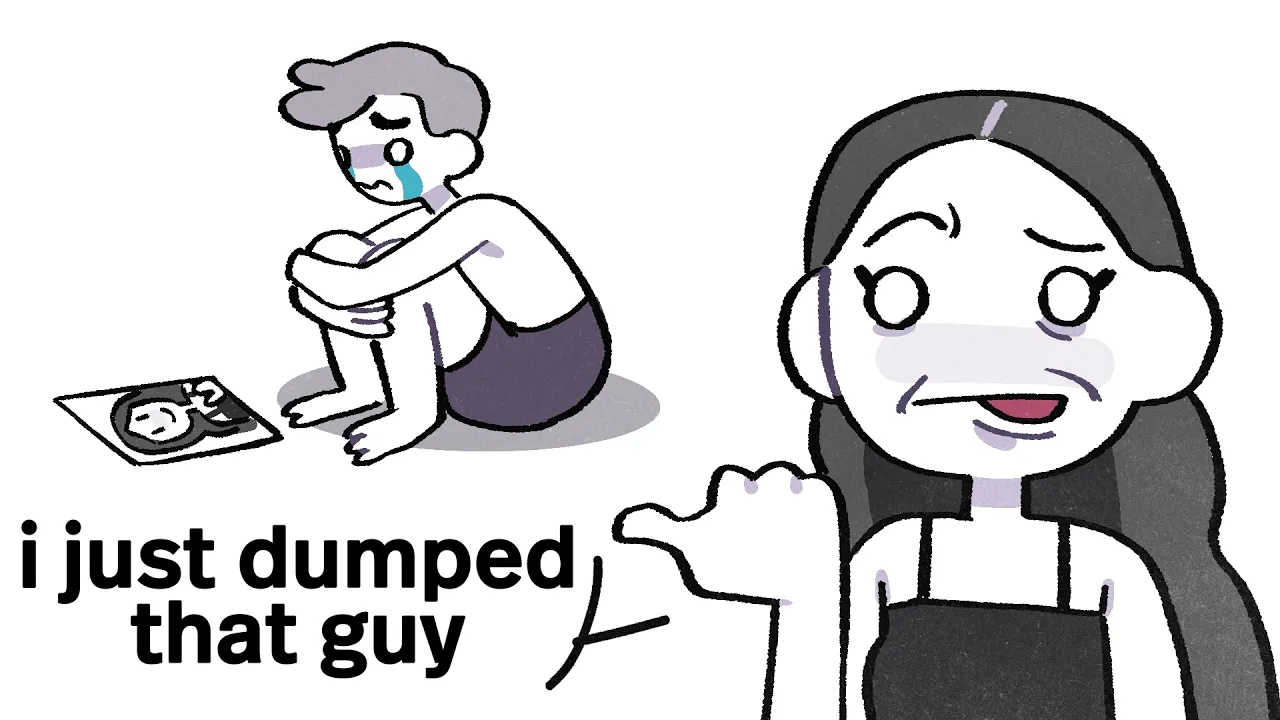
If you were the person who got dumped, you are more likely to linger with an attachment of that person. Last thing that isn't really too big of a surprise is if you enter into another relationship, that will help you get over the prior relationship. So this idea of like, you know, the rebound relationship actually has a lot of merit because it probably helps you get over the previous person. It's not that the common wisdom or the social media sentiment is all wrong, instead a lot of it is contradictory and incomplete and we really want to get to that equifinality point of resolved self-concept.
We want to become a new person, okay? So now the question becomes how do we do that? So this is where I think the best strategy is something that's called an activating deactivating strategy which means we want to muster up the right amount of emotion, that's an activating strategy, so we can do things like have a conversation about closure. Oh my god, we can do things like take a look at the pictures that we have and have the fond memories of that person.
That is an activating element, so that will bring up some level of emotion. And if you look at the process of grief, it's not like the antidote to grief is, "Oh my god, my wife of 40 years has passed away. Let me burn all of her pictures." That's not how we grieve and it's not how we need to grieve. Instead, what we want to do is those will activate some degree of emotion which is part of the healing process. So studies on trauma show that people who are able to experience intense emotion for a brief period of time are less likely to develop PTSD.
People who go hard avoidance and numb themselves have a greater rate of developing PTSD. So we want to use activating strategies, let that emotion come up. It doesn't just have to be through conversations or pictures or whatever. It can be through conversation, so we want to activate the emotion. It can also be through exercise. And then we want to use deactivating strategies. So if we're trickling into rumination, if we're starting to get super depressed about it, we want to use deactivating strategies which include things like emotional avoidance, which include things like hanging out with your bros or going on a girls' trip, which include things like camping, which include things like lifting.
I don't know if you guys have felt emotionally bad ever, but if you like go to the gym and you work out really hard, it helps so much with your emotions. So, what we basically want to do is titrate a level of activation and deactivation with our emotions so that it doesn't get overwhelming and keep us stuck. And so, here's the cool thing. If we look at the equifinality of self-concept reinvention, which I know is a a mouthful, all of these things will actually lead there.
So, if you talk to people about your relationship, that can help you get there. If you start solving problems that are either emotional in nature, start to feel emotionally better, or to just start to put your life together, get a job, get a promotion, hit the gym, get in shape, all of that stuff will help you develop self-concept. The last two things that I'll share with y'all are concrete things that will directly develop self-concept.
The first is to start living in service to what you truly care about. So, often times in relationships, we make compromises. So, I really love dogs, but I had to give up my dog because my partner is allergic. So, then get a dog. Really spend some time thinking about not what you want, what you care about, and then start to do things in service to that. So, how can you live a life where on a daily basis or weekly basis, you are doing something in service to what you care about, whether that's helping other people, whether that's learning how to write or acquire a skill.
This isn't just like vague self-development. This is really spending some time with yourself and figuring out what you care about and what you can do in service to that. The second thing, this is really important, arguably more important, is broadening your self-concept. So, generally speaking, as a psychiatrist, when I'm dealing with someone who has self-concept problems after a breakup, their biggest problem is that their identity is defined in this box, and half of the box is taken up by another person.
So, a lot of mistake that people do is they try to like fill in that box, right? This is where the rebound relationship comes in, which can be fine. But, the key thing here is we need to expand that box. So, who can you now become? You used to think of yourself. So, I've seen this a lot, especially with like women, who will start a relationship really young, will tend to have kids, become a stay-at-home mom. So, this is a really classic example.
And then at the age of 35, they they get divorced. And they've been dating this person since the age of 17. And so, they define themselves as a stay-at-home mom, as a good mother, as a good wife. So, what is their road? It is a broadening of their sense of self-concept. So, the key thing is what more can you be, right? And don't think about what you are or what you were, but like who else can you possibly become? And the last thing is we focus on equifinality of concept, but there are a lot of options in there.
And this is where who you are actually heavily influences what will work for you. Here's a paper, for example, that shows that there's a personality type that is capable of remaining friends after a breakup. Right? So, should you stay friends? Should you not stay friends? You'll get generic yeses and nos for all kinds of reasons on the internet, but it actually depends on the person. The more open you are and the more agreeable you are, the easier it is or the better it is for you to stay friends.
So, this is where when it comes to relationship stuff, we have these resources like there's this great deep dive into attachment styles and relationships, where if you understand what your personality is, our members have told us this is one of the best deep dives we've done, and it really gives them insight into their own making, so that they can navigate relationships better. Check out the link in the description below for your free trial.
The words are the caption track's own and nothing is reworded or re-transcribed. Paragraph breaks are placed between sentences so the text reads as prose.
Free tools for your own script: paste a draft and see where it stands before you record it.
Paste your draft and see where viewers are likely to drop off, with a rewrite for each weak line.
Paste the first 30 seconds of your own draft for a hook score and rewrites.
Check your draft against YouTube's advertiser-friendly guidelines before you record it.
Read this channel's public videos and transcripts, and download a writing brief for it.