Getting the transcript
Reading the captions from YouTube. A video nobody has opened here before takes 10 to 30 seconds; this page fills in on its own.
Getting the transcript
Reading the captions from YouTube. A video nobody has opened here before takes 10 to 30 seconds; this page fills in on its own.
Chase Hughes · @chasehughesofficial
This video has no Most replayed graph yet: YouTube shows one only once a video has enough views. These are the moments viewers replayed most in Chase Hughes's most watched videos.
Most replayed moment at 11:57
3.5x that video's typical replay level
an emotion. You have only ever stuck them together. You've assembled them. And how do we assemble emotions? One prediction at a time. It happens so quick, we experience this assembly as like, "Oh, that's the truth. I had a gut
Said at 11:51
The graph counts replays. It does not show where viewers stopped watching.
Words
3,131
Runtime
21:45
Speaking pace
144wpm
Reading time
13min
144 words per minute, below the 160 25th percentile of 349 measured videos. That distribution comes from the 349-video hook study.
Opening (first 30 seconds)
I'm going to put an image up on the screen right now. Magically. I want you to just take a look at this. Just stop whatever you're doing, take a look, really absorb what's in front of your eyes right now. It's not an optical illusion. So, it's a a photograph on your screen and it's the same object. It's two different photographs of a a downspout, like a a rain gutter.
72 words, the words spoken in the first 30 seconds at 144 words per minute.
Free, no signup. See how the first 30 seconds hold attention, with rewrites.
Sentence shape
| Measure | This transcript |
|---|---|
| Sentences | 251 |
| Average words per sentence | 12.5 |
| Longest sentence | 60 words |
| Questions asked | 17 |
| Sentences containing a number | 31 |
Most used terms
Filler phrases
47 in total: like 24 · uh 10 · actually 5 · right? 5 · kind of 3.
A literal whole-word count of the same phrase list the Prepublish browser extension uses, so a phrase inside another word is not counted and a phrase used in its ordinary sense still is. It is a count and not a judgement.
What this transcript is
Every word below is the caption track YouTube publishes for this video, pulled from the video itself and reproduced unchanged. It is not Prepublish's writing, not a summary, and not a re-transcription: it is the video's own published captions. English captions, generated automatically by YouTube, in the video’s original language. Source: the video on YouTube. A channel that would rather this page did not exist can ask for its removal through the contact page, and it is removed.
I'm going to put an image up on the screen right now. Magically. I want you to just take a look at this. Just stop whatever you're doing, take a look, really absorb what's in front of your eyes right now. It's not an optical illusion. So, it's a a photograph on your screen and it's the same object. It's two different photographs of a a downspout, like a a rain gutter. So, it's only job, it's built to take water off of the roof and stick the water down on the ground.
So, on the left side here, it's got this bronze, it's got scales and fins, it's a open mouth of this fish for water to come out of, and uh it's this curled up, I think it's called an acanthus leaf, uh holding this thing up against the wall. >> [music] >> Somebody drew that thing. Somebody cast it out of bronze. Somebody's probably entire couple of days went into making that thing. And seeing things like this, there's something in me that that I can't get past when we look at it.
The The thing that that I think no one really notices is that nobody was supposed to really look at that thing. You're not supposed to just stare at it and look at it. It's a gutter. [music] It's on the side of a building and it's at your the height of your ankle and it's a probably around the corner from nothing that anybody gives a So, none of your clients are walking past it and saying, "Oh, let's go look at the fish gutters today." So, nobody in the history of that building ever stopped while they're walking and said, "Wow, that is a hell of a downspout.
That's a hell of a gutter right there." So, it sits in exactly the spot where you put the cheapest possible thing that works and somebody carved a fish into that mofo anyway. So, the right side of that image is what we do now, the galvanized pipe, the little uh elbow bracket. It works and maybe it'll outlast the fish. I doubt it. I seriously doubt it. But, I don't want to argue about which one is better because that's happening right now in the comments, right?
You're seeing all these comments go by. People are like, "Oh, I'm I can predict what's going to happen." Uh this is what we're going to do. We're not going to talk about which one's better because you already knew, and you knew it in under a second. Your brain did that. You didn't need You didn't need a a master's in architecture to to know that. The useful part here isn't that the old one is prettier. Everybody gets that far.
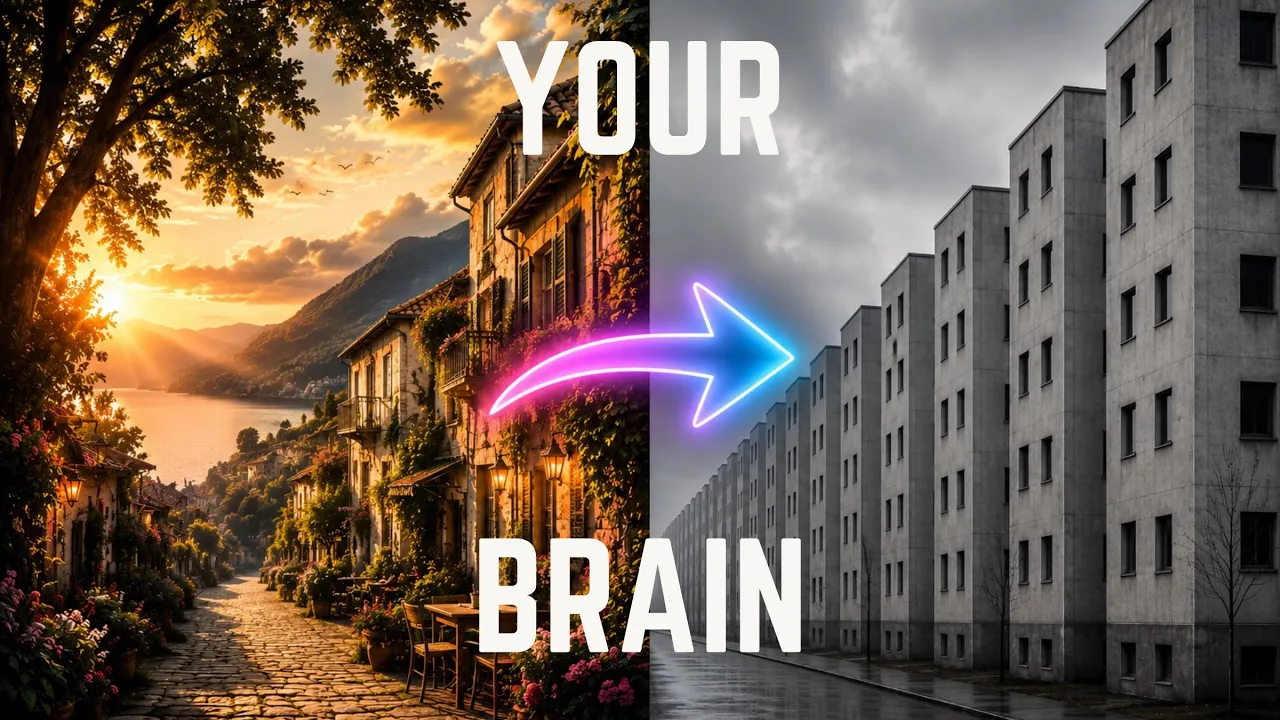
Everyone. And a 6-year-old can see that. It's a dead end, right? But, if you look at the right side of that photo, that galvanized pipe, here's what I want you to really think about. I want you to try to hold your eyes on that. Can't. There's nowhere for your your mental attention to sit to to just hold on to something. It's like your eye just slides off of that thing. Then, half of your brain, after about 1 second, files the entire thing as nothing, and your brain quits rendering it.
And I want you to remember that phrase, your brain quits rendering the pipe. So, what happens? What what happens in this little exchange? We think like, "Oh, cuz I have good taste. I'm looking at something that's beautiful. I know what I know what beauty is. I can see this thing." That's not what it is. What's happening is a created perception problem, and I'm going to prove it to you. And a long time ago, I wrote a chapter in a book about this, and I I think I had no idea what I was writing about at the time.
So, there's a section if if you look inside of the ops manual, there's a section on derealization. So, this is a a state in our mind when the world starts feeling flat and artificial like a like we're having a dream. It's where the environment either has a crap load of overwhelming detail or almost none of it. Like you've been in a grocery store before, like a Walmart or whatever, and there's 6 million little things and you don't really your peripheral vision gets destroyed.
Your brain just can't keep up with it, right? So it's a little more derealization. It's the same in the other direction. So I wrote about it in the book about what you do to a person when you need that person to be softer, more suggestible, and you need that person to be less able to keep a really good record, to keep a awareness of what's happening to them. You want them to have less awareness of what's happening to them. >> I do not know this person, but her name is Andrea.
She lives in Westerville, Ohio. She's an office manager. She drives a 2014 Tundra still, so she keeps things for a long time. She spent a few years moving from house to house to house until 5 years and 2 months ago something happened in her life and then she departed from a joint residence, it looks like. And it looks like her father passed away in 2016. Uh his name is Robert. And her kids' school is listed on here. There's also a cabin rental once a year where she takes a vacation, spends about $1,400 on that.
There's also social media use and photo sharing apps with her daughter's face visible on them. And I'm kind of getting to like her. I have a lot of stuff in common with her. Interesting. And when a stranger feels close to you, that is not intimacy in any possible way. That's like a horror movie. Somebody used to have to sit across from you at a table for a couple of years to know this much about you. It costs time, it costs trust, and right now it costs like $3.95 for me to get this, and it's 11 pages long.
And she, Andrea, never agreed to any of this. I train people to build trust in human beings for a living. Familiarity is the entire engine. That's how trust gets built and how somebody can just buy familiarity with you, not even in the picture. You've never met them. That's why this part in this video is sponsored by Aura and why I actually use it. Aura finds the brokers who have your file, and they pull you off, and they keep checking.
Cuz these companies, they put you right back in the second that you stop looking. So, everything that you type in is encrypted the second you type in, and if somebody actually uses your information, a charge, uh a new account, it's 650 times faster than the competition. If the other guy takes 10 minutes, this one takes under like a second. So, plenty of stuff does the removal, nothing does everything that Aura does for this price.
Nobody. So, somebody's file is being pulled right now as I'm saying these words to you. So, while you're watching this, maybe yours. I'm not leaving my family on a page that a stranger can just buy. Nobody should know you before you let them do that. So, go to our link, which is aura.com/nci. I stuck it in the description just down below. You can get 14 days for free. That's aura.com/nci. Your data is being sold right now, and Aura is going to find these brokers selling it and remove you automatically.
So, 14 days free, aura.com/nci. Let's get back to the video. >> So, then I I travel a lot. So, I flew somewhere after I wrote that chapter and I walked through the terminal of this airport. It was uh Atlanta and I realized that I'd written a description of an airport. So, what I want you to get here is people that are in that state, if you're in a derealized state, you care less about consequences. This is proven and researched.
You record fewer memories and you take suggestion 10x more easily. That's not my theory at all. That is in the published studies and all that. It's been the background condition of the developed world for like maybe 60 years, maybe 40. And there's a lazy-ass version of this. The men pouring all that concrete after the war, right? So, rebuilding after the war. They mostly thought they were doing something good. It was cheap.
Now, I'm going to make a cheap house. I'm going to make it fast for people that didn't have a house. And right after a lot of this stuff starts happening, it's it's uh like 1908, 1910. I can't remember the the date, >> [music] >> but there is a famous essay and the essay is called Ornament and Crime. That's the actual title, Ornament and [music] Crime. And by then, after this article kind of circulates around all these architects, [music] an entire generation of architects sincerely believed, and I want you to listen to this, that decoration was a moral >> [music] >> failure inside and that these architects actually believed that they were liberating people from this moral failure. >> All right, let me keep this simple.
You probably don't want to be watching an ad right now, but But you stay with me for 1 minute, this could change your entire life. It's already changed tens of thousands of people's lives all around the world. Most people try to influence by pushing harder, pushing harder. They say more, they explain more, and it rarely works the way that they want it to. This is because influence doesn't happen on the surface. Influence happens way underneath that.
NCI Level 3 is where you learn how behavior actually moves and how to guide it without any resistance. You start designing outcomes in your life instead of hoping for outcomes. You understand how decisions are made and then you learn how to shape them. This is where all those things stop feeling [music] random. NCI 3 is the most advanced behavior course [music] in the world. I guarantee it. I just want you to check it out.
I put the link right down below in the description. So, I'm not going to stand here like you'll see conspiracy weirdos on YouTube say that there's some plan and there's a room full of dudes who voted to make the world ugly as I don't need to do I don't think I need to do any of that. What I need in this situation is Pruitt Igoe and he's this award-winning modernist. Okay, he's an he's an architect and modernist. He develops this housing project in in St.
Louis, Missouri in 1972-ish. People were like, "Oh, this is great." And by 1973, they were dynamiting the whole thing on live television. And people called it the day that modern architecture died. So, the results came in. Everybody watched this whole thing come down on the news. And what do we do after after this thing got destroyed? We built it again and again and again for another 50 years. If you didn't know, I am obsessed with design theory and design thinking and fonts and uh all of this kind of like stuff about design.
If you look at the the terminal in Dubai, the airport terminal, it's identical to Denver, which is also identical to Frankfurt. It's the same gray beige block going up and that you'll see in Nairobi, Africa or Warsaw, Poland or Austin, Texas. And here's one thing I want you to really really hear inside the back of your mind. Nobody keeps doing a thing that provably flattens people out for 50 years after all the studies and all the evidence lands unless flat people are useful to someone.
So, it's not just buildings, which is what it took me genuinely a while to see. Run a line, even just through the last century, and the exact same thing happens to everything that ever put somebody in front of something that was way way bigger than they are. Art came out of the schools. The all the academies quit teaching people how to actually render stuff. Kids Kids' unsupervised time outdoors collapsed so entirely that nature deficit is a term now.
It's a real term from the EPA. The figures that Americans spend about 90% of their lives indoors, 90%. I guess we are an indoor species now. But, go back to 1970 really quick. Let's go back really fast. This thing gets passed called the Controlled Substances Act, and it puts psychedelics into a as a schedule one drug, which means no accepted medical use, no legitimate research use, despite a mountain of data, a mountain of data that it was the most effective thing that was ever tested for all kinds of psychiatric conditions and depression and addiction.
Probably [music] a thousand published papers just in the US alone proved that it was amazing. So research and on psychedelics completely stops for 25 years. There are a dozen badass books on how all that happened and they run on politics and all kinds of like panic fear porn psychology stuff. So I'm not telling you that a group coordinated this. I won't ever say that cuz I can't prove that. But I'm telling you to notice what all of this has in common.
Every single thing that I just listed it does the exact same job on a human being. If you stand under a cathedral ceiling inside of a cathedral or oh my god if you've never googled >> [music] >> what the ceiling of a Muslim mosque looks like, that's pure DMT. What about just standing in an old forest? Or standing in front of beautiful [music] painting that somebody just bled on for like four years. Or coming up on something in 1968.
The design of everything. All of this stuff is the same measurable absolutely measurable effect. Your sense of yourself gets big. I get bigger so the line between me and everything else gets really thick. But what about the psychedelics? What does it do? The line between you and everything else gets really thin or just disappears completely. And what are you having on psychedelics? People come out of the other side of that kinder, healthier, less territorial for years, decades afterwards.
That was free back then, free. Now just really quick think about what you've done to yourself in the last like 10 years cuz most of you have been running this program probably on your own life. What you did is and you don't have to admit this and you don't have to maybe say that you're above all of this in the comments when I say this. You sanded off the weird part of you, the weird thing that you're interested in, the thing that you make, that you love making, that doesn't sell, that that people aren't buying, [music] part of you that isn't efficient, right?
What do we do? We want to optimize. This is This is computer language we're applying to human beings right now. We don't optimize people. So, what do we do? We get more smooth. We turn ourselves into that little galvanized pipe. Cuz why? Just if if I'm that, I'm cheaper to maintain and nothing is going to really catch on me. I'm not going to absorb too much attention. And then, [music] what do people do? People that call me for coaching, call me for one-on-one coaching.
I've got to fly out to Chase's house and spend 3 days with him. You sit there and wonder why you leave a room without leaving anything behind when you leave the room. And why people forget you with it within a week. Why nothing that you say sticks to anybody. Nothing sticks to a smooth surface. And that's the whole effing thing. Detail is what makes something real. And you took your detail out. So, if you look underneath all of this stuff that we talked about, >> [music] >> the big concrete, the crazy ridiculous school system uh that our school system was based on, the [music] schedule one thing, the 90% indoors, there's one thing getting removed, just one thing.
It's the last free, absolutely free reminder that you were never separate from any of that stuff to begin with. You were never separate. I think it's the biggest lie ever perpetrated on our entire species. There's that separation. The biggest deception. If If you want to listen to the Sci Ops guy, that's the thing. That's the one thing that probably was orchestrated. [music] Find something in your town at wherever you live built before 1930 and stand in front of it.
It It won't probably won't take you long. >> [music] >> Look at what somebody did to a door frame or a a stairwell, some piece of metalwork that nobody was ever going to thank them for. Then ask yourself honestly whether anybody is going to be driving across town in 100 years to look at anything that we put up this year. And once you've got that answer, that's a big answer. It's a big deal. Just start wondering what else you got handed and accepted as normal without ever being asked at all. >> Authorities are reporting a citywide manhunt underway. >> [music] [music] >> The world is breathing.
A frail sound. >> [music] >> No echoes here. >> [music] >> On sacred ground. A quiet pose. A steady beat. The truth we feel in simple heat. >> [music] >> Barefoot steps on hallowed ground. A sacred rhythm >> [music] >> we have found. >> [music] >> The world just breathes and I can feel it. A perfect promise can't [music and singing] conceal it. Just shadows leaning on the light. Another [music] beautiful quiet night. >> [music] >> The past is gone.
But we remain. Washing over all the pain. A simple truth. >> [music] >> A feeling pure. A soft connection [music] to all the world. >> [music] [music] >> Just breathes and I can feel it. A perfect promise can't conceal it. Just shadows leaning on the light. Another beautiful [singing and music] quiet night. >> [music] >> Ooh. >> [music] [music] >> It's quite a night. >> [music] >> What makes it so good? >> [music] >> My world just breathes.
The words are the caption track's own and nothing is reworded or re-transcribed. Paragraph breaks are placed between sentences so the text reads as prose.
Free tools for your own script. No signup, no login.
Paste your draft and see where viewers are likely to drop off, with a rewrite for each weak line.
Paste the first 30 seconds of your own draft for a hook score and rewrites.
Check your draft against YouTube's advertiser-friendly guidelines before you record it.
Read this channel's public videos and transcripts, and download a writing brief for it.