Getting the transcript
Reading the captions from YouTube. A video nobody has opened here before takes 10 to 30 seconds; this page fills in on its own.
Getting the transcript
Reading the captions from YouTube. A video nobody has opened here before takes 10 to 30 seconds; this page fills in on its own.
EeZeE Company · @eezeecompany
This video has no Most replayed graph yet: YouTube shows one only once a video has enough views. These are the moments viewers replayed most in EeZeE Company's most watched videos.
Most replayed moment at 3:01
4.0x that video's typical replay level
juggernauts are there. And now your strikers are there, too. One section of the enemy army is suddenly taking fire from more units than it can answer. The enemy thought they were defending against a flank attack. What they really did was move part of their army out of
Said at 2:55
The graph counts replays. It does not show where viewers stopped watching.
Words
1,550
Runtime
10:01
Speaking pace
155wpm
Reading time
6min
155 words per minute, below the 160 25th percentile of 349 measured videos. That distribution comes from the 349-video hook study.
Opening (first 30 seconds)
I should not have fired my Warhammer. The enemy commander was badly damaged, but still in the fight. I had a reasonable shot, so naturally, I took it. Three damage later, I had reduced him to a single point of structure. It was the wrong decision. Because the damage crippled him. Crippled units are forced to withdraw. And because I had spent the game aggressively containing the Jade Falcon advance, [music] he was close enough to his own
78 words, the words spoken in the first 30 seconds at 155 words per minute.
Free, no signup. See how the first 30 seconds hold attention, with rewrites.
Sentence shape
| Measure | This transcript |
|---|---|
| Sentences | 145 |
| Average words per sentence | 10.7 |
| Longest sentence | 32 words |
| Questions asked | 0 |
| Sentences containing a number | 7 |
Most used terms
Filler phrases
4 in total: actually 1 · kind of 1 · like 1 · sort of 1.
A literal whole-word count of the same phrase list the Prepublish browser extension uses, so a phrase inside another word is not counted and a phrase used in its ordinary sense still is. It is a count and not a judgement.
What this transcript is
Every word below is the caption track YouTube publishes for this video, pulled from the video itself and reproduced unchanged. It is not Prepublish's writing, not a summary, and not a re-transcription: it is the video's own published captions. English captions, generated automatically by YouTube, in the video’s original language. Source: the video on YouTube. A channel that would rather this page did not exist can ask for its removal through the contact page, and it is removed.
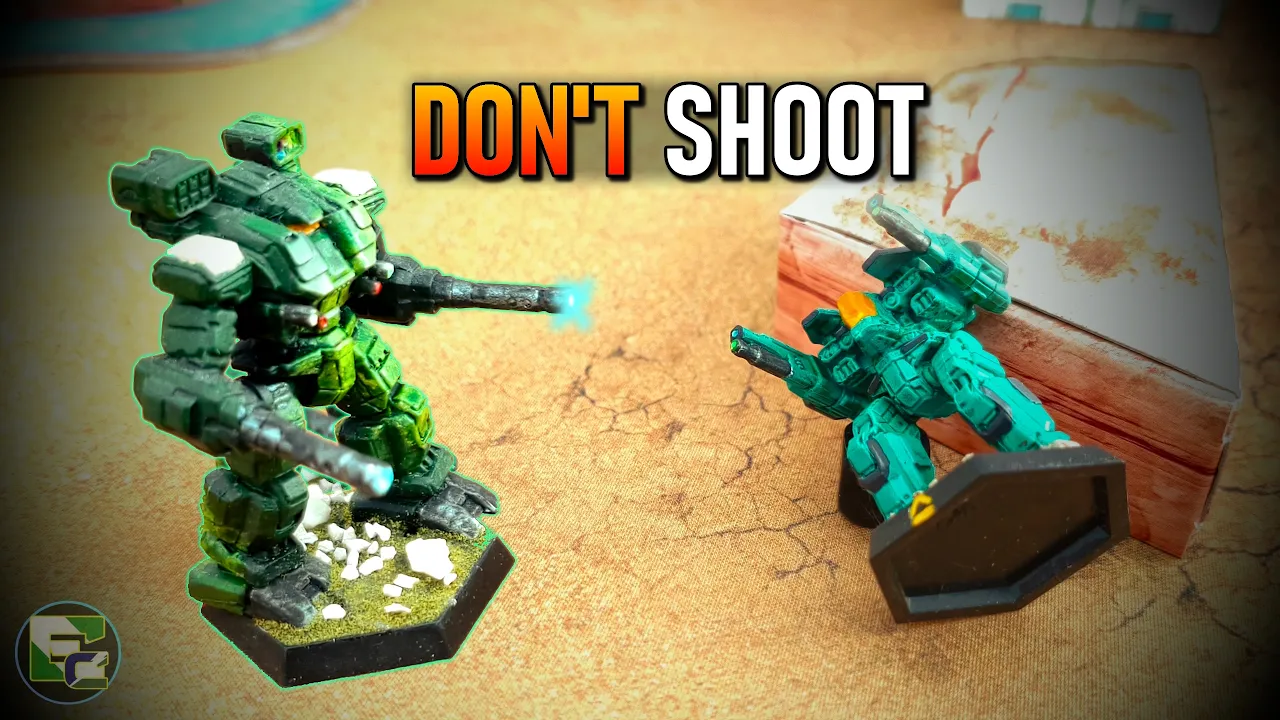
I should not have fired my Warhammer. The enemy commander was badly damaged, but still in the fight. I had a reasonable shot, so naturally, I took it. Three damage later, I had reduced him to a single point of structure. It was the wrong decision. Because the damage crippled him. Crippled units are forced to withdraw. And because I had spent the game aggressively containing the Jade Falcon advance, [music] he was close enough to his own board edge that on the following turn, he simply jumped away.
I had damaged him so effectively that I made him harder to kill. Welcome back to Scouring Sands. This is mission 15, and this time the lesson is that sometimes the correct tactical decision is to stop shooting the enemy. To understand how we got here, we need to go back to the start of the mission. Our objective was to defend an industrial plant while Jade Falcon infantry attempted to sabotage it. >> [music] >> At least three buildings needed to survive.
The problem was that we were entering from the board edge, and the plant was some distance away. That immediately made me question whether bringing the Atlas was a good idea. It is one of the most powerful units in the force. It is also not especially quick. But instead of dropping it, I decided to keep the Atlas, keep the Warhammer, Mad Cat, Archer, and Phoenix Hawk. And spent the remaining points on three very fast, very fragile light mechs.
The Dasher, Wasp, and Locust. Eight units in total. Five series combatants and three mechs held together largely by optimism. The plan was simple. The Atlas could run forward in the first turn and be fully involved from round two onward. The lights could race ahead and deal with whatever happened around the plant. That decision effectively split the battlefield into [music] two separate zones. The main force pushed aggressively towards the Jade Falcons.
The lights stayed around the plant, uncovering waypoints, [music] and dealing with infantry as they appeared. That separation ended up working extremely well. The Falcon max never got into the plant area. The infantry never became part of the main firefight. My heavier units had one problem to solve. My lighter units had another. Because the lights could handle the infantry by themselves, [music] there was never a reason for my main force to fall back.
So, I kept pushing. That became important later. Round one was fairly uneventful for most of the Falcons. They stayed [music] in cover. Except for the Howler. The Howler pilot moved forward, took a couple of shots at my Mad Cat, missed, and became the only enemy unit the Mad Cat could see. So, the Mad Cat returned fire, erasing the Howler. One Falcon down. Round two was where the battle really started. The Falcons pushed forward more aggressively.
Their Locust managed to get behind my Archer and put six shots in his rear. >> [music] >> Fortunately, only half of them connected. At the same time, the first infantry units started appearing around the plant. [music] And this was exactly why I had brought those lights. The Wasp, Dasher, Locust, and Phoenix Hawk could react immediately, move onto the waypoints, and prevent the infantry from successfully planting demolition charges.
They took some damage doing it. >> [music] >> The Locust triggered a booby trap and immediately picked up a movement critical. The Dasher eventually lost its armor. >> [music] >> The Wasp got hit, but the infantry never managed to successfully sabotage anything. Meanwhile, the main Falcon force had bigger problems. There was one interesting choice in round two. My Atlas and Archer both had easier shots onto the Marauder 2C, but the Warhammer could not see it.
All three could fire into the Summoner. So, instead of taking the easier individual shots, I concentrated all three units on the higher target. The reason was simple. If I split the fire, I would damage two different 'Mechs. If I concentrated it, I had a much better chance of breaking through one target's armor completely and damaging structure, reducing its combat effectiveness. That was exactly what happened. The Summoner lost all of its armor, took structure damage, and picked up an engine hit and a fire control hit.
So, instead of two moderately damaged enemies, I now had one heavily damaged enemy and one completely pristine Marauder. In round [music] three, I solved that problem, too. The Mad Cat, Archer, and Warhammer concentrated on the Marauder 2C and destroyed it outright. The Atlas hit the Summoner again and gave it a second fire control critical. At that point, the Summoner was barely functional. And by round four, the Falcon force was collapsing.
The infantry were being cleaned up. My Atlas delivered the finishing blow to the Summoner. And their commander in the Rifleman C2 was now the only healthy 'Mech left. Then, my Mad Cat got behind it. That's [music] usually not where you want the Mad Cat. Five points of damage went into the Rifleman from the rear. The Archer tried to follow up, but needed to roll 11s and missed everything. >> [music] >> And then we got to the Warhammer.
The Rifleman was already badly damaged. The Warhammer had a reasonable shot. So, I took it. I even overheated to the damage. Three more points went through. The Rifleman dropped to one point of structure. And at first, that looked great. The enemy commander was almost dead. The rest of the Falcon force had been wiped out. The plant was completely intact. But, the Rifleman was now crippled. And crippled units are subject to forced withdrawal. >> [music] >> That meant, on the next turn, the Rifleman was going to try to leave the battlefield.
And this was where the way I had played the mission came back to bite me. >> [music] >> I had pushed forward aggressively from the very beginning. That kept the Falcons away from the plant. It prevented their main battle line from ever interfering with the infantry fight. >> [music] >> It gave me control over where the engagement happened. But, it also meant that they never advanced very far from their own board edge.
So, once the Rifleman became crippled, it could easily [music] retreat. Round five started. The Rifleman still had enough movement to jump 14 in, and that was enough. And that was enough. >> [snorts] >> It left the battlefield with one point of structure remaining. Mission over. And that was when I realized the best move I could have made in the previous round was probably not shooting it. If I had not fired with the Warhammer, the Rifleman would have stayed above the force withdrawal threshold.
It would have remained on the table. And I would have gotten another full round of shooting, very likely destroying it. Which mattered, because I got points for each enemy mech I destroyed. So, mechanically, the better move would have been to deliberately leave the enemy commander healthier. That is [music] incredibly gamey. Narratively, the obvious decision is to take the shot. This is not [music] really a problem with forced withdrawal itself.
The weirdness comes from how forced withdrawal interacts with campaign rewards. Because if you are rewarded for destroying enemy units, but damaging them enough forces them to retreat, then there will occasionally be situations where dealing more damage is worse than dealing less. My play style makes that interaction happen more often. I tend to push aggressively. I want to control space and establish the firing line early.
I want to stop the opponent from getting where they want to go. Most of the time, that works. It worked here. The Falcons never managed to push their main force into the plant area. The infantry fight stayed isolated. [music] My heavy units could concentrate entirely on the enemy max. But the downside is that the enemy is often still relatively close to their own board edge when I start crippling them. So, winning the positional battle can actually make finishing them off harder.
There is a very easy solution to that. It is also one I do not particularly want to use. Just [music] stop shooting at the right moment. Leave the enemy healthier. >> [music] >> Keep them engaged for another round. Then overwhelm them. That is optimal play. It is also exactly the sort of thing that makes the campaign start feeling like a game system instead of a battle. Maybe next time my warmer pilot will ease off the trigger.
But I wouldn't count on it. Overall, the mission went extremely well. [music] Every infantry unit was destroyed. All seven units survived, and four out of five enemy max got destroyed as well. >> [music] >> I call that a nine out of 10 mission. And the biggest mistake I made may have been shooting the enemy. Which is not a lesson I expected BattleTech to teach me. If you enjoyed this kind of mission to brief, subscribe.
Before I let you go, I want to give a shout-out to Praetorian Guardsman, our newest channel member. Thank you for the additional [music] support. Good luck with your next deployment, MechWarrior.
The words are the caption track's own and nothing is reworded or re-transcribed. Paragraph breaks are placed between sentences so the text reads as prose.
Free tools for your own script. No signup, no login.
Paste your draft and see where viewers are likely to drop off, with a rewrite for each weak line.
Paste the first 30 seconds of your own draft for a hook score and rewrites.
Check your draft against YouTube's advertiser-friendly guidelines before you record it.
Read this channel's public videos and transcripts, and download a writing brief for it.