Getting the transcript
Reading the captions from YouTube. A video nobody has opened here before takes 10 to 30 seconds; this page fills in on its own.
Getting the transcript
Reading the captions from YouTube. A video nobody has opened here before takes 10 to 30 seconds; this page fills in on its own.
Mason Mignanelli · @MasonMignanelli
Words
4,047
Runtime
21:12
Speaking pace
191wpm
Reading time
17min
191 words per minute, between the 181 median and the 201 75th percentile of 349 measured videos. That distribution comes from the 349-video hook study.
Opening (first 30 seconds)
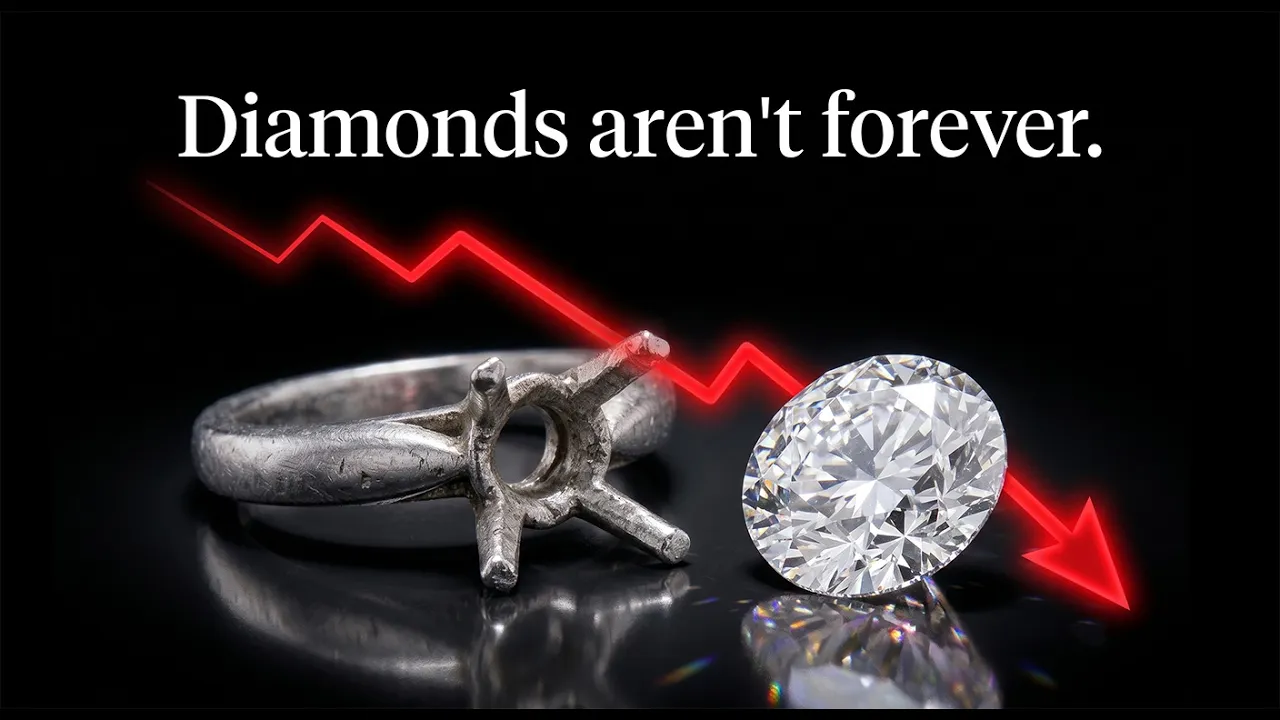
This is a round brilliant cut diamond. For nearly a century, a single company convinced the entire planet that a stone like this was extremely rare, eternal, and the only acceptable way to prove that you love someone. It was probably the most successful marketing campaign in human history. Not the most successful jewelry campaign, the most successful campaign, full stop. They instilled a near religious belief in the value of this mineral, building a modern-day empire. And right now, in 2026, that entire empire is collapsing in real time. The company that built it has
96 words, the words spoken in the first 30 seconds at 191 words per minute.
Free, no signup. See how the first 30 seconds hold attention, with rewrites.
Sentence shape
| Measure | This transcript |
|---|---|
| Sentences | 254 |
| Average words per sentence | 15.9 |
| Longest sentence | 56 words |
| Questions asked | 2 |
| Sentences containing a number | 35 |
Most used terms
Filler phrases
23 in total: like 12 · actually 6 · literally 3 · basically 1 · you know 1.
A literal whole-word count of the same phrase list the Prepublish browser extension uses, so a phrase inside another word is not counted and a phrase used in its ordinary sense still is. It is a count and not a judgement.
Run the check on the words above: where attention is likely to drop, with a rewrite for each weak line. The free check shows the scores and the one issue costing the most.
What this transcript is
Every word below is the caption track YouTube publishes for this video, pulled from the video itself and reproduced unchanged. It is not Prepublish's writing, not a summary, and not a re-transcription: it is the video's own published captions. English captions, generated automatically by YouTube, in the video’s original language. Source: the video on YouTube. A channel that would rather this page did not exist can ask for its removal through the contact page, and it is removed.
No Script X-ray for this video: YouTube shows a Most replayed graph only once a video has enough views.
This is a round brilliant cut diamond. For nearly a century, a single company convinced the entire planet that a stone like this was extremely rare, eternal, and the only acceptable way to prove that you love someone. It was probably the most successful marketing campaign in human history. Not the most successful jewelry campaign, the most successful campaign, full stop. They instilled a near religious belief in the value of this mineral, building a modern-day empire.
And right now, in 2026, that entire empire is collapsing in real time. The company that built it has had its value fall by about 75% in just 3 years, and its own parent company is trying to sell it for scraps. One of the richest, most powerful, most ruthless monopolies in the history of business is dying on the table. >> [music] >> And to understand why it's dying, you have to understand the foundation it was built on, because the strange part isn't necessarily that diamonds are collapsing, the strange part is how successfully their prices were engineered, defended, and mythologized in the first place. >> A diamond engagement ring.
How else could [music] 2 months' salary last forever? A diamond is forever. The Beers. >> For most of human history, diamonds genuinely were seriously rare. They were found mainly in river gravels in India, and later Brazil, gathered by hand from alluvial deposits rather than from industrial mines. They became symbols of royalty and extreme wealth exactly because the supply was extraordinarily limited. The rarity was real.
And then in 1871, in Kimberley, in South Africa, that all ended. For the first time in history, they found a diamond-bearing of volcanic pipes around the Kimberley region. Deposits that could be mined on a scale that nobody had ever seen before. Within a few years, South Africa was producing diamonds by the millions of carats. The global supply absolutely exploded. Diamonds went from the accidental treasure of isolated riverbeds to the product of an industrial machine.
It'd be like if all of a sudden we discovered some easy way to make gold from ordinary gravel, enough to flood the entire world and turn it into a semi-precious metal. Think about what would happen in that case. When something that used to be scarce suddenly becomes very abundant, the price falls through the floor. That's how it works for everything. This should have been the moment diamonds became pretty cheap, a semi-precious stone you'd find in a high street shop next to the garnets.
But as we know, that is not what happened. Instead, the industry learned to restrict production, stabilize prices, and preserve an aura of rarity around a material now being mined [music] by the tens of millions of carats. That doesn't happen by accident. Somebody made it happen. So, we left off with a problem. More diamonds coming out of the ground than the world had ever seen. The price should have been in freefall, and it nearly was.
In the early days of the South African rush, there were so many independent miners pulling so many stones out of the ground that the price started to slip exactly the way you'd expect, too much supply without matching demand. The whole thing was on the verge of becoming just another semi-precious stone. Enter Cecil Rhodes. If you've heard the name, it's probably attached to a scholarship, a statue people keep trying to tear down, or Rhodesia, the British colonial territory named after him that covered much of what is now Zimbabwe and Zambia.
All of those things are connected to this story. In Stifani Canfer's history of diamonds, The Last Empire, he explains how Rhodes was essential to the origin of the diamond industry as we know it. He was a British colonial who arrived in South Africa as a teenager and worked out something everyone else in the diamond fields was missing. The other miners were trying to find the most diamonds. Rhodes [music] realized the real game wasn't finding more diamonds because that would just push the price even further down.
What needed to be done was to heavily restrict the amount of diamonds available on the market, which would drive up the price and make the diamonds more valuable. But how are you supposed to restrict the supply when everyone is pulling fistfuls of diamonds out of the left, right, and center. Rhodes knew exactly [music] how. Through the 1870s and '80s, he did something methodical and ruthless. Rather than trying to out-mine his competitors, he bought them, one claim at a time, and then one mine at a time, swallowing the entire competition Rockefeller-style until in 1888 the major Kimberly operations were consolidated into a single company.
The final buyout of his great rival, Barney Barnato's Kimberly Central, was settled with a single check for 5,338,000 pounds. At the time, it was said to be the largest single check ever written, nearly a billion dollars in today's money. That new company was called De Beers, and Rhodes now controlled virtually all diamond production in South Africa. By 1900, he would control an estimated 90% of the entire world's rough diamond production.
And this was not a normal multinational mining company in the modern sense. The scale and power of the operation was insane. Rhodes was simultaneously a mining magnate, the prime minister of the Cape Colony, and an empire builder, using diamond money to acquire political and military power. Through the British South Africa Company, he obtained a royal charter to administer territory, fielded armed police and a literal settler army, and conquered lands that would later be called Rhodesia after him.
He supported a failed armed raid intended to overthrow the government of the neighboring Transvaal, unsuccessfully backed legislation that would have allowed black workers to be judicially flogged for breaking labor contracts, and during the siege of Kimberly, De Beers engineers even manufactured a functioning artillery gun called Long Cecil. His companies were beginning to behave like governments. Imagine if Apple, while producing iPhones, had a fleet of F-35s, annexed Mexico entirely, and renamed it Steve Jobsland, and launched a failed coup against the Canadian government.
That's not an exaggeration of scale. This raid literally happened. It's called the Jameson Raid, and it nearly started a war. And Rhodes wasn't smashing Red Bulls and digging up all the diamonds himself. The entire system depended on a vast and brutally controlled black African workforce. As Stefan Kanfer documents in The Last Empire, workers were housed in what were called closed compounds, fenced guarded enclosures they could not leave freely for the entire duration of their contracts.
Disease was rampant due to severe overcrowding. The official justification was preventing diamond theft, but the result was a system of near total control over the workforce. They were confined, surveilled, and strip searched. And many experts, including Stefan, have noticed how this compound system developed in the diamond and gold fields of South Africa prefigured methods of racial control that would later be formalized under apartheid.
[music] De Beers didn't simply happen to be operating in that world. It actually helped build the template. The crazy thing is that De Beers wasn't even uniquely evil among colonial extractive companies, but it was unusually coercive for its era, and it was exceptionally successful at converting that coercion into a respectable, enduring luxury empire. But despite all that, Rhodes was reportedly still scared of talking to women.
He would flee on horseback if a suitor tried to visit him. The man annexed two countries and attempted a coup, but a dinner invitation from a woman was apparently a bridge too far. Rhodes himself died in 1902, but the company he built didn't die, and it was about to get vastly more sophisticated. So, by the 1930s, De Beers has controlled the supply for decades. They decide how many diamonds the world is allowed to see, and therefore how much they cost.
But it's all about to fall apart because controlling supply is useless if demand collapses. The Great Depression had crushed luxury spending and diamond demand was a sliding downhill. Nobody is buying diamonds when they can't even afford to eat. And worse still, there was a structural problem baked into the entire business. A problem so fundamental it could have severely damaged diamonds as a consumer luxury forever.
Here's that problem. A diamond is not consumed. You don't drink it like a fine champagne. It doesn't really wear out like a pair of shoes. Nearly every diamond ever sold still exists sitting [music] in a drawer, a safe, or on someone's hand, which means every diamond De Beers sold was a potential future competitor to the diamonds it hadn't yet sold. If people ever started reselling their old diamonds in any real volume, the market would flood with second-hand stones, and the whole carefully controlled scarcity would come apart.
So, De Beers needed two things. They needed people to want diamonds far more than they did, people to never sell them. In 1938, they turned to an American advertising agency called N.W. Ayer, and what came out of that partnership over the next decade is, I think, the most effective marketing in commercial history. Think about the way that people perceived diamonds. It's not that people thought they were nice. It's not they thought they were pretty, or shiny, or a reasonable thing to buy.
People believed in diamonds the way you believe in something you were raised inside of. They function like a religion that nobody remembers converting to. A man is supposed to take months of his income, [music] sometimes go into genuine debt, to buy one specific colorless rock. It doesn't matter if he likes it. It doesn't really matter if his partner likes it, because the absence of it means something. Because if the ring doesn't have a diamond, the engagement somehow doesn't count.
And it has to be a diamond, not a sapphire, not a ruby, a diamond. [music] Even if you bought a beautiful two-carat ruby worth multiples of what a diamond would be worth, you might still feel need to justify it. It's not a diamond, but nobody decided to believe this. It was installed. In 1947, a copywriter at N.W. Ayer called Frances Gerety wrote [music] four words at the end of a long day: A diamond is forever. It's now considered one of the greatest advertising slogans ever written, and it's a small masterpiece because it does two completely separate jobs in only four words.
The first job is romance. A diamond is forever, your love is forever, etc., etc. That part is pretty obvious, but the second job is equally important. A diamond is forever also means a diamond is not for selling. You don't resell something that's forever. You don't put eternity on the second hand market. The slogan instructed an entire culture to keep their diamonds, to treat reselling them as [music] faintly obscene, like selling off a piece of your marriage.
And that solved the structural problem from earlier. Remember, every diamond already sold is a threat to every diamond not yet sold. So, [music] you have to convince people that diamonds are not really bought and sold, they're kept and treasured. In 1982, an investigative journalist named Edward J. Epstein took this entire machine apart bolt by bolt with his book The Rise and Fall of Diamonds. This book is effectively, to this day, the definitive hit piece on the industry.
He also wrote a famous companion article with a very direct title, Have You Ever Tried to Sell a Diamond, which we'll get into in a second. But you'll often hear people say something along the lines of diamonds are worthless, but that's not true. The truth is maybe worse. Diamonds aren't worthless, they're illiquid. Worthless means the thing has no value. You can buy it for $2 and throw it in the bin. Illiquid means it has value, but you can't easily get it back out.
Take a diamond you paid $5,000 for and walk into a jeweler the next day and try to sell it. You'll be offered a fraction of what you paid if you're offered anything at all. I've personally never purchased second hand diamonds from a client in my whole career. So, it's not that the stone is worth nothing, it's that you, the person who bought it, are prevented from ever realizing its value ever again. And then there's how much you're supposed to spend.
You've probably heard the rule, one month salary, two month salary, maybe three. The number changes depending on when and where you grew up, which is the first clue that it isn't a real tradition. It was another ad campaign. De Beers anchored the correct spend to a fraction of a man's income, and they made the size of the sacrifice into the measure of the love. The more it hurt you to pay for the big diamond, the more it proved that you meant it.
And the main reason, I think, that doesn't feel completely ridiculous is that it's hijacking something a lot older. Across much of recorded history, marriage has actually really involved a significant transfer of wealth, dowries, bride wealth, gifts, gold, livestock, property, or land. The customs differ enormously, and the wealth didn't always belong directly to the couple depending on the culture, but marriage and material sacrifice have been linked for thousands of years across pretty much every culture.
So, we're already primed to feel that marriage should involve handing over something of serious financial value. And the diamond ring slots perfectly into that expectation. It looks like concentrated wealth. It feels like the major transfer of value that marriage is supposed to involve. Except, unlike gold, land, or livestock, an ordinary retail diamond ring is extremely difficult to convert back into anything close to what you paid for it.
So, you overspent partly because the purchase occupies the cultural position of an asset, even though financially it doesn't usually function like one. Okay, so so far we've got control the supply, so you set the price, manufacture the demand, so people need the stone even if they don't really want it, sanctify the object so nobody ever resells it, and anchor the spend to guilt so people will pay as much as possible and feel righteous doing it.
That is a recipe for some serious profit and one of the most complete pieces of behavioral control ever pulled off commercially. And it worked so well that three generations later you might still feel a faint discomfort at the idea of proposing without a diamond, even as I'm literally explaining to you how that idea got there. But there's one last bit that's vital to the system and not often talked about. For this to work, they had to make people believe the diamond was the best stone, the pinnacle, the most precious thing you could put on a hand.
Otherwise, people might think, "Sure, diamonds are cool, but then end up proposing with a lovely ruby instead." So, all of this rests on one assumption, that the diamond deserved the throne. That out of all the stones on earth, this was the rarest, the most precious, and the best. The marketing was just amplifying something that was already true. And this is the part I feel like I can speak to directly because this is what I actually do.
I work with these stones, I set them, and I source them, and I can tell you that the idea of the diamond as the no-contest pinnacle of gemstones is no more a fact than saying Rolex makes objectively the best watch. Let me start with the rarity. Gem-quality diamonds are quite uncommon. I'm not going to do the comments section thing and tell you they're as common as gravel because a clean diamond is a very uncommon object, not the same as the rarest.
And colorless diamond is nowhere near the rarest precious stone you can put in a ring. You've got fine natural sapphire, ruby, types of spinel, private tourmaline, alexandrite, jadeite, just to name a few, but let's focus on ruby as an example. A decent untreated ruby, nothing particularly special, is rarer than a comparable diamond. And if we're talking fine natural ruby, that is a whole other world of rare. When you see the per-carat price records broken at auctions for stones, it's ruby, sapphires, and emeralds sitting at the very top, going for more per carat than all but the most exceptional colored diamonds on Earth.
The market itself and gemologists agree that rubies are scarcer and more valuable than the finest colorless diamonds. And it's not just ruby. Think about every stone the diamond myth had to step over to claim the throne. There's a green garnet called tsavorite that's often cleaner and tougher than an emerald, found in essentially only a few corners of the planet. There's alexandrite, which changes color from green to red depending on the light, which is so rare that most people will go their entire lives without seeing a real one.
There's a whole tier of colored stones that are scarcer and in many cases more beautiful than the colorless stone everybody was taught was the best. So, how did the diamond win then? Logistics. You can't run the De Beers machine on rubies. They come from too many places, too many small operators. You can't put your hand around the whole supply. The major South African diamond deposits were different. They were enormous, concentrated, capital-intensive industrial operations.
Once the mines and the distribution channels had been consolidated, a huge portion of the world's production could be sorted and released through a central system. That made diamond unusually easy to monopolize. So, the diamond didn't become the king of gemstones because it was objectively the best gemstone. It became the king because it was the most controllable gemstone. The throne, like most wars, was won on logistics.
A while back, I sold a 120-year-old Burmese ruby for a client. And unlike a diamond, which loses most of its value the second it leaves the shop, that ruby was worth about 15 times what he paid for it at auction in 1997. Fine colored stones have climbed in value for decades, while a $10,000 retail diamond bought in 1998 might only sell for a few thousand dollars today. It would need to sell for about $20,000 just to have kept up with inflation.
So, the diamond was never the rarest, never objectively the best. Its throne was built on supply control and one of the most sophisticated marketing campaigns in history and held there for nearly 100 years. The only question left is what happens when the old system can no longer control scarcity strongly enough to protect the price. And in 2026, we're watching the answer. >> [music] [music] >> For over a century, the machine held.
It survived the Great Depression, two world wars, anti-trust investigations, the end of apartheid, the blood diamond scandals, the Soviet Union, demonopolization of the industry. Every time something should have killed it, it adapted. And then it lost to the one thing it had spent its entire existence suppressing, abundance. >> [music] >> You probably already know what happened. We learned to grow diamonds. Diamond alternatives have existed before.
Originally glass, then cubic zirconia in the '70s and '80s, and then moissanite. But this time was different. Lab production of real, honest-to-god diamond with the same crystal structure, hardness, and chemistry as natural diamond. They're just grown in a machine instead of dug out of the ground. Put a natural diamond and a lab-grown one side by side, and not only can you not tell the difference, a trained jeweler can't either, not without specialized equipment.
And the nail in the coffin is they're roughly 75 to 90% cheaper. A natural 1-carat diamond might have run you $6,000 a few years ago, and now it sits closer to 4,000 and dropping. A big fall for sure, but the lab-grown equivalent is around 500 to $1,000. Think about what that does to the machine. The entire empire was built on just one trick, artificial scarcity. Make sure the world only sees the number of diamonds that you allow it to see.
But, you cannot create scarcity of a thing that can now be grown in a factory. The supply just isn't controllable anymore. Natural diamonds are still geologically finite. Companies can obviously still close mines, cut production, and withhold inventory. But, what they can no longer do is control access to the physical experience of owning a diamond. The hardness is available, the brilliance is available, the size is available, and now it's all available for a fraction of the price.
And the market responded almost instantly. In 2019, about 6% of engagement rings had a lab-grown center stone. Six years later, 61% from a rounding error to the majority of all engagement rings in the time it takes to pay off a car. You can see why the whole natural diamond industry fell over and themselves. So, let's go back to where we started this video. When De Beers went private in 2001, ending more than a century on the stock exchange, the final deal valued it at about $36 billion in today's money.
In 2011, when the Oppenheimer family finally sold out after 80 years of running the company, the deal valued De Beers at about $19 billion in today's money. By 2023, Anglo American had it on the books at about $9.2 billion. Today, the company that once literally was the entire diamond industry is valued at around $2.3 billion. Anglo has wanted it out for a while, but an old diamond monopoly in 2026 turns out to be quite a hard thing to sell.
The process has taken over 2 years, although by June 2026 when I'm recording this, negotiations are advanced and two bidders currently remain. And here are two more details that I find pretty interesting. First, a few years back De Beers launched their own lab-grown brand called Lightbox. In my opinion, at least partially to try to manipulate the lab-grown market the same way it did with naturals. [music] It set a very low price per carat to try to show how worthless lab diamonds were.
However, it backfired spectacularly when the message consumers took away was how good value lab diamonds were. The transparent low price just showed everyone how little these stones were actually costing to make these days. Second, and this is the one that really cooks me. Right up until the end, De Beers was still running the original playbook. Reporting showed that during a 2025, the company had been selling stones at a discount in private while publicly maintaining official prices around 20% above what the market was actually paying.
That is the exact same trick the whole empire was built on being run one last time in the dark as the lights go out. They were manufacturing the illusion of value right to the end because that was the only thing they ever really knew how to do. So, that's the story. And to be clear, none of this was the diamond's fault. Diamond is hard, very pretty. It's a genuinely excellent material. I'll set one for you any day of the week.
The stone was never really a problem. The problem was everything around it. Edward Jay Epstein's article on this topic is linked in the description. It's basically a condensed version of one of the books this video drew from, and it goes deeper than I could here. If any of this piqued your interest, read that one first. If you want to go deeper [music] into the physics, history, and other secrets of the jewelry industry, my book [music] is free in the description.
And if you want to see my work, the pieces I make are on my website. Otherwise, now you know what you're actually putting on your hand. I'll see you in the next one.
The words are the caption track's own and nothing is reworded or re-transcribed. Paragraph breaks are placed between sentences so the text reads as prose.
Free tools for your own script: paste a draft and see where it stands before you record it.
Paste your draft and see where viewers are likely to drop off, with a rewrite for each weak line.
Paste the first 30 seconds of your own draft for a hook score and rewrites.
Check your draft against YouTube's advertiser-friendly guidelines before you record it.
Read this channel's public videos and transcripts, and download a writing brief for it.