Getting the transcript
Reading the captions from YouTube. A video nobody has opened here before takes 10 to 30 seconds; this page fills in on its own.
Getting the transcript
Reading the captions from YouTube. A video nobody has opened here before takes 10 to 30 seconds; this page fills in on its own.
Laura Meyer · @lauraemeyer
Words
6,183
Runtime
31:03
Speaking pace
199wpm
Reading time
26min
199 words per minute, between the 181 median and the 201 75th percentile of 349 measured videos. That distribution comes from the 349-video hook study.
Opening (first 30 seconds)
I've helped thousands of experienced experts like you start their dream businesses and here's what so many people are doing when they're getting started online right now. They're told build an audience or post content every day or create a course or run ads or grow on social media and hope that something sticks. And what so many people are experiencing is total frustration. They burn through savings or they spend way too much time not getting a significant enough result to make it worth that time investment or they get discouraged waiting for traction that never really shows up.
100 words, the words spoken in the first 30 seconds at 199 words per minute.
Free, no signup. See how the first 30 seconds hold attention, with rewrites.
Sentence shape
| Measure | This transcript |
|---|---|
| Sentences | 336 |
| Average words per sentence | 18.4 |
| Longest sentence | 84 words |
| Questions asked | 10 |
| Sentences containing a number | 28 |
Most used terms
Filler phrases
68 in total: like 41 · you know 13 · actually 8 · kind of 4 · right? 1 · uh 1.
A literal whole-word count of the same phrase list the Prepublish browser extension uses, so a phrase inside another word is not counted and a phrase used in its ordinary sense still is. It is a count and not a judgement.
Run the check on the words above: where attention is likely to drop, with a rewrite for each weak line. The free check shows the scores and the one issue costing the most.
What this transcript is
Every word below is the caption track YouTube publishes for this video, pulled from the video itself and reproduced unchanged. It is not Prepublish's writing, not a summary, and not a re-transcription: it is the video's own published captions. English captions, generated automatically by YouTube, in the video’s original language. Source: the video on YouTube. A channel that would rather this page did not exist can ask for its removal through the contact page, and it is removed.
No Script X-ray for this video: YouTube shows a Most replayed graph only once a video has enough views.
I've helped thousands of experienced experts like you start their dream businesses and here's what so many people are doing when they're getting started online right now. They're told build an audience or post content every day or create a course or run ads or grow on social media and hope that something sticks. And what so many people are experiencing is total frustration. They burn through savings or they spend way too much time not getting a significant enough result to make it worth that time investment or they get discouraged waiting for traction that never really shows up.
Time is your only non-renewable resource. Every day that you spend trading your time for money with no leverage and every day that goes by that you are no longer making progress is another day where you're not working towards your dream life. And I don't want that to happen to you. So today I'm going to be sharing with you my seven-figure roadmap and this is very much based on my own experience of growing a business from the comfort of my own home working very much part-time and having a ton of freedom.
And this is something that I've worked really really hard on figuring out and I'm super excited to share it with you today. So first I'm going to share with you just the revenue plan and the big mistake that I made when I first started in trying to create a freedom first business. And then next we're going to get into the money math. So exactly what to do in which order and how to stack successes so that you can get to six figures or multi-six figures or seven figures profitably without burning out.
And then I'm going to talk about what the day-to-day looks like. So what it actually looks like to work with clients in the way that I recommend and I found to be successful. And this is all so you can get to your first six figures as quickly as possible without overextending yourself, without putting a ton of time in, without a significant enough return. And then how to scale from seven to seven figures from there without it completely taking over your life.
Cuz if if anything like me, your life really matters a lot to you and your lifestyle is important. And so finally, at the end, I'm going to give you the exact 30-day step-by-step roadmap, so you know exactly what to do in what order, so you can get started. So, the first thing I'm going to do is share with you a tale of two mountains. So, I spent years building a business that looked incredible from the outside. And this is uh years and years ago.
I had impressive revenue and a full team and industry recognitions, but behind the scenes, I was the last one to preschool pick up every single day. And this is something that I just realized I had this moment one day where I was like, "We're not doing this anymore." So, I want you to take a look at these two mountains. And the first one is maybe where you feel right now, where you've plateaued. And if you're anything like me, you know, you've climbed the mountain, you've done the things, and then you've hit a ceiling.
Like, you're done with the meetings about meetings, and you just want more flexibility and freedom. But what a lot of people do, and maybe they go and get a new job, or they completely switch careers because they're so burnt out. So, they think, "Oh, I'm going to be a life coach, or I'm going to start coaching, or I'm going to start creating digital products." And they start thinking about all these different things that they haven't done before.
And they think, "Maybe I should just get into something totally new." But that is a really difficult step backwards, especially if you're mid-career. It will take you way longer to get back up to this place than if you're just taking what you already know and leveraging it to create your own business and building from there. So, they end up kind of going backwards, and they end up going backwards in terms of time and money.
Instead of just going making a lateral move, and then going up from there. Because everything changed for me when I realized that there are two paths, and almost everyone is taking the harder of the two. So, the first path is to build an audience from zero and like burn through savings while waiting for traction, or create a course and program and hoping it sells. And that just leaves you exhausted and broke. Whereas path two is you just start helping other companies with what you already know using the network you already have.
And then you can get to you what I call your enough number. So I'll chat about that in a bit. And then you can just scale up from there and really create a freedom first business. So path one builds from freedom. The other this one builds towards a brick wall. So let's talk about the math of starting with path two. Because you want to be building from freedom. And when you're in a place of financial scarcity, it's really, really hard to make good decisions.
It's hard to hire. It's hard to think clearly. You feel like every client that comes your way you have to book them. And you end up marketing and selling from a place of desperation, which people can feel and that doesn't feel good. So there's a book that I recommend to every single one of my students and it's called The Psychology of Money by Morgan Housel. And it introduces this concept of your enough number. And your enough number is the amount of money that you would need to bring into your household without feeling this sense of scarcity.
And it's not about being rich or having a Lambo anything like that. It's really just making sure that you have enough so that you can feel secure. So for me, it means being able to book a private weekly tennis lesson without really thinking twice about it. Or being able to make a standard significant donation anytime I hear of something unfortunate that's happening in the world or within my community. It's about being able to decorate my home.
And just enjoy the space that I live in. So for you, that might mean something totally different. But you know that you've hit your enough number when you can just operate in your daily life and do the things that you love and without blinking, without thinking about it or worrying about it. And it's really important in this process that you know what your that enough number is. My core belief in this is backed by everything that I have seen work is this.
You want to grow path two to your enough number first, and you don't want to do anything else until you get there. Then, from that foundation of financial stability and just mental space and freedom in your schedule, you get to decide do you want to stay there or do you want to build another revenue stream or build more offerings? So, some of my students hit their enough number and they say like, I'm good. Like, give me a quarter million dollars a year at an 80% profit margin working part-time and I am good.
I don't want to do anything else. I'm out. And that's completely awesome. Others kind of have that fire in their belly and they want to go further. They want to get to seven figures. And I just I happen to be one of those people. I always love being challenged. And that foundation makes scaling so much cleaner and it's so much faster and it's so much more sustainable because you are working from your enough number. So, hey, just quick real quick.
If you're watching this and you've already heard enough to know that you want to explore what working together looks like, I want you to click on the link below to chat with my team. They would absolutely love to get connected with you and have just a simple conversation about what this path could look like for you. The people that I have on my team are not pushy sales people. I purposely put people in those positions that are graduates of my program and members of my community who work with our students every day and they will absolutely know and they will tell you honestly and genuinely if whether or not working with me would be a best path forward for you.
So, if this is something that you're listening and you're like, this makes sense to me and I actually want to learn more, jump on, have a chat, and I can promise you it will bring you tons of clarity. So, now I'm going to keep going because the beautiful thing about advisory services is that you do not need a big audience. That's what's so great. You don't need a course, you don't need a funnel, you don't need a social media following, you just need your expertise and your network and some really good conversations.
So, here's what the advisory practice phase looks like just like back of the napkin at a glance. So, the first step is to identify your area of expertise. So, you really want to ask yourself like what problems have you solved repeatedly that other people struggle with and that's your offer. It's not your credentials, it's not your certifications, it's not some kind of prescripted program that you're trying to jam people into, it's just your results.
And by the way, you probably know so much more than what you think. Like I cannot tell you how many brilliant people have just come into our community with years of experience, incredible results and they still said, "Oh, I don't know if I know enough to do this. I don't know if I have enough expertise to get started." Every single star student I have, everybody who's gotten to multi six figures and seven figures has felt that way in the beginning, every single one of them.
So, I just want to normalize that for you. Step two is to land beta clients and that is going to be your first three clients and they're slightly discounted. So, maybe if you want to charge $5,000 a month, maybe $3,000 a month or $4,000 in the beginning. And in exchange, you're going to ask for a case study or testimonial if it all goes well. And this takes the pressure off of you. It lets you do incredible work without feeling like you have to get it perfect because here's the thing, if you're new to the practice of advising other businesses, but you are not new to your field and that matters.
Step three is you're going to start having real conversations. This is where I want you to hear me cuz I know this scares a lot of people. Conversations create cash. Posting to social media does not create cash, not at this stage. So, posting content to a few hundred followers is not going to generate the clients that you need to justify the time going into your new business. So, what generates clients is real relationships with real people who have a connection to you or know somebody who has a connection to you.
And you don't need to do this perfect. I always tell our students like worry less about saying and doing the right thing and worry way more about being the person who cares more about their company than anyone else they've talked to. Let's take a look at the math. I've had students land $3,000 clients, I've had students land $20,000 clients. And they're able to do this quickly because the model is simple. And simple is easy to implement when you're first getting started, when you're first beginning, you need simple, right?
So I want you to write down and think about it right now. What would it take for you to get to your enough number? So let's take a look at this simple math. Let's say that you can get three clients at let's just say in the beginning $4,000 a month, then you will get to $20,000 a month in recurring revenue. So keep in mind, this is just an an idea, it's just an illustration. You know you and I'm not making any promises about what's possible.
But what's really nice is that three clients at $4,000 a month, you might work maybe three to five hours a week per client. And you don't need a staff, you can even have an AI executive assistant, which I will teach you how to do if you jump into expert freedom, which is my program. And what's really nice again is that you don't have much in terms of cost. You might have some software expenses, you might have the cloud expense for that AI employee.
But for the most part, you can just work three to five hours per client per week. Let's say on the high end it's five clients, then you're at 15 hours a week. And maybe another five hours a week building your business. This is where you can get to six figures in revenue working part-time hours without killing yourself. And that's what I love about this model is that it's very much high-ticket recurring revenue, low volume.
So that you can start getting experience, and most importantly, you can start getting momentum. Now, once you're in a consulting engagement, how do you actually deliver so that it only takes 3 to 5 hours a week? And what's important to understand is the difference between a 60-hour work week advising clients and a 20-hour work week or a 10-hour work week is in the delivery. And I think a lot of people are almost afraid to start working with clients one-on-one because they're worried that it'll turn into a 60- or 70-hour work week.
Because many people get into an engagement like this, and then they start to get frustrated. They start being treated like a freelancer, or they start positioning themselves as a fractional employee, and then they find themselves working so much more, and they're so much busier than they ever were in their previous job, and they're wondering what they did wrong. So, this is how I started out when I began consulting to other companies, and I learned really quickly that the framework, and the framework that you use in your delivery, is your ticket to freedom.
And not only that, but it actually helps your clients get an even better result. Because when you just come in and you just start doing and you just start solving problems, when they first start out, they think that that's the way to do it, and they think that they just clients just want people to come in and do. But ultimately, what those clients want is their problem to be solved. They don't necessarily care how many hours it takes you or how you go about it.
So, let's talk about what you have versus what your clients need, which is what I call the expertise translation. What you have is a track record. Maybe you have 10 or 15 or 20 or 25 years of expertise. You have proven results, and you have credibility. What they need is not necessarily somebody to just come in and jump in and do all the doing, but they need one specific problem solved. They need have one type of issue that usually is the recurring problem.
They want a clear, measurable ROI. I recently talked to somebody who wasn't in my program yet, but she was really struggling in her current role. And what happened was is that she came in and she came in as the doer and she's like, "I've worked so hard and I've done all these things and I delivered what they wanted." And I said, "Yes, but what did they get? What was the ROI?" And she's like, "You're right, I didn't even focus on that." So, what happens is when you just come in and you just start doing, you end up really feeling very undervalued because they just keep wondering, "Where's the return?" when that was never communicated or made a priority in the beginning.
And then they want somebody credible to trust. This is really important. They're not making decisions off of TikTok dances. This is something you probably know, but it's worth mentioning again. What they need is somebody that they can trust to advise them. So, I spent years perfecting a delivery system that gets massive results and I call it the LEAP method. It's the four-phase framework that I built my consulting business on and I hand to every single one of our students inside of Expert Freedom.
So, the first is to limit focus and that's the first step. When you first start working with a consulting client, the most important thing that you can do is prioritize. There's always a dozen problems to solve when you first start talking to a client and your job is to identify the one or two that will drive the biggest impact. So, inside of Expert Freedom, I give you my entire intake process and the prioritization system for this.
The second step is to establish a plan. So, you start to build a 90-day sprint with your client and you get clear milestones and you get clear deliverables. So, everybody knows exactly what success looks like and you're not just trying to go ahead and deliver result by being a smart person that they're paying by the hour. The third step is to deploy assets and this is where the consulting work actually happens, where you're advising and you're guiding.
And this is what I found. When you first start, you'll often over-deliver because you just want to do a great job. And over time, you'll learn that, "Oh my gosh, I don't actually need to do all of that." So, with every client, you just want to charge a little bit more and deliver a little bit less, and that's how you refine and scale. The fourth step is how to review progress, and this is where you look at the measurable impact of the work that you've done with your client.
Not your hours, not your effort, not intangible results, but the actual results. And this is where you can gather testimonials and sharpen your offer, and this is also where one client becomes two, and two becomes three, and the momentum compounds because there is a clear measurable outcome that you're working towards. The key principle through all of this is to leverage what you already have, your expertise, your network, your proven track record.
You do not need to invent anything. So, here's where it gets really, really interesting because once you've got beta clients and they're getting great results, you can just raise your prices, and this is what I recommend that my students do. Every time that you get a client result, you raise your price a little and you reduce your delivery, and you do it again and again. And as that income stabilizes, something shifts.
This is where you're not marketing from desperation anymore. You're showing up super confident because you know that you can get your clients results, and prospects can feel that. And the goal here is to reach your enough number with this model, and that's the income that just removes any financial stress and gives you mental space. For some of my students, that's $10,000 a month. For others, it might be 20 or 30,000.
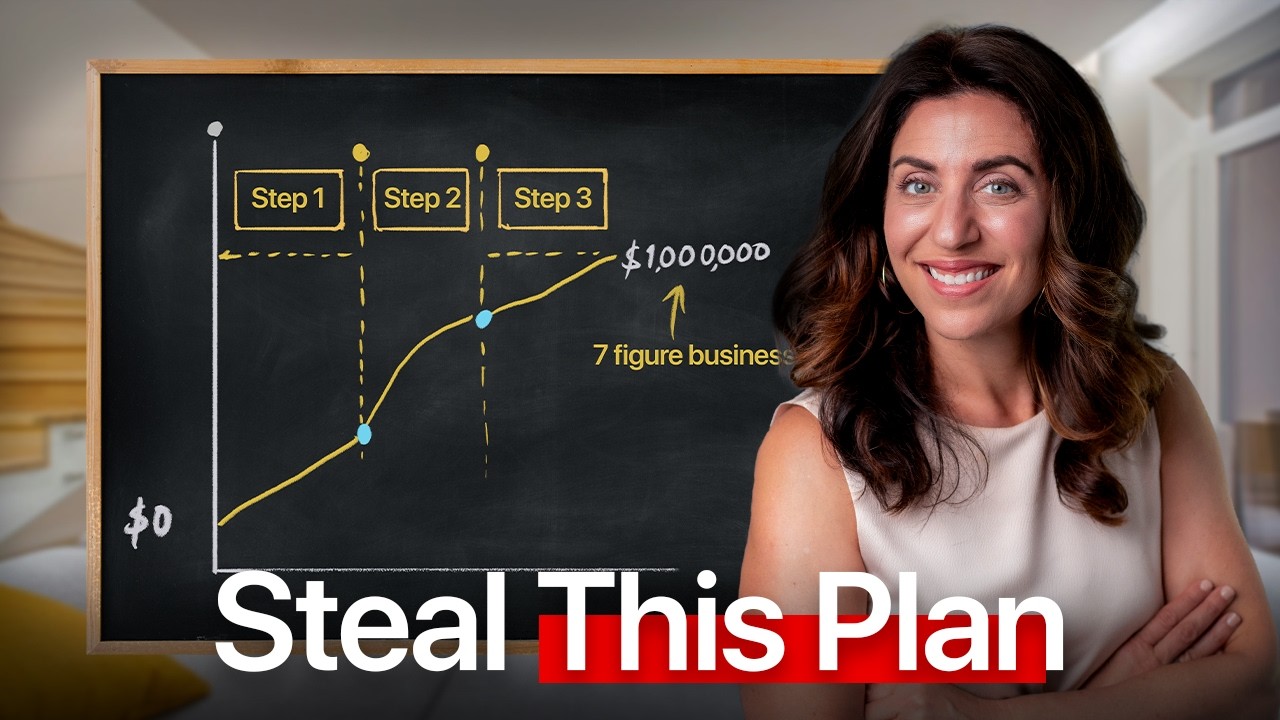
You know what your number is, and then from there, you can build to seven figures in three distinct stages. So, the first stage is just getting your enough number and deciding if you want to stay there or if you want to keep growing. So, this is the first stage, and this is your advisory practice, and this is where you're going to get to six figures. The second stage is to start building an audience by positioning yourself online as a thought leader.
I call this creating an expert brand, and you can use feedback from your clients and client examples and testimonials and stories from what to group find out what it is that you should be posting online. And the nice thing is is that you can take your time doing this. Like you don't have to feel rushed because your advisory practice is giving you your enough number. And finally, once you have an audience, that's when you can start creating a group program and scale to seven figures by leveraging your time into a one-to-many delivery model.
So, for example, about 4 years ago, I started creating content. I was advising some businesses. I had some great experience, and I used the capital for my advisory business to fund building that growth and that audience. I started hiring VAs to help me post online. I started having people help me create content and even in the early stages. So, that's the magic of building your advisory practice first because you get experience and you you build all of that expertise.
And by the time you're ready to create content, you're speaking from real experience. You have client examples. You have testimonials. You're not just posting hypothetical things that everybody else is posting. You have real results, and that's where you can stand out from what everybody else sounds like online, and that's what makes content powerful. Now that I am at stage three, the creator side of my business runs anywhere between 80 and 150,000 dollars a month in revenue, but I didn't get there by starting there.
I got there because I had the capital and the time and the mental space to build it properly. And because I built the advisory practice first, and I had that revenue stream in place, that's where I was able to create those additional revenue streams from a place of abundance. I still have this advisory practice to this day, and the entire time I built this three-sequence model, I was working part-time. I still picked up my kids from school every day.
I had a third baby during the pandemic. I picked back up tennis a few years ago after taking a huge amount of time off and it's just been so much fun. So, this is what building from freedom looks like. So, now I want to show you what this looks like in real people's lives. I've had students get into expert freedom and land their first $5,000 client within weeks and I've also had students who thought that they weren't ready, felt like they needed more time, felt like they didn't know enough yet.
And once they started having real conversations with people that they know or maybe haven't spoken to a while in a while or real business owners, they said exactly what I thought they'd say. I can't believe how much opportunity is out there. I've had students hit their enough number just working 10-15 hours a week. I have students who are still in their 9-5 building their practice on the side. Sometimes they just take like vacation days to deep dive with clients or they work on it in the evenings and weekends until it replaces their corporate income.
So, let me tell you a little bit about Miranda. She was working a corporate role full-time in a marketing capacity and getting started just doing a little bit of freelance work. But when she came to us, she was trying to figure out how to make all of this work and how to move forward with it without it consuming her life. Miranda came in, she did the work, she dove in and after getting started with us, she exceeded her corporate income within a matter of months without ever posting on social media.
So, this is 100% what's possible. Part-time hours and premium clients and a business that doesn't own you and growing a body of work that lets you eventually scale into something even bigger if this is something that you even want to do. So, that's much like Chris. She wasn't sure what to actually consult on because she has an unbelievably impressive background. She is incredibly intelligent and knowledgeable, especially when it comes to technology and operations.
She has a varied background, which can be very much a curse of knowledge. So, if you know what I'm talking about, you know. And when she came in, she knew that she wanted to leave her corporate role. She was ready, and she was done, but she just wasn't 100% sure how, and she felt stalled. So, I encouraged her just to take my own consulting offer because she had so much experience. And my own consulting offer combines growth strategy and AI, and I just recommended that she plug it into her own business.
Within a matter of months, she completely replaced her corporate income, she left her job, and she started working part-time hours. And the last time that I saw her on one of our expert freedom coaching calls, she was about to run out and ski with her kids on a weekday afternoon. When people get started in business, most of the time they treat freedom as the reward at the end of the hard work, where they build the business first, and they grind and grind until they're profitable, and then maybe eventually they'll make enough money to make it worth it and get their life back.
But when you build from freedom, when you're not desperate, when your bills are covered, when you've hit your enough number, when your nervous system is calm, you make better decisions. You attract better clients, and you build something sustainable. And what I know for sure is that if you've made it this far, you're already qualified. You've led teams, you've delivered results, and you've built expertise. And the question isn't whether or not you know enough, the question is, are you willing to get started?
So, let's talk about exactly what to do in the next 30 days if you're listening right now, and you know it's time to start taking action. So many people wonder how our students are getting to their enough number without becoming like Insta famous or creating TikToks or even publicly promoting their offer. So, what I find is that so many experts know way more people than they even realize. And because of the reputation that they have with the people that they know, with their own colleagues and peers, even with the people in their community, getting clients is way easier than they may even realize.
So, where clients come from is first people who have seen your work. And a lot of times what people do is they don't reach out to maybe somebody that they've known for a long time or that they have a good reputation with cuz they think, "Oh, I haven't talked to them in a while or they don't might not want to hear from me." And what we do is we help you analyze your entire LinkedIn connections. We help you analyze all of your contacts and figure out who is having problems that you can likely solve.
Because if you just stay quiet and you don't make any offers to help, they could be sitting there struggling with something that you're the perfect person to help them with and they don't even know it. So, people who have seen your work. Then we also talk about target organizations. How to get in front of very specific people within organizations that you know you want to work with. And this is without again trying to DM them or cold DM them on LinkedIn.
We don't do anything like that. It's all about building a relationship. And then the third type of connection is connectors or peers. People who you know that know people who could likely work with you. And what again we find is when you start putting the word out there and not in a sleazy way, not in a salesy way, not in a pushy way, but just in a helpful way, they just know more people than they realize and clients are much easier to get than they ever thought.
So, now I want to give you the four steps that we teach inside of Expert Freedom. And these four specific things are things that you can do in the next 30 days to land your first client. So, step one is just to name the one problem that you solve. And this is not five problems, not explaining your entire career. The one problem that you have solved repeatedly that excited you. One that other people struggle with and you have found it just be really easy.
And a that a business would pay you to fix right now. So, we want to whittle this down to one sentence, and that one sentence is your starting point for getting conversations going. Everything else gets built around that one sentence, which is your core message when you're first getting started. Step two is just a list 10 warm contacts. And this isn't cold outreach, we're trying to pitch to strangers, just 10 people that you already know and trust you're thinking.
So, these could be former colleagues, past managers, old clients, businesses that you frequent in your community or area, people who have watched you and know what you're capable of. And a lot of times people get kind of freaked out by this. They think, "I don't want to cold pitch people." But the nice thing is you're not pitching them yet. You're just writing the list and you're writing down 10 names, and that's the whole step.
So, get started doing that. Step three is to have one conversation a week. So, just pick one person from the list and reach out and ask for 15 or 20 minutes. You're not pitching, you're just asking them for advice. You can say something like, "I'm moving into consulting and I'm curious, what's the biggest challenge you're dealing with right now on the operations or marketing or finance or tech side of things." And what you want to do is get genuinely curious about their business.
And if you hear a problem that you already know how to solve, say so. They'll be thrilled to hear about it. And that's the conversation. That's it. Conversations create cash. Instagram posts don't, reels don't, especially not at this stage. Step four is to make a beta offer before the end of the month. So, in the next 30 days, we want to make at least one offer to help. You don't need a contract or a website or a template or a logo, you just need to say, "Hey, this is how I can help you.
And if we were to work together, this is what it would look like and this is what it costs." For your first three clients, you'll be making a beta offer and they'll come in slightly discounted. And the nice thing is you're not new to the practice of advising. You're not new to your field or your area of expertise. And that distinction is what makes the beta offer work. So, the worst thing that can happen is that somebody will say, "No, that's not something I'm interested in." But, the good news is is that you will survive a no, but you will not survive staying stuck any longer.
So, these four steps are here for you, and you can start with them today right as you're watching this video or right after you finish. And if you want the full system behind them, the scripts, the pricing, the leap method, the beta client blueprint, and if you want access to our AI agents that help you analyze your network or get up and running with an assistant, and if you want the exact script to use based on the contacts that you have, if you want to be part of an amazing community of experts and advisors doing this alongside of you, that's what expert freedom is for.
So, if this resonated with you today, just jump with our team, and we'll look forward to getting to know you better. So, here's where we are. I promised you at the beginning that I'd show you the system, and I want to make sure that you understand what expert freedom actually is, because it's not just a program, it's the complete roadmap. Inside of Expert Freedom, you get three complete tracks. So, the track one is what I call fractional freedom, and this is everything you need to build your high-ticket advisory practice from offer creation pricing to delete methods, the beta client blueprint, and the collaborative close, and all of the scripts and templates that I've refined over generating millions of dollars as an advisor to other businesses.
Track two is Expert Brand OS. So, once you're ready to build your audience, I hand you the entire system for creating your expert brand and a content strategy that attracts ready-to-buy clients, not just followers. Track three is Expert Offer Mastery. This is the full creator business scaling track, And this is how to move from one-on-one advisory into one-to-many offers, programs, and leverage revenue streams so that you can hit seven figures in revenue without burning out.
The nice thing about Expert Freedom is that it's designed so that nobody outgrows it. And we built it that way intentionally. I don't want you getting to a certain point and then feeling like you've got to go buy something else to get to where you really want to go. In addition, you get weekly live coaching calls and a community of advisors who are doing exactly what you're building towards. So, our coaches say it every single time, the community inside Expert Freedom is unlike anything they've ever seen.
I'm very lucky to be part of it, and so you will be. You get direct coaching from me and my team, and I don't hold back inside the program. If a question comes up more than once, I record a new lesson and add it. So, I'm always adding on the curriculum to make sure it's up-to-date. And some of you might be thinking, "Well, what if I get started with this and I fail?" And my honest answer is, "What if you don't try?" You're already trading time for money with no leverage.
You're already over working in a career that no longer satisfies you. So, the worst case is that you join Expert Freedom and you acquire systems, and maybe you get like one client, and you make your money back. The best case is that you come in and you blow your own mind. So, you could take this road map, spend years testing it and trialing it yourself, and then come into Expert Freedom and realize, "Oh, I did this wrong, or I did this wrong." and start over all again with the right system in place.
Some people need to do that that way, and I respect that. But if that's not you, this is your moment. So, here's what I want you to do. If what you've heard today resonates, and if you're ready to start scaling your business starting with an advisory practice, and work towards that enough number working part-time hours, we want to hear from you. So, just jump on a call with our team and let them know that you've watched this and you're ready to have a conversation about what could be next.
If it's a fit, you'll know. And if it's not, I genuinely hope that the experience with us gives you something valuable to work with. So, this is my journey to seven figures, and it was built on doing the right things in the right order. Starting with an advisory practice, and then building an audience, and then getting to seven figures so that I can have freedom throughout the journey. So if this is something that you really want, go jump on that call.
We would love to connect with you and figure out what the right path forward looks like for you specifically. We'll see you there.
The words are the caption track's own and nothing is reworded or re-transcribed. Paragraph breaks are placed between sentences so the text reads as prose.
Free tools for your own script: paste a draft and see where it stands before you record it.
Paste your draft and see where viewers are likely to drop off, with a rewrite for each weak line.
Paste the first 30 seconds of your own draft for a hook score and rewrites.
Check your draft against YouTube's advertiser-friendly guidelines before you record it.
Read this channel's public videos and transcripts, and download a writing brief for it.