Getting the transcript
Reading the captions from YouTube. A video nobody has opened here before takes 10 to 30 seconds; this page fills in on its own.
Getting the transcript
Reading the captions from YouTube. A video nobody has opened here before takes 10 to 30 seconds; this page fills in on its own.
Code Bear · @thecodebear
Words
1,248
Runtime
8:10
Speaking pace
153wpm
Reading time
5min
153 words per minute, below the 160 25th percentile of 349 measured videos. That distribution comes from the 349-video hook study.
Opening (first 30 seconds)
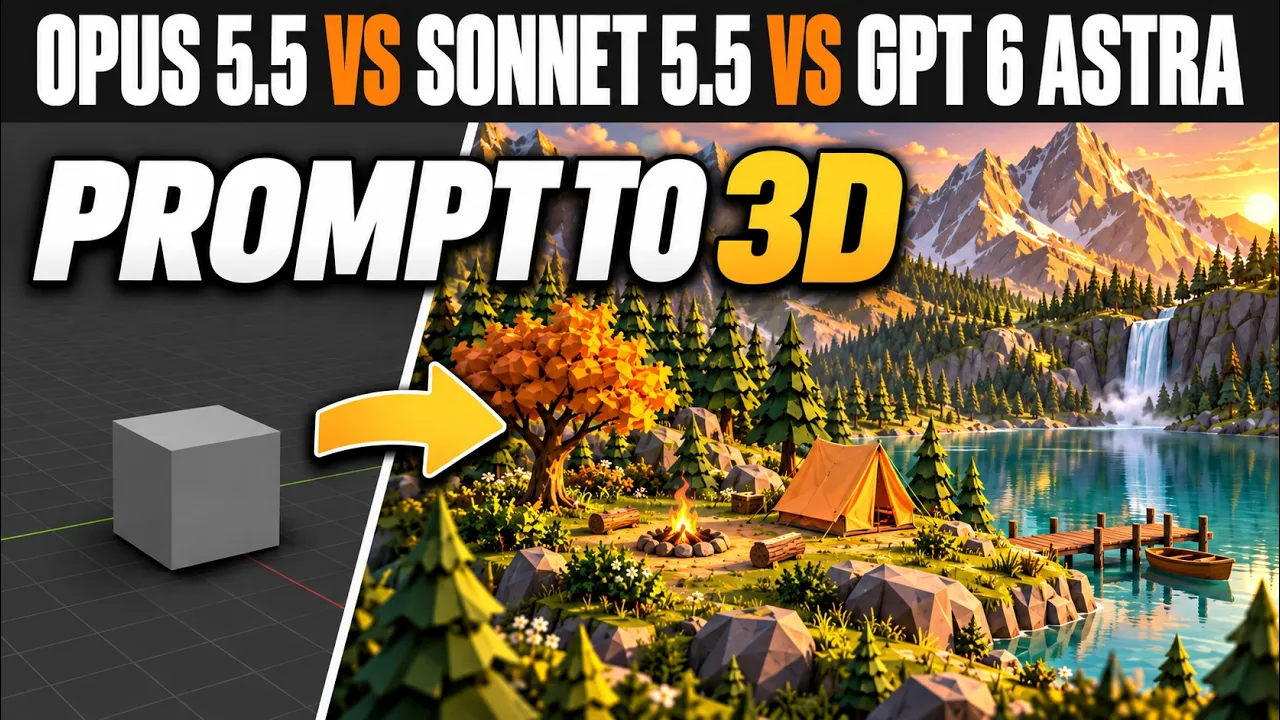
In this video, [music] we will put three best Frontier AI models, Opus 5.5, Sonnet 5.5, and GPT6 Astra to a test in Blender. We will give them the same prompt, build a rainy back alley in Tokyo with a tiny ROM install in Blender. And they can only write code, one Python script, no downloaded models, no textures, nothing from the internet. Everything you see comes out of that script. I rendered all three on the
77 words, the words spoken in the first 30 seconds at 153 words per minute.
Free, no signup. See how the first 30 seconds hold attention, with rewrites.
Sentence shape
| Measure | This transcript |
|---|---|
| Sentences | 127 |
| Average words per sentence | 9.8 |
| Longest sentence | 28 words |
| Questions asked | 1 |
| Sentences containing a number | 17 |
Most used terms
Filler phrases
15 in total: like 7 · kind of 4 · actually 2 · uh 2.
A literal whole-word count of the same phrase list the Prepublish browser extension uses, so a phrase inside another word is not counted and a phrase used in its ordinary sense still is. It is a count and not a judgement.
Run the check on the words above: where attention is likely to drop, with a rewrite for each weak line. The free check shows the scores and the one issue costing the most.
What this transcript is
Every word below is the caption track YouTube publishes for this video, pulled from the video itself and reproduced unchanged. It is not Prepublish's writing, not a summary, and not a re-transcription: it is the video's own published captions. English captions, generated automatically by YouTube, in the video’s original language. Source: the video on YouTube. A channel that would rather this page did not exist can ask for its removal through the contact page, and it is removed.
No Script X-ray for this video: YouTube shows a Most replayed graph only once a video has enough views.
In this video, [music] we will put three best Frontier AI models, Opus 5.5, Sonnet 5.5, and GPT6 Astra to a test in Blender. We will give them the same prompt, build a rainy back alley in Tokyo with a tiny ROM install in Blender. And they can only write code, one Python script, no downloaded models, no textures, nothing from the internet. Everything you see comes out of that script. I rendered all three on the same machine with the same settings.
So, let's see who built an actual place and whose alley falls apart when you turn the camera around. They all got the same checklist. 12 things. A ramen stall with a cloth curtain in front. The norin. At least three stools. A pot with steam coming off it. A red paper lantern that actually gives off light. Neon signs. Buildings on both sides with pipes and AC units and all that clutter. power lines, wet ground with puddles, falling rain, a glowing vending machine, a cat, obviously, and some fog.
Plus, two cameras, one hero shot, and a 10-second fly through down the alley. Sonnet finished first in about 45 minutes. And first impression, it's cozy. Warm light, pink neon lanterns, four red stools, and a cat sitting right up front. But the rain kind of eats the picture. It's these bright white lines over everything which looks kind of weird and the fog on top makes it all a bit milky. Then you look at the details and it gets thin.
The vending machines are boxes with colored squares on them. The building on the right is a flat slab. The whole scene is about 18,000 faces which is uh not a lot for a street. Opus took about uh 50 minutes and it went big. The alley is 43 m long. Signs everywhere, strings of lanterns, around 140 power cables, a wooden cart with real spoked wheels, and two vending machines full of cans. And the fog works. It feels like a wet night.
But some stuff falls apart up close. The raindrops look like white sticks. The puddles have hard edges, so they look like black stickers on the floor. The cat is gray and shiny, like a little statue. The vending machine says cold den because the coin slot sits right on top of the K. And the norin is there. It's just turned away from the camera, so you can't really see it in the hero shot. Oh, and for the Japanese text, Opus loaded a font that ships inside Blender.
The rule was no outside assets. It's inside Blender, so I'll let it slide, but it's a gray area. And then Astra, it took about 49 minutes. This is the cleanest picture of the three. This is surprising as Opus 5.5 in earlier tests was smashing Astra. The stall sits right in the middle. The Norin says ramen. There are tree stools, bowls on the counter, sake bottles on the shelf, a little menu board, and a ginger cat on a stack of crates.
It didn't use a font at all. It drew the Japanese letters out of strokes, which is kind of wild. But look closer. There's barely any rain. I had to zoom in to find it. There's almost no fog either. It looks great, but the brief asked for haze. The pot lid leaning next to the stove comes out as a flat white disc. And there's a little bar sign stuck behind the big neon sign. You can only see the top of the letters. Now, let's take the colors and lights away.
Same shot. Everything plain gray, so you only see the shapes. Opus, dense, cables, AC units, pipes, the cart, sonnet. Now you can see the blocks. A lot of this alley is flat boxes. Astra, the most detailed by a lot. Blinds in the windows, grills, fans inside the AC units, crates. It's about 190,000 faces, but it's also almost 3,500 separate objects. Every single window blind is its own object, 306 of them. It works, but if you had to open this file and change something, that's going to hurt.
So the checklist, everyone got the stall, the stools, the lanterns, the neon, and the power lines. After that, it gets messy. Steam, Astra is the only one where you can actually see it. And even that's a thin wisp. Rain, nobody really nailed it. Opus and Sonnet overdid it, and Astra barely did it. Fog, Opus got it right. Sonnet overdid it. Astra mostly skipped it. and the cat. Sonnet and Astra made cats. Opus made a cat statue.
Final count, Astra has 10 clean checks out of 12. Opus and Sonnet have seven each. Quick thing before the flyroughs. If you're into these AI head-to-head tests, subscribe to Code Bear. It really helps the channel, and there are a lot more of these coming. Then the fly through. 10 seconds each. Here's Sonnet, then Opus, then Astra. [music] >> [music] >> Oppus has the best move. It's a long, slow dolly down the alley right past the stall.
And this is where the Norin finally shows up. The first couple of seconds are really dark, though. Sonnet's camera goes straight through the Norin. For a second, the whole screen is just the curtain letters. And the alley ends on a flat wall with blank white windows. Astras is the smoothest. It pushes into the stall, slides right past the lantern, and turns down the alley. But past the stall, the alley is pretty empty.
Just walls, a few windows, and no rain you can really see. Then I tried one more thing. I put a camera further down the alley and turned it around to look back the other way. [music] That wasn't in the brief, I know, but it shows you if the model built a place or just one nice view. Opus, still an alley, just really dark. And the rain sticks are huge up close. Sonnet, same kind of thing. And Astra, there's nothing there.
It built the alley like a movie set. Everything faces the hero camera, and behind it, it's empty. A few numbers. Sonnet script builds the scene in under a second. Astros in about 1 second. Opuses in about seven. The hero shot at 1080p took about 70 seconds to render for Sonnet, 82 for Opus, and only 29 for Astra, even with by far the most geometry. So, who won for the hero shot? Astra easily. It's the one I'd use as a wallpaper, and it hit 10 out of 12.
But it went light on the weather, and the set only works from one angle. Opus built the most believable place. The fog, the size of it, the cables. You could walk through it. It just looks unfinished up close with the rain, the puddles, and the cat. Sonnet was the fastest and it's cozy, but it's the simplest scene of the three and the rain washes it out. So, my ranking, Astra first, Opus a close second, [music] Sonnet third, and not one of them made rain that looks like rain in a rainy alley.
If you like this one, subscribe to Code Bear and hit the bell so you catch the next duel. Tell me in the comments which alley you'd pick and what I should make them build next. See you in the next one. [music]
The words are the caption track's own and nothing is reworded or re-transcribed. Paragraph breaks are placed between sentences so the text reads as prose.
Free tools for your own script: paste a draft and see where it stands before you record it.
Paste your draft and see where viewers are likely to drop off, with a rewrite for each weak line.
Paste the first 30 seconds of your own draft for a hook score and rewrites.
Check your draft against YouTube's advertiser-friendly guidelines before you record it.
Read this channel's public videos and transcripts, and download a writing brief for it.