Getting the transcript
Reading the captions from YouTube. A video nobody has opened here before takes 10 to 30 seconds; this page fills in on its own.
Getting the transcript
Reading the captions from YouTube. A video nobody has opened here before takes 10 to 30 seconds; this page fills in on its own.
The Inner Circle Trader · @InnerCircleTrader
Where viewers went back to watch this video again, from YouTube's public Most replayed graph, lined up with what was said at that moment.
Most replayed moment #1
29:122.9x the video's typical replay level
Right there. Okay? So, now you have two primary functions. You're You're looking for a specific key level that's based on a octant or a quadrant level. You have to know what you're measuring and grading.
Said at 29:04
Most replayed moment #2
15:442.3x the video's typical replay level
This all night long as Lionel Richie would say. >> [laughter] >> What do you know about Lionel? No, what do you know about Lionel, okay? So, if you see we traded down into it here.
Said at 15:37
Most replayed moment #3
7:292.1x the video's typical replay level
stop hunt, this right here is a very clear depiction of the market saying I'm not going any lower. And you're watching that midpoint level
Said at 7:23
The graph counts replays. It does not show where viewers stopped watching.
Words
11,364
Runtime
1:14:52
Speaking pace
152wpm
Reading time
47min
152 words per minute, below the 160 25th percentile of 349 measured videos. That distribution comes from the 349-video hook study.
Opening (first 30 seconds)
Folks, welcome back. Welcome, welcome, welcome. So, just a quick little review. And then I'm most likely not going to be doing anything on Friday. So, just letting you know. Here's the daily chart on NASDAQ September futures. It's a daily chart. And I want you to take a look at how we again delivered this aggressive sell-off. And then look at this completely overlapping yesterday's FOMC. So, it's impressive, isn't it? So, let's add the
76 words, the words spoken in the first 30 seconds at 152 words per minute.
Free, no signup. See how the first 30 seconds hold attention, with rewrites.
Sentence shape
| Measure | This transcript |
|---|---|
| Sentences | 1,226 |
| Average words per sentence | 9.3 |
| Longest sentence | 52 words |
| Questions asked | 168 |
| Sentences containing a number | 36 |
Most used terms
Filler phrases
96 in total: like 44 · you know 21 · uh 10 · kind of 6 · literally 6 · um 6 · I mean 1 · actually 1 · right? 1.
A literal whole-word count of the same phrase list the Prepublish browser extension uses, so a phrase inside another word is not counted and a phrase used in its ordinary sense still is. It is a count and not a judgement.
Run the check on the words above: where attention is likely to drop, with a rewrite for each weak line. The free check shows the scores and the one issue costing the most.
What this transcript is
Every word below is the caption track YouTube publishes for this video, pulled from the video itself and reproduced unchanged. It is not Prepublish's writing, not a summary, and not a re-transcription: it is the video's own published captions. English captions, generated automatically by YouTube, in the video’s original language. Source: the video on YouTube. A channel that would rather this page did not exist can ask for its removal through the contact page, and it is removed.
Folks, welcome back. Welcome, welcome, welcome. So, just a quick little review. And then I'm most likely not going to be doing anything on Friday. So, just letting you know. Here's the daily chart on NASDAQ September futures. It's a daily chart. And I want you to take a look at how we again delivered this aggressive sell-off. And then look at this completely overlapping yesterday's FOMC. So, it's impressive, isn't it?
So, let's add the annotations. And this will make sense when we get in the lower time frames. But, we came down to the weekly basis I gave guidance this morning before the market opened up. Uh I thought that with everything that's been done, um the idea of the weekly low being in place, I believe that's all the more true today now. Um I want to take into the lower time frames and talk about this area between the blue shaded by side imbalance sell side inefficiency and this by side imbalance sell side inefficiency.
Okay, so both are suspension blocks. And that little space in between, right in here. Okay? So, if you weren't subscribed or following me on X, uh this morning before the market open, I posted a short little video. It's about 5 minutes long. Uh I tried to get as much as I could in in the very short period of time it takes for the video to render and then for X to process it and then allow me to post it. I tried to be as short and succinct as I possibly could, and uh now I'm going to give you a little bit more detail as to why I believed what I had said in that video and what you see transpired, okay?
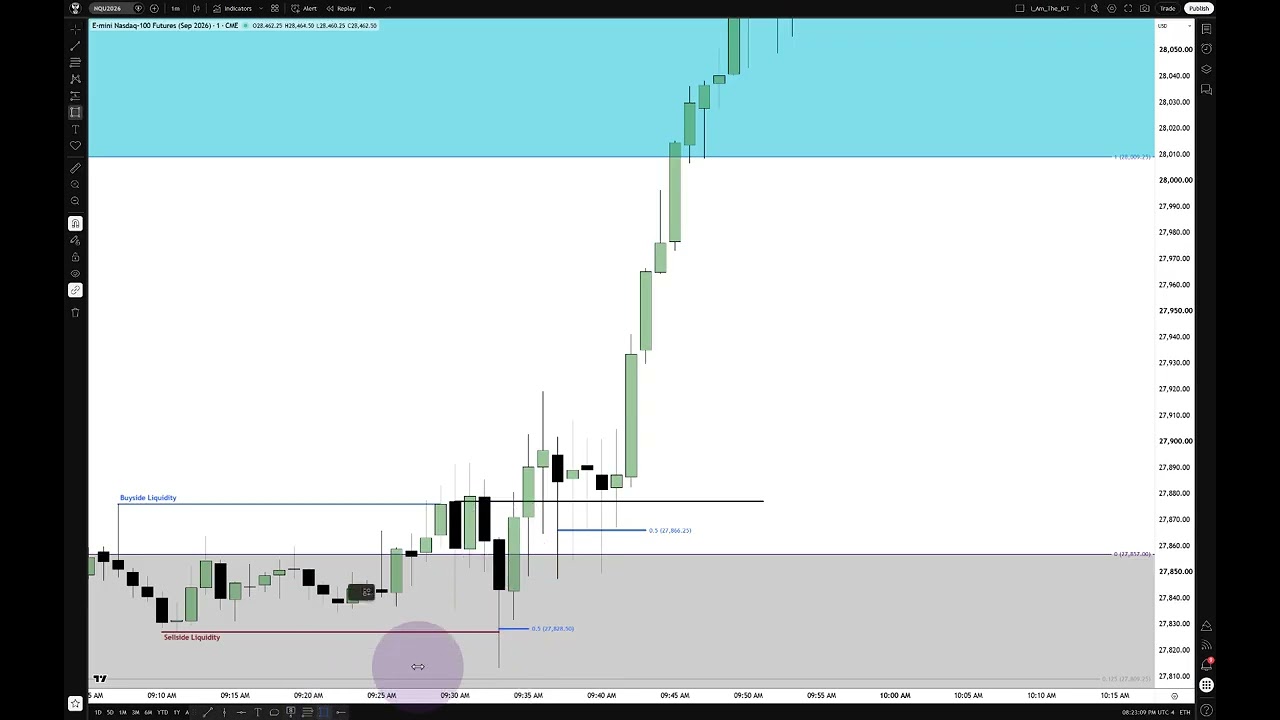
So, let's go down into uh 1-minute chart. And I promise we'll go through all this stuff here. We're going to look at the open at 9:30. Right in here. So, let's zoom into this little area. And the 9:30 opening is right here. All right. So, we'll take this little tiny line segment right on the open price. Like right there, and we'll make it black so it stands out a little bit. Okay, so that's the opening price. We opened in the lower portion of the space between this daily suspension block low, the shaded area in the blue, and the high of the lower daily suspension block.
So, again, rewind the video a little bit and look at the daily chart again. This and this, those are those two respective shaded areas on the daily chart. Okay? Now, we had relative equal lows in here at open. And we opened just above that short-term high. Notice that? So, what did they do first? Think about what they did first. They opened at 9:30 open above this short-term high. So, they've done this. And this is what narrative is like you you're you're going to learn how to build a narrative by listening to me tonight.
That's not right. No. All right. And then that should be blue. There you go. And it should be on top to the left. Okay. So, the open Notice again where it's at. Let me make it a little bit bigger. So, we can see very clearly what I'm about to explain to you. So, we opened above where buy-side liquidity would be. And then a little bit of a flurry higher, and then all in 1 minute it drops down here. And then we have relatively equal lows right there.
And then a few minutes later on 9:33 There you go. The market trades for the sell side. Now, when there is a expected direction. Now, I obviously shared my bias this morning. I told you where I thought it was going to go. And that being up here. Okay. So, when it does that it gives you a space between two inefficiencies like on a daily chart or 4-hour chart or an hourly chart. It's real easy to forecast and predict. And I'm I'm going to say that again.
We don't We don't react to price. Okay? Um everybody else will tell you that the market's random. And you just simply have to react to price because nobody knows what price is going to do. And now obviously, you know, when I show my executions, then the first thing that jumps in their head is it's market replay. Okay. Um I'm not going to beat that argument up anymore cuz I've literally showed it over and over and over again.
Um the only way you have to worry about when you're seeing an execution is this little thing up here that tells you it's not market replay. And there's a countdown to candle close over here. Okay? So, the opening price above here, the buy side's taken first. Then they come back for this. But it's occurring inside this little spatial area in white. Now, you can predict how price will move when it's moving from one area of inefficiency that's been traded back and forth.
In other words, we went down and up in the lower gray daily suspension block. We went down there at FOMC and we came right back up all through last night. Now, I'll zoom out in a minute, but for now I just want you to understand the logic. We trap traders buying above here trying to catch a continuation. Where do you think their stop loss is going to be placed? Right below these relatively equal lows. Where the books tell you it's support.
Then the market dives down, knocks them out. And now this right here, I'm measuring and grading this wick. See what I'm doing here? With this fib. When it creates this wick and it does a stop hunt, this right here is a very clear depiction of the market saying I'm not going any lower. And you're watching that midpoint level right there. Okay? What I'm measuring is the high, which is the close of this candle, and the low, that wick.
And this See? It can't even come down and touch that. Now, as I teach order flow, visually represented in the candlesticks, is this bullish or bearish? It's bullish. And the market trades higher. We're not looking at the fact that it's trading above this previous candle and saying that's an engulfing candle. That's That's after I already determined what taught what I taught you to determine when it's going to turn down here.
Okay? Everybody else's school of thought is wait for the breakout be confirmed by the breakout, chase the momentum. I don't want to do that. I don't want to do that at all. Remember what inspired me? My first real mentor, Larry Williams, said that he wished he knew how people that would be buying near the low of the days where he would get in and try to pursue that. Sometimes it it hurt him. And because he said he wished he knew that, I took it as a personal challenge, and that's where the idea of uh power three concept comes from.
Well, it bled into, and nobody taught me this, okay? So, stop talking about, "Oh, you got to look at this person's content, this person's content. He stole it, he borrowed it, this, that, and the other thing." Listen, you guys got to study some history, man. Okay? Cuz what I'm teaching, this is alien tech, okay? This is all new stuff. Knowing where these wicks will stop, when it's opening here and going down and you're anticipating, as I teach you, when it's bullish, what do we want to see?
The upper half. Okay? The upper half's going to support the narrative. We can wick down through it, but the body, and preferably not even touch the halfway point, cuz that's indicative of bullishness. And the market then trades and goes above the previous candle. Then everybody else will call that an engulfing candle. But, I'm already focusing down here at the low. That's what you as my students are learning. It's a repeating phenomenon.
When you know what you're looking for, it will give you such a high degree of front-row VIP seating in trading. And it repeats over and over and over again. But, unless you look for it and subscribe to the idea that you've seen me do it, you've seen me outline it, okay? And more and more students are going to come forward and they're going to be executing and showing you that they're doing it, too. But, it's scary in the beginning.
I understand it's normal for you to feel that way. But, here it fails to go down to consequent encroachment of this discount wick when the market has taken sell-side and tripped buy-side first. When I already told you before the market opened at 9:30 that I thought that the market was going to open and go straight on up into this level here. Okay? So, it's the lowest octant of the daily buy-side imbalance sell-side inefficiency.
Not just hit this and go lower, but trade up into here. I think it's going to draw up into that. Okay? So, moving forward, we have the market take out the short-term high here. And then, we start getting all these wicks. All these wicks. And what's actually happening is this body is the order block. So, the algorithm is reaching into this opening price here down to the body. And we'll extend this over. And we'll shade that in a very pleasant light blue.
Maybe you don't like light blue. But, I do. Okay. [laughter] So, the longest wick, notice it goes longer than there on the downside, this one and this one. This one sets the tone for where the bodies should not trade below. We open trade down into the order block and we send it higher. And then we get a little bit of wick. Why is this important? It's not because it hasn't breached the midpoint of this one. The next one here, this one goes lower than this one and it also goes lower Let me Let me Let me say it again.
This wick goes lower than this wick's consequent encroachment, but it also pierces its low right there. So, this is the lowest one. See how easy that is? It's It's not It's not complicated, folks. There There's no complication here. It's just you have to listen to the language I created and then apply it by backtesting and looking at things over and over and over again. And then once you get a feel for what it is that you should be able to recognize in the in past movement or hindsight data, then start tape reading and anticipating what these things are doing live.
Not even taking a trade. Don't even demo trade it. Just simply watch price action. You're going to condition yourself to anticipate and predict, not react. Price is going to react to our anticipatory price skills because we're anticipating these very things unfolding in the future because they are repeating on algorithmic logic. Said in a simple way, we don't have to pre- we don't have to play pretend that our chasing methodologies are going to work by reacting to price.
We're going to predict because we know that these things are repeating signatures. And that's advantage. It's advantage, okay? Anyone in this industry that tells you that you're not trying to predict right away is telling you in no uncertain terms they have no idea what they're talking about. Use your source of information carefully. I'm just going to say it like that, okay? If you're reactionary, if that's gambling as far as I'm concerned.
And I don't gamble. So, this wick, we don't get any bodies going below that. You notice that? But, we're digging down into this order block. And so, we have multiple attempts to get down here to accumulate this. What this is. Smart money's accumulating Notice what it's also trading into. It's the high of that lower buy side imbalance sell side inefficiencies suspension block. Don't forget that. You forgot about that gray area, didn't you?
Cuz you're so worried about these individual candles. So, you're blending several things here. There's that layering of discount arrays supporting the idea that this thing's about to go nuts straight up. To where the old man said it was going to go. The fact that we traded overnight in a very systematic slow grind higher. And I don't want to zoom out yet to show you that, but I promise you I will not forget because it's important.
We opened here, did all the business I had to say lined here. Then, because we're inside this white shaded area between two daily inefficiencies. Price, when it starts to go up, it's going to do so quickly, efficiently, running higher. It's going to go quickly to get to this area here and then drive right on up into that lower auction. Think about that. That's why price had all this clear pathway. And this is how you predict low resistance liquidity run conditions.
How you can blend the narrative of why price should go up. How it should behave as it goes up. We don't want to see this kind of stuff going higher slowly going higher slowly going higher slowly going higher. Now, I can zoom out and and show you that what the difference in my contrast. This all night long as Lionel Richie would say. >> [laughter] >> What do you know about Lionel? No, what do you know about Lionel, okay?
So, if you see we traded down into it here. And then we worked higher. And then once we broke this high, it went right into an efficient buy model. Or buy program rather. What is that? It stays in very short little candle ranges, but just keeps building higher and higher. Trying to short this is murder. It's murder. It's a death by a thousand cuts. And it just keeps going higher and higher and higher and higher. And every one of these quadrants and octant levels build PD arrays and it's supporting price going higher.
I'm not going to take that away cuz this is your homework assignment in here. Grade all of these turns and order blocks and breakers and fair value gaps and inversion fair value gaps using the technique I teach you when it has to anchor to one of the octants or quadrant levels. That's how you know an ICT PD array is valid. Just because you think it looks like one mean anything. Just because you think it matches something else that market profile or footprint or you know, the Hardy Boys model, whatever that stuff is that you're adding to it, you're diluting the purity of what it is I'm showing you.
The algorithm has no respect for all that stuff. I promise you. It's just time and price. That's it. That's all it is. And because it did this so efficiently, this is not a low resistance liquidity run condition. This is efficiently delivered price action. It's this real tight narrow channeled higher higher higher higher higher and you will murder yourself trying to short that. But now look what happens. Once we get to 9:30 opening right here and we're outside of the control Okay, you guys want to talk about putting control.
My daily suspension block was controlling this efficiency going up. I know that sounds very narcissistic. But it doesn't matter what you believe. It matters what I'm proving. The fact that here we have the market opening in the open space between two di- daily charts that are separated with a space where there's no overlapping. This blue area and this gray area on the daily chart are very specific things that I teach you to focus on.
How is it possible that the market reacts off of it like this and then behaves with this real clean price action run? Low resistance that means it's big candles, speed, it's got everything you want. Everything you want when you're wanting to go long. And wouldn't you know it, it just races right on into that level. Straight from here. We have at 9:41 that's 1 2 3 4 5 6 7 8 9 10 candles in a row. Just for 10 minutes it just screams up there.
Isn't that beautiful? That's like what? 200 handles? In 10 minutes? You going to complain about that? Market replay. So once we got into this area, then you're going to start looking at the octants and quadrants of the higher by side imbalance sell side inefficiency. We have this level here that's anchored to the lower octant. When price trades back down, that is a valid bullish order block. I'm sorry, bullish fair value gap.
Then, it forms an order block. You guys know why I stumbled over my words there. This opening price, I'm not going to draw it on here, but you can see it. That's the change in state of delivery. Draw that over. Okay, you can see them dipping down into the order block. Look at the bodies. The bodies are not violating the halfway point or mean threshold of this. So, I'm just going to quickly draw it on here. You see the blue in here?
No bodies are dealing anything there that. So, it's validating this as a what? An ideal valid ICT bullish order block within a bullish fair value gap anchored to the lower octant. How about that? So, you have several things there. Then the market, let me spread this out a little bit. And raise this up so we can see the candles a little bit better. And even the fair value gap, look at the bodies. They're staying in the upper half.
That's order flow. They cannot hide it from you, folks. You don't have to buy subscriptions to these gimmicks. You don't need all these things. You don't. You absolutely don't. And it's occurring during 9:50 to 10:10 macro. What's the lowest candle here? 10:10. But those things don't exist. All this stuff about macros, Michael's made all this stuff up. Why is it that you can go back through old data and see it's there, and why does it keep working?
Come on now, at some point you're going to have to realize that it's you all of you that are standing in opposition to what I'm showing you, you're all wrong. You're all wrong and you're denying it. You're You're literally a denier when the evidence is mounting every single day, every single week. How you going to escape it now? Like this stuff holds up in court. Come on now. So, we have a big wick here to draw us back down in here.
And that big long wick we want to measure that. Cuz it's standing out against this and this. These two candlestick wicks, and then this big prominent one. Soon as that candle closes soon as it closes we're waiting for it to trade back down into half of that. And if we're bullish, we do not want to see the body breach it. Does the body breach it? No. Does it wick through a little bit? Sure, it does. That's permissible.
But how do you know? You have to trust it. You After you see it for 34 years this November you know, you get used to it. You trust it. You You trust your bias, you trust the narrative, you think price is going to keep going. There's a small little minor buy-side liquidity pool up here. This is a buy signal right there. As it's opening and trading down, it doesn't feel like it when you're watching it. Nobody else on the internet's going to take that trade.
But you see me doing it all the time. I'm adding and building, pyramiding, entering straight on it. Come on now. You've seen it. You have seen it. And the market rallies up. And then we get this right here. Right in here. So, we have the low of the daily suspension block lowest octant and then the lowest quadrant. This lowest quadrant has a candlestick that's attached to this right here, so it's anchored. So here, watch now.
This is a short little fractal of the time price grid. Okay? Now, right away, some of you are zoning out. You're reaching for the Doritos, popping bonbons in your mouth, drinking down pop cola, liquid death, all that crap that's going to kill you. All these things in here are going to come together. Watch. We have the market leaving the macro, a 10 10. It's coming back and trading right back into this buy-side imbalance sell-side inefficiency that's anchored to the lowest octant.
That's this level is here. And we have an order block that's also anchored to this octant. That's what makes my logic mine, not supply and demand. You've never heard anybody talk about that stuff. Tell me, "Oh, yeah, it's a supply and demand rebranded." No, it's not. I know what the real levels are. I know how to see them. I know how to determine where they're going to form before they form. You have to wait for some kind of a mythology to say a specific level.
You call it a zone. I'm not trading with zones. I'm looking at very specific price levels and a very specific logic. And it's going to behave a certain way or it's not. And if it doesn't, then I'm probably offside. You don't have that with supply and demand. You have hope and prayer. And hope and prayer is not a model. The market trades down into the same inefficiency, the same order block that's anchored to this lower octant on the daily bullish suspension block and that daily chart, the blue shaded area, that's what we're focusing on in here.
We're in the lower end of that. So, when we trade back down into this, this is not Oh, you're trading outside of the macro time. No, you're trading in sync with the macro that started this run here. Look at the bodies. Look at the bodies here. What is it telling you? What do I teach? The body should not touch the halfway point when it's bullish. The body should respect the upper half once we leave it. It's having a hard time getting back down in there.
Then we have it trade up to the upper I'm sorry, the lower quadrant. Market trades back down, hits the same fair value gap and order block. And then we create a wick. Watch and see. It opens, trades down. We want to see it preferably fail to get there, then it's really bullish. But here, it opens, trades down. You can buy that. Stop loss below consequent encroachment. Why? Because you have this wick already anchoring that the logic should be it hits it and runs away.
This open trading down in the upper half of that wick. That's the buy signal. That's the buy setup right there. You don't have to be in the macro. You just have to know what the macro should be putting in motion. Okay? So, I'm predicting the momentum. Everybody else is trying to buy the breakout and try to hope it keeps going. You see the difference there? And I'm not trying to talk down to anyone, but all of you folks out there that trade momentum or or breakouts and stuff, if you just listen to me, you don't have to tell anybody that you like me.
You don't have to tell anybody that you support me. You don't have to do any of those things, okay? I want to see you do well. And I promise you, if you spend time with the things I'm teaching you, then simply watch and wait it out and you will see these things repeat over and over and over again. And there is no borrowed logic. Everything I just explained here is right from the horse's mouth. Here it is. I'm the guy to put that out there.
And when you see that the time grid is this, watch. We have line 50. Okay? 10:50. See that? Simple hour. I told you I can trade every hour and strip it down to time and price there. Here it is. Here's your grid. I'm going to shade this in a really weird color and you probably are not going to appreciate it, but it's just to make sure you see it stand out against everything else I have here. I know it's it's pretty intense.
I'm I'm sure you can get through it, okay? Endure it. >> [laughter] >> These levels here, okay? You see that? And that. Those are just like the multiplication table scenario or analogy I've used in the past many times. Okay? That is the grid aspect horizontally. Vertically, the vertical axis is the macro start time. I should probably stop teaching this and turn this video off. All these 20-year-olds going to go around pretending they figured this out and you didn't figure anything out.
You're just trusting the old man's life's work. So, we have horizontal, horizontal, horizontal, horizontal. Vertical, we had the beginning of the macro, and now divide the macro. Top of the hour. Right there. Okay? So, now you have two primary functions. You're You're looking for a specific key level that's based on a octant or a quadrant level. You have to know what you're measuring and grading. It's an efficiency. It's an opening range gap.
It's a new week opening gap. It's a new day opening gap. You're You're literally picking these very generic things I've told you to focus on. But, these very generic things in the hands of this type of application with them, it's untouchable. It's untouchable. Now, jump forward. We have a beginning of a macro over here. So, that will close the grid. Time-wise. You can carry it over here and start the same thing I did here.
But, now watch what happens. Every single time we get to a octant or a quadrant level, you're looking for a PDA to form. Here, I've already outlined it. And the order block. It's occurring at the octant inside the first portion of the macro. The second one, the lowest candle forms, look. Look. The lowest one forms at the close of the macro. And you think that's random? You honestly believe that some lottery level feat of randomness is going to create the turning point that's the lowest one at the end of the macro time that I teach you.
That some people on the internet make jokes about and laugh. >> [laughter] >> Come on, man. Come on. How much How much do you need to see of this stuff before you start realizing there's something scientific be here. There's something behind the veil that's beyond the scope of random buying and selling pressure. They would not allow these markets to operate under this simple chaos method of let the inmates run the asylum.
Think, folks. Think, man. This is trillions of dollars collectively across all markets. Come on, now. They're going to let that just run amok and we're all going to be in in control of influencing it? No way. No way. So, we have horizontal and vertical reference points. And the way you get your match, remember like the multiplication table you learned in school? Once we get to an octant or a quadrant, you have to know your bias.
You have to know what you're looking for. Okay? So, if you think that the market's likely to draw up above this high or draw down to the low Where are we at here? The low of that daily suspension block. The low of that blue shaded area down here. If you think it's going to retrace back down to there, then you can go through the process of looking for things to time it. We have a quadrant here. Look what this is. That That candlestick right there is a buy side imbalance sell side inefficiency.
If we are not able to trade to the next octant up here, if it can't trade there, or I'm sorry, that's the uh consequent encroachment midpoint. Midpoint of the whole blue shaded area. See it? Now, some of you already I already know, I can hear you. You're hissing at me, "This is too complicated. Give me an overbought oversold indicator." I can't help you. If if I see people leaving comments saying, "You complicate trading." You're immediately muted.
You can watch my stuff. You can pretend you're leaving comments that I'm seeing, but you're literally telling me that you're not trying to learn it. You don't care about precision. You don't care about prediction. You want to have something that's going to be easy, one, two, three, push a button, no brain thought, no concern for following rules, logic. Okay? Precision is not arrived at by randomness. Only God can can achieve that.
And our perspective is is random. God God moves in mysterious ways, but it's not mysterious to him. Our perspective is skewed. And when you understand that these things like this candlestick forming right there on that octant before you get to consequent encroachment, that line right here, >> [sighs] >> if we're going to see it move lower, because we've seen it pump straight out of the opening, and we're up in here. And now, look what it's doing.
It's failing to get to that consequent encroachment level. And we're fast approaching We're fast approaching what? A new macro. At 50. So, you can look at this right here, or at this octant, or upper I'm sorry, lower quadrant. This is the lower octant. We have a little bit of a a gap here, too. And if we're expecting a failure, cuz it can't go any higher, it's it's failing. Retail traders going to see this, "Oh, it's a bull flag, bro.
It's I'm just a momentum trader." >> [laughter] >> Yeah. The market breaks down, and then once we get this close outside of it, outside of what? This by side imbalance or side inefficiency that is validated right here, on this octant. Failure, breakdown, close outside of it. That validates this as an inversion fair value gap. It's first utilization is that of by side delivery. In a bullish market, it would support it.
But why isn't it doing it here? Sure, sure. The bodies, the wick, okay, it trades down through it, but the bodies are up here. That looks good for a while, and then it fails to go any lower in here. It looks good, right? And then Okay. We have that qualifying it to now a bearish inversion fair value gap. Focus on the midpoint of it. The bodies need to stay out of the upper half. It can wick into it like it does right here.
And if it does, you can short it just ahead of the macro. You don't have to take trades only in macro time. It's just a very sweet indication of time having an influence over price. Watch what happens now. We trade lower, and then come right back up. I'm going to take this vertical line away, okay? You know what that means. So, it's the it's the beginning of the new macro. Selling short here inversion fair value gap, it breaks down, and we get into this gap here.
If it's bullish, it's a should support price, and it doesn't. What's it doing? It's closing below that. Do you see a repeating phenomenon here that does not have any relationship or correlation to supply and demand, volume profile, footprint, Wyckoff, Elliott Wave, whatever. Find that logic. That's all you got to do. Find what I'm showing you right here just as I'm defining this. $5 million. Pay to you in a bank check.
It won't bounce. I promise. But you see these people all the time. Oh, this is a guy who rebrands stuff. Listen, man. It's important for you to understand that if you listen to smooth brains that say those types of things and just take their opinion and adopt it and not even look into the matter, challenge me. Say that you're going to go in here and see this stuff fail. Do that. I have won so many students over the last, I don't know, 25 years with me sitting down and explaining things to them and them saying, "Oh, it doesn't work." And then when they give it a real honest try, that means more than a weekend, they're converted.
They know that this market is algorithmic. They know these concepts are the truth. They are the market. It's the source code. Just like Neo in the Matrix, when he finally could see the Matrix, he didn't look at things like we see it. He saw the binary code, the ones and the zeros, but it didn't mask what it was. It gave him high definition. But see, when you look at these candlesticks, you're looking at the ones and zeros, but you can't see the structure what's really being indicated if you look past the binary source code.
Said in a different way, you see candlesticks moving up and down. It goes up or it goes down. It's a one or zero. And because you don't know the language that that binary code is showcasing and telling you literally with no uncertain terms, you don't know what it's telling you the market's going to do next. But when you understand the source code, you can see that oh, it's telling me it's failing to go higher. This right here I'm watching.
I'm predicting I'm predicting that this is going to fail up here. It will not be a bull flag. Then it goes lower and it closes below it there. That right there is the little telltale sign, the little crack, the little black cat that just happens and deja vu appears. In the movie The Matrix, just to borrow that little analogy, whenever you see deja vu, that's them changing the matrix. There's something afoot. That's Phil.
That's Phil. He's doing something there. He's disturbing it. And the average person that follows any retail logic, any gimmick, any software, this, that, the other thing, all of it is BS. You're subscribing to a cult-like mentality when you put your faith in number crunching. I'm not crunching anything. I'm showing you the yellow brick road, baby. I'm showing you the yellow brick road. Is it simple as that? You can choose to go off and do your own thing, but I'm here and I'm pointing and I'm following these yellow brick road paths that cannot hide from you once you understand what it looks like.
And right up in here, the logic is the body should not go in the upper half. It doesn't. It wicks. Short. Drops down and in here. Anticipate this becoming an inversion fair value gap. Trades down, closes below it, opens, trades up until here. Short. Short it. Why could you be confident there? Because look at this wick. We grade that. When it goes below there, any movement now when we're below it and trades up, this needs to turn into a wick and not be a body.
And you watch me outline this stuff all the time in recorded sessions. I said it in live tape reading where you watched and listened to me call every single 1-minute candle. It's the same rules. I'm not morphing it into something different all the time. It's the same rules all the time. But because you don't want to subscribe to it, because you want me to perform some kind of a stunt for you. I'm not a genie. You're not going to rub me and get three wishes.
I'm going to do things the way I want to do it. I'm entertaining myself. I'm getting my rocks off doing what I want to do, how I want to do it. But I'm making millionaires. And the ones that are getting there are the ones that are listening and saying, "You know what? I'm going to just listen to what he says about the logic. I don't care about the extra stuff. I'll filter it out. But this, this is what I'm here for. I want to learn this language.
I want to be able to do it myself and then I'll ever ever have to watch his videos ever again." That's what I'm trying to create in you, independent thought. You only have to stay around long enough until you learn it. And I'm not hiding it. I'm not withholding anything. I'm saying the same things all the time. Just been giving you more detail. If you would have put up less resistance to me in the beginning, you would have forgotten it by now.
We trade below it, open, short it. Runs all the way down. Just shy of getting into that low, and one more time, where does it trade back up to? The inversion fair value gap that you can predict. When it forms, it's ironic. It's almost mystical that the last candle is 10 minutes after 11:00. That's the close of my macro. That does not exist if you listen to people on the internet. I don't work on the Wall Street floor.
We don't We don't do stop hunts. That doesn't happen. >> [laughter] >> Yeah. Why can I Why can I tell you when it's going to do it? And the way I'm teaching you, you can see that it's forming. You don't need to have me tweet something to you. You're anticipating. All right, it's going to do something here. It's going to do something there. We're predicting. We're anticipating. We are not reacting. When you react to something, it's like you're sitting in a room.
You're holding your girlfriend's, your wife's hand. You're watching a scary movie. You don't know when the jump scare is going to come, and then boom, it hit it hit you. Your spouse jumps. Maybe you weren't scared by the movie, but because they jumped, now you're scared. You're jumping, too. What is that? That's a reaction. That's a reaction. Are you in control yourself at that moment? Nope, it's involuntary. But why is it that everybody around the world says to themselves, "We're not trying to predict anything.
We must learn to react." When reaction is literally the highest point of non-control. Think. That's exactly what that is. I don't operate like that. I'm not trying to cultivate that in my students' mindset either. I want you to be so confident in your ability to to handle these concepts in your own hands without me. The goal is not to watch my content. The goal is to get to where you want to be at and unfollow my social media.
Never watch my stuff. That's how you graduate. When you no longer feel the need to be tethered to me, that's how you graduate. It's not meant for you to stay in the nest forever. And some of you sometimes have to get booted out of here. So, we get the inversion fair value gap here, and the market starts to sell off, and look at that. Goes right down to the low of the daily suspension block. Isn't that crazy? It's wild, isn't it?
And then the market has a little bit of reaction, goes right up into here. Now we can start anticipating another PD array form. I'm going to take this yellow block off cuz it's bothering me. >> [laughter] >> It's It's a little too abrasive on the eyes. And then we have a wick here. And then you grade that, and if there's a body below it, that means we could probably go a little bit lower, and it does. And then we rally up.
Now that we have a fair value gap. Wait a minute. Wait a minute, bro. It's not on a key level. How you going to call that a fair value gap? What do you mean it's not on a key level? What do you mean it's not on a key level, man? The low of that daily suspension block. That's the lowest portion line. That's a That's a key level. That's where my PD array is going to form. How about it? Then market rallies up, creates a fair value gap, and then we trade down into it here, which is what?
Institutional order flow entry drill. You got to learn to cut things out. You got too many things ICT's teaching trying to confuse you. No. If you really want to be the highest top tier in reading the tape correctly, you're going to know all of my PD arrays. And you'll be able to read every single candlestick. You'll understand what it should do and what it should not do. And if you haven't picked up on that yet, you missed it.
And I told you before, even if you don't use every PD array, if anyone, even if they claim to be my student, if anyone tells you, "Don't waste your time looking at the other things." No. Don't listen to that person. I promise you, that's just them trying to step away. They want to step outside the nest and get a gathering of people that want to subscribe to their trailblazing attempt. But it's going to crash and burn.
The logic is you want to learn with one PD array. That's your model for getting into a trade, and then you take time learning the other ones. And eventually, when you get to a top tier analysis level, you will know all the PD arrays, at least the ones I've made public, and you'll know their place in price action as they form. And they will give you more criteria, more critical precision elements to know why price should or should not do something.
And that's where the confidence comes. You're asking me questions that I can't answer in sentences that make any sense to you because you don't have the experience using the things I've already taught freely. And I want you to rewind that and listen to to it again, because it's the truth. You haven't spent enough time with it yet to appreciate it. You think it should be easy because if I know how to do it so well and I've been doing it so long, then you should be able to make it easy to understand.
I have. You can't simplify any more than I have. But when you take yourself out of the rules I've made for it, you're not learning it. You're looking at a bastardized version of something that is being presented to you as a new way of doing something. I promise you, I promise you nobody did what you saw yesterday. Nobody did that. So, back to this. This fair value gap is anchored to that low. This candlestick. There's candlestick number one, candlestick number two is the inefficiency, and candlestick number three.
This area here is the gap. This gap is valid because it's anchored with the number two candle that makes the inefficiency. That has to be touching an octant or a higher low of an inefficiency or whatever range you're measuring and grading out. It's a key level. Market rallies up. Same bit of business here. We have this. Small little volume imbalance. Small little volume imbalance. Buy side imbalance sell side inefficiency.
Why is this a valid buy side imbalance sell side inefficiency fair value gap? In the form of a suspension block. Why? How's that? Cuz it's anchored to and it's touching that lower octant. Do you see a pattern here? Do you see some kind of a rhyme or reason? Of course so. It's coded like this. And you think it's buying and selling pressure. The random chaos of all these people. Think about what they think think think think.
You know how many noobs, these neophytes, that don't know what they're doing. They have no idea what they're doing, okay? You see them on the internet. Look at they're all over Twitter. They're all over Twitter. They're giving me advice. You know, they're they came to work late to their drive-thru job and they're telling me on their break how I should trade. You think that these type of people and their volatility, their little liquidity uh participation that has to be factored in.
Because if it's buying and selling pressure, it only takes one trade, one contract to print the high or the low of a candlestick. Argue on that with me. That's the truth. And you're saying that these smooth brains, okay? They have the power to stop the rally. Be the last bastion of decision-making for every fluctuation in the marketplace? Cuz that's exactly what you're saying, but you never really You never weighed it out.
Enough of these smooth brains, the smooth brain guild, okay? They themselves, that's what Reddit people thought they were going to do. They thought they were going to take down all the billionaires. We're all going to chip in and we're going to buy What were the stocks? >> [laughter] >> Uh GameStop, um BlackBerry and something else. I can't remember what all dumb head. AMC. Okay? Well, look at that Look at how that worked out.
You're not going to beat them, folks. Okay? They used that whole idea to sucker more people in into Ponzi and then they shorted it down. And now they're all mad. Oh, these mean traders on Wall Street. It's their casino. And you got to know what they do. It's simple. Let them play it the way they want. They built They built it. Don't wrestle them and try to say it needs to be this and be thankful that you can see it now.
I said about market efficiency. Trades right down to the low, stops. That's random. Rallies up. Look where the bodies are. Where are they? Where the old man tells you. If it's bullish, it's going to be in the upper half. Here you go. And here you go. One more time, tap to the middle. You're telling me that buying and selling pressure stops it here, stops it here. The bodies are opening, closing. I'm telling you the logic where these candles just going to start and begin.
Think. Is not what Is that not what's being shown here to you? For the folks who've been here for years, the people that were behind the paywall for years, you watched this every day. Every day. Go on. Rallies up and trades [clears throat] right back into that validated inversion fair value gap. I know these are fun videos, aren't they? This is the kind of video I like to watch. That's the kind of video I like to teach.
But it really it discourages me because when I put a video out like this, okay? I know there's going to be a lot of people out there that are just so team oriented. They like a They like a specific or influencer or they like a specific school of thought. And you get all upset, you get your feelings hurt, and you want to tell me mean things. You want to encourage other people to tell me mean things. Like I'm going to somehow abandon all this stuff and pack up and say I'm I'm no longer going to play with you.
I like standing out here and telling everybody that you're all wrong. I love it. Because I'm not losing when I say that. But I'm gaining traction with more of you. The more time I show you, the more times I convince you by proving it over and over and over again. Before the week started, I told you we were going to open trade up into that volume of balance on the daily chart and sell off for a short-term trade, not day trade.
I told you the imbalances and inefficiency on the daily chart was going to lead to and it went way past where I thought it was going to go. And today before we opened with trading hours, I told you we're going to go straight up into that level right there. And also I said trade up into upper half. That means all the way up that level there. Go back and listen to that little 5-minute video on X. It's there. It's going to trade up into this portion all the way up into the lower half.
It leaves relative equal highs here, a minor buy side. We're down here. We can anticipate what? It's going to probably try to get up to there. What is it going to be met with? There's going to be formidable resistance here. It's short-term, but it's only going down to accumulate there. Showing you signs it wants to go higher. It wants to go higher. Rally. Sells off, sells off, accumulates, runs through. Now this becomes it reverts back to first utilization.
Buy side imbalance, sell side inefficiency in a bullish market, it'll support it. Rallies up. Why are you whispering, bro? It's freaking creepy. Listen, don't mess up my flow. Inversion fair value gap, trades up. If it's really an inversion fair value gap, it should do what? The body stay in the lower half. The wick can go to and just past all the way up to the high, but no bodies are allowed to be buried in the upper half.
The lower half means to tell you this story is still intact. And what happens? The market breaks lower. Back down into the lower quadrant. We have a nice little sell-side imbalance, buy-side inefficiency here. Trades up into it, and then right back down to what? The order block right there. This is intraday pinball. You seen me do it. You seen me do it, okay? When I was trading Forex, okay? I did it there, too. And they all said I was using a a rented white label server.
Okay. I mean, hey, you know, if that's what you want to believe, go right ahead. But I wasn't doing that. I was not doing it. I throw down just enough to season the audience to let them all see enough where they They're forced to make a decision. But I'm also leaving just enough to keep the audience talking. And if the audience is talking, and there are some people that are scoffing and doubting, that keeps the audience active.
And that makes it animated in learning. Some of you get worn out with it. Like, oh, this is too much drama. It's really not drama. It's not drama. It's an engaged audience. Whether you like me or don't like me, you're an engaged audience. And that's because I'm engaging you as a good content creator. I'm holding your attention. Even though you don't like me, you don't subscribe, you keep coming back and watch You keep coming back and watching my videos.
You want to see something that you can say, "Haha, I got you." And it's me saying, "I got you." I got you coming back all the time. Because you keep seeing what I tell you works. You just can't do it yet, okay? And a lot of people went that route, and they become die-hard students of my stuff. And I I I support them. Some of them were were trolling people towards me. And I support them today. I encourage them. They they they came back and had a a complete 180° testimony said, "Look, you know, I believe what other people said about you." And one day I just said, "I'm just going to put it to test.
I'm not going to tell anybody." And it's Nobody can tell me anything different now. Hello. That's what happens. But you unless you become an independent thinker, you you can't get there. I already know some of you people are like, "Come on, get with it. Dude, you're talking too much. This is what makes you a bad teacher because you can't stay on topic." This is the topic. The topic is I'm teaching and I'm teaching the right way.
But I'm also encouraging the ones cuz you're not an audience of one. I don't just have one student watching the video. Some of you that are very arrogant and insisting that I do it the way you want me to do it. This is not Burger King mentorship, okay? It's not have it your way. Okay? This is This is my way. And they named streets after me, one way. Okay? This is the way you're going to get it and this is the only way you're going to be taught it correctly.
Inversion fair value gap trades down to the discount array. Do the bodies breach the consequent cushion? The buy side imbalance sell side efficiency here? No. Is that bullish or bearish? Bullish. Well, it snaps up. Then we get this buy side imbalance sell side efficiency here. One single candle. Cuz it's anchored to the lowest auction. Do you see a pattern, folks? Do you see how you can anticipate and predict the buying and selling pressure?
[laughter] The buying and selling pressure. Come on now. Let's give it up for buying and selling pressure, folks. Yeah, that's it. That's the life's blood, the heartbeat of the markets. Come on now. It's entertaining though, isn't it? The market trades back down. Look, is it bullish or bearish? The wick goes down to consequent crush and just a little bit hair fell through it, but the bodies can't even touch the halfway point.
Is that bullish or bearish based on the old man? It's bullish. Okay, the market rallies up. What's it doing? Trading right back up into this area here. Look. We're in a bullish buy program. It sells off a little bit, but it's only doing what? It's coming right back down into this. Buy side imbalance sell side inefficiency. Well, how is that one? Like, what's going on here? It's blending two things. Number one, this level was a bearish fair value gap here.
Then when we crossed over it there, this changes its first utilization to now inversion fair value gap. So, it's going to support price if the market's bullish. I don't know, you tell me. Is it the bullish? Bodies are not touching it. Wicks are touching it. And we have this buy side imbalance sell side inefficiency. Both are anchored to what? The lower quadrant of the blue shaded area that's the suspension block on the daily chart.
Once you have your daily chart mapped out appropriately in what key key PD arrays are there, notice I I have an entire universe, a smorgasbord, okay? It's like a all you can eat banquet in front of me. I can buy and sell all day long using this stuff. And some of you think you know me. You don't know anything. You don't know nothing. Bullish fair value gap, inversion fair value gap blended together. Stops [snorts] dead right there.
Tell Elliot to stick a fork in it. >> [laughter] >> You're not getting that. Then it rallies up, and here you go. It starts generating all this consolidation in here. Going into what? The afternoon session. So, it's building an area where retail's going to see that as what? Resistance. Well, resistance is futile. The market comes back down. The bodies can't even look at it. Look, look, look, look. Look real close, folks.
Is that body right there? Is that body touching the inefficiency here? No. Does it wick into it and react off of it? Yes. So, if it's bullish and we see these signatures here, do we anticipate the market going higher or lower? Higher. What should it aim for? Relative equal highs. So, it should bust through this like SWAT. Rally. Come back down in. Rally. Here you go. We have a wick. Okay? This wick, you grade that. Split it in half.
Maximize this a little bit, folks. My eyes are getting tired. Dude, you're getting old, man. All right, let me take all these other levels off. It's all math, folks. Okay? I promise. It's just math. Math and Let's do it one toggle at a time. Look at that, folks. Come on now. Give it up for the old man. Give it up for the old man, okay? The wizard behind the curtain. I told you it's mine and I am telling you my fingerprints are all over it.
Wick. Consequent encroachment. If it's bullish, the bodies are not allowed to breach it. You shall not pass. What to do in there? Look at that. If it does that, and then we open up here, we trade down to the wick, that's a perfect buy. Anything in here to here is perfect. But this is a bonus down here. Why do you know it's not going to go down here? Where is it at? What's this level? That's the lower quadrant of the daily suspension block.
We're going higher. Everything is indicating it's going to go higher. Does it go higher? Sure. Sure it does. Rallies up. What is this right here? This is just me using this inefficiency right here. Okay? Now watch, I'm going to borrow this wide inefficiency. We're going to go over here. Now I'm going to put a fib on this. Okay? There's no magic to the fib. All it does is just tells you where the reference points are going to be for the algorithm.
Now I'm going only going to use the uppers. So we have 87, 50, and 62. All right. No. 87 and 75. No, 25. There you go. That one, and then we'll look at the 87, and we'll look at this one. So not the 87, that was the low. All right, so we have heat these here. Now I'm going to extend these to the right. And I'm going to then scroll very slowly back over here. This is too complicated, man. Okay? Not everybody's going to be a rockstar.
Not everybody's going to a smart money trader. There's your key level that's part of all this this range, okay? So, what I'm looking at, we're inside of all this right here. See that? We're at that key level. Market trades down to this wick. Consequent encroachment. And it's half of this inefficiency. Okay? That's an inversion fair value gap, and now it's going back to what? First utilization. So, it would look like this now if it was following the color schemes that I use when I'm teaching.
It would look like Well, let me do it with a dark blue. There. So, we're in the upper half. But, we have this wick. That's why it's allowed to put that close below halfway point. You have to be able to measure these things. And it's confirming it wants to go higher. Then it goes higher. Rips straight out the gate all the way up. Piercing higher higher higher. And then we enter into a the retracement back down into that same order block.
Right here. We're using the wick high and the opening. That's a nice little sweet spot. Why is this an order block? Because it's laying on an octant. Trades down perfectly to the order block there. Rallies up, comes right back down, touches the key level again. Part of that inefficiency. Rallies higher. I know. There's levels to this, folks, and not everybody's going to get on my level. I told you in the beginning it's going to be like that, but some of you, if you just get just one plane of existence higher than where you're at right now, every year, you're going to be so good at this.
You're going to be so good at it. Market rallies. It's in in upper half of this buy side and balance sell side inefficiency, there is a key upper quadrant level. Rallies up. It starts getting a little disorganized in here, but that's okay cuz they're just painfully crushing everybody that wants to be shorting it. Relatively equal highs here. We trade down in here and this by side and balance sell side inefficiency. Working inside that.
Here's consequent encroachment of this inefficiency. And we have another little fair value gap right there. Right there. And then we use it there. Rallies up, supports it here. Goes higher and there we are at the high of the suspension block on the daily chart. Trades back down in and then there's where we're at now. Now think, folks. Is it guesswork? Or is it just simply just outside your reach and your capability for the moment?
Cuz that's all it is. It just can't do it in your own hands yet, but the logic is absolutely there. It's absolutely there. Small little by side and balance sell side inefficiency that wasn't on the chart when I was beginning this video. Gap. It's touching this upper octant. That level right there. So we take this and this. Draw it out. If it's bullish, it won't touch or put a body below the midpoint. Look at it. It can't even put a body on the upper top of it.
Come down, doesn't even touch. It gets real close to it right there. Watch. See? Small little separation. This candlestick's low. Look at it. 28,431 3/4. 32. It's one tick above. It can't touch it. Is that bullish or is it bearish? Bullish. Whoop. There you go. And then there's where we're at now. Ask a friend online. How many people told you it was going to behave like it did today? Ask around. Ask your friends online who told you how the market was going to operate and how it's going to trade before we even opened up on Sunday.
And how it was going to go to a very specific price level and then go lower. Just ask around, folks. That's all you got to do is just ask around and see if anybody else has been giving you this mini jackpots. Think about it. And old man does it for free because I love all of you. I want to see you do well. And I want to see you give God the glory. Not me. I'm not the greatest of all time. I'm not the best, okay? I'm just the pen he chose to use to write this little letter to all of you.
And some of you just simply want to view it as a means of arguing. And there's no argument here. You can't beat it. You can't outperform it. You can't come up with anything more precise or consistent. I don't care what you call whatever you think it is, none of the things I've outlined here is found in any other school of thought. And that's the reason why nobody comes forward and tells you, "Here's the book. Here's the video.
Here's the year it was released. Here's where they talked about and they use the same vernacular, the same description, the same logic. It needs to do this but it can't do that." It's not in anything else. That's what makes this a language. And you have to know the language. My youngest son, Caden, he's, you know, he's trying to look for shortcuts. He's like all of you. Yeah, can you uh can you make it a little bit easier?
No. He tonight he's watching the same same playlists that's on my YouTube channel. The same ones. Why? Because he has to listen to his dad use the language. I'm referring to specific things. How do you anticipate doing well, going to a foreign country, and not falling into trouble, or danger areas, or get what you need, unless you know how to speak their language? None of you know how to get to the land of consistency.
Like I'm showing you a way to get there. The way you thrive is you have to know the language that's spoken here. And if you don't want to do that, I can't help you. It's not worshipping me. You're not being a cult member, and everything I say is the fact. No, I tell you everything. Go in there and weigh it out. See if it's true. See if it holds up in your own hands. And give it a real honest effort. If we go back out to a daily chart, and I'll close this video.
There's a couple places right there I could have closed it and been real theatric. >> [laughter] >> But I I really want you to appreciate what's going on here. Look at that. It's real hard to figure it out when you look at it that way, isn't it? I can't tell you how many times I cried. Weeping. 20 minutes before I deleted to go to work. Hating life, hating everything that was going on around me, because I blamed these things here that they were hurting me.
These candles can't hurt you unless you give them the weapons to do so. Think about it. But when you say, "I'm going to make friends with you. I'm going to align with what it is you're doing, because I can't change what you're doing. The buying and selling pressure of all of us collectively isn't going to influence it. It's going to do what it's going to because it's scripted. So, what are you best suited in doing? Aligning yourself with what the market's going to do.
And don't resist it. And learn the language I'm giving you because it's the source code. It is the very thing that makes these markets behave and go where they're supposed to go. Does that mean you're going to be right all the time? No. But what if you're right half the time? And you don't over leverage. And you don't abandon the model. And you sound money management. You could change your entire family tree financially.
Not just remove yourself from the necessity of having a job. That could happen. But you could also build generational wealth that none of you even can fathom right now. You don't find it with competitions. You don't find it with trying to be on leader boards. You don't find it by being the most loved online influencer. You find it by staying in your lane, focusing on what you're trying to do every single day, and allowing nothing to distract you.
No one else's opinion. Nothing can thwart your approach to pursuing it. And it's yours. You deserve it. If you're going to put the work in to learn this, then you deserve it. If you don't want to work for it, you don't deserve it. And I don't feel sorry for you when you complain. Cuz I already told you in the beginning it's going to be hard. I told you it'll take more time than you wanted it to. And there is no shortcut.
And when you live life with the idea in your mind that there's no plan B. I'm burning the ships. I'm not going back. This is where I'm going to go. Nothing's deterring me. Nothing's turning me around.
The words are the caption track's own and nothing is reworded or re-transcribed. Paragraph breaks are placed between sentences so the text reads as prose.
Free tools for your own script: paste a draft and see where it stands before you record it.
Paste your draft and see where viewers are likely to drop off, with a rewrite for each weak line.
Paste the first 30 seconds of your own draft for a hook score and rewrites.
Check your draft against YouTube's advertiser-friendly guidelines before you record it.
Read this channel's public videos and transcripts, and download a writing brief for it.