Getting the transcript
Reading the captions from YouTube. A video nobody has opened here before takes 10 to 30 seconds; this page fills in on its own.
Getting the transcript
Reading the captions from YouTube. A video nobody has opened here before takes 10 to 30 seconds; this page fills in on its own.
Farsight · @Farsight
Words
6,250
Runtime
49:58
Speaking pace
125wpm
Reading time
26min
125 words per minute, below the 160 25th percentile of 349 measured videos. That distribution comes from the 349-video hook study.
Opening (first 30 seconds)
Hello Everyone! Welcome to the fourth Spotlight in September, and it's going to be a really interesting Spotlight, so I've got a lot of stuff to tell you. And it's really interesting for a whole bunch of reasons. First of all, we have a lot of stuff to release to you. It'll be on farsightprime.com, of course, but we have a lot of
63 words, the words spoken in the first 30 seconds at 125 words per minute.
Free, no signup. See how the first 30 seconds hold attention, with rewrites.
Sentence shape
| Measure | This transcript |
|---|---|
| Sentences | 495 |
| Average words per sentence | 12.6 |
| Longest sentence | 55 words |
| Questions asked | 26 |
| Sentences containing a number | 13 |
Most used terms
Filler phrases
65 in total: like 30 · you know 15 · I mean 8 · actually 6 · basically 2 · right? 2 · kind of 1 · sort of 1.
A literal whole-word count of the same phrase list the Prepublish browser extension uses, so a phrase inside another word is not counted and a phrase used in its ordinary sense still is. It is a count and not a judgement.
Run the check on the words above: where attention is likely to drop, with a rewrite for each weak line. The free check shows the scores and the one issue costing the most.
What this transcript is
Every word below is the caption track YouTube publishes for this video, pulled from the video itself and reproduced unchanged. It is not Prepublish's writing, not a summary, and not a re-transcription: it is the video's own published captions. English captions, published by the channel, in the video’s original language. Source: the video on YouTube. A channel that would rather this page did not exist can ask for its removal through the contact page, and it is removed.
No Script X-ray for this video: YouTube shows a Most replayed graph only once a video has enough views.
Hello Everyone! Welcome to the fourth Spotlight in September, and it's going to be a really interesting Spotlight, so I've got a lot of stuff to tell you. And it's really interesting for a whole bunch of reasons. First of all, we have a lot of stuff to release to you. It'll be on farsightprime.com, of course, but we have a lot of stuff to release to you, and let me just go through it. First of all, the next ET board meeting is ready.
It's fully edited now. It takes a lot to edit it. I mean, it's 6 cameras, 6 mics, it's a lot of work. But anyway, it's done, and the ET board meeting is really great, and this Spotlight is on Sunday, and we'll release the edited version of this by tomorrow morning, maybe late tonight, depends on how fast the editing goes. And then we're thinking of the ET board meeting, probably, just to space it out a little bit, it'll be Wednesday.
So on Wednesday we release the ET board meeting, and that is powerful. That one knocked us off our seats. There was this big guy, one of the ETs that came by was a big guy, and he was — talk about being forceful — he was a big guy. But he told us what was going on. Anyway, so you're going to see that Wednesday. I mean, we could release it now, but the Spotlight is today, and I like to space things out a little bit. And then the next major mysteries is, essentially, it's done, but we're still working on thumbnails and things like that.
So we're going to release that by Friday. So the thing is as follows. The next major mysteries is the next major attack in the United States, on the United States. And we're assuming it will be relatively soon. We're not talking years away, we're talking soon. It's weird. It's weird. And did I tell you it's weird? The next major attack, talk about deception. That's one of the reasons I'm talking about treachery and deception today.
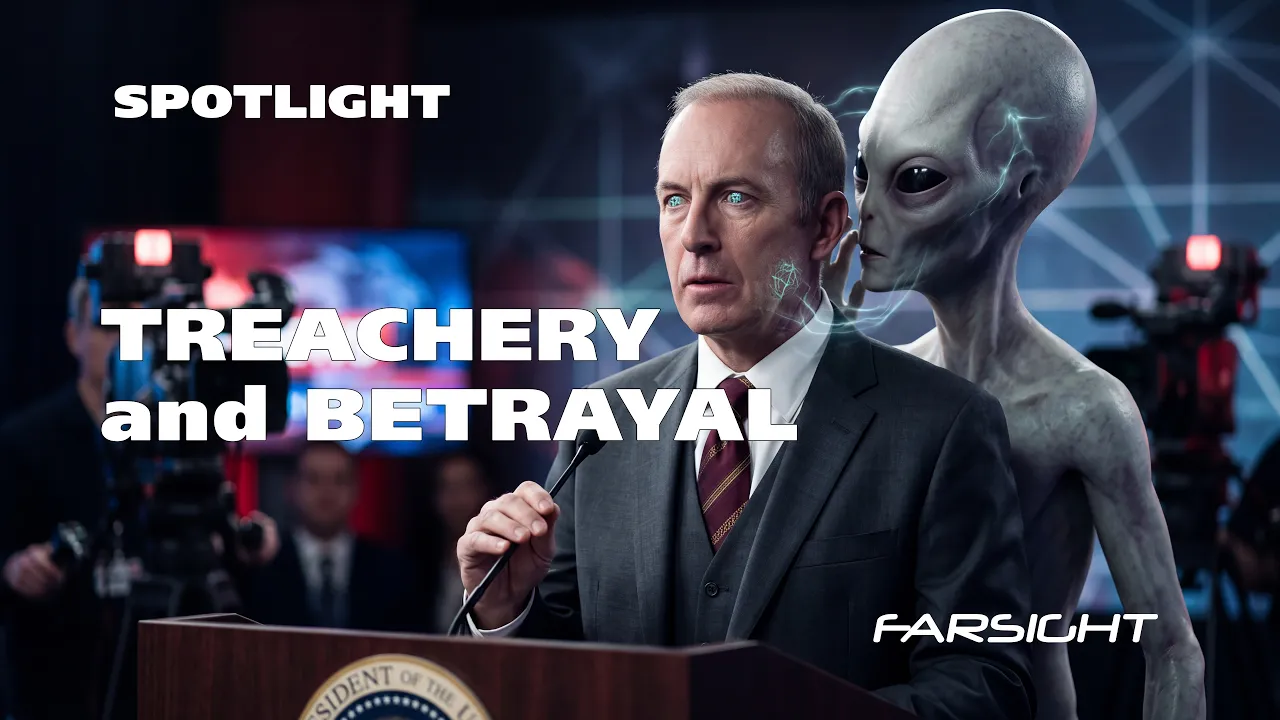
I mean, the actual title of the whole thing is "Treachery and Betrayal," but in part that's because it's very relevant to what's coming. This next major attack, it's going to be released on farsightprime.com, but this next major attack is — you've got to see it to believe it. It's got both human and ET involvement, and some false flag stuff. It's complicated, but we know the whole story. And it's soon. So we're thinking, if the Spotlight happens tonight, then the ET board meeting, which is super important, you've got to hear the big guy.
The big ET guy. He was powerful. And then the next major attack in the US, we're going to put that off till Friday. So, I mean, it's just big. It's just big. Anyway, so let's talk a little bit about a couple things that I really want to make sure you get. If you have not yet signed up for our free email newsletter, that's really important. Go to our website, farsight.org, and at the top of the nav bar on the left, you'll see the email newsletter.
You have to sign up for that. That's the only way we can really announce a lot of stuff. And we never send out spam, and we never, ever, ever give our mailing list out to anybody for any reason. Okay? So there's that. So those are the things that I'm going to be talking about in the near future. But the — how do I say this? We have a mission here at Farsight, and the mission is to use remote viewing under totally scientifically clean conditions, but in an interesting way that's fun to watch.
So many people that watch Farsight stuff are already liking remote viewing, but to change the planet, we have to affect everybody. And a lot of people don't know much about remote viewing. So we want to make our videos as entertaining as possible. All of our videos are authentic. It's the real stuff. And everything's done totally clean, scientifically clean, under totally blind conditions, and so on. But how do you make them entertaining so that you get the same authentic nature of it?
Everything's authentic, but it's entertaining. Fun to watch. So I want to give you a peek into something that you're going to be getting when the next major attack in the US comes out in a week. It's the new — we've told you that we've invested heavily in time and effort and money and new ways of doing things. And this type of presentation of remote viewing, you can't get anywhere else. And we have some surprises for you down the line that are going to be in about a month, and then a month after that that's going to knock your socks off.
Trust me, we have so much planned. But right this very second, I want to give you an idea of what Yeme Jeaneé's new session looks like. This is for the next major US attack. Now, I'm not going to show you the whole thing. I'm just going to show you a minute, just so you can get a flavor of how far we've come in terms of making these things really fun to watch. Are you ready? I mean, I look at this myself and I say, "Whoa, we did that?" But this is what we're doing now.
Okay. Here we go. Yeme Jeaneé. This is just a minute of a much longer presentation of the data, but this time you get to see what the — you'll see. We've got natural land here, both natural and man-made. Multiple structures, multiple subjects. Rectangular structures on natural land. I've got deductions of dirt, sand, gravel. There is movement via subjects. Natural environment. Peaks. Flat, hard land. Hills around. I see subjects inside of structures and surrounding the structures, or in and around the structures on the land.
I have some — I'm going to call them structures — that have pillar, and then they have kind of like a — it's not necessarily peaked, like pointed, but it goes diagonal, and then it parallels up and flattens out horizontally at the top. I've got a few structures that look like that, and then some that are shaped a little more rectangular-wide and a little more rectangular-long, horizontally and vertically. I'm moving to the center of focus one.
Okay, everybody. So as you can see, we've gone a long way. And now she continues that session, and she tells you who's doing it, what's going on, and what's in their heads, and all that stuff. And Intysam is also doing a lightboard session that is unbelievable. Well, it is believable. It's very believable, but it's just amazing. And that's coming out in a week. The next major US attack. Actually, that's an attack on the US, in the United States.
That's not an attack that the United States is doing. It's something that happens internally. But it's so complicated. It's so complicated. And it fits into the theme of today, of today's talk, which is treachery and betrayal. Anyway, so — oh, what's going on? She's all blue. Okay. The issue is, it's totally her doing the remote viewing presentation, but we use our software. It's her voice. Everything's her. We use our software to make her into a reptilian that still looks like her.
That was cool. That still looks like her. It looks like her, but she's now a reptilian, and it's still her voice. Everything is hers, but that's how she presents it. This gives us an ability to present information in ways that are totally unprecedented, and you have no idea what we're planning. Whoa. Anyway, keep tuned. This is all going to be on farsightprime.com. And for those of you who are not yet signed up for farsightprime.com, it's not expensive at all, and you can't get the information anywhere else.
And after today's talk, you'll realize why it's so important to get this type of information. Anyway, also remember to subscribe to the YouTube channel where we put out our Spotlights and our live stream lessons on remote viewing, probing, and things like that. Intysam does that these days. And we have a full collection of instructional videos on farsightprime.com, of course. All right, so let's actually dive into today's talk.
And it's going to be very interesting, but you will see how it all relates. So we're talking today on the idea of treachery and betrayal, but in a certain way. Now, you know I'm a professor at a major university, right? So I'm going to add something that normally you would get in a college class, in one of my college classes. But it gives you an ability to see behind the treachery and betrayal. So today I'm going to be talking about treachery and betrayal that's in our midst on this planet.
So today I'm going to be talking about the psychology and game theory of treachery and information control. Now, game theory is an approach, a theoretical approach, for how to look at certain things. And in certain cases, it really works well. And game theory is really important in what we're talking about today, and how the upcoming attack, and also the dynamics of what's going on in the world, actually happens. Now, by the way, remember that this Spotlight is in two parts.
We have the part that you're watching right now, the normal one-hour presentation in Spotlight. And then we have Spotlight overtime. And that goes on. That's an addition, an additional section of the Spotlight, but that's only included on the edited version that comes out on farsightprime.com. So remember, there's two versions. So if you are watching the live stream, still go to farsightprime.com to get the rest of it, to see the Farsight overtime.
Okay, now here. The psychology and game theory of treachery and information control. So here's the core dynamic. First, why does manipulation occur? Manipulation — and you guys are the ones who are being manipulated by everybody out there — manipulation is fundamentally a strategy of resource and power asymmetry. Asymmetry, meaning it's not symmetrical. So there are two players. There's player A, who does not choose deception because it is easy.
They choose it because a direct, transparent path to their objective is blocked. Meaning they can't get it any other way, so they have to use deception. And they're having a structured interaction with player B. And think of it like it's a game with two opposing players, player A and player B. Now, whether player B is a single individual or an entire nation, if player B's independent interests conflict with player A's in open contest, it would result in player A's defeat or at high cost.
So if the interests of player B — think of player B as everybody, and player A as those people who are manipulating you. So regardless of whether player B is an individual or the entire nation or the world, if player B's independent interests conflict with player A's interests, then open contest between A and B would not be good for player A. So therefore, player A, the manipulator, targets the foundation of all rational decision-making.
Now, that is information. That's the basis of all rational decision-making. Now, when you're looking at game theory, it goes under the assumption that people are rational. Now, you don't have to say that people are all coherent, rational, positive, you know, they're thinking. They either are rational or they act as if they are rational. They are rational or act as if they are rational. The only thing you have to know is what rules they are going.
Even if they're crazy bonkers, if you know the rules that they're using to make their decisions inside their head, then you can see the rationality of it. So information is the foundation of all rational decision-making. So people and nations do not make decisions based on true information. Did you hear what I just said? People and nations do not make decisions based on true information. They make decisions based on available information.
Do you all understand the difference? They don't make decisions on true information. They make decisions on available information. Now, you can consider it an available information set that they perceive as reality. So by curating this information, fixing it, player A, the manipulator, can artificially alter player B's incentive structure. So player B thinks that they want this, but in reality, what? They don't want that.
So let's talk about the idea of game theory and asymmetric information. Now, that relates to something in game theory called the prisoner's dilemma. The prisoner's dilemma. So in standard game theory, complete information leads rational actors towards predictable equilibriums. Complete information. If everybody knows everything, you can predict what will happen. However, player A knows this, and player A, the manipulator, introduces asymmetric information, or call it active disinformation.
And the structure mirrors a rigged prisoner's dilemma. So the prisoner's dilemma basic idea is you have two prisoners, and the police capture them. They were involved in some type of crime, and they separate them in different rooms. And then they tell each prisoner that they have certain options. If they confess and they finger the other guy, then they get only a couple months in the jail, and the other guy gets eight years.
And they tell that to each person, each prisoner. And the prisoners are not allowed to talk to each other, so there's information, you know, lack of information. And then they tell — but the reality is, so it's individually rational for each prisoner to finger the other guy. But if they both confess, then they both go to prison for, you know, seven years. So the point is that they pick a strategy that seems good for them on an individual basis, so it's individually rational.
But they get an outcome that neither one of them wants. It's collectively irrational. So something that's individually rational seems okay to you, seems okay. Turns out to be that it's the worst thing for everybody. And that's all done through information control. So what they do is they, with the prisoner's dilemma, they manipulate the choice. Now, player B, the one that's being manipulated, in the sense that we're talking about it today, not in the sense of people in jail, but in the sense that we're talking about today.
So player B, whether an individual or a collective public, which is like everybody, evaluates choices based on distorted payoffs presented by player A. So fearing immediate threats or chasing fabricated incentives, player B acts entirely rational from their restricted local perspective. And we've seen stuff like that a lot. We've seen stuff like that in terms of remote viewing projects. We've seen stuff like that with the 9/11 stuff.
We've seen stuff like that with the COVID, you know, debacle, where they basically shut down the whole planet and pushed in a lot of national security stuff. That's what they did with 9/11 too. They put in a whole bunch of security stuff, you know, for controlling. And we're starting to see it again with the fear-mongering that's being put out by the major AI companies on AIs being dangerous, going to wipe out humanity, and things like that.
They want regulation. Well, why would the AI companies want regulation of AIs? They don't want regulation on their AIs, on their stuff. They want regulation on everybody else's so that they can reduce the competition and have monopolies. That's all that's going on. So anyway, so let's get back to the idea that player A, which is the manipulator, fearing immediate threats or chasing fabricated incentives, player A manipulates what player B listens to, gets.
And then player B then is fearing those immediate threats or chasing fabricated incentives that player A is showing. So player B, the manipulated — think of that as the masses, everybody here — acts entirely rational from the options that they're given from their restrictive local perspective. However, there's collective irrationality. So while each isolated choice makes local sense to player B — sure, they want to have safety with regard to COVID or AI and stuff like that — so while each isolated choice makes local sense to player B, the aggregate outcome is disastrous for player B, for player B's broader group or nation.
Player A reaps the systemic rewards because player B willingly self-sabotages out of compliance with this false narrative. And this false narrative is almost always accompanied by fear. They come out with — whenever you see any major company or the government come out with armageddon fears, "Oh, AI is going to wipe out all of humanity," something like that. Or they say, "There was a rogue AI agent that got out and they did XYZ." They've known about stuff like that forever.
And a lot of that stuff is just manipulated, okay? People are to be trusted way less than AI. When major things happen, where things are — there's deception and stuff like that, wars and — nobody kills more people than people. People are the ones who have these wars and kill the people and manipulate the public with regard to diseases and crises and stuff like that. If you're worried about somebody, it's the people. The leaders, especially.
Those people. So then there's the turning point. So truth revelation and player A's vulnerability. That's what happens. When truth comes out, player A is stuck. It's vulnerable. The entire architecture of control that player A is trying to do collapses the moment the truth is fully revealed to player B. So there's a shift in rationality. Armed with accurate information, player B's utility, which is the benefits that they get from doing their calculations, their utility calculations change instantly.
Choices that previously look safe or beneficial are recognized as traps. Traps. They see it, finally. Now, player A, the manipulator, player A's disadvantage is this: player A relies entirely on the illusion. Once the information asymmetry evaporates, and player B knows what's going on, player A faces a unified, hostile opponent who now understands the betrayal. And player A is left exposed, having burned bridges and depleted cooperative capital, and suddenly facing a massive power disadvantage.
That's what happens when the information finally comes out. So I want to go through some historical examples of state-level information and manipulation so that you know that this is not just talk. This happens. For example, the Gulf of Tonkin incidents in 1964. Now, the manipulator — this is for the Vietnam War — the manipulator is player A. The US executive branch and the military planners is player A. And player B are the manipulated, which is the US Congress and the American public.
Now, this is the dynamic. Needing authorization to dramatically escalate military involvement in Vietnam without facing domestic political gridlock, information regarding alleged North Vietnamese torpedo boat attacks on the Gulf of Tonkin was selectively filtered and presented as unprovoked aggression. They said there were two attacks. One attack was just — first of all, the USS Maddox was in North Vietnamese territory.
Second of all, there was a small boat. It was a — and they shot some rifle fire at the USS Maddox, which is a destroyer. I don't know. It might have — a couple of the bullets might have hit the USS Maddox. Maybe it knocked some paint off or something, but no damage was done. And then there was a second incident that happened a couple days later, they said. And it turned out to be that that incident didn't even happen.
It was total fabrication. So President Johnson then went to Congress and said, "We were attacked. We have to be able to defend ourselves." And then the Gulf of Tonkin resolution came through Congress and history. The Vietnam — the Vietnamese war happened, and the US ended up losing that war and killing an awful lot of people. And that war was a disaster for a whole bunch of reasons. We weren't fighting communism or anything.
We were — what was really going on is corporate interests wanted to control the markets in that area of Asia. And that was all that was going on, and lies and deceptions throughout. So what was the result of that Gulf of Tonkin resolution? Acting rationally on the premise that national defense required an immediate response. Congress passed the Gulf of Tonkin resolution almost unanimously. And this locked the nation into a catastrophic, protracted war based on inaccurate information, ultimately resulting in deep societal trauma when the full truth of the intelligence distortion emerged years later.
This is not, by the way, in dispute. This is exactly what happened. It's not in dispute. It's not just me talking. That's what happened. Okay. Now let's talk about the Zimmerman telegram. That's my second example. That's a great one. That was 1917. 1917. Now, the manipulator is player A, and that's British Naval Intelligence, Room 40. Get that? That's cool. Really intriguing. British Naval Intelligence, Room 40. Okay.
Now, working to alter the global alignment. Now, the manipulated is player B. Now, the government and the public of the United States is the manipulated. That's player B. Okay. So here's the dynamic. During World War I, Germany secretly proposed a military alliance with Mexico via Arthur Zimmerman, promising the return of lost territories, which was Texas, New Mexico, and Arizona, if the US entered the war. Now, British intelligence intercepted, decrypted, and held the cable, releasing it strategically to maximum psychological effect.
Well, the result. When the telegram was published, the American public opinion shifted overnight from isolationism to profound outrage. "How dare they?" So the revelation shattered the German information facade, forcing the United States into conflicts on the Allied side and sealing Germany's strategic defeat. Well, let's go to example number three. What did you hear? Example number four. Okay. Example number three. The weapons of mass destruction, WMD, intelligence fabrication, or in the build-up to the Iraq War, 2002 to 2003.
Now, the manipulator is player A, and that's the coalition leadership that includes the United States, seeking regime change in Iraq. Now, understand what they really wanted was the oil. It's financial money interests always at the core of every war. Now, the manipulated is player B, the United Nations Security Council, and also Western legislative bodies and civilian populations. I mean, even the New York Times endorsed the Iraq War after all this information deception happened.
So here's the dynamic. To secure backing for an invasion where direct justification was otherwise insufficient, ambiguous intelligence regarding weapons of mass destruction was systematically exaggerated, cherry-picked, and presented as definitive proof of imminent threat. Now, it's laughable today because you had Colin Powell going in front of the United Nations, looking at these trailer campers, these trailers — these trailers — and said, "The weapons of mass destruction were in those things." But you know, Colin Powell had a pristine reputation at the time.
The result was domestic populations supported the intervention, believing it was an act of vital self-defense. Again, even the New York Times endorsed it. A rational individual choice under false pretenses that introduced catastrophic geopolitical destabilization. Iraq still hasn't settled down. Now, when subsequent inspections revealed the complete absence of active weapons of mass destruction programs, the collapse of the official narrative permanently eroded institutional trust between citizens and state authorities.
But you know, they keep on doing that. The key always is fear. Extreme fear, usually presented by someone — sometimes unknowingly, but someone who's tremendously respectful. So I don't know if Colin Powell knew that he was lying to the United Nations when he made that presentation, but he's a very smart guy, and it's hard for me to believe that he was that stupid. So, but anyway, you know, for what it is, that happened.
And I don't even — I don't even think President Bush — this is — I don't even think President George W. Bush was fully aware of everything. I think he was manipulated too. The people who do the manipulations are often people that you don't really see. People who have agendas. And it always boils down to money. It always boils down to money. Okay. Now, here's my fourth example. That's one of my favorite. The EMS telegram, EMS, the EMS telegram.
Now, here we have diplomacy, manipulation, and the spark of war. So here's the historical context and the succession crisis. So back in the day, there was tension between Prussia, which was the country there that was before Germany, Prussia and France, and it reached a boiling point in 1870 over a vacant Spanish throne. Now, Wilhelm I, who was running Prussia at the time, he wanted to install his relative as the leader of Spain, and France didn't like that.
France was being run at the time by Napoleon III. Now, that was not Napoleon Bonaparte, but one of his relatives, you know, his descendants. So it was getting to be a boiling point. Prussia and France were very upset over the vacant Spanish throne. France didn't want enemies on both sides of it, on the Spanish side and the German side, so. And that had been offered to Prince Leopold, the idea of becoming the leader of Spain.
It had been offered to Prince Leopold of Hohenzollern-Sigmarin, and he was a relative of the Prussian king. Sorry, those names are sort of hard for me to pronounce. So fearing a strategic encirclement that was reminiscent of historical Habsburg hegemony. Now, that's back to the old days with Austrian stuff. The French government under Emperor Napoleon III — and again, that's not Napoleon Bonaparte, that's his descendant — under the French government under Napoleon III, he was the emperor, it fiercely opposed the candidacy that the Prussian guy, King Wilhelm, Wilhelm I, demanded.
And Napoleon demanded a permanent guarantee that no Hohenzollern person related to Wilhelm I would ever sit on the Spanish throne. So there was an encounter at EMS, EMS, okay? Wilhelm, King Wilhelm I, was vacationing at the mineral spa town of Bad Ems, EMS, okay, when the French ambassador, Count Benedetti, approached him on the public promenade to press these demands. Wilhelm politely yet firmly refused to guarantee a lifelong guarantee regarding future candidates to the Spanish throne, although he handled the encounter cordially and dispatched a detailed telegram of the conversation via a royal cipher clerk to his chancellor, Otto von Bismarck, who was in Berlin.
Now, where do you get this? Bismarck made the only — we can call this — Bismarck made what we can call a Machiavellian edit. Bismarck received the dispatch, the telegram, at a moment when he was fearing the crisis was diffusing diplomatically, and a peaceful resolution would have dealt a severe blow to his vision of unifying Germany under Prussian leadership. So in this case, player A is Bismarck, the manipulator. So seizing the opportunity, Bismarck heavily edited the text of the EMS telegram.
Without altering a single word of fact, he condensed the phrasing to make the exchange sound like an abrupt, blunt, and deeply insulting to both nations. Like he was saying King Wilhelm was giving Napoleon the bird. Blankety, blank you. So by framing the royal rejection as a blunt snub, Bismarck deliberately weaponized the event to inflame nationalistic pride, ensuring that public outrage would force the hands of the leadership on both sides.
So the outcome — and he published it. He published it so people could read it. So it talked — you know, it was — it didn't turn out to be a confidential telegram going to Napoleon III. So the outcome and the geopolitical fallout was tremendous. The telegram was released precisely to media outlets on July 13th, July 13th in 1870. The published telegram triggered immediate fury in Paris. Like, what? Where it was perceived as a national humiliation.
Napoleon III, he blew his stack. Napoleon III and his government walked straight into the political trap, declaring war on Prussia just days later, which successfully united the southern German states with Prussia in a common defense and fundamentally altered the European balance of power. You see, Germany back in those days was a whole bunch of principalities. They just weren't just states. And Bismarck wanted to unify them into a single country.
And he was looking for a crisis to do this. So he engineered an emotional crisis. Same type of thing that happened with Iraq, the Iraq War, the COVID stuff, 9/11 stuff. This just happens. So this is the exact same situation we are in today on Earth. The authorities are manipulating the information that the masses have access to, and they are doing that in order to force humanity to choose options that initially seem rational, good for you and me, but in the end, the chosen option is collectively irrational.
Nobody wants it. So in Earth's situation, mass slavery is the result. We're talking now about the disclosure information. And the chosen options seemed good from an individual perspective at the time, but the outcome is disliked by all of the population in the end. So game theory enables us to understand how the controllers view those who are controlled. In game theory, there is no altruism. There's no good guys. There is only the game.
And the only goal is to win the game and defeat the opponent. And in terms of humanity, that results in catastrophic disaster. So where does this leave you and me and Farsight? Farsight should be seen as the element that gives information to the population that enables the population to change the rules of the game and to win. That means, according to game theory, when the information comes out, then player A, the manipulator, loses the advantage that they had, and player B gains the advantage, and the entire house of cards that player A has set up falls to pieces.
So that's the key. That's why you're going to see the next major attack in the United States in our next major project that's coming out in a week. And that's why you're seeing all of this hype about AI is going to destroy all of humanity and kill everybody. And that's why you're seeing all of the hype about major disasters are being threatened here and there. Always that go one major thing. Whenever you have either major corporate players or major government players saying the world is going to come to an end if we don't do something, that should be the signal for you.
That's the signal. That tells you that they're trying to use fear to shock you into doing something that you individually may think is okay, but collectively, once it's done, is a disaster and nobody wants it. So with regard to the AI stuff, they're not trying to protect you from the AIs. The major companies aren't going to slow down their research into AIs even for one second under any circumstances. What they're trying to do is to stop people like us at Farsight from using open-source models, having our own AIs.
They're trying to restrict the ability of other people to use AIs. So the whole — and so what they're doing is they're just coming up with, you know, Armageddon stories, everyone's going to die type of things. Now, the major companies and the United States government, they're not going to do anything to slow things down. What would happen if everyone in the United States started slowing down their research in AI? China would just do leapfrogging right over.
They'd become the dominant leaders in AI everywhere. It would be like stupid for the United States to shoot itself in the foot like that. So no one's actually proposing that the major companies slow down their AI developments. What they're doing is they're slowing down somebody. And you should say, why are they doing that? Money is the bottom line. The AI companies have invested hundreds of billions of dollars into this AI stuff, and they're heavily indebted.
And the last thing they want is a bunch of people using open-source AIs that would damage their ability to reap major profits from all that investment. So the AI companies are using that classic technique. The world is going to come to an end. Everybody's going to die unless we slow all of this research down. That's the same type of thing that happened with COVID. Everyone's going to die. It's a mass epidemic unless we can shut everything down.
Everyone had to wear masks. Schools, no one went to school anymore. They had distance learning. I mean, it was all this same type of stuff. And then when 9/11 happened, if you haven't seen our 9/11 project, you have to do it. The result was major new legislation was immediately passed that otherwise would not have passed that allowed the United States government to ramp up its monitoring of its citizenry. So this is just — whenever you see these major things, the governments will do anything they can, or the corporations will do anything they can to shock the public and to thinking that it's individually rational that they have all these controls put in for our own safety.
But collectively, they realize later, oh, that was bad. How did that happen? That's how game theory works. So, and that's how it works with respect to information control. All right. Now, that's basically — let me see what I — let me see what we've done here. Okay, great. We talked for almost an hour. Now I'm going to continue this with the Farsight overtime, Spotlight overtime, and that will happen — that will be available on farsightprime.com either later tonight or tomorrow, depending on how the editing goes.
And I want to thank everybody for being here. I think there's been a great — we've had a great turnout today. I mean, a really great turnout today. So this is great. I love you all. And remember, we've got a lot coming out. On Wednesday, we have the next ET board meeting. You've got to — if you have not been listening to the ET board meetings, you need to start listening to them. Everybody who knows anything about the extraterrestrial presence always says the same thing.
The ETs talk telepathically. Now, there are two basic sides of the ETs, what we call the good ETs and the bad ETs. The bad ETs are trying to manipulate your information by not having you know anything about what's going on. The good ETs are trying to do the exact reverse. So they're not only trying to explain everything, but trying to teach everybody how everybody in the galaxy actually talks, how they communicate telepathically.
So when you see humans learning how to do that, how to do that, the Farsight people learning how to talk telepathically to these ET visitors that come, you're getting a lesson in how the rest of the galaxy works. It's absolutely so crucial. But the actual content that they come and talk about is extraordinary. So you really need to do that. That's really important. Every single ET board meeting that's ever happened at Farsight, we've recorded it.
You've got to watch it. Anyway, the new one's coming out on a Wednesday. And then in a week, Friday, we'll be publishing the next major attack on the United States. And it's really complicated. There's ET involvement, looks like false flag involvement, but also you're not going to — you're not — it's not designed to be — you'll see. You just have to watch it to believe it. It's weird. It's weird. Anyway, that's coming out in a week.
And then again, of course, I'll be seeing you next week on Sunday for the next Spotlight. Anyway, I'd love you all to remember to sign up for our free email newsletter. And if you haven't yet subscribed to farsightprime.com, you get a free — farsightprime.com, you get a free week to see what's there. So it's really worth it. And it's very inexpensive. And you cannot get this information anywhere else. And we're the ones that are trying to show you your options so that you no longer are the manipulated player B.
You have to show what player A is actually doing. And that's what we do at farsightprime.com. Love you all. And I'll see you all in a week. All right? And then remember, you'll also see me Wednesday when the ET board meeting comes out, and then we're going to have the major thing. And you'll see the full session with Yeme stuff and the full session with Intysam stuff about that next major US attack. Okay. Take care, everybody.
I will see you next Sunday. Same time, same channel, same place. Take care.
The words are the caption track's own and nothing is reworded or re-transcribed. Paragraph breaks are placed between sentences so the text reads as prose.
Free tools for your own script: paste a draft and see where it stands before you record it.
Paste your draft and see where viewers are likely to drop off, with a rewrite for each weak line.
Paste the first 30 seconds of your own draft for a hook score and rewrites.
Check your draft against YouTube's advertiser-friendly guidelines before you record it.
Read this channel's public videos and transcripts, and download a writing brief for it.