Getting the transcript
Reading the captions from YouTube. A video nobody has opened here before takes 10 to 30 seconds; this page fills in on its own.
Getting the transcript
Reading the captions from YouTube. A video nobody has opened here before takes 10 to 30 seconds; this page fills in on its own.
Business Reform · @businessreform
Words
2,076
Runtime
13:39
Speaking pace
152wpm
Reading time
9min
152 words per minute, below the 160 25th percentile of 349 measured videos. That distribution comes from the 349-video hook study.
Opening (first 30 seconds)
They go by different names. Some are called second phone number apps. Some are called virtual phone number apps. Others are called burner phone apps or privacy phone apps. But regardless of what you want to call them, they give you one or more additional phone numbers you can use for making and receiving calls and text. And just to be clear, second number apps are not the same thing as private messenger apps like Signal,
76 words, the words spoken in the first 30 seconds at 152 words per minute.
Free, no signup. See how the first 30 seconds hold attention, with rewrites.
Sentence shape
| Measure | This transcript |
|---|---|
| Sentences | 100 |
| Average words per sentence | 20.8 |
| Longest sentence | 50 words |
| Questions asked | 1 |
| Sentences containing a number | 12 |
Most used terms
Filler phrases
5 in total: like 5.
A literal whole-word count of the same phrase list the Prepublish browser extension uses, so a phrase inside another word is not counted and a phrase used in its ordinary sense still is. It is a count and not a judgement.
Run the check on the words above: where attention is likely to drop, with a rewrite for each weak line. The free check shows the scores and the one issue costing the most.
What this transcript is
Every word below is the caption track YouTube publishes for this video, pulled from the video itself and reproduced unchanged. It is not Prepublish's writing, not a summary, and not a re-transcription: it is the video's own published captions. English captions, generated automatically by YouTube, in the video’s original language. Source: the video on YouTube. A channel that would rather this page did not exist can ask for its removal through the contact page, and it is removed.
No Script X-ray for this video: YouTube shows a Most replayed graph only once a video has enough views.
They go by different names. Some are called second phone number apps. Some are called virtual phone number apps. Others are called burner phone apps or privacy phone apps. But regardless of what you want to call them, they give you one or more additional phone numbers you can use for making and receiving calls and text. And just to be clear, second number apps are not the same thing as private messenger apps like Signal, Telegram, or WhatsApp Messenger.
Private messenger apps only communicate with users on the same messaging network. I use a couple of private messenger apps myself, but they cannot call or text ordinary phone numbers, and I will be doing a comparison of them in October. In this video, I am going to explain to you why you should consider using a second number app. Then I will compare a bunch of the most popular second number apps plus five that are specifically marketed as privacy apps.
I will then wrap up the video by discussing the only one that I personally use and recommend. [music] This is my second video in a four-part series about practical cell phone privacy. The first video in this series discussed the privacy advantages of using a Wi-Fi hotspot instead of a SIM card to minimize the amount of data that can be collected about you. This video discusses the privacy advantages of compartmentalizing your real world and online presence by using multiple phone numbers.
It's not your imagination. The reason it seems like every gas station, restaurant, and grocery store wants your phone number is because they do. Your cell phone number has become your new social security number. And a tremendous amount of personal information about you is directly tied to your phone number. There are hundreds of people search websites where someone can enter your phone number and get all types of personal information about you.
This video is not sponsored by and I do not have any financial ties with any of the second phone number apps I will be discussing in this video. But this video is sponsored by Incogn. If you've seen many of my other videos, you are probably aware your personal information is constantly being bought and sold by online data brokers. This data includes your name, home and email addresses, phone number, marital status, hobbies, political and religious affiliations, names of relatives, birthdays, etc., etc.
While this has been happening for years, it is getting worse because bad actors are now feeding all of your personal data into AI to target you with scam text and emails tailored specifically to your interest or that appear to come from your friends and family. The bottom line is you really need to get your data removed from these online data brokers. That is why I am happy to partner with Incogn. Incogn's data removal practices have been verified by Deote who confirmed Incogn successfully removes data from over 420 data broker websites.
Go ahead and check out the link on your screen right now or find it at the very top of the description box. Use my code reform to unlock an exclusive 60% off the annual plan, plus a 30-day money back guarantee. Now, back to the video. Improving your privacy involves not only deleting your data from data brokers, but making it more difficult for them to connect all of the dots of your life together with a single phone number.
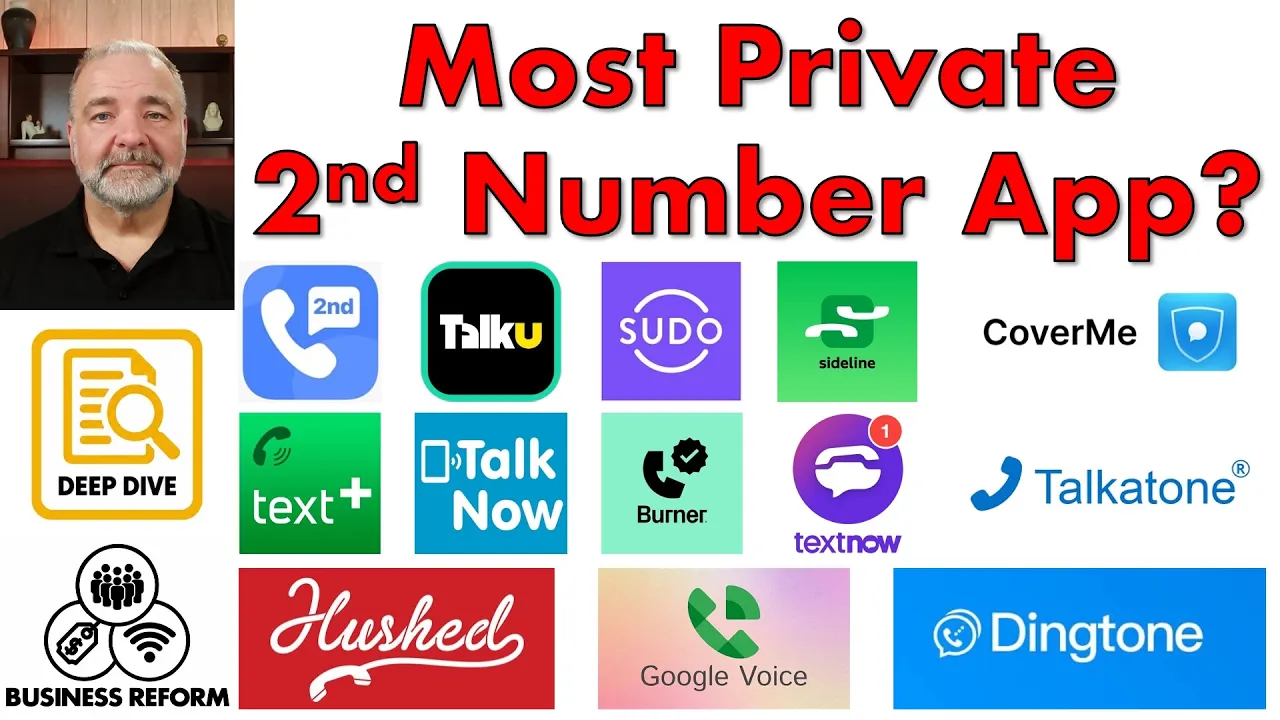
By using multiple phone numbers, such as one for social media, one for work, and one for family and friends, you make it more difficult for data brokers to track you. Thankfully, having multiple phone numbers does not require you to carry multiple phones, thanks to second phone number apps. I did a series of searches to find the most popular second number/verirtual number apps available for both iOS and Android. There is no definitive ranking of these apps, but after reading several websites that track downloads, these 14 apps appear to be the most popular consumer grade second number apps.
I say consumer grade because there are some apps that are primarily sold as business phone systems such as Microsoft Teams phone, ring central, dialad, etc. Because those apps are essentially business phone systems, I intentionally excluded them from this video. However, I did another search for second phone number apps that explicitly claimed to be privacy focused and that gave me an additional five apps to add to my list.
I then had to establish my criteria for determining the most private second number app. This is a little bit like trying to come up with criteria for determining who is the best athlete. How do you compare the athleticism of a football player versus a gymnast versus a swimmer? I decided to make this a two-stage comparison where I would quickly eliminate the least private apps, then do a deeper dive on the short list of apps that survived the first pass.
My four criteria were whether the app requires your personally identifiable information, whether the app shares data with third parties, if the app facilitates compartmentalized identities, and whether the app offers end toend encryption. To keep things simple, I used a threecolor scale where red means no, it doesn't, yellow means it does partially, and green means yes, it meets that criteria. For example, while I did not take privacy ccentric marketing into account while evaluating the apps, I noticed eight of the apps made no claim whatsoever about privacy.
Six apps mention privacy and five apps made privacy a central feature in their marketing. 15 apps directly required personally identifiable information to sign up and four apps required payment information or a Google or Apple account to purchase a subscription to get a working phone number after signing up. In other words, four of the apps allow you to use the app without directly giving them your personal identifiable information, but it is still not completely anonymous because it is tied to your Google or Apple account.
In addition to virtual phone numbers, My Sudo also offers virtual credit cards. And if you want to use that feature, you must verify your identity to follow know your customer laws. Next, I scored the 19 apps on whether they share your data with third parties. 15 of the 19 apps explicitly state they do share your data with third parties, generally for advertising or business partner purposes. I found conflicting information regarding sidelines, so I listed it as unconfirmed.
Burner and Surf Shark's own privacy policy also disclose sharing personal data with third-party service providers for things like analytics, fraud prevention, and payment processing. So, I scored them yellow rather than red. Neither discloses selling your data, though Surf Shark's policy does list marketing as one of the purposes for its third-party tools, so I won't call either of them fully clean on this front. Only my pseudo scored green with no third-party data sharing disclosed at all.
Next, I scored all the apps on whether they facilitate compartmentalized identities. 14 of the 19 apps only give you one virtual phone number, so they do not facilitate compartmentalization. Phoner, Burner, CoverMe, and Hushed all allow you to have more than one virtual phone number, but they do not give you separate email addresses or browsers to use with each of your phone numbers. Only my pseudo allows you to create completely separated identities.
So you can pair a browser, email address, and phone number together. They also allow you to create different virtual credit cards to use with those identities as well. So they truly facilitate compartmentalization. Then I looked at which apps offer end toend encryption for communications. Only two of the 19 apps, CoverMe and My Pseudo, offer any end toend encryption. I scored them yellow instead of green because in both cases it only applies when you're communicating with someone else on the same app.
My pseudo's end toend encryption covers calls, text, and video between pseudo users, while CoverMe applies to its private messaging feature. If you're calling or texting someone on a regular phone number like a Verizon or AT&T number, none of that communication is end to end encrypted. As I mentioned a moment ago, I am not taking privacycentric marketing into account for my overall rating. My pseudo scored two greens and two yellows, so I consider them a tier one finisher in this round.
Phoner, Burner, Cover Me, and Hushed each scored two yellows, so I consider them tier 2 finishers in this round. Only those five tier one and tier 2 apps moved on to the final round of evaluations. For this final round, I began by looking for any lawsuits or data breaches involving these apps, and I couldn't find anything. I did not color code this column because I am dealing with the absence of evidence, not solid proof that no lawsuit has ever been filed or any data breach has never occurred.
I then looked at each of the apps data retention policy, specifically what happens to your data when you delete the app. My pseudo has a very definitive statement about data removal. Whereas hushed, burner, and coverme all have vague statements about retaining data for some period of time. The Phoner app data retention policy is even more troubling by claiming they reserve the right to store or delete any data as short or long as needed.
Likewise, My Pseudo has a very explicit commitment to not selling your data, whereas the other four apps all openly admit to sharing data with various entities for various purposes. The next category is a little more subjective. One of the main reasons a person might want a second phone number app is for verifying your identity online without giving someone your real phone number. The problem is some places such as banks or delivery apps may not accept a virtual phone number.
My pseudo reports their paid plans work with SMS verification from banks, delivery apps and social media platforms, etc. I have been using my pseudo for about 5 years and I can personally vouch that their virtual numbers usually work for verification, but that is not a 100% guarantee. Hushed and Burner both state in their materials that their services may not work with SMS, short code services, or verification text, and neither CoverMe nor Phoner say anything about this at all.
I then looked up where each company is headquartered. My Pseudo and Burner are both headquartered in the United States, while Hush is headquartered in Canada. I was unable to track down the corporate headquarters for CoverMe. And most troubling, I found two conflicting corporate identities for Phoner, and I was unable to determine the jurisdiction of their headquarters. Finally, I looked up the price range for each of these apps.
What I found is hard to summarize because each app offers a variety of plans with different options and features. I mentioned a moment ago that I have personally been using my pseudo for about 5 years now. Originally, this video was just going to be a review of my pseudo, but I realized that was far too narrow, and I really needed to do a broader comparison to make sure that I was using the most private second phone number app available today.
After spending the time researching this video, I am more convinced than ever that I am using the best app, and My Pseudo is the only second phone number app that I recommend. I do not have any financial ties to My Sudo, but full disclosure, last month I met and interviewed Nick Davidson, the director of customer success at Anonyomy Labs, the company behind My Sudo. I also met and interviewed Steve Macau, the chief architect at Anonyomy Labs, and I will be posting that video within the next week or so.
Over the next week or two, I will also be posting my third and fourth videos in this series on practical cell phone privacy, where I will review Cape Mobile cellular service and the FO app that enhances privacy through profile pollution or what's commonly referred to as data poisoning. If you have ideas for other videos in this series or other topics, please let me know. As always, I can't wait to read your comments.
The words are the caption track's own and nothing is reworded or re-transcribed. Paragraph breaks are placed between sentences so the text reads as prose.
Free tools for your own script: paste a draft and see where it stands before you record it.
Paste your draft and see where viewers are likely to drop off, with a rewrite for each weak line.
Paste the first 30 seconds of your own draft for a hook score and rewrites.
Check your draft against YouTube's advertiser-friendly guidelines before you record it.
Read this channel's public videos and transcripts, and download a writing brief for it.