Getting the transcript
Reading the captions from YouTube. A video nobody has opened here before takes 10 to 30 seconds; this page fills in on its own.
Getting the transcript
Reading the captions from YouTube. A video nobody has opened here before takes 10 to 30 seconds; this page fills in on its own.
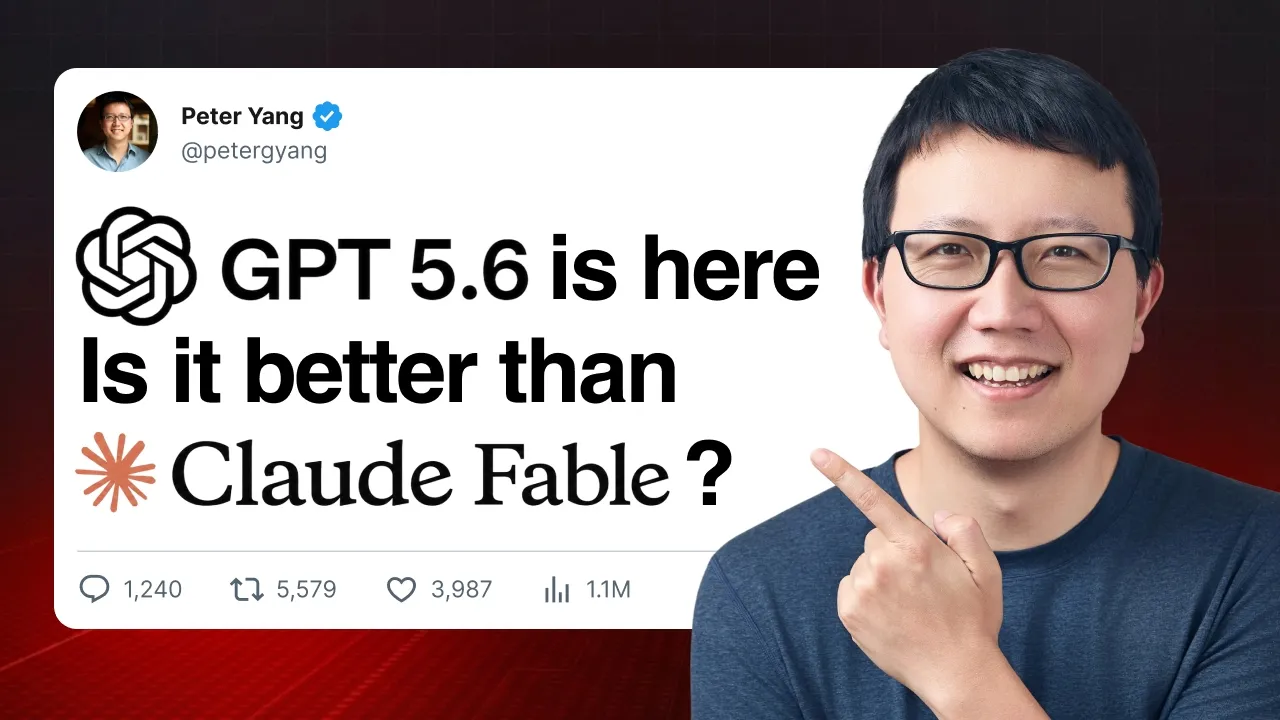
Peter Yang · @PeterYangYT
Where viewers went back to watch this video again, from YouTube's public Most replayed graph, lined up with what was said at that moment.
Most replayed moment #1
26:304.0x the video's typical replay level
I recommend that you do not go to very high or ultra color or whatever unless it's really stuck on a problem. Default to medium or high to save on tokens. All right, so let's recap all six use cases. Building an interactive travel web website, I think it's pretty much
Said at 26:25
Most replayed moment #2
4:173.6x the video's typical replay level
hurry, nowhere else to be. It kind of creates a nice mood for me to go visit some onsens in December. Now, let's take a look at the website that Fable generated. So, here we are. Japan in winter lights. So, it has a beautiful image in the
Said at 4:09
Most replayed moment #3
3:253.1x the video's typical replay level
It doesn't really make any sense. So, that's GPT 5.5. Again, that's the previous version of the GPT model. Now, let's look at 5.6. As you can see, we now have a beautiful 3D quarry gate that's somewhat interactive and then there is a moon or
Said at 3:19
The graph counts replays. It does not show where viewers stopped watching.
Words
5,175
Runtime
28:29
Speaking pace
182wpm
Reading time
22min
182 words per minute, just over the 181 median of 349 measured videos. That distribution comes from the 349-video hook study.
Opening (first 30 seconds)
Hey everyone, OpenAI just made GPT 5.6 available to everyone. So, I wanted to answer your most burning question. Is GPT 5.6 or Claude Fable 5 the best AI model in the world? And the answer is, it depends. Let me show you what I mean by testing both models head-to-head across six different use cases. Building an interactive travel website, creating a three-dimensional space shooter like Starfox, editing and publishing short videos programmatically, adding a new feature to a mobile app, getting life and business advice, and finally upgrading my
91 words, the words spoken in the first 30 seconds at 182 words per minute.
Free, no signup. See how the first 30 seconds hold attention, with rewrites.
Sentence shape
| Measure | This transcript |
|---|---|
| Sentences | 380 |
| Average words per sentence | 13.6 |
| Longest sentence | 49 words |
| Questions asked | 26 |
| Sentences containing a number | 58 |
Most used terms
Filler phrases
101 in total: like 36 · actually 18 · right? 17 · basically 14 · kind of 10 · I mean 3 · sort of 2 · literally 1.
A literal whole-word count of the same phrase list the Prepublish browser extension uses, so a phrase inside another word is not counted and a phrase used in its ordinary sense still is. It is a count and not a judgement.
Run the check on the words above: where attention is likely to drop, with a rewrite for each weak line. The free check shows the scores and the one issue costing the most.
What this transcript is
Every word below is the caption track YouTube publishes for this video, pulled from the video itself and reproduced unchanged. It is not Prepublish's writing, not a summary, and not a re-transcription: it is the video's own published captions. English captions, generated automatically by YouTube, in the video’s original language. Source: the video on YouTube. A channel that would rather this page did not exist can ask for its removal through the contact page, and it is removed.
Hey everyone, OpenAI just made GPT 5.6 available to everyone. So, I wanted to answer your most burning question. Is GPT 5.6 or Claude Fable 5 the best AI model in the world? And the answer is, it depends. Let me show you what I mean by testing both models head-to-head across six different use cases. Building an interactive travel website, creating a three-dimensional space shooter like Starfox, editing and publishing short videos programmatically, adding a new feature to a mobile app, getting life and business advice, and finally upgrading my personal AI OS.
At the end of this tutorial, I'm going to give you a clear recommendation of what model I'm going to use as my daily driver moving forward. So, just a quick recap. GPT 5.6 comes with three models, Soul, Terra, and Luna. And based on this terminal bench chart, GPT 5.6 Soul is slightly better than Fable on coding, especially when set to ultra mode. But, OpenAI's biggest competitive advantage is actually not model quality.
Instead, I think it is how efficient OpenAI's models are. GPT 5.6 Soul is about 50% cheaper than Claude Fable 5 based on API pricing. And when I use my ChatGPT Max subscription, I don't even think about my rate limits at all because I almost never hit them. And I think this is a really big deal because increasingly we're going to see both consumers and enterprises look for not only the best, but also the most cost-effective model.
But, these benchmarks only tell half the story. So, let's run both models through our six real use cases. Let's start by comparing GPT 5.6's front-end capabilities to Fable. Now, I'm planning going on to Japan December, and here's my itinerary. Looking at all these bullet points is boring, so let's ask GPT 5.6 to do this. Build a beautiful interactive travel website from the most recent Japan itinerary that I have in my Google Doc.
Organize it by day. For each day include a date, area, activities and dinner, plus images for major attractions. Make it feel like a real travel catalog that I'll share with my family. And here is a useful line. So, one trick to generate beautiful web pages is to ask AI to add a 3D and WebGL element to the hero so that it looks more immersive and animated. Now, let me show you what GPT 5.5 generated, the previous version of the model, then we'll see 5.6 and then finally we'll take a look at Fable.
All right. So, here is the page that 5.5 generated and it is perfectly functional. You scroll down here, you can see that it has the travel schedule, itinerary, arriving in Tokyo. It has going to animal cafes, seeing Tokyo lights, and so on. And it goes down here, right? So, this is perfectly functional, but I think some of the images that it picked seem pretty out of place and boring like this one. And also on the hero image, the 3D route that I made seems kind of random, right?
It doesn't really make any sense. So, that's GPT 5.5. Again, that's the previous version of the GPT model. Now, let's look at 5.6. As you can see, we now have a beautiful 3D quarry gate that's somewhat interactive and then there is a moon or a sun in the background. And let's scroll down. And the rest of the cards look pretty great, too, right? The journey begins. Hello Shinjuku. It found more relevant images like Meiji Shrine to go to and so on and so forth.
And in some cases, it even included multiple images. Although, I can see here that image got cut off. And let's keep going down and yeah, it looks great. This is something that's perfect that I can show my wife and the rest of my family to get them excited for the trip. And also like some of the copy here. Steam in the cold air, no hurry, nowhere else to be. It kind of creates a nice mood for me to go visit some onsens in December.
Now, let's take a look at the website that Fable generated. So, here we are. Japan in winter lights. So, it has a beautiful image in the background and it looks like it used WebGL to generate these snowflakes that look awesome. Let's scroll down. And it's got all the cities that I want to visit here. It has the daily itinerary. The images are kind of small, but I like how they're kind of on point to the places that I actually want to go to.
And yeah, it looks pretty good, too. I love how it included like multiple images for each place that I want to go to. And let's just scroll all the way down here. And all the way down and you can see that it's included some Japanese that I don't understand and some summaries and so on. So, overall, I think GPT 5.6 the travel catalog that it made is definitely much better than GPT 5.5. And I think it's pretty comparable to Fable's travel catalog, too.
Fable, you can see here some of the text got cut off, right? And 5.5 is very clear. I I feel like this is almost a tie now, which is actually very impressive because 5.5 was a lot worse than any kind of cloud model when it comes to design. And 5.6 has really closed that gap. So, now I think GPT 5.6 is a totally viable option for design and creating beautiful websites. Okay, now let me show you something super fun and impressive.
I don't know about you, but I grew up with Nintendo and Super Nintendo games. And one of my favorite games is Starfox, which is a 3D space shooter. So, I asked both GPT 5.6 and Fable to build a single level for a Starfox style 3D retro game that I can play in the browser. The player should be able to fly forward through a planet's surface with computer controlled wingman. I should be able to dodge obstacles, shoot enemies, collect power-ups, and even fight a boss at the end.
And make it look and feel amazing, right? And 5.6 basically worked through it. And yeah, I I think overall, it probably took maybe a little bit over 10 minutes to build this game. So, let's go ahead and actually play this game now and see what it looks like. Okay, so this is the game that GPT 5.6 made. Let's launch it. And here we have our plane with our wingman. And it's flying. As you can see here, there's some controls.
I can fire. I can just boost to move faster. I can collect power-ups. And let's just go ahead and play all the way to the end. I made it a pretty short game. So, there's enemy ships coming, as you can see. I will keep flying. There's different types of ships. And let's see what the boss looks like, shall we? All right, here we go. The dreadnought. And it looks pretty strong. I have a bomb button. I can hit X to hit the bomb.
Okay, there we go. It's shooting at me. And let's just kill the boss and see what happens. There's different phases. All right. Here we go. Boom. We hit another bomb. And the boss blew up. And there you go. The sky is yours, and we finished the game, right? So, again, a game that you can build in just 10 minutes that looks like this is pretty impressive. It could not have been done with the previous version of the models.
Now, let's take a look at the game that Fable generated. It's called Starwing. Press enter to launch. Okay, here we go. So, it looks quite different from the GPT game. We can also go faster. One thing that I noticed right off the bat is it's given the wing man some more personality, and it's also added rings for me to fly through, which is pretty cool. Yep, there's a lot more chatter, as you can see. There are buildings that look kind of weird.
Hopefully, I won't die here. And let's get the power-ups. All right, and there's buildings coming into view. Some of the buildings look really floating in the sky. But, I like how I can power up my laser to be much stronger. And as you can see, it even supports barrel rolls, which is a key feature of Starfox. All right, let's go to the end here, and let's see what the boss looks like. All right, here we go. Here's the boss.
All right, the boss even taunts me. And here it is. And let's keep doing barrel rolls. And let's see what happens. Okay, so for the boss, you have to beat up the cannons first. So, it has different hit points and hot spots. And then, let's keep shooting at the boss. And hopefully, we can kill it pretty fast. Oh, it even has a laser that we have to dodge. All right, I don't know how I don't actually know how to dodge it.
All right, there you go. The boss blew up. And that's about it. So, there you go. And And Fable, I think took a little bit longer, maybe a little over 10 or 15 minutes to build the game, but it also one-shotted the game here, right? So, overall, these two games are both pretty impressive. But, I'm going to have to give a slight edge to Fable on this one because it actually remembered to build support for a barrel roll, which is again a key feature of Starfox.
And I didn't specify this in the requirements, but Fable remembered it, and GPT forgot, right? And I think overall, the the game is a little bit more exciting, although that's totally up to taste. But, the point is you can now build totally awesome games in 3D or 2D with these models in just a little over 10 minutes with a single prompt. Okay, so now let me show you something that GPT-5.6 is definitely best in class at, which is browser and computer use to edit and publish short videos.
So, browser use basically means letting the AI navigate your web browser. And computer use means letting it work through your local files. Now, this may sound scary, but these features are literally magic once you get used to it. In fact, browser use is the primary reason why I switched away from Claude Code to using ChatGPT and Codex as my daily driver. The reality is that most websites and apps do not have great APIs or MCPs.
So, good browser use is so important to save time on common workflows. Let me show you exactly what I mean. So, I have this video post skill that I built that makes clips from my long-form podcast videos and then post those clips to several different social platforms at once. And here's how it works. So, first I type {slash} video post and give it a link to one of my YouTube videos. Then, it's going to suggest five parts of the transcript that it thinks is interesting to clip.
So, you can see here there's five different snippets, right? From the transcript this interview that I have with Kun, who is the AI engineer. Now, what I need to do is tell it which transcript I like, so clip four. And then it's going to go off and use FFmpeg, which is open-source library, to basically make the actual video. So, you can see here, if you look at the landscape view, and let's open this. It's basically made the video here.
It's even added captions, right? All right, and you can see here that it can also make the vertical version as well at the same time. Now, the vertical version looks a little bit off because the screen is cut off, but I can give you further instructions to make that better. As you can imagine, this is already a magic and saves me a lot of time because otherwise I have to go into manual video editing tools and clip stuff myself.
But now let's take a step further. Let's ask GPT-5.6 to schedule this clip on Instagram, TikTok, and YouTube Shorts for 5:00 p.m. on Thursday. Okay? So, what it's going to do now is it's going to use browser use because Instagram, TikTok, and YouTube Shorts don't have the best APIs to customize the saying the way I want it to. And while we're waiting for this, let's ask Claude Fable 5 to do the same thing. So, I'm going to go to my video post here and it's also made some video clips for me.
And I'm going to say schedule this. Let's schedule it on Friday instead. All right. So, now let's take a look at how GPT and Claude Fable works. So, let's go to GPT first. Okay. So, you can see here that it navigated to YouTube Studio because it's going to do the Shorts first. It's clicking a bunch of buttons. And let's just go over here to Chrome and see what it's doing. So, you can see here it's navigating to the clip that we want.
And it's going to upload the clip. And eventually it's also going to add a title and description that we want. Let's take a look at it right now. All right. So, it pasted in the title and the description here. All right. Now, let's take a look at what Fable is doing. So, you see here that Fable has also read through a bunch of documents and is using the Claude extension in Chrome. So, the Claude extension it just works a little bit slower than GPT and in Claude X.
You can see here that it has to take screenshots of everything to figure out where to click. Let's check back in on GPT. It looks like it's uploaded everything and let's take a look at Chrome. It is clicking through the ad suitability stuff. None of the above, submit rating. Oh, by the way, I didn't give it any instructions for this stuff. It just kind of figured it out all the right things to do. And at some point it's going to finish uploading the file.
Okay, so I'm going to stop it now on both GPT and Fable because it's going to take a while. And it's going to basically go through over 20 steps to do this. To not only upload and schedule the stuff on YouTube Shorts, but also TikTok and Instagram, which are even more difficult to deal with. For Instagram, for example, we have to use some sort of Facebook tool to make this work. And as complicated as this is, I've been using GPT 5.6 for this flow ever since it launched, and it hasn't made a single mistake yet.
And and Claude, it can also do this, but the problem is Claude Fable is expensive to use. There isn't that much limits to use. And doing this browser stuff just takes a lot of tokens. Okay? So, I'm not sure if this is actually a gap between GPT 5.6 and Claude Fable or more of a gap between ChatGPT and Codex app versus Claude Code, but from my testing, browser and computer use is definitely much better in ChatGPT and Codex than Claude Code.
So, I cannot emphasize enough how important this is because there are so many different ways that this stuff can save you time. Just think about all the terrible forms and PDFs that you have to fill online or the hours of compliance training that you have to take. Browser and computer use can help with all of this. So, this is a clear area where OpenAI and GPT 5.6 is ahead. Now, let's move on to our next use case, which is adding a new feature to a mobile app.
Many of you have asked me to make more videos about how to build mobile apps, and that is coming soon. But for this video, let's just focus on adding a new feature to an existing app. So, I have this mobile fitness app that I vibe coded to help me track my workouts. And basically, I submitted the same prompt to both GPT 5.6 and Fable. Which is, I would like to add a tab to track daily nutrition and meals in my fitness app.
Please build a detailed plan in interactive HTML first with requirements, designs, tech stack, and more. Take a look at my fitness app repo if you need context, right? So, a tip here when planning is to always ask the model to create HTML plans instead of the standard markdown files. Just because HTML is way more interesting and engaging to read. Another tip is to use compound engineering, which is this free skills repo that you can find on GitHub that I'll link in the description below to build more robust plans.
Okay. So, now let's take a look at GPT 5.6 plan. This is the plan that I made. And let's see what sections it has. So, it has objective, which is to ship a force tab for nutrition. It has the problem framing, who the users are, what the requirements are, what the acceptance criteria is, and this is really important section, especially if you start using goal or long-running agents cuz the agents have to verify what you're trying to do.
And it has a bunch of stuff about success criteria. Some of the stuff is a little bit too much, in my opinion, but I love how it included the design direction, so I can actually see what the nutrition tab would look like, right? And it looks pretty standard. And scrolling down, there is key technical decisions, there is high-level tech design, data model, tech stack, and more, okay? And let's take a look at Fable's plan.
So, Fable's plan looks very similar because I'm using the compound engineering skill for both. And just so you guys know what I'm talking about, just search for compound engineering, and you'll see it here and all you got to do is just like point your AI at this GitHub link to download the skill. So, there's a compound engineering planning skill that will help you make these robust plans. Anyway, let's keep scrolling down on the Fable thing and you can see things are very similar.
I want to look at the design and yeah, the design is also very similar to GPT. And I think this is because of compound engineering plan, but more importantly, I've given this project a design.md and a set of components that it should always use as designs to have this kind of consistent red theming. So, after asking it to come with the plan, I then basically asked it to just go build a prototype. And what I asked for it to do is to just use local data cuz I don't want it to actually build the whole back end and the database for this nutrition stuff.
I just want it to use local data so I can see what the new tab looks like. And this is what GPT came up with. So, this is the new nutrition tab. So, I can track my nutrition every day. I can add foods. I can add, let's say, chicken and rice and it will update everything here. And yeah, I can add to dinner as well. I can add eggs and toast for dinner. And there you go. So, we have our tracker here and here are some other tabs in my app for workouts and more.
Now, let's take a look at the Fable's output. Honestly, it looks very very similar to GPT's output. I mean, let's go back and forth. I think it uses slightly different colors and GPT actually has some sort of words of encouragement, but Fable's output looks very similar. It has different set of things to add. All right, add to breakfast. And yeah, so both apps again look very similar because I have a shared design.md and components library that I'm using for this app.
So, if I asked GPT 5.5 to generate this, it would look a lot worse cuz I've tried this before, right? So, again, as you saw from the travel example and this example, GPT-5.6 is much more on par with Fable and Anthropic's models when it comes to front-end design and experience. I still think it's maybe a slightly worse, but I think it's a lot closer now. So, from my point of view, mobile app planning and building, it's a tie between these two models.
Now, let's go back and quickly cover our two remaining use cases. So, getting life and business advice and upgrading my personal OS. So, as I shared in my previous Fable video, I have a plan document where I keep my long-term goals, business strategy, and what gives me and drains my energy. And I have this advisor skill that I built that I use to basically talk to my plan all the time and get advice. So, let's go back to GPT and let's open our plan review.
And basically, what I asked GPT-5.6 to do is to read my plan doc, give me direct advice on what I should focus on, be candid but encouraging like a trusted friend, and try to identify insights that I may be not aware of based on our past conversations. So, here's the advice it gave me. It says that our revenue is doing well. Here's what I should focus on. I'm working on a Codex course cuz I love Codex so much. And I'm working on some other stuff here.
And I love how it included this blind spots I think you may have missed section. So, for example, the first blind spot is your ideal customer profile is still too broad, right? It's saying that I'm building for PMs, engineers, creators, and operators, and they have very different reasons for buying. So, try to narrow down the profile a little bit more, which I think is totally true. Something I didn't really think about.
And I can see that this output here is a lot more personal and engaging than previous versions of GPT models. But let's take a look at Fable now. So, again, I asked Fable the exact same question. And this is what Fable came out with. Its output is not really as organized as GPT-5.6 output. But if you actually carefully read through some of this, it does have some pretty unique insights. So, for example, insight number three, you're close to 100,000 YouTube subscribers, but YouTube only drives X% of your Substack traffic.
I assume that means it's a very small percent, right? There's something really broken about this pipeline here. So, maybe there's a better way to actually bring awareness to your newsletter and your Substack on the YouTube. So, this is advice that I don't think GPT 5.6 recognized. I think overall here, Fable has a slight edge on just like understanding my intent, but I think GPT's responses are actually more clear and better organized than Fable.
And just one thing I found is that as both OpenAI and Anthropic have optimized for coding, the writing of these models has actually kind of regressed in my opinion. So, for example, I think Opus 4.6 was a better writer and editor than Opus 4.8. But, these results are pretty encouraging. I think GPT 5.6 is now a much better writer, has more personality, and Fable as well. Okay, last but not least, let's take a look at my personal OS project.
So, this is where I keep all my skills and workflows like the video post skill that I shared before. So, over time this repo can easily get messy because I keep adding new skills and automations to it. So, periodically I like to ask something like this. Take a detailed look at my repo based on your understanding of my workflows and our conversations, how can we improve it? What skills can we build or consolidate? Please list your suggestions in a numbered list.
And here's what GPT 5.6 came up with. It's suggesting that I build an ops review skill, that's like a Uber skill across all my other skills to keep me on track. It's saying that I have four different sponsor skills. I should consolidate all of them. And it has a bunch of other suggestions here. Now, I like to do this because then I can actually read through each of these suggestions and say, "Hey, go do one, two, and three, but skip four." So, I can actually give some feedback before it just goes off and does all of this.
But, my one piece of advice is if you have a very active repo like like this, schedule a recurring job so that every week or so it will run this scale and automation to clean things up for you and get your approval, right? But, now let's take a look at what Fable came up with. So, it's saying that there's a bunch of document drift across different skills. I should clean stuff up there. It's also suggesting that I should consolidate a bunch of thinking skills and merging a bunch of other skills around research and so on so forth.
And it has the same suggestion to try to consolidate my sponsor skills into one. So, it's encouraging that both GPT 5.6 and Fable are suggesting the same thing. And maybe there's actually a way to get 5.6 and Fable to basically bounce off each other. Pretty sure in Codex and ChatGPT, you can actually call the Claude CLI to trigger Fable. Like, just go back and forth a little bit, figure things out before making a suggestion list to me.
So again, if if you have an active project repo, I highly recommend that you also do this on a regular basis and maybe even set up an automation for it so that you can keep all your skills and all your files clean. So, in this case, I can't really tell which model is better. I think ideally I would have both models and have them like make suggestions off each other. All right. Now, before we wrap up, I want to share some perspectives from other builders and creators online about GPT 5.6 and Claude Fable's pros and cons.
So, GPT 5.6, basically its biggest advantage is it has a dog in it. I'm not sure if you heard of this phrase. It has a dog in it means that it will grab your problem by the throat and it will not let go, right? It will not give up. It will keep working until it's done, okay? And that is a very great quality. It's extremely hard working. I think that's what it means. Number two is is very reliable, especially for browser and computer use.
As I demonstrated in my video post scale, it would just like check out the boxes, go through 21 steps to make things happen for you manually using the browser. So, I can basically trust it to get the work done. And finally, it's also fast and token efficient. And the negative is it's slightly worse on understanding your intent and also on front end, although I think it's closed the gap on the latter a lot versus the previous version of the GPT model.
All right, so now Claude Fable is a magical model. It's incredibly intelligent and wise. It's like a wise owl, someone said. It's very thoughtful and very well spoken. It is still really good at front end. It will craft a better UI from scratch. And I think it also pushes back more, although I think GPT does this, too. But it has it's more principled. Like something that I really hate is when models just really agree with me or change their mind all the time.
And I think with both Fable and GPT, I've seen that it sticks to its principles more. And the biggest con with Fable, of course, is that it's expensive and limited. It's about twice as expensive as GPT 5.6 on API pricing. In contrast with GPT 5.6, I can just keep using it without thinking too much. By the way, when you use both these models, I recommend that you use them mostly on medium or maybe high. I recommend that you do not go to very high or ultra color or whatever unless it's really stuck on a problem.
Default to medium or high to save on tokens. All right, so let's recap all six use cases. Building an interactive travel web website, I think it's pretty much tied between GPT 5.6 and Fable. Creating a 3D retro space shooter, I give the slight edge to Fable. Editing and publishing short videos or any kind of browser use, GPT definitely wins. Adding a new feature to a mobile app, getting life and business advice, and upgrading my personal AI OS.
I can't really tell a clear winner across these three bottom use cases, so I think for now, they're pretty much all tied. So, which is my daily driver? GPT 5.6 is my daily driver. And that's because GPT 5.6, as I mentioned earlier, just has a much more generous rate limits than Fable. Basically, it's as good as Fable on everything except for front-end design and maybe long-term planning, but it's just much cheaper and faster to use.
So, if you can only get one subscription, I would get ChatGPT Pro or Max, not only for GPT 5.6, but also for the new ChatGPT app, which has best-in-class browser use and basically the Codex back-end supporting ChatGPT. I'll make another video on ChatGPT work and my favorite automation to save time at a later date. But, if you can afford both subscription plans, I would think of Fable as my planner, my architect, and my designer, and GPT as my engineer and my daily driver.
All right, so that's my recap of GPT 5.6 versus Claude Fable. We're super lucky to have these two next-generation models exist and competing at the same time. And I'm really excited to go off and build more things and save more time with both of these models. Now, if you enjoyed this video, please like and subscribe for more practical AI tutorials like this. And also check out behindthecraft.com to get my best AI skills and courses.
I'll see you soon.
The words are the caption track's own and nothing is reworded or re-transcribed. Paragraph breaks are placed between sentences so the text reads as prose.
Free tools for your own script: paste a draft and see where it stands before you record it.
Paste your draft and see where viewers are likely to drop off, with a rewrite for each weak line.
Paste the first 30 seconds of your own draft for a hook score and rewrites.
Check your draft against YouTube's advertiser-friendly guidelines before you record it.
Read this channel's public videos and transcripts, and download a writing brief for it.