Getting the transcript
Reading the captions from YouTube. A video nobody has opened here before takes 10 to 30 seconds; this page fills in on its own.
Getting the transcript
Reading the captions from YouTube. A video nobody has opened here before takes 10 to 30 seconds; this page fills in on its own.
The Inner Circle Trader · @InnerCircleTrader
This video has no Most replayed graph yet: YouTube shows one only once a video has enough views. These are the moments viewers replayed most in The Inner Circle Trader's most watched videos.
Most replayed moment at 51:50
3.7x that video's typical replay level
Okay? So, now we have two points of reference. Now, when I have this like that, I have two little sweet spots in the previous day's range and to the left of that, why? Cuz we're going to go back 3 days.
Said at 51:44
Most replayed moment at 10:06
3.2x that video's typical replay level
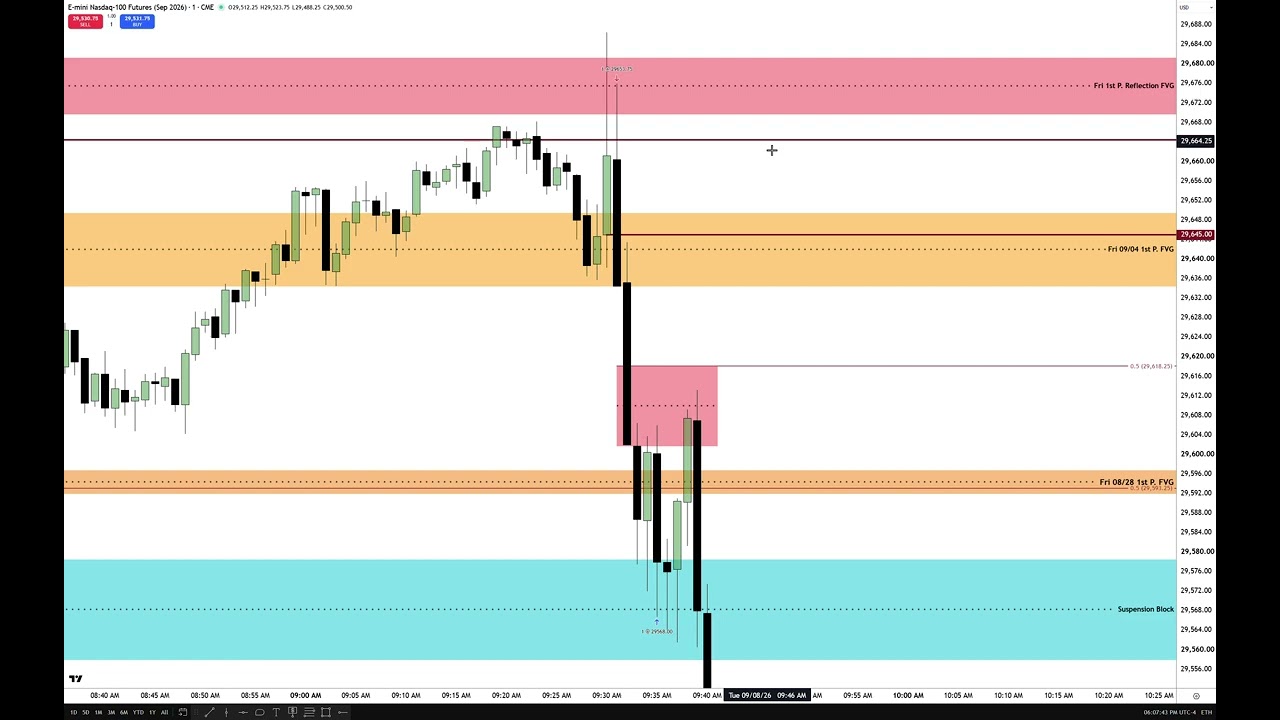
towards that of this buy side imbalance or side inefficiency, which is a suspension block, which has a volume imbalance on the high end and a volume imbalance on the low end. All right, so let's move into the lower time frames now. So, we're at a 1-minute chart.
Said at 9:58
The graph counts replays. It does not show where viewers stopped watching.
Words
5,238
Runtime
33:04
Speaking pace
158wpm
Reading time
22min
158 words per minute, below the 160 25th percentile of 349 measured videos. That distribution comes from the 349-video hook study.
Opening (first 30 seconds)
Welcome back, folks. So, we're going to do a review on today, okay? I'll try to be swift and straight to the point, okay? I saw some questions and I hopefully will clarify some things and also introduce you to a PD array that I talked about in a trader roundup space with KittenTheGang. So, if you would lend me your attention just for a few minutes. I know sometimes you're eating potato chips and Doritos and probably looking
79 words, the words spoken in the first 30 seconds at 158 words per minute.
Free, no signup. See how the first 30 seconds hold attention, with rewrites.
Sentence shape
| Measure | This transcript |
|---|---|
| Sentences | 415 |
| Average words per sentence | 12.6 |
| Longest sentence | 65 words |
| Questions asked | 40 |
| Sentences containing a number | 34 |
Most used terms
Filler phrases
44 in total: like 12 · you know 12 · kind of 7 · uh 5 · right? 3 · I mean 2 · um 2 · basically 1.
A literal whole-word count of the same phrase list the Prepublish browser extension uses, so a phrase inside another word is not counted and a phrase used in its ordinary sense still is. It is a count and not a judgement.
What this transcript is
Every word below is the caption track YouTube publishes for this video, pulled from the video itself and reproduced unchanged. It is not Prepublish's writing, not a summary, and not a re-transcription: it is the video's own published captions. English captions, generated automatically by YouTube, in the video’s original language. Source: the video on YouTube. A channel that would rather this page did not exist can ask for its removal through the contact page, and it is removed.
Welcome back, folks. So, we're going to do a review on today, okay? I'll try to be swift and straight to the point, okay? I saw some questions and I hopefully will clarify some things and also introduce you to a PD array that I talked about in a trader roundup space with KittenTheGang. So, if you would lend me your attention just for a few minutes. I know sometimes you're eating potato chips and Doritos and probably looking at Pornhub and glancing at the uh significant other. >> [laughter] >> Focus for a couple minutes, okay?
So, we're looking at last Friday. All right, so last Friday's trading. In my annotations when I was doing the lecture for part four, you see this gap here. As first presented fair value gap, and it is first presented fair value gap. There's a distinction between first presented fair value gap, then there is first presented fair value gap with displacement. Now, I taught both of them. They're each an individual PD array.
The classification is one that has a displacement. This gap has no displacement. Displacement is where it's part of a run that takes out the high or low, and it's not doing that here, okay? This candlestick did not clear this high. This candlestick did not clear that low. But, this candlestick is first presented fair value gap with displacement. Now, if you extend this in the future, there's inherently nothing wrong with that.
It's a usable PD array. But, if you recall how I stated these things, I'm going to focus more emphasis on one that has displacement, and it's the first one that does that after 9:30 Eastern time. Now, for the folks that are in the Trader's Roundup spaces, you all know, and I expect to see some of you that were in attendance to corroborate my story here, because I know there's going to be a lot of folks out there that's going to say that this was not something I taught, when in fact it was.
It came by way of a charter member asking me a question about the first presented fair value gap, for instance, like this is a buy-side imbalance, sell-side inefficiency. Now, the characteristic is it's a buy-side delivery inefficiency on sell-side. In other words, an up closed candle. The charter member asked if there was any significance if this is a buy-side, what happens if you look at the first opposite fair value gap opposed to that.
So, in this case, we would look for the very first sibi. So, if the first presented fair value gap in this case here is a buy-side imbalance, sell-side inefficiency, the opposite of that would be a sibi, sell-side imbalance, buy-side inefficiency, or down closed inefficiency candle. The first presented fair value gap with displacement here, cuz it clears this high and this high, that is much more significant. It's going to have a little bit more emphasis placed on it than that of that.
But this gap here doesn't fall away in its importance. In fact, it's very crucial, because what this does is it helps me trade today's high the day. The very first sibi that forms is right here. If you look at this candlestick's close, it's 29,681.25. This candlestick's open Make sure I'm looking the right way here. 681 even. Okay, so it's slightly lower than the close on this. So, this is 1/4 point or one tick higher on the close than this next candle's open.
You see that? So, that's a small little volume bounce. That's what's being annotated there. And then we have a sell-side imbalance by sell-side candlesticks high. That's what's That's what's being shaded here. Now, if we see the very first presented fair value gap is a buy-side imbalance sell-side inefficiency, it's crucial for you to go through price action after 9:30 to look for the very first opposing characteristic than that of the very first fair value gap.
In other words, if it's an up-close candle that creates the first fair value gap after 9:30 Eastern time, the very first candle that creates a down-close inefficiency, that's this one right here. Okay? Now, by having that, it's also part of a macro time. See what time it is? It's 1 minute after 10:00 on Friday Eastern time. So, by extending that in the future, okay? Extend that in the future, we're going to see several things here.
I'm just going to walk you through the long way because I want you to see all the nice little reactions, how price has used all my PD arrays. And if you complain in my comment section that it's too many things on the chart and it's confusing, I'm going to mute you. Because I told you how to manage the information. I'm going to present it all in one chart because you should have all these levels on your own individual workspaces or layouts, okay?
So, you're still being expected to hold that measure of data collecting and management. I'm not going to do everything for you. But, you can see how price eventually gets up into first presented reflection fair value gap. What is a reflection? It's the reflection of the first presented fair value gap on Friday. The one that a couple of you were complaining about, "Why did my first presented fair value gap change from what I showed last Friday?" Because I'm bringing you more detail.
I'm showing you a lecture here where it tells you the distinction between two. There's three PD arrays being discussed here. First presented, first presented with displacement, which I told all of the students that that's the one I'm going to have much more emphasis on. I'm going to care more about that one. But, the very first presented fair value gap, if it's a busy, I'm going to look for the very first sibi that forms after that.
And that is a reflection. Why? Because if you look in the mirror, you think that's what you look like to everyone else. And it's not. You're just seeing a reflection. And the reflection is opposite of what the truth is. If you show a word written out on a piece of paper and show it to the reflection in the mirror and you try to read it, it's going to be backwards, right? That's why it's called reflection. Okay, it's it's a mirror image of the very first presented fair value gap.
If there's a fair value gap before a fair value gap with displacement, you have to go back and refer to the first presented fair value gap for classification. Otherwise, your first sibi, if the first presented fair value gap is not a busy, there is no significance on the first sibi that forms. So, it's crucial that you understand this. Three specific PD arrays are being taught here with context. It also makes it stronger when it is a macro delivered inefficiency.
In this case, as we saw on Friday, that's what this first presented reflection fair value gap. Find that micro too, by the way. >> [laughter] >> So, we have Monday's trading. We meander around. Go through the motions of all this price action. Goes down and we go up in a gap. Netted the week opening gaps. And we come right back up into that first presented reflection fair value gap. Trades in here. Now, Tuesday 1:00 a.m.
We overshot it a little bit here, but that's okay. It's a dead time. 1:00 in the morning Eastern time. And now, we get into the nitty-gritty. Here we have this morning, which you watched me do a lecture with my son. Live. As price opened at 9:30. We opened here. We traded up and we wicked above it. And that's okay. It's permissible because it can do the damage. But what does the candlestick do at its close? Closes down here.
Two pieces of information is what I acted on. Okay, two pieces. Number one, we had already traded above overnight previous week's high. So, previous week's high is is not important here. This line right here is something I used during Asia last night. And I was referring to this little piece of price action. Right there. Okay, right in there. And I did a trade just trying to get a sync just get in sync with price action, okay?
That's all I was trying to do. And you can see the executions here. Trading inside of Friday, August 28th first presented fair value gap there. And then aiming for these relative equal highs even though there's a higher high to the left of it there. I was more concerned about that. It's too smooth. And you can see the exit is right there just above that as I showed today in the video recording. See it right there underneath my cursor right here as you'll see it the populate right there.
It's just me taking that out as a target. No big deal. No no no nothing that really go crazy about. But over here now we're trading back up in that first presented reflection fair value gap. Yes, it's a lot of words to describe something, but now you know what it is. And you know the distinction of this gap and why it's there, okay? So if you extend Friday's first presented fair value gap the to the right there's nothing wrong.
You'll see some price action being respected, okay? But you'll see a whole lot more emphasis on this one. Why? Because it's based on the logic that I taught you and offered that an imbalance that has a displacement is much much more significant in future price action than something that could be just simply oh yeah, it's the first gap. It's the first one. That's useful information if you're going to be using a PDA array, the reflection fair value gap which is going to be the immediate opposite of whatever your first presented fair value gap is. >> [sighs and gasps] >> So, some of you are scratching your head saying, "Man, this is never ends." I told you I have 81.
So, stop complaining. >> [laughter] >> Okay, I warned you ahead of time. You do not need to know all these things, but if you want to know what I'm dealing with when I'm acting on it, this is what you get. You don't need all these things. You don't need them all, okay? I just happen to know them all because I authored them. So, if we look at now what price was doing, it'll like make a whole lot more sense. Price opens up at 9:30 here.
We rally up. We wick through last Friday's first presented reflection fair value gap. It comes down and closes, and it closes below that line, or that smooth area in Asia where I traded to, and I used that as a target. So, it closed below that. That gave me a lot of conviction to then watch the middle of this wick. Okay? This right here. Because as long as we don't put a body close above that, I'm going to try to be short.
Okay? And in the recording, while I was lecturing my son, you can hear me say I'm watching this wick's consequent encroachment, its middle point. And I'll take all this off cuz it's not important. We're only concerned with the middle of that wick. Okay? And yes, extended to the right. So, there it is. So, we open here on the very next 1-minute candle, and we trade up and go through it, but we're trading just to consequent encroachment of last Friday's first presented reflection fair value gap.
Now, I already know I already know I'm going to be muting a lot of smooth brains in the comment section. Okay, because this requires some thought. This requires a great deal of independent effort on your part and me not holding your hand. Okay, but I told you anything worth doing if you want to be superior to everything else out there is going to require you a little bit of effort on your part and you have to do your own due diligence.
You don't need to know everything that I know. You don't need to know everything that I teach. You just need to know what you're going to be useful as a trader using and limit it to the minimum amount of moving parts. Over time you can always add more things, okay? I'm just a bit of a freak because I have all this stuff in my head and I can see price action in a way that's above the average intellect of traders. You're looking for patterns and you know, signals and indicators and moving over moving average crossovers and you're looking for value area highs and value area lows and you just want to see a breakout of that and if it goes there you want to look for it to go the other direction.
I know all your stuff, okay? I know all that stuff. Okay? The folks that use bubbles on their chart, you know, heat maps, liquidity maps, this, that, and the other things maps. The things I'm showing you here, that's what really is going on. And I know it probably upsets you and it probably hurts because you're going to come in to me through the sock puppet accounts like you always do cuz you have something you're selling, a software program, you're selling some kind of mentorship, you're selling some kind of nonsense.
And you're mad and you ain't going to come at me with your main account and you're going to see all kinds of little silly things and I'm just going to mute your account and laugh at you when I do so because you're not changing anything. Okay? So, now we've covered that. Okay, got that housekeeping out of the way. When the market rallies up there I was changing my platform from six contracts down to one. And I went in while we were coming back down in and you'll see right in here there's the fill and it's part of this bearish fair value gap.
It has a little volume imbalance at the high. And I knew once we had moved that far away from I'll show you in a second. This was my last chance to get in otherwise it was going to tear off without me. Once we did this and we come back down below this candle's close, it was done. It was absolutely done and the reason why is because we did half this wicks run up here and it went right to the middle level which was on my notepad.
Yeah, here's my notepad right here. That's what this is up here. That's what's written on my notepad. Okay, so what I'm doing [clears throat] is I'm showing where ideally I would have wanted to enter there. Now it's trying to get to the contract size portion in the upper left hand corner here. It was six and you'll see that in the recording I uploaded this morning on YouTube. It's only 17 minute video. I know that most of you watch it double speed so you'll be able to watch it in like I don't know like 9 minutes or so, 8 minutes.
Not that you should do that cuz you're cheating yourself watching the actual delivery and price action live. But when it went out there, I wanted to have it be in close proximity to that or at the very minimum be in the lower half of that last week's Friday's first presented reflection fair value gap. Because this is where the sensitivity is going to be with the bodies. If it's going to be a body at all, it's going to be at this point here, the halfway point or less.
In this case we opened, traded up and came all the way back down below this candle's close. That is absolutely one of the strongest reversal patterns there is and that's that's what's going on here. And I'll get to that in a moment when change the other chart. So inside here I saw this gap and I said, "Okay, well I I'll just take here." And you'll listen to me say that and then then I refer to how my entry's right inside that gap.
I knew as long as I'm inside that, I'm okay. It's okay. And then I'll use this wicks uh high as the stop. Because the likelihood of it coming back up here, once it's proved this wick and it went half of that, that's just one of the sweetest little things if you have context correct. If you know the draw is correct. If you know your directional bias is correct. And you're predicting, not reacting. You're predicting these things to be there.
Then you can be in there real close to the high. Um I I could have done I could have done this candlestick right here with six contracts. And that would have been okay, but I wanted to teach Caleb and also share the lecture with you that post holiday, like yesterday was Labor Day Monday in the United States and I live in the United States. After a holiday that has abbreviated trading hours, so at 1:00 p.m. yesterday, Eastern time, trading was stopped for the day.
And then the rest of the day we were not able to participate. So, that's holiday volume. That to me kind of skews the very first trading day after the day of the holiday. Where it can kind of be weird in in a way how it delivers price action. Sometimes it can it can be great. But most times it can be a little funky. So, I elected to go with that route and just trade with one contract and and teach by preaching what I tell you to do in your own hands.
So, the market then rolls through Friday's September 4th, first percentage of fair value gap by displacement. That's what this is here. And then opens to the next candle, trades up into its consequent encroachment, fails to get the 9:30 opening price. That's weakness. Cuz it very well should have touched that. It didn't. Then we have strong displacement lower, and then I stated that I don't want to see the entire range.
If there's any retracement, I want to see the upper half not even tested. And listen to that recording, you'll hear me say it exactly as it's happening. The market creates two little wicks in here. Then we come back up here and here. And I stated that if we close above this midpoint of this SIBI, so from here to there, and that's those two reference points that's creating that FIB 50% level. If it were to close above that, then it's going to go back to 9:30 opening price.
That's That was the if-then. Okay, that's the logic there. But because it didn't do that, and the body stay in the lower half of the lower half of this SIBI, that's extremely weak. Really, really weak. And then the market trades down here, and there's my exit right there on the consequent encouragement of the suspension block, which is shown over here. Which is part of the 7:00 to 9:00 a.m. premarket session hours. We're going to switch over to a chart in a second and show you what else was here, why I liked taking that as my low-hanging fruit objective.
I saw comments, "Why did you close early?" Because you didn't listen to the video. >> [laughter] >> Come on. The whole context was how to trade or engage with price action after a holiday volume. So, you don't want to go in with heavy leverage. You don't want to go in thinking you know everything. You don't want to go in demanding the best of the best in exits. So, half the gap the consequent encouragement of the regular trading hours opening range gap was 29,593.25.
So, by having that level, we know it could it could trade half the gap, which it was up here. That's what this level is here. That's that right in there. See, watch when I click on that, right? That little red line there with the number in it. You'll see that 930's opening price lights up. And where's my other reference point at? I don't know where I anchored it to the regular trading hours settlement price the previous day, but either way it's down here.
So, we get a full gap closure. We get the market break down aggressively and it clears out the 7:00 to 9:00 range low here. And it takes out London low. And the lowest low overnight and Globex right there. So, it clears all that out and it even a another lower low, which is at 29,468 even. So, I I don't regret showing what it is that I'm teaching you to do. Okay? I didn't say how to engage price act after holiday volume days and get the maximum trade.
That's not the title. The title was how to engage after holiday volume. That means what you should be thinking as a developing student. For someone that's new, how should you approach going in? So, that way you don't hurt yourself or build up large expectation and then it not deliver and then you feel like you failed. Okay? So, beautiful delivery there and now let's go over to another chart. We're inside of in the little layout that I taught you to do and how to create it.
And what we're doing is is we're looking at the relationship of the London session. A key overnight high there. And then we have 7:00 to 9:00 in the morning pre-market session. So, we have trending in London. Trending in London. Then we go into consolidation, then expansion. Then we go into reversal for New York session. So, there's your there's your four phases that I teach in the first lecture of 2016's mentorship playlist on my YouTube video.
Uh that's where I'm getting that information from. And we bump that overnight high here. There. And it's also all the things I talked about in the other chart. So, that's what was occurring there. It's trading into that last Friday's first presented reflection for Vega. And the bodies stay outside of the entire thing. They can't even leave leave a body inside it. So, is that bullish or bearish as I teach order flow? It's bearish.
Again, what I'm saying is this. The fact that we couldn't leave a body up in this and it's just wick and then half the wick of the previous wick touched and then it only went to consequent encroachment of the Friday first presented reflection for Vega. I get it, folks. I get it. This is making your head spin. Like this is so many things. This is so hard and complex. It's complicated. Everything worth doing that's superior to everything else, it's going to feel like that.
And I don't apologize for that. I do not apologize for it. So, if you complain, if you bellyache about how it's too complicated, the easiest thing you can do to make me never read anything from you again is say something like that. You'll still be able to leave comments. You'll still be able to see that happening on your end, but I won't ever see it. Okay? And that's that's how I'm dealing with people that are simply just not doing anything that resembles effort.
Complaining out the gate, that's the that's the biggest sure sign that you are not teachable. And it's your it's a your problem. It's not of my problem. So, go over to that chart again. We're in expansion. We go to this level here, which is everything I just discussed. And then, we create today's first presented fair value gap. Okay? And it forms by what means? Displacement. So, displacement here. And we trade up into it there.
And the whole business about how I want to see it staying in the lower half, not even test the upper half, it came true. Came down, traded into the suspension block down here I gave during the lecture with my son. And then I used that as my exit strategy. Knowing that it could very easily come down here and take out that low, which is the low between 7:00 and 9:00 in the morning. It could do that. But it could do it after running right back up and overlapping what I've already been short in.
Because it's a day after holiday. That's the reason why I taught what I taught this morning. That's what I told my son. That was a whole the whole preface of that lecture, which you're not privy to, was the conversation of Okay, well, we had a abbreviated day, Dad. What do we What do we do on the next day? Perfect. That's a great lecture. And then you saw me do it this morning. Okay, so again, I don't have to show these things to you folks.
I mean, if you want to sit back here and armchair quarterback me, okay, [laughter] while you're broke and working and you can't even trade, you I don't have to share them with you. You You don't have to learn. You don't have to have these things given to you. You don't have to have that. Don't ever come to my channel. Don't watch my videos. But, you know, foolish people leaving dumb comments, well, I think it's amusing.
You only get to say what you want to say that I don't like one time and I'll never get to see it again. That's the beauty about having these kind of conversations. You only have to have one time. So, the market then goes through a process of going even lower and taking out the London low. So, nice delivery there. And then we come right back up into the gradient levels that's over here. Now, watch. The low between 7:00 and the high, these two candles here, that one and that one, are the same high.
Okay, that high is 29,654.75. All these levels confirm and validate every PDA rate it forms on the downside. After it drops down, so you can see that this sibi is absolutely valid. And this inefficiency here, it's anchored to this level and this level. So, it's valid. You're carrying it forward by, you know, extending it to the right. And the market breaks lower and then we clear out the liquidity. And then as we went into the latter portion of the day, this is where I said it can get wonky.
Now, it tends to do it in the morning session right off the gate. So, I kind of was expecting all this kind of stuff here at the open. So, I was looking for a very easy low-hanging fruit objective. And also, my target, let me add that back again. Where I chose to use an exit strategy that was low-hanging fruit, it means the easiest one to get to. And if if it went further than where I got out at, I'm still okay with what I did.
That's low-hanging fruit. Um it's basically also a a protocol to prevent you from being greedy. So, if you're in doubt about what the market will do in booking price, how it's going to behave after a holiday, you don't know, I don't know, nobody knows what's going to happen because everybody has all this pent-up aggression or fear, anxiety, whatever, and you don't know Look, you don't know what the the the real market maker is really going to do.
You don't know that. It could come out here and just cause this thing to go into a small little tight range and just drive people nuts because they know everybody's in a hurry to go out and start making money again. Or at least try to, right? But we just happen to have a reversal and it traded down and then we come right back up in to first resistance fair value gap of the day. And then look at the levels it's working off of 7th to 9th gradient levels.
Carry them forward. Here. And we're inside of the first resistance fair value gap for today. Works in that and comes right back Look at this dive here. Look at that. That's an octant from the 7th to 9th pre-market session. Grading that. Sibby. Trade up Look at the bodies stopping dead in its tracks. Dead in its tracks. Drops aggressively and goes down into the low of 7:00 to 9:00 range. Sweeps it there and then we go into crud.
And then we start drifting a little bit lower and here's where we're at right now. So, this is what I mean. How days after holidays can be a little funky. That's not a day that I want to be participating in. I'm not trying to go in here and try to, you know, push very aggressively in a condition of the market that isn't likely to be conducive for low resistance liquidity run conditions. Okay? So, hopefully this lecture was a a little bit better amplification of what you watched me do this morning and also cleared up the confusion that I may have caused because teaching requires you to be patient.
I told everybody from the beginning, even back when I was on BabyPips, most of your questions will be answered if you just continuously study and keep notes. If you have a question, write it down. Keep it Keep a topical list of questions. Things that have to do with uh fair value gaps, things that have to do with opening range gaps, things that have to do with the AM session, the pre-market session. Have a little topic uh you know, section in your journal or keep a separate journal just for questions that way you can keep keep a record of it.
Okay? And that way you'll be able to write the answers in that and then you can transpose those in areas where you had that question originally show up in your study journal. But you you have to be do you have to do due diligence when you're studying something highly technical. And it isn't easy. It's not I I told you, it's not going to be easy to put yourself through this. But this is the cost. This is the tuition. And you might look at this and say, "Well, there's easier ways to do all this stuff." Great.
I hope it works for you. I sincerely, absolutely hope it works for you. I just don't believe everything else out there is anything close to my stuff. And you know, I have the rest of the year to prove that, too. >> [laughter] >> So, until I talk to you next time, Lord willing, be safe.
The words are the caption track's own and nothing is reworded or re-transcribed. Paragraph breaks are placed between sentences so the text reads as prose.
Free tools for your own script. No signup, no login.
Paste your draft and see where viewers are likely to drop off, with a rewrite for each weak line.
Paste the first 30 seconds of your own draft for a hook score and rewrites.
Check your draft against YouTube's advertiser-friendly guidelines before you record it.
Read this channel's public videos and transcripts, and download a writing brief for it.