Getting the transcript
Reading the captions from YouTube. A video nobody has opened here before takes 10 to 30 seconds; this page fills in on its own.
Getting the transcript
Reading the captions from YouTube. A video nobody has opened here before takes 10 to 30 seconds; this page fills in on its own.
Jack Roberts · @Itssssss_Jack
This video has no Most replayed graph yet: YouTube shows one only once a video has enough views. These are the moments viewers replayed most in Jack Roberts's most watched videos.
Most replayed moment at 7:07
3.9x that video's typical replay level
can download all of them. And then, what we can do is then integrate these icons into any kind of animation or graphic. And this is an example. I just gave it the packs and said, "Hey, design me something interesting." Now, check this out. This is just something on travel. So, this didn't have to be a trip. And you
Said at 6:59
The graph counts replays. It does not show where viewers stopped watching.
Words
3,622
Runtime
15:11
Speaking pace
239wpm
Reading time
15min
239 words per minute, above the 201 75th percentile of 349 measured videos. That distribution comes from the 349-video hook study.
Opening (first 30 seconds)
GitHub is the best place to get to the future of AI technologies. And in the last month, we've had so many incredible drops. In this video, I'm going to show you seven of the best GitHub repos that you need to use with Chat DBT Astra. It will do things like destroy AI slop, give you incredible spyware, and even help you level up all parts of your work. So, grab that coffee. Let's check it out. Beginning with what we call God's Eye View. This one is an incredible interactive system that essentially gives you almost like hero level vision over the planet. This one blew up and it's pretty exceptional. So, let's start with what it is.
120 words, the words spoken in the first 30 seconds at 239 words per minute.
Free, no signup. See how the first 30 seconds hold attention, with rewrites.
Sentence shape
| Measure | This transcript |
|---|---|
| Sentences | 251 |
| Average words per sentence | 14.4 |
| Longest sentence | 89 words |
| Questions asked | 15 |
| Sentences containing a number | 8 |
Most used terms
Filler phrases
91 in total: like 36 · actually 12 · basically 10 · kind of 7 · literally 6 · um 6 · you know 5 · I mean 4 · right? 3 · sort of 1 · uh 1.
A literal whole-word count of the same phrase list the Prepublish browser extension uses, so a phrase inside another word is not counted and a phrase used in its ordinary sense still is. It is a count and not a judgement.
Run the check on the words above: where attention is likely to drop, with a rewrite for each weak line. The free check shows the scores and the one issue costing the most.
What this transcript is
Every word below is the caption track YouTube publishes for this video, pulled from the video itself and reproduced unchanged. It is not Prepublish's writing, not a summary, and not a re-transcription: it is the video's own published captions. English captions, generated automatically by YouTube, in the video’s original language. Source: the video on YouTube. A channel that would rather this page did not exist can ask for its removal through the contact page, and it is removed.
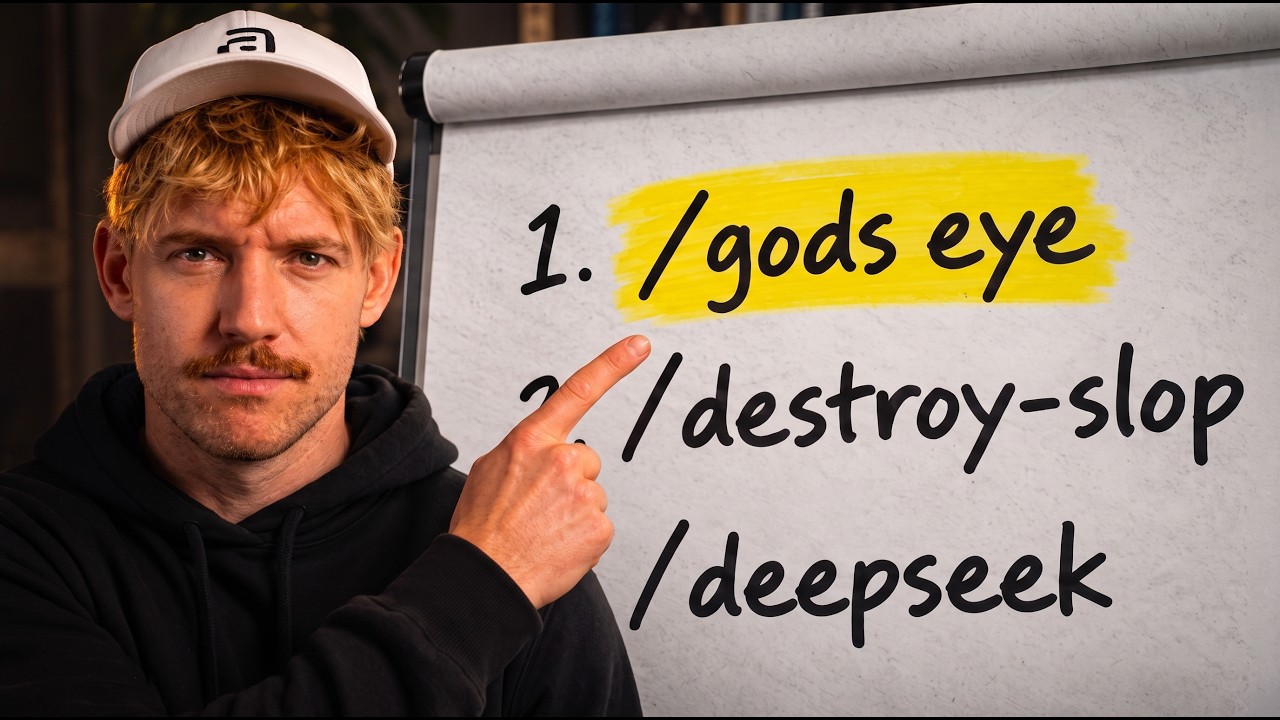
GitHub is the best place to get to the future of AI technologies. And in the last month, we've had so many incredible drops. In this video, I'm going to show you seven of the best GitHub repos that you need to use with Chat DBT Astra. It will do things like destroy AI slop, give you incredible spyware, and even help you level up all parts of your work. So, grab that coffee. Let's check it out. Beginning with what we call God's Eye View.
This one is an incredible interactive system that essentially gives you almost like hero level vision over the planet. This one blew up and it's pretty exceptional. So, let's start with what it is. You can see all the details for every flight. You can see all the satellites, every single ship, and you can effectively go ahead and explore the world. This is what it looks like in action. We're going to go through this together.
I'm going to show you how you actually go ahead and use this. Now, when we load this up, you've got all your intelligence on the left. Lifelights, military flights, earthquakes, LPL cameras, everything you can imagine. Probably the coolest thing you can do is chat with her. So, check this out. Hey there, take me to the Pentagon. >> Okay, let me take you there now. All set. I've flown you into the Pentagon. >> Next thing I want you to do is basically beam me into the closest flight happening overhead. >> All right, let me check where the camera is and pick the closest overhead traffic.
All set. >> Awesome. Now, take me into cockpit mode. >> Cockpit mode is entered for the selected aircraft. D >> I also now I also now want to hear the radio. Can you put a local radio station on for me, please? Sure thing. Let me get a local station going for you now. I've already listeners of WBUR Boston and from Math Works. >> So, as you can see, guys, you can see these plane views. You can zoom out. There's like a million different things that you can do with this.
It's super cool. I can see every flight that's going on there. And you basically can go ahead and connect this to many different API keys. It gives you loads of different views. You can do TD maps. You can do anything. I mean, even now, I can go ahead and see essentially what's going on all over the globe. It's such a cool project built with a lot of love and attention. Now, what this will enable us to do basically is to see the whole picture.
So, aircraft, ships, satellites together. You can explore any place to see what's happening in real time and it's really good for visual storytelling. So, live demos and exploring places. Um, basically certified tracking or kind of like guaranteed coverage as well. And this essentially aggregates loads of independent public data into one view of the world where you can go anywhere you want to. And it's got some really cool features.
Now, you can go ahead and install this by clicking on the GitHub link. It's super duper easy. Just head over to this website, give it over to Jack GBT Astra and it'll go ahead and do everything. This has gotten a lot of stars and it's blowing up pretty quickly. So, it's pretty exceptional. Now, this is nothing though compared to the other levels we've got. Unless you over and have a look at skill spectre. This is by Nvidia.
This is a must-have one and it's just a really good safety skill, but just sits over everything. Skill spectctor itself, I'll show you right now. We open this bad boy up. Made by Nvidia, 17,000 stars as of at the moment, but it's really powerful. So what does it actually do? Well, effectively it scans your agent skills for any hidden instructions, any unsafe access, and any data leaks. So to kind of keep you protected to everything you're doing, and it'll give you a a risk, a risk factor, basically.
It can catch anything that's hidden, so it can spot suspicious instructions and data flows, check the access uh that a skill actually asks for. And essentially, whenever you install anything, just use skill spectre to go ahead and physically do that for you. And to do that, all you're going to do is come over, literally come over, grab the URL like so, click on copy, and then you can say, "Hey there, I want you to go through every skill I have and run it through this skill spectre." And once you've done that, just come down and just enter in that repo.
And then it will use this Nvidia skill to go ahead and check that everything is okay. And as you can see, even right now, it's using the school spectre to look at my inventory of installed skills and run that across it to make sure that we're safe and we're not compromised. Now, the third one I want to talk about isn't actually repo, but it's something I've been having a lot of fun with that I had to include it. It's called Flute.
And what's really interesting about this is when you're using Chat GBT or Claude, it essentially takes anything you're building and turns it into an app without any complexity. And I wasn't aware of this concept until recently, but I think it's a really interesting one. So, effectively what it does, and I'll pull up the website and show you this. So, you're building in cursor chat GBt Claude. Effective what you can do with one click you can take the designs that you published and created inside chat GP claude and publish them and they look after everything from the authentication and the forms and the databases saving you lots of effort.
So you publish with one click. It manages all the backend the data and plugins and it can even sort out emails and notifications and it's built to be found and obviously you can integrate all your tools which is cool and what this effectively means is that all you do is build in chat DPT you build and claude you just connect flu and then effectively you can just manage all the publishing and the displays which is really cool.
Key thing being we go from an idea to an app. So we build it in chat or claude and it isn't just a going live cuz chat sites does that it's mainly the database the authentication the login all that sort of thing and the back end is notoriously the bit that we don't like. So this really helps us do it and you can get started for free which is freaking cool. So let me show you an example of this to best understand it. So for example I went over to church and I built a homepage and I was like look I want to go ahead and build me an example form.
Okay like let's say we built something we like like what's the company called? What things could be better? What would you love to automate? loads of different questions. What investment feels right? Maybe we've got a really cool business idea and we want to get this live, but you know, I don't want to have to sign up to different forms. I just want to get one place that's really cool. I can do all of this, right? It's got loads of interesting questions here.
And once that's done, all I'm going to do and say to check is, hey, I want you to connect to Flute and I want you to publish this as an app. And then once you've done that, it will then go through the authentication process. It's why I quite like using CHP for this. We just go ahead and click on approve. Come down and click on finish connecting. And right now it's finishing the connection and it can go ahead and create that for us.
Then essentially chat GBT will just work with Flute to build everything over there. As you can see now it's moved over the entire design. It's doing some authentication making sure it creates some accounts and that is the whole thing that you need to do. And then guys you can come back over to Flute. You can see all the plans and usage here. For example, on this computer I'm on one of the free accounts and you can see exactly what happens and the usage.
But if I come into projects for example I can click on this one here. you can build directly. And when I open this up, you should be able to see the exact same thing that I built and claude, but now it's something that can go ahead and be used anywhere we want to. Here we go. And here's all of the questions that ready to rock and roll. And then literally, guys, this will go ahead and publish. And you have everything connected from basically all the forms, all the databases, and you can share this and start growing whatever project you're working on.
Now, as you can see there, we have the full app with the form and everything connected in the background. Now, this takes us very nicely onto the next level, which is going to be the fourth repo. And this one is called the slop monster. Now, I invite you to join me in the war against AI slob. I am fighting hard. I am one man. We can do this together. Now, the whole idea of slop monster essentially is it takes any text and then turns it into something that doesn't sound like it's written by AI.
And I actually built this one myself because it was probably the most frequent thing that I was asking AI to do in many of the websites that I built. And essentially I saw that there were so many different anti- like you know AI slop kind of repos out there and I thought what if I actually just got all of them and took the best bits from every one of them and then kind of fixed the thing that I think a lot of them miss.
So essentially what this will do is go ahead and actually score the work that you've got. It tests it across a few different factors. It looks at a vocabulary, looks at AI constructions, punctuation cadence, rule of three rhythm, and then the bit that a lot of them miss is actually sales and marketing. So, if you're building copy for your website, for example, for example, instead of saying the area's most trusted roofing experts, roofing and only roofing since 2001, it looks at what the trade actually does, what the customers fears, what the competition won't say, and just basically runs us through in a million different directions.
And it's based on work by Steve Krug, who wrote a summer book called Don't Make Me Thinkers, you shouldn't have to think about what you're reading. We've got Daniel Priestley, we've got Alex Hos's offers all in here. All you literally do to do this guys is come over, grab the link, and just tell the chat GBT, "Hey, run this text or this website through the slop monster." And the results have literally blown my mind. I'm a big fan of this.
And it's just going to rewrite any vague AI copy into clear, specific writing. For example, it takes stuff like this, trusted, reliable, and built to last. Like AI loves this rule of three, and instead you get something like six nails per shingle, every shingle. It's specific. And each one of these has a different thing underneath it, a different principle as to why it goes ahead and uses it. And you can see what loads here.
Not just a roof, but peace of mind becomes a written scope and a fixed number before anybody climbs a ladder. We leverage industryleading materials to deliver unparallel protection. That becomes we source materials from manufacturers who test for wind, hail, and sun. You can just see the difference here, right? It's really great. After the demo, take the build apart, change it until it solves a problem of your own. It's really great like that.
It makes every line calm and essentially just takes you from generic. It works on emails, works on websites, you can throw it in anywhere and of course it is completely free to use. And if this all sounds like I'm speaking Spanish, I'm going to put a link down below for my full course that I'm dropping this week essentially on mastering chat Astra. It covers everything from AI foundations productivity and live business and sales marketing automation agents.
You also get full access to all of my memory systems I have been building for months, content I never share on YouTube. You get full access to things like the business operating system as well as my design operating systems all down below. I'll put a link so you can grab that and take everything to the next level. Now, speaking of the next level, we need to go ahead and talk about level six. Now, level six is going to come after level five.
And level five is the Claude X loop. So, this is a handy skill. Um, one of the things that you always want to think about when you're building with claude and chat GPT is the fact that they are awesome. But actually, when you use both of them together at the same time, they become even more powerful. So, I always, for example, when I'm even building on my memory systems, right, or I'm connecting anything, I will always have Claude or Chat GBT crossverify with the other best models.
There are two best models in the world right now. Claude Fable 5.1 and CHBT Astra. So sometimes they catch things that the other individual misses at the same time which is why this is so handy. Now effectively what works is clen codeex can review a plan before you build it. One model drafts a plan and the other one looks for weak spots. So they basically crossverify one another and it work they just work beautifully together in that sense.
Now they will catch mistakes that the other model missed. So why not use both at the same time? I would say that I would use this loop probably in about 10% of the time I'm using AI. It's for big stuff. It's where the decision matters and you're looking for diversity because every model has its blind spots. It doesn't matter how good it is. Use it for complex builds. And again, all you're doing is just tagging it in and it just connects with what we call the command blind interface.
Nerd speak for thing happening on your computer. It just reaches over and uses that. A very powerful system to go ahead and use claw. And again, I'll put all the repairs down below so you go ahead and grab it. Now, let's have a chat about level six, which is the deep sea harness. Now, the deep sea harness is interesting. Let me show you what I mean. Hey there, could you go ahead and open the Deep Seek harness and just ask it um what is it?
Explain itself to me. Now, I'm just using Glider for this. It's something that I set up basically to um you know, one prompt, open up the Deep Seek whenever I want to. Now, the Deep Seek Caress itself is if you imagine that you have the race car driver and you have the Formula 1 car. Now, the Formula 1 car is like Codeex, the Chat GPT app. It's like the Claude app. And Deepseek themselves also now have an app, an environment, a harness.
It's all the stuff around the model. It's the car basically. Deepseek now have their own version is called the Deep Seek harness. Now you have the harness and then you have the model. So we can use any model in any harness that we want to. It's very very cool like that. What it makes this particularly unique though is effectively this DeepC harness can access files, terminal tools, browser and it is fully customizable.
So you don't have to just do what Chat GPT says and what Claude says. You can use this for anything. Me personally, I like having it because essentially the Deep Seek V4.1 model is so cheap and I can just launch it up with literally one command to do that. I go ahead and I use Glido. It's um the speech to text startup that I found that it's really really cool. But effectively, you have these commands where you can open things up.
Of course, you can use any speech to text to chat, but we built this cuz we thought it was really freaking cool. I just find that very handy and helpful to do to go ahead and build those things. Now, the thing about it is you can run coding tasks using your model files and tools. It's really simple. Um, you can shape your own workflow. And remember, performance is a combination of the driver and the car. And the idea with this is it just kind of lets you customize the car as well as choose what driver you want in it.
So, that's some of the really interesting things that you can do with it. And it's really good to have a little play around with. You can just fire off little questions. And if you find yourself hitting token limits, it can be a great way to play around with as well to take you to another level. And then that takes us nicely onto level seven, which is archer fire, which is a really interesting one actually. And effectively what it does is it takes anything from plain English into architecture in seconds.
So essentially we'll map out any kind of complicated process for you. So let me show you an example of what that would look like. So I've just asked it here could you use Archifi to map out the optimum cell system according to Alex Hoszi please? And then just like that we've got an example of this. Okay so let's expand this a wee bit. I say weat that's what they talk like in Scotland I'm hearing on good authority but sales system mark offer generating demand earn interest.
So essentially, you can take any idea that you like and see it and interact with it graphically, which I think is cool. So this may not win the world's best award for like most like visually perfect, but I I say visual perfect, I mean like designy, edgy, cool thing, but it does really do the job. And honestly, it's a light year ahead of anything you're going to find in any corporate office. You have different themes you can play.
Dark mode I think looks better to me. And again, look at this. Look at the level of things you can do from here that like author reach downstream, upstream. What happens when you're on interest? You know, you imagine just playing around with this and think about, okay, look, what is our sales cycle? What actually is the way that we want to do business here? Having this really makes an idea look fit and intent. What is this?
And you can present it. You have classic mode, signal flow. You can play around in so many different things. It's just such a cool way to get ideas out and play around with them. Of course, we can export it, share it with people. I mean, the amount of times I've spent, guys, when I was in corporate, and by the way, if you're new here, I'm Jack. I built a small tech startup with a gazillion customers. But before that, I was working in corporate in a strategy job and the amount of times I'd have to map out like a process thinking about like the future of the business, the employees and stuff was crazy time that now honestly this can just say for straight away and obviously you can build out and add many different elements to this and some of these cases that you're going to find very helpful are you know seeing components and their connections tracing a request through the system.
We once did something that had like it must been like 500 different steps. It was crazy a lot of copy required when a code base is new. So onboarding, handoff and reviews. Imagine having a full meeting explaining the process. Then you just use Archery to kind of build a bit of a process map that everybody can follow. Remember, you want to find excellence first and then you can proceduralize after. And again, it is literally free to use.
Understanding what's trending on GitHub is one thing, but if you really want to get ahead, you need to understand how to use an agentic operating system that is going to add value in ways that you probably aren't even thinking about right now. And we're going to do that together in this video right
The words are the caption track's own and nothing is reworded or re-transcribed. Paragraph breaks are placed between sentences so the text reads as prose.
Free tools for your own script: paste a draft and see where it stands before you record it.
Paste your draft and see where viewers are likely to drop off, with a rewrite for each weak line.
Paste the first 30 seconds of your own draft for a hook score and rewrites.
Check your draft against YouTube's advertiser-friendly guidelines before you record it.
Read this channel's public videos and transcripts, and download a writing brief for it.