Getting the transcript
Reading the captions from YouTube. A video nobody has opened here before takes 10 to 30 seconds; this page fills in on its own.
Getting the transcript
Reading the captions from YouTube. A video nobody has opened here before takes 10 to 30 seconds; this page fills in on its own.
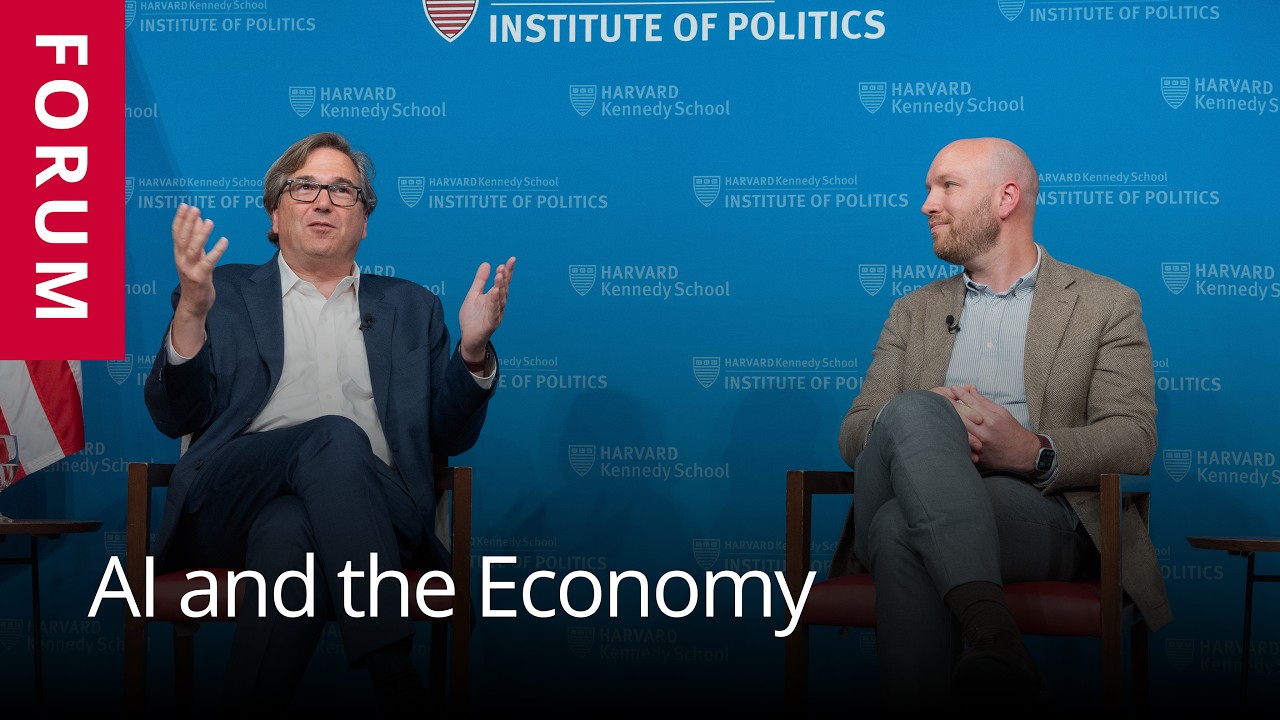
Institute of Politics at Harvard Kennedy School · @HarvardIOP
Words
10,443
Runtime
1:02:42
Speaking pace
167wpm
Reading time
44min
167 words per minute, between the 160 25th percentile and the 181 median of 349 measured videos. That distribution comes from the 349-video hook study.
Opening (first 30 seconds)
Good evening everyone and welcome to the John F. Kennedy Junior Forum here at the Harvard Institute of Politics. My name is Morgan Jay. I'm a sophomore at the college studying government and history and I'm a member of the student forum committee. Before we begin, please take a moment to note the exit doors which are located on the park side and the JFK street side of the forum. In the event of an emergency, please proceed to the exit nearest you and
84 words, the words spoken in the first 30 seconds at 167 words per minute.
Free, no signup. See how the first 30 seconds hold attention, with rewrites.
Sentence shape
| Measure | This transcript |
|---|---|
| Sentences | 505 |
| Average words per sentence | 20.7 |
| Longest sentence | 169 words |
| Questions asked | 39 |
| Sentences containing a number | 44 |
Most used terms
Filler phrases
349 in total: um 104 · like 97 · uh 76 · sort of 24 · you know 19 · actually 14 · I mean 9 · basically 2 · kind of 2 · right? 2.
A literal whole-word count of the same phrase list the Prepublish browser extension uses, so a phrase inside another word is not counted and a phrase used in its ordinary sense still is. It is a count and not a judgement.
Run the check on the words above: where attention is likely to drop, with a rewrite for each weak line. The free check shows the scores and the one issue costing the most.
What this transcript is
Every word below is the caption track YouTube publishes for this video, pulled from the video itself and reproduced unchanged. It is not Prepublish's writing, not a summary, and not a re-transcription: it is the video's own published captions. English captions, generated automatically by YouTube, in the video’s original language. Source: the video on YouTube. A channel that would rather this page did not exist can ask for its removal through the contact page, and it is removed.
No Script X-ray for this video: YouTube shows a Most replayed graph only once a video has enough views.
Good evening everyone and welcome to the John F. Kennedy Junior Forum here at the Harvard Institute of Politics. My name is Morgan Jay. I'm a sophomore at the college studying government and history and I'm a member of the student forum committee. Before we begin, please take a moment to note the exit doors which are located on the park side and the JFK street side of the forum. In the event of an emergency, please proceed to the exit nearest you and congregate in the JFK park.
Tonight's program will be live streamed and archived online and will include an audience Q&A segment. Audience members asking questions are asked to identify themselves if they wish, but they are not required to do so. Please also now take a moment to silence your cell phones and join me in welcoming Harvard College undergraduate Zoe Becker. Thank you. >> [applause] >> Good evening everyone and welcome to the JFK Junior Forum at the Institute of Politics.
My name is Zoe Becker and I'm a first year in the college studying English as well as a member of the forum committee. Tonight we welcome anthropics chief economist Peter McCroy. McCroy leads the economic research team at Anthropic which focuses on understanding how AI will shape the labor markets and the broader economy. His team publishes the Anthropic Economic Index, which shares new research from within the Frontier Lab, looking at a wide range of scenario models for just how AI will affect different locales and economic sectors over the coming years.
Just last week, the Anthropic Economic Index published a new scenario model looking at three different possibilities for the economy of 2030. Joining Mr. Mcorroy to moderate tonight's forum is Jason Ferman, the Etna professor of the practice of economic policy jointly at the Harvard Kennedy School and Harvard's Department of Economics. He serves as the wild director of the Mosavar Romani Center for Business and Government at the Harvard Kennedy School.
He is also a non-resident senior fellow at the Peterson Institute for International Economics. From 2013 to 2017, Ferman served as the 28th chairman of the Council of Economic Adviserss, acting as President Obama's chief economist. Now, please join me in giving a warm welcome to our guest and moderator for the evening. [applause] [applause] Okay. Well, I'm delighted to be here with Peter McCroy. I've read a lot of your writing.
We've never had a conversation, and we're going to have one now and just ignore all of those people. >> Incredible. Um, I have two plans for the conversation and it depends on your answer to the very first question. I just want a number, not anything more. Um, what's P Doom? >> So, I this is >> a number. A number. [laughter] >> This is not I don't have a I don't have a personal number on this. >> Well, my plan was if it was below 10, I was going to ask you about jobs and productivity.
If it was above 10, I was going to scrap all of those and ask like what we should do to survive. >> Um, >> okay, great. So, uh, we can we can focus on the thing that I had fleshed out a little bit more, um, in terms of my thinking. Um can you just start by just sort of quickly telling us what the role of a chief economist is at Anthropic right now and in general what the role economists not just at Anthropic but elsewhere should be playing in thinking about this just incredibly rapidly moving thing.
We usually study the past where you can get a precise estimate of whether something did or didn't happen. Um you spend an awful lot of time writing about the future which is harder. So the way that I think about my job and the the work that my team is doing is we're trying to understand the economic implications of AI which is challenging because it's a general purpose technology affects every sector and almost every occupation to some extent.
Not only that it's uh moving very quickly. Capabilities are improving very rapidly. There's this famous meter chart that I'm sure you're familiar with. The task horizon of what these models can autonomously complete is doubling roughly every four to seven months and we're at days long horizons for these tasks. So capabilities are improving. It's a general purpose technology that's going to hit the economy in a concentrated way and indeed adoption's been very fast and there are other reasons why it might like automate the process of innovation.
So there's a lot of uncertainty not just over the future but also over the present. So the way that I think about the work that my team is doing is how can we produce data and research that couldn't happen anywhere else except from within within anthropic and to do that in the public square. So we produce the economic index which is a privacy preserving measure of how people and businesses are using claude around the world across different tasks and occupations and geographies.
And we make that publicly available in the hope that independent external researchers will take that data and find it useful for in real time making sense of one of the most consequential technologies. But then we can also do additional research on the most pressing questions both as a way of helping us have some sensible answer of what's happening but also maybe even illustrating to the world what questions are most important to focus on.
And here I think about our work as doing research out in the open it with suggestive answers on important questions. To your point, most academic research is oriented around finding like a a perfect natural experiment or a cleanly designed randomized control trial that really gets helps you isolate the causal effect of a new technology or of a policy. We don't have the luxury necessarily of waiting a year from now or two years from now for that research to emerge.
We need some insight on what's happening today. And so we do that work out in the open and also hope for feedback and criticism which I'm sure that you have some uh insight for me that I can bring back to the team. >> Oh well, we'll see. Um let me then just jump into what I think is the biggest sort of mystery of the moment um and under and hear what your explanations are and then hear what its implications are for the future.
Um, couple years ago I was talking to one of the top people at one of the frontier labs and they were showing me the scaling laws and they sort of were visually, you know, extending it out and telling us where we'd be in 2026. And I was like rolling my eyes and like just because you have more processors doesn't mean these things are going to be better and better. Um, it'd be fair to say I was wrong. They were right and the capabilities vastly exceeded probably even what they thought.
Certainly what I thought. Um, they also told me that all the jobs would be gone by basically now, right? >> I was rolling my eyes and I'd like to think that they're on the West Coast right now talking to someone else telling this exact same story um about how they were chasened um and wrong. So why is this? The unemployment rate is 4.1%. It's basically sustained basis the lowest we've ever seen. Productivity growth, you can squint and argue it's picked up a little bit.
Total factor productivity hasn't picked up really at all. arguably um but just nothing you can see in the economic data that incredibly obviously screams anything commensurate with the magnitude of this technology. So just explain to the present and then after that I want to extrapolate and go forward with the implications of your explanation for the future but just so far why not in the economic data. So I am regularly confronted with confronted with this puzzle from within the lab and then also outside the lab.
To your point, people who have been looking at these scaling laws for more than a decade have been pretty good at predicting capabilities and even like predictions a decade ago about what the models might be able to do in 2026 have unfolded. Um, and maybe even to your point have have exceeded some of those predictions. I think uh what is maybe underappreciated but economists have a better sense for is that diffusion plays out over a long period of time.
So if you look at past general purpose technologies over the 20th century that have been very consequential some academic work arguing that it took about like 50 years for that technology to diffuse throughout the economy. And so over that horizon, even a large step up in productivity, the level of productivity might be smoothed out um and and and harder to to parse. That being said, AI adoption has been much quicker than past technologies.
And I did recently write an essay uh titled Why hasn't AI caused a rise in unemployment? My sense from looking at the labor productivity numbers is that it's a little bit more than squinting that you can see that productivity growth has been relatively stronger in sectors of the economy where AI has been adopted. But exactly to your point, the unemployment rate is close to what the Fed would deem as maximum unemployment.
The prime age employment to population ratio is at multi-deade highs. And so what explains that here across a lot of our research? What I see in our data is that it looks more like a skillbiased labor augmenting technology than a technology that outrights outright automates and displace displaces jobs wholesale. So for about half of all jobs across the US economy based on the Department of Labor's ONET taxonomy, we see a quarter of the tasks showing up as the sorts of thing that things that people are using Claude for.
But there's no job in that taxonomy where every single task is being automated by Claude and those weak links, essential aspects of our jobs that are hard to automate limit the extent to which you can fully remove the human in the loop. Moreover, when we look at what actually precedes very complex output from the model. So if I ask claude to or I see people using claude to build very complex financial models systematically across tasks and across geographies, people are providing sophisticated complex inputs.
So that complex output is in part rellyant on the complexity of input provided by the humans. And we find evidence that when there's humans in the loop, the models tend to be more successful. People are able to tackle harder and more complex problems. And the trade-off between complexity and success with using AI is lower. So there's less of a trade-off. All of that points in the direction of changing and restructuring returns to different forms of expertise but not wholesale displacement and disruption for uh for workers who are affected by AI.
That being said, if you look at pockets of the economy where you might expect displacement and disruption to materialize, jobs like technical writers or data entry workers, jobs where the core task is something that these models are not only already good at, but are systematically being used to automate that type of task. There isn't much yet in the labor market in terms of unemployment rising. But these workers are much more likely to express concern about losing their job in the future, which is like some indication that maybe something's on the horizon even if it's not yet shown up in the data. >> Yeah.
And I and I agree with you that there's probably some of it in productivity, but we've had, you know, I don't know, 13% cumulative productivity growth since 2019. And you can argue whether one point of that is due to AI, half a point of that or none of that. I don't think >> I think it's mostly in like the last year. >> I don't think you could argue much more than that. Um, you didn't mention a J curve as part of your explanation.
So, you know, I've spent I feel like the last six months writing 900,000 lines of code and it's going to make me more productive for the rest of my life, but it wasn't like a great way to spend the last six months at least by the output in any dimension other than lines of code. Um, how many businesses are doing that? is that say that what would happen one or two years from now is sort of discontinuously different rather than your weak links argument which would maybe still be there. >> So it's a great point.
I I was talking for a while so I just uh cut it off but I'm glad you raised it. About a year ago we looked at how businesses are embedding Claude in automated ways through the API. So the API is provide context to the model and the model just does something autonomously. Maybe it's something related to uh internal business operations, processing, I don't know, tax statements or something. I'm not sure. What we see systematically is that for the most complex tasks that businesses are using Claude for, they rely on disproportionately more contextual information than relative to like very simple tasks like drafting an email.
What that points in the direction of is the need for complimentary investments to really unlock the productivity benefits that the technology might offer. It's not just capabilities alone. It's capabilities plus context. If you think about very large organizations, multinational organizations that have accumulated and built over 50 years, they have very fragmented structures and firewalls keeping data that might be useful to the model unavailable to the model.
And unless you do the appropriate investment to reorganize that data and make that contextual information available, you might not get much of an impact. There's a similar thing in terms of organizational processes. If you want Claude to help you develop a sales strategy, you might need tacit information that's in your colleague's mind. And if you don't have the process that elicits that information and makes that available to the model, the model might struggle at completing that task, even if in some sense it's actually capable.
And I think that's one way that you might think about JC curves. Firms are experimenting with different ways of embedding and deploying the tools. It'll take some time co through costly experimentation to figure out what's work what works. Maybe that's going to happen on the entry margin through creative destruction. New firms are the ones that don't have to reorienting re reorient existing structures to get that productivity.
They can be AI native from the beginning. And so that might be one place to look to get some insight of what's on the horizon in a few years from now. >> Let's not talk about the future. Um you recently co-authored a terrific paper called um what is it the transformative scenarios for AI or something like that. Um, it has more equations than some people in this room would like, but one, you can skip the equations, or two, you can just give it to Claude and say, "Rewrite this, but without the equations, and you can get a perfectly good version, I would guess." I I did not do that myself, just but for anyone here that wants to.
Um, I want to ask about two scenarios you didn't have there before you get to the ones you did have. All of yours had a combination of higher productivity, growth, and higher unemployment rates. And the more productivity growth we got, the more unemployment we got. So the first question is, is there something much worse than what you said where you get a lot of displacement, a lot of dislocation, a lot of unemployment, but you don't get productivity growth.
Duran Simaglu um at MIT has argued that we might see this. That's not one of your scenarios. Another one you don't have is a one that would be natural to a lot of economists, which is productivity growth has nothing to do with replacing jobs. Historically, faster productivity is not associated with higher unemployment rates of anything. It might even be lower unemployment rates in the transition. Why do you think this time the higher productivity will lead to higher unemployment?
So just do that part of it and then we'll get to your scenarios. So the the the the goal of that paper and also the inter interactive scenario explorer that is much more accessible than all of the equations which I encourage folks to go check out is >> the equations or the >> the scenario explorer. So you it's it's a beautifully designed website where you don't have to look at any math and it walks you through the logic of how the model works which is think about the economy as being composed of all the different tasks that we all do in our jobs from writing emails to doing statistical analysis to communicating with a colleague to uh helping a patient uh uh reposition themselves uh as a healthcare worker.
And then you can think about how does AI affect each of those individual tasks throughout the economy. And there are five key inputs. One is what are the models capable of doing? Two, how quickly is it adopted throughout the economy? Three, is AI adopted? >> And by the way, just for people to know, these scenarios are through the year 2030. This is very near future. This is not like super futuristic. >> Yes. And we actually cut it off in 2030 because beyond that you need to take more seriously the impact of AI on robotics and there's a sense in which the impact of the broad class of technologies are >> sorry sorry but go back to your >> there's a shroud of uncertainty.
Let's focus on the near-term shroud. Um so autonomy is AI adopted in automated ways or in augmented ways that we I'll return to that on this like idea of so automation where you can get adoption and displacement in the labor market without much productivity improvement. The fourth input is how much more efficient are you when you use AI? And then fifth, how hard is it for a displaced worker? If you lose your job because of AI and you need to switch to a new occupation, how hard is it for you to find new type of work?
Uh maybe that relies on training or just like takes time to uh to transition. The scenario the scenarios that we focus on the paper focus on in the paper are just one among many possible scenarios. Depending on how you configure those inputs, you can actually get a scenario that looks sort of like this so adoption where AI is adopted in automated ways but it doesn't actually generate much of a marginal improvement in productivity.
So it leads to displacement without much overall gain and workers still have to re reallocate to the parts of the economy that that aren't experiencing that productivity lift. Um the goal of the paper was to sharpen the conversation. So it was interesting. We we put the report out and some people criticized us for not having more extreme scenarios that allowed for even more automation and disruption and others criticized us for including the substantial and the extreme scenarios.
Um on the the second point, what is maybe different about AI as as it relates to past technologies I think is the breadth of impact and the speed at which it's being adopted throughout the economy. The US economy is very resilient. We learned a lot about that during the pandemic. um and can absorb shock. So the the gross flows in in in and out of jobs in any given month is on the order of like 10 million jobs, but the net effect is something that is closely watched and it's like 50,000 or 100,000.
So the economy can adjust and respond to shocks, but this is a shock that maybe is even larger than the economy is typically able to accommodate. And because it produces such a reallocation force that you need a lot of workers to move from the automated part of the economy to the less automated part of the economy, that friction in the labor market is what generates a rise in unemployment in across the scenarios and especially in the extreme scenario. >> And you know, there's one view that says we've had hundreds of years of experience with technological progress and there's no more farmers and no one could have imagined what everyone does today. and everyone still seems to do things today. >> Yep. >> And this will be the same thing.
Um there's another that you know can't imagine anyone working again. And I think there's even one person who talked about 50% of white collar jobs being eliminated within one to five years. And he first said that nearly a year and a half ago, but I won't I won't ask you to comment on him. um you know how do you does the data that we've seen so far speak to either of those scenarios or is it just is it way too soon I mean can you extrapolate at all to try to tease out >> so I I think like the those range that range of forecasts is exactly the motivation of this work is like what would have to be true in order for these extreme scenarios to materialize in the extreme scenario you have GDP P growth accelerating to something that would be absolutely unprecedented which is year-over-year growth on the order of 15% and the unemployment rate overall rising to 12%.
To get something like that you would need extremely rapid capability advances so that more than the vast majority of knowledge work is the sort of thing that AI systems could do and moreover it would need to be adopted in mostly automated ways and diffuse very rapidly. I think the evidence the data so far is not consistent with that pace of both capability uh capability advances or diffusion. But even across these three different scenarios, the data or the scenarios don't really diverge in their forecasts until next year.
But part of the reason that you put the research out now is so that you can track it against the data that materializes and begin to get some clarity um over what which of the scenarios we might be moving toward. >> And to situate some of your scenarios in the sort of way people think about these things. Your modest scenario is 2.4% growth per year. the um people on the Federal Reserve's open market committee who decide interest rates put out a forecast every couple months.
In the last one, 2.4 was maybe the most optimistic person over the next four years and I think probably above where the most optimistic person was. Um their central view is something more like two. Um, the Congressional Budget Office is enormously respected and relied on for budget analysis and budget forecasts. And their analysis of what's going to happen to our fiscal situation is based on a growth rate of 1.7. You know, 2.4 may not sound that different from 1.7 or 2.1 or something like that, but if you're at the Fed, if you're doing budget analysis, it's vastly different.
So, you're sort of your modest is like wildeyed optimistic by those people's lights. And now to go to the other end. Um, it's not uncommon in your Do you live in San Francisco? >> I do live I live in Berkeley, but >> Okay. It's not uncommon in your neighborhood to hear people talking about like a 100% a year growth. And I I I haven't like tried to get to 100% on your simulator, but I think it would probably be pretty hard to do.
So, you know, I guess maybe start with the Fed. Are they just making a really big mistake in the way they're conducting monetary policy? and too da is CBO making us all much more afraid than we should be um about our fiscal situation or do they're just sort of clueless. So you mentioned looking to history and I think looking to history is incredibly valuable that the long 20th century from 1870 to 2010 exhibited uh I think what Chad Jones who helped us on the scenario explorer and is on the team has described as like the scaling law for the economy that that it's essentially grown at 2% on average over 140 years despite the incredible restructuring of the US economy and vast automation of past work and the emergence of new type of types of work.
So I think you need to enter into this discussion with quite a bit of humility and benchmarking to 2% is a very sensible uh benchmark. We did this and and then of course in advanced economies we've had a slowdown in productivity growth over the last 20 or so years and various headwinds to productivity growth which a number of economists have famously written about and talked about in the late 2010s. So I think against that backdrop the modest scenario is an optimistic scenario.
One way that I try to wrap my head around it is we did this exercise in November where we looked at how people are using Claude and we estimated at the task level how much time would it take someone to do the thing that Claude was doing if they didn't have AI. So doing a literature review might take you multiple days. Claude can do that in in five to 10 minutes. It's a incredible speed up. You do that for the range of things that people are asking Claude to do.
And then you use standard growth macro growth accounting techniques, Holton's theorem for those interested in digging into that literature to add up what those task level efficiency gains imply for labor productivity over the next decade if that's how long diffusion takes. Based on current models and current usage patterns, it points in the direction of 1.8 8 percentage point increased in labor productivity growth which would be and that like takes into account some capital deepening deepening assumptions, >> right? 1.8 percentage points on top of what otherwise would have happened. >> Correct. >> And what otherwise would have happened would have been maybe 1.5ish depending on the world. >> Yeah, that's that that that's right.
Um and that would like roughly bring us back to what prevailed in the late 90s and early 2000s. and would be more consistent with this modest to a little bit more than that uh modest scenario. I think I question that number, but I think that's like a useful frame for getting a sense of the potential magnitude based on the the way to think about users on our platform is they're the ones experimenting with and learning how to use these tools as that diffuses throughout the economy. and those product productivity gains materialize, you might expect something on that order. >> So, is a short version of that that you think sort of the Fed and the CBO are a bit out to lunch because they don't have any of this and we're making monetary and fiscal policy based on just terrible forecasts. >> Um, I don't think I would put it that way.
I I would I I would say that um the the the potential impact on growth and productivity is quite substantial. I mean there are various headwinds and so like what is the counterfactual? I mean the the the 2% over the last 150 years might have been sustained by the requisite >> innovations that kept us at that rate. And so maybe this is just another set of innovations that keeps us on that trajectory and maybe there's some other fundamental moderating force that keeps us from accelerating too much further from that.
The the strength of weak links can be quite pronounced. So a different model that Chad Jones and Chris Denetti at Stanford uh had put together uh had this model where imagine Moore's law held for every part of the economy in some sense. So this is like a really fast rate of automation. Even if you get infinite growth and finite time eventually the economy is growing at a rate of around like 2.5% 2.6% 6% for the next 30 or so years because the other things that you are are unable to automate hold back the pace of growth.
Yep. And yeah, I mean because when something's infinite, it becomes so much larger in both periods. It sort of isn't its price falls and it becomes less important in the growth calculations and all the other stuff left behind. >> Yeah, there's going there's um I I've seen Ben Jones who's at Northwestern describe it as you take this like the the a model where these weak links bind in some sense and you get infinite growth in just half of the economy. >> Right.
Exactly. >> It only doubles only doubles the size of the economy. >> The the things that you're failing to automate strongly constrain uh the overall impact and we see evidence of this in some of the emerging literature on the impact of AI. So uh some researchers earlier this year put out a paper looking at the introduction of coding agents claude code and others and lines of code generated rose by around 20 times but software output only rose or software releases only wrote rose 30%.
It's a pretty big gap. >> Yep. And it sound like you were prepared to say all those mean things about your colleagues that think there's 100% annual growth that they actually sort of don't have a different view on capabilities than you. They just know less than you do about how the economy will process those capabilities and translate them into growth. >> I would say that I have a base case that looks closer to the modal economist, but I have wide error bars.
Um, so I want to understand what is the source of disagreement between myself and someone who has been tracking the technology and the scenario explorer is one way to wrap my head around that. And you know my sense of talking to folks inside the lab is that the disagreement is primarily on the inputs side on capabilities and adoption and automation and less about sort of the the underlying economic mechanics that translates those inputs into outcomes. >> Great.
Next I want to ask you about inequality and there's two types of two sources of inequality. One is inequality within labor income. So if managers are paid a lot more and line workers aren't paid as much, that's inequality. Um, a second is inequality between capital and labor. So if you know people who have stocks get a lot higher returns on their stocks and other people don't, and by the way, rich people have more stocks, that's more inequality.
Um, let's talk about those in sequence and then combine them. So first, labor inequality. What is your forecast for the impact of this on labor inequality and how uncertain are you around the sign and magnitude? >> Um I'm uncertain about the sign and magnitude. >> That's the right answer to all questions. >> Yeah, it's a great a great account e economist answer. um my in so there there are these uh nice papers showing in RCTs that uh AI can in principle improve uh help someone become more like an expert when they're more like a novice.
But when you look at the data on who's actually adopting, it looks more like uh on the adoption margin that it's primarily adopted by uh higher paid higher skilled people. And through that lens, I expect that it's going to be income wide or inequality widening as opposed to inequality uh compressing. But part of the reason that I have the uncertainty here is that part of what AI does is it it doesn't just accelerate how or doesn't just help you do something faster.
It broadens the scope of what you're able to accomplish. In the survey that that we ran of 81,000 people around the world asking them about just like their general hopes and fears with AI, when people talked about the productivity gains of AI that they experience, they more often cited increased scope that I can do things that I previously weren't wasn't able to do. And that might be an equalizing force um that you can you have access to expertise that is complimentary to your particular skill set and uh maybe that that compresses uh the income distribution.
Um, yeah. So, maybe I'll stop there. >> But you, you know, Alex Immus, who has something like your role at Deep Mind, and we both know, very smart, very creative economist, was going on about how this was going to help sort of less skilled people become more skilled. And then he was also going on about all the like unbelievably visionary ways he was using the technology. And I had an exchange with him. As far as I can tell, it's taking your brilliance and making it like 10x in ways no one else could figure out how to do.
So you're saying you think that's a little bit more prevalent than the bad writer becomes a good writer and the great writer it doesn't change anything for them. >> I think one one way to put it is I think there are two forces. One does the 10x software engineer become the 100x software engineer. I think there's like some anecdotal evidence of that maybe some suggestive evidence from our research that points in that direction based on how domain expertise interacts with effective cla code use for example then a second question is is the 10x engineer more likely to adopt AI than the 2x engineer and even if the productivity lift is the same if that adoption margin differs by pre-existing skill and expertise then that could be a a a a a force that sort of widens uh inequality in the labor market.
Now let's talk about the inequality between labor income and capital income. Here the data speaks quite clearly. You may not see it in the unemployment rate. You may not see it in productivity growth. You definitely see it in the stock market already. Um, when I've looked at economic modeling, a whole bunch of them, including every one of your scenarios that I've tried, um, you get a higher rate of return to capital.
The share of income going to labor falls, the share of income going to capital rises. And given that people who have capital already better off, all that's inequality increasing. Is that the right read of the data to date, the data in the future, what you expect to play out? >> So, in it's a it's a great question. in in the model that we wrote down what >> this by the way is like a record amount of talking about economic models in the IOP forum and it's also like a record turnout for discussion of economic models so I hope you don't all regret it um >> um I'm very honored to be here and hope you're enjoying and learning I'm certainly learning from the questions so in in the model what shapes the return to capital is how elastic capital is.
So in the standard model you might think that capital is sorry uh infinitely elastic and in that world all of the gains would just acrue to workers and you wouldn't have this fall in the labor share of income. >> I did warn you that this was going to be like a conversation between us and we'd pretend you weren't here. So go back to the infinitely elastic stuff. It's it's hard to get the the the the factories needed and to to build out um to have the supply of capital to meet this incredible demand for uh investment.
If if it is harder for that adjustment to occur, you get a stronger downward pressure on uh the labor share of income. In the extreme scenario, uh the labor share of income falls by like 15% relative to 60% out of every dollar the economy produces. So I want to talk about public policy and then get to your questions. Um I think of a continuum of policy problems. One policy problem is that these models could make boweapons that kill all of us.
One solution is telling the frontier labs you're not allowed to do that. Another is telling them go ahead and do it and the government's going to give everyone gas masks. So that's one choice. Um then I think of something worse than boweapons which is um enabling our students to cheat. And one solution there uncomfortable left. Um one solution there is a regulation that tells the labs you cannot help students cheat. You cannot answer their questions.
And another is that we switch to in-class exams. For the first, I'm sort of in favor of don't make the boweapons. For the second, it's utterly impossible to say you can't answer questions. Who knows who the question came from, what it was for? So, the only solution is for us to solve the problem in university by switching to in-class exams or anything else. When it comes to jobs, where is it on that continuum? You're going to wreak whatever havoc you wreak and policy makers need to clean up after it with UBI or training programs or wage subsidies or whatever it is versus like you actually can steer these models, direct them and make it so that they don't replace people but they augment people and you don't train them to be like a person, you train them to help a person.
Um, and maybe even a regulation could help make you do that. So, when it comes to the issues we've been talking about, um, who's going to clean up the mess that you so vividly described in so many of your scenarios? >> So, I I think there are a number of ways to answer this question. One way is to recognize that AI generally is coming and the impact on the economy is highly uncertain and what we can do and we have a responsibility to do at anthropic and I certainly feel it on my team is to produce data and research that can help us make sense of how this technology is is affecting work producing the economic index to hopefully empower people to have some sense of which skills might become increasingly important, which ones might be less relevant.
Um, and to empower society to make make these choices that like we shouldn't be the ones to unilaterally make. So the impact of the technology is is as as shaped by capabilities advancing as it is by the choices that we make as a society. And my goal on the team is like help society make better decisions. Now, when it comes to like my team's actual work, we've primarily and historically focused on producing data and research.
Um, but I wrote about this in uh something I put on my Twitter earlier this year, which is uh I want to use the tools of economics to help anthropic understand the impact of its own decisions so that we can at least have a better handle on the public benefit versus commercial trade-offs that may be implicit in the decisions that we're making. Um, one way to put that in the language of the economics literature is can we operationalize directed technical change?
Like I don't actually know if it's possible or not, but my team has an opportunity to see if it's possible. Um, and directed technical change would be this idea that you direct the technology in ways that are labor augmenting and you you steer it in that direction as opposed to outright displacing. Can I ask what is augmenting and displacing? So if you my research assistant, did you replace them or did you augment me? >> I was perfect segue.
I could not have asked for >> I think the answer is yes in that in that example. Um but >> sorry what I didn't >> I think the answer is >> oh I think it's it it augmented you and it displaced the worker like it um the your research assistant. >> Um >> I mean that's like that's like one other exampation shock that AI might produce in the scenarios that we we explore. But I was I was actually just about to come to this point which is Xanti it's not even clear what if we look at the task level and we see that claude is used to only ever automate the tasks that people bring to it that even that how do I want to put this exactly the scenario you describe you're being augmented and it it shifts the balance of returns to certain types of expertise peace and complimentary skills that that you have.
And historically, new technologies have automated away some parts of work. It's led to new forms of work. It it's led to rebundling of what you do across your job. And um it's it's not clear. I think it's like it's a hard hard question. I think it's worth trying to understand to what extent we have any influence over it. Um but but I'm not >> and the Wii there could be several things. One is the government could make a rule.
You can't make technology that does a certain type of thing. >> A second is that you take it upon yourself. And if anthropic took it upon itself, do we know if the other labs would? And by the way, your products are used in lots of other people's stuff that can put it to all sorts of other uses. Um, and then third, if we don't understand, does that say we should still try or does that say, usually when we don't understand, we sort of say we don't try to regulate.
We let the market and distributed knowledge figure it out like when we have no idea if improving one part of the process creates even more jobs in another part of the process, you know, and we're at risk of stopping that. How well h are our are ignorance and uncertainty how should that fit into regulation on the economic side not the safety side? >> So so I I think because I might say it says less that if you just don't know what you're doing as a regulator you're probably going to mess something up. >> So in some sense the the data and research that we're trying to produce is to provide some clarity on exactly these questions.
Maybe by way of looking at like the impact of our own decisions on these sorts of outcomes producing the economic index which for example was used by the Stamford Digital Economy Lab to look at employment trajectories for young workers and they only document worse employment trajectories for young workers in jobs associated with automated use on our platform. I'm not entirely convinced by the causal interpretation of that, but it's suggestive that this data can be useful for disentangling the the impact.
On the policy response side, I generally agree that we should have policies that take as given the uncertainty and are resilient to that uncertainty. Um, for thinking about jobs, the fundamental trade-off that I think policy makers will need to contend with is are we in a scenario where unemployment is low and there's a lot of occupational churn and maybe uh transitions are much more intense and more severe. I think that's the nice insight from the Yale Budget Lab for focusing on occupational churn as a measure of AI's impact.
That's like one scenario. Or the other scenario is recession level unemployment alongside rapid rapid economic growth. If you focus on ensuring the the worker, you can maybe facilitate that disruptive transition period, but that disruption overall might be too large. And that might be one reason why you want to incentivize retaining the the match between the worker and the firm um through like retention subsidies or uh retraining subsidies.
But I think there's a lot of uncertainty over what exact mix of policies make sense. And uh having in view that uncertainty and having some humility about what will work across the range of possible scenarios is is what we hope our data can >> great >> help support. So we're going to go to questions now. Um one question just one a question. Um and introduce yourself before it. I'm gonna do three at a time because there's just so so many people here.
Um you'll give briefish answers so we can get in as many as possible. Um start over here >> with your one question. >> One question. Okay. Hello. My name is uh Diego Sarmento. I'm a second year at Harvard Law School and I'm from San, California. So SoCal, but uh go Cal. Um and my question is kind of touching on the you know public policy idea of government and maybe uh uh what you guys could do and and talking about the military impact of anthropic.
Earlier this year, uh the United States uh used a tomog tomahawk missile on a school in Iran and a recent Pentagon investigation showed it was uh you know caused and due uh to AI and the AI that was being used was anthropic through a palunteer model. Uh my question to you is what are your feelings as being part of a a company that has this cause and I know your your CEO didn't know exactly what role uh Anthropic played in this uh in this tragedy uh but they said there was a role and uh they they they said the line that that Anthropic draws is on the autonomous uh you know use of AI to to kill targets.
Uh do you agree with that line or do you think it should be lessened to just you know banning the use for killing of of any children or just any target? We're taking three questions. Thank you for that one. >> All right. Uh I'm Liam Damji, MPB student here at the Kennedy School. My question for you is more on the lens of competition and market power. From what we were saying earlier, the big firms, the monopolies that exist today, the only thing stopping them from widespread adoption of AI are the silos both organizationally and data wise.
Do you see AI as concentrating market powers among these big firms or will it spread across nimble AI first entrance? >> Great. There's microphones there and there. So you're you're at that one. >> Oh wow. >> Hi, I'm Akquilan. I spend a lot of time thinking about like post training for ML models. I guess my question is like how do you all think about pricing intelligence? You talked a lot about like models for macroeconomics, but I'm very I'm very curious like in SF we talk a lot about like tokconomics and kind of the pricing of what intelligence looks like for these models.
So if you can discuss how traditional models for how we think about economics at the macro and micro level might change when we think about what is the level of intelligence that's contained in a token in opus or fable. How does that look for your predictions? >> Okay. Um, I mean, first off, I the thing that brought me to Anthropic was a belief that the company takes seriously being clear about the risks and benefits of this technology and having a clear sense of uh being committed to uh maybe even taking costly action to mitigate risks as much as possible.
I don't know about that specific scenario. Um, but I am I am very grateful to be at a company that takes those risks seriously. And it's important that we get it right. This this weak links model that delays the benefits of economic benefits in some sense might also frontload some of the risks of misuse and nefarious misuse. And um I'm going to try to do what I can on the economic side to help us navigate those risks and those benefits to ensure that the benefits are broad-based, the risks are minimized and not unfairly born.
Um but I I really appreciate the question. Um on the this is a I think this is an open question about uh what is the efficient firm size and the impact of AI. On the one hand, it seems to increase the returns to economies of scope that you have you do more things, you can centralize more of that information and you can as a consequence become more productive over an increasing uh range of uh of activities. And on the other hand, the entry cost is much lower.
It's much easier to have a oneperson firm that scales very rapidly because you can expand scope and now you have access to a web developer and an accountant and everything that an HR department you have like access to everything that is needed to run a firm and um and there's like some evidence uh from Rem Coning and uh co-authors looking at sort of organizational structures of AI native firms that seem to operate with fewer people at a given level of scale and I think it's still unclear.
I I was going to say earlier >> one thing on the data is there's a huge increase in startups and this is probably related to it. >> Yes. And I was also going to say unfortunately for us the arrival of this world historical technologies amidst one of the more macroeconomically volatile periods business new business formation labor productivity spiked at the onset of the pandemic due to reasons that were clearly not AI but it stayed very high >> but it stayed high.
How much of that is AI? How much of that is the arrival of remote work and like the the new organization of So these are open questions on the >> tokconomics >> tokconomics. Um >> I um I mean what one thing is clear is that the the for a given level of intelligence the the cost of that intelligence is just plummeting. um what is the marginal return of that intelligence I think is still unclear and I don't I don't have I actually don't have a maybe yeah this is an open question I don't have much to say on it good good question >> okay another round >> hi thank you so much for being here I'm Sonia Frell Pearson I'm a joint degree student at the business school and here at the Kennedy school um you talked a little bit about uh the paper that you recently wrote I'm wondering Maybe if you I mean maybe maybe backing up like it just feels like the world is about to get really weird like all this stuff is going to happen that we can't really explain and the extent to which you want to say that's catastrophic like the extent to which that's catastrophic risk versus just like okay we have these agents roaming around the internet stuff is happening we can't attribute it don't know what's going on.
I'm curious how you think about that in the economic models. I don't think the paper you wrote deals specifically with catastrophic risk but I'm sure your team thinks about it. So, I'd love to hear both that, but also even in the less catastrophic cases, how do you think about the sort of new features of the economy in the world that are influencing the models, I assume? >> Good evening. I'm Alex. I study public policy here.
Um, I'm curious about taxes. Leaders at Anthropic have proposed new tax regimes. How do you see this working within the United States? Potentially foreign countries also that contributed to training data and potentially the compute of anthropic. How would this work? >> Thank you, Professor Jason. Um my question is about so your um uh your report uh projected up to 2030 and I think your example was AI can't bathe a patient but like I'm curious about your thoughts about well into the future when AI's you know collaborating with robotics and everything is agentic what jobs will be or rather not be taken over by AI thoughts on that and also if you'd like to comment on uh Donald Trump's and Xiinping's meeting from today onwards some of your hopes and fears if you'd like to comment on those. >> Um, all great questions.
So, the the the first one, the the way I think about our research profile is to take seriously the sort of range of real uh strange uncertain possibilities. And so I I I like to think about this in terms of various singularities that might be on the horizon and trying to understand the economic forces that shape them. So one is the this like idea of a software singularity. These AI systems are getting much better. The anthropic institute has put out recent data on some evidence that the models are getting better at improving themselves.
What are some of the economic implications of that process? sometimes referred to as recursive self-improvement. The second singularity is the economic singularity, which is uh what are the forces that shape whether or not the economy experiences infinite growth in finite time. That is crazy. That's never happened. Um if you plug in the automation of innovation that the models might represent, you can get that type of scenario in otherwise standard models.
So what is either wrong about the standard model or what's what's wrong about our understanding about how it might affect innovation? Something that we didn't have in our economic scenarios that touches on the third singularity is what some people refer to as the coian singularity. Increasingly, you have agents who can take sophisticated actions on your behalf and negotiate with counterparties in some centralized exchange and sort of transaction costs in some settings will plummet even as they rise in others.
How does that reshape the boundary of firms? How does this the structure of economic exchange changed? We've done some like exploratory pilot research on this front. We did this experiment that we called project deal that we published I forget in the spring look where we had Claude interview anthropic employees about items that they had at home that they would be willing to sell and things that they might be interested in buying and then we set up a centralized marketplace for the agents to just interact with one another and execute on financial trans transactions.
And there were like some interesting things like the stronger models systematically extracted more rents in the negotiation with weaker models but people were unaware of that asymmetric balance of negotiating power. People's latent preferences that were not fully articulated in the interview were nevertheless evident in some of the things that the models chose to buy on their behalf. In one example, someone's AI agent bought a snowboard that they themselves already owned.
Even though they didn't express that they liked snowboarding, they mentioned other things that relate to it. I think that raises some open questions about how access to frontier models for and for whom and how that affects negotiations over higher stakes financial and economic outcomes um what what the implications of that will be. So I I catastrophic risk I think is like in the the bundle of like the singularities we might need to to to think about.
Um but but yeah so it's a really great question. The was that the first the the okay tax policy. Um so I think this touches back on the labor share of income versus the the the capital share. Um, right now a lot of the the tax structure in the US and other countries is focused on taxing labor. But if the labor share of income falls, you may need to consider other uh tax regimes. A value added tax on consumption in sort of the standard model has the same effect on sort of uh household decision-m over labor supply and consumption.
And so maybe that's one way to respond, but I think there's more research needed to consider um different potential policy responses. >> Token tax. >> So I think >> brief answer. >> So we talk about in the economic policy framework, the way that I I think about the token tax as as an incent force that disincentivizes adoption. Um there's this cool paper by Martin Bera at Berkeley. Um and I'm blanking on the the other co-author inefficient automation.
This idea that firms don't internalize the uh the externality of their adoption of automation technologies and that in a world of like financial constraints where it's hard for people to smooth that unemployment shock that there's an not just an equity rationale but an efficiency rationale for taxing automation. I think of a token tax along those lines, but >> like a carbon tax or a tobacco tax. >> Yeah. Yeah. Yeah. Um and then >> you got two questions from over there, so you're only allowed to answer one.
So it was either the meeting with she today or robotics. I think I know which one you're going with. >> I'm going to go with robotics. So that's exactly why we stopped the model in or the scenario in 2030. It's a I think there's there's enough uncertainty over the next few years at least depending on the inputs to that model that we wanted to focus our energy there. But it's a framework that in principle allows us to build in that possibility into future iterations of the model and carefully modeling out the robotics implications is sort of high on the priority list.
Of course, there you have to think about the the physical accumulation of capital as being fundamentally different than the general prevalence and availability of disembodied intelligence. But it's it's a really great question. >> Okay, we're going to take one last question and then thank you. Um, you've been waiting so patiently. >> All right, my name is Vanessa. I studied economics and education at the college and I just graduated in May.
On the question of access, I was curious to hear what are your thoughts on AI's impact on inequality, seeing that AI is going to change the skills valued in the labor market, but schools are not equally prepared to help their students with that transition. >> Yeah, I think this is a really uh really important and open question of the the impact on skill acquisition and human capital acquisition. Um, we've done less of that research ourselves.
Uh but one thing that you do see in our data is we we do this exercise where we try to classify is is usage primarily for personal use. So we see people searching for sleep advice at like 3:00 a.m. in the morning for example. Um that's personal advice primarily. Um or is it using cloud for work or are you using claude for learning and uh there we see that actually learning use cases are more prevalent uh in lower income countries. reason.
And so I think there's actually a global dimension to that human capital acquisition. On the one hand, it gives access to intelligence and expertise that maybe previously unavailable. On the other hand, there's like some the example of like our students using the these these tools to cheat and getting the signal of success but not actually internalizing and developing the the human capital and the cognitive endurance that is fundamentally very important and very invaluable for navigating these sorts of transitions. >> Thank you. >> So, as I wrap this up, I just want to say one thing about this conversation.
I mean, first of all, you didn't say anything that was obviously illogical and wrong. So that puts you in like the top 10% of of people on this topic. >> Second, you approached it with just enormous humility and uncertainty, which also I think puts you in the top 10% on this topic. Um, and listening to you as a reminder, I think to a lot of the students here, we have a lot to learn um about this and a lot of things we need to understand.
And so putting things in place now that are collecting data that are tracking that are making forecasts and I hope when we bring you back you can tell us which of your forecasts were wrong and why you were wrong which is part of what being and mine are wrong too. It's not you know it's part of what humility is an error correction and learning process. So I think you've really modeled to us something that you know we all ourselves um need to be doing and how we need to be thinking on this topic and for that I and all of us thank you. >> Thank you.
Heat. [applause] Heat. >> [applause]
The words are the caption track's own and nothing is reworded or re-transcribed. Paragraph breaks are placed between sentences so the text reads as prose.
Free tools for your own script: paste a draft and see where it stands before you record it.
Paste your draft and see where viewers are likely to drop off, with a rewrite for each weak line.
Paste the first 30 seconds of your own draft for a hook score and rewrites.
Check your draft against YouTube's advertiser-friendly guidelines before you record it.
Read this channel's public videos and transcripts, and download a writing brief for it.