Getting the transcript
Reading the captions from YouTube. A video nobody has opened here before takes 10 to 30 seconds; this page fills in on its own.
Getting the transcript
Reading the captions from YouTube. A video nobody has opened here before takes 10 to 30 seconds; this page fills in on its own.
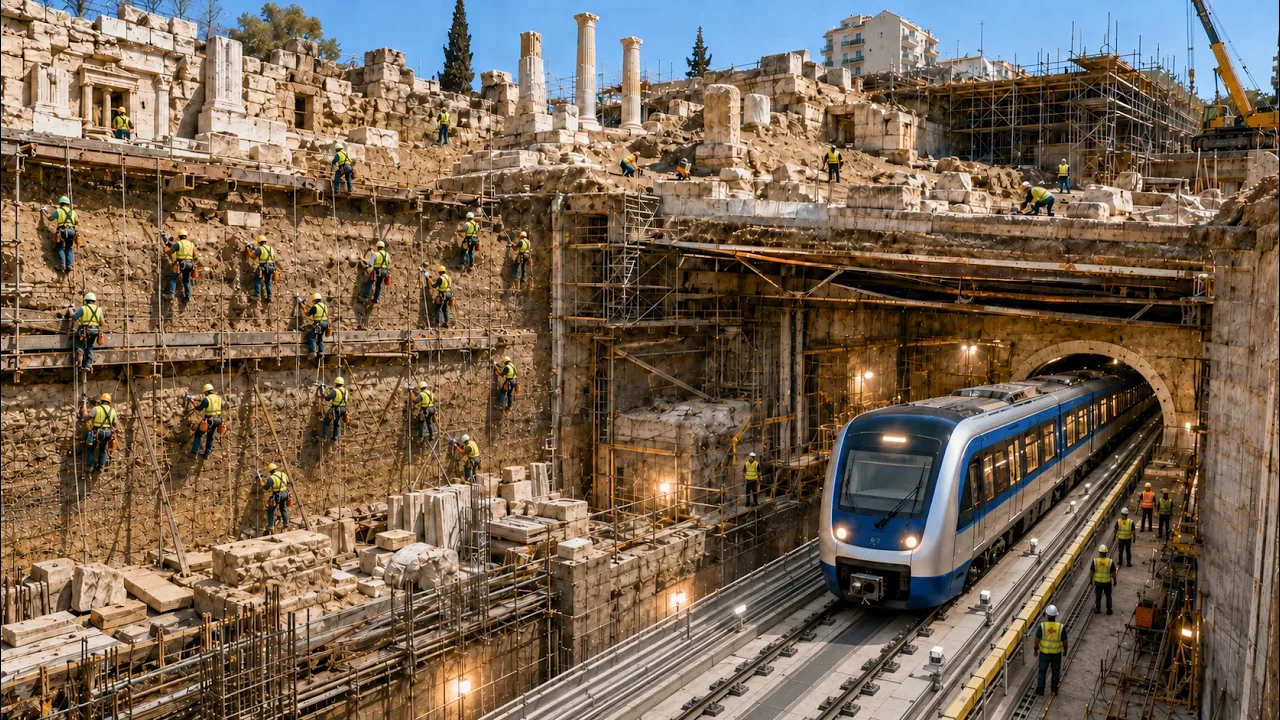
Mega Engineering · @MegaEngineering79
Words
2,154
Runtime
16:10
Speaking pace
133wpm
Reading time
9min
133 words per minute, below the 160 25th percentile of 349 measured videos. That distribution comes from the 349-video hook study.
Opening (first 30 seconds)
They dug for a subway. They found an empire. 300,000 artifacts buried under one city directly in the path of a single train line started at $800 now 3 billion still not finished paying for it. the idea >> 2003 the shovels hit dirt. 2013 they nearly buried the whole project instead. the fight almost started all over again. >> This project was the joke of the
67 words, the words spoken in the first 30 seconds at 133 words per minute.
Free, no signup. See how the first 30 seconds hold attention, with rewrites.
Sentence shape
| Measure | This transcript |
|---|---|
| Sentences | 190 |
| Average words per sentence | 11.3 |
| Longest sentence | 34 words |
| Questions asked | 6 |
| Sentences containing a number | 50 |
Most used terms
Filler phrases
7 in total: actually 4 · like 2 · kind of 1.
A literal whole-word count of the same phrase list the Prepublish browser extension uses, so a phrase inside another word is not counted and a phrase used in its ordinary sense still is. It is a count and not a judgement.
Run the check on the words above: where attention is likely to drop, with a rewrite for each weak line. The free check shows the scores and the one issue costing the most.
What this transcript is
Every word below is the caption track YouTube publishes for this video, pulled from the video itself and reproduced unchanged. It is not Prepublish's writing, not a summary, and not a re-transcription: it is the video's own published captions. English captions, generated automatically by YouTube, in the video’s original language. Source: the video on YouTube. A channel that would rather this page did not exist can ask for its removal through the contact page, and it is removed.
No Script X-ray for this video: YouTube shows a Most replayed graph only once a video has enough views.
They dug for a subway. They found an empire. 300,000 artifacts buried under one city directly in the path of a single train line started at $800 now 3 billion still not finished paying for it. the idea >> 2003 the shovels hit dirt. 2013 they nearly buried the whole project instead. the fight almost started all over again. >> This project was the joke of the town one resident told reporters. Every deadline came and went.
Here's the crazy part the ground under Thessaloniki was never going to let them leave without a fight. Wait until you hear what they found under Venezuela Square Thessaloniki. 1 million people Greece's second city jammed onto a strip of land between a gulf and a wall of hills. For decades this city had one of the worst traffic bottlenecks in Europe. No subway no relief just gridlock and some of the dirtiest air on the continent.
The idea for a metro is old 1976 Prime Minister Constantine Karamanlis puts it in the national budget. Nothing happens for a decade. 1986 engineers finally break ground 650 meters of tunnel then the money runs out. The hole gets abandoned. >> This project was the joke of the town. Every time we heard a new completion date it was never met. >> Here's the crazy part. When construction finally restarted in the early 2000s the problem wasn't money it wasn't politics.
It was the ground itself. Thessaloniki has been continuously inhabited for 2,300 years. Hellenistic, Roman, Byzantine, Ottoman. Every civilization that ever passed through this port city left something behind. Buried directly in the path of the metro's twin tunnels. The sea didn't stop this metro. The mountains didn't stop it. The city's own history did. Nobody thought a modern driverless underground railway could survive digging through two millennia of buried civilization without destroying it or without being destroyed by it first.
So, here's the question that took 20 years and 3 billion dollars to answer. How do you build a subway through a city that refuses to stay buried? Feel this. Soft clay, loose sand. This is what's underneath Thessaloniki. And somewhere between 15 and 30 m down, it gets even more complicated. Geologists call it Neogene and Quaternary deposits. Stiff red clay from the Miocene era capped by layers of sand and silt near the surface.
Tunnel boring through this kind of ground is a coin flip. Too soft and the tunnel collapses behind the machine. Too rigid and the machine can't cut through fast enough. Engineers ran borehole logs, particle size tests, permeability tests, standard penetration tests. Every meter of the route mapped before a single blade turned. Here's the crazy part. The geology wasn't even the strangest thing they found. 2008. Workers drilling test shafts hit something that wasn't soil.
It was bone. Then jewelry. Then coins. More than a thousand ancient graves sitting exactly where the tunnel needed to go. Watch this. This wasn't an isolated pocket. This was the first sign of what was actually buried under this entire city. A problem no engineering textbook had ever solved at this scale. The team had two options for the boring machines themselves, a slurry TBM or an earth pressure balance machine, an EPBM.
Slurry machines are built for wet, unstable ground. EPBMs hold the tunnel face together using the excavated soil itself, pressurized like a plug. Given pH equals Thessaloniki's mixed clay and sand geology, the choice was EPBM. Not because it was easier, because it was the only method precise enough not to destroy whatever was waiting below the surface. Some people will ask why they didn't just reroute the whole line.
They couldn't. The route ran straight through the historic heart of a city continuously inhabited for over 2,000 years. There was no version of this project that avoided the past. Now watch what they sent down there to find out exactly what they were dealing with. Two machines. Two names pulled from Greek mythology, Ellie and Frixos. Each one an earth pressure balance machine, 6.12 m in diameter, wide enough to swallow two lanes of traffic whole.
Their job? Bore twin tunnels, each nearly 8 km long, 12 m apart, without ever touching each other, and without collapsing the ground above them. Miss the pressure balance by too much and the tunnel face blows out. Sinkholes, right under a city of a million people. I'm standing at what used to be open ground. Now there's a machine the size of an apartment block grinding through it, meter by meter, 24 hours a day. Here's the crazy part.
The deeper the machines went, the more of the city's past they hit. Around Venizelu Square, workers uncovered something that stopped the entire project cold. A marble-paved Roman road, 70 m long, lined with columns, nearly 2,000 years old. Underneath it, the remains of an even older Greek road laid 500 years before that. >> We have found roads on top of each other, revealing the city's history over the centuries. >> Let that sink in.
Two ancient roads stacked on top of each other, sitting exactly where the modern tunnel needed to run. Nobody thought this was actually solvable without either destroying a 2,000-year-old monument or canceling a $3 billion transit project outright. The answer engineers reached for wasn't a compromise. It was depth. Bore deeper, much deeper than originally planned, and let the ancient city stay exactly where it was, undisturbed, while the trains ran beneath it.
Look how far down this goes. From street level, you can't even see the bottom of the shaft. At Venizelou, the tunnels ended up sunk to around 31 m. That's roughly 100 ft deeper than the original design called for. The machines held their line. The road above stayed intact. Now, here's what happens when you have to build an entire station around a monument you're not allowed to move. With the tunnels holding, the real challenge began, turning 13 station sites into something that had never been built before, anywhere in Europe.
At Agia Sophia Station, archaeologists mapped a site covering more than 800 square meters. Building foundations, streets, and structures spanning late antiquity through the post-Byzantine period, all in the direct footprint of a working transit hub. Watch how they solved it. Instead of clearing the site, engineers redesigned the station around it. The entrance shifted, the platform layout changed. The archaeology stayed exactly where 16 centuries had left it.
A P.H. equals Dimokratias station. A section of Byzantine era city walls sat squarely in the excavation zone. The solution? Move the entire station roughly 9 m sideways, rather than demolish a 1,400-year-old fortification. This is not a small adjustment. Shifting an underground station means re-engineering the tunnel alignment on both sides of it. But, the biggest problem was Venizeliou. More than 1,500 square meters of the ancient city center, shops, colonnades, the intersection of two Roman avenues, sat exactly where the platform needed to go.
Aristotle University stepped in. Three separate working groups, civil engineering, architecture, and archaeology, spent years modeling every possible configuration. Here's the crazy part. The final answer wasn't to remove the ruins and rebuild the road somewhere safer. It was to keep the ancient road exactly where it was found, and build the station in the space around and beneath it. The result? A train platform with a 2,000-year-old marketplace suspended above it, visible through glass, lit like an exhibit, because it is one.
Nowhere else has anyone tried to run an operating metro station directly underneath an intact ancient city street. This is the part nobody had a blueprint for. Segments of Byzantine road foundations from five historical eras and a functioning subway platform all sharing the same handful of vertical meters. You'll see why this mattered later when the doors finally opened to the public, but building the physical station was never going to be the hardest part of this project.
The hardest part was convincing the country to let them finish it. Then the nightmare hit. Not underground this time, but in court and in the streets. In 2015 after the site's significance became undeniable Greek authorities approved a plan detach the antiquities, preserve them, and reposition them exactly where they were found once the station structure was complete. Construction could continue. It didn't stay settled.
Not a redesign problem this time. A political one. Powerful enough to bury a project 20 years in the making. December 2019, the Central Archaeological Council reopened the question. Their new recommendation remove the antiquities even temporarily so construction could move faster. The city exploded. Banners went up across Thessaloniki. Three words on all of them. Crime at Venizelos Station. Archaeologists, historians, and residents who had waited over a decade for this metro were now fighting to stop it from moving forward the way it was designed to.
Legal challenges followed. Work on the station froze. 28 months. That's how long construction on this one station stopped. Nearly 2 and 1/2 years on a project already 15 years behind schedule over whether 2,000-year-old stones would be allowed to leave the ground even temporarily. Some people will ask what was actually at stake. Everything. A wrong move here could shatter artifacts that had survived intact for two millennia.
A wrong political decision could kill the entire station outright. In the end, the antiquities never left. Piece by piece, they were documented, protected in place, and the original in situ design survived the fight. Problem absorbed. They kept going. With the legal fight behind them, engineers pushed toward the finish line. 2018, the tunnel boring machine Frixos broke through at 25 Martiou Station, completing the last stretch of bored tunnel on the entire line.
Both twin tunnels, nearly 8 km each, now connected end to end. 18 fully automated trains arrived, built to run without a single driver on a system that had never operated commercially anywhere in Greece before. Headway? 3 and 1/2 minutes between trains. Top speed? 80 km/h. Every one of those trains had to be tested, not just for speed, but for how they respond to 100 different failure scenarios automatically, with no human on board to intervene.
Here's the crazy part. After everything, the archaeology, the lawsuits, the 28-month freeze, the final test wasn't underground at all. It was whether the public would trust a driverless train running beneath a city that had spent two decades being told this day would never come. >> 13 stations, 9.6 km, five of them doubling as archaeological museums nobody outside Greece had heard of yet. >> Then, the real test came.
November 30th, 2024. Nearly two decades after the first shovel hit the ground, and 18 years after officials first promised this exact date, Prime Minister Kyriakos Mitsotakis cut the ribbon. President Katerina Sakellaropoulou stood beside him, and for the first time, the public walked into Venizelou station, kept sealed and secret right up until this moment. The doors opened. The trains ran, fully automated, zero drivers on a system that had never carried a paying passenger in this country before. >> Zero incidents, zero delays reported on opening day. 13 stations running exactly as designed. >> Beneath the platform at Venizelou, commuters walked past a marble Roman road nearly 2,000 years old, undamaged, unmoved, lit, and displayed exactly where it was found. 300,000 artifacts unearthed over two decades, every single one accounted for.
Not one lost. Not one destroyed. "This is a truly unique technical project," Mitsotakis told reporters, "which highlights all the cultural richness of the city." 20 years, 3 billion dollars, one ancient road still standing exactly where the Romans built it with a 21st century subway running past it every 3 and 1/2 minutes. It worked. They dug for a subway. What they found could have buried the entire project instead.
It didn't. Marina Arouch used to spend 30 minutes fighting traffic to reach her family's business downtown, then hunt for parking on top of that. Now the ride takes 15 minutes. No car, no traffic. Multiply that by an estimated 250,000 riders a day, and by as many as 60,000 cars pulled off Thessaloniki's streets in a city that once had some of the worst air quality in Europe. The Greek Ministry of Culture called this the biggest salvation operation the country has ever carried out.
Not because of the trains. Because of what the trains now run past untouched every 3 and 1/2 minutes. Every meter of tunnel here was paid for in decades and in arguments over what a city is allowed to bury and unbury. Every meter still held 20 years late, $3 billion over, and on November 30th, 2024, a 2,000-year-old road and a driverless train finally learned to share the same 6 inches of Thessaloniki. If you want to see what's actually running beneath your own city, that's next.
The words are the caption track's own and nothing is reworded or re-transcribed. Paragraph breaks are placed between sentences so the text reads as prose.
Free tools for your own script: paste a draft and see where it stands before you record it.
Paste your draft and see where viewers are likely to drop off, with a rewrite for each weak line.
Paste the first 30 seconds of your own draft for a hook score and rewrites.
Check your draft against YouTube's advertiser-friendly guidelines before you record it.
Read this channel's public videos and transcripts, and download a writing brief for it.