Getting the transcript
Reading the captions from YouTube. A video nobody has opened here before takes 10 to 30 seconds; this page fills in on its own.
Getting the transcript
Reading the captions from YouTube. A video nobody has opened here before takes 10 to 30 seconds; this page fills in on its own.
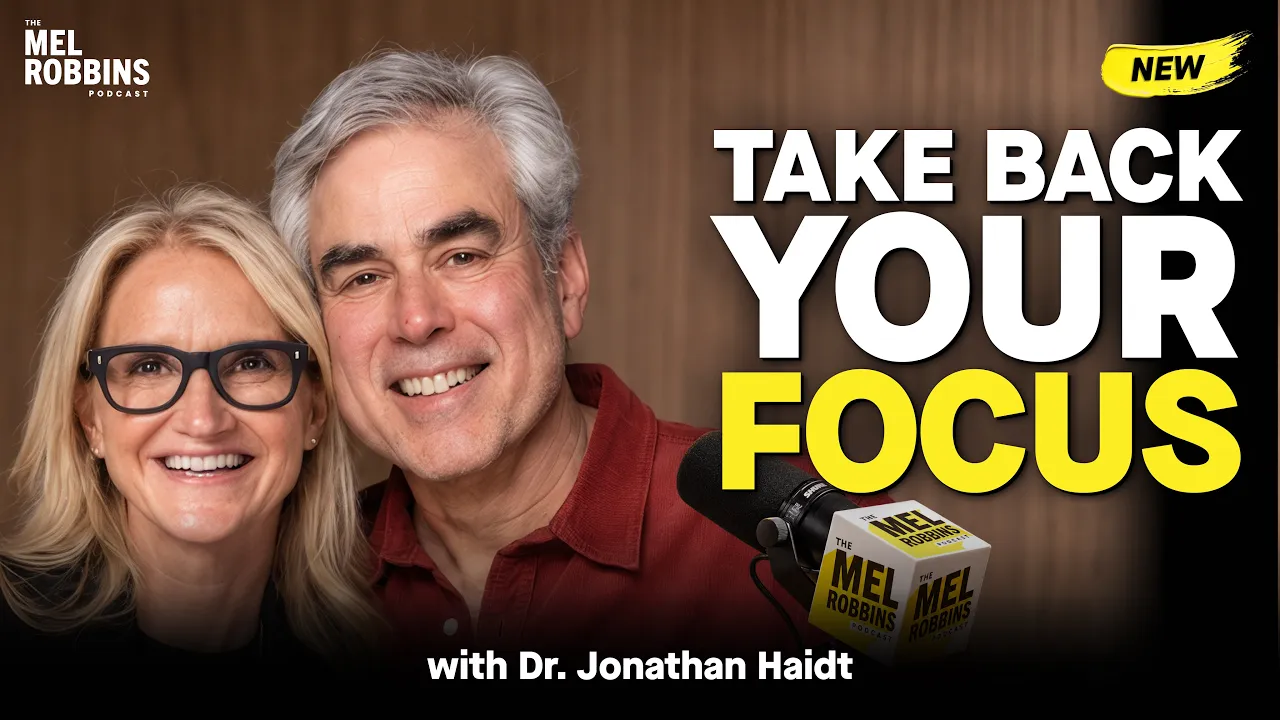
Mel Robbins · @melrobbins
Words
10,665
Runtime
53:43
Speaking pace
199wpm
Reading time
44min
199 words per minute, between the 181 median and the 201 75th percentile of 349 measured videos. That distribution comes from the 349-video hook study.
Opening (first 30 seconds)
Today on the [music] Mel Robbins podcast, Dr. Jonathan Height, the world's leading researcher on how social media and quick dopamine is devastating to mental health. >> The average American teen now spends 5 hours a day on social media, mostly watching short videos. I [music] think 40% of American 2-year-olds have their own iPad. >> With a new warning about how it impacts boys, >> boys now have a slot machine, a porn theater, a video game parlor. They have all of this stuff in their pocket with them all the time. >> Meta has agreed to pay up
100 words, the words spoken in the first 30 seconds at 199 words per minute.
Free, no signup. See how the first 30 seconds hold attention, with rewrites.
Sentence shape
| Measure | This transcript |
|---|---|
| Sentences | 757 |
| Average words per sentence | 14.1 |
| Longest sentence | 108 words |
| Questions asked | 39 |
| Sentences containing a number | 56 |
Most used terms
Filler phrases
286 in total: um 91 · you know 69 · like 60 · uh 38 · actually 9 · kind of 7 · sort of 6 · I mean 3 · basically 2 · right? 1.
A literal whole-word count of the same phrase list the Prepublish browser extension uses, so a phrase inside another word is not counted and a phrase used in its ordinary sense still is. It is a count and not a judgement.
Run the check on the words above: where attention is likely to drop, with a rewrite for each weak line. The free check shows the scores and the one issue costing the most.
What this transcript is
Every word below is the caption track YouTube publishes for this video, pulled from the video itself and reproduced unchanged. It is not Prepublish's writing, not a summary, and not a re-transcription: it is the video's own published captions. English captions, generated automatically by YouTube, in the video’s original language. Source: the video on YouTube. A channel that would rather this page did not exist can ask for its removal through the contact page, and it is removed.
No Script X-ray for this video: YouTube shows a Most replayed graph only once a video has enough views.
Today on the [music] Mel Robbins podcast, Dr. Jonathan Height, the world's leading researcher on how social media and quick dopamine is devastating to mental health. >> The average American teen now spends 5 hours a day on social media, mostly watching short videos. I [music] think 40% of American 2-year-olds have their own iPad. >> With a new warning about how it impacts boys, >> boys now have a slot machine, a porn theater, a video game parlor.
They have all of this stuff in their pocket with them all the time. >> Meta has agreed to pay up to $17 [music] billion in damages due to the claims that Facebook and Instagram have harmed the mental health of young people. >> The biggest damage, the destruction of the human ability to pay attention, to focus, and to pursue goals. >> Dr. Hyde is here to teach you how to get your life back right now. If you're addicted to something and you stop doing it for the first few days, it actually can be painful.
But if you stick with it, within a week or two, your life comes back. >> Jonathan Height, welcome to the Mel Robbins podcast. >> Mel Robbins, it is great to be here. And of course, one always says that, but the welcome that your team gave me, I have never seen anything like it. So, it's a real pleasure to be here. >> Well, we are very, very excited that you made the time to come to Boston. I have had you on a list of people I want to sit down with for well over a year and I want to start out by talking about what could change about my life >> or about my kids' lives or the lives of some of the youngsters that I care about if I really take to heart everything that you're about to teach us and share with us about this shocking research and I apply it to my life.
Mhm. >> So what what we'll be talking about here is how to regain your attention, how to improve your habits, especially your digital habits. And if you do this, then I can I can offer you the the listener, the viewer, the same thing that I offer my students at New York University. I teach a course called Flourishing. And I say if you stay with the program, if you make these changes to your habits, by the end of the course, you will become smarter, stronger emotionally, and more sociable.
And if you become smarter, stronger, and more sociable, then you will on average be more successful in love, broadly construed, and in work. And love and work is the magic formula in psychology for happiness and flourishing, going all the way back to Sigman Freud. So if you are more successful in love and in work, then I guarantee you, you will be happier. >> I feel like this is one of these topics that makes everybody anxious. the title of your blockbuster bestseller and all this research, the anxious generation is the right title because I know we have a sense that there is something deeply wrong. >> Yeah, that's right.
That's right. >> And that we are losing parts of ourselves. We are losing parts of our connection to other people. We've all had that experience of just walking down the street and nobody's talking to anybody. Everybody's staring at their phones. You see families sitting out at a restaurant. Everybody's on a device and my heart quietly breaks and I also feel this deep sense of panic and so are there things that we're going to learn today that may give us a sense of control back or like exactly what to do because it almost feels like this is one of those topics that the genie is already out of the bottle and we're all screwed. >> Yeah.
Um so something big changed between 2010 and 2015. I've called it the great rewiring of childhood and you and I are going to talk about that. What happened when everybody switched over from having flip phones or basic phones? You know, the millennials went through puberty with the Motorola Razor to by 2015, everyone has a smartphone. We've got to get to the point where we can return our phones to being tools that we use when we want to do something.
You take it out. The smartphone used to be a Swiss Army knife. Even had flashlight and maps. Like, it was amazing. We've got to get back to where it's a tool that you use when you want something as opposed to a thing that's dominating, controlling your life and and altering your consciousness and telling you what you need to do now and when. So, um, and it's it takes some work. I'm not going to say it's easy, but it's actually pretty simple.
Like, the things you need to do aren't aren't complicated. With a little practice, you really can regain control of your attention and then you'll regain control of your life. I would love to start with just really digging into your research in this blockbuster book, The Anxious Generation. What effect does living a life where you're constantly connected have on you as a human being? >> Yeah. So, the most important component of happiness uh research in positive psychology has shown this for decades.
The most important thing is relationships and relatedness. uh we humans are ultraocial creatures. Uh we have intense social needs. We need to have close relationships uh supportive relationships in our family. And then as kids especially as they reach adolescence the de the plan is they kind of move out they they stop being under your toutelage under your protection and they need to begin creating their own life and that means that they need to make it in the world of prestige of their peers.
So that's always been the case and that's why I don't what it was like for you. I hated seventh grade. Middle school was the worst. Like I generally liked school but middle school was horrible and you know suddenly you realize wait how I look you know suddenly it suddenly matters so much. So middle school is a very very difficult time. It always is. You can't remove that. Um but um if now suddenly everyone is online and everyone is connected and the companies tell us oh it's how you make connections.
It helps kids you know get together. But what kids need is a few close friends. And and early on what we were told was, "Oh, this is, you know, let them, you know, have an Instagram page. They'll have all these friends. They have all these followers." Um, but it turns out that that doesn't bring you closer to your friends. It replaces them because the average American teen now spends 5 hours a day on social media, mostly watching short videos.
They're not even liking each other's posts. It's mostly short videos. Um [snorts] these 5 hours a day pushes out everything else. Time with friends, sleep, sunshine, reading books. You know, if you if you have kids, imagine taking 5 hours out of their day and saying, you know, you have to go do something for 5 hours a day. Now get everything else done. Everything else is going to suffer. Um and that's what these devices did.
When the kids got on social media, it severely damaged their relationships because [snorts] it gave them quantity at the expense of quality. They now had hundreds of friends that they never saw. I also think it's stunning that the five hours is spent watching short form. It's not even five hours spent chatting with friends or talking to friends or doing something with friends. >> That's right. So, this is something very important for people to understand.
Um, social media used to be social. Social media used to actually be called social networking systems. That was what we called them around 2006 to 10. Social networking systems. Facebook was a social networking system. You put up your page, you've got your information, maybe your photographs, and you can go check out your friend's page and they can check out yours. That's perfectly healthy. There's no problem with that. >> And it was also very static.
Yeah. >> It was sort of like looking at a flyer. >> Yeah, that's right. It was not addictive. There was no dopamine issue. It was It connected people and it let you catch up with your friends very quickly. >> Yes. >> So, a lot of things change. So, the iPhone comes out in 2007. >> Okay. Okay. Um, but very few kids have one and there's no app store, no push notifications. Um, 2008 you begin to get the app store and push notifications. 2009 you get the share button, the retweet button.
So now and then you get newsfeed in this period also. So instead of going to check out your friends page now suddenly it's your newsfeed and it's not just updates from your friends, it's news updates, it's commentary, it's culture war stuff, it's isn't he stupid, it's can you believe those Democrats, those Republicans. Um, so now you're getting push notifications about things that aren't your friends. Uh, and this begins to sort of ramp up our are, you know, the the overstimulation, the the anxiety, but you can only do Facebook when you sit down at your computer. >> And if you're a teen, you may have to sit down at your parents' computer.
So nobody is on for 5 hours a day. So that's where we are in 2008, 9, 10. 2010, the iPhone, I think the five has the uh first iPhone with a frontfacing camera. That's also the year Instagram comes out, but it's a photography site. Teens aren't on it. [snorts] Um, by 2012, now lots of teens are getting an iPhone, whatever, six, whatever it was by then, an iPhone with a front-facing camera and an Instagram account because Facebook buys Instagram in 2012 and that's when all the girls rush onto Instagram.
And so 2012 is the pivotal year for girls especially. For boys, the curve is a little more curve linear. They're not there's not such a sharp elbow for boys at 2012. For girls, it's very sharp 2012. So imagine being a a 12 or 13 year old girl in 2010 versus 2015. You're always concerned about your status, your reputation, your looks with the small group that you're talking to. And now suddenly by 2015, everyone is talking about your looks.
Everyone is commenting on the dress you wore. Everyone's commenting on your skin, your breasts, your hair, everything. Um, this is horrible for girls. This is a horrible way to put girls through puberty. So that's why we see girls suffering immediately. And that was what my early research was on. It was really clear. Social media, especially Instagram, is harmful for girls, especially anxiety, depression. And for older Gen Z, which is those born 1996, 7 8 9, I think that's the main story.
And it looks like the boys aren't doing so bad. Okay. But now, let's trace it forward a bit more cuz everything changes. By 2015, now the video games are moving onto the phone. And now boys get their quick dopamine hits. They begin to get addicted to their phones for video games. Now that [snorts] everyone has high-speed internet, now porn, boys can watch porn anywhere, anytime. And so a lot more boys are getting addicted to porn, which makes it much harder for them to ever talk to a girl or flirt with a girl or seduce a girl or get a girlfriend.
For boys, the thing to keep your eye on isn't necessarily social media. It's quick dopamine. Boys now have a slot machine, a porn theater, a video game parlor. They have all of this stuff in their pocket with them all the time. and you're a boy, it's going to be just lots and lots of stimulation, which is going to make it very hard for you to ever pay attention. Boys especially lose executive function, the ability to make a plan and follow it.
Um, for girls, it's constant social comparison. It's constant stuff about clothing, looks, makeup, f, you know, is it get ready with me videos that the girls watch. >> Um, so it is having a different effect on boys and girls, but they end up in the same pit of despair. >> And why is it important to understand that it's a slot machine? So, could you explain to the person listening because I think we know we know from a common sense standpoint that slot machines are not a good thing.
They're designed to keep you pulling the lever. If you're an adult, you've probably walked through a casino at some point. You see people zoned out pulling the slot machine. Exactly. But can you explain to the person who's listening, who's never heard this explained to them >> why it's important to understand that it's the same way a slot machine is designed. >> That's right. So the original internet was wide open. It was very difficult to make money on it.
People put things up. But once you get push notifications, the app store, all that stuff, a lot of companies develop what's called an advertising based business model. They make their money from showing you ads. And a company like Facebook was the first to really pioneer this. If they make money from showing you ads, then they'll make more money if they show you more ads to keep you on longer and keep you more intense.
And so the business incentive for them was to figure out how to keep everyone on longer. And they told their engineers that they said, you know, your bonus will depend in part on you raising increasing the engagement numbers, which means time spent on the device. And you know this because you're involved with class action lawsuits now and so we have the evidence. >> That's right. >> That these are designed in a way to keep you and your kids on them longer. >> That's right.
So uh first so I know people who worked at Facebook and and they told me about the bonus structure. Uh but because so many parents are suing face Meta in the course of the lawsuits we have a process of discovery. The attorneys can request documents. Also, they're whistleblowers like Francis Hogan who brought out thousands of screenshots of internal documents. [snorts] And so, here I'll just read a couple. So, here's a discussion a discussion among two researchers at Instagram.
Um, one of them has a PhD in uh in neuroscience. Uh, and he says, um, it seems clear from what's presented here in this internal report that some of our users are addicted to our products. And I worry that driving sessions incentivizes us to make our product more addictive without providing much more value. How to keep someone returning over and over to the same behavior each day? Intermittent rewards are most effective.
Think slot machines. >> Now, I want to just make sure that as you're listening or watching, you understand what that means for you and me. One of the reasons why you catch yourself and it's not your fault >> sitting on your phone for 2 or 3 hours when you didn't mean to. You just went to go get a text. >> Next thing you know, you're scrolling. That's right. is that if you notice as you scroll, every once in a while you get a funny meme. >> Exactly. >> But then you scroll through a bunch of boring stuff and then you get another funny one >> and then you scroll and you start to think, "Oh, I should get off this thing." And then you see a funny one. >> That's right. >> But you don't know how often.
And then you go to put your phone away and then what ends up happening, at least for me, I notice >> is that I feel this lingering pull that maybe there's something good >> that is on that thing. >> That's right. And so I go to pick it up again and because I don't know, there's there's this interesting thing that happens when you start to realize that this is by design. That's right. >> That it's the fact that you don't know if there's a funny thing coming yet.
You don't know if you're going to like the next thing >> that keeps you on it. >> That's right. That's exactly right. >> At the end of the day, the device is neutral. >> That's right. It's the software that's on the device and the apps in particular and the social media platforms and the shoppingification of social media that has led to all of this addictive behavior. >> Exactly. So, it's going to devastate the deep connections.
They're not going to have the deep connections. They're going to have lots of shallow connections. That's really bad, especially for girls. That's one. >> Why is it really bad for girls to have shallow connections? >> Um, boys are boys are developing friendships as as my friend Richard Reeves says. He he runs the American Institute for Boys and Men. He says, "Girls like to like to connect face to face. Boys like to connect shoulder-to-shoulder, like we're doing something together, we're hiking, we're building something, we're whatever." Um, there's also an enormous difference between connecting and performing.
And there are times when kids need to learn how to boast, how to impress others. Um, but it shouldn't be most of the time. And it shouldn't be when they're with their friends. And as soon as girls get social media and now everything's about their profile and who liked them and why did he like her post but he didn't like my post and all the stuff that girls do a lot more than boys about like the you know the going further on why they thought that or did that.
Um >> it drives them into just an endless loop of that kind of thinking. [snorts] Um as opposed to just connecting and having fun and sharing secrets with a friend. >> Um then there's the sexualization. If you just think about what healthy development is for a girl, the British have a phrase, "Don't put your daughter on the stage, Mr. Worththington." It's from like an an old play or something, but you [snorts] know, you don't want to raise a girl on a stage.
That would be devastating to her because what matters is her looks. The world judges her for her looks and that's what she cares about. Social media is just devastating for all the things girls need to do to turn into competent, happy women. So that's why that's why my group says, we say very clearly in the book, no social media till 16. Why is the internet a uniquely dangerous place for a young person to be wandering around unprotected? >> So, it's kind of insane to put children in with anonymous adults.
I mean, imagine if there was some place where you could just drop your kids off and they're going to interact with all kinds of men um who are wearing masks and we never know who they are. That's completely insane. But that's what happens on a lot of platforms, even Roblox. U you know, Roblox is a virtual space where people wander around, they interact with other people. Some of them are men who want sex. So once you get into any of these platforms that allow communication among strangers, this is a sick thing to do to children, but it's common.
We just accept it. It's just common. And where did all the sexual predators go? If you hang out at a park, you the police, you know, people report you, you'll get arrested. So they're all went they all moved to Instagram and a few other platforms. Um so research done by u Arturo Behar was a Facebook employee. He was working on Instagram. um and his daughter, his 15-year-old daughter, created an Instagram page because the two of them enjoyed restoring classic cars and she kept getting hit on by men showing creepy things. 15-year-old girl, photographs of her fixing cars, like she has to go through this.
And so Aruro says, "I wonder how common this is." And he's able to do research and he finds that 15% of I think it was 14 to 16 year old teens and here boys and girls were getting it equally. He said 15% of them get an inappropriate approach from a stranger every week. >> Every week. >> Every week. If you just look in the past week, the question he asked was in the past week. >> This was around 2018, 2017. >> So this was 8 years ago it was 15%. >> Yes.
He said his questions were in the past week has this happened to you and one of them was an inappropriate approach from a stranger made you feel uncomfort. [snorts] Um and so it is just ubiquitous. So, of course, look, these there are, you know, most men are very decent and would not harm a child, but if it's 5% or two, whatever it is, some percent, the these platforms give them free reign. And I should clarify, you know, once your daughter gets on on Instagram or Tik Tok, it's not just strange men who are going to be doing stuff.
It's the boys in her class. Also, there's a book called American Girls. It's horrifying. I forget the author, but she goes through how boys use nude pics of their female classmates as currency. And the eighth grade boys, if they can get a pick of a of a, you know, an eighth grade girl's breasts, you know, um they [snorts] can then trade that to a high school boy who will get them beer. I mean, things like that. Just that girls bodies become currency and the degradation and the humiliation.
Um so it's just there's a degree of of sex and degradation to life online where children are interacting with strangers and there's no rules and no one's accountable. Um so that's why that's why my group says we say very clearly in the book no social media till 16. >> I find it really fascinating that you have two divergent things happening when it comes to parenting and modern society. On the other side of the coin, in real life, we've become like so psycho overprotective that we're overprotecting our kids from real life >> exactly >> experiences.
I want to read to you from page 90. American parents have lost so much trust in their fellow citizens and their own children that many now endorse the near total elimination of freedom from childhood. Now, this is a report that's over 10 years old and it's still stunning and it's way worse. And this reports from Pew Research Center. Parents on average say children should be at least 10 >> in order to play unsupervised in their own front yard.
This was 10 years ago. People were saying, "I don't want my kids playing alone in my own front yard, even if I'm in the kitchen." >> Yep. >> Holy cow. They say that kids should be 12 before they're allowed to stay alone in their own home unsupervised for 1 hour. They should be 14, which is basically high school, before being allowed to go unsupervised to a public park. That's right. It That's right. I can summarize the whole book by saying we have overprotected our children in the real world where they need a huge amount of experience unsupervised and we have underprotected them online where there's a huge amount of threats and not a lot of benefit.
We've denied kids the freedom to become tougher, stronger, more independent. Um we put them on computers instead because we well that's safe. They're on computers. Maybe they'll be like Steve Jobs. Maybe they'll, you know, start a company. Good. He's on a computer. Um, and we didn't understand as the internet changed, we didn't understand that putting our kids on the internet exposes them to all kinds of terrible people and and companies that want to addict them.
While most people are focusing on the phones, the larger message that I want to bring to everyone is keep your eye on childhood. Don't focus on the phones. Keep your eye on childhood. What kind of childhood do you want for your child? Do you want a childhood that's going to prepare them for adulthood? it's going to give you a confident per person, young person able to go off and travel, go get a job, go to college. Um, or do you want someone who's going to just spend their life keeping up with the memes on on on five different platforms? >> So, you know, Dr.
Height, let's talk about boys because we've talked specifically about the reasons why social media is psychologically devastating >> for girls, >> especially ages 10 through 14. which is why your recommendation is no social media until 16. >> What is the impact on boys when you give them a smartphone too soon or they have access to social media too soon? >> Right? [snorts] So for boys, don't keep your eye on social media.
For boys, keep your eye on anything that's like a stimulus response reward thing. So it starts with video games. And I remember my son, you know, we had simple games on the on the iPhone and I remember seeing addictions form where he was he would get very irrit you know if you took it away he'd scream he had to have it. Um if when you take something away the kid is very upset that's a definite sign of dopamine adaptation.
That is their brain has gotten accustomed to a lot of quick dopamines that when you take it away now their brain is in a deficit state. It takes a couple of weeks um you know a couple of weeks to sort of get over that for the brain to restore itself. >> Okay. So just hover here for a second. So for boys what you're teaching us so far is it's less about all of the stuff on social media. The bigger picture is when it comes to boys and brain development, >> the addictive nature of social media and short form content and all this stuff makes them super addicted to it. >> And then when you go to try to limit it, now you're going to get the outburst.
Now you're going to get the issues. And that's a sign that you got a problem. >> That's right. Maybe a metaphor that would be helpful here is imagine, you know, imagine a thousand um uh it's kind of a weird metaphor. Let's try it. Imagine uh a thousand uh uh fishermen with big hooks dropping their hooks down and your boy is sitting there on the ocean floor and all of these hooks are baited with the most amazing possible things and they're all trying to get your boy to bite and this is his entire childhood.
It starts with the video games and those are amazing and there's so many coming at him on every possible surface. Um, and it's the short videos and the memes and then when it gets a little older it's the porn and then it's the um, uh, sports betting. My god, you know, uh, states have legalized sports betting and kids are able to get around the age limits, but there are there's gambling in almost everything now. So for boys, it's open season on their dopamine system.
Open season companies are sending out fishing fleets to try to suck out all the all the dopamine. Um, that's what you need to keep your eye for boys. >> And what does it do psychologically to your son? >> Uh, dopamine is the hormone of motivation. And what you want is slow dopamine. Uh, what you want, especially for boys, boys outcomes are more variable than girls. Boys can be incredibly successful and they're over represented at that.
And also among society's losers, they're way over represented in that. So boys, the outcome of their life is much less certain than it is for girls. If boys are able to apply themselves and work towards a long-term goal, they can be incredibly effective and successful in the world and they're and they often end up with a certain kind of ambition that you find more in boys than girls. But boys are also so easily lured into becoming lazy bums that never move out of the house. >> So if you're frustrated cuz your son is not launching or he's in the basement or he's dropped out of college or he's lost motivation or never sees his friends, there is a direct link. >> Yes. a direct link because so think about it this way.
Um we we all have to learn how to do hard things. Children have to do hard things over and over again. Um if you present if you present a child with a path either you can do this really hard thing to get a candy bar or you can just have the candy bar. Which do you want? I'll take the candy bar. So it used to be that you had to work to get things. So for example, you know, the biggest project for me when I was in middle and high school was getting a girlfriend. you know, I'm not saying sixth grade, but you know, by nth grade, it was painful to not have a like, you know, cuz some some boys had a girlfriend.
Um, >> so that [snorts] was sort of a long-term project. And, you know, I would try to flirt a little bit and and, you know, I didn't know what I was doing, but that's how you learn is by trying and failing, trying and failing. And [snorts] then when you finally succeed, it's amazing. And yes, it's dopamine, but it's also a deep feeling of satisfaction. And so if boys have that over and over again, they try, they struggle for something, they get it, they get the pleasure of success, that's how you make a man.
Whereas if you always say, "You have a choice. You can work hard or I'll just give you the reward." What you're going to end up with is a boy who's not really capable of doing much in the world. We talked about mental health and mental illness a lot here. Um, but what I've discovered since the book came out is that that's actually not the biggest damage that this stuff has done to our kids. biggest damage is the destruction of the human ability to pay attention to focus and to pursue goals.
That is the destruction of what we call executive function. The ability to formulate plans uh you know orchestrate what you need to do, keep it in mind and pursue it. While all the while your phone is saying, "Come look at memes. Come look at videos." So if a boy has the ability to delay gratification, to keep his eye on the prize, he's going to be effective in this world. Women don't want a man who's nothing. They don't want a man who has no achievements.
They don't want a man who's going nowhere. So, a lot of our boys are basically consigned to unmarability because they've been damaged by this and they don't have the ability to really pursue long-term goals. >> I have never heard anybody explain it this way. I have heard lots of amazing researchers and experts talk about the crisis in men and in boys and often times especially as a woman and I have a husband who is in that field.
He leads men's retreats. He's a death doula. He is about to get his finish his degree in spiritual psychology. >> Deeply concerned about it. Um, but it often feels like it's always been pitted as it's the rise of women and the empowerment of women and and it's and what I'm hearing >> is so compelling. And so I want to make sure that I'm getting this right, Dr. Height. And I want to make sure as you're listening that you're gaining this key and critical insight >> into what's actually happening, especially for boys and young men.
When it comes to girls and the ways that social media has entered a central role in their life, it has replaced connection. It has made them perform. It has exposed them to hypersexuality. We see a direct causal link in a spike in anxiety, a spike in mental health disorders, self harm, suicidal ideiation, and eating disorders. Yes, >> with boys, the impact of all of the short form content and the dopamine and the addictive nature, the gambling, the porn, the gambling, the porn, all of it >> that your boys, your brother, your sons, your spouse, your boyfriend have all been exposed to. >> It has a direct and causal link to destroying motivation. >> That's right. to imploding executive function. >> And to creating sort of almost like a depressive state. >> Yes. >> Of just not feeling engaged or excited by anything. >> Mhm.
That's right. That's perfect. Yeah. That's exactly the way that I would put it. >> That's terrifying. >> It is terrifying. And there's a big there's a big social class divide here. That is uh as Richard Reeves has shown, he wrote the book of Boys and Men. If we look at wealthy families, you know, educated, uh, you know, college educated, married couples, the girls are doing a little better than the boys in those families. >> They're anxious as hell, but >> that's right.
They're anxious as they're more anxious. Um, but um, but the boys and the girls are both finishing high school and they're generally going to college. And but as we go down in social class, the bo it's the boys that are really really dropping off. So that in the bottom half economically we see a huge gap between boys and girls. And this is terrible for so many reasons. One of which as I mentioned is that girls generally don't want to marry down.
They want to marry up. And the supply of young men who are worth marrying keeps shrinking and shrinking because so many of them are lured off the path of development into just quick easy dopamine addictions. What do you do if you're listening to this and your heart is sinking >> and you see this in your brother >> or you see this in your boyfriend? >> Yeah. >> And as you're learning about this, you also are going to go home and see them sitting on the couch scrolling through short form as they've got the game on.
Yeah. >> And they're placing a bet. >> What do we do? Like what's the first thing to do if you're concerned about a man >> who had this impact him or you are concerned about a young adult or a boy that you are starting to see they don't want to do sports. They're kind of pulling out. They spend a lot of time in their room. >> No moral judgment. Let's you know understand what's what's happening here. Um and of course it's very hard to even change yourself.
It's very hard for a person to make New Year's resolutions. Just say I'm going to have better habits. it's even harder to change another person. Um, so if it's just you trying to persuade this person to change, that is really, really hard. But there's a couple things that can really help you. >> Okay? >> One is to have that person agree and be on your side. [snorts] >> And so if you talk to them and see, do they see it as a problem or not?
And most young people do, they they're very clear. >> What do you hear from young people? What do you hear from the boys and from the young men that when they hear that it's not their fault? Cuz I think that's a very empowering thing >> to hear >> that the lack of motivation, the lack of gusto, the lack of passion and direction. It's not your fault. You're not a loser. You were prayed upon. >> So what do you hear, Dr.
Height, when you're in front of boys and when you're in front of these audiences about what boys and young men are saying >> when the realization is, "Holy cow, this rotted my drive in executive functioning. What are they saying?" I can tell you from the young men in my course at NYU um is that in every class there's a couple that are gaming addicts especially um that spend huge amounts of time on on all of this stuff.
Um one young man um he was spending 10 hours a day on video games and social media 10 hours a day as a college student. You know, he goes to classes and he's on like that's it. That's all he does. You know, you come to New York City to go to college and all you do is sit on your bed and you know, scroll or play video games. And when in the course when they we get their digital habits right, you know, start by moving it off your phone onto a computer and then possibly just deleting it entirely, um their lives open up.
And I remember one uh one young man um he got back 5 hours a day from electronic devices. He started working out which he didn't do before. He had time to go out with friends, which he didn't do before. And in the course of going out with friends, he got up the guts to actually approach a girl in life, not on an app, and flirt with her and became his long-term girlfriend. And so his life completely turned around. This is a 19-year-old young man.
Um life completely turned around because he regained control of his attention, which also gives you back control of your time, which gives you a sense of agency because you're not always like, "Ah, I'm so rushed. I've got to do this and this and this and scroll through this and this and this." So, I've seen many young men just their lives blossom. >> Now, what do you want to say to the teenager or the middle schooler >> who's frustrated with their parents >> and feels like they're the only one? >> What do you want them to know, >> Dr.
Height? >> Well, I would start by acknowledging the pain. I would start by acknowledging that that none of us want to be left out, especially at that age, that it is painful. So, I would acknowledge that. Um, and then I would also say, um, that in the long run, other kids are going to look at you as the cool one because you're going to develop the skills and the confidence. You're going to learn how to do things in the world.
You're going to, uh, retain a sense of focus and sharpness. Um, so in the long run, things are going to be better for you. >> Well, sometimes the most loving thing that you can do is something that your kids hate you for in the moment. And that's the job of being a parent. >> That's right. That's the right. The job of a parent is to work yourself out of a job. It's to create a self-governing functional young adult. >> Yes. >> And uh even though it's painful and I'm not I'm not coming here as the expert who did this all right.
As I said I did a really good job on social media. I did not do a very good job on general computers and watching videos on the computer. You know during co everything was on the computer. So I know how hard it is. >> I can almost hear the person listening. Copy link text to brother. >> Copy link. Send a boyfriend, >> copy link, send a husband, copy link, >> send to my colleague that just got laid off. >> Mhm. because nobody has ever explained to me the way that you just did >> the direct connection between social media apps, video games, short form content, 5 hours a day on average of being online and how it is destroying motivation, drive, executive functioning, confidence and zest for life in young men.
Yes. And so I think there is probably a million young men, I'm not kidding when I say that, >> who will be receiving this episode from mothers and sisters and girlfriends and colleagues and friends and fraternity brothers. >> And what do you want to say to the the guy? >> Yeah. who has started to feel that sense that he's not himself. >> He's not exercising. >> He has trouble motivating at work. He's feeling like the world is moving forward and he's sitting still.
What is possible when you embrace the truth that this isn't your fault, but there's something you can do. >> I would start with a conversation. Yeah. >> And and you know, oh, you know, I I heard this episode, you know, I think it would be I think it would be helpful to you. Do you want me to send it to you? So at least because you know boys are very conscious of their status and if someone is calling them a loser and they and many of them know that they're losers in tempor like in the sense that they're not accomplishing and they >> well of course because you're sitting there and you see your friends excelling or you used to on social media you see them excelling or you used to do this or you're not able to like hit the marks at work and it's just like and you're putting and you just start to feel this sense >> that's right >> that you're losing yourself. >> That's right.
And I don't think anybody's going to copy paste and go, "Hey, you're a loser. Listen to this." You know, you send it and you say, "This is one of the most compelling interviews I've ever heard." >> This professor at NYU is going to explain something. >> That I think you're going to resonate with, and I really hope you'll take a moment and listen, particularly around Minute XYZ. >> Yeah. Yeah. >> Talk to me about the psychology of why >> you have to be a little bit >> you've got to be manipulative or strategic >> in your approach.
Very intentional because you want to make an impact. And I think the best news here is it's not your fault. This was done to you. >> That's right. >> And there's something you can do about it. >> That's right. So, as with any other addiction, um sometimes people be defensive or in denial about it. Okay. But for the most part, they're going to be aware that they have a problem. And they're aware that other men are succeeding, other men are getting girlfriends, other men are driving fancy cars.
Um, and so, um, if you, it's very important that you enlist the man in wanting to change. Um, is there a vision of yourself in the future that you'd like to see or are you happy with the way things are now? Um, and then also make it make it seem easy to change. It can be hard to change overall, but it's easy to take a few steps. And so, >> what are the first couple steps to take? >> The first couple steps to take uh might be let's just get your sleep in order.
Um, how about would you, you know, could could we just do like everything gets shut off at 10:00? >> Um, try to put some structures in space and time. um if you're going to take a take a drug away from an addict entirely, they're going to have withdrawal symptoms that it's going to be very difficult. But if you start saying, you know, okay, you know, you can take your drug, but you know, not in these places and not in these times, it's not as threatening.
If the young man sees this as a goal, that they actually want to get there and then they take a step, what happens? Dopamine. M >> progress gives you a hit of dopamine >> and it becomes it can become self-reinforcing. So if you ask them just you know just quit video games entirely or or stop watching porn entirely. Yeah that's too big a step but but you know enlist them uh help them make small changes um take small steps um and social support. though.
Um, you know, it's hard to beat an addiction with nothing. But if you can swap in a healthier habit, find another male friend who will, you know, you know, you know, play basketball with him once a week or go on a walk. >> Go like if you played sports as a youngster. Yeah. >> Pickup league. >> That's right. That's what a lot of young men say is, and you you'll see this in in in the books, young men will say, "Yeah, you know, I used to, you know, I used to run.
I used to play guitar. I used to do all these things, you know, and I want to do them again. and I just I just end up watching you know playing video games instead. So um find so boys are really activity motivated boy young boys and men are much more about doing things action in the world. Um so find ways to uh to entice them into that with other with other with their friends. >> Well let's talk about the advice to those of us who blew it.
So, you have kids in high school who are addicted to social media >> or you've been listening to this and you've seen your son withdraw or your daughter just have a spike in anxiety. >> You feel that this could have been done differently, but now it's too late. What do you want us to know if we feel just bad and panicked about the way that we handled it? So, I'm not uh I'm not going to advocate, you know, if your kid's whole life is on social media, I'm not going to say delete their account, take them off, because that that would be really difficult for a lot of kids once they're deeply into it.
But you you can help them have much much better habits. And remember that these these apps, they expand like a gas to fill every available moment. That's how we get to 5 hours a day of social media use for kids is that it fills up every moment when it possibly can. So, you can stop that. So, um, no matter how addicted your kids are, you can certainly, um, apply a new policy, you know, a new rule, all screens out of the bedroom at 10 p.m. and you don't get it back until you're on your way to school or something like that.
But put in limits so that especially to protect your kids' sleep. >> Well, let's talk about the limits. So, give me the specific concrete. >> If you were to run your household >> with proper boundaries, with devices, >> Yeah. What are they? >> Yeah. Here's what I wish I did. Here's what I'd recommend. Starting if you have young kids, um, you can have a computer in a common space. You can have a TV in a common space. And then you just simply have a rule.
No screens in the bedroom ever. >> Okay. But so no, so screens are in common places, no screens in bedrooms. Rule number one. >> Rule. Rule number two, um, is stories are good, but short form is bad. And so what I mean is um human we have to all understand this isn't like no screens no TV. This is understand that humans are storytelling animals. We have always told stories. We use stories to convey patterns to our kids.
This is part of inculturation. All cultures use a lot of stories. So if you want to have movie night with your kid once or twice a week. That's a good thing. Like you should do that. That's a really good thing. They pay attention for a 2-hour movie. Maybe you have to break it up over two days when the kids are young, but they pay attention to a story which transports you into a fictional space. There's something magical and good about that.
When you get lost in a Harry Potter book, when you get lost in a movie, that's all good. Okay? And a TV screen can be a good way to do that. So, um, so watching long videos with another person, a sibling, a friend or a parent, um, on a on a with a regular schedule, meaning only on like, you know, Friday and Sunday night, whatever, like some regular schedule. So, it's not like, "Mom, I'm bored. Can we put on The Incredibles?" You know, it has to be very, very regular.
This is when we do movie night. You know, one of the things that has really helped me, and I just offer this uh in case it might help you as you're listening, is I love the rule because I like very concrete black and white things. I don't like things like you could do this, you No. I love no phone in the bedroom. It gets put away at 10:00. You don't look at it again first thing in the morning until you're out the door or whatever. >> I also It has made a huge difference in our family.
We have no phones at the table. Period. Not allowed. Not allowed on the table. >> Not even to look up something quick. Mom, I'm just looking up. we were talking about. No, that's right. That's what >> um and my husband is a big policer. No dual screens when we're watching TV unless somebody walks in with a laptop and says I can only watch with you guys if I can also send a couple emails. >> Mhm. >> Make it We try not.
It's better to just say just send them and then come in. >> Yeah, that's right. >> Because then they'll they'll spend two hours sending an email versus the two minutes it takes and then shutting the laptop. Exactly. >> But the other piece for me that's made a huge difference because you know we can talk all we want about kids but it starts with you as the parent. >> I don't have my phone on my body. >> Mhm. Good. >> And I noticed that if I don't have it on my body it's like sitting on my desk or somewhere in the office right now.
At home it's always in the kitchen or in my bathroom >> and like you know on the sink area charging. If I don't have it on my body I don't reach for it. >> Yeah [snorts] that's right. >> Can you say the rule about nighttime again? >> Yeah. So, the rule about nighttime, no matter where you are, no matter how deeply your kids are into this, the rule has to be all devices out of the bedroom by 10:00 or something or other cuz that cuz that's where the worst stuff happens is overnight.
So, the boys, a lot of boys are developing porn addictions and that's going to be a little more controlled if they don't have it overnight. And that's where uh a lot of the really the worst stuff, the sexual predation happens is overnight. >> That is one rule we had. You didn't you were not allowed to have your phone in your bedroom overnight. and I would have to go in there and pull it out of their hands. Like you have to be the heavy in this regard.
But what I also started to notice >> is that it really had been impacting our daughter's sleep because they felt as though >> they needed to be available >> in case a friend needed them >> in the middle of the night. And so there is this psychological pressure that your child may be feeling. Yeah. >> That they can then blame on you when they text whomever they were talking to and said, "My mom's about to take my phone.
I'll see you at school tomorrow." >> Yeah. That's right. That's right. And this is something that the kids themselves say. Uh in fact, I just did a session with some middle school and high school kids a few days ago in New York. And when they were asked like what advice you have for the for parents in the audience, one of them said um uh let your kids blame it on you. They specifically this was an eighth grade boy. He specifically said, "Impose the rules and then your kid can say, "Well, I don't have it.
I don't have Snapchat cuz my parents won't let me." Or, "I have to shut everything down at 9:30 cuz that cuz my parents make me." Like, let them blame it on you. So, Dr. Height, you've done a wonderful job waking us up, teaching us, empowering us, and I'll speak for me personally, scaring me now that I see the dots all connected. Can you explain though the good news? Mhm. >> that is available to us now that we see the connection.
What is possible particularly for men and women, boys and girls that have been impacted by this. So, what I can assure listeners is that if you if you have any slot machine apps on your phone, if you have any apps that that are sending you notifications and and and getting you to come back and scroll, if you just move them off your phone for starters, just use it only on a computer or on a on an old iPad. Um, if you if you get it off your phone, you'll be less addicted to your phone.
M >> and if you're [clears throat] less addicted to your phone and you turn it back into a tool, not a master of your life, you're going to find your your consciousness sort of clearing and coming back. Um, and so what I'm saying is if you change your habits, you're going to change the the the things that are coming into your eyes and ears, and you're going to find that your attention is less fragmented. And when your attention starts coming together in larger pieces, >> then you can work more quickly and effectively with higher quality work.
And then you have more time. And if you have more time, you feel less time pressure. You're less anxious. >> Do you have research that shows or proves that when you get control of your relationship with all these apps and social media, >> Mhm. >> that mental health conditions get better. >> There is a body of experiments. They're called social media reduction experiments. A lot of researchers have said, "We're going to randomly assign people, you know, 200 people, reduce their social media use to an hour a day, 200, no change, and we see what happens." Um, so we've collected, we found, uh, I think about 35 of them by now. those that go on for at least a week, um, ideally two or three, and that focus on mental health, on anxiety and depression, almost all of them find that the levels of those things go down if you're off for a week or two. >> That's how quickly turn around. >> That's right.
Because think about the think about dopamine. Your dopamine circuits, they'll recover if you stop the stimulation and if you start doing thinking, you start doing other things. So, but very important is that one of the groups that did this was META. We know from the leaks, we know from all the documents that have come out, they did an experiment. They called it project mercury and it was uh it was both uh Facebook users and Instagram users.
It was around 2018, I think. Um and they randomly assigned them. They requested that they I believe it was stop using stop using it and they just did it for one week and they found that the people who got off their mental health improved. >> Now this was supposed to be a pilot study. they were going to do a much larger study, but once they found out, oops, oops, this looks bad, um, it looks like they never did the larger study, but we have that we have their findings from that and they talk about it and one of them says it looks like it's causal.
This is not a correlation. This is causal evidence. So, we know this very well. If you're addicted to something and you stop doing it for the first few days, it actually can be painful. But if you stick with it, within a week or two, your life comes back. >> I love that. phrase your life comes back because I think we all feel like we're losing >> Yeah. There's a deadness >> our lives there's a deadness >> for somebody who feels very inspired and motivated by all this work and research and advocacy.
Are there is there a place that someone can go to get tools to advocate changes at their local school or to have guidance on how to talk within your own family about this? >> So if you want to take action uh please go to anxiousgeneration.com and [snorts] at the website we have a take action button and then you can choose are you a parent, are you a teacher or educator, are you a [snorts] legislator? Um uh and so we have specific advice for all of them.
Um also letGGGrow.org if you want to give your kids more of a real world childhood. Um those are the two the two organizations that my team and I have have created to help parents and teachers and everyone else give our kids back life in the real world. >> Thank you. Thank you. Thank you Dr. Height for providing all these resources. Thank you for this extraordinary book and for scaring the hell out of us but also [laughter] empower no but also empower like it's important to know the truth. >> Yeah, >> Dr.
Height, what are your parting words? >> No matter how rich you are, you can't buy more attention and most of us give it away for free. Young people tell me they get a notification every time they get an email because they don't want to miss anything. But if you commit to not missing things, that means you're never fully present and you actually miss everything. So turn off almost all notifications. Put an almost infinite value on your attention.
Only give it to companies that are offering you something really valuable like of course Uber andyft. You should leave on notifications. You want to know if the car is coming, but no newspapers, no sports scores, no nothing should interrupt you. Um, treat your attention as though it is sacred and precious. Uh, and if you can get larger pieces of it, your life will change. >> I I cannot thank you enough for doing this research, for writing this blockbuster book, for all of the advocacy that you're doing, for the support that you're giving to the class action lawsuits that people are bringing to try to get the laws changed. and I really appreciate um your work and I know that my life is going to change for the better because of it and I know millions of people's lives will as well.
So, thank you. Thank you. Thank you. Do not stop. >> Oh, my pleasure. And thank you, Mel, for all you do to bring psychological research out to the world. >> You're welcome. And thank you. Thank you for making the time. You heard Dr. Height say your attention is the most important thing that you have. In fact, where you pour your time, where you put your attention is what determines how your life is. Period. And so, thank you for giving your single most precious resource, your attention to this conversation.
It matters and it's going to empower you to support your kids and support your family and support yourself in taking your power back. And in case no one else tells you today, I wanted to be sure to tell you that I love you and I believe in you and I believe in your ability to create a better life. And there is no doubt in my mind if you take everything that you learn today and you apply it to your life, your life is going to get better and you're going to feel better and you're going to feel more in control of it.
And you deserve that. All right, I'm going to welcome you in to the very next episode. I will see you there the moment you hit play. And thank you for watching all the way to the end on YouTube. Thank you for sharing this. I [music] hope you are cutting and pasting the link to this and putting it in your family group chat and sharing it with the people that you care about. We all deserve to know the truth and we deserve [music] to know what we can do in order to take our power back.
Now, if you love this, do me a favor. You see [music] that subscribe button? If it's lit up, it means you're not a subscriber. Take a moment to hit subscribe. It's the best way for you to say, "Hey, Mel, I [music] love what you're doing here. I appreciate you showing up for me. And Dr. Height, I appreciate you being here, too. Thank you for doing that. I truly appreciate your support because it's my goal that 50% of you that watch the podcast here are subscribers.
It's free. That way you don't miss a thing and it's the best way to say thank you. All right, I know you want to watch another video and I'm sure you're going to love this one next. I'm going to welcome you in the moment you hit play.
The words are the caption track's own and nothing is reworded or re-transcribed. Paragraph breaks are placed between sentences so the text reads as prose.
Free tools for your own script: paste a draft and see where it stands before you record it.
Paste your draft and see where viewers are likely to drop off, with a rewrite for each weak line.
Paste the first 30 seconds of your own draft for a hook score and rewrites.
Check your draft against YouTube's advertiser-friendly guidelines before you record it.
Read this channel's public videos and transcripts, and download a writing brief for it.