Getting the transcript
Reading the captions from YouTube. A video nobody has opened here before takes 10 to 30 seconds; this page fills in on its own.
Getting the transcript
Reading the captions from YouTube. A video nobody has opened here before takes 10 to 30 seconds; this page fills in on its own.
Mr. Science · @mr.scienceYT
Words
3,936
Runtime
25:34
Speaking pace
154wpm
Reading time
16min
154 words per minute, below the 160 25th percentile of 349 measured videos. That distribution comes from the 349-video hook study.
Opening (first 30 seconds)
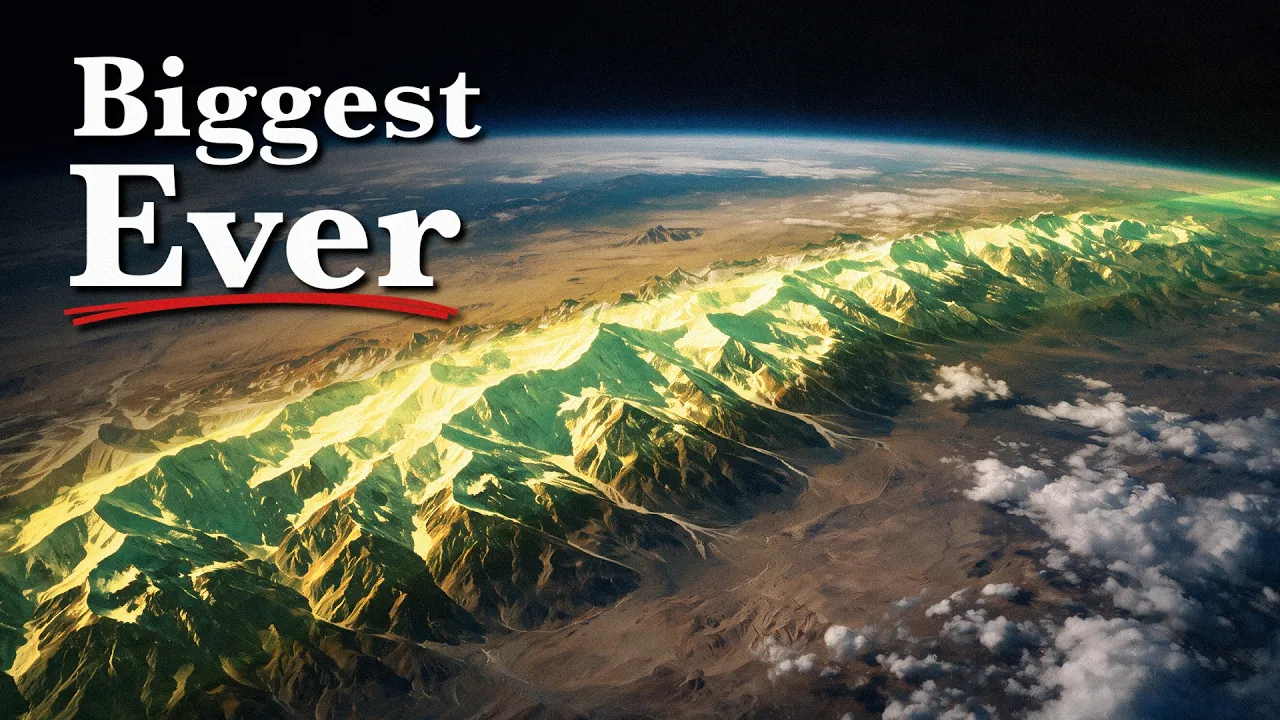
High on the border of Nepal and Tibet, the summit of Mount Everest stands 8,849 m above the sea. And near the very top, above the clouds and beneath the ice, runs a band of gray limestone. Pressed into that limestone are the remains of sea liillies, small filterfeeding animals that lived and died on the floor of a warm shallow ocean around 450 million years ago. The highest rock on the planet is made of seabed.
77 words, the words spoken in the first 30 seconds at 154 words per minute.
Free, no signup. See how the first 30 seconds hold attention, with rewrites.
Sentence shape
| Measure | This transcript |
|---|---|
| Sentences | 224 |
| Average words per sentence | 17.6 |
| Longest sentence | 62 words |
| Questions asked | 0 |
| Sentences containing a number | 41 |
Most used terms
Filler phrases
11 in total: like 7 · kind of 2 · literally 1 · you know 1.
A literal whole-word count of the same phrase list the Prepublish browser extension uses, so a phrase inside another word is not counted and a phrase used in its ordinary sense still is. It is a count and not a judgement.
Run the check on the words above: where attention is likely to drop, with a rewrite for each weak line. The free check shows the scores and the one issue costing the most.
What this transcript is
Every word below is the caption track YouTube publishes for this video, pulled from the video itself and reproduced unchanged. It is not Prepublish's writing, not a summary, and not a re-transcription: it is the video's own published captions. English captions, generated automatically by YouTube, in the video’s original language. Source: the video on YouTube. A channel that would rather this page did not exist can ask for its removal through the contact page, and it is removed.
No Script X-ray for this video: YouTube shows a Most replayed graph only once a video has enough views.
High on the border of Nepal and Tibet, the summit of Mount Everest stands 8,849 m above the sea. And near the very top, above the clouds and beneath the ice, runs a band of gray limestone. Pressed into that limestone are the remains of sea liillies, small filterfeeding animals that lived and died on the floor of a warm shallow ocean around 450 million years ago. The highest rock on the planet is made of seabed. It was lifted there by the collision of India with Asia, a slow motion impact that began some 50 million years ago and has never stopped and which continues to drive the summit upward by roughly half a centimeter every year.
The range that Collision built is the greatest of our age. The Himalayas run for about 2400 km and carry all 14 of the world's 8,000 m peaks, a wall of rock and ice. so vast that it bends the weather of an entire continent, ringing the monsoon out of the sky on one side and casting a rain shadow across Tibet on the other. To stand beneath them is to feel that they are permanent. And that feeling is a lie. Every mountain range that has ever existed is engaged in a losing battle with rain, ice, and gravity.
And the moment the tectonic engine beneath a range shuts down, erosion begins grinding it back into the sea. Given a 100 million years or so of quiet, the Himalayas themselves will be reduced to low hills and their substance will be spread across the floor of the Indian Ocean in beds of sand and mud. The Earth is 4 1/2 billion years old, and it has been building and destroying mountain ranges for almost the whole of that time.
Nearly all of them are gone, planed flat and folded back into the crust, surviving only as roots and scars for geologists to puzzle over. For a long time, one of those scars refused to make sense. Geologists kept finding pieces of it on different continents. A belt of crushed rock in Africa. The same belt in India. The same again in Antarctica, in Australia, in South America. Lands separated by entire oceans were carrying matching fragments of one wound.
And when the fragments were finally placed together, the wound ran for more than 8,000 km. The mountain range that made it would have been as tall as the Himalayas and three or four times as long and nothing of it remains above the ground anywhere on Earth. Then came the stranger discovery. This had happened before. More than a billion years earlier, the planet had raised another range on the same scale and wiped that one away too.
Twice then the Earth has built mountains larger than anything in the modern world. Geologists call them super mountains. And the closer researchers have looked at what these two ranges left behind, the harder it has become to avoid a conclusion. They may be the reason complex life exists at all. Each range rose, stood for 200 million years, and vanished. And each time one fell, the living world that emerged from its wreckage was profoundly different from the one that came before.
In 2006, a team of geologists at the Australian National University noticed something in their data that had no business being there. The team led by Richard Squire and Ian Campbell had been studying enormous deposits of sandstone spread across the southern continents. These deposits are hard to miss once you know about them. They show up in India, in Africa, in Australia, Antarctica, and South America. And in some places, the sandstone is stacked kilome thick, covering areas bigger than entire countries.
All of that sand had to be worn off high ground somewhere and carried downhill by rivers. So, the team wanted to know where it came from. To find out, they turned to one of the most useful minerals in all of geology, a tiny crystal called Zirkon. Zirkon is special for two reasons. The first is that it is nearly impossible to destroy. A grain of Zirkon can be washed out of a mountain, dragged down a river for a thousand km, buried under new layers of rock, squeezed, heated, lifted back to the surface, and eroded out all over again. and it will come through the whole journey unchanged.
Zirkons are so tough that the oldest object ever found on Earth is a Zirkon grain from Western Australia dated at 4.4 billion years old. The second reason is stranger and it turns every zirkcon into a clock. When a zirkon crystal forms inside cooling magma, its structure lets uranium atoms in but keeps lead atoms out because lead atoms are the wrong size to fit. So, a brand new zirkon starts with some uranium inside it and no lead at all.
From that moment, the uranium slowly decays into lead at a steady, well-known rate, a bit like sand trickling through an hourglass that never stops and never speeds up. Since every lead atom inside the crystal must have been made there by decay, scientists can measure the amounts of uranium and lead in a grain and calculate exactly how long ago it formed. The method is accurate enough to date a billion-year-old crystal to within a few million years.
Squire's team dated thousands of these grains from the sandstones, and the results made no sense at first. The zirkons from India showed the same pattern of ages as the zirkons from Africa. So did the ones from Antarctica and Australia and South America. Most of the grains had formed in two waves. One between about 650 and 550 million years ago and another between 1,200 and 900 million years ago. And that same double fingerprint kept appearing on continent after continent in lands now separated by thousands of kilome of open ocean.
Normally every region has its own geological history. So, its sand carries its own unique mix of ages. Matching fingerprints across five continents could only mean one thing. All of this sand had been shed by a single source. And the rivers draining it had spread the debris across half a world. Now, think about what that source had to be. It had to be made of the right rock. Because Zirkon crystallizes in the kind of magma that forms deep inside continental crust. exactly the rock that gets cooked and melted when continents collide and pile up into mountains.
It had to be enormously high because only steep high ground erodess fast enough to shed sand in these quantities and the deposits added up to millions of cubic kilm of it. It had to be enormously long because its debris reached basins spread across five continents which no single peak or plateau could ever manage. And it had to keep standing for a very long time because those zirkon ages span a 100 million years of continuous supply.
Put the clues together and only one kind of structure fits. A mountain range as tall as the Himalayas but many times longer, rising and eroding for tens of millions of years. Around 650 million years ago, the pieces of what would one day become Africa, South America, India, Antarctica, and Australia were drifting toward one another. And over the following 150 million years or so, they collided one after the other into a single land mass that geologists call Gondana.
Continental collisions are slow affairs. The plates move a few centimeters a year, roughly the speed at which your fingernails grow, but they never really stop and crust caught between two converging continents has nowhere to go but up. The Himalaya is what one such collision looks like today. What Squire's team proposed in 2006 was that the assembly of Gonduana produced the same thing on a far larger scale. a chain of ranges running for more than 8,000 kilometers or 5,000 miles through the middle of the new superc continent from roughly what is now Arabia down through East Africa to Antarctica and in places up to 1,000 km or 600 m across.
One thing worth being clear about is that super here refers to size, not height. There is a limit to how tall a mountain can get. Continental crust floats on the denser mantle beneath it. Much like an iceberg floats on water. And just as an iceberg needs a deep root to hold up its tip, a mountain needs a thick root of crust below it. Beyond about 9 or 10 km, the rock at the base of that route is under so much pressure and heat that it begins to flow and the mountain settles.
So the super mountain was probably about as tall as the Himalaya. What set it apart was its length. its width and above all how long it stood. Well over a 100 million years compared to the roughly 50 million the Himalaya has managed so far. A mountain begins to fall apart the moment it begins to rise. Water seeps into cracks, freezes at night, expands and pries the rock open. Rainwater, slightly acidic from the carbon dioxide it picks up in the air slowly dissolves the minerals themselves.
Gravity does the rest in rockfalls and landslides that move the loosened material downhill where rivers pick it up and carry it toward the sea. The Himalaya today loses somewhere in the order of a billion tons of rock every year this way. Most of it flush down the Ganges, the Brahmautra and the Indis into the Indian Ocean. How fast this happens depends very strongly on how steep and how high the terrain is. Which means that a bigger range doesn't just shed somewhat more sediment, it sheds enormously more.
Based on the volume of sandstone they had mapped, Squire's team estimated that the Super Mountain produced in the region of 100 million cubic km of sediment over its lifetime. That is very roughly enough to bury the entire United States under a layer 10 km deep, higher than the summit of Everest. And the researchers suggested that the rate of erosion may have been among the highest in the planet's history. Part of the reason was where the range stood.
Much of it likely lay in the tropics close to the equator in a belt of heavy year round rainfall. And rain is the engine of erosion. You can see the same effect in the Himalaya now where the wet southern slopes facing the monsoon wear away many times faster than the dry northern side facing Tibet. The other reason is stranger because it involves something that was missing. Plants did not begin to colonize land until around 470 million years ago.
And plants with proper roots came later still. When the Super Mountain stood, every slope on Earth was bare rock and loose rubble. There were no roots to bind the soil, no leaf litter to soften the impact of falling rain, no forests to slow the water on its way downhill. Today, you can watch what that does to a landscape whenever a hillside is cleared of its trees. The first heavy rains strip the soil and the streams run brown for years.
The Super Mountain was in effect a freshly cleared slope 8,000 km long. And it stayed that way for its entire existence. On either side of the range, enormous river systems carried the debris down to the coast and out into the surrounding oceans, spreading it across the basins that would later become the sandstones of five continents. It was an extraordinary quantity of rock. And rock ground fine enough and soaked in water for long enough does not stay rock.
It dissolves. And what dissolves out of it ends up in the sea. This is a fossil of an animal roughly 550 million years old. It is only a few millimeters across, a series of hollow cones stacked one inside the next like paper cups. And it was found in rocks in Namibia in what was then the southern flank of the super mountain. It is called Cloudina. And as far as we know, it is one of the first animals on Earth to have built itself a skeleton.
The timing of that is worth pausing on. Clavina appears near the end of the Edi period when the first large soft-bodied animals show up in the fossil record. A few tens of millions of years later comes the Cambrian and with it the event usually called the Cambrian explosion beginning around 539 million years ago in which nearly every major group of animals alive today from arthropods to mollisks to our own ancestors among the vertebrates makes its first appearance within a window of perhaps 20 to 25 million years.
In the 3.5 billion years of life before it, nothing comparable had happened. And it happened, Squire's team pointed out, at almost exactly the moment the Trans Gondwan super mountain was at its largest and shedding sediment into the oceans at the highest rate in the planet's history. Their suggestion, published in 2006, was that this was no coincidence and that the mountains had in effect fertilized the sea. The reasoning goes like this.
Life in the ocean is limited far less by sunlight or space than by a handful of chemical ingredients. And the most important of these come from rock. Phosphorus is the clearest example. Every cell needs it for DNA and for the molecules that carry energy. And unlike nitrogen, it cannot be pulled out of the atmosphere. Over geological time scales. The only new phosphorus entering the sea is what rivers wash out of weathered rock on land.
Iron is similar. Large parts of the modern ocean are so short of it that adding a small amount to the water sets off a bloom of plankton within days. Something that has been tested repeatedly in experiments since the 1990s. If a mountain range 8,000 km long is being ground down with nothing to slow the process, the rivers draining it are delivering these elements to the coast in quantities the oceans had presumably never seen before.
More nutrients mean more plankton at the base of the food chain. And more plankton means more food for everything above it. But that is only the first step. When plankton die and sink, a fraction of their carbon is buried in seafloor mud before it can decay. And every atom of carbon buried this way leaves a molecule of oxygen behind in the water and the air. So a long period of unusually high productivity should over millions of years push oxygen levels up.
This matters because oxygen is what large bodies run on. A microscopic animal can get by on very little, absorbing what it needs through its skin. But muscles, guts, and predators that chase things need far more. And there is independent evidence from the chemistry of ancient seafloor sediments that oxygen did rise substantially across the Edi and early Cambrian. Then there is calcium. Weathering of continental rock releases it in enormous amounts.
And Squire's team argued that the flood of calcium into seawater during Super Mountain time may be the reason skeletons appear in the record when they do. Building a shell out of calcium carbonate is far easier in water already rich in the stuff. And some researchers have gone further, suggesting that early animals may have started depositing calcium in their tissues simply to get rid of an excess that would otherwise have been toxic and only later found a use for the result.
If so, Cloudina and the animals that followed it were quite literally building the first hard bodies out of groundup mountain. It is a neat idea and it was received as one. But the trouble is that in 2006, the only real evidence for all of this was timing. The mountains rose and the animals appeared and the two happened at roughly the same time. That is suggestive, but it is not proof. Things that happen together are not always connected, and geologists know this better than most because the rock record is long enough that almost any two events can be found overlapping somewhere.
There were also plenty of other explanations on the table. Some researchers linked the Cambrian explosion to the end of the snowball Earth ice ages when the planet thawed after being frozen almost to the equator. Others point to the first predators, which would have forced their prey to evolve shells, armor, and eyes in response. Others, again, point to changes in the genes that control how an animal's body is laid out, which may have made new body plans possible for the first time.
Several of these could easily be true at once, and a super mountain might be one cause among many, or none at all. So, the idea was left in an uncomfortable place. It was interesting. It made sense. And it could not be tested because there was only one super mountain and only one Cambrian explosion to compare unless that is the same thing had happened before. In science, one example is an anecdote. If a super mountain really had set off the Cambrian explosion, then the cleanest way to test the idea would be to find another super mountain from some entirely different period of Earth's history and see whether life had jumped forward then as well.
The problem was that nobody had a good way of looking for one. The difficulty with finding an older super mountain is that the method of 2006 depends on the sand still being there. The trans gonduan range left its debris across five continents because in geological terms 600 million years is not very long. Go back two or three times as far and most sediment from that age has been buried, melted or recycled into new rock entirely.
If there had been an earlier super mountain, its sand was not going to give it away. Its zirkons might. In 2022, 16 years after the original paper, a team at the Australian National University, led by a graduate student named Zihu, and including Ian Campbell from the 2006 study, published a way of reading those same crystals for something other than their age. The key is a rare metal called luteesium. When zirkon crystallizes, it normally traps a little luteium inside itself.
But at the pressures found only deep beneath a major mountain range, some 40 or 50 km down in the doubled up crust, another mineral becomes stable in the melt. That mineral is garnet, the same deep red stone found in jewelry. And garnet takes up luteesium far more greedily than zirkcon does. It acts like a sponge, so any zirkcon that grows alongside it comes out unusually poor in the element. A luteesium poor zirkon is therefore a grain that formed in the roots of a mountain and if you find them in large numbers formed at the same time and spread over a wide area the mountain above must have been correspondingly large.
Jews team applied this test to a database of many thousands of dated zirkons from every continent and plotted how many luteesium poor grains had formed at each point in Earth's history. Two spikes stood out. The younger one sat between roughly 650 and 500 million years ago, exactly where the Trans Gondondwan super mountain should be, which was reassuring because it showed the method worked. The older one was unexpected.
It lasted from about 2.0 to 1.8 billion years ago, and it was, if anything, larger. To understand what that spike means, you have to picture the Earth it belongs to. 2 billion years ago, there was nothing alive on land, nothing in the sea larger than a single cell, and barely enough oxygen in the air to keep a candle lit. The day was a few hours shorter because the planet spun faster, and the moon was noticeably closer and larger in the sky.
And across this empty world, the continents, which had until then drifted mostly as separate fragments, were for the first time gathering into a single landmass. Geologists call it Nuna, from an Inuit word meaning simply land, and it is generally considered the first true superc continent in the planet's history. The collisions that welded it together survive today only as belts of deeply eroded ancient rock in northern Canada, in Scandinavia, in Western Australia.
Worn so flat that you could drive across them without noticing. But the Zirkons say that when these rocks were young, they stood at the base of something immense. Lined up end to end, the collision zones form a single chain more than 8,000 kilometers or 5,000 m long. A mountain range as long as the one that would rise on Gonduana 1.3 billion years later on a planet that had never seen a mountain range of any size. The team named it the Nuna Super Mountain, and the pattern repeated.
The oldest fossils on Earth, large enough to see without a microscope, come from rocks in Michigan, dated to around 1.9 billion years ago, well within the lifetime of the Nuna range. They are coiled ribbon-like filaments called grapania, forming spirals a cime or two across. And while nobody is sure what they were, a giant bacterium and an early alga are the usual suggestions, they are hundreds of times larger than anything that came before them.
The first ukareotes, cells with a nucleus, the kind that all animals, plants, and fungi are built from, are also thought to have appeared somewhere around this time. Although the fossils are hard to read, and the exact date is still argued over. Just as telling is what lies between the two spikes. From about 1.8 billion to 800 million years ago, there are no luteesium poor zirkons to speak of, and so presumably no super mountains.
That same interval is known with some affection as the boring billion because oxygen levels barely moved and evolution barely moved with them. The one long stretch of Earth's history without a super mountain is also the one in which very little seems to have changed. Nothing on the scale of Nuna or the Trans Gondwan range has risen since. The Himalaya for all its height is a third the length. And if the pattern holds, that may be part of the reason evolution has produced nothing in the last 500 million years to match the two great leaps that came before it.
That is speculation and it should be treated as such. The Super Mountains are known from crystals, not from mountains. And how much of the credit they deserve for complex life is still very much an open question. What the story does show more securely is how little separates the history of rock from the history of life. The limestone at the summit of Everest was seabed once built by animals out of calcium dissolved from older rock.
And the same is true in a sense of every skeleton alive today, including yours. The calcium in your bones was at some point part of a continent. It was pried loose by rain, carried down a river, dissolved in the sea, and gathered up again by living things. And it has been passed from body to body ever since. Somewhere at the start of that chain, quite possibly, was a mountain range that no longer exists.
The words are the caption track's own and nothing is reworded or re-transcribed. Paragraph breaks are placed between sentences so the text reads as prose.
Free tools for your own script: paste a draft and see where it stands before you record it.
Paste your draft and see where viewers are likely to drop off, with a rewrite for each weak line.
Paste the first 30 seconds of your own draft for a hook score and rewrites.
Check your draft against YouTube's advertiser-friendly guidelines before you record it.
Read this channel's public videos and transcripts, and download a writing brief for it.