Getting the transcript
Reading the captions from YouTube. A video nobody has opened here before takes 10 to 30 seconds; this page fills in on its own.
Getting the transcript
Reading the captions from YouTube. A video nobody has opened here before takes 10 to 30 seconds; this page fills in on its own.
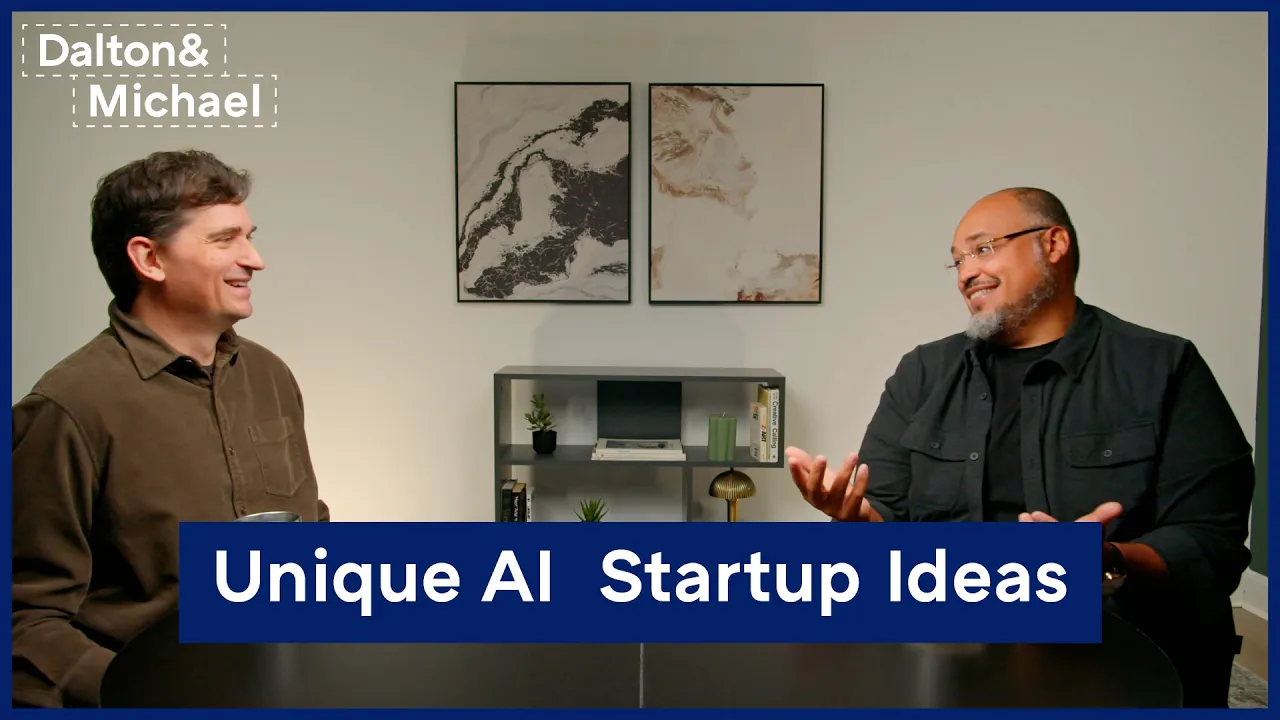
Dalton + Michael · @daltonplusmichael
Where viewers went back to watch this video again, from YouTube's public Most replayed graph, lined up with what was said at that moment.
Most replayed moment #1
14:242.8x the video's typical replay level
it is hard to feel like you're working on something where a lot of people think it's a bad idea. That's hard. And I like talking about this because you should brace yourself for that. Like, that is 100% the experience of
Said at 14:17
Most replayed moment #2
5:242.1x the video's typical replay level
it's really interesting cuz like another way that I like to think about how to move away from consensus is doing things that are just hard. Saying that you want to do something that takes 10 years, especially when you're a young person, that just seems really intimidating. So it's like easy to tell yourself, "Oh yeah,
Said at 5:17
Most replayed moment #3
9:101.8x the video's typical replay level
ever fit within that framework. And so of course the example, you know, your startup uh Justin putting the camera on his head to start Twitch >> Doesn't work. >> That's Is that a $100 billion opportunity, Michael? Like you would filter that out. >> Yes. >> Right? >> Yes. >> Something like Whatnot, which is, you
Said at 9:04
The graph counts replays. It does not show where viewers stopped watching.
Words
3,180
Runtime
16:22
Speaking pace
194wpm
Reading time
13min
194 words per minute, between the 181 median and the 201 75th percentile of 349 measured videos. That distribution comes from the 349-video hook study.
Opening (first 30 seconds)
People that are non-conformist or otherwise quirky, they constantly are generating strange ideas on their own. And if anything, society tells them, "Hey, like Like, shut up. Like, we don't want to hear all your dumb ideas on how to make things work better. Right? That's like like the system grinds that out of you. Those people tend to do well with startups because they don't actually have any problems coming up with unique ideas. >> Yes. >> All right, this is Dalton plus Michael. And today, we're going to talk about how to get unique AI
97 words, the words spoken in the first 30 seconds at 194 words per minute.
Free, no signup. See how the first 30 seconds hold attention, with rewrites.
Sentence shape
| Measure | This transcript |
|---|---|
| Sentences | 242 |
| Average words per sentence | 13.1 |
| Longest sentence | 66 words |
| Questions asked | 31 |
| Sentences containing a number | 11 |
Most used terms
Filler phrases
166 in total: like 113 · you know 13 · right? 12 · actually 8 · um 7 · kind of 5 · uh 3 · I mean 2 · basically 1 · literally 1 · sort of 1.
A literal whole-word count of the same phrase list the Prepublish browser extension uses, so a phrase inside another word is not counted and a phrase used in its ordinary sense still is. It is a count and not a judgement.
Run the check on the words above: where attention is likely to drop, with a rewrite for each weak line. The free check shows the scores and the one issue costing the most.
What this transcript is
Every word below is the caption track YouTube publishes for this video, pulled from the video itself and reproduced unchanged. It is not Prepublish's writing, not a summary, and not a re-transcription: it is the video's own published captions. English captions, generated automatically by YouTube, in the video’s original language. Source: the video on YouTube. A channel that would rather this page did not exist can ask for its removal through the contact page, and it is removed.
People that are non-conformist or otherwise quirky, they constantly are generating strange ideas on their own. And if anything, society tells them, "Hey, like Like, shut up. Like, we don't want to hear all your dumb ideas on how to make things work better. Right? That's like like the system grinds that out of you. Those people tend to do well with startups because they don't actually have any problems coming up with unique ideas. >> Yes. >> All right, this is Dalton plus Michael.
And today, we're going to talk about how to get unique AI startup ideas. Here are a bunch of old people telling you how to get unique ideas. Where should we start, Dalton? >> I mean, look, the problem right now is the tools are so good, >> Yes. >> you can crank out anything. And so, the bottleneck is less building the thing, it's actually um having an idea. And the problem is most ideas are extremely non-unique. >> Yes.
And I would even go so far as to say many founders out there are not even being encouraged come up with unique ideas. Like, they're almost being encouraged to like what just raised? What just raised a seed round? What sounds good to investors? Just tell me how I can get funded, Dalton. Just tell me what idea gets me funded. >> almost like whatever the current thing is on on Twitter. Oh, I guess I'll make a clone of that.
Like, oh, you know, when we're when we're recording this right now, it's like, oh, open claw. Yeah, well, let's just clone that. There you go, that's my startup. Um Pretty low effort. >> Pretty low effort. I think the other thing that's weird is like when people who are trying to start companies think that they can de-risk their idea by doing something that they see recently got funded or they see is like raised a series B.
Either one of those is really funny. It's like I've seen so many examples someone's like, "Well, that thing has raised money at a billion-dollar valuation. Therefore, dot dot dot dot dot." >> Well, what's so funny is we inadvertently were part of that problem. And so, it would always happen when I was doing interviews for YC is someone I was interviewing would flag, "Oh, YC funded a company two batches ago doing XYZ.
So, that validates the market." And I'd be sitting there being like, "I funded that company. I did not fund it for the idea. I actually funded a different idea and they pivoted during the batch. And so, as the person who funded that, this is not validation." Like, I can't stress enough as the source of this validation thing you're talking about, there's no signal here. >> You involuntarily validated. >> Yeah. So, I can't stress enough that trying to read the tea leaves of what kind of stuff is launching in the YC batch, >> Oh. >> it's not that it's like exactly wrong, but it's certainly not um a marketplace of picking ideas that have been de-risked. >> I think it's exactly wrong.
I think they're like like I'm sorry. Like, you're going to decide on what you're going to work on for maybe the next 10 to 20 years of your life by looking at a list of what other people are working on? Like, come on. There's certain things that you're picking that you should think about that way. Like, maybe where you go to college. Like, or maybe what you major, maybe. But like, what you spend the next 20 years of your life on, like, let's have a little bit more conviction on that. >> So, um one of the ideas that you brought up that I really like is this idea of look in the discard bin. >> Yep. >> So, so let's talk about that.
If if you shouldn't look at what's cool, how do you look in the discard bin? >> Yeah, the way to think about it is everyone has a filter for startup ideas. And because we have very similar filters, if if your if your ideation process is to find an idea that is both good and no one's ever thought of it before, you're going to have a bad time. You're trying to discover something that no one has ever thought of before, and there's a lot of people in the world.
I don't know if you heard Michael, there's billions of them. And so, most likely what you actually need to do is to find an idea that has already been discarded by others, and it's been discarded for some reason. Do you get what I'm trying to say? Like Like instead of trying to find something no one's ever thought of, find something that everyone's thought of and thinks is bad. >> Yes. Classic examples of that, uh Instacart would be maybe a very classic example.
One of the things that I see a lot of people do when they're in this kind of ideation stage is talk to their friends and look for things that all of their friends thinks are good ideas. >> Yep. >> And I might advise the exact opposite in this situation. Like what happens if you talk to your friends and like you got maybe not universal bad. >> What if they told you >> Yeah, what if they're like, "Look, I'm worried about you." If that If you explain your idea Isn't that Isn't that what happened with the founders of Airbnb, Michael?
Isn't that the story? >> It's I would say this. >> Like their parents were worried about them. >> Many successful YC companies, every one of their friends and family members thought the idea was bad. We keep on saying the way you get a unique ideas is you have to move away from consensus, right? So we got to move away from the consensus of startup founders, away from the consensus of investors, away from the consensus of your friends.
And it's really interesting cuz like another way that I like to think about how to move away from consensus is doing things that are just hard. Saying that you want to do something that takes 10 years, especially when you're a young person, that just seems really intimidating. So it's like easy to tell yourself, "Oh yeah, I know the numbers say it's going to take 10 years, but like I'll figure it out in two." And then you cut down all of the things that might take longer than two years to work.
And I feel like if you want to cheat, just imagine ideas that might take longer than two years to work. And the this is the the the likelihood of success can be way higher. >> Yeah. And when you think about examples, like currently the the consensus is that being a founder of Open AI and Anthropic is a good thing. Again, maybe that'll change. >> Well, someday. >> 18 months, right? And when you think about those companies, A, they were deeply weird. >> Yes. >> Like, can you imagine a weirder start than how Open AI got started by being a non-profit research lab and >> Yeah, during the time of SaaS ascendance. >> And you know, a lot of things didn't go well and they didn't really have a product for a long time.
Anthropic was like super weird. >> Yep. >> And a lot of their early money came from FTX. Like the whole story is like bizarre. And now they seem consensus very good, but wow, they're the definition of non-consensus things. >> Yes. >> Right? And so, I'm not even arguing those are instructive stories that if you do what they do, you're going to succeed. I'm actually arguing the opposite. Which is trying to just copy what worked in the past for other people isn't necessarily going to give you a truly unique idea. >> One of the things that actually makes this harder is how much content VCs are putting out there. >> Yep. >> If you're a young founder in the early 2000s, how much VC content did you have access to? >> It didn't exist, right?
So, the way it worked is before TechCrunch, the only people that wrote about technology were like the Wall Street Journal, >> Walt Mossberg. >> And he would mostly cover Apple. >> Yeah. >> He'd be talking about the new Mac or whatever. >> Yeah. >> And so, if you were a startup, there was nowhere >> CES. >> Yeah, right? >> Yeah. >> Um And so, then TechCrunch came out and it was the first place to like cover startups. And then now we have this like, you know, we have a lot of content out there.
And again, I'm, you know, we are certainly part of it. And I realize that our voices have been part of this thing. >> Yes. >> My justification is that we've never tried to explicitly tell founders what to think. More kind of just giving telling stories, giving advice, kind of like we're doing office hours, but with a wider group of people. >> Yes. >> But if you're making all of your life decisions based on podcasts, that is a definition of coming up with ideas that are not unique. >> Yeah. >> Like literally that's the definition of a non-unique idea is something that you heard in a podcast, right? >> Yeah. >> There's a trope around startup ideas that have been around the entire time that we've been doing startups that I might argue wasn't followed during the B2B SaaS era.
This idea of solving your own problem or being your own user. It's interesting now because it almost seems like this is completely gone out of style. This idea that like, oh, if I'm working on something for myself, there's no way it can get big or like there's no way the market's big enough or like why why I don't trust my own ability >> to like Yeah. choose things. How do you think about this? >> I think one of the big talking points on on, you know, VC podcasts or VC content is hey, $100 billion outcomes, trillion dollar outcomes are the only things that matter.
And if it doesn't seem really big, it's not even it's like a joke. You'd like You'd like mock someone who And so what that's causing is a lot of ideas that are like truly unique, wouldn't ever fit within that framework. And so of course the example, you know, your startup uh Justin putting the camera on his head to start Twitch >> Doesn't work. >> That's Is that a $100 billion opportunity, Michael? Like you would filter that out. >> Yes. >> Right? >> Yes. >> Something like Whatnot, which is, you know, one of my better investments at YC.
It's like, okay, so it's a marketplace for authenticated Funko Pops. What's the TAM on that? >> Yeah. >> You would discard that. >> Yeah. >> And so I think trying to take these like late-stage investor advice things and apply them to startup ideas, only a small number of things would meet that bar. Mhm. And so you're going to end up with extremely derivative repetitive ideas that would meet that bar. >> I completely agree.
And I think this leads me to my last thought on the subject, which is I have found that sometimes weird people have an easier time coming up with weird aka unique ideas. We do have this challenge that now that tech seems like such a money maker and there's so much money invested in early stage startups, there are a lot of people who are not very weird, who are very attracted to this space. It's funny that I'm saying weird is like a positive because I think in the normal context in America, weird isn't seen as positive, but like a lot of these ideas that worked seemed really weird and a lot of the people, when you know them, yeah, are a little weird.
So like how do you think about you know, I sometimes wonder is the tech startup world as welcoming to weird people as it once was? >> Yeah. >> How do you think about this? >> I think it's a great point. And again, maybe this is just, you know, we're getting old or something. That's That's an option, but people that are non-conformist or otherwise quirky in ways that you would describe as Uh quirky is the nice way to say it, but like like it they they tend to do their own weird stuff and they don't usually need to ask permission.
Like they they constantly are generating strange ideas on their own. And if anything, society tells them, "Hey, like like shut up. Like we don't want to hear all your dumb ideas on how to make things work better. Right? That's like like the system grinds that out of you. Those people tend to do well with startups because they don't actually have any problems coming up with unique ideas. >> Yes. >> Probably their bigger problem is filtering out deciding which unique idea is worth their time cuz they're always coming up with ideas. >> Yes. >> Versus a lot of systems are consensus machines >> Yes. >> and people that are really good at calibrating and triangulating consensus, those tend to be people that have the hardest time coming up with unique ideas cuz it's sort of been beaten out of them and it's just not their natural thing.
Like again, in the in the example of like Y Combinator itself, most investors that start funds have investment experience >> Mhm. >> and have a career where they're like, "Oh, I have a Harvard MBA or a Stanford MBA and then I worked here as an associate and then >> Yeah. >> And like Paul Graham was like, "I built a Lisp website and I got rich and I decided to do this really weird thing that I made up from first principles of letting young people apply to a summer program >> Yeah. >> and as it turns out, that's the guy that all these like normie VCs like look up to >> Yep. >> and he's just like a weird guy >> guy. >> who had no um training. >> Yeah. >> And did something that would never have been produced by by like a normal investor, right? >> Well, to take it a step further, made something that he wished existed when he was a founder. >> Yeah. >> Like made something that he would have appealed to him.
So, it's tricky cuz I think that like, you know, there are a lot of people who are watching this video who are probably thinking, "Is the startup world right for me?" I find it awkward to say that like even though this is an exciting time for tech, not everyone is cut out for this. >> Yeah. >> Not everyone is cut out to be the person coming up with the idea. I don't know. What What should you do if you're having too hard of a problem? >> If it's your dream, you should totally try to start a company and I would never I would feel really bad if I ever said something that made people question themselves or feel bad in these videos we're making cuz we're making them because we're trying to to help people, but if you really really really struggle to come up with unique ideas, >> Yeah. >> it's totally okay to go work somewhere. >> Fair. >> Like and you still get to be part of >> That's true. >> You still get to be part of things.
Like, not everyone has to be like a weird shaman that comes up with strange ideas. Like, it's okay. And when you think about it, society wouldn't work if if everyone like thought that way. >> Well, I love that point cuz also maybe you should work with someone who's weird. >> Yeah. >> And they should come up with the idea. I mean, that's that's what I did. >> That's true. You just kind of went along for the ride for the on the ideation part. >> Yeah, exactly. >> That's what you guys want to do. >> Yeah.
I would have not helped in the ideation process of putting a camera on Justin's head. contributed at all. So, you can work somewhere, you can join with someone. This is maybe an interesting point. Like, everyone interested in startups doesn't have to be the person who comes up with the idea. >> Yeah. >> I think that like, in closing for me, um it is hard to feel like you're working on something where a lot of people think it's a bad idea.
That's hard. And I like talking about this because you should brace yourself for that. Like, that is 100% the experience of everyone that's succeeded. So, it's like So, like I know it's hard, right? But, like you should feel like you're there. And you should feel maybe like you're going to be there for a couple years. And like, if you're working on something that you're so excited by, you're willing to be there for a couple years. >> As someone who funds startup founders, I am excited by that, right?
When I meet someone who I get the vibe, if this doesn't work in a couple months they're moving along. I I'm always like, oh. >> Yeah. I don't you know, I always had this phrase. It's like, you're 10% in, but you want me to be 100% in? Like, that's like a weird So, I don't know. So, for for for the people watching, like, it's totally cool to be weird and to work on something people think is weird. If you're going to use it, including us.
Like basically like if your filter is do the people on the on these videos seem like they'd approve of our ideas, we're saying no. Like don't be approval seeking from authority figures if you want actually have unique ideas. Well, and I'll extend that further. We have regularly funded ideas that we thought were bad. We have regularly worked with founders who pitched ideas that we thought were bad. And like to be completely honest, like sometimes I think of my job is like I'm a doctor.
I'm treating the patient walking in the door. I don't get to choose. Like I want to help these folks succeed and who am I to know whether this is going to work? Yep. I'm not going to, you know, let's not put ourselves in that position. Anyways, great chat, Dalton. All right, thanks.
The words are the caption track's own and nothing is reworded or re-transcribed. Paragraph breaks are placed between sentences so the text reads as prose.
Free tools for your own script: paste a draft and see where it stands before you record it.
Paste your draft and see where viewers are likely to drop off, with a rewrite for each weak line.
Paste the first 30 seconds of your own draft for a hook score and rewrites.
Check your draft against YouTube's advertiser-friendly guidelines before you record it.
Read this channel's public videos and transcripts, and download a writing brief for it.