Getting the transcript
Reading the captions from YouTube. A video nobody has opened here before takes 10 to 30 seconds; this page fills in on its own.
Getting the transcript
Reading the captions from YouTube. A video nobody has opened here before takes 10 to 30 seconds; this page fills in on its own.
Aerodynamic CFD · @AeroCFD
Words
821
Runtime
7:24
Speaking pace
111wpm
Reading time
3min
111 words per minute, below the 160 25th percentile of 349 measured videos. That distribution comes from the 349-video hook study.
Opening (first 30 seconds)
so here let's let me introduce this idea which is we call the adjoint method by giving you a very simple but actually very hot person to solve so what if I what do you what if I have a optimization problem like this I want to minimize okay I want to minimize C transpose times
56 words, the words spoken in the first 30 seconds at 111 words per minute.
Free, no signup. See how the first 30 seconds hold attention, with rewrites.
Sentence shape
| Measure | This transcript |
|---|---|
| Sentences | 1 |
| Average words per sentence | 821.0 |
| Longest sentence | 821 words |
| Questions asked | 0 |
| Sentences containing a number | 0 |
Most used terms
Filler phrases
12 in total: actually 8 · I mean 1 · basically 1 · kind of 1 · like 1.
A literal whole-word count of the same phrase list the Prepublish browser extension uses, so a phrase inside another word is not counted and a phrase used in its ordinary sense still is. It is a count and not a judgement.
Run the check on the words above: where attention is likely to drop, with a rewrite for each weak line. The free check shows the scores and the one issue costing the most.
What this transcript is
Every word below is the caption track YouTube publishes for this video, pulled from the video itself and reproduced unchanged. It is not Prepublish's writing, not a summary, and not a re-transcription: it is the video's own published captions. English captions, generated automatically by YouTube, in the video’s original language. Source: the video on YouTube. A channel that would rather this page did not exist can ask for its removal through the contact page, and it is removed.
No Script X-ray for this video: YouTube shows a Most replayed graph only once a video has enough views.
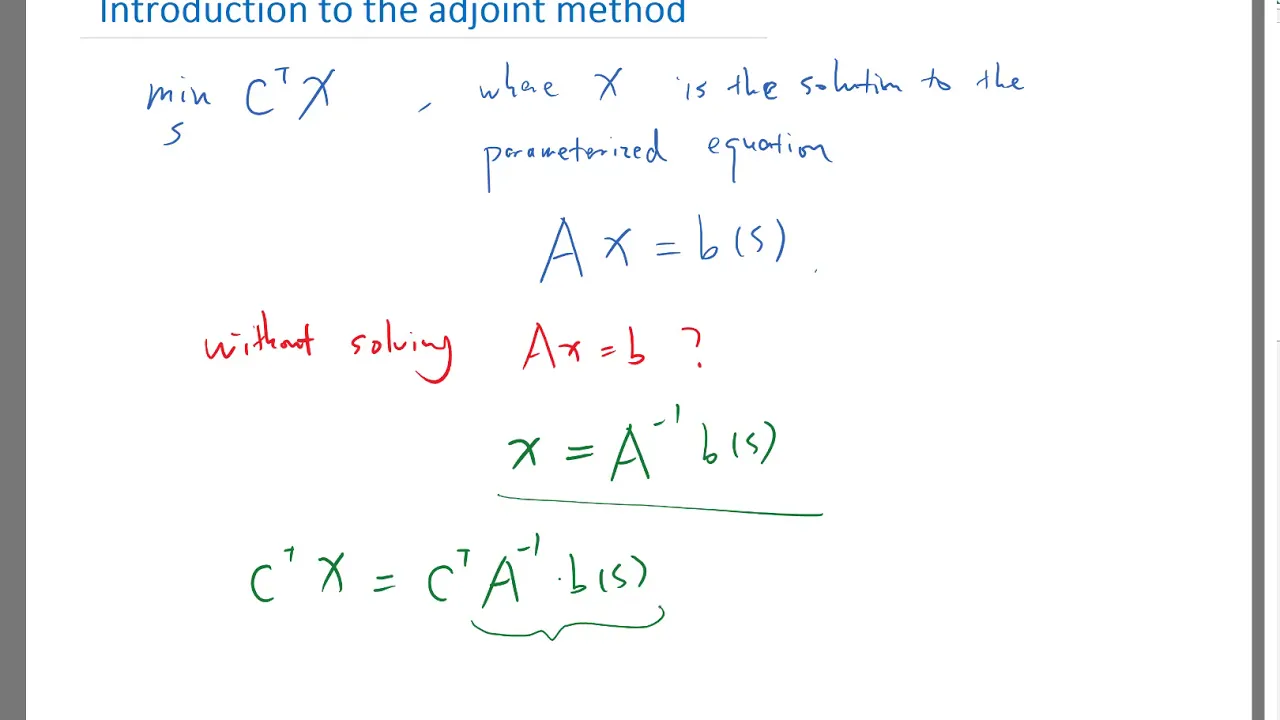
so here let's let me introduce this idea which is we call the adjoint method by giving you a very simple but actually very hot person to solve so what if I what do you what if I have a optimization problem like this I want to minimize okay I want to minimize C transpose times X where X is the solution to the parameterize the link equation equation a ax equal to B which is a function of s and here I want to minimize over the parameter space of s so imagine my ax equal to B of s is a structural equation you are solving and s is parameters that parameterize is the the the system set up the design okay and I imagine I want to minimize a certain deformation which is a which is described by the known vector C so here the problem C is known the matrix a is known the function B is known the thing that is unknown is s and you want to figure out what kind of s is going to give me the minimum C transpose X now here's the challenge can you solve the problem without ever without ever solving the system ax equal to B all right I mean a natural way to think of solving this problem is for example I'm just gonna try a milling different esses and further all of these are mailing different asses I'm gonna compute respect respective X and for each X I can compute in C transpose X the objective function I'm just gonna pick from this meeting solutions the one that works the best right that's a brute force way of calculating of solving the optimization problem but the challenge here is what can I do if I'm not allowed to compute the solution ax for any of these asses is there still a way to do it since there are just the three of you you guys are free to discuss the line of thought is correct so so maybe let me do it a little bit more rigorously over here the line of thought is exactly correct so instead of not allowed to solve this but I can I can actually write X right whatever ax I have is actually a inverse times P of s right and if I'm able to substitute this into the objective function then C transpose X is actually equal to C transpose a inverse times P of s so this is my X which depends on what s is but I'm not obligated to compute this one first I can use the Association rule to compute this first right so this is a where the somebody comes from if I compute a transpose B first I have to do these every time I change s but if I compute C transpose x inverse first I can just do that once all right which means if I can if I call this if I call this X hat let's say which means that well let me call this X hat transpose then this is basically saying I pre compute X X hat transpose equal to C transpose times a inverse or if I write this in a little bit more if I transpose both sides and move the a inverse to the left hand side this is actually a minus transpose oh sorry not a - transpose a transpose times a so it is X hat a transpose times X hat equal to C so this is equivalent to that right if I if I take if I can if I multiply both sides by the inverse of a transpose and transpose both sides I get these so if I solve this equation first this is actually by the way called the add to an equation in this case then the objective function can be written as X hat transpose times B then from now on I don't really have to optimize the original function I can optimize this function is that right I just evaluate B again and again without ever having to solve any linear equations again so what's the idea we get from this example is that the order of the operations is very important it can be very important in determining the cost to the computation cost of your optimization algorithm the backpropagation method I'm going to describe next it's actually a very much extension of this idea instead of instead of looking an expression and start evaluating the expression in the usual way which is computed your pass then compute them the next logically next one we we can actually reverse the whole operation and start from the left side start from the side that is close to the objective function and the propagate in a backwards way right so that's the idea of the back propagation
The words are the caption track's own and nothing is reworded or re-transcribed. Paragraph breaks are placed between sentences so the text reads as prose.
Free tools for your own script: paste a draft and see where it stands before you record it.
Paste your draft and see where viewers are likely to drop off, with a rewrite for each weak line.
Paste the first 30 seconds of your own draft for a hook score and rewrites.
Check your draft against YouTube's advertiser-friendly guidelines before you record it.
Read this channel's public videos and transcripts, and download a writing brief for it.