Getting the transcript
Reading the captions from YouTube. A video nobody has opened here before takes 10 to 30 seconds; this page fills in on its own.
Getting the transcript
Reading the captions from YouTube. A video nobody has opened here before takes 10 to 30 seconds; this page fills in on its own.
Djamina Handojo · @djaminahandojo8867
Words
4,752
Runtime
35:07
Speaking pace
135wpm
Reading time
20min
135 words per minute, below the 160 25th percentile of 349 measured videos. That distribution comes from the 349-video hook study.
Opening (first 30 seconds)
Hi everybody, how are you? This is Dr. Ina and today is Saturday, May 16, 2026. I pray God bless you. Bless you in your study and in your family and in your life. Let's do a review for cardio part one. What is the size of our heart? Your fish. Where is the location? Mediastinum. How many chambers do we have? Four chambers we have atrium left
68 words, the words spoken in the first 30 seconds at 135 words per minute.
Free, no signup. See how the first 30 seconds hold attention, with rewrites.
Sentence shape
| Measure | This transcript |
|---|---|
| Sentences | 139 |
| Average words per sentence | 34.2 |
| Longest sentence | 767 words |
| Questions asked | 15 |
| Sentences containing a number | 53 |
Most used terms
Filler phrases
21 in total: like 9 · right? 9 · you know 2 · um 1.
A literal whole-word count of the same phrase list the Prepublish browser extension uses, so a phrase inside another word is not counted and a phrase used in its ordinary sense still is. It is a count and not a judgement.
Run the check on the words above: where attention is likely to drop, with a rewrite for each weak line. The free check shows the scores and the one issue costing the most.
What this transcript is
Every word below is the caption track YouTube publishes for this video, pulled from the video itself and reproduced unchanged. It is not Prepublish's writing, not a summary, and not a re-transcription: it is the video's own published captions. Indonesian captions, generated automatically by YouTube, in the video’s original language. Source: the video on YouTube. A channel that would rather this page did not exist can ask for its removal through the contact page, and it is removed.
No Script X-ray for this video: YouTube shows a Most replayed graph only once a video has enough views.
Hi everybody, how are you? This is Dr. Ina and today is Saturday, May 16, 2026. I pray God bless you. Bless you in your study and in your family and in your life. Let's do a review for cardio part one. What is the size of our heart? Your fish. Where is the location? Mediastinum. How many chambers do we have? Four chambers we have atrium left and right ventricle left and right. How many valve do we have? We have four tricpit at the right, bicaspit or mitral at the left between atrium and ventricle.
So we call that atrioventricular valves tricaspit and bicaspit right atrioventricular valve because they are in between atrium and ventricle tricaspit at the right side bicaspit mitral at the left side and then you have ourortic and pulmonic valves. They look like half moon. So we call that semi lunar. Semi is half. Lunar is the moon. So half moon valves aortic and pulmonic. Aortic at the left pulmonic at the right. Left side is clean blood O2 and right side is dirty blood CO2.
Alri. So you have triaspit and by caspit. When your tricpit and buypit open and close they will make your S1 lap. So S1 and lap is the same. That's your tricpit and cpit open and close. Your S2 DP that's when your pulmonic and aortic open and close especially when they close they make the sound. So your normal hard sound only S1 and S2 lap and dap. S1 is the same with lap tricpit and bicpit open and close. S2 the same with D.
That's when your pulmonic and aortic open and close. If you hear another sound after S2 that will be S3. If another sound abnormal come that's S4. So after S2 you have S3. If another abnormal sound we call that S4. Usually congestive heart failure have S3. many time why they can have s3 or s because there is a insufficiency with the valve so if the valve not good the blood that already go to the ventricle they can go back up regurgitation go back up to the atrium so it will make murmur sound right so the blood regurgitation so the blood will make turbulens sound turbulence right turbulence of the blood so it will create murmur sound many time this murmur S3 S4 because insufficiency of the valve.
So if the baby born abnormal with hole maybe at the in between the two atrium we call that arterial septal defect or maybe they have a hole between the two ventricle we call that ventricular septal defect or whatever abnormality that happen so if there is movement of the blood they will make new sound murmur oke possible the baby born with stenosis so the valve is too small or the valve not working right so stenosis means narrowing or structure of the valve so you will hear it sounds like tensy tendency s1 s2 and s3 right if they have s4 they can sound like mississippi mississippi lap dab lap dab z so the s1 s2 and then the the next one is s3 s4 it can Sounds like horse galloping.
So doctor have to find out what is the problem. Alri but your normal sound s1 and S2. So your S1 is lap trypit by caspit open and close. And your S2 is D. That's your pulmonic and aortic open and close. So your heart sound S1 S2 lap dap lap dap lap dap. It should be regular and normal heart rate 60 to 100. Oke, normal heart rate 60 to 100. Alright. So, your S1 is open and close atrioventricular valves. That's your tricaspit and bicaspit.
And your S2 is your open and close semiunar. That's your aortic and pulmonic valve. and S34 that's usually because of the abnormality there is insufficiency of the valve so the blood regurgitation the blood go back up it will make it will make murm sound because of the turbulence of the blood congestive heart failure usually you can hear s3 alright electrical conduction system your pacemaker is your sn note sinoatrial node sinoatrial You only we only have one snode at the right side atrium that's the source of the contraction soatrial will send the electric go to the node atrioventricular node right because it in in between atrium and ventricle that's why we call that node and then from evne it will send the electrical to bundle of his and then purkinji fibers fibers is very small so that's the last one right so start with snote go to note of his and then go to perkinji fibers make sure you know the order right note is the pacemaker send to every note go to bundle of his and then purkinji fibers our akg we have pqrst this is from part number two akg we look at the number two easy to understand p wave is the atrium contraction the other word for contraction is depolarization or systol so p wave because atrium contraction systol depolarization qrs is a strong one because this is your ventricle contraction depolarization cstal and then your t wave when the ventricle relaxation relax and you see the st segment should be horizontal line isoelectric so this is the normal pqrst eh kg P atrium contraction QRS ventricle contraction the T ventricle relaxation so the one that you don't see in this picture is the atrium relax you don't see that because the QRS already come path of the blood you can start from the right you can start from the left no problem because it's a circle anyway right if we inhale O2 from the air from the room air 21% O2 it will go to the pulmonary vein.
The vein will bring the blood heart right whatever blood vessel that bring the blood go to the heart is the vein so pulmonary vein will bring O2 reach with O2 go to the left atrium from left atrium it will enter left ventricle it will pass by caspit or mitral valve in between atrium and ventricle left from the left ventricle it will go to aorta it will pass aortic valve Right. So aorta will bring the blood go to the brain and go to the whole body.
It will bring all the O2. So the cell will use all the O2. The waste product is CO2 dirty blood. So now the dirty blood will go to the venacava superior and inferior. Venakava superior bring the blood from the head from the upper side and then from the below side it will go through the venakava inferior. Right? from the leg from the arm it will go to ven inferior and bring the dirty blood CO2 and back to the right side atrium.
So now the right side is dirty blood CO2 it go to the right atrium it will go to the right ventricle it will pass the tricpit because your tricpit in between your atrium and ventricle right side. So now the blood enter the right ventricle and then it will go to the pulmonic trun right pulmonic trun and then the pulmonary trang here you have a pulmonic valve right from pulmonic valve bring the blood go to pulmonary trun and the trun will bran left and right artery pulmonary so whatever blood vessel that leave our heart is artery usually artery should be clean blood except artery pulmonary because this pulmonary artery at the right side or dirty blood right and usually the vein dirty blood like your venakava superior ven inferior usually dirty blood co except pulmonary vein right so pulmonary vein is the clean blood other vein is dirty blood right and then pulmonary trun pulmonary artery left and right already dirty blood but other artery they are clean blood they are o2 so the the exception Alri so whatever blood vessel that leave our heart is artery and whatever blood vessel that come back that go back to our heart is the vein so usually the one that go back to the heart the vein will bring dirty blood except pulmonary vein and usually artery leave the heart clean blood except pulmonary artery So make sure you understand right where is your left atrium.
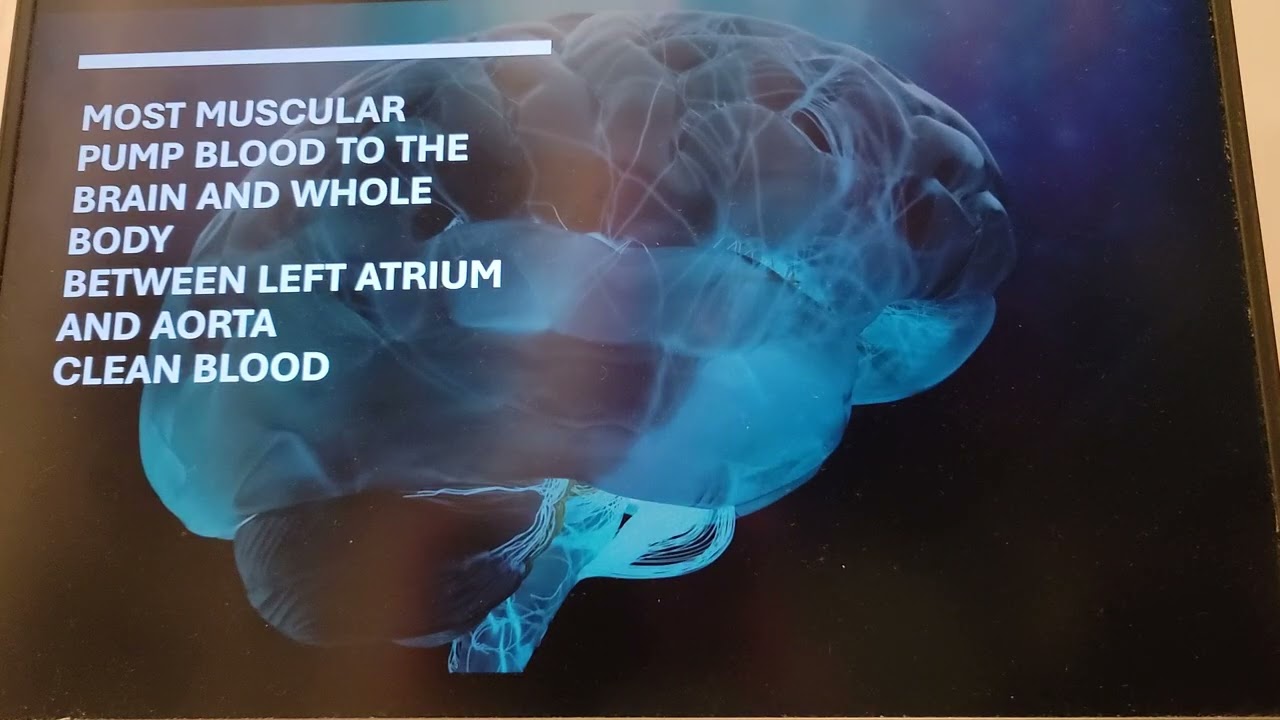
So your left atrium at the left side this is clean blood receive the blood from pulmonary vein that just inhale to 21% from the room and then it will send the blood from this left atrium it will send the blood go to the left ventricle. Where is your left ventricle? left ventricle at the left side of course and receive the blood from the left atrium. This is the area that most muscular the muscle at the left ventricle very thick right compared with other chamber because the left ventricle have to pump the blood go to the brain and the whole body.
So this is the most important part of the heart. You don't want any blood cloth especially at the left ventricle right? So left ventricle is the most muscular. It pump the blood go to the brain and whole body between left atrium and aorta and this is clean blood O2. Your right atrium of course at the right side and this is dirty blood CO2 receive the blood from venacava superior venakava inferior and it will send the blood go to the right ventricle your right ventricle of course at the right side now dirty blood receive blood from the right atrium it will send the blood to the pulmonary trun right before it enter pulmonary trun you have pulmonic valve Then it will go to pulmonary trun and will branch left and right pulmonary artery.
Alri so know where all your chamber where they got the blood and where they send the blood. Tric speed at the right side right between atrium and ventricle right side. Your bic mitral this is your between left atrium and left ventricle. Oke left atrium and left ventricle is your bicaspit or mitral this is also the place for apical pulse. So the is the fifth intercostal left mid clavicular line right your mitral if you want to listen to the mitral it's the same place with your apical pulse.
It's the fifth intercostal left mid clavicular line. Make sure everybody know where is your apical pulse right the fifth intercostal left mid clavicular line that's also where you listen to the mitral is the same with picaspit valve your pulmonic valve at the right side between the right ventricle and pulmonary trun right that's where you have your pulmonic valve at the right side between the right ventricle and pulmonary trang and then yourortic valve at the left side between the left ventricle and the aorta so make sure you know where are your valve there is there are four valve and know the place of the valves murmur does the sound because of the blood regurgitation it make turbulent sound and usually this happen because of insufficiency with the valve right valve insufficiency so if one valve insufficiency you can hear s3 but if the two valve insufficiency you can hear s3 and s4 what is coronary blood flow per word this is the flow through the coronary circulation right so this is the blood vessel in your coronary circulation at the wall of your heart so coronary blood flow right coronary blood flow talking about the blood at your coronary artery and vein it flow through your coronary circulation.
Coronary means the heart. So the blood enter coronary blood flow through the artery. Right? So when the when enter they bring O2 so of course it will go through the artery. So right and left coronary artery. It bring the clean blood O2 for your wall of the heart. And then when it already dirty already CO2 it will return to the systemic circulation right it will go through the vein so coronary vein already dirty blood CO2 and coronary artery is bring the O2 blood right coronary artery is clean blood it just enter and then the one when when it already dirty it will get out through the coronary vein diagnostic test Cardia cateterization.
Be careful. Monitor bleeding. This is the catheter that will go through the femoral artery. Doctor will look at the TV and they will push the catheter. Go to the left side, right? And then you can see the left atrium. You can see the left ventricle right you can see how much blood there they can put the dice to see the coronary artery if there is any obstruction is there any blood clot they can see with the x-ray because you put the dice right and geography eh every time you see the word graphy they use dice make sure they not allergic to shelfish right and after they give dice they need x-ray so they can see where is the occlusion and after cardiaceterization make sure monitor for bleeding they also can put the catheter via the vein the right side and then you they can see also the heart that right side area right through the vein so right side and they also can see the atrium at the right the ventricle at the right they can also measure the pulmonary area whether the patient overload or not enough blood they can tell right so with cardiac cateterization but after cardiac cateterization usually they have to lay down 2 to six hour if they have the equipment that have the valve they can lay down two hour no flection at all the leg have to be flat no do not get up right because monitor for bleeding and then your vital sign you don't want taky cardia because takyardia is the early sign of bleeding you also will check their pedal every 15 minute right because if they don't receive the blood you will not feel the pulse at the distal area and when you touch the leg it will be cold and clamy if there is no blood go to the distal area.
No monitor bleeding at your bed side you do have to have sterile glove if something happen if bleeding you have to use steril glove and press the artery femoral right if bleeding then you press right and and call doctor until doctor come do not release that that finger if bleeding happen usually at the bed side they also have sandbag also for pressing the artery if bleeding so cardiac cateterization the Most important flat flat no flection because you don't want any bleeding and then doctor can dog eh the mini akg that portable that they can take at take home is the holter monitor right because sometimes they have problem at home but every time they come to doctor nothing happen so doctor can give them holter monitor just like portable akg the patient to live as normal as possible and journal at the time every hour right down what what happening and if there is something wrong they report to doctor doctor can see the recording from the office so that's holter monitor but teach the patient cannot get wet because there is battery alri eh and then akg cardiac monitoring especially if your patient receive IV potassium at the bed side need cardiac monitoring to double check right because potassium is the most important electrolyte in our body if potassium high or low it will affect the heart so if the rn give iv potassium iodide or potassium chloride it has to be dilute right cannot concentrate because dangerous eh the at the bad side guarantee the patient will have to have cardiac monitoring just to make sure potassium not too high not too low not affect the heart doctor can do talium scan this is only scanning echocardiography echo is the sound wave pad scan just like city scan so if they use dice of course sign consent make sure they not allergic to shelfies and then muga scan only scan right it's not invasive only scanning so muga scan muga stand for multiple gated acquisition so this is only scan take picture of the heart um they with the muga scan we can see the size of the heart if the size not normal if it's big we call that cardiomegali right so from mugas scan we can see the size and we also can see how strong is the contraction right especially the strength of the left ventricle we want to see is that strong pumping or not we can see this with the muga scan diagnostic test we can do x-ray radiography is the x-ray and then angiogram that means angio is the blood vessel So if you see gram that means they use dice make sure they not allergic to shelfish right and after the the procedure tell them to drink a lot of fluid to flush the dice out or that means I use dice I want to see the aorta doctor suspect that there is maybe blood clot at the aorta right maybe the the patient born with abnormality in the aorta so if doctor suspect something wrong we can do the aortogram to see the aorta Oke, so this is cardia catorization it is invasive of course they have to sign consent and with this cateter go inside right we can look at the chambers look at the valve look at the great vessels the aorta right coronary artery because we put the dice so we can measure the pressure we can tell if the patient not enough blood or overload and we can see the valve is there any abnormality with the valve is there any occlusion right because we put the dice and maybe the patient have congenital an normally they born with abnormality so we can put eh cardiac cateterization via femoral artery or also from the vein right if vein at the right side if femoral artery we want to see the left side again monitor bleeding takikardia is the early sign of bleeding do not wait until hypot potension hypotension already late sign right side you have to have sterile glove sand back so flat no flection at all no ambulation 2 to 6 hour so if they have equipment with the valve then 2 hour but if not 6 hour and then check their pedal pulse every 15 minutes at the distal area right check the pulse check the capillary refill and it the skin have to be warm to touch if something wrong report to doctor The lab value doctor will check CBC the complete blood count.
I want to know the RBC white blood cell and thrombo please memorize your lap value right? RBC 5 million white blood cell 5000 to 10,000 thrombo 15,000 to 450,000 please memorize right. If your RBC low anemia if RBC high, polycytamia. If white blood cell low risk for infection. If white blood cell high, they already infection. If thrombo low thromboytopinia risk for bleeding. If the thrombo high, they risk for blood clot.
So doctor want to see the CBC, doctor want to see the red blood cell, white blood cell and the thrombocye. If the patient receive warferine warferine kumedin, right, that's your antiuagulan PO per oral tablet, then we need to check PT and INR. PT normal is 10 to 12 second INR 2 to3 for kumedin right PT 10 to 12 second INR 2 to3 if the PT increase report to doctor because that means the blood already thin and the antidote for this kumedin is vitamin K pitonadion aquameviton right pitonadion aquameviton so PT normal is 10 to 12 inr 22 to3 disease for warferin kumedin po antidot vitamin k pitonadion aquameviton doctor will check the eritrocite sedimentation rate and also crp c reactive protein because if somebody have inflammation ther and the crp will increase right example maybe they have endocarditis pericarditis so itis itis itis inflammation and CRP will increase.
Door will check the serum electrolyte sodium 135 145 right chloride 95 105 calcium 8.6 to 10 mg per dl 4.5 to5 m equivalent per dl for calcium there is two different unit right if milligram per dl 8.6 6 to 10 if m equivalent per dl 4.525 and then you put your magnesium phosfat and potassium in one row easy to remember magnesium 1.5 to 2.5 phosphat 2.5 to 4.5 your potassium 3.525 albumin is the same with your potassium 3.525 and then your protein 6.2 to protein is very important for wound healing right so for wound healing we need protein we need zinc vitamin c so your normal protein memorize 6.2 to8 oke 6.2 to those are important eh serum electrolyte that you have to memorize and then serum lipid normal cholesterol under 200 normal triglycerid under 150 HDL is the good cholesterol I want eh 40 to 60 the higher the better right that's your HDL good cholesterol and LDL is the bad cholesterol low density lipoprotein LDL that's The bad cholesterol I want it under 100.
So normal value should be less than 100. So serum lipid cholesterol under 200, triglycerid under 150, HDL 40 to60 the higher the better and then LDL under 100 of medication for lipid right statin statin statin I want to increase the HDL but I want to decrease the cholesterol triglycerid and the LDL because LDL is the bad cholesterol. Alright, doctor will check the ABG. Don't forget pH low acidosis, pH high alkalosis, right?
So, pH low, acidosis, memorize pH high alkalosis. And then remember ROM respiratory always opposite. If the pH low the CO2 high, if the pH high the CO2 low. So if you see pH and CO2 the opposite guarantee that's respiratory right metabolic always equal so if the pH high the HCO3 also high if the pH low the HCO3 also low if you see those equal that means metabolic so know your ABG right pH low acidosis pH high alkalosis and know your ROM respiratory always opposite metabolic always equal and then doctor will check the serum cardiac marker troponin ckmb and myoglobin right troponin ckmb and myoglobin the best is troponin because troponin will go up fast and then will stay long right other marker usually they late to go up and then too fast to go down so the best cardiac marker is troponin You do have troponin I and troponin T, right?
And then BNP is the hormone from the heart. You do have A NP natriopeptide but the one that important is B natriopeptide. Normal BNP is under 100. If BNP high failure please memorize right BNP normal is under 100. If somebody BNP let's say 500 that's hard failure. So every time when you see BNP very high failure doctor can order the nurse to write the order to the to check the lab right BNP because doctor want to know the heart failure is that worse or better for the patient.
Homo systin if increase that means the patient risk for coronary artery disease right if the homo syst that means the patient high risk for cardiac problem so see reactive protein together with your eritrocy sedimentation rate. If increase that means they have inflammation like endocarditis, pericarditis right it will in it will increase ESR and CRP. So doctor will check this lab doctor will check the diagnostic test collect data to find the diagnostic.
Oke, so CBC complete blood count memorize RBC average 5 million white blood cell 5000 10000 trombosite plat right is the same 15,000 45,000 if you see lab value a little bit different book right it's okay because there is many different lab right but when you go to your inlex they will give you the range ng question they will give you the range Lab for warferine PT and INR 10 to 12 second INR 2 to3 eh don't eat too much green leavy vegetables they can eat but it has to be consistent so the INR can be stable oke antidote is vitamin K right pitonadion aquamephiton so lab that increase when inflammationr and CRP cardiac enzyme troponin CKMB myoglobin and the best is troponin BNP B natriopeptide under 100 if increase heart failure high homosystein high risk for CAD alright risk factor there is modifiable and nonmodifiable right something that you can modify like example you can stop smoking you can reduce the cholesterol main pressure, take medication, reduce the weight, right?
Maintain blood sugar so everything that we can change we can modify that's your modifiable risk factor reduce the stress psychosocial support system right so these are modifiable risk factor. The one that nonmodifiable is the family, gender age, etnicity, right? genetic so they cannot change so the one that risk factor that nonmodifiable family gender age and ethnicity alri eh where is your aortic valve in your inlex they can give you picture and then they ask you where you put your stethoscope to listen to to the aortic to listen to the pulmonic tricaspit and bicaspit right so this is the picture your aortic All pick mat.
That's my strategy to remember right. All pick mat. The aortic at the second intercostal right side from your sternum. The pulmonic second intercostal left side from your sternum. Tricaspit the fourth intercostal left side from your sternum. So look at the picture and know how to read the picture. Oke. And then your mitral or your bicpit at your apical pulse. And your apical pulse is the fifth intercostal left side mid clavicular line right all pick take mat right so aortic second intercostal right side from your sternum pulmonic the second intercostal left side from your sternum tricaspit fourth intercostal left side from your sternum and mitral or bicaspit at your apical post that's the fifth intercostal left mid clavicular line alri so our blood vessel we have artery smaller than artery we call that arteriol and then you have vein smaller than the vein we call that venules and the smallest blood vessel is capillaries right so the one that very very thin is capillaries where your o2 and co exchange happen in capillaries because it's very very thin how much blood we have 5 quart one quart is about 1 liter right so 5 qu 5 liter of the blood we have splin splin is the the bank for the reserved blood right so we reserve our blood 500 ml in the splin so if somebody lost the blood less than 500 they don't need blood transfusion because we have this blood reservation about 500 ml inside the splin alri Right.
So the heart fish test the size at the mediastinum and remember 1 cup to 40 ml one pine is 2 cup so 480 ml and 1 qu is two pine 960 ml almost 1 l right so our blood 5 qu that's about 5 liter blood left side heart failure lang lang lang lang lang lang lang lang lang lang lang right so if the left heart fail the blood will go up to the lung so they have sobrackles pulmonary edema sputum whatever that lung l lang l lang lung they complain about lung that's usually because of the left side heart failure right and then right side heart heart failure if the right side fail then the blood will go to the right side back flow right so they will have juggler vein distension right juggler vein distension they can have edema hepatos splinomegali the liver and the splin become big and acitis acitis means they have fluid in the peritoneal cavity right juggler v distension edema hepatos splinomegali the liver and the splin become enlarge and then a cytus means they have fluid inside the peritoneal cavity so these are the eh sign and symptom if they have right side heart failure.
So easy to remember the one that left side lang lang lang lang lang right left side heart failure lang lang lang SOB crackles pulmonary edema right lung problem that's the left side heart failure and then the right side heart failure is the one that juggler van distension edema hepatospinomegali and acitis alright so this is part one of the cardio. I will stop here.
The words are the caption track's own and nothing is reworded or re-transcribed. Paragraph breaks are placed between sentences so the text reads as prose.
Free tools for your own script: paste a draft and see where it stands before you record it.
Paste your draft and see where viewers are likely to drop off, with a rewrite for each weak line.
Paste the first 30 seconds of your own draft for a hook score and rewrites.
Check your draft against YouTube's advertiser-friendly guidelines before you record it.
Read this channel's public videos and transcripts, and download a writing brief for it.