Getting the transcript
Reading the captions from YouTube. A video nobody has opened here before takes 10 to 30 seconds; this page fills in on its own.
Getting the transcript
Reading the captions from YouTube. A video nobody has opened here before takes 10 to 30 seconds; this page fills in on its own.
Aleks Rosme · @aleks_rosme
Words
2,000
Runtime
13:23
Speaking pace
149wpm
Reading time
8min
149 words per minute, below the 160 25th percentile of 349 measured videos. That distribution comes from the 349-video hook study.
Opening (first 30 seconds)
Drawing lines and boxes on chart, believing there is liquidity and confirming trades by FVG close will never make you profitable. You see, we've been told by many influencers that liquidity is what runs the markets. Well, my question to you, where is data? What company on Wall Street uses these concepts? Answer is right, no one. No one uses these concepts. Those concepts are made for influencers to make profits on you, to sell
75 words, the words spoken in the first 30 seconds at 149 words per minute.
Free, no signup. See how the first 30 seconds hold attention, with rewrites.
Sentence shape
| Measure | This transcript |
|---|---|
| Sentences | 158 |
| Average words per sentence | 12.7 |
| Longest sentence | 37 words |
| Questions asked | 29 |
| Sentences containing a number | 6 |
Most used terms
Filler phrases
45 in total: um 15 · uh 14 · like 8 · you know 4 · right? 2 · actually 1 · basically 1.
A literal whole-word count of the same phrase list the Prepublish browser extension uses, so a phrase inside another word is not counted and a phrase used in its ordinary sense still is. It is a count and not a judgement.
Run the check on the words above: where attention is likely to drop, with a rewrite for each weak line. The free check shows the scores and the one issue costing the most.
What this transcript is
Every word below is the caption track YouTube publishes for this video, pulled from the video itself and reproduced unchanged. It is not Prepublish's writing, not a summary, and not a re-transcription: it is the video's own published captions. English captions, generated automatically by YouTube, in the video’s original language. Source: the video on YouTube. A channel that would rather this page did not exist can ask for its removal through the contact page, and it is removed.
No Script X-ray for this video: YouTube shows a Most replayed graph only once a video has enough views.
Drawing lines and boxes on chart, believing there is liquidity and confirming trades by FVG close will never make you profitable. You see, we've been told by many influencers that liquidity is what runs the markets. Well, my question to you, where is data? What company on Wall Street uses these concepts? Answer is right, no one. No one uses these concepts. Those concepts are made for influencers to make profits on you, to sell courses.
It's not about psychology like guru always say, it's about your edge. And if you're tired of blowing accounts and losing, and if you want to take trades like these from this month, listen closely. I'm going to reveal the single market mechanic that made me profitable and made me consistent. You see, option flow is what causes price in futures like NQ or ES to move. Because futures markets are underlying of indices, market makers have to hedge their positions on options, okay?
Market makers that provide liquidity on SPI, QQQ, SPX, NDX, those biggest biggest options for uh indices, have to hedge their positions on ES and NQ. So, most traders, when they learn options, they learn it from their own perspective. You buy a call, delta goes up, you profit when NQ goes up, okay? That's very simple. But, that tells you almost nothing about what actually moves the market. The thing that moves NQ every single day is what the other side of your trade has to do.
So, when you buy a call, when you long, someone sold it to you. That someone almost always a market maker. We call them a dealer. And you see from ICT perspective, that's always liquidity. That's always someone on the other side from a trade. That's always someone who runs their stop losses, you know, but that's completely wrong, okay? The dealer has a problem. They just took a risk they don't want. So, they immediately start hedging.
That hedging, buying or selling NQ futures to stay neutral, that is the flow that you see on your tape, right? So, that happens every single day. This is the foundation of everything that we're going to cover today. So, who exactly is this dealer? When you go and buy a call option on NQ, you're clicking buy on your platform, whatever broker that is. But, who is on other side, okay? In most cases, it's a market maker.
These are firms like Jane Street and so on, whose entire business model is to create smart markets, you know, to provide liquidity in option markets. So, here's the key thing about them. They don't have a view on where NQ is going, okay? They don't profit from NQ going anywhere. They just have to create markets. They have to make sure that markets are there, because that's their job, okay? So, the moment they sell you a call, they turn around and immediately buy NQ futures to offset the risk.
And the moment anything changes, price moves, volatility moves, time passes, they have to re-hedge. They have to adjust their position, right? So, that constant re-hedging is mechanical. There is nothing emotional about it. There is no one hunting your stop loss. It just happens every day for billions dollars worth of it. One thing that I want you to remember from this video is dealers are always trying to be delta neutral.
So, every time price moves, they re-hedge. Every time volume moves, they re-hedge. Every time time passes, they have to re-hedge. So, next time you're watching NQ around 10:00 a.m. and it just starts drifting higher out of nowhere, or you see some PA like everyone say in April, March, February, every month possible, ask yourself, what's option flow is doing in that moment. Nine times out of a 10, when move looks random, it's not, okay?
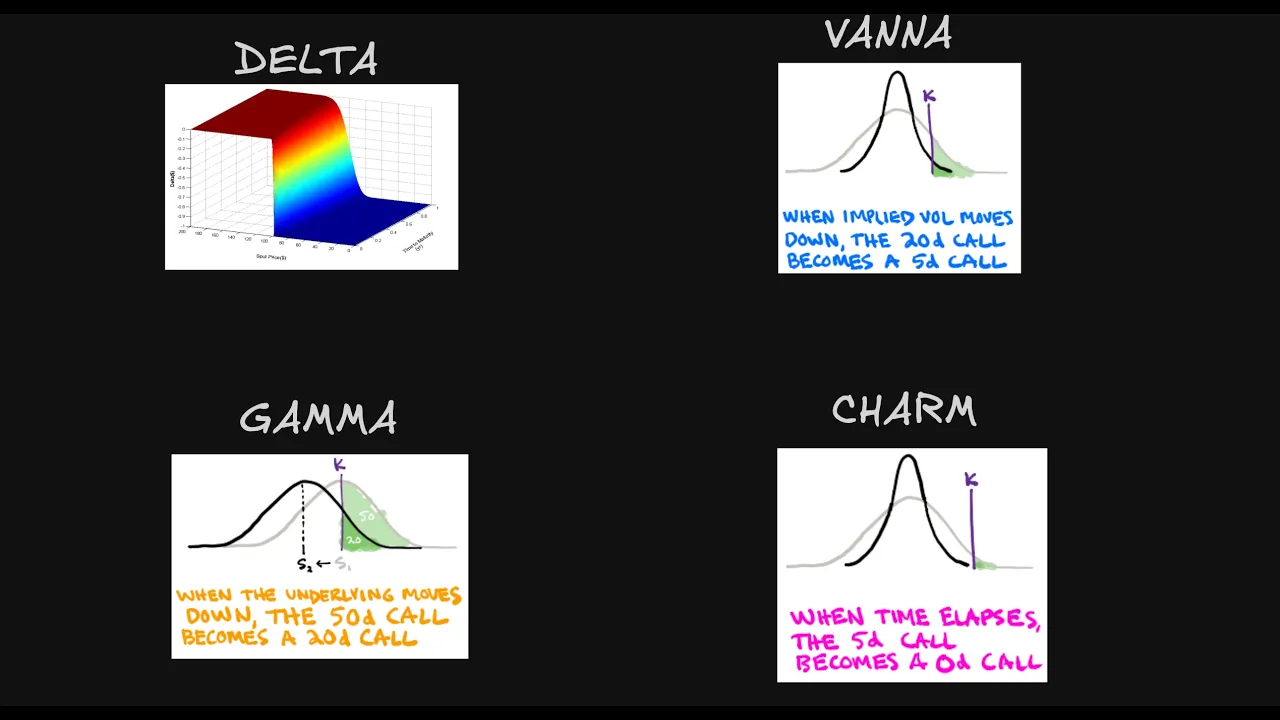
It's mechanical. And once you understand this mechanic, you're going to become profitable. Okay, let's get into the actual Greeks. Greeks are the mechanics that move the markets. So, starting with delta, delta tells you how much an option price moves for every $1 move on NQ. So, let's say if you buy a call, which is uh an equivalent of long in options market, the dealer who sold it to you now has negative delta. NQ going up hurts them.
To fix that, they buy NQ futures, okay? Now they're neutral again. They have to stay neutral. When you buy a put, which is an equivalent of short in options market, dealer has positive delta. NQ going down hurts them. To fix that, they sell NQ futures. So, if you look at the table right here, the dealer always does the opposite of what you did. So, you need to burn this down into your memory. This is the mechanical foundation of everything that we're going to talk about today.
Now, delta isn't a fixed number. It changes constantly as price moves. So, that rate of change is called gamma. And gamma is the most important Greek. It's the most important options mechanic for understanding what NQ, ES is going to do. So, here's the problem for dealers. If price moves, their delta changes, which means their hedge is constantly getting out of the balance, okay? They have to keep adjusting. Now, there are two regimes based on whether dealers are long gamma or short gamma.
Positive gamma, meaning dealers are long gamma. If you look at the green column, when NQ goes up, their delta increases, so they sell to re-hedge. When NQ goes down, their delta decreases, so they buy. They're constantly fighting the move, price gets pinned. So, price is going to stay inside that range, okay? So, from the other side, negative gamma, meaning dealers are short gamma. So, if you look at the red column, when NQ goes up, they need to buy more, okay?
When NQ goes down, they need to sell more. They're amplifying every every move, so price is going to accelerate. You see how um we're going to adopt different market conditions just by utilizing this simple um simple concept of positive and negative gamma, okay? But, to simplify it all, positive gamma means mean reverting environment, and negative gamma means aggressive continuation environment. But, let's break down positive gamma in detail, because this is the environment NQ is most of the time.
So, we know it's from AMT, 70% of the time we're going to stay in a range. You can see that here, okay? This is simple AMT theory. So, if you see NQ starts moving up, the call dealers sold are getting closer to in the money, okay? Their delta is going to increase. Now, their existing NQ hedge is too small, and they need to sell NQ to get back to neutral. So, NQ then moves down, delta decreases, hedge is now too large, and they need to buy NQ.
So, this is [clears throat] the whole mechanic of it, how how that works, okay? You can see why this creates this rubber band effect, this mean reverting environment. Every move in either direction gets faded by dealer mechanics, and on your chart it's going to be tight ranges, failed breakouts, absorption at the highs, and um you know, wicks slowly drifting lower. So, the best trading approach in this environment is fade extensions, take profits quickly, don't chase breakouts.
If you want to trade continuation, um please wait until enough confirmation. Now, negative gamma, this is the regime that traps most of the traders. So, it has the same mechanic, but the opposite result. If NQ moves up, dealers are short those calls. So, their negative delta exposure gets worse as price rises, okay? So, they need to buy NQ to re-hedge. That buying adds to the upward move. NQ moves down, they need to sell more.
That selling adds to the downward move. So, instead of fighting the move, they're sponsoring it. They're part of that move. So, this is why NQ can drop those ridiculous 400 4 500 points in a matter of few hours. That's why dealers are being to sell mechanically, okay? Every down tick triggers more selling, and on your chart, it's going to be a strong trend. Um normally, you're going to think, how the hell do I get in this position now, because I want to be a part of it.
So, your approach for negative gamma, do not fade these moves. If you do, you're fighting a mechanical force, and um you just need to make sure you have enough confirmation from other um from other catalysts, from other mechanics like order flow, like AMT, and so on. Now, let's talk about what happens when volatility moves. That's vanna. So, you don't need to understand the full math behind it. Let me explain it in a simple way.
When VIX is going to drop, dealers are forced to buy NQ. When VIX rises, dealers are forced to sell NQ. So, you see it constantly the same scenario. VIX is going to spike, NQ drops hard, everyone is going to panic, but then a few days later, nothing changes, no big news, but NQ just starts slowly drifting higher. There is no buyer on the tape, there is no reason for that, no catalyst, and that's normally where people get liquidated a lot.
It just grinds up, but the reason for that is Vanna. So, VIX is quietly fading back down and dealers are mechanically buying NQ in the background, okay? That is one thing you can't see neither on order flow nor on the chart. So, how I use it practically, every morning I check VIX first before I even look at NQ. If VIX is declining, I'm biased long. If VIX is rising, I'm much more cautious on longs, okay? Uh that same mechanic is now working against me, okay?
So, this is one rule for you to remember. Every time um every morning check this out before you look at anything else. Last Greek is Charm. This one is very simple, and I'll keep it short because uh for your morning trading, it barely affects you. So, as the day goes on, options from current price start losing their delta just because of time passing. So, dealers slowly remove their NQ hedges as a result, and that creates a slow directional drift uh in the afternoon.
Um that's Charm. So, uh but if you're like me and you trade the first 90 minutes, uh Charm is basically zero in your window. Um the morning uh you know, uh I trade in the morning, and this is the cleanest um time window uh for these mechanics to play out. Um what you're going to read on your tape is pure gamma or Vanna. But uh the one practical thing Charm gives you, every afternoon NQ gets pulled toward the nearest uh key gamma exposure level um as Charm runs, okay?
So, by the close, NQ tends to be sitting near or at a significant level, either uh the HVL or the um zero DTE put support, call resistance, whatever you name it, okay? So, in your morning prep, look at where NQ closed yesterday, and match it with your um with your option provider levels. Let's wrap up this first episode. We have four Greeks, four forces, and each one creates a different type of NQ behavior. So, delta tells you which direction dealers are hedging right now.
Gamma tells you whether move get pinned or accelerated. Vanna tells you what happens when VIX moves, and Charm tells you about time-based drift. Every morning before you trade, one question. Which of these forces is dominant today, okay? This framework uh is not about entries, okay? It's not about psychology. It gives you context, and context and defining the right market conditions is what separates consistently profitable traders from everyone else.
The words are the caption track's own and nothing is reworded or re-transcribed. Paragraph breaks are placed between sentences so the text reads as prose.
Free tools for your own script: paste a draft and see where it stands before you record it.
Paste your draft and see where viewers are likely to drop off, with a rewrite for each weak line.
Paste the first 30 seconds of your own draft for a hook score and rewrites.
Check your draft against YouTube's advertiser-friendly guidelines before you record it.
Read this channel's public videos and transcripts, and download a writing brief for it.