Getting the transcript
Reading the captions from YouTube. A video nobody has opened here before takes 10 to 30 seconds; this page fills in on its own.
Getting the transcript
Reading the captions from YouTube. A video nobody has opened here before takes 10 to 30 seconds; this page fills in on its own.
Megalithic Vault · @MegalithicVault
Words
4,650
Runtime
26:37
Speaking pace
175wpm
Reading time
19min
175 words per minute, between the 160 25th percentile and the 181 median of 349 measured videos. That distribution comes from the 349-video hook study.
Opening (first 30 seconds)
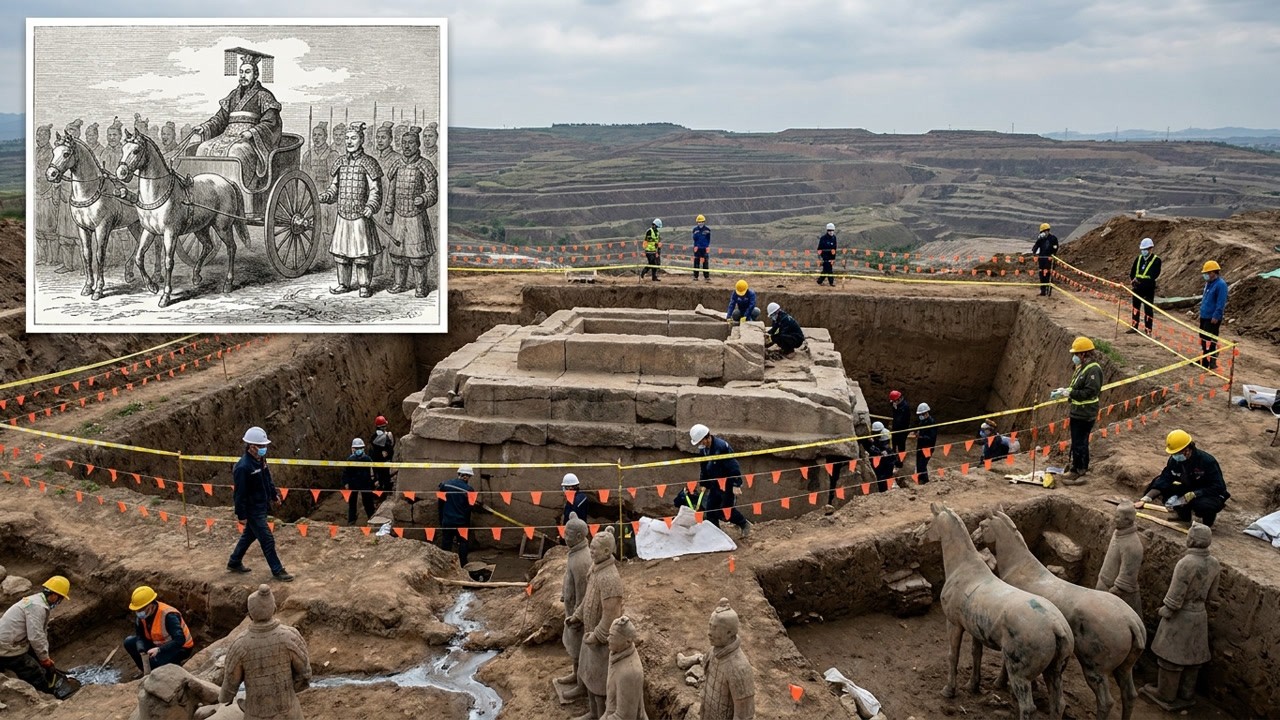
Beneath a green hill in central China, under a mound of packed earth taller than a 10-story building, there is a room that no living person has entered in more than 2,000 years. We know it is there. We have measured it. We have mapped its walls with radar and traced its outline from the sky. We have taken soil from the ground above it and watched our instruments spike into the red poison saturating the earth, exactly where the old record said a poison would be. And
88 words, the words spoken in the first 30 seconds at 175 words per minute.
Free, no signup. See how the first 30 seconds hold attention, with rewrites.
Sentence shape
| Measure | This transcript |
|---|---|
| Sentences | 292 |
| Average words per sentence | 15.9 |
| Longest sentence | 55 words |
| Questions asked | 11 |
| Sentences containing a number | 17 |
Most used terms
Filler phrases
11 in total: like 8 · kind of 3.
A literal whole-word count of the same phrase list the Prepublish browser extension uses, so a phrase inside another word is not counted and a phrase used in its ordinary sense still is. It is a count and not a judgement.
Run the check on the words above: where attention is likely to drop, with a rewrite for each weak line. The free check shows the scores and the one issue costing the most.
What this transcript is
Every word below is the caption track YouTube publishes for this video, pulled from the video itself and reproduced unchanged. It is not Prepublish's writing, not a summary, and not a re-transcription: it is the video's own published captions. English captions, generated automatically by YouTube, in the video’s original language. Source: the video on YouTube. A channel that would rather this page did not exist can ask for its removal through the contact page, and it is removed.
No Script X-ray for this video: YouTube shows a Most replayed graph only once a video has enough views.
Beneath a green hill in central China, under a mound of packed earth taller than a 10-story building, there is a room that no living person has entered in more than 2,000 years. We know it is there. We have measured it. We have mapped its walls with radar and traced its outline from the sky. We have taken soil from the ground above it and watched our instruments spike into the red poison saturating the earth, exactly where the old record said a poison would be.
And still, no one has opened it. Not because they cannot, because they are afraid of what breathing air might do to it. Or, some whisper, afraid of what is waiting inside. For most of us, the story of this place is a comfortable one. It is a tourist attraction. It is a photograph on a postcard. Row upon row of clay soldiers, each with a different face, standing in silent formation in a museum hall in the city of Xi'an.
Millions of visitors have walked past them and marveled at the artistry, at the patience of the sculptors, at the sheer devotion of an ancient people who wanted to honor a dead king. An eternal army, we are told. A ceremonial guard buried to protect an emperor in the afterlife. A monument to loyalty and grief. That is the story we have all been given. That is the story on the placards and in the school books. And for decades, no one had any reason to question it.
But consider for a moment another possibility. Consider that the soldiers were never the point. Consider that the 8,000 warriors, the horses, the chariots, the whole vast field of buried clay, that all of it is only a fence. A perimeter. The outer wall of something. And that the thing they were built to stand watch over is not a corpse to be honored, but something that the men who built this place did not want to come out.
Because here is a fact that should unsettle you. In all this time, with all our tools, all our funding, all our curiosity, the actual tomb has never been touched. The soldiers are the part they let us see. The soldiers are the part that was safe. The center of this complex, the heart of it, the sealed chamber beneath the hill, remains exactly as it was left when the last worker climbed out and the entrance was closed forever.
And every time someone proposes finally going inside, the answer comes back the same. Wait. Not yet. Leave it alone. Ask yourself why. Ask what a civilization that will excavate almost anything might be reluctant to disturb. And ask what the man who ordered it built was so terrified of that he spent nearly his entire life and the lives of hundreds of thousands of others sealing it into the ground. This is the tomb of the man history calls China's first emperor.
And the more closely you look at what he built, the less it resembles a resting place and the more it resembles a prison. To understand the tomb, you first have to understand the man because the two cannot be separated. He was born into a world at war with itself. This was the age that later historians would name the Warring States period, centuries of blood when the land that would one day be China was carved into rival kingdoms, each one clawing at the other's throats.
Armies numbering in the hundreds of thousands marched across the plains. Cities burned. Entire populations were put to the sword. A child born into that era was born into slaughter. And the boy who would become the first emperor was born into it as the heir to one of those grasping, hungry states. He He his throne at the age of 13. A boy king surrounded by advisers and assassins and [music] ambition. And where other kings might have been content to defend what they had, this one was not.
Piece by piece, war by war, he set out to devour every rival state that stood against him. His generals ground the other kingdoms into dust. One after another they fell. Some crushed in battle, some starved into surrender, some simply erased. And in the year 221 before the common era, the last of them collapsed. >> [music] >> And for the first time a single man ruled it all. He gave himself a new title, one no ruler before him had ever dared to claim.
A word that fused the old names for gods and sovereigns into something greater than either. He was not merely a king now. He was, in his own telling, the founding emperor. The first of a line meant to rule for 10,000 generations. And those who lived under him saw two things when they looked at him. Some saw a god walking the earth, a figure who had ended centuries of endless war and made one country out of the wreckage.
Others saw a monster. And the terrible thing is that both were right. Because the peace he built, he built on terror. He was not content merely to conquer the states, he wanted to dissolve the very differences between them, to make his subjects into a single obedient mass. So he standardized everything. He decreed that all of China would use one system of writing, so that a scholar in the east and a scholar in the west would read the same characters.
He fixed the currency, so that one coin was good across the whole empire. He set the width of the axles on carts, so that every wheel ran in the same rutted tracks along his new roads. To the eye, these look like the sensible reforms of a great administrator. And they were. But they were also the acts of a man who could not tolerate the existence of anything he had not personally ordered into being. His laws were merciless.
Punishments were savage and exact. A small offense could cost a man his nose, his feet, his life. And to build his vision of a unified empire, he needed labor, endless, expendable labor. He conscripted it by the hundreds of thousands. He drove them into the mountains and the deserts and set them to work on projects of a scale the world had never seen. It was under his rule that the first great foundations of what would become the Great Wall were begun.
Long defensive lines of rammed earth flung across the northern frontier, raised by the backs of men who had no choice and no rights. And they died. They died in numbers that are almost impossible to hold in the mind. Men worked until they dropped, and their bodies, so the old stories say, were sometimes built into the very works they had been raising. To this emperor, a human life was a resource no different from stone or timber, to be spent in the pursuit of permanence.
He was building something meant to last forever. And forever he was learning has a price. But there was one form of permanence that troubled him more than any wall or road. It was not enough to command the bodies of the living. He wanted to command what they thought. And here the story turns from cruelty into something colder, the deliberate erasure of memory itself. Consider what a book was in his age. Not a printed thing, mass-produced and easily replaced, but a rare object.
Bundles of bamboo slips bound with cord, each one copied by hand over months of labor. A single text might exist in only a handful of copies in all the world. The knowledge of centuries lived in these fragile things. Histories of the states he had conquered, the teachings of philosophers who had argued about how a ruler should behave, records of a world that had existed before him. And that was the problem. A world before him meant a world without him.
It meant that men could look backward and imagine that things had once been different, that authority could be questioned, that his way was not the only way. To a mind like his, ideas were not harmless. They were a slow poison seeping into the foundations of everything he had built. So, in the year 213 before the common era, on the advice of his chief minister, he gave an order that still makes the skin crawl to read about.
He commanded that be burned. Not all of them. Texts on farming, on medicine, on divination were spared because those were useful. But, the histories of the rival states, the philosophy, the poetry, the records that carried the memory of the old world, those were to be gathered up and destroyed. Fires were lit across the empire, and the accumulated thought of generations went up in smoke, curling into the sky and vanishing.
And it did not stop at the paper. The scholars who kept this knowledge in their heads, who dared to study the past, who whispered that the old ways had been better, they were a threat that fire alone could not reach. The stories say that hundreds of them were rounded up. Some were executed outright. Others, according to the darkest accounts, were buried alive, thrown into pits and covered over with earth while they still breathed.
Their voices silenced beneath the soil of the very empire they had questioned. Whether every detail of this is literal history or the horror of later chroniclers, the meaning is the same. This was a man who understood that to rule forever, he had to be the only story left. He would be the beginning. Anyone who remembered a world without him had to disappear. And here is where the great irony of his life begins to tighten around him like a noose.
Because for all his power over the living and the dead, over books and bodies and the shape of every coin, there was one enemy he could not conquer, one border he could not seize, one rebellion he could never put down, death. He was terrified of it. This is the detail that humanizes the monster and makes him more frightening at once. The man who had made himself a god could not bear the thought that gods in his own body at least still died.
And so he became obsessed not with ruling forever through his descendants, but with never dying at all. He wanted to live physically, personally, endlessly. He sent envoys out across the empire and beyond to the edges of the known world and past them searching for the secret of immortality. There were legends of islands in the Eastern Sea where beings lived who never aged, who possessed an elixir that could hold death at bay.
He dispatched expeditions of young men and women to find these islands and bring the elixir back. They sailed east into the mist and the stories say some never returned. His court filled with alchemists and mystics, men who promised they could brew the potion that would make him deathless. And here is the cruelest turn of all. The substance they believed held the key to eternal life, the shimmering silvery liquid they thought was the essence of permanence itself, was mercury.
To them it looked like living metal, flowing, [snorts] gleaming, incorruptible, never rusting, never decaying. If a man could take that incorruptibility into his own body, surely he too would never decay. So they made pills, mercury mixed and shaped and swallowed. The emperor took them >> [music] >> day after day, year after year, believing that with every dose he was pushing death further away. He was poisoning himself.
Slowly, invisibly, with every silver pill he swallowed in his hunt for eternal life, he was killing the very body he was so desperate to preserve. The metal accumulated in him. It clouded his mind, some believe made him more paranoid, more erratic, more convinced that assassins lurked everywhere, and that only more mercury could save him. He built palaces connected by covered walkways so that no one would ever know which one he slept in.
He hid himself from his own subjects, and all the while the poison worked in him. And the one enemy he feared above all others crept closer, wearing the very disguise he had welcomed. But he was not only preparing to cheat death, he was from almost the beginning preparing for its possibility. Because even as he hunted immortality, he was building the largest grave the world had ever seen. The construction began not when he became emperor, but decades earlier, when he was still only a boy king of 13, newly seated on the throne of his home state.
Think about that. A child of 13, and already the ground was being broken for his tomb. It is as if the shadow of death was on him from the very start, as if some part of him always knew he would need somewhere to go. And once he had unified the empire and its full resources fell into his hands, the project swelled into something monstrous. For nearly four decades, the work went on. Hundreds of thousands of laborers, some accounts say as many as 700,000, were driven to the site, an army of the doomed, carving a world into the earth.
They dug down through the water table. They hauled stone and bronze and mercury and jade. They built chambers and passages, and if the ancient descriptions are to be believed an entire kingdom underground a mirror of the empire above. And like every other project this man touched, it was built on the bodies of the men who made it. They died in the tunnels. They died hauling the loads. Whole armies of laborers the old records suggest perished in the making of a tomb designed to outlast them all.
And their deaths it would turn out were not merely the cost of the work. For some of them according to the darkest tellings the tomb itself would become the grave. And here is where the record leaves plain fact behind and steps into something colder. Because to understand what happened at the end of the construction one must understand what the tomb was meant to protect. It was not merely a burial. It was a treasure house, a vault holding the accumulated wealth of a united empire.
And more than that it held the secret of its own construction. Every worker who had descended into those tunnels carried knowledge in his head. He knew where the passages turned. He knew where the mercury pooled. He knew above all where the entrance lay and how it might be reached again by anyone bold enough or greedy enough to try. Consider that from the perspective of a dying paranoid ruler. A man who has spent his life certain that others want what he has.
A man who has already buried scholars alive for the crime of disagreeing with him. Would such a man allow hundreds of workers to walk back out into the daylight carrying the map of his eternal home in their memories? The court chroniclers say he did not. They tell us that when the great inner chamber was finished and the emperor's body was sealed inside, the middle gate was dropped and then the outer gate was lowered behind it and the artisans and laborers who had done the final work were trapped in the space between.
Sealed in the dark with the man they had served. Buried alive so that the secret would die with them. Imagine that moment, the last torches guttering, the grind of stone as the gate came down, and the slow dawning horror as the men realized the sound was not the beginning of their journey home, but the end of everything. The air thick with the smell of earth and metal, the knowledge that the light would not return, and above them, unhearing, the weight of a mountain of packed earth already rising to hide the crime.
If the accounts are true, they died not as an accident of the work, but as a deliberate act of concealment, a sacrifice offered to secrecy itself. But, consider another possibility, one the darker tellings return to again and again. What if the men left inside were not simply sealed away to keep quiet? What if they were meant to remain as part of the design? Because a tomb built to mirror an empire would need more than treasure and rivers of silver poison.
An emperor accustomed to being served in life might expect to be served in death. And so, the whole grim question hangs there. Were those final workers victims of the seal, or were they the last of the offerings added to the tomb the way the mercury and the jade were added, as one more component of a machine built to carry a dead man into eternity? And it gets worse because the ancient descriptions insist the tomb was never meant to be a passive grave at all.
It was engineered. It was armed. The chroniclers speak of crossbows and arrows rigged to fire on their own, mechanisms set to release the moment an intruder crossed into the wrong passage. Picture the logic of it. Bows drawn taut and left drawn, held by triggers connected to the floor, to the doors, to the dark. A man creeping forward with a stolen torch, reaching for gold, stepping on the wrong stone, and from the blackness ahead, without a sound of warning, the release.
Bolts loosed by a hand 2,000 years dead, still obeying the last command of an emperor who trusted no one, not even the living, not even the future. Whether those mechanisms could still function is another matter entirely. Wood rots, cords fray, springs of ancient bronze lose their tension across 20 centuries. And yet the very idea has kept a certain kind of fear alive around the mound for generations. The sense that this is not simply a place where a body lies, but a place that was made to fight back.
A place with a will of its own still standing guard. And then there is the mercury. This is where the tomb stops being merely a story of cruelty and becomes something stranger. The old records describe rivers of liquid mercury flowing through the underground chambers, seas of the shimmering metal set to move by some mechanical means, a whole landscape of the empire rendered in poison. The great rivers of the real China reproduced in silver quicksilver flowing across the floor beneath the painted sky.
For centuries this was dismissed as legend, the kind of impossible flourish a chronicler might add to make a dead tyrant seem more terrible than he was. Surely no one would flood a tomb with one of the deadliest substances known. But the mercury, it turns out, is real. And that single fact changes everything about how this story must be read. Because if the rivers of poison were not a poet's exaggeration, but an actual engineering choice, then someone made a deliberate decision to fill the heart of this monument with a substance that kills slowly, invisibly, through the very air above it.
A substance that would seep upward through the soil for thousands of years, a moat not of water, but of vapor. A guardian that never sleeps, never rusts, never rots, and asks no permission before it does its work. And that raises the question the entire mystery turns on. Why would a man who spent his life terrified of assassins, a man who sealed his workers in the dark and armed his own grave with hidden weapons, also surround himself for eternity with a lake of poison?
The comfortable answer is that the mercury was symbolic. The rivers and seas of his empire recreated so he could rule them in the afterlife as he had ruled them in this one. That is the mainstream reading and it may well be the true one. But consider another possibility. What if the poison was not there for beauty and not only there to punish intruders? What if it was there to keep something in? A barrier works in two directions.
A wall that stops the living from entering also stops whatever is within from leaving. And the deeper one looks at the design of this place, the ceiling, the traps, the poison, the mountain of earth pressed down on top of it all, the more it begins to resemble not a home built for a king, but a lid pressed down over something that must never be allowed to rise. Here is where it stops being archaeology and becomes a question about what exactly this emperor believed he was leaving behind.
The modern instruments have only deepened the unease. In the 1970s, when researchers first pushed hollow probes into the great mound and drew up samples of the soil, the readings came back so high that at first they assumed the equipment was broken. Mercury saturating the ground far above where any natural deposit should be, concentrated most heavily toward the center, exactly where the old chronicler had placed his rivers and seas 2,000 years before.
The legend had been laughed at for centuries and here was the earth itself confirming it, breath by poisonous breath. Then came the radar. Ground penetrating scans sending pulses down through the packed clay returned the outlines of vast hollow spaces beneath the mound, chambers with height and structure, corridors branching outward, the ghost of an architecture no living eye has seen. Drone surveys and three-dimensional mapping traced the shape of the complex across the plane and some of those studying the tunnels claimed the layout mirrored the constellations overhead, the underground palace arranged to match the sky.
A cosmic map, the chronicler had written, a ceiling painted with the stars so the emperor could lie beneath the heavens forever. And the scans in their cold electronic way seem to agree that something up there was meant to imitate the heavens, and something below was meant to imitate the world with the emperor suspended between them like a god presiding over both. And here is where it becomes crucial. Because for all the technology that has crept up to the edge of this tomb, no one has opened it.
Decades have passed. The instruments have improved. The pressure to look inside has been enormous. And still the seal holds. The official reason is preservation, and it is a real reason, not an excuse. When the terracotta soldiers were first unearthed, they came out of the ground painted in brilliant lacquered color, reds and greens and violets that had survived 20 centuries in the dark. Within minutes of meeting the open air, the paint curled, cracked, and flaked away.
And the figures faded to the bare gray we see today. Fragile things do not survive contact with our world. Silk crumbles. Wood collapses. Pigments vanish. To open the central chamber would be to destroy in an afternoon whatever waited 2,000 years to be found. >> [music] >> So they wait. They scan instead of dig. They let artificial intelligence sift the radar returns and build models of what might lie below so that the tomb can be studied without being violated.
That is the stated caution, and it is a wise one. But consider the other reading, the one that hangs over every careful delay. What if the reluctance to open it is not only about protecting what is inside from us, but about protecting us from what is inside? The mercury alone is reason enough to fear the air of that chamber. Fumes that have been building in a sealed space for millennia would pour out the moment the seal broke, invisible and lethal.
A poison the emperor set flowing before Rome had an empire and which has been waiting, patient as stone, ever since. And it gets worse when you realize that this is the one guardian in the whole design that still works. The crossbows may have rotted, the traps may have rusted, but the mercury does not decay. It is exactly as deadly today as the day it was poured. What were they so afraid of? That is the question that will not let go.
Picture the scale of it again. Hundreds of thousands of laborers, four decades of work, whole armies of the dead sealed into the walls to keep the secret. A man does not build like that to be remembered. He builds like that because he is terrified. The emperor who unified the world could not conquer death, and so he did the only thing his kind of power knew how to do. He tried to wall it off. He poured out poison and sealed in soldiers and pressed a mountain over it all, not merely to honor himself, but perhaps because he believed something down there needed to be held.
Whether that something was death itself or a fate he glimpsed in his mercury-poisoned dreams or nothing at all but the delusions of a dying tyrant, we cannot say. The tomb has not answered. The tomb has never answered. And so the great mound still stands on the plain, grassed over, gentle-looking, ordinary, the way a lid looks ordinary until you wonder what it was pressed down to keep from rising. Beneath it in the dark, the rivers of poison still run their silent courses.
The painted stars still hang over a floor no living person has walked. The soldiers still face outward or perhaps inward, we do not truly know which, waiting for an order that was given 2,000 years ago and never rescinded. Everything about the place was engineered to endure, and it has endured, and it is enduring now in this moment as you listen. That is the part that comfortable stories leave out. This is not a ruin.
A ruin is finished. This is a machine that is still running. Maybe it is exactly what the historians say, a magnificent monument to a fragile man's fear of ending, nothing more sinister than one mortal's refusal to accept that he was mortal. That is likely the truth, and it is a sad and human truth, but every time the instruments creep closer, and every time the authorities decide once again to leave the seal unbroken, the darker reading whispers a little louder.
Some doors are left shut for the sake of what is inside them, and some perhaps are left shut for the sake of everyone outside. We do not yet know which kind this is. That is the whole terror of it that after 2,000 years with all our machines and all our knowledge, the honest answer is still that we are afraid to look. So, the question is yours now. If the decision were placed in your hands, the drills ready, the tents raised, the sealed suits waiting, would you give the order to break open the tomb of China's first emperor, and finally see what lies beneath that mound?
Or do you believe some things were sealed for a reason, and were never ever meant to be opened? Tell me in the comments what you think is really down there, and what you think should stay buried. Subscribe if you want to be here when the seal finally breaks, because somewhere beneath that quiet green hill, the rivers of poison are still flowing, [snorts] the stars are still painted on the ceiling, and the tomb of the first emperor has still, after all this time, never been opened.
The words are the caption track's own and nothing is reworded or re-transcribed. Paragraph breaks are placed between sentences so the text reads as prose.
Free tools for your own script: paste a draft and see where it stands before you record it.
Paste your draft and see where viewers are likely to drop off, with a rewrite for each weak line.
Paste the first 30 seconds of your own draft for a hook score and rewrites.
Check your draft against YouTube's advertiser-friendly guidelines before you record it.
Read this channel's public videos and transcripts, and download a writing brief for it.