Getting the transcript
Reading the captions from YouTube. A video nobody has opened here before takes 10 to 30 seconds; this page fills in on its own.
Getting the transcript
Reading the captions from YouTube. A video nobody has opened here before takes 10 to 30 seconds; this page fills in on its own.
Jeff Nippard · @JeffNippard
This video has no Most replayed graph yet: YouTube shows one only once a video has enough views. These are the moments viewers replayed most in Jeff Nippard's most watched videos.
Most replayed moment at 29:21
4.4x that video's typical replay level
because I do think this level of leanness, especially combined with certain special supplements, can cause people to act in ways they no longer recognize. After filming this video, Lachlan ran into Ali, our 9% subject, at the gym and acted completely out of line.
Said at 29:14
The graph counts replays. It does not show where viewers stopped watching.
Words
3,644
Runtime
19:06
Speaking pace
191wpm
Reading time
15min
191 words per minute, between the 181 median and the 201 75th percentile of 349 measured videos. That distribution comes from the 349-video hook study.
Opening (first 30 seconds)
Peptides are kind of insane and right now they're everywhere. You cannot open social media without seeing a new peptide that'll transform your body. >> There's millions of people that are taking peptides and it's radically improved their health. What if I told you that there was a peptide that tells your brain to grow new neurons? >> If you are not on peptides, I want to know why you are not on peptides. >> I am now on five different peptides. >> You're telling me I'm going to be able to inject myself with a
96 words, the words spoken in the first 30 seconds at 191 words per minute.
Free, no signup. See how the first 30 seconds hold attention, with rewrites.
Sentence shape
| Measure | This transcript |
|---|---|
| Sentences | 255 |
| Average words per sentence | 14.3 |
| Longest sentence | 57 words |
| Questions asked | 24 |
| Sentences containing a number | 39 |
Most used terms
Filler phrases
52 in total: like 29 · actually 7 · kind of 4 · right? 4 · uh 4 · basically 3 · you know 1.
A literal whole-word count of the same phrase list the Prepublish browser extension uses, so a phrase inside another word is not counted and a phrase used in its ordinary sense still is. It is a count and not a judgement.
Run the check on the words above: where attention is likely to drop, with a rewrite for each weak line. The free check shows the scores and the one issue costing the most.
What this transcript is
Every word below is the caption track YouTube publishes for this video, pulled from the video itself and reproduced unchanged. It is not Prepublish's writing, not a summary, and not a re-transcription: it is the video's own published captions. English captions, generated automatically by YouTube, in the video’s original language. Source: the video on YouTube. A channel that would rather this page did not exist can ask for its removal through the contact page, and it is removed.
Peptides are kind of insane and right now they're everywhere. You cannot open social media without seeing a new peptide that'll transform your body. >> There's millions of people that are taking peptides and it's radically improved their health. What if I told you that there was a peptide that tells your brain to grow new neurons? >> If you are not on peptides, I want to know why you are not on peptides. >> I am now on five different peptides. >> You're telling me I'm going to be able to inject myself with a zmp to lose the fat and then inject myself with something else to keep the muscle. is wild.
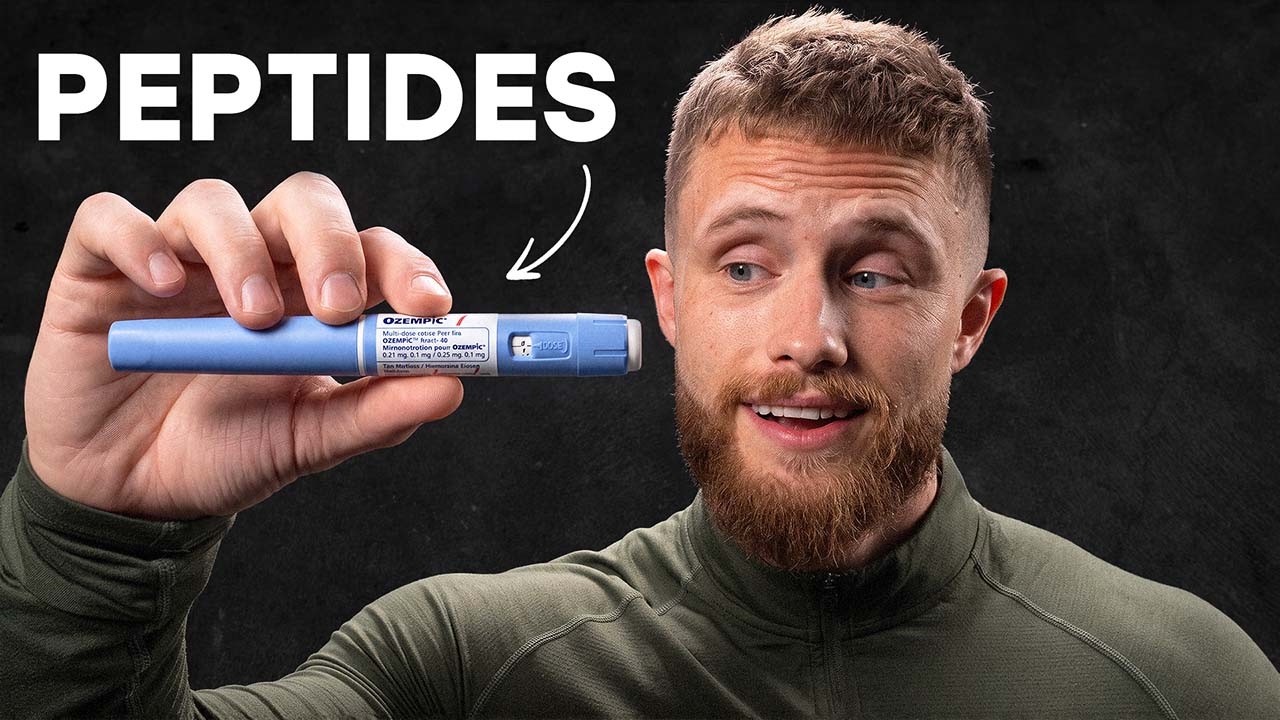
Usually big claims like that trigger my detector right away. And they did in this case, too. But the thing is, peptides actually do work. At least some of them do. For the first time ever, people can simply take a peptide like OMPIC, and fat seems to melt off, like a lot. This is what weight loss typically looks like over a year of diet and exercise. And this is what weight loss typically looks like over a year of diet and exercise, plus a GLP-1 peptide.
People have been struggling with fat loss for decades. So, this is a huge shift. And naturally, it raises the question, if peptides can do that, what else can they do? So, I went down the rabbit hole. I pulled together all the studies I could find on peptides, the good and the bad. In this video, I want us to take these peptides together, see what happens inside our bodies, and figure out which ones are actually worth the hype.
At this point, I'm sure you've probably heard about peptides, but you may not know what they actually do. A lot of people think of them like mini steroids, but chemically, no. They're nothing like testosterone. They're also not stimulants like the caffeine in your coffee. They're not vitamins or minerals or anything like that. Biochemically, they're actually most similar to protein. If you take a scoop of protein powder and zoom all the way in, the individual protein molecules look like this.
Long tangled chains of amino acids. You get a peptide if you untangle those long chains and cut them [music] down into shorter chains of amino acids. There are about 20 amino acids in total that can be linked in different combinations to make millions of different peptides. But we can simplify all that down to the three kinds of peptides that health and fitness people really care about. First, the fat loss peptides. This is where most of the mainstream hype is coming from.
These are the GLP-1 peptides like Ompic. Second, the injury healing peptides like BPC-157, also known as the Wolverine peptides. And third, the anti-aging peptides that claim to help you stay fitter, healthier, and younger looking. Right now, one in every eight US adults say that they use fat loss peptides. [music] And tens of millions of people are taking fat loss peptides right now [music] across the globe. Obviously, this has become a really lucrative business, which is why I want to say upfront that I'm not sponsored by any peptide companies.
I do have a degree in biochemistry, and I've published peer-reviewed studies on muscle growth, and I'll be fact-checking this video with researchers and medical doctors to make sure it's as unbiased as possible. Easily the most famous fat loss peptide is this one. It's called Semaglutide. It's a big GLP-1 peptide sold under the brand names OMIC and WGOI. To take semaglutide, you usually inject it because if you swallow it, it gets destroyed by the acid in your stomach.
There is an oral version, but it's still degraded in the stomach, so you need a higher dose and special technology to help it get absorbed. Surprisingly, the oral version seems to be getting pretty close to the injectable version. After you inject semaglutide into a layer of fat, the peptide moves into the surrounding blood vessels and travels to three places: your pancreas, your stomach, and your brain, where it activates GLP-1 receptors. that tells your pancreas to stabilize your blood sugar, your stomach to slow down its emptying, and your brain to stop sending so many hunger signals.
Those three effects create one very simple yet very powerful super effect. You feel less hungry. Unlike pretty much every other fat loss supplement, semiglutide works in a pretty unique way. It doesn't claim to burn more fat. It also doesn't claim to boost your metabolism. Instead, what it does is it simply lowers your appetite. So, you just eat less calories without really noticing it. And that really works because back in 2018, right before the peptide hype started to take off, 2,000 people volunteered to take semaglutide for the first time.
But here's the thing, the researchers only gave some of the subjects real semiglutide. They gave the other subjects a fake placebo that looked like semiglutide, but it didn't have any actual semiglutide in it. None of the subjects knew whether they were taking the real semiglutide or the fake placebo semiglutide. And all the subjects were told to exercise and given dietary counseling. Everyone's average weight was 232 lbs on day one.
[music] The group taking semiglutide lost 34 lb in 16 months on average. But the group taking the fake placebo semiglutide only lost 6 lb. [music] That's 34 pounds of weight loss versus six pounds of weight loss with the only difference being a single peptide. But that was 2018. These days, there are newer peptides that honestly kind of wipe the floor with ompic. For example, compared to semiglutides 15% weight loss, a newer peptide called trazepatide caused 23% weight loss in a similar time frame.
And redatride just passed through phase 3 clinical trials caused 28% weight loss. That means if you started at 250 lbs and took retatride for about a year and a half, you'd be expected to lose around 71 pounds. The reason they work so well is that semiglutide only activates one receptor, GLP1, but tzepide activates two receptors, GLP-1 and GIP. Readatride activates [music] three. So your hunger gets even more blunted and there may be a metabolic effect, too.
The thing is, these fat loss peptides clearly do work, but are there long-term health issues? Are they even safe? >> All right. >> Hey, buddy. What's up, man? >> Can you hear me? >> Yeah. Yeah. Can hear you loud and clear. So, you prescribe weight loss peptides to patients, right? >> Yeah. Uh, I've been fully board certified since 2014 and and on. So, I don't think there's really any doubt at this point that they work, right? >> Yeah.
They are the most effective nonsurgical uh way for weight loss. Yes. >> Would you say that there's any doubt about whether they're safe or not? >> No, there doesn't seem to be any big smoking gun. There are some potential very rare things that may not show up in a randomized control trial. We just don't have enough people to see some of these rare things. They're extremely safe, especially in the indicated population. >> In your clinical practice, have you run into any issues with patients or do most people seem to tolerate them pretty well? >> By far the most common side effect you see in the trials and what we see clinically is is nausea and vomiting at the severe level.
High in the beginning when you start the medicine, but over time the nausea just goes down. The other things that we see constipation, things get slower in the GI tract and that actually doesn't go away over time. the constipation stays constant. But other weird side effects, people feeling like they have a UTI. I've had some patients with developing gallstones. I haven't had any patients with gallbladder attacks, but you see it once in a while.
But that's still relatively rare as well. >> For what it's worth, of the three weight loss peptides that I've focused on, semiglutide and tzepide have FDA, Health Canada, and European medicine's ay's approval. Retat true is just now getting through phase three clinical trial, so it doesn't have approval yet, but based on what I've seen, also seems to be tolerated pretty well overall. >> Yeah, very similar. Maybe a slight increase uh risk of nausea, vomiting, and a few other things, but really until you do headto head, you won't know for sure.
But it looks pretty similar. >> These peptides do have a [music] dark side, though. This January at the gym, a lot of people noticed that there wasn't the same New Year's rush as usual. I think that could be because a lot of people who set New Year's resolutions to lose weight this year simply just started taking a peptide instead of exercising, which sucks if true, because exercise has mental health benefits that you simply can't replace.
And you will lose a lot of muscle if you take one of these peptides without lifting. In fact, without weightlifting and proper protein intake, about 40% of the weight lost on the GLP1 peptide is lean mass. That's almost certainly not due to the peptide itself, but simply the fact that people are just losing a lot of weight without eating enough protein or training hard enough. I do think a lot of people using GLP1s do know about the risk of muscle loss, though, because more people are using protein powder now than ever before, which sounds great in theory, but in some places it seems to be leading to protein shortages, which may be causing the price of protein powder to skyrocket.
Much more concerning is the fact that you technically need a prescription to get a GLP-1 peptide, but a lot of people either won't qualify or don't want to get access through their doctor. As a result, swast of people are buying them from black market and gray market sources online where there's often zero quality control. That ease of access means that now they're being used by already lean, healthy people who are trying to get even thinner, which could further shift society's expectations about what a healthy or desirable body should look like.
But to me, that's different than overweight people using them as medicine to try to help them get down to a healthier body weight. As someone who prescribes these medications to people, you'll often hear it's cheating. It's taking a shortcut. Do you see it as a shortcut? >> As someone who has to take a few medicines for my own diseases that I have. I have hypothyroidism, Hashimoto's. I would think of it similar to like put the fork down and start eating a dashlike diet and do exercise for hypertension.
Nobody shames anybody for taking an anti-hypertensive or tells them it's a shortcut. Obesity has biological drivers in it that we can't just necessarily outdisipline or out willpower and so it goes and hits the receptors in the brain to basically not have those same biological drivers anymore. Kind of evens the playing field. So I don't see it like a shortcut at all. >> Yeah. I think people almost like hate on shortcuts a little bit too much too, right?
Like to me there's a fine line between like taking a shortcut and just like working smarter. If you can get the same outcome for like less torture on yourself, why make it harder on yourself than it needs to be, right? There is a slippery slope there where you're just like always looking for the easy way out. But like at the same time, you know, I don't think it's so black and white as to say like, oh, because it's a shortcut, therefore it's not a good thing. >> A good analogy would be like, okay, you got to go from New York to LA.
Do you take the direct flight or do you drive? Do you take a train? Do you walk? Do you hitchhike? Do you bike there? We have newer technology. as long as it's safe and not harming people, why not utilize good new technology for the better? That that's the way I would I would uh say it. >> Now, before we move on to the next category of peptides, should you take a GLP-1? Well, I think if you're already at a healthy body fat percentage, you feel good, and you're performing well, no.
And I do think diet and exercise should be your first go-to. But if you've been struggling to lose weight and you've talked to your doctor about this medication, I think that's a decision that you and your doctor can come to. We can debate whether the good outweighs the bad society, but what isn't up for debate is that these peptides that we've covered so far clearly do a lot for fat loss. So then, what in the world do the other peptides do?
Injuries suck and they happen to every serious lifter at some point. And until recently, your main options for treating an injury were basically physiootherapy and maybe surgery if it was serious enough. But now there's a peptide for that. It's called BPC157 and it has absolutely raving reviews. >> You need to know about the BPC157. >> BPC57 is a miracle compound. It has anti-inflammatory properties, also blood driving properties. >> It tells damaged tissues how to heal.
BPC stands for body protection compound, and it's surprisingly simple. Just 15 amino acids taken from a larger protective protein in human gastric juice. It was developed by Croatian researchers in the early '90s while studying potential healing effects it had in the stomach. To test those healing effects elsewhere, scientists gave BPC-157 to rats with an injured leg and discovered that, yeah, 50% more blood vessels formed in the injured leg.
More blood vessels should mean more blood flow and more nutrients going to the damaged tissue, which led later scientists to test BPC57 [music] in a variety of different tissues, including muscles, tendons, and ligaments. Once again, it accelerated healing everywhere it went. But there's a catch, and it's a big one. All those studies were done on rats, rabbits, and [music] dogs, not humans. BPC157, the Wolverine peptide all over the internet, has only ever been formally studied in 30 people.
That's it. Compared with semaglutide or tzepide which have been tested on tens of thousands of people across multi-year phase 3 placeboc controlled clinical trials. BPC57 has just three pilot studies with barely a small handful of subjects in each. To be fair, those pilot studies did show some promise for knee pain, bladder pain, and safety, but they're still plagued by really small sample sizes and no placebo or control group.
There's no highquality, well-controlled science. There are plenty of anecdotes, though, and I think they're worth something. I know people who've had an injury that's been nagging them for years suddenly heal up after taking BPC. The internet is full of similar stories. >> I was in a really bad car accident. I immediately started taking BPC that day. I was back at work in like 2 or 3 days. >> I've been running the BPC cuz I had some pretty bad elbow inflammation.
Within a few days of being back on that, I have no issues, no inflammation, no pain. I healed a little knee injury. I healed some nerve damage. I've healed my gut. I've healed my shoulder. I know that it works and I know that it works super fast. >> Eh, we need to be careful with these though because most injuries heal with time. Anyway, if you started taking BPC and your shoulder finally started feeling better after 6 weeks, it's tempting to credit the peptide and maybe it was the peptide or maybe your shoulder just started healing naturally on its own.
Without a placeboc controlled trial, it's hard to know. In my opinion, the mechanism does make sense. The animal data is intriguing, and I hope more high-quality human research happens. [music] But as of now, it's still not FDA approved. It's banned by Wada, and sourcing it can be sketchy. So, as frustrating as injuries are, I'd stick to the boring stuff for now. Manage your training loads, try to find pain-free variations, and gradually build yourself back up over time.
If your injury isn't getting better, have it looked at by a qualified physical therapist. So, before we cover the last peptide category, should you take BPC 157? I think no. I just don't think that the human evidence is there. Sourcing can be sketchy. And even though the mechanism does make sense, I'd stick to the verified, safe, boring stuff for now. But injuries aren't what most people are truly worried about anyway.
It goes deeper than that. What a lot of people are really worried about is aging. Getting older than looking older. The most ambitious peptide that we've covered to date is this tiny little four amino acid peptide called epitalon. Because unlike the GLP1 peptides that promise weight loss or the injury peptides that promise healing, [music] epalon is aiming at something much bigger, aging itself. [music] Epelon works by targeting the most fundamental structure in your entire body, your DNA.
Every muscle, tendon, organ, blood cell that you've ever had has come from instructions encoded in your DNA. And to keep those instructions protected, your DNA is packaged up into chromosomes with these little caps on the end called telomeirs. As we get older, those telomeres get shorter and shorter. And that may be one of the key reasons why we age in the first place. And it's why so much anti-aging research is focused on telomeirs.
So this is where the peptide epylon comes in. [music] It activates an enzyme called telomeorase which helps rebuild those protective telomeres as they shorten over time. Sounds promising on paper, but does epalon actually increase lifespan in the real world? Well, actually, yes. Yes, it does. At least it does in flies, mice, and rats. Unfortunately, when it comes to increasing our human lifespans, the only studies that we have is this 2003 study from Russia and this 2006 study from the same Russian research group, and neither study was independently replicated outside of Russia.
There's little doubt that telomeic shortening is involved in the aging process, but overactivating talomeorase may be involved in cancer development. So, it is a delicate balance. And when it comes to epitalon and frankly the rest of these peptides, the human evidence on anti-aging specifically just [music] really isn't there at all. That's kind of okay, though, because humans are already uniquely well adapted for longevity.
When you compare humans to other mammals of a similar size, you consistently see that humans live much longer. And virtually all the compounds out there that are being marketed as anti-aging solutions follow a similar pattern. They probably work in rats. They might work in pigs. Sometimes they'll work in other primates. And then they do basically nothing when it comes to humans. But we don't really need to look for a peptide to help us live longer anyway because the science is already quite clear on what helps slow aging down in [clears throat] humans.
It's relationships, [music] friends, family, and community. That's the big one. And the rest is the same boring stuff you've heard about before. Exercise, sleep well, don't smoke, don't drink too much, and try to maintain a healthy body weight. Not as sexy as a new anti-aging peptide, but those [music] truly are the things that move the needle the most. So, should you take an anti-aging peptide? I think no. The human evidence is just really, really scanned.
And like I said, we already know what helps with aging the most. It's the boring stuff. My key message with this video is that just because there are certain peptides that do work for weight loss doesn't [music] mean that everything that falls under the category peptides will work for everything. It's ultimately your daily habits that'll determine how well you follow through on your health and fitness goals. One habit that I follow through on pretty much every day is tracking my nutrition with MacFactor.
I'm a part owner of the app, and we've done everything possible to make it the easiest, simplest, and most intuitive nutrition app on the market. It isn't just a tracker, though. It uses science-based algorithms to learn your specific metabolism and then updates your calories and macros over time to mathematically guarantee that you get to your goal as long as you stick to the plan. We have a really amazing community with over 500,000 users.
And I think the app's reviews and testimonials speak for themselves. If you'd like to try it out, just use code Jeff when you download on the App Store or Google Play, and that'll get you 2 weeks for free. There are zero ads on the app and we'll never sell your data. And we have 24-hour support if you ever run into anything that you're not sure about. So, click the first link in the description box below or scan this QR [music] code on screen.
If you've never tracked your nutrition before or you just haven't been consistent with it, I really think Macroofactor will help you get to where you want to be. That's it for this one, guys. Thank you so much for watching and I'll see you all here in the next one.
The words are the caption track's own and nothing is reworded or re-transcribed. Paragraph breaks are placed between sentences so the text reads as prose.
Free tools for your own script: paste a draft and see where it stands before you record it.
Paste your draft and see where viewers are likely to drop off, with a rewrite for each weak line.
Paste the first 30 seconds of your own draft for a hook score and rewrites.
Check your draft against YouTube's advertiser-friendly guidelines before you record it.
Read this channel's public videos and transcripts, and download a writing brief for it.