Getting the transcript
Reading the captions from YouTube. A video nobody has opened here before takes 10 to 30 seconds; this page fills in on its own.
Getting the transcript
Reading the captions from YouTube. A video nobody has opened here before takes 10 to 30 seconds; this page fills in on its own.
HealthyGamerGG · @HealthyGamerGG
Words
2,787
Runtime
14:38
Speaking pace
190wpm
Reading time
12min
190 words per minute, between the 181 median and the 201 75th percentile of 349 measured videos. That distribution comes from the 349-video hook study.
Opening (first 30 seconds)
So, in a neurotypical brain, I think you can let reward motivate you. The problem is that in a neuroatypical brain, the reward is usually insufficient to overcome the difficulty of the task. One of the most tricky things about ADHD is that good habits are protective against ADHD. But, the problem is that in order to form a habit, you have to do something really consistently. And if you're someone with ADHD, doing things consistently is really hard, right? We're distracted, we have difficulty focusing, we can't do the same thing day after day
95 words, the words spoken in the first 30 seconds at 190 words per minute.
Free, no signup. See how the first 30 seconds hold attention, with rewrites.
Sentence shape
| Measure | This transcript |
|---|---|
| Sentences | 188 |
| Average words per sentence | 14.8 |
| Longest sentence | 55 words |
| Questions asked | 20 |
| Sentences containing a number | 13 |
Most used terms
Filler phrases
45 in total: like 20 · actually 8 · right? 8 · kind of 3 · you know 3 · basically 2 · sort of 1.
A literal whole-word count of the same phrase list the Prepublish browser extension uses, so a phrase inside another word is not counted and a phrase used in its ordinary sense still is. It is a count and not a judgement.
Run the check on the words above: where attention is likely to drop, with a rewrite for each weak line. The free check shows the scores and the one issue costing the most.
What this transcript is
Every word below is the caption track YouTube publishes for this video, pulled from the video itself and reproduced unchanged. It is not Prepublish's writing, not a summary, and not a re-transcription: it is the video's own published captions. English captions, generated automatically by YouTube, in the video’s original language. Source: the video on YouTube. A channel that would rather this page did not exist can ask for its removal through the contact page, and it is removed.
No Script X-ray for this video: YouTube shows a Most replayed graph only once a video has enough views.
So, in a neurotypical brain, I think you can let reward motivate you. The problem is that in a neuroatypical brain, the reward is usually insufficient to overcome the difficulty of the task. One of the most tricky things about ADHD is that good habits are protective against ADHD. But, the problem is that in order to form a habit, you have to do something really consistently. And if you're someone with ADHD, doing things consistently is really hard, right?
We're distracted, we have difficulty focusing, we can't do the same thing day after day after day. One of the most ironic things is that habits will protect you from a lot of the problems of ADHD. The real tragic thing is that even though the habit circuitry is relatively intact in ADHD, it's difficult to form good habits if you have ADHD. So, if you've got ADHD, you're distracted, it's difficult for you to focus, it's difficult to stay consistent, so you can never form a habit.
But, the really interesting thing is once you form a habit, it will take over even if you are distracted. Because let's think about what a habit really is. So, in my mind, if I've got ADHD and I'm thinking about something else, and my body is moving around doing random things, what is it that's controlling the random things that my body is doing? Those are actually my habit That's my habit circuitry. Right? So, the really interesting thing if you look at what a habit is, a habit is behavior that happens on autopilot.
A habit is behavior that is programmed. A habit is behavior that does not require your attention, and in fact takes over when your attention is somewhere else. And this is exactly why they are so useful for people with ADHD. Because imagine for a moment that you did get distracted, that you did wander around, but there was an autopilot circuit in your brain doing all of the right things. Putting your keys where they belong, putting your wallet away, starting to do the dishes.
Imagine you could program your autopilot stuff when you get distracted. That's what we're going to talk about today. So, one of the trickiest things as a psychiatrist is trying to help my patients build good habits. And this is where we have to understand the neuroscience, okay? So, ADHD is a disorder of two things. The first is it's a disorder of our frontal lobes, which allow us to plan and execute tasks, allow us to restrain impulses, retain focus, right?
That's That part of the brain is weak, the frontal lobes. The frontal lobes are basically the is the master controller of the other parts of your brain. They're like the orchestra conductor that makes sure all the different parts of your brain are working together. So, in ADHD, this circuit is weaker or impaired. So, your brain acts in a very disorganized fashion. All your brain parts are on kind of autopilot. The second thing that's really different in ADHD is your dopaminergic circuitry and your reward circuitry.
So, this is the nucleus accumbens, the ventral tegmental area. So, we see alterations in dopaminergic sensitivity. This means that some tasks give you a ton of dopamine, like video games, pornography, other random things when you're really excited about something, right? You get a bunch of dopamine from it for about a day or so. And then your dopaminergic circuits acclimatize very easily, so you don't stay interested in things for long.
The other problem is that normal tasks for a neurotypical brain will give you a healthy amount of dopamine, but in ADHD, it's hard to get that dopamine flowing with boring stuff, regular stuff, okay? Now, there's a completely separate circuit of the brain, which is the endocannabinoid habit circuitry. This is the dorsal lateral striatum. This is also sensory motor parts of the brain, and this is actually endocannabinoid receptors.
So, this is like a completely separate part of the brain, okay? The habit circuitry is relatively intact. So, what we want to do if we've got ADHD is create a situation where when our mind wanders, when our dopaminergic circuitry is going off track, our endocannabinoid circuitry is doing exactly what it should be doing. The tricky thing is that in order to train the endocannabinoid circuitry, in order to build a good habit, we need consistency.
And so, if you're having trouble building consistent action, I hope today's video will help, but I'd also recommend you check out our coaching program. We have a bunch of neurodiverse ADHD coaches, and we've had thousands of clients with ADHD. And coaches are really good at helping you solve for your individual problems so that you can actually achieve what you set out to. And so, we're going to talk about how to build good habits in ADHD.
So, the problem here is that a lot of the advice that we get about building good habits doesn't work great with ADHD because it assumes a neurotypical brain. So, great example of this is, you know, there's a book by James Clear called Atomic Habits. It's an awesome bestseller, and he basically breaks it down really simply. He says, "There's a cue, there's a craving, there's a response, and there's a reward." The problem is that for this cycle to be intact, you need a relatively neurotypical dopaminergic circuitry.
So, let's start with a cue. So, he says, "Make something in your environment that triggers you, reminds you to do the task, right? Like, create a sensory trigger." Makes perfect sense. The problem is that if you've got ADHD, that cue doesn't work nearly as well because your brain is also picking up all these other random cues. Like, "Oh, yeah, like I see this I left a to-do list on my fridge. Let me Let me look at the to-do list.
Oh, I see the to-do list. I need to do something." And then you start to walk, you turn around, and then you look out the window and you see something else that you need to do. So, cues don't work quite as well. The other problem with ADHD is that we tend to be less responsive to the same cue after time. So, if you're someone who like leaves a reminder on your fridge and it reminds you the first day, reminds you the second day, but then on the third day you filter it out, it stops working.
Second thing, once you see the cue it triggers a craving, which is great, except your craving circuitry, which is dopaminergic, dopamine in the nucleus accumbens, gives you cravings, gives you pleasure, and gives you behavioral reinforcement. That is also altered. And so, when you see the cue on the fridge, it may trigger a craving, but there are lots of other cravings that you have, and the the biggest problem is actually in the response, which is that the joy that you get from completing a task may be down-regulated significantly if you have ADHD.
That's the whole problem with the disease is that, you know, finishing my to-do list just doesn't give me the dopaminergic reinforcement that like getting high does. And so, this becomes a real problem. So, this is great advice, and if you can use it to build habits, like I'm sure people with ADHD have benefited from this, but my point is that it's harder to apply. So, instead what we need to do is figure out a strategy to build habits that fits our neurotypical brain, that actually doesn't rely on dopamine, that actually really focuses on the endocannabinoid circuit.
So, how do we do that? Step number one, understand how long it takes to build a habit. So, there's this stupid idea floating around, I don't even know where it came from, that habits take 21 days to build. Research shows that habits take anywhere between 18 and 254 days to build, with the median amount of time being about 66 days, okay? So, step number one that a lot of people with ADHD mistake that they make is that they try to build too many habits at the same time.
The habits that they try to build are built are chosen out of desperation. I need this to be habitual. I need this to be habitual. I need to do this to be habitual. And so, then what you do is you're working on this and you're working on this and you're working on I know what I'm going to do. I've got ADHD. I'm going to work on habit one on Mondays, habit two on Tuesdays, habit three on Wednesdays. You're building way too many habits.
So, what I recommend to people that I work with is you pick one habit, just one, and you're going to do it for 66 days. You're going to do it for two months. One habit every two months. Now, if I say that to you, your response is going to be, "Dr. K, that is so long. That's not going to be enough. I can't do a habit just every 66 days, right? That's like that that feels impossible. It feels like it's not going to be enough." Exactly.
So, your response to this question has to do with your frontal lobes, which do a very bad job at projecting how things are going to be in the future. And the dopaminergic parts of your brain are not going to like that. They're like, "Give me a habit now. I want to have it in 21 days. I want a big habit. I want a good habit." Don't listen to those parts of your brain. Pick a habit, stick with it for 66 days. You're only going to do one thing for 66 days.
"But what about all the other parts of your life? Leave them as the mess they are. Continue working on I don't care. You're going to fix this one thing." Second thing, what kind of habit should you build? The key thing is to make it very small. So, a good example of what I would recommend is put your keys away. Never put them down. Really simple. So, if you've got ADHD, what tends to happen is when we get distracted, I've got keys and I'm going to set them down somewhere.
And this seems like such a small thing. But when I talk to my patients, what I find is that a disproportionate amount of their stress comes from trying to find their keys. Like, once every week, I'm looking for my keys. I'm late to a social event. I'm late to work. I'm late to something else. I'm stressed out about it. Now I'm spending all of my energy looking for my keys, so I'm cognitively exhausted by the time I go to work.
I'm 30 minutes late and I'm already spent for the day. Ruins my whole day. So, one of the key things I found working with people with ADHD is they grossly underestimate the value of very small things. So, for two two months, we've got one job, which is to put your keys away. Never put them down. Now, how do we make this more possible, okay? What we want to do is focus on a transition. So, the transitions are the most dangerous parts for people with ADHD.
Once I get down and I activate hyperfocus.exe, I'm doing pretty good. But it's in between things that I waste so much time. I they'll even be really productive, right? Like I got two hours of work done, then I got home, and then two hours disappeared. I don't know where they went. So, focus on that habit building during a transition. So, when I come into the house, I want to, you know, put my keys away in the same spot every single time.
And the cool thing about that is that if you train that behavior, then your mind will do it even if you're distracted. Okay? So, you want to focus on the transition, focus on doing one thing right during the transition. Put your keys away. You can pick whatever else it is. It doesn't really matter, okay? Is you really want to make it easy to do the task. So, what I strongly recommend is that you organize your environment to make it easy to do the task.
So, if we're putting our keys away, we want to designate a basket for our keys. And there's a lot of good evidence that shows that organizational tools will buffer us against the problems of ADHD. So, if I have something like a bookshelf, if I have a particular place to put things, that works incredibly well. So, we want to organize the we want to focus on the transition, which is the when we are going to build the habit, and we also want to focus on the dimension of where.
So, where is this action kind of taking place? So, we can create a basket for our keys, or it could be something as simple as when I'm transitioning from work to home, I'm going to stop at the gym. So, try to anchor the when and the where to build this habit. And it's okay for the habit to be small. Next thing that we want to do, and this is really, really, really important, is think about what will make it hard to engage in the behavior.
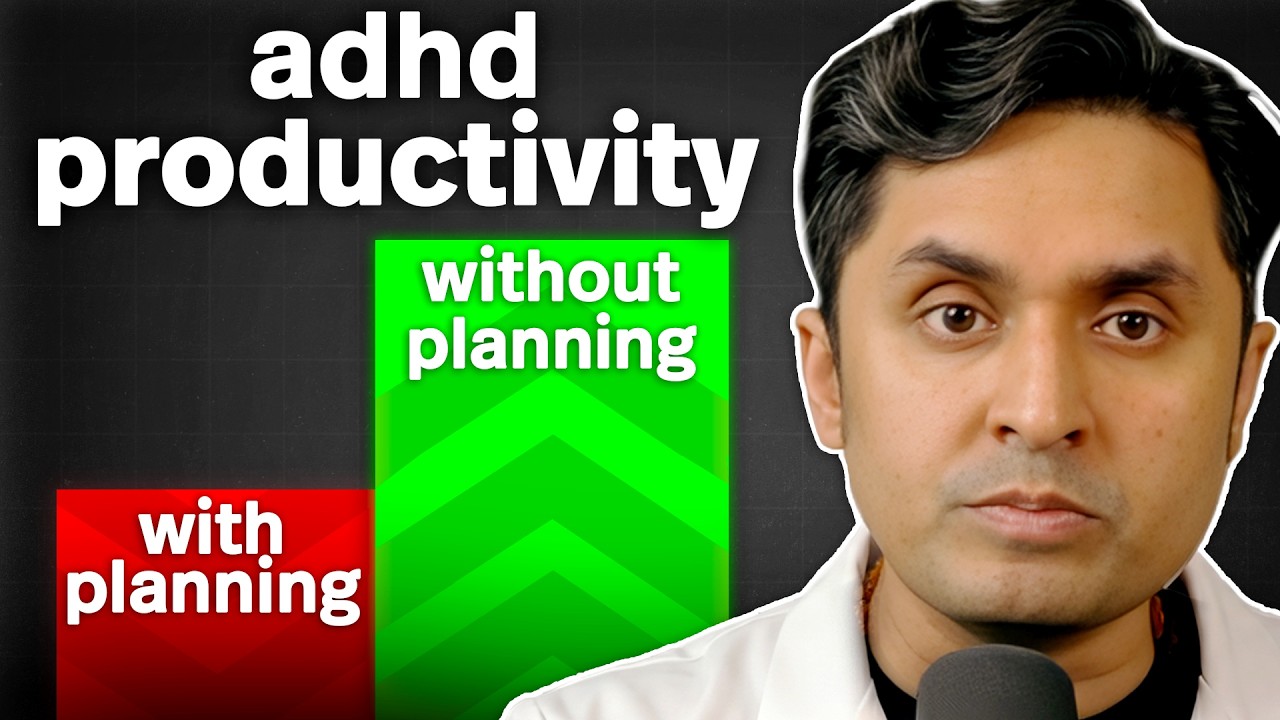
So, in a neurotypical brain, I think you can let reward motivate you. The problem is that in a neuroatypical brain, the reward is usually insufficient to overcome the difficulty of the task. So, when I'm working with patients with ADHD, there's a lot of research that shows this. There was one study that tried to get 437 people to exercise every week. And what they found is focusing on building a complex plan actually reduced the average amount of exercise by 217 minutes.
And planning for obstacles, focusing on the difficulty, what makes it hard to exercise, actually increased exercise time by 184 minutes. Okay, so this is what's insane. Building a complex plan, especially if you've got ADHD, is not what leads to really good results. Focusing on the things that will mess you up, which is usually what happens, right? That's the problem with ADHD, is that you have the best of intentions, but then you some problem gets in the way.
So, the next thing that we really want to focus on is what is the obstacle. Anticipate ahead of time what the obstacle will be that will get in the way. And so, if you put these things together, hopefully what you can do is build one habit. And if you can build one habit over the course of 2 months, it may not have a big impact. But here's the other really, really, really big thing. When I talk to my patients with ADHD, what we tend to focus on is building six habits per year.
We're going to take six things that you are now programming your body to do automatically. And that removes the load of six problems from your life. Over the course of 4 years, that's going to be 24 problems that you don't deal with. The other little secret thing, just to give you guys like your ventral tegmental area, your dopaminergic stuff, and your your frontal lobes that that want things faster. What I'm going to tell you is once you start implementing this method, you will get better at the method.
And so, you will be able to handle larger habits or implement habitual change more frequently because you will develop the habit of building habits. And once that happens, the whole the whole ballgame changes. So, if you guys want a complimentary perspective to like neuroscience and habit building, strongly recommend you check out our lecture on puer aeternus, which is a Jungian sort of big picture approach to understanding how ADHD shapes your life.
It's not really ADHD, but so many people in the lecture were like, "Oh my god, this describes me so well, and I used to think I had ADHD. Now I realize I'm also a puer." And if you want to know what the hell that means, check out the link in the description below. It'll take you to our website. It's an awesome lecture. People really love it. Check it out with our free trial and see if it's for you.
The words are the caption track's own and nothing is reworded or re-transcribed. Paragraph breaks are placed between sentences so the text reads as prose.
Free tools for your own script: paste a draft and see where it stands before you record it.
Paste your draft and see where viewers are likely to drop off, with a rewrite for each weak line.
Paste the first 30 seconds of your own draft for a hook score and rewrites.
Check your draft against YouTube's advertiser-friendly guidelines before you record it.
Read this channel's public videos and transcripts, and download a writing brief for it.