Getting the transcript
Reading the captions from YouTube. A video nobody has opened here before takes 10 to 30 seconds; this page fills in on its own.
Getting the transcript
Reading the captions from YouTube. A video nobody has opened here before takes 10 to 30 seconds; this page fills in on its own.
Thomas DeLauer · @ThomasDeLauerOfficial
Words
2,302
Runtime
11:51
Speaking pace
194wpm
Reading time
10min
194 words per minute, between the 181 median and the 201 75th percentile of 349 measured videos. That distribution comes from the 349-video hook study.
Opening (first 30 seconds)
Most guys trying to optimize testosterone are focusing on what to take in the morning, but the real production window happens at a specific sleep stage at night and most people end up blowing right past the sleep stage. 3 g of glycine before bed gets you into that stage faster by dropping your core body temperature, which we're going to talk about specifically in relation to testosterone, but this is not all that I'm focusing. I want to get into deeper stuff. Glycine's just the foundation. I'm also going to walk you through three foods that
97 words, the words spoken in the first 30 seconds at 194 words per minute.
Free, no signup. See how the first 30 seconds hold attention, with rewrites.
Sentence shape
| Measure | This transcript |
|---|---|
| Sentences | 171 |
| Average words per sentence | 13.5 |
| Longest sentence | 63 words |
| Questions asked | 14 |
| Sentences containing a number | 24 |
Most used terms
Filler phrases
42 in total: like 16 · actually 9 · right? 5 · kind of 4 · basically 3 · literally 2 · I mean 1 · sort of 1 · you know 1.
A literal whole-word count of the same phrase list the Prepublish browser extension uses, so a phrase inside another word is not counted and a phrase used in its ordinary sense still is. It is a count and not a judgement.
Run the check on the words above: where attention is likely to drop, with a rewrite for each weak line. The free check shows the scores and the one issue costing the most.
What this transcript is
Every word below is the caption track YouTube publishes for this video, pulled from the video itself and reproduced unchanged. It is not Prepublish's writing, not a summary, and not a re-transcription: it is the video's own published captions. English captions, generated automatically by YouTube, in the video’s original language. Source: the video on YouTube. A channel that would rather this page did not exist can ask for its removal through the contact page, and it is removed.
No Script X-ray for this video: YouTube shows a Most replayed graph only once a video has enough views.
Most guys trying to optimize testosterone are focusing on what to take in the morning, but the real production window happens at a specific sleep stage at night and most people end up blowing right past the sleep stage. 3 g of glycine before bed gets you into that stage faster by dropping your core body temperature, which we're going to talk about specifically in relation to testosterone, but this is not all that I'm focusing.
I want to get into deeper stuff. Glycine's just the foundation. I'm also going to walk you through three foods that you can add to your evening that directly support testosterone production through completely different pathways. One modulates DHT, one provides the single most critical mineral for steroidogenesis, and then one that actually delivers the fat-soluble vitamins that your Leydig cells need to function and ultimately produce testosterone.
And then we'll tie it all together with a cortisol mechanism that a lot of guys have no idea is suppressing their testosterone at the testicular level. A lot of times guys don't want to focus on cortisol cuz it doesn't seem cool, but the reality is it's impacting testosterone a lot. The last piece is kind of what makes all this come together, okay? So, here's what we're going to cover. First, we will talk about the glycine mechanism.
We'll talk about how it changes your sleep architecture, how it affects core temperature, and why that truly is a trigger for testosterone production. Secondly, we're going to talk about the three evening foods that hit testosterone. Okay, we're going to talk about zinc, we're going to talk about DHT modulation, we're going to talk about Leydig cell vitamin signaling. Then third, we're going to talk about the research showing glycine protects your brain even when sleep is shorter.
Then fourth, I want to talk about this whole cortisol Leydig cell testosterone mechanism. So, let's go ahead and get into it. Before we get into the specific science, I did also put a link for Element Electrolytes. They have some really cool new flavors. They have one in particular that is their lemonade tea. This is amazing. It's electrolytes, but it also has 50 mg of caffeine. If you want to have just something in the morning that's going to help maybe curb that cortisol curve a little bit more better than then this is a great place to start cuz you're getting 1,000 mg sodium, 200 potassium, 60 magnesium, plus a little teeny bit of caffeine, and you're getting theanine, and you're getting the polyphenols in the black tea.
So, you're getting all the electrolytes, plus a little pick-me-up. Now, this isn't the only thing they've got. They've obviously got their pink lemonade, their regular lemonade, all their other flavors. They've got their sparkling cans, they've got their larger cans, everything. So, that link down below gets you a free sample variety pack with any purchase. So, it gives you their leading flavors in a variety pack anytime you make a purchase.
So, that link is down below, drinklmnt.com/thomas. Let's talk about glycine first before we get into this other stuff, because this is very specific to testosterone. How does it change your sleep architecture related to testosterone? Glycine, believe it or not, is not just a supplement. Like, we've been getting glycine forever when we eat nose-to-tail. A lot of us just aren't getting it because we eat regular muscle meat, and we don't get the actual glycine.
Most of us actually end up in a net loss of about 10 g of glycine per day cuz we're not getting enough from our food, and we only produce about 3 to 4 g of it. Glycine crosses the blood-brain barrier, and it acts on NMDA receptors in the actual master circadian clock region of your brain. This is what gives you this vasodilation. Okay, so blood flow increases to the surface, core body temperature drops. That drop is the signal that your body uses to initiate sleep onset and transition into a very specific type of sleep that has to do with testosterone.
So, we've seen in studies that people that take 3 g of glycine before bed have better sleep quality, better sleep efficiency, it shortens the time to fall asleep, no surprise, okay? And it's not sedating you, it's really just accelerating your own process. But with testosterone, we look at a study in the Journal of Clinical Endocrinology Metabolism. It put people through a fragmented sleep protocol test, basically. So, it measured their testosterone every 20 minutes overnight.
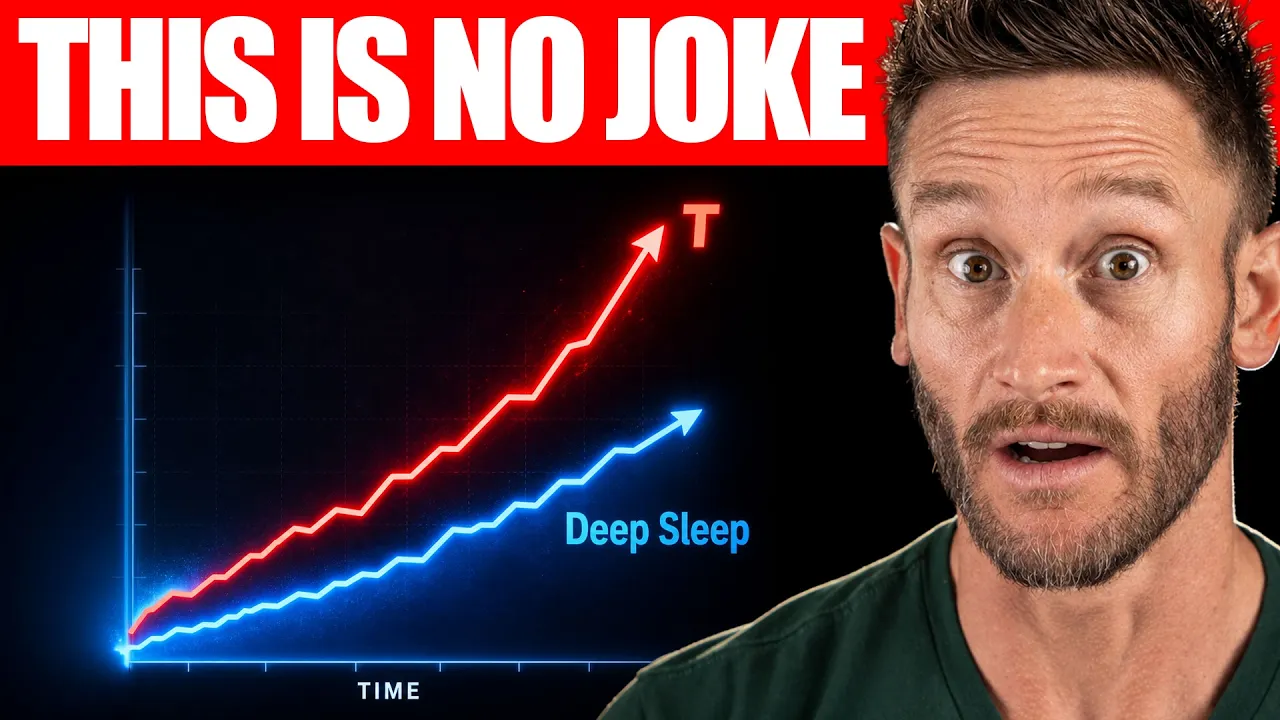
And what they did is they like basically looked at fragmented sleep versus non-fragmented sleep. The nocturnal testosterone rise preceded the first REM episode by about 90 minutes. So, what that means is that testosterone actually spiked during the deeper phase, like the non-REM sleep, just prior to the first REM sleep. When sleep was fragmented, the rise in testosterone was pretty much abolished. Okay, if you didn't get REM episodes, there is no testosterone.
It was absent. Testosterone synthesis is sleep stage dependent. It does not just depend on how long you sleep. Subjective sleep scores doesn't really matter in this case. Like we need the specific sleep stage. So, the sequence from non-REM sleep all the way to the first REM cycle, that early stage of sleep is actually the biological trigger for luteinizing hormone pulsatility, which drives the Leydig cell steroidogenesis.
So, you need at least 3 hours of specific, very consolidated sleep with normal architecture for testosterone production to even begin. Glycine gets you into that architecture faster and more effectively. Temperature drops and your deep sleep will hit you sooner. So, the non-REM to REM sequence ends up firing and testosterone can actually function. It can actually do its thing. That's the simple chain. So, 15 g of collagen before bed actually gives you those 3 g of glycine, but you're also getting connective tissue repair since tissue turnover peaks during sleep.
So, it's a great way to have your cake and eat it, too, in many ways. You're getting collagen, you're getting tissue repair, but you're also extracting the glycine. So, if you don't want to just take straight-up glycine, no one's going to balk at taking collagen. There's so many good benefits there. If you stack that with magnesium glycinate at like 3 to 400 mg, you get a little bit of additional glycine from the chelate, plus you get magnesium's own slow-wave sleep support.
Okay, so that is a terrific combination. That way you're getting glycine that's a chelated form of magnesium in this case. Like you're or or magnesium that's chelated with glycine. It's It's bit of glycine, but it's chelated in that way. And then, you have the collagen. Like double whammy, super simple, 30 minutes before bed. Now, that covers getting into the right sleep stages. Okay, but while glycine is setting up the architecture, you could also be giving your body the raw materials that it needs to produce testosterone once the window opens.
So, the first food in this stack is literally just having pumpkin seeds. I mean, yes, they're a terrific source of zinc. Okay, that that's going to help us for sure. But, pumpkin seeds contain something else. They have what is called beta-sitosterol. Okay. It is a plant sterol that interacts with what is called 5-alpha reductase, which is the enzyme that converts testosterone to DHT. DHT is not the enemy. It is a potent androgen.
Okay, but excessive 5-alpha reductase ends up shifting too much of your testosterone towards what's called DHT conversion. Beta-sitosterol modulates that balance. So, just literally a handful of raw pumpkin seeds, put them on your chicken, put them on your salad, what the little snack, whatever. You're getting zinc for steroidogenesis. Okay, very good for testosterone production, but also a natural 5-alpha reductase modulator.
Getting two amazing things from pumpkin seeds. Secondly, oysters, which is the single most zinc-dense food that exists. And zinc is a direct cofactor in Leydig cell steroidogenesis. It is required, absolutely required, for the enzymatic conversion of cholesterol to testosterone. So, when zinc is low, that conversion is rate-limited. Bingo, you don't produce testosterone. So, even two to three oysters a few times per week will change your zinc status.
But, if oysters aren't realistic, I would say maybe 15 mg of supplemental zinc. Start there. Work your way up. You don't want to overdo it, okay? Because it does kind of like it can be counteractive. It can be counterproductive for some other minerals. Okay, food source zinc is better, okay? It's definitely going to get you as it comes with the copper and the selenium as the cofactors and kind of in that natural balance.
Third is cod liver oil. Very underrated, the stuff our grandparents were using. A tablespoon of cod liver oil gets you preformed vitamin A and vitamin D3 in its already fat-soluble matrix. These have direct relevance to Leydig cell function. Okay, vitamin D receptors sit on the Leydig cells. They sit on our testicles. And activated vitamin D3 from like cod liver oil upregulates steroidogenic enzyme expression in this whole testosterone biosynthesis pathway.
So, vitamin A is playing a role additionally in maintaining testicular health, but also spermatogenesis. And then of course you have the omega-3s, which that whole base improves absorption of both. So, if you take cod liver oil with food, with your evening meal, like you're going to increase the uptake. Take it with some fat. So, the evening stack in practice is very simple, right? Dinner with some oysters or some zinc-rich protein, maybe a little bit of pumpkin seeds, a tablespoon of cod liver oil or a couple cod liver oil capsules, collagen and magnesium glycinate 30 to 60 minutes before bed.
That way you're giving yourself the raw materials at dinner, but the sleep architecture support sort of at bedtime. Now, glycine isn't just about the deeper sleep. Okay, there's also research showing that it's protecting our brain the next day even when sleep is really bad. That has direct implications for how your hormonal window functions under real-world conditions. So, there was a study and it took people and it restricted their sleep to 75% of their usual sleep.
They found that 3 g of glycine before bed reduced the next day fatigue and improved their cognitive performance compared to placebo. So, they actually had better brain function despite less sleep. In the testosterone context, a lot of people can't just magically add a few hours of sleep. Yes, that's great, but you got to work towards it. So, glycine at least makes the hours you do get more productive. You get faster onset into sleep stages.
Okay, so you get more of that limited time actually spent in the architecture that drives testosterone, and your brain is somewhat protected the next day. Okay? So, on short sleep nights where you know you're not going to get that much sleep, like maybe you got travel, you've got meetings, like whatever, take the collagen 30 minutes before whatever truncated bedtime you're getting, and you may even want to bump it with a little extra boosted glycine.
Those compressed hours become more hormonally productive than 7 or 8 hours of fragmented sleep. Another thing you may want to consider is even mouth taping, right? Nasal breathing reduces these little micro arousals that kill this whole non-REM to REM sequence. Sounds crazy. It is kind of intense, but it's training your body to be able to nasal breathe. Now, the cortisol piece, okay? This is very interesting because there was a study that was in the Journal of Clinical Endocrinology and Metabolism.
It induced cortisol elevation, and then it measured their testosterone and luteinizing hormone and prolactin. They found that when cortisol went up, testosterone went down rapidly. But luteinizing hormone didn't change. So, basically, the brain was still trying to say produce testosterone, but the testes could not create it. Testosterone still fell. So, cortisol was acting directly at the Leydig cell testicle level. So, the brain was saying go, go, go, but the testes couldn't execute.
Sleep deprivation elevates cortisol. We know this. So, you're getting this double whammy of disrupted sleep architecture and high cortisol that are giving you the same negative effect on testosterone, in fact, compounded. Right? So, the evening protocol's designed to prevent this from happening. Glycine brings the cortisol down, not by being an anti-cortisol supplement, by helping you sleep. And then the zinc from the oysters and the pumpkin seeds and all this is helping the actual testosterone levels.
The vitamin D is helping this as well. The magnesium is supporting the slow wave sleep and the Leydig cell function. You're fixing the architecture. You're You're lowering the cortisol. You're doing the things like from a holistic perspective, right? Another thing is like keep the lights dim, okay? Lights dim at night is going to help you fall asleep. That's plain and simple, okay? It's less about blue light bombarding your face and more about what's the overall lux like.
So, 3,000 Kelvin, maybe below 60 lux, right? So, super simple. And if you want a full testosterone protocol, including things that I've talked about before like ashwagandha, tongkat ali, all these things. These support production through a completely different pathways. I did a breakdown on that video right here that you can check out. I also did another video on tongkat ali that I'll link to as well. You can check that one out here, which is a very specific compound for testosterone.
So as always, keep it locked in here on my channel. I'll see you tomorrow.
The words are the caption track's own and nothing is reworded or re-transcribed. Paragraph breaks are placed between sentences so the text reads as prose.
Free tools for your own script: paste a draft and see where it stands before you record it.
Paste your draft and see where viewers are likely to drop off, with a rewrite for each weak line.
Paste the first 30 seconds of your own draft for a hook score and rewrites.
Check your draft against YouTube's advertiser-friendly guidelines before you record it.
Read this channel's public videos and transcripts, and download a writing brief for it.