Getting the transcript
Reading the captions from YouTube. A video nobody has opened here before takes 10 to 30 seconds; this page fills in on its own.
Getting the transcript
Reading the captions from YouTube. A video nobody has opened here before takes 10 to 30 seconds; this page fills in on its own.
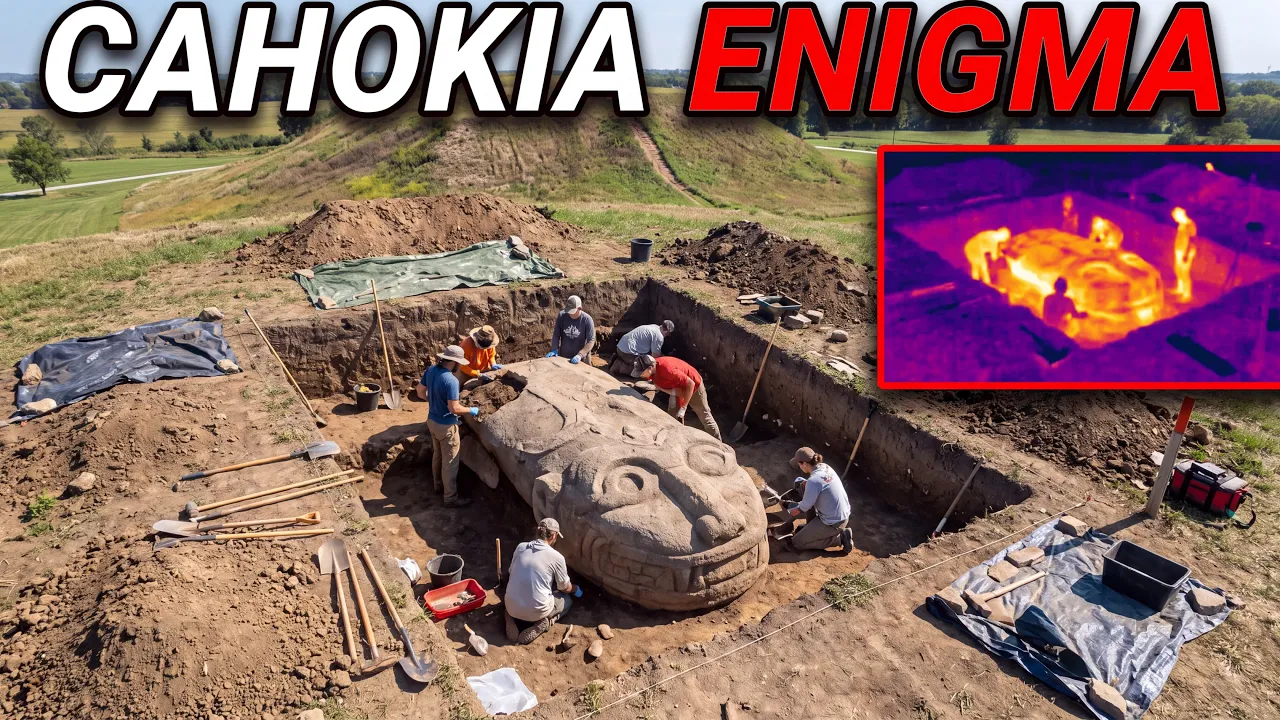
The Silent Ruins · @officialTheSilentRuins
Words
4,910
Runtime
34:32
Speaking pace
142wpm
Reading time
20min
142 words per minute, below the 160 25th percentile of 349 measured videos. That distribution comes from the 349-video hook study.
Opening (first 30 seconds)
A research team walks a quiet Illinois flood plane in the Midwest, drilling routine core samples from ground archaeologists have picked over for more than a century. The steel core pulls up a tube of packed earth, brown, dense, undisturbed, layer stacked cleanly on layer. No flood line. But that missing layer was supposed to be there because the entire explanation for why the largest city ever built in pre-Colian North
71 words, the words spoken in the first 30 seconds at 142 words per minute.
Free, no signup. See how the first 30 seconds hold attention, with rewrites.
Sentence shape
| Measure | This transcript |
|---|---|
| Sentences | 310 |
| Average words per sentence | 15.8 |
| Longest sentence | 54 words |
| Questions asked | 3 |
| Sentences containing a number | 67 |
Most used terms
Filler phrases
19 in total: actually 11 · like 6 · kind of 2.
A literal whole-word count of the same phrase list the Prepublish browser extension uses, so a phrase inside another word is not counted and a phrase used in its ordinary sense still is. It is a count and not a judgement.
Run the check on the words above: where attention is likely to drop, with a rewrite for each weak line. The free check shows the scores and the one issue costing the most.
What this transcript is
Every word below is the caption track YouTube publishes for this video, pulled from the video itself and reproduced unchanged. It is not Prepublish's writing, not a summary, and not a re-transcription: it is the video's own published captions. English captions, generated automatically by YouTube, in the video’s original language. Source: the video on YouTube. A channel that would rather this page did not exist can ask for its removal through the contact page, and it is removed.
No Script X-ray for this video: YouTube shows a Most replayed graph only once a video has enough views.
A research team walks a quiet Illinois flood plane in the Midwest, drilling routine core samples from ground archaeologists have picked over for more than a century. The steel core pulls up a tube of packed earth, brown, dense, undisturbed, layer stacked cleanly on layer. No flood line. But that missing layer was supposed to be there because the entire explanation for why the largest city ever built in pre-Colian North America emptied out depended on finding it.
Instead, the soil shows 600 years with no flood layer at all. The exact span this ancient civilization's collapse had required. Her name is Caitlyn Ranken. And in 2017, she wasn't trying to overturn anything. She was just testing dirt. But to understand why that dirt mattered, you need to understand what Cahokia actually was. Because most people have never heard of it, and the ones who have usually get it wrong. Cahokia sits in the Mississippi River flood plane archaeologists call the American bottom, a few miles from where the Gateway Arch now stands in St.
Louis. Around 700 CE, it was a farming village like a 100 others along the river. Then around 1050 CE, something happened that archaeologist Timothy Pocketat named the Big Bang. In the span of a single generation, this village [music] exploded into a planned city. A 40 acre plaza leveled almost overnight. Neighborhoods laid out in careful order. Monumental earthworks rising out of the flood plane as if someone had switched on a civilization.
At its peak, Cahokia held between 10 and 20,000 people in the city itself. with tens of thousands more across what archaeologists now call greater Cahokia. No later American city matched that number until Philadelphia crossed 40,000 residents in the 1780s, nearly 700 years afterward. Some historians go further, arguing that by 1050, Cahokia's capital had already outgrown London itself. That comparison depends on which population estimate for medieval London you trust.
But the fact that serious scholars can make it at all says something. This was America's first metropolis built without metal tools, without the wheel, without a single beast of burden to haul anything. At the center of it stands Monk's Mound, it rises about 100 ft, nearly 1,000 ft long at its base. Built almost entirely from soil and clay carried by hand. an estimated 22 million cubic feet of earth basket by basket.
Its footprint at ground level roughly matches and in some measurements slightly exceeds the base of the Great Pyramid of Giza. No cut stone, no inscriptions, just dirt stacked in at least 14 separate building phases across two centuries until 1867. It was the tallest man-made structure anywhere in the United States. West of the mound, archaeologists in the early 1960s found something stranger still. Massive circles of cedar posts sunk into the earth with careful repeating precision.
Warren Witri called it woodhinge. There's evidence for at least five circles built in sequence. One version used 48 posts stand at the center of the reconstructed version on the morning of the spring equinox and the sun rises directly over the peak of Monks Mound. Nobody built that by accident. A thousand years before telescopes or magnetic compasses existed anywhere in the region. That was the accepted picture for decades.
A sudden sophisticated city aligned to the sky larger than anything that followed it on this continent for centuries. and then just as suddenly gone. By around 1350 to,400 CE, Cahokia was empty. Monks Mound stood alone over an abandoned plaza. And for 30 years, the textbook answer for why was simple, tidy, and as it turns out, wrong. The theory came from a 1993 study by Neil Leno and William Woods of Southern Illinois University Edwardsville, sometimes called the wood overuse hypothesis.
A city of tens of thousands needed enormous amounts of timber for houses for defensive walls for fuel to cook and heat through Midwestern winters. Strip the surrounding hills bare, the argument went, and exposed soil erodess. Erosion chokes the local waterways with silt. Silted creeks flood more easily than they should. Flooding buries farmland under sediment. Farmland failure starves a growing city. It was elegant, intuitive, and for years it became the standard explanation in books, documentaries, and museum panels alike.
Cahokia didn't fall, the story implied. Its own people cut down the very thing holding their world together. There was just one problem. Nobody had actually gone looking for the flood layer the theory required to exist. That's what brought Caitlyn Ranken to a mound in the Cahokia Creek flood plane in 2017 and 2018. If the deforestation flood theory was correct, the soil should carry the physical evidence, layers of silt and sediment stacked cleanly on top of the old ground surface people once lived on.
Publishing in the journal Geoarchchaeology in 2021, Rankin and her colleagues dug down through that profile looking for exactly that signature. What they found was a surface that stayed remarkably stable from Mississippian occupation straight through to the mid 1800s when industrial development finally began. No destabilizing flood sediment sitting where it should have been. The layer the entire ecoside theory depended on simply wasn't there.
Rankin didn't dismiss the fact that Cahokians used enormous amounts of wood. That evidence was real and well documented. But people who need timber don't automatically destroy an entire forest. They reuse it, salvage it, manage it, much the way you might recycle materials today rather than throw them away. We should not automatically assume that deforestation was happening, she said. Her co-author TRK KDR of Washington University in St.
Louis pointed at something bigger. How easily a modern anxiety, the fear of a civilization destroying its own environment, gets quietly projected backward onto a society that left no written account of its own ending. And in one of the more remarkable turns in the story, William Lope, the original author of the very theory Rankin had just dismantled, told National Geographic he welcomed the correction. That should have settled the why did they leave question in a completely different direction.
It didn't. 3 years later in 2024, Natalie Mueller of Washington University and Ranken returned to the same soil, this time testing for drought. If crops failed across the region during a known dry period in the Midwest, the chemistry of the soil should shift in a specific measurable way. Prairie grasses use a different photosynthetic pathway than the corn cahokians grew, leaving behind a distinct carbon isotope signature if farmland reverts to wild grassland after crop failure.
Mueller's team tested for that signature and found nothing. We saw no evidence that prairie grasses were taking over, Mueller said, which we would expect in a scenario where widespread crop failure was occurring. Whatever else was happening across those centuries, the fields kept producing. The people likely had stored surplus, a very diet of fish, deer, bear, fruit, and nuts. Drought alone doesn't explain the exodus either.
So, here's where the official story starts to genuinely crack. [music] Two of the leading environmental explanations for Cahokia's fall, self-inflicted deforestation and regional drought, have both failed the physical test. That doesn't mean nothing happened to the land. It means the simple version can no longer survive contact with the evidence. Because while Rankin was ruling out local ecoside, a different researcher was finding something that pointed straight at water on a much larger scale.
AJ White, then a doctoral student at UC Berkeley, drilled sediment cores from nearby Horseshoe Lake, and measured fecal stanols, chemical compounds from human waste that settle into lake bed sediment and function as [music] a rough proxy for population. published in the proceedings of the National Academy of Sciences in 2019. His data showed Cahokia's decline tracking closely with the period of Mississippi River flooding and shifting seasonal precipitation centered around 1200 CE, a full century before the city was finally abandoned for good.
Here's the detail almost nobody mentions. White's flooding evidence and Rankin's ecoside evidence [music] aren't actually contradicting each other. White is describing large-scale regional river flooding driven by climate patterns entirely beyond anyone's control. Rankin is ruling out something narrower. The specific self-inflicted local flooding the deforestation theory [music] demanded caused by Cahokians clearing their own hillsides.
You can hold both findings at once. The river was flooding on its own terms. The city was not committing slow suicide to cause it. And white's cores held one more reversal, arguably the more important one. If Cahokia collapsed by 1400 and its region [music] sat empty afterward, the stanel signature in that lake sediment should flatline and stay flat. It doesn't. A 2020 study in American antiquity found renewed spikes in that same chemical signature between roughly 1500 and 1700 CE. clear evidence that native peoples returned to and lived in the Cahokia region for centuries after the city itself emptied out right up until European colonization disrupted everything.
One would think the Cahokia region was a ghost town at the time of European contact. White said it wasn't. The land was never abandoned by the people who belonged to it. Only the city was. And that quietly demolishes one of the oldest, most damaging myths in American archaeology, the vanishing civilization disappearing into nothing before anyone else arrived to see it. So the environmental collapse story, a civilization destroying its own forests, starving on its own drought, doesn't hold up the way it used to.
Something else was happening at Cahokia. Something social, maybe political, maybe violent. And if you want to see where that darker possibility lives, you have to go to mound 72. In 1967, archaeologist Melvin Fowler began excavating a low ridgetop mound south of the main plaza, expecting a routine dig. What he found instead is still one of the strangest mortuary sites in North American archaeology. Beneath the surface were five separate mass graves, each holding anywhere from 20 [music] to more than 50 bodies packed close together in the dark soil.
At the center of it all was a burial unlike anything else at Cahokia. Two bodies laid out on a bed of roughly 20,000 marine shell beads. The beads arranged in a pattern Fowler read as the outstretched wings and body of a falcon. Fowler interpreted the two central figures as elite male chiefs, warrior rulers tied to an ancient falcon warrior mythology found across the Mississippian world. It was a powerful image, twin kings buried in glory, surrounded by sacrificed retainers.
It shaped how an entire generation of archaeologists and museum exhibits described Cahokia, a rigid male-dominated hierarchy ruled from the top by warrior chieftains who commanded absolute power over life and death. It made intuitive sense. For decades, it went essentially unchallenged. Then in 2016, Thomas Emerson, director of the Illinois State Archaeological Survey, went back through Fowler's original field notes and combined them with a fresh independent osteological reanalysis of the actual bones.
What his team found overturned the foundation of the famous burial. There weren't two individuals in the beaded feature. There were 12. And the two bodies at the very center, assumed for nearly 50 years to both be men, were a man and a woman, flanked by additional male and female pairs and at least one child. The fact that these high status burials included women changes the meaning of the beaded burial feature. Emerson said, "What we have at Cahokia is very much a nobility.
It's not a male nobility. It's males and females." His team reframed the entire burial, not a monument to warrior conquest, but a ritual centered on creation, renewal, and fertility, closer to an earth mother cosmology than a battlefield myth. An image that had defined Cahokia's power structure for two generations wasn't accurate. Nobody had lied. The bones had just never been looked at closely enough until someone finally did.
But mound 72 had one more secret, and this one is darker. Four of the mass graves were long described in the original excavation notes as containing only young women aged between 12 and 25. Bioarchchaeologist Kristen Hedman has put it plainly. They were likely sacrificed and may have been drugged and strangled before burial. One later grave shows unmistakable violence, bashed skulls, decapitations, embedded projectile points among men, women, and children alike.
This was not a peaceful society. Human sacrifice on a real and repeated scale happened at Cahokia. But even that story had a detail nobody had checked closely enough. In 2013, Emerson's team ran a dental measurement study on those four all female mass graves. The results complicated the clean narrative. Each of the four groups, long described as containing only young women, actually included individuals identified as male.
The sacrifice maiden story that circulated for decades in books and documentaries [music] wasn't quite what it claimed to be. It doesn't erase the violence at mound 72. It just means the simplest version of who was killed there and why was wrong. And who these victims actually were remains a genuine unresolved dispute. Strontium and dental evidence has raised the possibility that some weren't locals at all. Historian Christina Snider argues the retainers were almost certainly captives taken from beyond Cahokia's borders and killed to accompany the elite dead into the next world.
If she's right, that changes Mound 72 from a story about ritual within a community into a story about war, hierarchy, and human trafficking on a scale most people never associate with pre-Colombian North America. Not settled, maybe never will be. But the polished museum image of a unified, peaceful Cahokia is at minimum incomplete. And the idea that Cahokia was one unified population at all just took another hit. This time from chemistry, not bones.
In 2014, researchers Philip Slater, Kristen Hedman, and Thomas Emerson tested strontium isotopes from 133 teeth belonging to 87 people buried at Cahokia. Strontium works its way into teeth from local water and food during childhood and its isotope ratio varies with the underlying geology of wherever a person grew up. The local range for the American bottom sits in a fairly narrow band. About a third of the people tested fell outside it entirely.
They hadn't grown up in Cahokia. They had moved there. Such early centers around the world grow by immigration, not by birth rate, Emerson said. Follow-up isotope mapping pointed toward likely origins in the Illinois River Valley, possibly as far as Wisconsin. Though a handful of individuals matched no known regional signature at all, a small mystery of its own. This wasn't an isolated farming community that happened to build big.
Cahokia pulled people in from across a huge stretch of the continent, making it, as some researchers now describe it, America's first melting pot. centuries before that phrase meant anything to anyone. That migration pattern shows up in the ground beyond Cahokia's borders, too. 300 miles north in Jefferson County, Wisconsin, sits Azelon, a genuine middle Mississippian site with pottery made from Cahokia area clay in a platform mound built in the same style as Monks Mound.
For years, some archaeologists framed it as a colony, an outpost planted by Cahokian settlers or missionaries carrying their religion north. Others like researcher John Richards call the connection tenuous. The two sites share clear cultural fingerprints, but there's little evidence of sustained ongoing contact after aon's founding. Was it a colony, a trading post, or something in between? That's a live legitimate academic debate, not a fringe theory.
And it's one more sign that Cahokia's influence stretched further and stranger than the map inside most textbooks suggests. Naturally, the next question people ask is the one science struggles hardest to answer. What does DNA say about who these immigrants actually were? And this is exactly where popular retellings of Cahokia go off the rails. Genuine ancient DNA work has been attempted on remains from mound 72, but only in unpublished graduate dissertations in a single conference poster, [music] never in a peer-reviewed journal.
Nicole Napier made an early attempt around 2000. [music] Jessica Harrison at Indiana University tried again with more advanced techniques, presenting results in 2015 and completing a full dissertation in 2021. Her findings were limited by exactly what you'd expect from thousand-year-old bone. Only 10 of 34 sampled individuals yielded usable genetic material at all. And what she recovered showed standard Native American Hapla groups and no significant differences from other contemporary sites in the region.
[music] There is no scan, no lab result, no published study that has ever identified a hidden foreign population buried inside Mound 72. Claims circulating online about African DNA at Cahokia trace back to a misreading of one researcher's methodology critique of another's decades old unpublished attempt. Not to any actual genetic finding. It isn't [music] real. It never was. And going forward, that kind of destructive genetic testing is only going to get harder for reasons that have nothing to do with science and everything to do with respect.
In 2023, a paper by Bader and colleagues in the American Journal of Biological Anthropology argued that biological samples taken from Native American ancestors, bone fragments, teeth, anything pulled for lab analysis, are themselves human remains under federal repatriation law, not disposable [music] research material. Some of the biggest open questions about who built this city may simply never get a genetic answer.
Not because the technology can't do it, because it shouldn't be done without consent that in most cases cannot even be obtained. If genetics can't finish the story, the ground itself still had more to say. And this is where the title of this investigation stops being a metaphor. Most of what we know about Cahokia came from ground level excavation, walking the site, digging test pits inchby [music] inch, but large sections of the historic landmark are forested and swampy, effectively invisible to that kind of survey.
Starting around 2024, the National Geospatial Intelligence Agency, the same US government agency responsible for militarygrade satellite mapping, partnered with St. Louis University to fly dronemounted LAR platforms at roughly 250 ft over the site's overgrown southern reaches, mapping terrain the human eye simply can't penetrate through tree cover. Then in 2025, a separate highresolution LAR study focused on the site's rattlesnake mound complex, an area previously thought to hold only two documented low mounds.
The new scans found more structures nobody had ever recorded, hiding under decades of forest growth. The same survey reassessed old excavation damage from a 1927 dig, uncovered evidence of a possible spirit house, and confirmed bundle burials in locations the official archaeological map simply never accounted for. Earlier LAR flights going back to 2011 and again through 2019 had already rediscovered a long buried processional causeway invisible from the ground.
And this isn't only happening at the edges. Salvage excavation of the East St. Louis precinct across the river uncovered more than 6,500 features and 45 additional mounds, confirming that Cahokia wasn't a single city at all. At all, but the anchor of a sprawling multi-recinct region. Think about what that means. This is one of the most studied, [music] most excavated archaeological sites in North America. a UNESCO World Heritage site examined by professionals for over a century and less than 1% of it has actually been excavated.
New mounds are still being found. New structures are still surfacing on scans that didn't exist a decade ago. Whatever the official map of Cahokia says today, the ground underneath keeps proving it incomplete. And if the physical map was incomplete, so was the assumption about why the city existed in the first place. That brings us about 24 km east of downtown Cahokia to a place archaeologists now call the Emerald Acropolis.
It sits on a naturally elevated prairie ridge and for a long time it was treated as a minor satellite settlement. Then researchers Timothy Pocketat and Susan Alt noticed something in the alignment of the ridge and its mounds. They point toward an azimuth of roughly 53°, the exact direction of the northern minor lunar standstill, a rare astronomical event where the moon rises and sets at its most extreme point on the horizon, recurring only once every 18 1/2 years.
Using radiocarbon modeling, the team found the site's construction happened in distinct pulses, timed to line up with those lunar cycles. Pocketat's conclusion reframes everything about Cahokia's origin. The city seems to have its origin in a religious movement of some extraordinary scale, he said. Not a king consolidating power, not a warlord building an empire, a pilgrimage site. Researcher B. Jacob Scalson traced an actual processional road, an emerald avenue connecting the shrine directly to Cahokia with pilgrims traveling there from the city itself in the lower Illinois.
Cahokia's explosive big bang may not have been driven by conquest at all. It may have been driven by belief. That cosmic thread runs deeper than one shrine. Researcher Sarah Bears has pointed out that Cahokia's entire street grid and mound alignment sits offset from true north by roughly 5°. Not an error, she argues, but a deliberate choice. Tracking the same path the Milky Way traces across the winter sky, tied to Mississippian beliefs about a path of souls the dead were thought to travel after death.
A causeway running south from the city toward the rattlesnake mounds may have marked that very [music] path in the landscape itself. If she's right, Cahokians weren't just building a city. They were building a map of the afterlife into the ground beneath their feet. one that thousands of people converged on the American bottom to help construct almost as an act of devotion. If belief [music] built this city, did the erosion of that same belief help empty it?
Nobody can prove that yet. But here's what makes it worse for the old textbook version. None of these newer findings agree with each other on a single simple cause. Flooding. political fracture visible in the defensive palisades built across the site starting in the 13th century. Sacrifice and possible internal conflict at Mount 72. A religious movement that may have lost momentum. Every one of these threads is real, documented, [music] published.
And none of them alone is the whole answer. That's not archaeologists failing to solve a mystery. That's what happens when you dig deep enough into a thousand-year-old society to realize it was never simple to begin with. Which makes it worth confronting the version of the story that isn't real. In the 1800s, as American settlers pushed west and encountered massive earthworks like Cahokia across the Midwest and South, a popular theory took hold that Native Americans could never have built anything so sophisticated.
Surely the thinking went, it must have been a lost race of Vikings or wandering Israelites or refugees from Atlantis later wiped out or absorbed by local tribes. It's known today as the mound builder myth. And it wasn't an innocent mistake. It was a convenient story for a nation actively displacing the very people whose ancestors had built these cities. Because if Native Americans hadn't built them, there was less to feel guilty about erasing.
Thomas Jefferson personally investigated a mound on his own land and rejected the lost race theory outright. A definitive 1894 report from the Bureau of American Ethnology led by Cyrus Thomas systematically dismantled it using the archaeological evidence itself. The myth still lingers in pockets of pseudoarchchaeology today echoed in writers like Graham Hancock who lump Cahokia in with sites like Gobecipe as evidence of some lost global civilization.
A theory rejected by essentially every professional archaeologist who actually works these sites. The truth needs no lost civilization to be extraordinary. Native Americans built Cahokia. They built it fast. They built it enormous. And they built it with an astronomical precision that still lines up perfectly a thousand years later. The myth that says otherwise was never really about history. It was about who gets to be remembered as capable of greatness.
And that question, who gets remembered, who gets consulted, who decides what this place means, hasn't gone away. It's just moved from the 1800s into paperwork sitting in offices today. Cahokia's remains anderary objects excavated across more than a century ended up scattered through institutions far beyond Illinois, the Illinois State Museum, Washington University, the Milwaukee Public Museum, the University of Michigan, the University of Chicago, and others, often transferred between collections with little documentation of how or why.
The University of Illinois now runs an active NAGPRA project specifically to untangle that trail and consult with tribal nations about what should happen to those remains. Illinois updated its own state repatriation law in 2023. And underneath all of it sits a quieter, stranger fact than most documentaries admit. No single modern tribe carries an unbroken recorded line of descent back to the people who actually built Cahokia.
Several nations, the Oage, the Quapal, the Chickasaw, the Peoria among them, trace ancestry into the broader Mississippian world that Cahokia belonged to. But the city's builders left no writing behind, no king list, no genealogy. the historic Illinois Confederation tribe that gave the site its modern name where a different later Algangquan speaking people entirely. [music] They didn't build the mounds. They simply lived near them centuries afterward.
[music] The name stuck to the place. The identity of the people who raised Monk's Mound out of the flood plane remains in the strictest archival sense unresolved. Even the physical site itself has spent the last few years locked in its own smaller drama. [music] UNESCO's own assessments list erosion, urban encroachment, and flood control work as ongoing threats, [music] a highway, and a railroad cross directly through the historic landmark.
Back in the 1970s and 80s, the state spent over a million dollars just removing a 60 home subdivision that had been built on top of the ruins before an interpretive center finally opened in 1989. That very center closed again in March of 2022 for its first major renovation since that opening, a project meant to modernize exhibits that hadn't [music] changed in over three decades. The budget ballooned from an original estimate around $5 million to [music] nearly 13 million amid delays.
Visitors were left walking the grounds standing at the base of Monks Mound and Woodhinge with the museum meant to explain what they were looking at closed [music] and dark behind them. It finally reopened only partially in June of 2026. The gift shop, a site model, a temporary exhibit with the main gallery, the one meant to hold the real story, still not ready. Meanwhile, in Washington, Senators Tammy [music] Duckworth and Dick Durban have pushed legislation ordering a National Park Service study into whether Cahokia deserves full national park protection, a status that would extend even to isolated fragments like Sugarloaf Mound, the last surviving mound inside the city of St.
Louis itself, [music] standing alone today between houses and traffic. So, here is where this leaves us. A city that appeared almost overnight nearly a thousand [music] years ago, built by people who left no writing, no name for themselves that survived, and no single confirmed bloodline of descendants standing here today to answer for it. A collapse theory that dominated textbooks for 30 years until a scientist finally dug down and found the evidence simply wasn't in the ground.
A famous burial that quietly rewrote the gender of the people it was supposed to memorialize. a mass grave of sacrificed maidens that on closer inspection wasn't only women at all. A population that turns out to have been pulled in from hundreds of miles away, arriving as strangers and dying as Cahokians. a lunar aligned shrine and a five-deree offset suggesting the whole city might have been born from faith and mapped to the stars rather than force in a landscape that even now in the 21st century using satellites and drone-mounted lasers keeps handing archaeologists structures that don't appear on any existing map.
None of this proves Cahokia is more mysterious than the textbooks ever admitted in some vague mystical sense. It proves something more uncomfortable than that. It proves the textbooks were confident about a story, the ground itself never actually confirmed. Every time someone has gone back and actually tested the assumption, the flood layer, the drought signature, the gender of the beaded burial, the sex of the sacrificed maidens, the DNA that supposedly proved something it never proved.
The simple version has failed. Not because Cahokia is fake, because it was never simple to begin with. And for a long time, almost nobody bothered to check. Somewhere in Illinois right now, a soil core sits in cold storage. Its layers already photographed, already measured, already published in a journal most people will never read. Somewhere else, LAR data from last year's flight over the southern forest is still being processed, waiting to reveal whatever shape is hiding under that tree cover next.
And at the center of it all, Monk's Mound still stands exactly where it has stood for a thousand years, silent, unmarked by any inscription, holding 22 million cubic feet of earth that somebody whose name we will likely never know, once decided was worth carrying by hand, basket after basket toward the sky. The official story keeps changing around it. The mound never has to say a word.
The words are the caption track's own and nothing is reworded or re-transcribed. Paragraph breaks are placed between sentences so the text reads as prose.
Free tools for your own script: paste a draft and see where it stands before you record it.
Paste your draft and see where viewers are likely to drop off, with a rewrite for each weak line.
Paste the first 30 seconds of your own draft for a hook score and rewrites.
Check your draft against YouTube's advertiser-friendly guidelines before you record it.
Read this channel's public videos and transcripts, and download a writing brief for it.