Getting the transcript
Reading the captions from YouTube. A video nobody has opened here before takes 10 to 30 seconds; this page fills in on its own.
Getting the transcript
Reading the captions from YouTube. A video nobody has opened here before takes 10 to 30 seconds; this page fills in on its own.
Blue Sense Digital · @bluesensedigital
Words
20,900
Runtime
3:00:53
Speaking pace
116wpm
Reading time
87min
116 words per minute, below the 160 25th percentile of 349 measured videos. That distribution comes from the 349-video hook study.
Opening (first 30 seconds)
In this video, I'm going to teach you how to write a winning ad that will scale in your account. I'm not just going to hand you a framework. I'm also going to accompany it with building a script live so you can see the exact thought process. By the end of this video, you'll know the nine
58 words, the words spoken in the first 30 seconds at 116 words per minute.
Free, no signup. See how the first 30 seconds hold attention, with rewrites.
Sentence shape
| Measure | This transcript |
|---|---|
| Sentences | 1,429 |
| Average words per sentence | 14.6 |
| Longest sentence | 120 words |
| Questions asked | 169 |
| Sentences containing a number | 101 |
Most used terms
Filler phrases
343 in total: like 171 · actually 92 · kind of 32 · right? 29 · uh 16 · I mean 1 · literally 1 · you know 1.
A literal whole-word count of the same phrase list the Prepublish browser extension uses, so a phrase inside another word is not counted and a phrase used in its ordinary sense still is. It is a count and not a judgement.
Run the check on the words above: where attention is likely to drop, with a rewrite for each weak line. The free check shows the scores and the one issue costing the most.
What this transcript is
Every word below is the caption track YouTube publishes for this video, pulled from the video itself and reproduced unchanged. It is not Prepublish's writing, not a summary, and not a re-transcription: it is the video's own published captions. English captions, generated automatically by YouTube, in the video’s original language. Source: the video on YouTube. A channel that would rather this page did not exist can ask for its removal through the contact page, and it is removed.
No Script X-ray for this video: YouTube shows a Most replayed graph only once a video has enough views.
In this video, I'm going to teach you how to write a winning ad that will scale in your account. I'm not just going to hand you a framework. I'm also going to accompany it with building a script live so you can see the exact thought process. By the end of this video, you'll know the nine things that every ad that's ever sold anything actually does. You'll be able to read any script from your team, and you'll be able to give them feedback beat by beat.
And you'll know which of the 40 drafts that are put in front of you is the is the one that's actually worth running. Now, nothing that sells in copywriting or script writing has really been invented since 1966. Every ad script that you see these days has core fundamentals and principles that were developed years and years ago. And so, we're going to pull them into this video. We're going to teach you the fundamentals of copywriting so that you can understand where all this theory came from and then how you can actually go and put it into application.
So, here's how this video is going to run. We're going to start off with the buyer and understanding the consumer. We'll then move into the research and the offer piece. Then we go into writing the argument line by line. Then we're going to take that one argument that we write and we're going to put it into three completely different formats. And lastly, we'll finish with what kind of AI scripting can be done to complete it.
We are aiming to make this video the most valuable copywriting, script writing, ads scaling video that exists on YouTube. Tens of hours of prep has gone into this video. So let's dive in. So firstly, 99% of sales theory or copywriting hasn't really been invented since 1966. Kennedy in 1904, Hopkins 1923, Collier 1931, Capable 1932, Reeves 1961, Oglev 1963, Shorts, Eugene Schwarz 1966. If you see any copywriting content, if you see any sales content, if you see any sales books that come out these days on how to copyright, it's all just a distillation of these people, okay?
Okay, it's all just this stuff reworked. And I want to say that up front because this video is the same thing. I'm not inventing anything new here in sales copy. We're just taking all of the OG legends and we're distilling it into a consumable format so that you can take all of these lessons and then apply them into your own script writing process. Now, I want to fix two core concepts that I have said in previous videos that I've said on Instagram reels that I put out.
Number one is I have said quite often that the hook is 80% of performance. I said this in my creative strategy video as well. The hook is 80% of performance. This is not true. This wording is actually bad by me. The hook is not driving 80% of performance. Really, what I should have said here and the correction is that the hook is 80% of the audience. Roughly none of it is persuasion. And so the hook is selling no one.
Okay? No one gets sold by the hook. there's nowhere near enough scripting within the first 3 seconds to actually be able to sell someone. However, it is where 80% of the audience lies. So, that is a slight refinement of on what I've already said. Uh, which is a really important note for when we start building these scripts and thinking through these frameworks. Another thing that I said back on the 29th of Jan in both a YouTube video and an Instagram reel was that I was pushing the fact that you need to move away from frameworks. stop using frameworks because frameworks are incredibly generic and they don't allow you to actually have top 1% expertise and do something that's outside of the box and that stands out.
Correct. I still stand by this. However, the refinement is that frameworks are really good to be able to get competent to be able to become top 20% at a skill. Frameworks will get you there. In fact, they could probably even get you to the top 10%. Now, there's going to be some people watching this that are already really, really good at copywriting. And then there's going to be a lot of people just by the law of averages that are not very good at copywriting, and that's why you're watching this video.
So, we're going to be giving you frameworks. We're going to be giving you ways to be able to create much better copy, much better scripts than you ever would have made before. Then, once you've become competent, you can break the frameworks because you've earned the right to. Now, a little side note here is in the preparation of putting this video together, I went and scraped 360 YouTube video transcripts on how to write good ads because I want to see what was already out there in market.
What were people talking about? And 75% of the content in like time duration of those 350 plus ads, 70% of it was just on hooks. Now, it makes sense, right? Hooks is where 80% of the audience is. But the hooks don't sell anyone. And that's really important when we're trying to write a script that sells. If the objective is to sell, to get a return on ad spend, to get a return on investment, to get more leads, you need to actually focus on the other 57 seconds of the 60-second script.
And so, yes, we will go into hooks in this video. Yes, we will touch on them. But at the end of the day, your hook can be terrible. And as long as some people watch past it and then like get into the proper meat of the ad, they will still buy. And so yes, the hook is where 80% of the audience is, but the hook doesn't sell anyone at all unless there's a really prevalent unique mechanism that you can put at the start, which is going to be category specific.
All right. So this is a real script that we have anonymized slightly and this is the premise of the entire video. So, as we move through the video, we are going to be teaching elements to be able to come back to this script and improve it. Now, this is an okay script, but it's not going to sell that well. And so, we're going to turn it into a great script. Let's run through it really quickly. If you're finding more hair in the shower drain, you're not imagining it.
Women lose it at the part line first, usually about 18 months before anybody notices, which is why we made Nourish Plus with six clinically studied ingredients, vegan, cruelty-free, and made right here in Australia. Head to the site and grab yours. A very typical script that I'm sure a lot of you have written before. And on the surface, this is like, yeah, this is good. Go and shoot it. Brand team would approve. Performance marketing team would probably approve.
But if there is one thing that you take away from this entire video, let it be the finished version of this script. So at the very end, we are going to obviously chip away at this script, improve it line by line as we run through frameworks and explain how they tie in to this particular script, and we're going to turn this into a really good app. Two disclosures. Number one, this isn't a real brand. I've anonymized the script.
Number two, we are going to change a lot of this script based on copyrightiting frameworks, but if the stuff that we say isn't true for your brand, don't say it because it's not compliant. Okay? So, I'm going to start to mess with these words and change them into stuff that's a lot more convincing, that sells a lot better. But if I am saying stuff that is not actually true to what the product can deliver, then obviously don't say it.
But we are going to assume a particular product here and assume a particular outcome and then we're going to obviously write around that product. Let's dig into a few things here and then obviously throughout the next one to two hours we're going to continue to dive into frameworks and understand how every single word here can be improved. Let's just dive a little bit into this one because this is very very common used all the time in like every script every ad I see.
So this line is making three claims. They're making a claim that it's vegan, that it's crueltyfree, and that it's made right here in Australia. Firstly, are these legitimate claims? Yes. Okay. We're compliant. Moving on to the next important question, which is, can the tub or whatever this is next to it on the shelf say the exact same thing? And the answer is probably like I imagine a good chunk of the market is vegan, cruelty-free, and made in Australia.
And if that is the case, then we have just wasted about seven, eight words, probably four and a half seconds of this ad on something that is not differentiated within the market. Now, what do you generally want to do towards the end of an ad, towards the end of a script? Generally, if you're using frameworks, you'd want to objection handle. So, we could look at this line and we could say this is an objection handling line.
This is a very big mistake that people make, which is that they objection handle objections that the consumer doesn't even have. How many people get to the end of this script and go, "Oh, this is a really good product and yes, my hair is falling out, but uh better be vegan. It better be cruelty-free." Like, is that really the core objective of most people that have watched through this ad to this point? Probably not.
Therefore, we need to understand the consumer intimately before we start going and writing scripts like this, or else we talk about stuff that no one actually cares about and it doesn't actually sell. So, should we go and try to rewrite this? Well, you don't have to rewrite everything. Lesson one arguably of this video is deletion often is a lot better than uh trying to refine. And so we can just delete this line out.
We don't need to replace it. We don't need to come up with new things here. Let's remove it. And the reason why we'll remove it is because we need to replace this with something. But no one yet, me, you guys, no one has actually done any research yet. So if we haven't done research, if we don't know what is actually unique about this product, what is unique about this brand compared to the competitors? We haven't done the competitor research.
I don't know what to go and put in here. Like I'm just going to be also making up stuff that is also not convincing to the consumer. We need to start with the research. And it is that that is going to build in and potentially give us the capability to rebuild this sentence. Now, that was a quick 90 second script breakdown cuz what I wanted to do was tease what we're going to be doing for the next 2 hours. This is actually I'm not meant to be talking about this right now.
This is meant to be in about 60 minutes into the video and we'll go into more detail and start to flesh this out. Uh, but I wanted to show you the process that we're going to be running through over the next two hours, line by line, lesson by lesson, explaining how we can improve scripts. Now, you might be thinking, ah, I just came here for hooks. I just want some framework. Just give me the swipe file and let's go. Probably the wrong video for you.
If you want to become really good at script writing, if you want to become really good at copywriting, if you want to become good at a skill that is actually very difficult to do, a swipe file, couple hook templates, not going to get you there. Like the best copywriters I've seen, the best script writers I've seen have written a thousand scripts and consumed all of the content from all the people that I showed you at the start, all of the OGs in uh selling and copyrightiting.
And so if you just want a swap file, if you just want some hooks, leave the video. Don't continue watching. It's good. It gives everyone else who does watch the video a bit of arbitrage. So let's dive into section one, which is the buyer. Starting off on one of the best copyrightiting quotes by Eugene Schwarz. Copy cannot create desire for a product. It can only take the hopes, dreams, fears and desires that already existed in the hearts of millions of people and focus those already existing desires onto a particular product.
So this is the fact that you cannot create desire in the consumer. You simply need to channel existing desire into your product. So you want to always find the desire and then speak to the desire rather than just writing it. And so people will write what they think but you need to start from the first principle which is what is the desire that we're actually focusing towards our product. Almost every brief that I get handed starts with the product and then it tries to reverse engineer a reason to care about the product.
So you might have magnesium as a product and then you go, "Okay, we need to create an ad for magnesium." But that's backwards and it's the specific thing that ends up producing flat unwanted ad copy that everybody in the audience has seen before and that all your competitors are just producing 40 times a month. The general rule of thumb is that if you can't find evidence for the underlying desire somewhere outside of your own marketing, whether that's in a review, a support ticket, a Reddit thread, a call recording, then you don't have a concept and you don't have a desire that you can speak to.
You have a product description where then you're just like slapping on a hook at the start and calling it an ad script and then it never performs well. Most scripts aren't bad because the hook's bad. Most scripts are bad because they don't even speak to an underlying desire and it's just like a Shopify description page put into an app. Here's a real example for a client that I worked on a couple years ago. They were using as their core messaging gentle shampoo for sensitive scalps.
That was really the angle. That's what they were coming at most of their ads with. But we then went into all of their reviews and we started looking through tickets as well that were getting sent to their email support. And what we found was a recurring theme that the shampoo had a lovely fragrance that didn't activate histamine issues. Now, this speaks to a much more specific underlying problem, underlying desire. The specificity here is so much better than this one.
It stands out in the crowd. How many people are actually using this kind of messaging? And so suddenly we have a script rewrite available here which is rather than saying I love this gentle shampoo because it helps with sensitive scalps which I think 5,000 people are saying you've differentiated the product cuz now you can say every fragrance-free shampoo I tried still sets my histamines off. This one fragrance didn't.
There's a really famous story about how Helbert asked a classroom of I think marketing students and he said, "What advantage would you want if you were trying to sell hamburgers?" And people would say, "Well, they want the best meat. They want the best location. They want the lowest price." And then his answer was, "The only advantage I want is a starving crowd." Now, when you have access to serving ads nationwide, worldwide, you can find the starving crowd.
Okay? You don't need a starving crowd locally around the hamburger shop, right? You just need to speak to that crowd and then you'll have a script and copy that sells incredibly well. Translating this into the ad platforms for a second, this isn't through audience settings anymore. You're not trying to find a persona that's starving in the metaphorical context of whatever you're selling. Instead, you're going to do this through the first line of the ad and more specifically the messaging.
What you'll start to figure out about Facebook advertising is the number one most important thing about Facebook ads is the messaging. You want to be talking to the right person. And it's through every single word being selected correctly that speaks to that individual. And when you get one word wrong, they can feel something's off. They're like, "Uh, this are they really talking to me? That wasn't how I would say it.
That isn't how I'd interpret it. That isn't the emotion that I actually feel at this moment." And so the messaging becomes phenomenally important for targeting the right people, which is metaphorically the starving crowd. Here's a headline example that leans into a persona call out, but not in the way that you think. Amazing secret discovered by one-legged golfer. Adds 50 yards to your drives, eliminates hooks and slices, and can slash up to 10 strokes overnight.
John Carlton, written in the early 1990s, apparently one of the highest performing ads in this niche at the time. Now, you might think, "This makes no sense. How is this one of the most highest performing ads when it's doing a persona call out on one-legged golfers? How many one-legged golfers are there?" Well, it's not doing a persona call out. This is instead using this as a proof device. It's really saying without having to say it that this guy had every reason possible to have a terrible swing and to be horrific at golf.
Which means that the secret to him actually being able to be good at golf must not be some kind of rare athleticism where it could be with a normal person, could be with an elite pro golfer. Instead, it has to do with the device. The most specific detail in your opening is doing the targeting, proof, and casting all at the same time. So, it's not just a targeting mechanism. It does a lot. On every differentiator that you use, you want to be asking three questions if you're going to use it in your copy.
Number one, is it a proposition? Which means, does it say buy this and you get this specific thing? Number two, is it unavailable to competitors? Meaning, can competitors just say this too or is it like uniquely differentiated to just you? And then number three, is it going to move a stranger? Or like more importantly, the way to frame this is, is it strong enough to pull a mass audience? Another way to think about this.
Are you making a claim? Can everyone else make the claim? Is it really a good claim? Like that's that's kind of another way to think through this. So, let's look through some really common differentiators that you see all the time. Familyowned since 1994. Is this a proposition? Yes. Is this unavailable to competitors? Yeah, probably. Like unless a competitor started in the exact same year as you and their family owned, you might be uniquely differentiated here within the market.
Is this strong enough to move a mass audience towards purchasing from you? No. Ultimately, this might be a huh that's nice to know, but ultimately this isn't going to cause like conversion rates to double. What about made in Australia? Yes, that is a proposition. Is it unavailable to other people? Technically, yes. It depends on the market that you're in. If everyone's producing in Australia, this would be a no. If you are uniquely differentiated here, then yes, sure.
Is this going to materially move a stranger? Probably not. Probably not a mass market. Definitely not. If there's other people doing it as well, and like this is some of the most commonly used messaging that exists. Free shipping. Is this a proposition? Yes. Free shipping by itself, sure, it is a proposition. Now, what you'll often see with free shipping is you'll see free shipping and like free returns or you'll see free shipping and great worldclass is the classic worldass service.
Worldass service or great service is not a proposition because you don't actually get it. There's no proof of like, hey, no, this is factually 100% true. This is a proposition of the brand. Great service is more of a claim. It's like trust me, we have good service, but it's not a core proposition. Is it available to everyone? Yes, it's available to everyone. So, no, it is not unavailable. It is not unique. And is this going to move a stranger?
No, not really. What about third-party lab tested published results on the website? Is this a proposition? For sure. Is this unavailable to everyone else? For sure, because there's a barrier of entry. It's expensive to do. Most people aren't going to do it. Is it going to move a stranger? Yes, probably. Because it's expensive. It's a high barrier of entry. Most people don't do this. And so because of that, this actually is likely going to have a material impact here.
And so of all of these, the only one that you would really even want to consider mentioning in your copy and script writing is the bottom one that is a proposition that is uniquely differentiated that is going to move a mass market. Now, something I've heard quite a bit is, I don't need all of this copywriting and script writing capability. I'll just go to the Facebook ad library. I'll pull up my competitors. I'll try to find what are the longest running ads and I'll just run them, right?
They must have the most amount of spend. They must be the winners because that's what's been running in the competitor's ad library the longest. But longevity of an ad in a competitor ad library doesn't mean that that ad copy and pasted into your ad account is going to work. What it really means is that that ad works for that brand at that spend level against that audience that they're talking to with that level of existing belief in that brand's name. which is why you see a lot of really big brands, nine figure ad accounts with some pretty mediocre ads that are holding a ton of spend.
And it's because the ad in the context of your brand is not going to perform. But the ad in context of their brand, their audience, or the existing belief that they have built does work. When you steal someone's ad and you steal someone's copy and you steal their script, you don't inherit their entire belief chain that they've built in their consumers and target demographic, their brand recognition, their proof assets, and they're all the things that do most of the hard work in the ad account and the ad that you're looking at.
Now, I put a YouTube video out on similar topic here 2 and 1/2 years ago. Sort the YouTube channel by oldest and go back. It's it's super obvious. It probably has 80 views. But the point in that video was I was talking about this gentle shampoo concept where the client was using all their messaging as this is a gentle shampoo for sensitive scalps, but we should reframe it towards histamines and allergies because that seemed to pop up quite a bit in their reviews and in their ticketing system.
Now they didn't want to do it because they wanted to have this premium aspirational style brand rather than to make money and so they didn't want to pivot messaging in that way and wanted to continue going down the same route. So then we chose a second like method here to be able to differentiate the product without just being in the red ocean which is that we combined two generic propositions together. This is something I've said a little bit, which is like take something generic, add it to something that's also generic, and then you should hopefully get something unique because your competitors aren't doing this.
This is also called like just offer stacking or USP stacking. It's an okay strategy. It isn't very good. Like I would never build a brand on just USP stacking. An example of this is that for this brand, we took like Australia made, we took great fragrance, we took gentle on the scalp, like we took all of these different things and we just tried to value stack them together. And the idea is that if a competitor isn't value stacking in this particular way, we do uniquely differentiate.
Particularly if you can get two like USPS that often aren't seen together. An example of this might be like a really good fragrance shampoo that also doesn't irritate your scalp. Okay, that is unique in a way because most fragrances will have some kind of irritation and stuff that doesn't irritate is usually all natural which doesn't have a good fragrance and doesn't last. And so that's a way like you can take two value propositions, combine them and make it unique in a way.
The issue with this kind of stuff is that everyone's done it. Like this is very red ocean still. You might think it's blue ocean. Oh, we're coming up with two things and we're putting it together. But ultimately, it fails on the one thing that this entire thing is about, which is right up the top here, which is that you can combine value propositions all that you want. You can mix and match generic stuff to try to uniquely differentiate.
But who cares about you being uniquely differentiated? Being unique actually does not matter if we are not talking to an underlying desire and channeling it into the product. So we can combine free shipping and free returns and make some kind of unique prop. But if it doesn't speak to an underlying desire that people have, which is that people really care in this particular niche in this industry about free shipping and free returns, like is that speaking to an underlying design?
No. No one has an underlying core human desire that has existed for the last 100 years that they want free shipping and free returns. Like you could argue that's potentially low risk, like a lowrisk desire. But you need to be always asking yourself that question. How are we speaking to an underlying human desire that has existed for hundreds, thousands of years? All right. Where can you start sourcing these ideas from?
Where can you start getting inspiration? Where can you start linking to underlying desire? Well, you've got really these core categories. You've got call recordings, support tickets, reviews, post purchase survey, and then Reddit, Facebook groups, forums. So, stuff that's just widely available on the internet that isn't specific to you. Now I'd be thinking through these in order of yield. So how much can we actually get out of it in really high quality relevant information to our particular product?
And then effort, how hard is it to actually collect this? And then all of them actually have something unique. So each one of these tells you something that none of the other ones do. So call recordings. This is super high yield because you're actually talking to your customers. So this is you could talk to them in person or obviously record the calls. This is also super high effort cuz you got to go and talk to your customers.
What this one is going to give you that none of the other ones are is the final objection prior to purchase. So finding out like why were you not going to buy just before purchase? What was going to stop you or what was stopping you for weeks and then you decided to actually convert. Not going to get that as well from any of these other ones because reviews, they're not going to talk about the final objection. Support tickets, you might get a little bit of it.
A little bit maybe. Post-purchase survey, it's not a good use of questions. And then public forums where people aren't even a customer, you're not going to get it. Support tickets and return reasons. Yield is high. Le e effort is very, very low because you're collecting this already. So, you just pull it in through an MCP or an API into Claude or any LLM and just have this populating into a Slack channel. What this is going to give you that the other ones aren't cuz these are unhappy customers, is it's going to give you the failure modes.
So where does this product actually fail in the customer's own escalating language and then how do we repel that those type of people those that type of messaging that led to the failure mode. You see this all the time in consumer package goods or any kind of product that you need to use and you see a transformation like you might have makeup and you're claiming that it makes your skin glow and then it doesn't make your skin glow but you're saying tons of stuff.
So you're saying it makes your skin glow, it helps with covering up acne, it does this, it does that. And a bunch of them it works really well at, but one particular value proposition it doesn't falls apart. We want to make sure we know what those failure modes are because we don't want to talk about that in ads. Then no matter how good the return on ad spend is, if we have a 50% return rate on one particular angle that we're pushing, we don't want to push the angle.
Reviews are also quite high yields and also the lowest effort that exists cuz this is often just on an automated flow to collect reviews. What's unique here is the word. So the exact words that the consumer will use to describe the product. You often end up getting some of the best stuff out of reviews. Post-purchase survey is medium yield. The reason being is that this is typically multi- choice. The second you move away from multi- choice, the submit rate will go down enormously.
Quality of data here too is like not incredible because they don't have the product yet. So on call recordings they have the product, they've used it. On support they have the product, they've used it. On reviews, they have the product, they've used it. On post purchase surveys, haven't even got the product yet. They just bought it. They might have impulse purchased. So the quality of the data on someone that hasn't even received the product yet isn't very high.
The effort here though is low. What this is going to give you that's unique is the real time thinking on the moment of purchase. So, right as the consumer purchases, we're getting an understanding what were they thinking that like got them over the line. Then we got Reddit and external stuff. This is medium uh potentially low. And this just depends on your quality of scraping and how relevant it is on the stuff that you're looking at.
The effort here is not high but not low. It's also medium. What this is going to give you is the language of people who haven't bought your product yet. And so what are people talking about in their industry? What are they wanting to see? What is failures of competitors? How can you differentiate? So all there's no best one here. Obviously like the ones that are ranked high are obviously where you should start if you can only do one of them, but all of them have a unique piece of context that is going to help in the broader picture.
So, we would strongly recommend that you do all of them. If you are time constrained and capacity constrained, I would start at the top and work your way down. Now, if you're a startup and you have no uh customers, you have to start at the bottom and work your way up because you don't have any customers. So, you're going to have to start here and then as you start getting customers and on you go. I'll give you two tips here before we move on.
Tip number one is on reviews. Where there's a lot of value in reviews, particularly in the scripting structure and the framework we're going to go through, is in the like two to four star reviews. And where there is value there is that they think the product's okay, but they have some reservations. Those reservations are your objections. So the objections, the reasons why people wouldn't buy. Why wouldn't they buy? The service was bad. they wouldn't buy because they thought it would be a little bit better at doing this or whatever the specific mechanism is in the product, they were like, "Yeah, it's not very good at that." Well, number one, it gives you good feedback on how your product needs to be better, like improve the product.
Number two, now you know the exact hesitations and the language of why people are not buying and so you use that in your objection handling and your scripts. Now, if you don't actually fix the product, this is just deceitful and you're just conning the market. So like everything I'm saying here goes with like make the product good and then also make the script good. So you can make the script good by using these objections.
It's obviously unethical if you don't make the product better as well. And then the second high effort thing but is worth doing is on call recordings I would look for specifically key terms like I nearly didn't. So take all of the call recordings transcribe them. What I would do is I would run them through Claude or a model that cleans up the language too. And so we will always do this on transcripts rather than just having the raw transcript where words are like if you look at the transcript of this video you're watching right now, it's going to be all over the place.
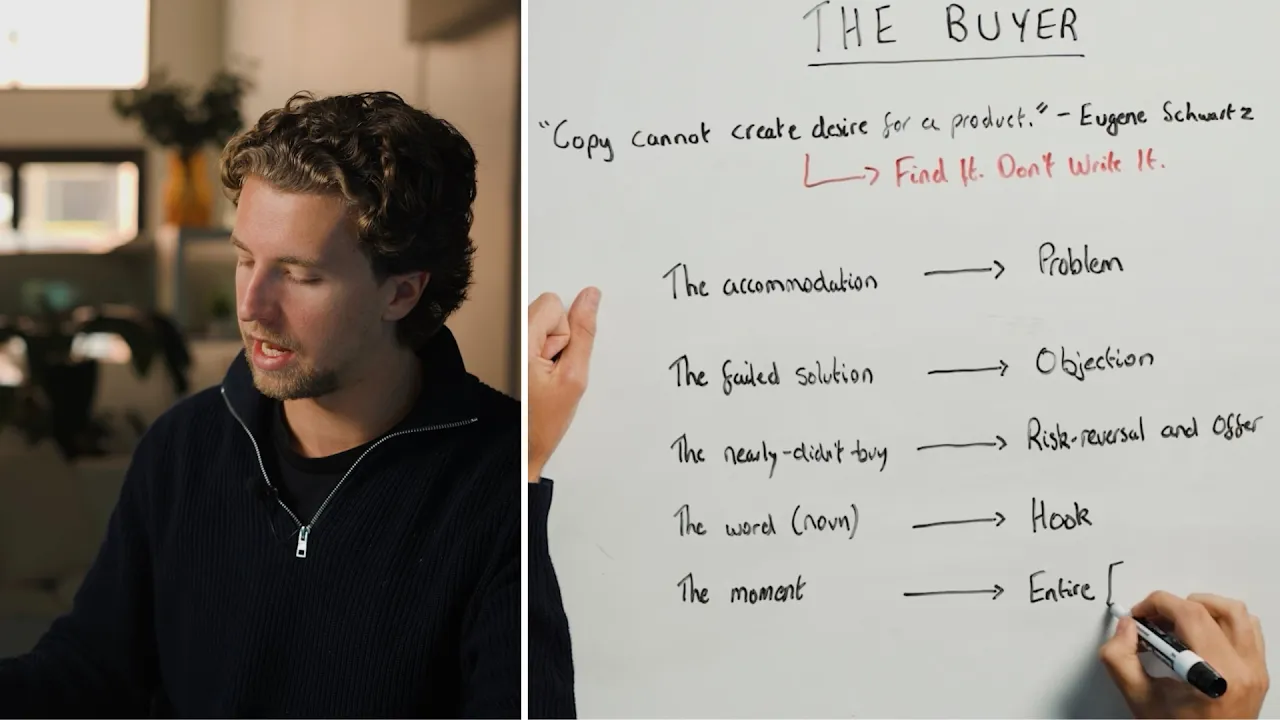
It's going to say that I'm saying words that I'm not saying because of my accent. You want to clean that up. So you can just run it through a model and say clean up all the words, make the sentences make sense. And then once you do that, you make all the call recording transcripts searchable. very very searchable and so then you can go and uh tell a large language model hey I want to look for people who mentioned objections they will say something like I nearly didn't or something relevant to why they didn't purchase go and look for it and you get a much higher quality output because you have cleaned up the source data so this is exactly what you want to be hunting for now that you have all the data you've done all the research what are you actually looking for number one you're looking for the accommodation this is what they've changed about their life to work around on the problem usually without admitting that they changed it.
This becomes the part of the problem within the script. By the way, we have a whole chapter on this. We're just going to be going through how to write the script around the problem as we go back to the script at the start and we start breaking down every single section. The next one is the failed solution. What did they try first? What did it cost them? And why did they stop with that solution? This goes into the objection handling part of the scripts.
The nearly didn't buy. So this is the last thing standing between them and the purchase. This goes into the risk reversal and offer section of the script. The word this is the noun they use for the problem. You can you can expand this further into like talking about language. But what this really becomes is the hook. Like we want to really understand what language, what words are they using to where in just one sentence we can say something that's going to talk to that specific person and hone directly in on them.
And then the moment, this is the specific trigger on the week or the month or the day that they started looking for a solution. This really goes into the entire script, but if we want to hone it down, it goes into the urgency word or sentence of the script. So why should they buy now? What is the trigger? How do we problem agitate on that trigger? Now, the script writing framework that I'm going to give you further in on this video, it has nine core elements or nine core beats or nine sections.
Five of these beats or five of these sections are here. This is how you find them. You can't go and just write a script without first doing the research to find content on the problem, the objection, the risk reversal, the hook, and then urgency and scarcity. Now, you can go and try write a script, but good luck doing any of this very well. Let me give you an example on the word because this is the one that's probably the most overlooked of all five of these, but the most important of the five cuz this is messaging, communication, language.
Let's say that you're selling hair thinning. So, you're selling a hair thinning solution. Now, what most marketers will do is they'll just talk to hair thinning. They'll say like, "Is your hair thinning? Are you having hair thinning problems? My hair is thinning?" Any kind of language that's around those two words. But as you start to dig into all of your research and you start to understand that the language of people that are dealing with this particular problem, you actually come to find out that they never say athenic.
They don't like saying that word. Instead, they'll say stuff like, "I started to be able to see my scalp. I started to look down and see hair in the drain." The language is materially different. And with that language, you better resonate with that particular persona and with that problem. Another thing you might be selling bloating. Now, you can say all day long, do you suffer with bloating? Do you have bloating all the time?
But it's too broad of a persona call out, and it's too factual rather than emotional. And so, instead, we want to use language like, "I looked 4 months pregnant by 4 p.m. And this might be actual language that is getting used in your reviews." You might sell joint support. And rather than talking about joint support or maybe I have pain in my joints, instead you talk to once again more emotional language that is the real language of the consumer dealing with this problem, which might be stuff like I struggle to get off the floor without needing support.
Much more viscerally connected to the actual problem and the state in which that consumer is in. Every time you try to use your own language, your marketer language, the language that is plastered on the packaging of your product like joint support, what you were doing is you are asking for the consumer to try to translate that into their own emotions, their own feelings, their own perception of what they are dealing with.
That's not what you want to do. You want to meet them where they are. Okay, what are they dealing with? Let's speak to that. Let's not try to speak to something that's irrelevant. Give you one last example, then we'll move on. Creatine. You can say creatine is great for muscle support, but that requires the consumer to connect muscle support to them starting to get pain and aches at 55 years old when they go to they've never had that before.
Right? It's a big connection to make. You're trying to ask them to go from that all the way to this state that they're in. So instead, we want to skip straight to the state that they're in, and we want to speak that language to that person. All right. So now, let's go and apply that to the script that we started the video off with. And we're going to apply each of these pieces of research. The accommodation is actually already in here.
It's already done, which is we already pulled this from either a call review or actual review on the website, which is I stopped parting my hair in the middle because that's where you can see it thinning. And so this was used directly for this line. Women lose it at the part line first. So this was pulled from here. For the failed solution, we've got a quote that we pulled out. I did the rosemary oil thing for four months.
My pillowcase smelled, but nothing actually happened. You can see how this is going to be great to work into this script later on. The nearly didn't buy. We've pulled out I almost didn't buy because everything in this category takes 6 months to actually work and I've been burned twice before. In terms of words from the research, we found that they say shedding and they say my part. So they talk about the part in their hair a lot.
They don't say hair loss and they'll never say stuff like alipcia. So it'll always be shedding or my part. And then the moment we might find or pull out a moment where say it was at my sister's wedding photos. If you're calling customers, you want to be asking for the moment as much as possible. Like what was that inflection point? When was it that you realized you needed a change? You needed a solution. You needed to buy a product in this category. needed to buy our product because this becomes really great material to then use in the copy.
So ultimately, look at all this, right? This this is the ad. Like the ad is pretty much almost done here. We just need to clean it up. We need to format it correctly. We need to add a few sections in that we haven't even spoken about yet. And you pretty much got a really good ad. None of this was us writing. Like we haven't even written a single word yet. This is all just from pulling research and data out of the buyer and the consumer.
And so this is why uh people say that the research portion is the most important biggest component of writing because if you don't do all this stuff, if you don't understand the consumer, if you don't understand the buyer and what they're doing, what they're saying, then you'll never get an ad as good as this. And this is some like really great material to start running with. Now, as a quick example as to why this is so much more important than you just asking CHBT or an AI model for all of this data, what you can do right now, and I've just done it on my computer to the left, is go and type into Chacht, "What objections might buyers have to a hair thinning supplement?" And the response that you'll get, cuz I've got it right here, is will this actually work for me?
Where's the proof? How long will it take? What if I stop taking it? Could it make my hair worse first? Are there side effects? Like this is all just super generic stuff that you will get back from any question that you ask a model because you'll just get the average. You will not get good research by using an LLM to go and pull data. You need to pull data from the categories that we showed you before in the order that we showed you before.
And that's how you get a really high quality output that's going to speak to the consumer. Make sure that if you are going to use CHBT or an LLM that you always ask it to retrieve information. You don't ask it to go and invent information. So you never want it coming up with its own words. You want it going out and just scraping the internet and pulling quotes in. And you want it to give you the hyperlink to the quote because that way you can get stuff like this if it's publicly available on the internet and it's just a research tool rather than a tool that's making up the copy and the words for you.
Now you might go, Dan, we don't have time for all of this. like this is so much work. We need to pump out 50 ads a week. How are we going to do 50 ads a week if we're going to have to do this every time? Well, you batch it, right? You batch one large section of res research. You do as much as possible and you structure it through the concepting system. Now, if you've watched our creative strategy video, which is on the way to 100,000 views next week.
So, I'd strongly recommend that if you haven't watched that, that's the next video that you watch from us. We break down exactly how we walk through creative strategy. But the idea here is you want to build concepts. And a concept is a persona. So who exactly are we talking to here? What is the angle? So what is the value proposition? How are we approaching it? This is the messaging. And then what is the offer? What are we actually giving people?
When you do all this research, you want to be researching and finding out who are all the personas, who are all the people that are buying from us, and then what are all the angles? You want to pull in quotes, you want to save quotes under this structure. And what you'll end up being able to do is hopefully you can find a couple personas. You can find two to three different people. If you're a larger brand, you can probably find more than that.
You want to find three to four core angles that we could speak to. And then if you have two different products, like there's two offers here. If you have one product, there's one. And then you can start obviously mixing matching these where relevant. Obviously, the angle needs to meet the persona. You can't give an angle to someone that's not relevant. But then you'll have like 30 or like let's say you'll have, let's be conservative here, right?
Two personas. Let's say three angles work with each. So you're going to have six concepts. Now the nice thing about six concepts is that then underneath this you can make 10 ads per concept. So you've got 60 ads. So all you need is to find a few personas, a few angles and then you're good to do quite a lot of volume. How are you actually getting this volume? If the persona and the angle in the offer is the same, you are getting this through different scripts, right?
You can talk to the same person with the same angle and have a entirely different script. Okay? So it can be a very different ad. You're also creating variations through hook swaps. So change the hook a few times and you've got a few new unique ads which is actually worth doing because 80% of the audience hits the hook. So if you change the hook slightly you'll get more people to watch through. And then the other is format variation.
So you could do a VSSL animation claimation ad and then you could go into a piece of UGC then EGC then founder story like just switch the format but keep persona angle research scripting very similar and you will have differentiated ads which will reach new people which will count as diversity in the account. The next thing we need to understand about the buyer is what do they know and how tired are they of hearing it.
Now this is from Eugene Schwarz breakthrough advertising. This is me simplifying down the language. What this is actually called is the stages of awareness and over here is the stages of sophistication within the market. So what they know what stage of awareness are they at? Are they unaware? Which means they don't know that they even have a problem. An example of this is that I see no problems with using this whiteboard, but you might educate me that there are actually a lot of issues with using a whiteboard and instead you should use this other solution instead, whether it's an iPad or something digital because there's a bunch of problems that I don't even know exist yet.
Or I'm problem aware. I know that there are issues with this whiteboard. I have to wipe stuff out every time and then the markers left behind and so eventually I have to do a massive clean and so I understand the problems or at least I'm aware of a couple of them. Then I could be solutions aware which is I understand the problem. I also understand that there is obvious solutions to this problem. Okay, I could get a better whiteboard.
I could use a digital whiteboard instead. We could do this in a few different ways. There might still be some solutions that I'm not not aware of but generally I know solutions exist. Then there is product aware which is that I know that this specific solution that you are selling exists. An example of that is that I know that an iPad is a solve for this problem. And then most aware means that I am all the way through the funnel.
I have looked at the options. I have looked at iPads. I've seen what kind of apps I could use to solve this particular problem for myself. And I'm pretty close to buying. The only thing holding me back is a really strong reason or probably pricing. And so I'm likely shopping the market deciding what I'm going to do. Now dependent on where someone is in the stages of awareness, the script looks entirely different. If people don't know that there is even a problem, we cannot talk to the problem without first addressing them at the stages of awareness that they're at.
So we have to meet people where they at in stages. It is also the fact that most this is like a funnel, right? Most people are unaware or problem aware and then some people are solution aware and then much less people are product aware of your product and then very few people are in market right now. Now you've seen people try to ascribe percentages to this and the percentages you normally see is like 3% of people are down here, 9% of people are down here.
Then you have like 30% up here and then obviously the entire population, well the entire remainder of the population, sorry, is unaware at the top. What will also happen when you market is that your ROI, your return on investment will go down as you go up because you are speaking to less warm audiences. You're going colder and colder. So, you can go and put an ad in the market and say like, "Hey, we sell Nike shoes." And that's amazing because if you just target people that are currently most aware or product aware and they're looking for Nike shoes, they will buy simply because you have what they're after and they're educated.
But going and trying to take Nike shoes and then educate cold audiences on the product is a very expensive branding exercise because you have to go all the way up the stages of awareness and start selling value propositions, start objection handling against competitors, start telling them about problems they didn't know even existed that you solve. And so the skill required to go up in the stages of awareness increases a lot.
It becomes much harder. It becomes very very hard. There's really not many people in the world like there'd be I'm going to argue they'd probably be in the tens of thousands at a maximum people that can create phenomenal unaware ads. Very very rare skill. It's very hard to do. And you can almost think about your progression as a script writer or copywriter as progressing up in your ability to write scripts at the stages of awareness scale.
Then we have the layers of sophistication. Stage one means that you're speaking to a product and you're first to market. So the claims that you're making, it's the first claims that have ever been made. An example of this is let's say you were the first to GLP1s and you were saying that GLP1s help with fat loss and they can help you lose x amount of weight in 4 weeks. Now, if you're the first person to ever make the claim, if you're the first person to ever say that, and realistically in stages of awareness, we'd actually have to go back past JLP ones, and we'd have to go to the first weight loss solution ever, ever made, right?
If we go all the way back like 60 years, first weight loss ads, they would have been stage one. The reason why stage one is so advantageous and the methodology and the way that you script changes as you go to earlier stages is because you're first to market. No one's heard the claim before, and so people believe you. It's very easy to convince people on something new, right? But then as we move to stage two, this is where the claim already exists in the market.
So people have been making this claim and so with that people trust it less that we've heard this before. I've bought these weight loss products and these weight loss tablets and they don't actually work. And so why do I trust this brand? Because I tr I trusted these other brands and it didn't work. So what happens at stage two? Claims increase. They enlarge. So rather than claiming that this will help you lose weight, suddenly the claims go from this will help you lose weight to this will help you shred 40 lbs in 7 days while still eating whatever you want.
So the claims become crazy and the reason for that is that people stop converting as well because they're used to the claims. So everyone has to become like more verbose in what they're saying, which is where compliance gets pretty sketchy. Stage three, the market becomes tired of all these claims. They've been burned at stage one. We've gone through stage one. We've gone to stage two. Claims have gone ridiculous. Everyone's like, "This stuff doesn't work." Like this guy is saying, "I can make money online.
I've gone through four courses before and like this clearly isn't true." This is the stage in where people start to introduce unique mechanisms. And so this and I'll use the like make money online option is that rather than just making a claim, hey, you can make money online by the course, it becomes you've tried a bunch of stuff. You've tried A, you've tried B, you've tried C. And all of these were from gurus making false claims.
But this isn't anything that what we're doing. Instead, we're doing the Tik Tok ad method, which is completely new and unfounded. No one's even touched this. This is a digital gold mine. You want to pivot into this completely new mechanism because that is what's going to get you there. And so what they're introducing there is like clear uniqueness in the market through a mechanism that no one's heard of before. And so this effectively revitalizes hope.
It's like, oh, we've been told this would work. Then people got ridiculous with their claims. But okay, this seems to be differentiated. Then we move into stage four. Everybody now has a mechanism. So what happens? The mechanism claim then goes and enlargements. Just like from stage one to stage two where the claims got bigger. Now the mechanisms get bigger. The mechanisms get crazier. And then stage five is the mechanism exhausts.
And now the market has become used to the mechanism. And so instead, where does messaging pivot? It pivots to you selling transformation and who the buyer becomes. And so rather than now talking to some unique mechanism that's going to make you money online that you've never heard of before, now all the messaging switches to emotion and it goes, imagine the life you can live. Imagine how things will change. Imagine that you don't have to get up worried.
Like all of this kind of language starts to become very prevalent because we've exhausted mechanisms. We've exhausted claims. They don't work anymore in this market. Everyone's used to it. And so, we have to really tie into emotion. Now, it's important to know in your particular industry, in your niche, where you're from, what stage of sophistication are you in? Just look at your competitors. You can identify this pretty quickly.
Now, the cheat code is that ads at higher stages of sophistication are better at. And so, I don't even really care if the market is in stage one, which not a lot of markets are, but let's say the market is in stage one. Good example of this actually would be AI. So AI is probably in stage two, right? Like claims are pretty big. There's a lot of claims in the market that all these AI rapper softwares can do a lot of stuff.
There are some unique mechanisms getting introduced, but generally speaking, I'd say we're still quite low on the stages of sophistication and people aren't exhausted yet with AI. People are still hyped. They still think like this is this is something that is going to revolutionize at least their work and whatever you tangibly apply it to through the desire that you speak to and you use AI as a unique mechanism. But ads that are up here are always better, right?
Like even if like AI right now is in stage one, you will have a better ad that will do better talking to AI if you talk to what the buyer can become through AI and if you have some kind of unique mechanism within the AI frame. If you can do that, it's much better ad than just making claims. Now, you can make claims with AI and you can get away with it. People are getting away with it right now. Like, you just make a claim that AI can do some stuff.
You'll sell some courses, you'll sell some software, you'll sell whatever it is that you're selling, but you'll sell a lot better if you go up here. Before you write every ad, identify, circle, who are you talking to? What stage of awareness are we talking to? What stage of sophistication are we speaking to? Because also, although the whole market will sit in one stage of sophistication, the reality is is that there is a bell curve of people sitting across these stages. as an example for AI, I would be very high up in the stages of awareness.
I'm very skeptical of the topic. Like I'd say that I've I was an early adopter and so I've gone through the bell curve faster and so to speak to me, you wouldn't be able to speak to me at all or sell me through these stages. You'd have to go way up on the stages of awareness to actually convert me. And I would probably sit on product solution to product aware on AI products and AI solutions. And so if you wanted to talk to me, you would have to select here and here.
Now, you might want to talk to me in some ads and then talk to other people in other ads. That's how you open up your total addressable market. You get more scalability in the account. You get more scale in the business. Ultimately, the more people you can talk to, the better. And so, you might do some ads like that. And then, you're going to do some ads at problem aare on stage two to three. And then, you're going to do more ads on unaware stage five.
And you mix and match. And that will obviously change the language, change the ad, change who you're talking to, and ultimately change who you reach on the platforms in terms of targeting. A phrase that Dan Kennedy would use is you want message to market match. And so whatever your messaging is within the ad, it needs to meet the market that you're speaking to. So you need to identify who is the market that you're speaking to so you can start crafting the message.
Awareness and stage of sophistication is a property of the whole ad rather than a unit uh that sits within the script alone. And so I have seen before a video will get written by an in-house copywriter as a problem aware ad because the copywriter went and put the brief together. Then that will go into the creative team and they will create a static that gets built at the product aware level because the designer just pulled in a shot of the product rather than actually being across what stage of awareness we're talking to here.
Then the primary text will get written as solution aware because somebody in the team or the agency just went and quickly put the copy together but didn't actually think about what stage of awareness are we in right here. Meaning that nobody in that chain really did anything wrong. It was just that no one clearly stated and labeled and said this ad is at this stages of awareness. Does everyone understand this? All of the production line has to be congruent.
So what ends up happening is this ad doesn't work because the buyer is hitting three different starting points in terms of stage of awareness. the targeting doesn't know who to go after and the messaging is just really messy. Let me give you stages of sophistication examples for this core script that we're going through. Stage one would be you saying this is a supplement for your hair. Stage two would be you saying this is the strongest hair supplement on the market.
So you've increased the claim. Stage three would be you saying it's not about the hair, it's about the follicle. And DHT is what's shrinking it. So we've introduced a unique mechanism. We use pelito at the dose that the studies actually use, not the dose that everyone else is using. So we've got the unique mechanism, but we've ramped up the claim on the unique mechanism, which is that yeah, everyone's using this mechanism, everyone's using this ingredient, but not at the dose that it should be based on the clinical studies.
And then we go all the way to stage five, which is leaning into emotion and what the buyer is going to become, which is the women who keep it are the ones who started before they could even see it. And so we're going to be integrating some of this kind of language, some of these kind of quotes into this script as we continue to iterate on it. What about stages of awareness? How does this tie into the script that we're working on?
An example of unaware would be the photos you don't like of yourself are usually taken from behind and there's a reason for that. So they don't even know that they're thinning. They don't even know it's a problem, but we're going photos from behind, you don't like them. Here's why. Here's the reason. If we go to problem aare, we're saying if you've started parting it on the side, this is for you. So, we're speaking to the problem, but we're not doing a persona call out.
We're actually speaking and agitating on the problem that they have. Solution aware. Most hair supplement doses use pelito, by the way. That's the ingredient at a fifth of what the studies used. So, they know the solution exists. They know about the unique mechanism, which is the ingredient, but now we're objection handling against other solutions and why ours is better. Then product and most aware kind of the same thing in terms of messaging.
It's becomes very similar. What actually starts to differentiate these two stages is the ad type more than anything. Messaging in product-most aware would be the 90day pack is back and it's the last run at this price. Okay. So like they're very very product aware. They're very low down in the stages of awareness and we're just trying to convert them. Now we understand the stages of awareness. We understand the layers of sophistication and we still technically haven't written a single word yet on this script.
And that is on purpose because we need to understand these things. We need to start selecting, okay, what are we going to what is all the research? Who are we talking to? What layer of sophistication is this going to be? 90% of the work is done before we even put the pen down. And once we get to the scripting stage, it's going to be pretty quick. Now, a bit of an important caveat to throw into this, which is that thing that'll ultimately beat everything is the offer.
And so, if we start ranking a list of importance, number one is the offer. Then it is the market that you take that offer to and speak to. Then it is the unique mechanism. Then it is the proof and the credibility in which you can sit the brand. And then there's everything else you've ever focused on within scripting. The reason why I say this and put this in this video is because you can go and become the best copywriter script writer in the world, but ultimately if you do have a bad offer, people just will not buy from you.
And the subset of the offer to be clear is and we we have a one maybe one and a half hour video on offers in e-commerce. So I would highly recommend you watch that video. But to break this down really quickly, the offer is going to be the product and it's going to be the value perception. That is really the two core components of what an offer is and why this is so important. What do I mean? If the product sucks, if you just have a really bad product, good luck.
Now, you can be good enough at marketing to sell bad product. People do it all the time. Like literally all the time. The issue is no one will ever repeat buy. And the only reality is that as you scale, CAC will continue to go up no matter how good you are at marketing. And if you do not have repeat purchasing and if you're not building brand over a long time horizon, you are just capitalizing on a short-term arbitrage opportunity that is going to shrink and you're gonna have to move on to the next thing and just continue scamming people if the product's not good.
So the product has to be good. Step one. Step two, consumers have to see some kind of value perception here. Now, you can write scripts good enough to increase value perception, but one of the easiest ways to do that is to just reo the offer. And so like can we go on a quarterly bundle but then add in five gifts that they get and then we can write our script around why those gifts are so valuable. Like if you make the offer better everything else will become a lot easier.
And if you have a really bad offer and a really bad product you will find it very difficult no matter how good you become at script writing and copywriting and talking to the buyer and the consumer psychology. It doesn't matter doesn't matter if the offer is bad and the offer is used in a lot of the scripting as well. And so we will be limited in our ability to copyright and script if the offer isn't good. Let me tell you the elements of an offer that's important when it comes to scripting.
It's the thing, the terms, the reversal, the reason for now and the effort. So the thing is what do I actually get in my own words? So like what are we selling them? The terms is what does it cost me framed against them? The reversal is what happens if it doesn't work? How do we risk reverse? And if that's not in the offer, then obviously we can't risk reverse in the script. We can't say that they can get their money back in seven days if it doesn't work.
If they can't get their money back in seven days and it doesn't work, right? So the offer is reliant for a lot of these tactics that we can use in the script. The reason for buying now like why should they buy this week rather than in 2 months time? Once again, this is really contingent on the offer. So is there some kind of urgency or scarcity on the offer? We framing the product as something that is required now rather than later.
Offer becomes important here. And then the last is the effort. So what do I have to do and how long does it take for me to get this to work? And so that is also once again contingent on the offer because there is stuff that you can do with bundles or changing uh the product slightly or changing the offering so that you can decrease effort and increase perceived likelihood of outcome. I wouldn't mind getting a little bit tactical on how you can actually script around pricing.
So some pricing tactics that we might even put into this script later on. Number one is that you can anchor against an alternative. So an example of a bad script. What people will do here is they will say it was $89, now it is $69. A better rewrite of that would be that you can say one appointment with a hair specialist doctor will cost you $200 and they're just going to tell you to take this product. Okay? So you're reframing as what's the alternative?
You can go to a doctor to try to fix your hair thinning or you can just buy this which they're going to tell you to buy anyway. Number two is you can reduce to the ridiculous. And so this is where you'll reduce to like a daily rate that can be compared to a coffee. So a bad script would be it's just $69 for a 90-day supply. A rewrite a good version of that script just spend 73 cents per day, which is less than the coffee that you're drinking while you read this or watch this right now.
And so you're reframing down to a day by day or a dose by dose. Number three is you want to price the problem rather than pricing the product. So a bad version of this script would be it's only $68. The rewrite would be you've spent more than this on two other solutions and they didn't even work for you or like what is the price of the problem? If you don't get your interest rates down on your loan, then what's the price of that?
Like for the average person with a home loan, it's $500,000 2%. That's going to cost you $50,000 a year if you don't fix this problem. And we can solve it for you for $400. Last tactic is you can make the effort the price. So rather than saying something like free shipping on orders over $50 or whatever your price frame is going to be, rewrite it, scrap it. Instead, frame against how loweffort this is going to be. And so if it is taking creatine and like creatine powder often people can't get into a habit because creatine powder is terrible to take unless you put it in like a protein shake and mix it in.
Instead you say it's one gummy every morning. You'll forget you're even doing it because it's just a part of breakfast. And so you substantiate price through the decrease in effort. And then quick tactical rewrite on guarantees. Classic guarantee that people will put in scripts is we have a 30-day money back guarantee. So if you don't like it, you can get a refund. pretty apt rewrite for this particular script which we'll include later.
Take it for 90 days. If your part hasn't changed, send us the empty tubs and we'll refund all three. What does this do better than this? Well, like so much. Almost every word is better. But if we're to framework it up, number one, it is very specific. Everybody has a 30-day money back guarantee. If you can get much more specific with like what specifically we're going to guarantee, it's going to cut through and uniquely differentiate.
Number two is that it is slightly uncomfortable. A guarantee that costs the seller nothing really doesn't prove anything. So a 30-day money back guarantee to most people is like ah if they're doing that they must not be like losing much money. But if we're like if we increase the stakes we're like no no we're not just going to refund you. We're going to refund you 3 months worth and we will pay for you to send us the tubs.
By increasing the stakes it increases the confidence and what you're saying is actually true. And so when I say slightly uncomfortable, it doesn't make the consumer uncomfortable. Like me as the person watching that ad, I go, "That's amazing." It should make you feel slightly uncomfortable because with you making this claim, you're like, "Oh, that's a that's a little bit of a big claim. That's not just an easy 30-day money back guarantee.
Like, we're we're really putting ourselves behind this." And because of that, that's actually what's going to make it work. Number three is that it's directly matched to the mechanisms timeline. So, we expect this ingredient and this product to work over a 90-day period. So why would we guarantee on a 30-day, right? We guarantee on a 90. Reinforces the mechanism, reinforces our confidence in the fact that it takes 90 days, reinforces any studies that we show that might also be similar to this.
And then number four is the most important thing in meta advertising, which is the messaging. So it's reinforcing the unique mechanism of 90 days. It's reinforcing the language here that we're talking about the hair part. We are also reinforcing that if you actually just use the product and you empty out the tubs, that is what will make it work. And that's why we will only refund if you use it. Before we move to section two of this video and we move away from the buyer, a common objection I'll get, particularly when saying the offer is really, really important when we're framing up and scripting the ad is that I'll get I'm just the creative strategist.
I'm the the copywriter. I can't change the offer. that's a business direction move and it's three levels above me which is half true but it's also half not true and that's the half that I would actually be worrying about. I wouldn't worry about the stuff that you can't control. Sure you can't control changing the price and you shouldn't really be changing the price as the copyriter or the creative strategist or the agency.
Like that should be determined by the highest uplevel people within the business that understand the price elasticity and where we want to sit within the market. Really what you want to do on the offer is identify things that the business is already doing or would be very low risk and easily implementable and then just use that better within the messaging and the language of the ads. If you think back to the stuff that I put up before, four of five were things that the business was already doing, but they just never said free returns isn't a pricing decision, right?
Most people do free returns anyway. It's just how are we going to package this up and present it within the messaging rather than saying free returns putting it into the primary text or putting into the script. We're going to say the exact same thing, but we're going to reframe it around we're going to refund the first 90 days, but you got to send the stuff back to us and prove that the tubs are empty and prove that it actually didn't work cuz we're so confident it will work.
The 90-day pack, right? So, we're putting that guarantee on the 90-day. The offer would need to change to someone actually buying 90 days worth. And so the 90-day pack probably already exists. Everyone in the company would be probably happy to just put a three-pack bundle on the website, even hide it, put it on a custom landing page. Like that isn't a big offer change at all. But now it's congruent with the messaging and what we want to do here.
The reason for why they should buy right now, the urgency, the scarcity in the offer. Well, that's probably built into the mechanism of the product, right? Which is that like if you're losing your hair, you should buy it as soon as possible because you can never get your hair back. Like you can't reverse thinning. You can only stop it. And so that wasn't a now it seems like a change to the offer because we're increasing urgency and scarcity, but we're not.
So you can really change the perception of the offer without actually materially changing anything about pricing or structure on the website or the product. An offer isn't a discount. It isn't a bundle. It isn't a free shipping threshold. An offer is a reframe from the consumer's perspective of the value that they're getting. So we have covered the buyer, we've covered the market, and we have covered offers. and we still haven't written a single sentence.
So, I want to start writing. I want to start fixing this script. So, we're going to go into section two of the video. And we're going to start with the highest yield mechanical edit that you can make on this script. All right. So, let's start with specificity within the arguments that we're going to make. I want to start off with pulling a lot of lessons from Hopkins. A lot of this is directly from his work around specificity.
So, we want to be specific in whatever we talk about, whatever we script, whatever copy we write. The latter of what the specificity looks like is we want to start off with numbers. We want to be using measured numbers rather than just random statements. Now most people should know this. If you don't know that use a number like it's much more powerful saying 98% of people get clearer skin than saying most people get clearer skin.
Okay? So using a number is good. A named third party is the second. Number three is specificity in a very specific physical detail. Number four is specificity in a time. For example, it will take 87 days to for you to start saying results rather than just saying it'll take some time. And then you want to use proper nouns. A little bit on this adjectives. Anyone can use an adjective. Any competitor can use any adjective.
And that's why it's not very good. Adjectives are the writer's opinion or the ad creator's opinion whereas specifics are evidence. And so what we're doing here is building evidence rather than just making subjective claims or subjective opinions. I'll give you two examples. Example number one, our serum leaves skin looking healthier. Probably heard that a thousand times. Instead, it's 0.05% retinol and the first tube is dose low on purpose.
What we're also doing there is creating a curiosity gap that we'll then solve by the end of the ad. But this is obviously much better specificity. Another example, a shorter example is rather than saying fast absorbing, we say it's dry in 40 seconds and we actually timed it. Much more specific. There's proofing built in at the end here as well, which makes it a much better script. Oglev says that research will always be adjectives.
I'll give you an example. You can say luxury craftsmanship you can feel. Now, the issue with this is you're sitting outside of the manufacturing process. You're sitting outside of the brand and you're trying to come up with descriptive language. Okay? It's really luxury. You can really feel it. Like you're trying to convince people through adjectives. Instead, one simple fact about the manufacturing line if you just went in and looked at how they made stuff is you could instead say one person stitches each pair start to finish.
It takes her 4 hours. Now suddenly you're like, well, 4 hours to stitch this and it's all stitched start to finish. It must like we know it's luxury then and we know that like we must be able to feel it. We don't even need the emotive language. We know the stakes. Hopkins wrote this in 1923 and it's and it couldn't be more true than it is today, which is platitudes and generalities roll off the human understanding like water from a duck.
They leave no impression whatsoever. To say best in the world, lowest prices is at best to simply claim the expected. This is what most of the scripts that you read and the ads that you watch are doing. Premium ingredients, superior quality, unmatched results. Every one of those is a word that your competitor can also just use whenever they want, which means it carries no information. It gives no reason for people to buy the product, which means that the buyer and the consumer will just delete it from their memory from the script before you've even finished saying it cuz it's meaningless.
It holds no weight. If you remember at the start, this is what all these claims were. Vegan, cruelty-free, made right here in Australia. These hold no weight. They're meaningless. they don't even need to be here because they get the consumer no closer to purchasing. Specificity also translates into urgency messaging. This is something that Albert talks about which is that you don't just want urgency. You want honest urgency because honest urgency creates specificity which is much more powerful than just saying stuff.
For example, a weak example of urgency would be you saying limited time only. Don't miss out. Weak meaningless would never do it. Instead, if you rewrite that to something honest, let's say you're a creative agency. Let's change industries for a second. You could say, "We make 400 ads a month. October's already gone. Our next batch ships on the 14th of November. You need to get in before the end of this month to be able to be involved in that batch." That's real.
It's real scarcity with a real number, with a real date. It's not manufactured. And people can feel that. And it also carries with it specificity. There's this really good story about Hopkins and it's when he went to the Schlitz brewery in 1907 looking for a claim that he could put within the marketing and he watched them sterilize the empty bottles with live steam and asked why nobody had ever mentioned that they do that.
The answer was that every brewer did it. He ran it anyway because no one had it in the messaging and Schlitz climbed from fifth in the market to the very top of it. There are a couple good lessons and questions you should be asking off the back of that. Three questions I'd ask is what does your factory do that you assume is boring? Can probably be used in messaging. What did you reject during the formulation process?
There's a story there. There's something that you can weave into ad messaging. And what constraint did the product impose on you that you've never mentioned before? There's usually a bunch of constraints all over the place and you could probably use them in the messaging and the reasoning as to why someone should buy and how you're uniquely differentiated. An example of this is that you could say that we have the best magnesium on the market.
It's going to soothe your muscles. It's going to make you feel way better than the other magnesium. Or we can go ask these questions and then dig into a unique mechanism and what separates us, which is that we could say uh most magnesium is magnesium oxide. It passes straight through you and it's the easiest to manufacture, which is why all of the factories produce it. But ours is magnesium glycinate, which is what your body actually absorbs, but it's much harder to produce.
We had to jump over hurdle after hurdle. We have to do XY Z in the factory. But it actually works and that's why we did all this stuff and that's why we put in all this effort. Important thing to understand here is that you can take a process which is in the factory and you can turn it into a unique mechanism and that's really powerful. Now a common push back that I'll get on the specificity section here is well we can't be specific because that puts us at compliancy risk.
Okay. So like we can't say that it will do XY Z with this specificity because we can't back the claim. You can still be specific without making a claim. Okay, you just have to be more careful and you have to uh guide the narrative a little bit better. So you might say that you might do a time duration like a 90day rather than talking about a very specific time component in which it will fix. All right. So what is the script structure?
What is the framework? There are nine core sections, nine core beats that I mentioned before. Number one is the hook. Number two is the problem. Number three is the promise. Number four is the mechanism. Number five is the objection. Number six is the proof. Number seven is the offer. Number eight is the risk reversal. And number nine is the call to action. This is how you should be scripting all of your ads. This is the exact framework.
Let's go through what each one does. So the hook buys the attention at the start. So this isn't going to sell anyone, but it's going to capture the right people. It's important because if people don't like the hook, they scroll past and they don't watch the app. So we all know the importance of a hook. The problem is important because we're problem agitating and we're naming the consequence that they've already accommodated or that they already have.
This is for context from Eugene Schwarz. Number three is the promise. This states what they get in their terms. The mechanism gives them a reason to trust or believe the promise. We then move into objection handling which is uh talking about all the other solutions that they have tried in the past. We then move into proof. So we're substantiating the claims on the offer. We actually present the product. Then what is the product?
What is the offer? We then risk reverse to make the offer look a lot better and be more convincing. And then we have a call to action. Let's dig into the problem. When we're scripting out the problem section of the script, we want the symptom and we want the consequence. We always want to be agitating the consequence, not the symptom. A symptom is what the body or the day is doing. But the consequence is what the buyer has already had to change about their life to accommodate the symptom.
And the consequence is what the buyer can't unsee or forget about once you've mentioned it and brought it to light, said it out loud. The symptom they likely already know about. You also don't have to invent the symptom. We actually called this something else at the start, which is that we called this the accommodation. Let me give you an example and then we'll actually pull this in and we'll start rewriting some of the script.
Weak would be saying uh bloating can be uncomfortable and frustrating. The rewrite is you've started planning what you wear around which days are bad. Now, why does this work so much better? Well, it's because the weak version describes the state that the buyer already knows that they're in. So, it buys nothing. But the rewrite describes the accommodation that they have made in their personal life that they've never publicly admitted.
And so it's directly calling out a persona without needing to directly state them or call them out. And it's going to stop their scroll and actually get them interested. So here's the rewrite. And I actually made a mistake before, which is that the accommodation is not the symptom. The accommodation is the consequence. And so you're accommodating your life in some capacity due to the consequence of the symptom. Just for clarity, that was messed up.
That's where the arrow should go. Currently, this is actually the best part of the script. And we're rewriting the best part of the script, but this actually isn't that bad. If you're finding more hair in the shower drain, you're not imagining it. And then arguably, this is also proper agitating a little bit. Women lose it at the part line first, usually about 18 months before anybody notices. Now, what we've rewritten this to is you've stopped parting it in the middle.
You didn't decide to do that. You just started doing it. Now, why does this sell harder? It sells harder because the shower drain is a symptom. So, this script right here is talking to symptoms. Number two, the shower drain is owned by anyone and so your competitors can write this as well. And you would argue that the category already leans pretty hard into it. The difference between the shower drain and parting your hair is that parting your hair is a consequence, an accommodation for the symptom.
And so we can agitate on consequences. We can't really agitate on symptoms. Like us saying, "Oh, there's shower in your drain. Sorry, there's hair in your drain. Ah, no one cares about there being hair in their drain. As long as it goes down and it doesn't cause a bass and etc. No one really cares. What do they care about? They care that the hair is falling off their head. Like that is the that is the consequence of that symptom.
Why this works even better is that the target demographic probably hasn't heard this before in an ad. She hasn't said it out loud, but it's a direct problem that is she has actually dealt with. Now, where this can get even more powerful, in my opinion, this type of script and this type of frame is if you change from first to second to third person. And so, you can change this to first person and put it into a piece of UGC, EGC, or a creator content or a VSSL, even even an animation VSSL would be good.
And you instead switch it to I stopped parting my hair in the middle. I didn't decide to do it. I just had to start doing it. Right? that will be a little bit more personal and it'll just be another angle and a variation that you can test. It might outperform this second third person framing. So you want the problem part of the script to last about 10 to 15 seconds. Any longer than that and we're just agitating on consequences for way too long.
Now I have seen formats in which you can drag this out. A good example of this is like claimation AI animation VSSL ads. They will problem agitate for a long time. I've se I've seen really good high performing VSSLs probably agitate for like 2 minutes not needed like you can do them do them as variations put them in the account I've seen some of them hold like half a mill million dollars in total ad spend but you don't need to do it for your average script okay every script doesn't need 3 minutes of problem agitating give it a shot but generally 10 to 15 seconds there is a way that you can really fail on problem agitating and problem scripting and that's where the agitation starts to read as complaining.
It'll happen whenever you go and stack a bunch of symptoms instead of escalating towards a consequence. And the tell on whether you're doing this or not is whether you can swap any of the lines with any other line and it won't actually change the argument. Meaning that if the order doesn't matter, you've written a list rather than escalating the viewer or the prospect towards something. You can enter into a problem script with really like three core entry pathways.
One is you enter with the accommodation. Number two is you enter with the moment. Number three is you enter with a failed solution. Just worth noting that this puts you into the solution aware stages of awareness, which is totally fine. You can have tons of ads in the solution aware stage of awareness. Just important to note that's then who you're speaking to. You lock yourself in. What do these actually sound like? Accommodation is what we just did here.
You've stopped parting it in the middle, right? We're talking to a consequence, an accommodation. The moment is what I said before when I said it was a photo from the wedding, but from behind. So, we're talking about the moment in which someone realized they started feeling uncomfortable with their hair thinning. We speak to the moment or we speak to a failed solution, which is that you did the rosemary oil thing for 4 months, did nothing, just made your pillowcase smell, and nothing really happened.
Right? That's what we're talking about the failed solution as the opening of the problem agitating. People often think that failed solutions only land in objection handling because we want to objection handle everything else that they've done. But you can agitate on failed solutions. Right now, an objection that I'll get here on this part of the script writing is that our brand doesn't want to be negative. Right? Our brand is aspirational.
Our brand is looking up. We don't want to problem agitate on your hair parting. Right? That's fine. You can give them aspiration and you can keep the same level of accuracy because they're not in conflict. Nothing on this board is necessarily negative. You've stopped parting in the middle, right, which is what we used. It's not an insult. It's an observation. And the reason it works is that it's true when nobody has said it.
What brand teams or yourself actually probably objecting to is pity. You don't want there to be pity within the brand's messaging. Pity is what you get when you stack a bunch of symptoms and you describe someone as a sufferer. So you're framing them into being a sufferer. Now you can take problem agitating too far and that is where you start to frame someone as a sufferer. And that's what happens really when you extend the problem agitating part of a creative out to 2 3 4 5 minutes is that you are really starting to lean into this kind of messaging and totally fair that you think that that would be an objection to the brand.
The difference here is that we're naming just one thing and we're letting the consumer recognize it in themsel. The rule I would give is that you always want to frame against an accommodation, never the affliction. And that should generally allow you to pass through brand reviews and stay more on brand. There's a few things to be careful of when you are going and you're writing out the problem part of the script. Number one is you generally want to argue to a degree at a category level rather than a product level.
At this point in the script, you haven't introduced the unique mechanism yet. So, we're not really trying to talk about your product. In fact, we're really trying not to introduce the product at all. And instead, we want to talk about the category at large. Reason being is that you can't dismiss an entire category as like marketing hype. You might be able to with AI and stuff like that, but generally speaking, like you can't say the entire industry of preventing hair loss is completely a lie, right?
There's a little bit of authority automatically built into the category level. And so you want to move up to the category and then home down into the product as you move through the script. If you do this too, you're not asking them to believe anything about you yet. You're not really asking them for belief until you get all the way down here towards the end of the ad. The next thing is that you always want to problem agitate on one person, not two.
This is the single biggest predictor of really whether the problem agitating part of an ad will work well. You can't problem agitate everyone. You can't problem agitate multiple people. You have to problem agitate one single person. And then the last thing is do not resolve the problem in the problem part of the ad. The whole point in this part of the ad is to create discomfort. It's to be uncomfortable. You don't want to resolve it straight away.
You want to sit them in the discomfort and then you want to move into the other stages. So what you can actually use from this right now latest script that you've written is take the problem section out of the script and ask whether it names a symptom or an accommodation. If it's an accommodation, aka a consequence, you're on the right track. If it's a symptom, which most people use, the fix is going back to the start of the video, doing research, and finding out what are some accommodations, what are some consequences of the core problem, and then pull that into your script.
So now the prospect recognizes themsself in the ad. Now we need to tell them what are they actually going to get and what is the promise of delivery here? How are we going to solve? And so that's where we move into the promise and the mechanism. So we want to answer what does she get? The woman that we're talking to in this particular ad, the target demographic, what is she actually going to get? Most scripts that people write never actually answer that question in a single sentence.
Instead, what you will often do is you'll describe a problem. You'll then explain the mechanism. You'll list a bunch of proof, and then you'll have a call to action, and you'll ask for the sale. But then the buyer in this case the person that we're trying to talk to is left to work out what the actual outcome is for herself from the context of the little amount of information that you've provided. So what are the failure modes of promise mechanism?
Well number one that there's no promise at all. People will often go problem straight into mechanism but they won't have the promise section. This is really common in like technically minded brands. So brands that sell a very like technical solution. It's a really common shape in supplements as well. Second failure mode is five promises. People make way too many promises and so they all lose their value. An example of this is the vegan cruelty-free made in Australia, right?
Just a bunch of promises that are meaningless. Promise stated as a feature. This is actually kind of common. For example, people would sometimes say that this part of the script with six clinically studied ingredients, they're saying that's a promise. Not a promise at all. It's just a a feature. It's an input. it's not what we want to be talking about here. And then a promise bigger than the proof. We actually dive into this in a lot more detail in probably another 30 to 40 minutes in the video.
So I'll leave that there. So with our original script, we don't have the promise, right? This is one of the issues with it is we go straight from the problem into the mechanism. So let's add a line. We're going to add the line into here. Here's the promise we're going to add. This is about keeping what you've still got, not getting back what's gone. And to my understanding of hair loss, that actually is a really good compliant claim, which is that I don't really know of any solutions other than surgery that allow you to increase the density of hair.
You can just stop it going away. You can stop it getting worse. And so that's what we're saying here. And it's truthful if they know anything about the topic, which they should because they're dealing with this problem. So this is a great way in which we can implement a promise that is talking to them in between the problem and the mechanism. This also effectively uses the Ben Svena rule which is that a smaller promise that you can prove will outsell a larger promise that you can't prove every single time.
So we can prove this. We can't prove something more extreme. So we shouldn't say something more extreme. So what people will commonly do is they will only have two of these three elements but the three elements all work together to push someone through the cell. So the feature is what it is. The promise is what you get and the mechanism is how you get it. Aka the thing that produces the promise. Features alone sell to an already convinced audience which when you're trying to push to cold audiences and scale cold targeting that's no one.
So a feature by itself is selling to absolutely no one. The promise also really won't sell people by itself because anyone can make a promise. The whole category is probably making promises and dependent on the stage of sophistication, it's probably not going to work in isolation. Although you need it as a bridging mechanism and as a way to complete the story so that then when you introduce the mechanism it makes the promise believable and it differentiates you inside of the one sentence.
So you can promise mechanism feature all very quickly and you get a script that convinces someone and pulls through and gives them a reason to buy. A good way to think about this is that you're saying the feature which means the promise which is why the mechanism and I'll give you an example. So saw pelmet meadow. So this is a ingredient 320 mg that's the feature then the promise. So you can ask yourself which means you stop losing hair at the part which is why DHT is what shrinks the follicle every cycle.
Pelito blocks the DHT enzyme. So we're listing what the feature is. We're then listing the promise. So like what does it actually mean? And this is why the promise is important because people skip the promise because it's like anyone can make a promise. But the promise to an unaware or cold audience explains like what does this actually mean for them? We can explain the features, the mechanism, the jargon. What does it mean?
Well, it means that you won't lose your hair. Why won't I lose my hair? Well, because there's this unique mechanism that you didn't know about, and this product actually fixes it. So, the next thing is a promise always has to be followed by a mechanism. An example of this is that a weak script would say it has as much caffeine as an energy drink, but you don't get the crash. Why don't you get the crash? There's no unique mechanism that explains the why or gives the consumer a reason to believe this is different.
And so instead, you would rewrite it to caffeine gives you the alertness and the jitters in the same dose, but eltheanine cancels the jitters out. So you no longer feel the crack. And so you introduce that unique mechanism, which in this case is elanine. In the case of supplements, it's pretty much always just the ingredient. When you list a feature and it has no mechanism, you need to either go and find a real mechanism to be able to put in there or you need to switch the feature out.
If the feature isn't paired with the mechanism, there's no point in even putting it in. Or if you cannot find the feature with a unique mechanism in your entire product and all of your advertising, then you need to just switch it out for proof. And so this is very commonly done at the lower down in the stages of sophistication, which is that you will just promise and proof, promise and proof. So you're like, we can do this for you because look at our results.
But you never actually introduce any kind of unique mechanism. It's not going to work as well as this, but it's your alternative. Now, the order in which you present these two is really important. Some people, and you see this very commonly in scripts, probably now that I've told you this, 30 to 40% of ads that you watch now on your feed, you'll notice that people make this mistake, which is that they introduce the mechanism before they introduce the promise.
Example of this is, and this is a real ad, they say lowers grein and increases leptin, which makes you less hungry. Now, the issue with structuring in this way is that the retention curve falls as people go through the ad. And if you're opening at the front of the ad with technical jargon language that people don't understand, you'll just lose a bunch of people and they won't even understand what it means and they won't even get to the promise.
And so you want to introduce the promise because everyone knows what the promise is. It's going to hit the whole TAM and then you move into the unique mechanism which also then makes sense cuz it's clarified by the promise. So how you would rewrite this is you stop thinking about food at 11:00 a.m. because the ketones suppress ghrein which is the hunger hormone. So suddenly you stop thinking about food at 11:00 a.m. We're actually problem agitating on something that they're feeling and then we're moving into the unique mechanism and explaining it.
Always present the promise then the mechanism. And if you do not have a mechanism, find a different feature or value proposition that has one. And if you still can't do that, switch it all out for proof. Now the objection we'll get here is, well, my product doesn't have a mechanism because it's a t-shirt or it's clothes. But there's still a bunch of unique mechanisms that you can talk to there, right? It has a fabric which could be unique.
It has a construction process. It has a supplier. It has likely some kind of wash test that is done during the supply process. There's a person who cuts the t-shirt out. A mechanism is just the reason that the feature produces the promise. Every physical product still has one because somebody made a decision and that decision has a consequence that you can go and name. Marino wool in a t-shirt is an argument. The fiber is crimped so it traps air so it holds odor in the fiber rather than on your skin when you're working out.
There's no chemistry in it. There's no ingredient technically that we're using like we would in supplements, but there's still so many unique mechanisms that you can find. Another really important disclaimer here on this part of the script is you don't want to name the product before the un before the mechanism is introduced and understood by the consumer. An example of this is that if you sell electrolytes, right? You don't want to give away that you sell electrolytes right at the start and that's what the product is because then you just fall into the sea of every other electrolyte provider and then why don't you just go to the cheapest option cuz they're all just selling salt and a little bit of magnesium, right?
So instead, when you're at this part in the script, you want to introduce some kind of mechanism that differentiates your electrolytes from everyone else in some kind of way. Now, once again, your electrolytes could be the exact same as everyone else, but you look at the manufacturing process. You look at something that's in the supply chain and you can pull on that and then make an argument for why it's better. Even if it's just the flavor, like you can speak to the fact that you spent 6 months in the factory doing this, that, this, and then discovered this process, which allowed for the flavor of the electrolytes to be substantially better.
Like, whatever the mechanism is, you need to lean into the mechanism and then you need to introduce the product later down. What I also don't like is that sometimes people use a contradiction and they think that a contradiction is a mechanism, which it isn't. So, an example of a contradiction would be saying that this caffeine gum gives you as much energy as a coffee, but you don't get the crash. Now, you look at that and you go, "Oh, that's like that's a good line.
We should probably run that." But the issue is you're not actually introducing any kind of mechanism there. You're just in introducing a contradiction. You're trying to open a curiosity gap, but we don't have any way to substantiate it at this part in the script. And so you either need to in introduce the mechanism here, you need to move that and make it the hook instead or you need to remove it entirely and think about a rewrite.
A little side note, all of this also applies into the design of static ads. So when you're putting static ads together and you're trying to get something that's a little bit more top of funnel, it's effectively the exact same process is we want to think about where are the where's the eyes going first. That's going to be the hook. Then we want to move people into some kind of problem agitation. Now that could just be in the imagery.
And then we need a promise, a mechanism. And then we need to ideally have some kind of objection proof offer. If we don't, this stuff then all goes on the landing page because we don't have enough room to work with in just one static ad. And we keep all of this in the static. Now, we've talked about the problem promise mechanism, but we skipped the hook at the start. So, let's dive into the hook. First thing is the visual element.
So, right out of the gate, you can choose two different formats. You can go like lowfi native or you can go hi-fi clearly an ad. That's really the two distinctions that I'd make here. In bucket A, we have hero. We have polished up hero shots. We have like your logo is centered in the middle. You've got a tagline. You've got something that's obviously an ad, very professional. On B, we have an example of like it opens with a screenshot.
We've got notes to self. We've got loi talking cam. So, we all intuitively know what this is. This looks native to the platform. This is something you would actually potentially post on organic. This does not look native. This looks like an ad. Generally speaking, we would opt to put majority of your focus over here. This has a role. It creates some kind of branding effect where people will associate aspiration to the brand.
This is like particularly important in fashion. You still need your photo shoots that go up as ads. However, if you're trying to really cut through and get performance, performance normally comes out of bucket B and then bucket A kind of helps it by substantiating value and making the brand look better. The idea of the hook is to pre-qualify the consumer before they go through the ad as opposed to trying to hook and capture everyone's attention.
Really critical. Also really critical in the optimization of the campaigns. The campaigns will optimize towards the people that are actually watching the ad. Even if you're optimizing for the purchase objective, they're going to go people watch this ad, this type of person. Let us serve more to those people. An example of a weak headline, a weak piece of copy on the hook, or even just a weak piece of primary text would be introducing the new summer collection.
Now, I know a lot of like high-end aspirational fashion brands, you have no other choice. Like, this is what you have to do. This is the messaging of the brand. This is the positioning. You can't really go outside of the box here. But if you can, and you have the luxury too, then you can rework this entire front end of the ad. You can rewrite too. I ordered this dress in three sizes because I had no idea which one I was.
Opens up a curiosity gap. Actually fills native to the platform. Probably shot on lowfi talking cam. This is a substantially better hook. Now, we want would want to like risk reverse out of this by talking about how they don't actually need to buy three sizes and how there's a size guide because this would obviously just lead to people buying a bunch of sizes and returning. So, we don't want to encourage this behavior, but it's an incredible hook to be able to get people listening and watching through.
Hellbert came up with this idea back in the 80s. It's like this is nothing new for digital and social. What they used to look at this in in terms of pile A and pile B is that pile A is everything that's obviously advertising when you get letters in the mail. So you can look at the letter and you just immediately know it's advertising and so you put it into pile A. And then pile B is everything that appears to be a personal letter.
And so this is where this concept comes from which is you get a bunch of letters and you quickly sort into two piles and one you probably never look at and throw in the bin and the other one you'll work through. you want to make sure you land in the one that people actually work through on and actually open and read. And so it's the exact same concept in a hook on a video ad. Now, these concepts that we're talking about here in terms of hooks, this applies not only into the hook of the script of a video ad, but it applies into the hook on the headline of the Facebook ad.
It applies into the hook of the primary text and it applies into the hook of the landing page if we're driving to some kind of listical, some kind of advvertorial or long form preander. you really ultimately have a bunch of hooks that are all getting presented to the consumer at the exact same time. And we want to make sure there is congruency in the argument. What you'll see very commonly is the first frame of the ad speaks towards luxury, but then the spoken word over the ad has cheap language in it.
Then the overlay or maybe the primary text has sale messaging and then the primary headline down the bottom is talking to science or some kind of science backing. And so there's immediately a disconnect between all of these things. And you could argue, oh, it's creating a curiosity gap, but we don't want them to conflict each other. We want them to make one clear claim out of the gates that gets people to start watching.
An example of a bad headline would be, and once again, this is bad hook, bad headline, bad primary text, bad top of a avitorial landing page, introducing Nourish Plus. Remember, this is the product that we have over here in the script that we're working on. Stronger version would be why hair thins at the part line first. Now, this obviously immediately encapsulates the persona that we want to talk to because if your hair is parting, you're going to keep listening.
The core objection to having a hook that feels native to the platform that fits in feeds and that actually gets your target demographic to continue watching. Brand teams will often go, we'll never get this signed off. We can't go and launch like influence UGC or EGC or anything that's lower than what we're currently running. And that's kind of fair enough, but I wouldn't think about the difference between pile A and pile B in terms of fidelity.
Like the actual resolution of the content is not what makes it feel native. You could take the pile A, which is the stuff that is obviously an ad. And you could just make this a little bit lower quality and it will still be seen as an ad. So what makes it look like an ad? It's the marketing language. And so you want to move away from heavy marketing language within the hook and you want to move towards more native language that feels like you're not about to get sold to.
So this is less of a visual thing, although it is definitely a visual thing. Like changing the visuals to some native format on the platform does work phenomenally well. Like if you can hide in plain sight, it's going to work. But if you can't do that, I would more so be thinking about the marketing language than just the quality and the format. Now, I would go deeper on the hook, but we already have a 1-hour video on how to write and script good hooks in Facebook ads.
So, I recommend going to that video. I just search up hook strategy, blue sense digital. We also have our 2 and 1/ half hour creative strategy video where we also spend about 25 minutes on this topic. So, there's a lot of pre-existing content if you want to go deeper on hooks, but that is the core premise on how to script and write that portion of the ad. Now, the section that isn't listed here that I want to quickly touch on is these transitions.
So as you move from the hook into the body and from the body into the offer, these are bridges. And people will often write all of these separate sections in isolation and not think about how they bridge into each other. And what that ends up causing is this retention decay. So if we have retention in seconds on the y- axis and then we have the amount of people watching on the x- axis, this is what a normal retention curve will look like.
If you have a bad bridge, what will happen is you'll have everyone at the hook and then it will fall like that and then as you move from proof to offer, it'll do that again. So, you'll end up losing a lot of people cuz it's very obvious that you're either moving into a sale or the content just isn't good. Cuz at the end of the day, a video ad is just a piece of content. And if people are watching it and suddenly there's a disconnect and they're like, "I'm going to scroll." They're going to scroll and you're going to lose them.
A good way to really sum bridges up and to be thinking through them is that the whole objective of the first line in your script is to get the user to watch or read the second line in the script. And the whole objective of the second line in the script is to get the user to watch and listen to the third line in the script. That's the entire discipline here. And if the hook suddenly h is disconnected in some way from the problem or if the objection and proof is somehow disconnected from when the offer and then the product gets introduced, there will be a large drop off in retention.
Now just thinking tactically for a second, how do people make this mistake? Like how do you not do this? Well, the easy way that people make this mistake is they make a bunch of hooks and then they put them onto the front of the ad and they don't think about how all of these 20 hooks that they made are going to flow into the second line of the ad. And so what ends up happening is you have a bunch of hooks. There might be good hooks in isolation.
You look at them and you go, that's good. And then you see it stitched onto the second sentence, which becomes the problem agitation, and you go, that's a that makes no sense. Like why did you stitch that hook onto that body? And that's where you get this massive retention fall off because there's this discontinuity down the bottom here. How people people often make the mistake on the second bridge that occurs. And this bridge can actually be like anywhere
The words are the caption track's own and nothing is reworded or re-transcribed. Paragraph breaks are placed between sentences so the text reads as prose.
Free tools for your own script: paste a draft and see where it stands before you record it.
Paste your draft and see where viewers are likely to drop off, with a rewrite for each weak line.
Paste the first 30 seconds of your own draft for a hook score and rewrites.
Check your draft against YouTube's advertiser-friendly guidelines before you record it.
Read this channel's public videos and transcripts, and download a writing brief for it.