Getting the transcript
Reading the captions from YouTube. A video nobody has opened here before takes 10 to 30 seconds; this page fills in on its own.
Getting the transcript
Reading the captions from YouTube. A video nobody has opened here before takes 10 to 30 seconds; this page fills in on its own.
Jeff Su · @JeffSu
This video has no Most replayed graph yet: YouTube shows one only once a video has enough views. These are the moments viewers replayed most in Jeff Su's most watched videos.
Most replayed moment at 3:13
3.7x that video's typical replay level
will change and wait for confirmation. Think of these like training wheels on a bicycle, right? You can remove them as you get more experience with Co-work. Next, under settings, capabilities, enable both memory features. I leave location metadata off, like that's going to help with data privacy.
Said at 3:07
Most replayed moment at 8:34
5.0x that video's typical replay level
and maintain our very own memory systems. Here's how it works. At the start of every single task, the AI system loads one small file that's basically a routing table for your active projects. So, when you say, "I want to continue working on the micro presentation," it checks that table and
Said at 8:27
The graph counts replays. It does not show where viewers stopped watching.
Words
2,286
Runtime
13:09
Speaking pace
174wpm
Reading time
10min
174 words per minute, between the 160 25th percentile and the 181 median of 349 measured videos. That distribution comes from the 349-video hook study.
Opening (first 30 seconds)
Finding reliable resume advice online was already hard enough. And now that employers are using AI to screen job applications, it's only fair to ask, "Do resumes even matter anymore?" And so, I spent weeks analyzing hiring reports and academic studies from institutions like MIT and Oxford, covering more than 4,000 hiring managers and nearly 2 million applications. And bottom line up front, I found that resumes still matter, but the rules have changed. In this video, I'll start off by sharing the five most important findings
87 words, the words spoken in the first 30 seconds at 174 words per minute.
Free, no signup. See how the first 30 seconds hold attention, with rewrites.
Sentence shape
| Measure | This transcript |
|---|---|
| Sentences | 137 |
| Average words per sentence | 16.7 |
| Longest sentence | 38 words |
| Questions asked | 4 |
| Sentences containing a number | 31 |
Most used terms
Filler phrases
22 in total: like 10 · actually 6 · basically 2 · uh 2 · I mean 1 · right? 1.
A literal whole-word count of the same phrase list the Prepublish browser extension uses, so a phrase inside another word is not counted and a phrase used in its ordinary sense still is. It is a count and not a judgement.
Run the check on the words above: where attention is likely to drop, with a rewrite for each weak line. The free check shows the scores and the one issue costing the most.
What this transcript is
Every word below is the caption track YouTube publishes for this video, pulled from the video itself and reproduced unchanged. It is not Prepublish's writing, not a summary, and not a re-transcription: it is the video's own published captions. English captions, generated automatically by YouTube, in the video’s original language. Source: the video on YouTube. A channel that would rather this page did not exist can ask for its removal through the contact page, and it is removed.
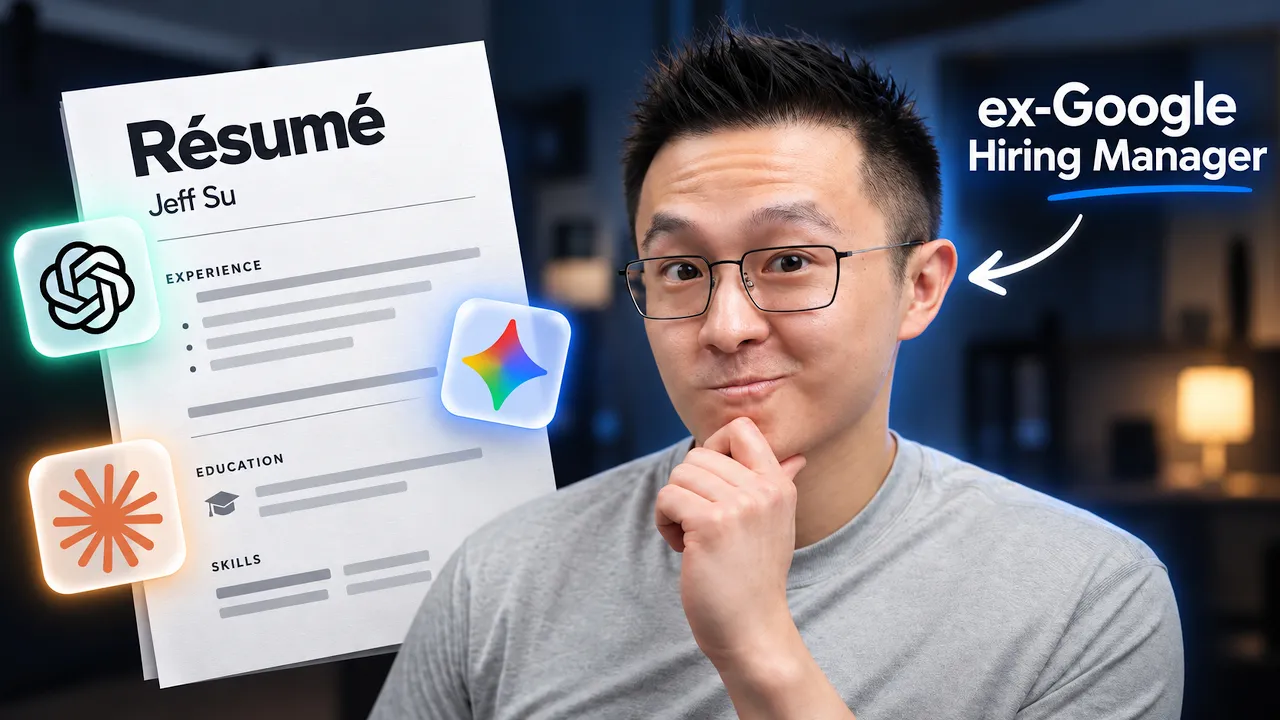
Finding reliable resume advice online was already hard enough. And now that employers are using AI to screen job applications, it's only fair to ask, "Do resumes even matter anymore?" And so, I spent weeks analyzing hiring reports and academic studies from institutions like MIT and Oxford, covering more than 4,000 hiring managers and nearly 2 million applications. And bottom line up front, I found that resumes still matter, but the rules have changed.
In this video, I'll start off by sharing the five most important findings and what each one means for you. Then, I'll break down exactly what you need to do to stand out in the age of AI. Let's get started. Kicking things off with the five key findings. First, 87% of hiring managers say their AI hiring software reads simple, text-based resumes more accurately than fancy, visual ones. Second, tailored resumes saw 84% higher interview rates, but resumes with the most keywords actually performed worse.
Third, 59% of hiring managers see candidates using AI as a good sign, but 28% reject AI-heavy resumes that show little to no effort. Fourth, resumes that quantified a candidate's impact saw 75% higher interview rates than those that only described responsibilities. And fifth, 60% of hiring managers want candidates to prove their AI skills, not just list them. I've linked the sources I went through down below, along with the prompts and bullet point examples I showcased in this video.
Now, before diving into each finding, let's quickly cover the two stages your resume has to pass in this new era. Pass the AI and pass the human. Stage one, pass the AI. Basically, companies use AI to read, rank, and organize applications. So, your resume needs to be easy to process and clearly show how your experience matches the role. Stage two, pass the human. So, if we squint really hard, there is some good news in that only 6% of hiring managers say AI is the decision-maker when it comes to passing or rejecting candidates.
Meaning, humans still play a central role in hiring. So, your resume needs to take the human reader into account as well. Put simply, passing the AI gets your foot in the door, and passing the human gets your application moved forward. And the five rules we're about to cover address both parts of that equation. On that note, rule number one, make sure the AI can read your resume. For context, while 87% of employers say their AI hiring software prefers simple, text-based resumes, an explosion of AI design tools actively encourages job seekers to stand out with graphics, icons, and large images.
Since it's much easier to sell you a fancy resume template than to tell you boring is best. Therefore, we should be optimizing our resumes for readability, not appearance. And although there is no universal file size limit across every hiring system, some tools explicitly state they cannot parse resumes larger than 2.5 megabytes. And high-quality images are one common reason files cross that limit. All this to say, even if you have all the right qualifications for a role, none of that matters if the AI software can't even read your resume properly.
So, here's what to do. First, keep the formatting intentionally boring. Use one column and conventional headings like summary, experience, education, and skills. And for God's sake, avoid skill bars like it's the plague. The one caveat is to follow local norms. For example, in China, headshots are very common on resumes, and many employers even ask for a candidate's zodiac sign. True story. Second, export your resume as a selectable text PDF, ideally below 2.5 megabytes.
A quick check is to open the PDF and see if you can highlight and copy the text. If you can't, the text may be trapped inside an image. Moving on to rule number two, make your fit obvious. As a quick reminder, studies found that tailored resumes saw 84% higher interview rates, but resumes with the most keywords actually performed worse, which sounds contradictory until you learn the difference between keyword mapping and keyword stuffing.
Keyword mapping is when you use relevant keywords from the job description to describe work you've actually done, which is not new advice, but AI makes this process much faster. Keyword stuffing is when job seekers cram in every phrase from the job description, whether or not their experience backs it up, and AI makes this process much faster as well. Taking a closer look at the data, we see that across nearly 2 million applications, untailored resumes had a 3.09% interview rate versus 5.71% for tailored resumes, which is also where the 84% increase from earlier comes from.
In that same study, we also see resumes with the highest keyword coverage receive 21% fewer interviews compared to those with moderate coverage. And so, in other words, using AI to over-optimize can do more harm than good. For example, imagine you're applying for a customer success role. A keyword-stuffed bullet might read, "Delivered customer support, customer service, and customer-focused communication to improve the customer experience." I wish I was kidding, but I legitimately read something like that during my time at Google.
Whereas, a thoughtfully mapped bullet would say, "Reduced customer complaints by 31% using AI to create an onboarding email sequence from help center documents." So, here's how to use AI to tailor your resume faster without keyword stuffing. First, give AI the job description and your base resume. Ask it to identify the problems the employer needs solved, extract the skills and keywords that matter most, and only then ask AI to suggest stronger bullet points.
Next, review every suggestion and keep only what you can prove. Meaning, if you can't point to a real experience that supports a keyword, remove it. So, basically, the AI is smart enough to figure out whether you're just adding random keywords for no reason, or including keywords intentionally. And that completes stage one. The AI can now process your resume and see why you match the role. But, you still need to convince the human to pass you, which brings us to stage two.
By the way, if you want to get 1% better at AI every week, sign up for my free newsletter to receive one insanely actionable AI tip you can apply in under two minutes. Link down below. Next up, rule number three, know where AI should stop. Remember, 59% of hiring managers like to see candidates using AI, but 28% reject AI-heavy resumes that show little to no effort. And the research shows why both can be true. A randomized experiment from MIT involving nearly half a million job seekers found that using AI to help with spelling, grammar, and wording increased the probability of getting hired by 8%.
That said, a separate experiment giving applicants access to ChatGPT made their pitches more similar and reduced evaluators' screening by up to 9%, meaning it became harder to identify who was actually more qualified. I mean, just imagine if you're the hiring manager and you read, "Spearheaded cross-functional initiatives to drive operational excellence across 20 resumes." You'd give up as well. Put simply, the experiments show that thoughtful AI use is fine, even encouraged, while lazy prompts like, "Make my resume better." produce the same generic BS like, "Result-driven professional with a proven track record of success." that hiring managers are sick and tired of reading.
So, how do you use AI thoughtfully? Here's a simple two-step process. First, focus on brain dumping your raw thoughts for every work experience you have, and just make sure you cover three things for each. The final result, what you specifically contributed, and how you achieved it. And don't worry if the notes are a complete mess because the goal at this step is just to capture the facts, not make them sound good. For example, your brain dump might look something like this.
I compared the replies from sales and support and there were so many conflicting answers. Uh so, I wrote a refund guide that they can both use and uh once both teams used it, duplicate tickets dropped by 50% and the customers got consistent answers. Cool. Next, upload the job description along with your rough notes and ask AI to strengthen the wording for each bullet without changing any of the underlying facts. Then, review every suggestion and only keep the language you could explain naturally in an interview.
So, your final bullet point might look something like this. Decreased duplicate tickets by 50% by creating a shared refund guide for sales and support so customers received consistent answers. To quickly recap, hiring managers and recruiters read enough resumes to spot the difference between thoughtful AI use and lazy So, do the hard thinking first, then use AI to make that thinking more clear and concise. Up next, rule number four, prove your impact with numbers.
In a nutshell, the research found resumes that quantified a candidate's impact saw 75% higher interview rates than those that only described responsibilities. And this makes perfect sense since two people can have the exact same responsibilities and yet produce completely different results. Just imagine a hiring manager reading, "Responsible for planning social media campaigns." 10 times in a row. And the 11th resume says, "Drove a 30% year-over-year increase in short-form views over two months." It's not hard to guess which candidate stands out.
Now, none of this is new. Adding metrics to your resume has been best practice for decades. What is new is that AI makes the two hardest parts much easier. Figuring out which metrics actually matter and turning your rough notes into polished bullet points using a proven framework. Here's what that means in practice. First, upload your resume and tell AI, "Help me identify the most relevant metrics for each experience on my resume.
Ask me clarifying questions if needed. This matters because a lot of candidates assume revenue is the only metric that counts, when there are many many other ways to measure impact, such as time saved, speed, scale, accuracy, etc. Next, after you've supplied numbers you can verify, tell the AI, rewrite each bullet using Google's XYZ formula. Accomplish X as measured by Y by doing Z. Do not add or change any facts or numbers.
Building on the earlier example, a revised bullet might look something like this. Drove a 30% year-on-year increase in short-form views within 2 months by testing different video openings and repeating the best performing formats. So, the takeaway here is simple. Job seekers used to skip metrics because they either didn't know what to measure or didn't have the time to rewrite every bullet. But now AI removes both of those barriers, turning one of the highest impact resume improvements into one of the easiest.
And finally, rule number five, prove your AI skills. So, it shouldn't be surprising that 60% of hiring managers want candidates to prove their AI skills and not just list them, right? And when we look at how they want that proof, 26% prefer an interview or task, 19% want work examples or outcomes, and 15% look for certifications or courses. On top of that, an experiment from Oxford University found that adding role-relevant AI skills increased a candidate's chance of being selected for an interview by up to 15 percentage points.
Put simply, writing ChatGPT in your skills section is not enough. You need to actually demonstrate how you use AI to solve a problem for the role you're applying for. So, here's what to do. First, whenever possible, make the first bullet under each of your experiences an AI achievement that is directly relevant to the job description. For example, cut weekly customer feedback reporting from 2 hours to 30 minutes by using Claude Code to build a shared database with recurring issues.
If you don't have a relevant workplace example yet, complete a small project for the job you want and list it under a separate project section in your resume. For example, created a customer insights report from 100 public product reviews by using chat GPT work to identify recurring complaints, checking the themes, and recommending three improvements. Next, make your proof easy for the hiring manager to inspect by linking directly to your portfolio.
Here's a real example for my friend Zara Zhang who publishes all her AI projects on GitHub. So, any hiring manager can immediately see what she built and how she used AI. And if you have no idea what GitHub means, no problem. Simply create a Google Doc and under each project, explain the situation, how and why you used AI, and what changed as a result. Pro tip, unless you're a fresh graduate, put your experience above your education since 86% hiring managers value relevant work experience over formal education.
All right, let's quickly recap by closing the loop on the two stages. Rules one and two help you pass the AI by making your resume readable and connecting your experience to the role. Rules three, four, and five help you pass the human by using AI thoughtfully, quantifying your impact, and proving your AI skills with real work. Now, was every finding from this video new and mind-blowing? No, not really. But hopefully, now that you've seen the data behind the advice, you can follow them with more confidence, especially now that AI is involved on both sides of hiring.
If you enjoyed this, you might want to check out my AI playlist next. See you on the next video in the meantime. Have a great one.
The words are the caption track's own and nothing is reworded or re-transcribed. Paragraph breaks are placed between sentences so the text reads as prose.
Free tools for your own script: paste a draft and see where it stands before you record it.
Paste your draft and see where viewers are likely to drop off, with a rewrite for each weak line.
Paste the first 30 seconds of your own draft for a hook score and rewrites.
Check your draft against YouTube's advertiser-friendly guidelines before you record it.
Read this channel's public videos and transcripts, and download a writing brief for it.