Getting the transcript
Reading the captions from YouTube. A video nobody has opened here before takes 10 to 30 seconds; this page fills in on its own.
Getting the transcript
Reading the captions from YouTube. A video nobody has opened here before takes 10 to 30 seconds; this page fills in on its own.
Zkvolunteers · @zkvolunteers5420
Words
9,227
Runtime
56:22
Speaking pace
164wpm
Reading time
38min
164 words per minute, between the 160 25th percentile and the 181 median of 349 measured videos. That distribution comes from the 349-video hook study.
Opening (first 30 seconds)
Thank you so much for joining us for the September volunteer meeting. Whether you are watching this live or watching the recording, thank you so much for being here to listen to all of the things happening in the month of September and beyond. And those of you that are watching the recording, thank you so much for taking the time to watch the meeting in a timely manner and really hear these updates, making them as meaningful and as relevant as
82 words, the words spoken in the first 30 seconds at 164 words per minute.
Free, no signup. See how the first 30 seconds hold attention, with rewrites.
Sentence shape
| Measure | This transcript |
|---|---|
| Sentences | 599 |
| Average words per sentence | 15.4 |
| Longest sentence | 62 words |
| Questions asked | 17 |
| Sentences containing a number | 49 |
Most used terms
Filler phrases
336 in total: um 213 · uh 45 · like 31 · kind of 22 · actually 12 · you know 6 · sort of 4 · basically 2 · I mean 1.
A literal whole-word count of the same phrase list the Prepublish browser extension uses, so a phrase inside another word is not counted and a phrase used in its ordinary sense still is. It is a count and not a judgement.
Run the check on the words above: where attention is likely to drop, with a rewrite for each weak line. The free check shows the scores and the one issue costing the most.
What this transcript is
Every word below is the caption track YouTube publishes for this video, pulled from the video itself and reproduced unchanged. It is not Prepublish's writing, not a summary, and not a re-transcription: it is the video's own published captions. English captions, generated automatically by YouTube, in the video’s original language. Source: the video on YouTube. A channel that would rather this page did not exist can ask for its removal through the contact page, and it is removed.
No Script X-ray for this video: YouTube shows a Most replayed graph only once a video has enough views.
Thank you so much for joining us for the September volunteer meeting. Whether you are watching this live or watching the recording, thank you so much for being here to listen to all of the things happening in the month of September and beyond. And those of you that are watching the recording, thank you so much for taking the time to watch the meeting in a timely manner and really hear these updates, making them as meaningful and as relevant as possible for you.
Of course, there is that keyword or phrase I make sure that you guys get. And then just email me directly after the meeting. So that way that's already taken care of and you can get that 2 hours in meeting credit and we can get that done promptly. So, we're going to get started with some announcements. So, as always, we start with our strategic plan and our mission and vision. Um, really excited for what is to come with Zun Oxwell and just so grateful that you are a part of this really exciting movement.
And just a reminder with our mission, we want to inspire people to protect the natural world through connections with wildlife and our vision, a world where wildlife and people coexist in harmony and where all generations are inspired to protect our planet. We also have our core values, which is always something you guys are exuding every single time you all are here at the zoo. Please continue to push that and use that.
We love seeing our volunteers out there on the pathways utilizing these core values. Uh you just never know who is with an earshot or eyeshot of you when you are here on ground. So always make sure that you are exuding those core values. It is a really good reminder to remind you all about your memberships. So if you've got your membership handy, I would make sure that it is current. So, scenario number one. Mine's expired.
So, Autumn, what what do I do? You're going to go to the front gate. You're going to give the front gate staff your name and share with them that you were a volunteer and that you need to renew. They should be able to look you up. I have an active roster of all of our youth and adult volunteers. So, you should be on that list. You will email me at ajackson@zunoxle.org. or your membership number and the new expiration date.
A lot of times people will just send me the number. I need that number and that expiration date for my records. You also could be scenario number two. Autumn, my membership is expired, but remember I got 100 hours last year in 2025. What do I do? You will go to the front gate. share with the staff member that you volunteered 100 hours last year. You'll give them your name and then Autumn has a list for Front Gate that's been given to them and everyone that got 100 hours last year in 2025 is on that list.
How that list is generated is by the previous hours form. So 2025 hours form, everybody that filled it out, they've got that list. Same thing for those of you here in 2026 that get 100 hours. That's going to be the protocol for next year. Again, you'll email me ajackson@zunoxle.org your membership number and the new expiration date. And this applies for all memberships, individual, student, to adult, um, whatever the case may be, circle of friends.
Please make sure that you are keeping that up to date. I've been doing an audit with different parts of the volunteer program. I've been doing that with volunteer meetings. I also will be doing an audit as well on Zoom membership. So, you might be getting an email from me regardless if your membership is current or not. I might reach out to you and have you give me that updated number and expiration date just so I have it for my records.
If you do have any questions on this, again, my email address is right there on the slide. Hey, Jacksonville.org. Let's make sure that those Zoo Knoxell memberships are current. We do have our ongoing volunteer opportunities that you guys have hopefully been reading each and every week in my weekly volunteer email. More specifically, wild encounter areas. Time is of the essence. So, I really want you guys to sign up for these areas, especially if you enjoy them.
Um, the hours and everything is up here on the slide. Um, but I will go ahead and quickly read it to you. Budgies is open Fridays through Sundays 10 to 4. Kids Cove Contact yard is open every day 10 to 4. Giraffe feeding, ostrich feeding, and tortoise trail are open Fridays through Sundays. And those hours and feedings are all the same as before. Giraffe feedings are still at 11:1. Ostrich feedings are still at 10 and two.
So, it is just important that you guys are signing up for those areas and especially as we get closer to October, Tortoise Trail is going to be closing because unfortunately as the weather gets cooler, maybe not right this minute at the time of this recording. Um, but um they're going to be closing soon. Um, probably sometime after the first weekend of Boo. Um, so we want to really enjoy these opportunities while we can.
So, make sure that you guys are signing up and those job descriptions are on the homepage of allistics. If you have not seen the announcements in my weekly volunteer emails, you guys do have the opportunity to do painted pumpkins. This is a very popular opportunity. So, as you see popping up on the slide, I've got lots of inspo pictures. Um, just very, very fun, nice, clean craftiness. Um, so really, um, taking advantage of this opportunity, especially if you are someone that is nowhere close to 50 hours.
I'm practically giving away volunteer hours for this opportunity. You can receive up to 10 volunteer hours for this. Please do not carve your pumpkins, but seal them with a clear acrylic sealer, any kind of polythane or clear glaze to protect the pumpkin. The pumpkins have got to last from the first weekend of October all the way to Halloween. So, we want to ensure that they are sealed up, ready to go. Um, so they don't get um a lot of moisture in them and start peeling and get all yucky.
The drop off opportunities are here on the slide. [clears throat] It is the most up-to-date dates um from the September habitat and then the weekly volunteer emails. So September 27th 2 to 5 and September 30th 3 to 5. Those are going to be your opportunities to be able to drop them off and you'll be able to put them directly into the mulch beds in the plaza. Again, communication is always very much appreciated with me if you want to shoot me an email and let me know.
Um I can give a heads up to rangers that you're potentially parking in the front circle to be able to load those pumpkins in. um and make that as easy as possible for load in. And then of course, email me as soon as you finish all of your pumpkins to receive credit. And then um I will remind you just where to find those um hours and things like that cuz you might go back in your service history and wonder what the heck are these hours for and it would be for those painting pumpkins.
So if you do have any questions, feel free to email me, ajack zunoxwall.org. I can't wait to see your craftiness come to fruition. Then we do have Brew at the Zoo. This is for our adult volunteers 21 and up. Um Susie Hall talked about this in the um in the August volunteer meeting. And for the September volunteer meeting, I want to update you all on what we need. Um unfortunately, at the time of this recording, we have had some cancellations.
So, we need more volunteers for the designated driver tents. We do um need a couple of volunteers for animal chats. There's a couple of different areas, of course, setup and cleanup, and then any assistant zone captains. Those are some really great positions. We could really use everybody's help with this. It's going to be extremely busy. Um so, that is something that I want you guys to kind of consider and think about.
It's a great way to get hours if you need something in the evening time. I know a lot of people are always looking for something in the evening. Well, this is your opportunity. Make sure you sign up under the code special events and if you've got any questions or anything about it, please let me know. Same thing with Boo at the Zoo. Susie Hall updated us in the August volunteer meeting. The dates are here up on the slide.
If you are looking for those dates, they are in the color purple. If you are looking for the map, that is also here on the slide. It is the most up-to-date map. and really making sure that everybody has an opportunity to sign up. Um some of the different roles that we have um assistant zone captains, again, this is going to be somebody that you are willing to um engage, jump in, take initiative. Um there's a lot of moving around.
You're on your feet. There's a lot happening in that position. There is an online training for that that I will be communicating with everyone who is a zone captain or assistant. Community escort and volunteer breakers. That's a very important role as well. If you're looking for something a little bit more stationary, we do have the dinner assistant. This is great for anybody that maybe needs to sit down, wants to participate in the event, um, but maybe doesn't want to be in the throws of the event.
Being a dinner assistant is great. just making sure the breezeway and area is nice and clean. Um, as staff that are working a double shift are able to go in and get a meal. We have our special event rovers. Again, got to be able to take initiative, got to be able to jump in and help as needed um as things pop up at the zoo. We do have the carnival games that are happening um all throughout Boo at the Zoo, but as Susie Hall said in the August volunteer meeting, Chick-fil-A is specifically not here on Sundays because they are closed.
So, getting that extra help um with carnival games. Of course, we do have other things like treat stations um things like that and our member night helpers um for the first weekend, Saturday, October the 3rd and Sunday, October the 4th. Um so, you are going to be primarily in the area where the members are going to be and Susie had mentioned that was probably going to be the Kids Cove tent. Um there's going to be some more updates that come probably closer to the end of September.
So, just continue to watch the weekly volunteer emails. Um, but in Vistics right now, this is a screenshot of Saturday, October the 3. You're able to see under the code special events all the different task. So, you should be able to see everything for special events. And then also here is a screenshot of Sunday, October the 4th. So, you're able to see what everything looks like. You're able to see the times. You're able to see the different task.
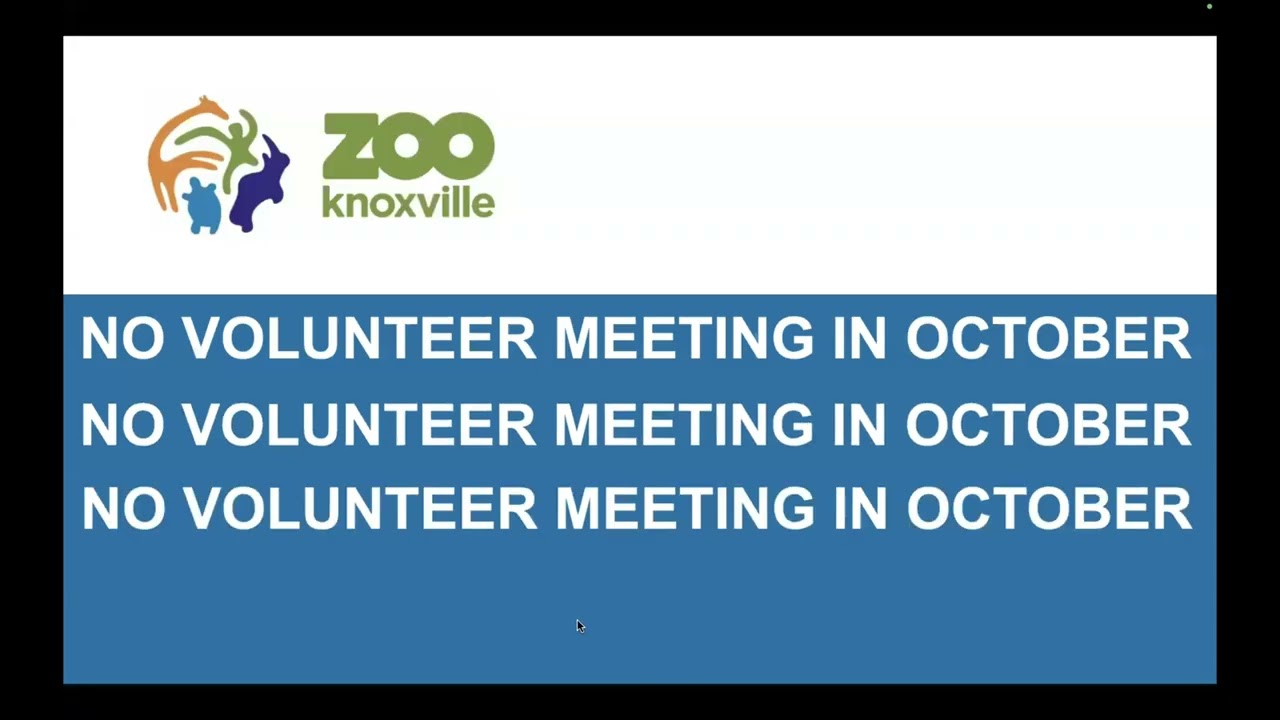
And in the September habitat, I broke down all of the different tasks. Um, so if you've not looked at September habitat, please take a look at that. Um, so, um, being able to to have everything that you need for Boo at the Zoo. And what's really important is for the month of October, there is no volunteer meeting in the month of October. We typically will have 10 volunteer meetings a year and that's because we do not have a meeting in the month of October because of Booth at the zoo and everything else that's happening in the month of October.
We are not having a meeting in October. So there is not a meeting for you to look for in the month of October. Those of you um that are very enthusiastic about the calendar, if you would like to go ahead and pencil in Tuesday, November the 17th, that is going to be our next volunteer meeting. At the time of this recording, I do not have a guest speaker yet, so it will be a surprise. Have no idea who it's going to be.
Um but it will be the third Tuesday, November 17th. We will have a time during the day. We will have the 700 p.m. time. And again, creating really good habits every single month. If you already know without even knowing the time that you are unable to do the November meeting, you can ask for the recording. I already have a list of people that um consistently every month already get the recording. It's just for anybody on a oneoff um circumstance that needs to have the recording, you can absolutely ask for it.
Um, but I will communicate those times and who the guest speaker is and our topic and all of that as it gets much closer. So, I promise um you will find that out in a weekly email. I will not leave you um without info. Um so, um just a big big PSA that there is no volunteer meeting in October. Um so, somebody will likely email asking for the October recording and there there will not be one. So um so you have the month off.
You do not have to have a volunteer meeting. And as we are approaching a very busy season of life for me, I just want to communicate with you all that I am going to be off the next several Saturdays. So if there is anything timesensitive that I need to know, just let me know by Friday so I can make sure that that email is taken care of before I'm out of the office. Also, as Boo at the Zoo gets going, my schedule could very well be altered, especially if I am working like a 13-hour day.
Um, so I will always put that at the bottom of the youth volunteer email and the bottom of the adult volunteer email if my schedule is different. So, just be aware of that as you see the weekly email. And here is that example above of what that will look like. it'll say calendar note and then I will have laid out to the best of my ability what that altered schedule is going to be. Um also one slight slight change to my little owl slide um that I kind of bypass every single month.
Um one thing I do want to adjust for us a little bit is using my direct email. You may absolutely use the ZK volunteers email for anything extremely time-sensitive, SOS, emergency, anything like that. Um, if if you need to get a hold of Jessica Hurley, but as far as um me and as far as just meeting credits and daytoday and whatever that might be, you can absolutely um use my direct um email. Um, so Jessica Hurley gets lots and lots of emails, a lot more than I do.
Um, so we just want to clean that up a little bit and um, just remind you guys to use ZK volunteers if if it's an SOS time-sensitive situation. Otherwise, shoot me an email. I email you as fast as I can, as quickly as I can, um, to be able to serve you and help you and answer questions and and things like that. So please, please, please utilize that ajax zunoxville.org. And it is my honor and privilege to introduce you all.
I call her the red panda queen um because she is and um just has such incredible tenure here at the zoo. Um just an incredible person. So, I'm going to virtually turn it over to Sarah Glass, our curator of red pandas and wild ambassadors and is extremely in instrumental with the species survival plan for red pandas. So, Sarah, I'mma turn it over to you. >> Hello. How are you? [laughter] Um, to all you folks who are out there, I can't see you, but there you go.
Um, hi. and we're going to just talk about bread pandas and what we're doing right now, how it kind of works, what's going on in the next upcoming few months. So, and if you have any questions, obviously, just um let us know. So, just some background on myself. I've been here since 1993, have worked with pandas the entire time. um started out as a volunteer working in what was our research department back then and uh with Greta McMillan for those of you who might remember her and we were just over pandas and then over the years have kind of absorbed some things and gone hither and yan and ended up where we are now with red pandas and ambassador.
So I kind of see a bunch of you on both capacities. Mhm. So we are involved with as many of you know um Red Panda SSP. It's one of the first SSPs that came to be back in mid80s or so. It was started by Miles Roberts who worked at uh National Zoo along with Frank Conn who was his studbookkeeper. So, those are the folks that I was raised under and Miles really was one of the first to take on red pandas here in the US and actually go out and do some work in the wild as well.
[gasps] Um, I became a coordinator I think 15 years ago or so. Um but for those of you just sort of a a nutshell um SSPs as we know they are the conservation program that works to maintain genetic diversity and behavioral competency of a particular species. Um we are lucky enough to work with every zoo under a who has red pandas which are not just American zoos. We are basically all of the Americas. Also two zoos in Korea and one in Hong Kong.
And we also have some non-AZA zoos that we work with as well that I'll touch on a little bit when we get to the global program. Um, right now we have about 350 red pandas across I think 174 institutions for both subspecies. We are the only SSP that works with both the Stion's red pandas and the uh fulgans red pandas. Um what we have here are the fulgens or the nepoese or Indian red panda. They are found in northern India up through Nepal um kind of over around to the edge of China.
And then the fulgens are found uh just in China and they are all sort of south of the Himalayas. They're kind of a Himalayan foothill mountainous species. Um we have an active growing SSP. We h are adding probably three to four new institutions per year wanting to join in. Um, ever since aa redid SSPs and uh how they work, everybody wants to be part of an SSP plus also their red pandas. So, how could you not want to work with them?
So, we have a very we are lucky that we have enough often more institutions that want red pandas than we have red pandas. A part of the SSP is also making sure that the information gets out there. We I am the coordinator, but I also have a stud bookkeeper, Jessica Cordell, who is currently at CRC, which is the offexhibit shoot of National Zoo in Front Royal. And then, as you know, every SSP has an institutional representative at it.
So, we have a whole army of folks who help us get things done. One thing that we added in the last couple of years with the new reimagining of SSPs is we now have a management group. So we have um six manager group members and then our sort of adjunct SSP vet nutritionist. So we have a whole team that works to help manage and also help spread the work which is really nice because we have so many institutions. So we look at every year we are a uh seasonal breeding population which makes life so much easier for us.
So we have our planning sessions every August which means that we have to go ahead and make sure our population is up to date in the stud book and in Zims. And so we get all that information. Actually let's be fair Jessica gets all that information in and we have our census. We know what's going on. Um in August we do our primary planning session. What we do at that is we ask our representatives for any wishes, wants and needs and we try and meet those needs.
So kind of three things we're working on with the SSP. One, we want to meet the needs of the population. We also want to meet the needs of the institution and then the needs of the individual. And all three are equally important. If you don't have happy individuals, you're not going to have a happy population. If the institutions don't want to work with you because you're not meeting their needs, it's not going to work for anybody.
So, we try and meet all three of those needs. So, we go through, we look at our breeding pairs. Were they successful? Um, did they get along? Because they all have different personalities. And then we can uh pair or repair, not that they're broken, but repair our pairs. Um, and we then, um, get all that worked out. We make sure that pandas that aren't getting along, maybe it's two shy pandas and we need to mix and match personalities, we'll make some of those changes.
Or we'll have a panda that doesn't like being near a zoo train, so we'll try and find a nice quiet zoo for them, work all of that out, and then we go into the draft period, which is what we do right now. We just started that a week ago. And then we work through all the dominoes because of course in a perfect world every plan you make would be exact but there's always a domino. Um and then we work that all out and then we are good for a year.
Um the main things that we look at when we look at a population from the population level um we want to look at how related the population is to all the other individuals. Um two ways we do that. One is through inbreeding. Um your inbreeding coefficient is going to be what it is for the entirety of your life. If you are the product of two first cousins, you will always be a you'll always be a 00825. That's what's going to be.
The biggest thing we look at is actually something called mean kinship. And that is how related you are right now in this point of time to the rest of the living population. And that can change every year. If you have a bunch of younger siblings born, you're be more related to the population. Conversely, if you have a bunch of older relatives die off, you'll be less related to the living population. So, that is why you might see pairs that have been successful for 2 or 3 years, um, we will take them offline and shut them down for a couple of years because the more babies they have and the more that those babies go on to reproduce, the more related that whole family becomes to the population.
So if you hear in the next couple of years that we have u asked Cisu and Dufo to take a year off that is why. So we apologize if that happens. Uh also SSPs used to be the ones who were in charge of all of the um insitu conservation that was going on out in the world and that was a lot. Um coordinators as you probably know is it's something we do in addition to our regular duties. So, um it would be lovely if I could have 40 hours a week to devote to just red pandas, but um that is where we have found a way to break up the work and use different uh groups to help us with the wild versus the native or the captive population.
So, part of that we have two other groups that we're involved with. One is the red panda GSMP and the other is the red panda safe. So going back to what we said about working with wild conservation. As you know zoo started something called safe saving animals from extinction about oh gosh it's almost 10 years ago now. U and they take over the wild component of managing a population. Our coordinator for red panda is Nikki Boyd.
Um she is also the uh director of the Red Panda Network board. So she was the perfect person to take this on. Um we are on the steering committee for this group. So Knoxville is intimately involved with managing the safe. Uh but we do not have all of it under one umbrella which is great. You want to make sure that all of your resources are spread evenly so that it can get the best eyes upon it. So what the safe does is they find a uh conservation group hopefully that's already doing the work.
Um if not they create one. We are very lucky in that the red panda network already existed. It has for oh gosh almost three decades now. And so all of our safe efforts are going to support the network. Um for those of you who may not know red panda network or red panda.org super simple to find. um they work within the range countries with red pandas. Uh their model is a great model. Everyone who works for it actually lives in the area that the work is done.
It just makes sense. Um if we, you know, were to hire graduate students from the US to go over there, we could not pay them very much. Um $10,000 doesn't go far to living cost and paying off your student loans. Um also, they're going to have to learn a language. they're going to have to learn how everything there works. Whereas, when you hire people who are in country, they know the language, they know the neighbors, they know the roads, they know how it all works.
Driving there is super scary. Been there, done that. Um, so if you can get the folks that live there to support you, it goes a long way to having a successful uh conservation project. So the folks on the ground, they work with everyone in the area um to understand why red pandas are important, try and mitigate some of the reasons why red pandas are endangered. A lot of it is just human animal interaction. That is passive.
It's not that they're going out and hunting them or catching them. Just the more people you have, the more land you need to house people, to grow crops, uh wood to keep your house warm and cook your food. So what Red Panda Network has done is they have found ways to utilize less ground for crops for them to grow. Um found markets for those crops. So not only do the red pandas thrive, but also the folks that live there have a way to support themselves uh more effectively.
They can have more money, they build schools, they build um infrastructure. um they've come up with uh ways to use solar heating for the houses there and also for cooking things that have a very low footprint. So, it's kind of a win-win all around. This coming Saturday, we are going to be hosting International Air National Red Panda Day, which I think some of you helped out with before in the past. Um I know we're going to have some activities up there.
We're hopefully going to have the uh great fossil site people up there, which we can touch on a bit. Um, it's just a great way to get the information about pandas and the network out to the community and also for those of you who like to come interpret for pandas, get some great information from those folks. And yeah, u the GSMP is the global species management program. So, WAZA, which is the World Association of Zoos and Aquariums, um, reached out to us about 15 years ago and said, "Hey, we want to start some new programs and we're going to call them GSMPs." And red pandas, tigers, and I there was a bird, which I should remember because birds are super important, but I don't.
I apologize. Um, everywhere in the world that has a managing body like AA or CAZA or AA in Australia, they have a version of an SSP for Red Pandas and we already were working um amongst ourselves. We were doing transfers internationally and we just sort of did those individually between coordinators working with the global stud bookkeeper. So instead we made it more formal. So we all came together in Roderdam and since we've met in Dargiling to come up with a global plan.
What is the best way that we can utilize these populations in the different parts of the world to keep the global population strong. Um, one thing was looking at a way to standardize a management um, husbandry plan so that if I'm asking someone in Peoria to send a Panda to Australia, they know there's the same standard of care uh, between the two organizations or conversely sending from India to the US. India knows they're going to receive the same standard of care here and it really helps with transfers because there's a lot of paperwork that happens behind the scenes to make sure we're all on the same page with um how we do acquisitions, dispositions, how we do our our care.
So it it adds that element of trust to it. Um, also not every region handles transfers the same way. Or for example, in Japan, each city zoo owns all of their individual animals. So if we wanted to get a bring a pair in from two zoos in Japan, we would have to work with each one individually. We managed to talk to the uh Jaza U coordinator there and they were able to work out a way to simplify the process and also we can transfer animals now without a monetary exchange because all of their animals because they're quote city property have a monetary value which made things tricky.
So we worked it all out. It was great. [snorts] Um little history for uh folks who don't know, we have been involved with red pandas here forever. We were one of the first outside of National Zoo to get red pandas. Our first pair were Buster and Bernice. We got them in 77, had our first cubs in 1978. We're kind of off to the races after that. um we were either lucky or unlucky to um some of our females that we received had issues producing enough milk.
So we the folks back then quickly became experts in hand raising and supplement feeding and how to uh do maternal management and the best way to make the mother successful. Um I'm sure it was incredibly nerve-wracking back then, but we did learn from that and we've since been able to spread that information throughout the entire community. Um, we've had, I think overall about 129 different pandas come through the zoo and I think we are as far as adults and we're at about 115 cubs born. >> Woohoo. >> Maybe 116.
I should know. I lose count after a few years. >> Yes. Yes. I think in the animal book we say over 110 just to cover that. So, touching on gray fossil site, we we like to joke that red pandas are a native species. They um I don't know if you remember the big dig that was happening decades ago uh where they found a few odd bones. Dr. Wallace was the paleontologist over that. He found what he thought was a red panda tooth.
He started working with us because we had some red panda teeth here he can compare to and they have since discovered it to be one of the best paleontological finds outside of the librar. Um it is I think they say it could be over a hundred years before they even touch the magnitude of what is there. So they have found complete red panda fossils down to the tiny little wristbones. Um they found a new species of mastadon.
They have found saber-tooth cats and rhinos and tapers. And if you've never been up there, go. It is in the middle of nowhere. It has been built where the actual road work was happening. And um ways is not taking you the wrong way. Just trust the process. And I know that in the past they've allowed folks from here and volunteers to go up and help participate with digs. The relationship we have with them is that you can't really study ancient animals without having modern animals to compare them to.
And so a lot of our animals here when they pass we donate them to the gray fossil site. Um I like to think of them as they have a role as educating here while they're alive. And it's really the most honoring thing you can do is allow them to continue that after they're gone. So they have and other zoos participate with them as well. Um every time we donate to them, they make a little life history card that goes along with the uh skeleton so that the students when they're learning can actually learn about who this panda was and what they did.
Um and so we have a nice relationship with them. They we actually participated in a super simple science project because I know kids can be afraid of science. Um, a few years back when they were comparing the um, ancient red pandas and the the modern red pandas, they noticed that some had more robust left arm, some more robust right arms, and that happens when you're handed. So, if you are right-handed, you're going to have more robust bones in your right arm.
Um, so could pandas be handed? So, a simple way to check this out was to ask several zoos to have their panda sit on a flat surface and put something on the ground and see what hand they picked it up with. Um, turns out they are handed. Willow is a left-handed panda. Um, we don't know why they're handed, but um, it was interesting to see that that still continues on, and they seem to do just fine regardless of, but it was a 10-minute project that kind of gave an answer as to why they were seeing some differences in bone density.
Um, red pandas are I don't know if you know about the great confusion that we had with the giant pandas and the red pandas back in the day. Um, they were the first panda. Uh, 48 years later, someone come came along and said, "Oh no, here is another panda." Named that bear a giant panda, making these guys lesser pandas, which was kind of rude. Um, so they have very similar skulls. They actually have a carnivore skull.
Um, they have a carnivore digestive system even though they are folores. So they are one of those animals that kind of breaks the mold when you take your biology classes. So they are the only fiberous carnivore, which means they eat a lot a lot a lot of greens and they pass them within 4 hours. Um, you can see with the ancient panda, they were they were a little more um doglike, I guess you would say. I mean, pandas do fall more onto the dog bear side of the tree than the the cat side of the tree.
They were uh look seem to be more omnivorous, a little more uh ground dwelling, a little more terrestrial than the modern panda. Somewhere along the way, modern pandas found a way to exploit bamboo, which is a super great trait if you can do it because as you know, um, if you've planted it or your neighbor planted it, it is really hard to get rid of. It just grows inches a day during the growing season and not a lot of other things eat it.
So, if you can find a food source that can't escape from you and when you're old and gray, you can just walk right up to it and eat it, that is magical. Um, our red pandas, we currently have six of them. We have Dufa. Dufa is uh the dad to the cubs. He will be hopefully going back in with the family group tomorrow. He is not an aggressive panda. He's just a super nosy, in-your-face panda. Um, if you've ever had a golden retriever that just has super excitable moments, um, that is Dofa.
So, since Cisu doesn't really want to be bothered when she's raising her kids, um, we put him into a separate area while she is in the process of getting through the first few months. Um, normally red panda dads don't want anything to do with their cubs, even when they're bigger. Um, for those of you who are lucky enough to see it last year, Dufa really enjoys having cubs around. He likes to play with them. He would instigate a lot of play.
Um he likes to snuggle up in a big old pile. Um we just wanted Cisu to have the time [laughter] to do what she needed to do because she does not tolerate his um nosiness so much and she ends up usually having to smack him and that's not nice all the way around. So he'll hopefully be going back tomorrow. Um then we have Cisu. This is Cisu with one of the kids. She is magical. Um, she is her second litter. She has been great.
Um, she seems to produce one smaller kid, one bigger kid, but they are proportionally the weight that they should be. Um, she's pretty lowkey. She has let them out once um with us there and then she made them go back in after 15 minutes. Um she has been taking them out outside of ours. Um but she is not actively trying to get them out. That should start soon. It's also been real crispy in the afternoons here. Nobody wants to go outside when it's 100° out.
So they've been kind of enjoying the off the off view hours. Um our new cubs, they just are named uh Jerry and Ruckus. I think a lot of you are aware that we had the raffle, raised almost $8,000 for Red Panda Safe. So, that is fantastic. We chose Jerry and Ruckus out of the names that we were given to choose from. Um, Jerry is going to be the bigger one that you see over on the right, and Ruckus is a little more of a troublemaker, so it just seemed fitting to give the little one the name Ruckus.
They are both going to be going to Philly next year in the spring to go as a brother pair for a year or two before they go off to find their ladies. Um, and I just kind of love the idea of a panda named Jerry at Philly. I don't know why. I just think that those are two great names for Philadelphia. I can just see them like, "Hey, Jerry, what's going on?" So, they are super adventurous. They are um viewable usually on the screen up at p at the panda building.
They I think they know when they're being watched because sometimes they'll push the nest box out and they'll sneak behind it. But definitely look forward to seeing them out more over the next month or so. Uh our little lady is Cayana. She came into us last year. She was supposed to go with Lincoln. Unfortunately, as we know, Lincoln passed away. She was born at the Oklahoma Zoo where they discovered her hip issue. Um, having an immobile limb when you are a climbing animal would have been detrimental.
So, she she doesn't know she's never had a leg. She She just gets along great. She is very active. She is either running around like a crazy person or she is passed out. She is a bit of an air conditioning princess. Um, however, she does like to come out in the evenings, which is great for our afterhour events because she's often outside then when everybody else has gone to bed. She is slated to pair this year. Uh, the male that is best for her is actually Dufa.
So, we will be conducting a bit of an experiment this year [clears throat] where he will be spending the nights with um, Cayana and then go back in with Cisu during the day. So, we may actually have um half sibs next year, two different sets of cubs. So, fingers crossed. But she, as far as personalitywise and genetics, he is the best cuz he is super he's super chill and she is not. So, we did not want to put a highrung panda with her because they might just bounce off each other.
But, Duet is a gentleman. And then, of course, we have Willow. U Willow came to us uh as a set of triplets. back in 2021. Um, she since decided about a year later that she did not like spending time with her siblings and so her siblings moved out and she has been by herself. It is absolutely normal for Red Pandas to be solitary. We have tried roommates with her in the past and she is she'll tolerate it, but she really doesn't care to have any any buddies.
So, she is our meet and greet panda right now. Um, some of you may have got to go in and see her and she is in the middle exhibit. Sarah, now now we're visible. Um, [snorts] so yeah, what questions do you guys have um for her? I know I'm very grateful um to have the pronunciation of >> Ceu and Cayana. >> Kayana, >> although we just call her Kai. >> Kai. Okay. So, you can call her Kai or Kai Anna. Y >> Kai. Yeah. Very similar to female um tiger Kai.
Very similar, but totally different animal. Totally different animal. All right. Great. What questions do you guys have for Sarah? because now now is the time to to ask what is the relationship like with other species in a red pandas environment. >> Um with red pandas and other species, well the the cats would want to eat them. So they they tend to kind of stay to themselves. They're pretty solitary. They are, even though they're a carnivore, they have a prey mentality because a clouded leopard would see one as a treat.
Um, and when they're little, which um, you've seen how small the cubs are when they first come out, like birds of prey could take them. So, they tend to be more defensive than aggressive. Um, they don't seek people out. They're often around farms. They can be chased by dogs cuz what dog wouldn't find a fluffy red panda a great thing to chase around. U so they they tend to stay to themselves. >> Yeah, absolutely. Um SSP.
So the slide that Sarah had about SSP and the goals because we have red pandas we have to participate in SSP as a accredited zoo with the association of zoos and aquariums. So that that's the reason why we participate in SSP. So lots and lots of animals have a species survival plan program. Y >> we're lucky in that our our population is different than others in that every single red panda that's in the country was within an aa zoo.
So in order to get red pandas, you had to join the SSP or you have to become a part of the SSP. Uh we do work with some non-AZA zoos because just as important as breeding red pandas is holding our retired ones to make space for the breeding zoos to make more pandas. Um right now we're not to where we would have non-AZA zoos breeding because we have so many zoos within a to breed. So, we don't actually have to deal with any private organizations.
Um, if you think about like radiated tortoise, they are within a non-AZA private hands and so they have to coordinate all of that. We're lucky that there are and thankfully no like pet red pandas out there in private hands. While they're super cute, they would just be a horrible pet. They are not social. They don't want to cuddle. They kind of want to be left alone. kind of like that super pretty cat your grandma had that hissed and spat at you whenever you went near it.
Um, so we are fortunate that we all the red pandas in here are associated with the SSP and that's partly because of how Miles Roberts said up in the beginning because they all came through National Zoo and then he got all the zoos involved. Um he was a pretty forwardthinking guy in wanting to think beyond what he was doing and all the SS we've had I guess I'm the third one since him. We've all tried to maintain that.
I should be able to drop off the face of the earth tomorrow and the SSP just continues on the way it is. So we have contingency plans for um kind of keeping it operating the way it is because it's not me, [laughter] it's the whole organization. >> That's great. Average lifespan for Red Panda in human care. >> Um the average is going to be 10, but that's means of course 50% go on. So it's not unusual to see 18, 19, 20. um because some of those oldsters it does make people look a scance when they hear of a 10 or 11 year old passing away but that is the average and that's even taking out the the cub mortality is fairly high.
So that's taking those cub that cub mortality out. So from one year until 10 is average. Does that make sense? >> Yeah. Um, so as far as red panda breeding, um, is it better in appalachin like environments since it matches to their native environment or is it more behavior matching? >> A little bit of both. They don't do as well in much warmer environments because and they spend a lot more time inside and they're very cyclical with the the light cycles.
Even a couple of zoos in Texas have tried uh big indoor exhibits that have had the matching light cycles, all of that, and they just never bred. Um even Chattanooga when they had an indoor exhibit, which isn't within the range, um they didn't breed when they were entirely inside, even changing temps and uh light cycles. So, they can deal with a lot of humidity because where they're from is very damp and drippy. So, they do better in the warm environments than we would think.
Um, Minnesota, uh, Canada, that's great. They, the Canadian zoos do really well with them. Um, Billings out in Montana is an excellent, they do really well out there. Plus, it's also really quiet. Um, but we do have to make sure we match personalities with zoos. Um, if we had a panda that didn't like tigers, um, or was afraid of big cat smells, it would not do well because we are right up from tigers. So, we we always ask people when we're doing placements what their exhibits like, what their husbandry is like.
So, we can kind of make it a win-win all the way around. So, from a hand raising standpoint, um what do we use to feed the cubs when they're born if we're handraising? >> So, we years ago they did a whole extensive study and looked at they were managed to get milk from from pandas and break it all down and it turns out that puppy esbelac is basically what they need. So, we we here use the powdered um as black because it's easier to figure out concentrations.
I have a harder time figuring out for some reason using liquid as black. So, my brain just goes to the powder. Um and then you just vary the concentration of it based on their age. Low concentration when they're little, more amount, and then we flip that when they're older. And that seems to work really, really well. That's great. Has there ever been discussion on releasing red pandas into the wild in Appalachia? >> In that'd be great, but I think they disappear.
If we could um we could put a couple of stands of bamboo in a protected area of the Smokies, they would probably do fantastically well. Um, India which is one of their range countries actually is when India puts their mind to conserving a species it is insane the amount of effort and money and science they will throw behind it which is fantastic. So, just like the elephant and tiger population there, they've really embraced red pandas.
And so, they actually have a couple of um soft release sites which I got to visit um right up at the very tip very very well tip would be down here very top of India. Um, and they have these, I think, 40 hectare soft release sites where they can put them in, uh, make sure that they can fend for themselves. And then working with Roderdam Zoo, they've developed these teeny tiny little solar powered, uh, long-lasting battery trackers because just putting them back doesn't mean you're successful.
You have to put them back and make sure they survive. Um and they have a great program going right now to the point where they're going to have to expand because they've kind of filled up the once they were fully released the wild area where um they went. So they have to identify some new protected areas for them. But it is happening. Uh it'll probably never happen with any of our guys here unless we were to send some to India so they could uh go to their uh off-site breeding facility and then perhaps those babies would be released if that makes sense. >> Yeah.
What is the wild population for red pandas? >> It's anywhere between two and 10,000. They're super hard to track. Um luckily pandas are latrine users. So, just like rhinos have mittens in areas with red panda populations, they all tend to use the same place to poop. A fun fact with mammals is they will groom themselves. They'll ingest some hair. They'll pass the hair and then you can DNA test the hair to see how many different individuals there are.
Fun fact, with endangered species, you need certain permits to send things through across country lines. Um, you can't send hair because you can't prove where you got that hair from, but you can send poop. So, those doing research just send the poop and then we extract the hair once it gets here or wherever it's going because you don't need a permit to send poop. So, you can send poop, >> but you can't send hair for DNA testing >> because you [clears throat] can't you can't prove you didn't go pluck that hair off a live panda. >> So, poop is your friend when it comes to doing DNA. >> Poop is your friend when it comes to DNA. >> And your September volunteer meeting keyword or phrase is poop is your friend when it comes to DNA.
That is absolutely perfect and memorable. So again, at the end of this meeting, go ahead, take care of that email. Take care of letting me know you've watched the September volunteer meeting and I'll get those two hours in meeting credit added. That's hilarious. I love that. Um, if a red panda does not eat its carnivore part of its diet, what exactly would it eat? So, red pandas are perfectly fine eating nothing but bamboo and the occasional fruit and berry.
Would they on occasion grab a mouse or even a rabbit or a bird if they could? Absolutely. Uh, we used to have a panda here named Leewoo. He lived back in the old off exhibit behind old reptiles and he would leave bits of his diet up on a stump so he could go bird fishing and if the birds came down he would grab a bird. Um, willow has been seen um catching house mice and eating them like little popsicles. Um, so they will do that.
Especially pregnant females become more carnivorous. If we offer them any meat products, they turn their noses up. So it seems to be more of a I'm feeling like a mouse today. U I've offered them uh bugs and grubs and they were horrified. But um here at the zoo they get the Missouri biscuit which is the same as the uh chimp gorilla biscuits the leaf eater biscuit and then they get as much bamboo as they want twice a day.
Um and they get fruits and veggies for their treats >> and only the freshest bamboo too. >> Only the freshest bamboo. >> Only the freshest. That's fantastic. That is great. Um, so I'm going to script the meeting. Um, so that way you guys have got all the red panda information, especially if you are finding yourself volunteering in the red panda area in Boyd Family Asian track. U, but what amazing knowledge today from Sarah Glass.
Absolutely incredible today talking about red pandas.
The words are the caption track's own and nothing is reworded or re-transcribed. Paragraph breaks are placed between sentences so the text reads as prose.
Free tools for your own script: paste a draft and see where it stands before you record it.
Paste your draft and see where viewers are likely to drop off, with a rewrite for each weak line.
Paste the first 30 seconds of your own draft for a hook score and rewrites.
Check your draft against YouTube's advertiser-friendly guidelines before you record it.
Read this channel's public videos and transcripts, and download a writing brief for it.