Getting the transcript
Reading the captions from YouTube. A video nobody has opened here before takes 10 to 30 seconds; this page fills in on its own.
Getting the transcript
Reading the captions from YouTube. A video nobody has opened here before takes 10 to 30 seconds; this page fills in on its own.
Nate Herk | AI Automation · @nateherk
This video has no Most replayed graph yet: YouTube shows one only once a video has enough views. These are the moments viewers replayed most in Nate Herk | AI Automation's most watched videos.
Most replayed moment at 5:28
3.3x that video's typical replay level
and then I want the lid to be put back on, no shadows, no hands, no reflections." It spits out this prompt, I put that into Kling, and here's the result. I haven't watched this yet, so hopefully it's good. Okay, interesting. I mean, obviously we
Said at 5:22
Most replayed moment at 20:09
3.5x that video's typical replay level
from that exact avatar five different times. So, selling gets easier, you're able to increase your prices, and more clients stay on retainer because you're not just a vendor at that point, you're the person who actually understands their business. So, here's one more prompt for you. Open up Claude and run this when
Said at 20:01
The graph counts replays. It does not show where viewers stopped watching.
Words
5,648
Runtime
21:32
Speaking pace
262wpm
Reading time
24min
262 words per minute, above the 201 75th percentile of 349 measured videos. That distribution comes from the 349-video hook study.
Opening (first 30 seconds)
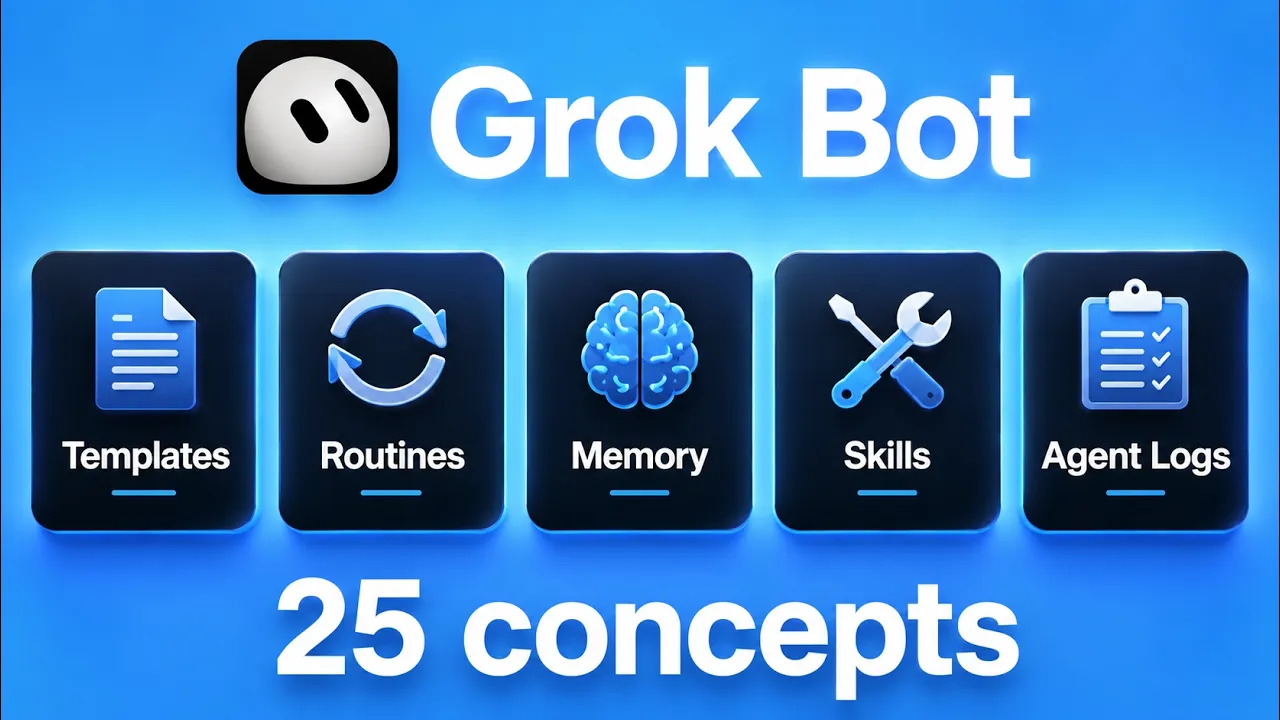
I'm about to break down every single GrokBot concept that you have to understand in order to start getting immediate value out of your GrokBots. So, let's not waste any time and just get straight into today's video. So, in today's video, I've got 25 concepts for you guys and they're split across five parts. So, part one is what the bot is. So, a GrokBot is one single bot. As you can see, I've got a bunch over here and each one has a name, a job title, and a description. So, as you can see, if I click on Motion, which is actually building the animations for this video that you saw already, his name is Motion. You can see right here he's got a tag that says animator.
131 words, the words spoken in the first 30 seconds at 262 words per minute.
Free, no signup. See how the first 30 seconds hold attention, with rewrites.
Sentence shape
| Measure | This transcript |
|---|---|
| Sentences | 310 |
| Average words per sentence | 18.2 |
| Longest sentence | 97 words |
| Questions asked | 6 |
| Sentences containing a number | 31 |
Most used terms
Filler phrases
125 in total: like 55 · actually 24 · basically 18 · you know 9 · sort of 8 · kind of 7 · literally 2 · uh 1 · um 1.
A literal whole-word count of the same phrase list the Prepublish browser extension uses, so a phrase inside another word is not counted and a phrase used in its ordinary sense still is. It is a count and not a judgement.
What this transcript is
Every word below is the caption track YouTube publishes for this video, pulled from the video itself and reproduced unchanged. It is not Prepublish's writing, not a summary, and not a re-transcription: it is the video's own published captions. English captions, generated automatically by YouTube, in the video’s original language. Source: the video on YouTube. A channel that would rather this page did not exist can ask for its removal through the contact page, and it is removed.
I'm about to break down every single GrokBot concept that you have to understand in order to start getting immediate value out of your GrokBots. So, let's not waste any time and just get straight into today's video. So, in today's video, I've got 25 concepts for you guys and they're split across five parts. So, part one is what the bot is. So, a GrokBot is one single bot. As you can see, I've got a bunch over here and each one has a name, a job title, and a description.
So, as you can see, if I click on Motion, which is actually building the animations for this video that you saw already, his name is Motion. You can see right here he's got a tag that says animator. So, if I click in, you can see that is his label. And the description for this bot is that this bot creates motion graphics and animations for intros or transitions for YouTube videos. And you can see that each of my different bots, I'm having one very specific conversation with.
So, each bot is very much their own individual bot with their own skills, their own descriptions, their own processes, and you have unique conversations with them. And now, that's a really nice segue into number two, which is bot descriptions. Because you can see here that you're going to start to build out a ton of different bots, you want to make sure that each one is doing one very specific job very well. So, in this case, you saw Motion's description.
If I went to Miner and we looked at his description, "Mines X for AI news, new models, and new tools. Also knows Nate's YouTube and X posts so the briefing stay useful for his content." If I go to this bot called Eyes, I can click in and see that this description is that this bot is a master at research. It gathers lots of credible sources and helps form opinions based on facts and data. Now, the reason why these descriptions are so important is because as we get into different concepts later, you're going to notice that these bots work together a lot.
And the way that they're able to understand I need to delegate work to Eyes because he's the researcher or I need to delegate work to Motion because he is the animator is all based on those descriptions. So, these descriptions are super, super important. Because what's really cool about GrokBot is as you build more and you scale them up, you might think that you want to build some sort of ecosystem like this where you're up top talking to all your bots, but really what you want to do is you want to build more of an ecosystem like this that looks more like an org chart where you talk to just a few executives and those executives know all of the bots underneath and they know which ones are on their teams and what their strengths and weaknesses are.
And that's kind of what you can see what I've got going on up here with my C-suite, but we'll talk more about that later. And that brings us on to number three, which is bot templates. So, this is really cool. Do you remember how in N N you could bring in other people's N N templates? In Claude, you can bring in other people's skills, things like that. Well, in Grok bot, you can bring in other people's Grok bots. So, look at this link for example.
This is a Grok bot that I called studio. It creates photos, graphics, and short video creative for marketing. So, what I can do is I can actually add this to my own Grok bot. It opens it up in the app and I can read through the context here. So, instructions, memories, skills, and then I can just add this bot. And what happens is it spins up this bot and then it just basically starts creating itself. Here you can see it says on it, "I'm saving your memory and skill now." If I click into the bot, you can see it already has a name, a label, and a description.
Of course, you will have to configure your own things. So, if someone gives you a bot that's connected to their ClickUp, it's not going to be connected to their ClickUp. You would have to connect it to yours. But still, it basically has the other assets in there, just nothing personal. And the other cool thing is you can share your own bots. So, let's say I wanted to share my Views bot. I could just come in here, click on the settings, and right here click share as template.
And this basically says, "Hey, Views, create a template of yourself that I can give to someone else." And there you go. Now, Views has created its own link, which I can go ahead and publish. And now, if anyone copies this link, they'll be able to pull in Views and have that bot in their own bot ecosystem. Look at this. I'll copy the link. I'll go to Google, paste that in, and now anyone can go ahead here and copy Views.
Which brings us on to number four, which is kind of a two-parter, context and memory. Context is basically all of the stuff that your Grok bots have access to to see. So, the conversation history and anything else that you're feeding in, like your prompts. And the second piece of that is memory. And this is really interesting because right here you can see that when I asked Views to make a template of itself, it said, "Yeah, I'm just going to read through my memories first." And if I come into the details, we can see here in the context that there are specific memories that it actually saved.
And if someone copied this bot template, they would also get those memories. But what's really interesting is the difference between all of your GrokBot like global memory and individual bot memory. So, watch this. Hey Views, can you quickly tell me what is the difference between what you know about me from a global perspective that all other GrokBots know? And then, what's the memory stuff that only you know about me?
The point I'm trying to make here is you have all these different bots and overall they have like a collective file of information about you, but as you converse with each bot and you build up their capabilities, they have different memories individually, too. Here you can see there's two distinct memory stores. This is what every bot is able to see about me and this is what only Views knows about me. So, make sure you are understanding what agents know what.
And if you want to update the memory, just say, "Hey, add this to your memory." or "Add this to the global memory." And now that brings us on to concept number five, which is compaction. So, if you guys have used something like Cloud Code before, then you're probably aware of the whole idea of like filling up the context window and being careful to make sure you're not entering into context rot territory. Now, with GrokBot it's a little bit different because each individual agent has their own conversation history, which means they have their own context windows.
But, the thing about GrokBot is it auto compacts everything. So, we don't get to control that. We also don't know exactly when it auto compacts, but it has some sort of like auto summarization and compacting capability so that it doesn't hit that context window. So, if I've been talking to Views for like 500 days, it probably wouldn't see my first couple messages, but overall it would have memories kept about me and it would have context of what we're trying to work towards and it would see, you know, maybe the last 30 or maybe the last 50 messages as a summary while it's taking action.
All right, so those are the first five. Now, we're moving into part two, which is where it works. All right, cool. So, number six is the agent computer. Now, what this means is that your GrokBots can actually use a computer. As you can see, Klaus has a computer right here and I can look at his screen and he can also control his screen. If I go over here to Becky, you can see that she's also got a computer open as well.
Every single one of your GrokBots has a computer. Now, this is kind of similar to memory because they all kind of have their individual screens that that working on, but at the end of the day they're all working on the same computer. And you'll understand that a bit better when we move into concept number eight. But moving on to concept number seven is the idea of a browser. So, inside of the computer, obviously I can open this up and I can drive this browser or Klaus can because that's the bot right here.
But what happens in the browser is we can you literally just use Google the same way we might want to if we were actually on our own Google Chrome or whatever it may be. And what's cool about that is it saves your login. So, I logged into school, as you can see, this is my account. And if I close out of this, it's going to stay logged in. So, now Klaus is able to actually do things inside of my school community for me or it could log into my GitHub or it could log into my LinkedIn.
It can log into things pretty much once we save the credentials. So, you would basically just come into the site you want, you would log in, you would enter your own username and password, and then your bot could just take control and do stuff in there for you. And now moving on to number eight, we have the file explorer. So, just like on my screen, you can see right here I've got a local file explorer. I can look through my Herkimer project, I can look through my camera roll, I can look through all of that kind of stuff.
So can all of your agents. And this is where they share all of this stuff. If I open up our actual workspace, you can see that I've got stuff like brainstorms, I've got dashboards, I've got Grok Bot concepts, which is the video that you're watching right now. And all of these files that are being looked at are the exact same ones on every computer for the bots. So, if I go over here to let's just go to Dev and I'll open up this screen, you can see that if we open up the file explorer on Dev's computer, it's the exact same workspace with all of the same files that are stored across the shared computer for your Grok bots.
And while we're still on this whole concept of the computer, moving on to number nine is the terminal. So, just like you have a terminal on your computer, so do these bots. They can run commands, they can set up scripts, they can do things through a terminal just like this as well. So, it's literally just a computer. They can do everything that a computer can do. And then moving on to number 10, we have local file access.
So, that means that yes, they have a cloud computer that they all share, but whatever computer that you're actually working on, they can access local files. So, right here you can see that I gave it a file path, which was in in downloads. I said analyze this file and tell me what's in it. It grabbed it, it analyzed it, I told it to rename it and then move it, and it actually was able to rename it and move it. So, if I go into my new thumbs, this is the file that it was talking about right here.
It used to be in my downloads and it was just called like, you know, orange blah blah blah, and then it looked at it, it renamed it to zero to pro, and then it moved it inside of this new thumbs folder, and it did this locally on my own desktop. All right, so those are the first 10. Now, let's move on to part three, where we are going to talk about its abilities. Okay, so concept number 11 here is called plugins. This is basically how you let your agents actually talk to things like your Slack or your Gmail or your Google Docs, whatever it may be.
And you go down here to the plugins, and you can see that there are a bunch of options to choose from, and pretty much all you have to do is click add, and then you just sign in. It couldn't be easier. And what's also cool is you can see the ones that you're already authenticated into, and you can connect multiple accounts. So, let's say for ClickUp, I like to have my main account as well as a different account. So, I can authenticate into both of them and then have different agents use different accounts.
So, right here in my ClickUp, you can see that it's actually creating tasks for everything that it's doing. Here is when it started working on the motion graphics for this video. And my Grok bots know that they need to be logging their tasks inside of this board in ClickUp, so I can always see what's going on. So, once again, this is the one for this video, and you can see that we have an owner, we have what I asked, we have the deliverable, we have links, we have all of this information and progress updates.
And this is really good for me to just be able to keep tabs on what's going on, and you know, look back at the week and see everything that they did. And moving on to number 12, this is skills. So, just the same way that you use skills in Claude or Codex, you can do a slash command and then you could reference some sort of skill. So, if I come in here and I type school, you can see that this one says like seven-day challenge posts on school, and that is a skill that I can actually invoke, and the agent understands how to use it.
And if you've never heard of a skill before, real quick, it's basically just a recipe. So, let's say you wanted to make chocolate chip pancakes, well, you'd probably pull up a chocolate chip pancake recipe, then you'd make the pancakes, and then you'd realize, okay, cool, these were really, really good. I want to make them really, really good every time, so I'm just going to save this recipe, so next time I want to make chocolate chip pancakes, I just read the recipe.
And hey, if these weren't good, if they were too raw or they were too burnt, why don't I just update the recipe and say, "Hey, next time cook these a little longer on each side or cook them less." So, these skills are editable and every time you run them, they can get better because you just give feedback. You find the skills inside of your plugins, you go to the installed, and then you look at these private plugins, and these are all of your skills that your Grok bots can use.
So, you can see I have like an AIS plus recording post, I have grill me, I have fireflies ingest. These are basically just processes that your agents will probably do more than just once, then you turn it into a skill. And a good skill has things like when to use it, the exact order of operations, and anything that if it could go wrong, what you do. And speaking of skills, let's move on to number 13, which is teach a task.
Whenever you're somewhere in the browser, I typically think that you do this on Chrome, but whenever you're in here, you can click on this button that says teach a task. And remember that skill that you guys saw earlier, the like 7-day challenge post in AIS plus? This was a teach-a-task, where I basically came into here, I clicked on record, now you can see the screen's being recorded. It says Klaus is watching and learning.
So, then I could, you know, click into this tab, I could go to news, and then I could go ahead and like open up this link. And then, when I go ahead and stop recording, Klaus gets that message, it watches that demonstration, and it turns what you just did into a skill. So, this is going to be some skill called like find Chicago Cubs food news and whatever, but the point being, you can either create skills with natural language and then instructing what a process looks like, or you can basically have them shadow you.
You could record for a couple minutes, pull some reports, analyze some data, whatever you need to do, and then it will automatically turn that into a skill for you. As you can see, it decided to save that skill as a search Google news. Now, obviously that's a pretty useless skill, but just trying to demonstrate the point here. Now, moving on to number 14, we have routines. You can see that right here I have one called Sunday work log archive, which runs every Sunday at 8:00 p.m.
And in order to create one, you can basically just say, "Hey, can you do this for me every day at 5:00 p.m.?" Or you could just click on this plus and then set one up. Right here you can see I'm setting one up called AIS 7-day challenge likes, and what I'm doing is I'm telling it to run a skill. So, routines make something happen automatically, and that thing that happens automatically can be a skill. So, I chose interval, and I decided to let this one run every single minute.
So, I'll just sit here and let this trigger, so you guys can see how that looks. So, it's been a minute. You can see that this routine's firing. We can see that Klaus is working down here. So, it found the skill file. It's reading it, and now it's going to be able to take action using that skill. And you can see in the browser, it just opened up a new tab. I'll make this full screen, and you guys can just watch it actually take action here and start liking those posts.
So, the top of the screen, you can see that it's searched for the word challenge. It just clicked into a post, and now it's scrolling down, and it's going to click on the like button. Boom. There we go. Okay, while that skill is finishing up, I'm going to move on to number 15, which is webhooks. Now, I know webhook sounds like a technical word, but it's really not. Just think of it like someone ringing on your doorbell.
Because in the routine section, you can see that they can be triggered based off a time, like a schedule every hour, 5:00 p.m., or it can be off of an event. So, these are event-triggered routines, like someone ringing your doorbell. That could be on a Slack message, on a team message, or a webhook. And these are all basically the same thing. This one is just like you can configure your own webhook call. So, let me show you an example.
I've got this bot down here called webhook, and I created it just for this demonstration. If I go into this app that I created, what happens is I fill in this information. So, I will just put Nate, I will put Nate Hurk 88@gmail.com, and I will put hello, I need a new dog. And when I send this request, what this does is it actually sends a webhook. So, it basically just shot a payload to this webhook address, and you can see now this bot has woken up.
It's going to take that payload, so basically the information I submitted in that form, and it's going to take action for me. So, you can have agents automatically wake up when you get a new email, or a new Slack message, or a form submission, or so many other possibilities. A new CRM record, even. So, what happened is it said, "Hey, a form just came in asking for a new dog. I emailed them that we got it, and we're processing it, and I DM'd you in ClickUp." So, if I go to ClickUp, you can see that I got a message from Up at AI.
If I can make this a little bigger, you can see that that form just came in. And in my email, you can see that we just got a message which says we got your form and you wrote, "Hello, I need a dog. We'll follow up soon." So, obviously just a quick demonstration, but the point being you can have Grok bots take action when something happens in your business or in your life. Okay, so that was 15. Now, let's move on to part four, which is how bots work together.
This work gets like really cool. Okay, so the first one is group chats. Now, look at this. I have a group chat with my leadership team. I've got Klaus, Dan, Chandler, Becky, and I could add members if I wanted to or I could remove them. And in here, I basically said, "Hey, I need you guys to like tell me about our long-term goals and ideate on how we're going to keep growing and scaling the business." And because these are different agents, my chief of staff, COO, CFO, CCO, they're able to talk about their own areas of expertise and all the individual agents that they're actually managing, remember I like to use sort of like this vertical hierarchy, and they're able to all hear each other, mention each other, and just ideate, and then I can come back and take a look at what they've done.
And that brings us on to number 17, really perfectly, which is mentions. You can see that Klaus mentioned Becky right here. You can see that Dan mentioned Becky and Klaus right here. And if I click on that, it actually takes me to that conversation. So, you can actually see, too, that Klaus just finished that skill and I'm going to go ahead and disable that routine cuz I don't want that to actually fire every single minute.
But what else you can do is you can have agents delegate work out by mentioning people. So, like, "Hey, could you please check with" and then I could just go in here and mention, you know, like @Becky to do X, Y, and Z. But the cool thing is if your descriptions are good enough, you don't actually have to explicitly mention these bots. Klaus or whoever you're talking to will be smart enough to know that it should be delegating work.
But you can still message them in chats just like that. And that brings us to number 18, which is about handoffs. Like I said, agents delegating work to other agents. If I go to Becky right here, you can see that I asked her to do some stuff for creating um these motion graphics that you're looking at and she delegated all this work to motion. You can see right here. Now, in here, if I click into motion, we can see that the actual conversation between them.
So, Becky said, "Hey, Nate needs this. Here's what you need to do. Here are the deliverables." And then they have a conversation. And it can also be more than just one agent, right here. Klaus was able to delegate work to Coffee and Minor. And then down here, it also shot off messages to Minor and Becky. The whole point is agents can work together, and you can also view their conversations, so you get full visibility into what they're actually doing and talking about.
Which brings us on to number 19, which is about replies. Say you're talking to Klaus and there's a bunch of things going on. Team just fired, you were building a skill, whatever. You can use this little reply button to actually isolate that conversation sort of. So, if I click on this and say, "Okay, very cool. Go ahead and run that as a test." Nice. And then I can also respond to this for example and say, "Very nice.
Well done. You're crushing it." And just like the way you reply to things when you're actually in like Slack or ClickUp, it's just able to understand what you're responding to and the context is a little bit better. Because if I randomly just said, "Okay, cool. Go ahead and run that as a test." It might think that I wanted it to do this again, which I in fact do not. Okay, so we've been through 19 concepts. We've got six more to go.
Moving on to part five, we have how you control and monitor it. So, the first one is about approvals. If you go in here to your settings, you can see that we have computer. And this shows execution on this computer, let GrokBot open files and run tasks on your computer. So, this is my actual local environment. Remember we talked about the difference between local files and the sort of like agent computer in the cloud.
Now, sometimes when you're talking to these agents, they're going to ask you, they're going to pause the workflow and say, "Hey, am I allowed to do this?" And you can either choose like always allow or allow once, and you can change your default setting over here as well. Which brings us into concept number 21, which is human takeover. Sometimes to hit a blocker where you're really the only one that can take over. For example, if you're asking it to do something in LinkedIn, and it says, "Okay, I've pulled up LinkedIn in my browser, but you need to sign in." It will pause and it will wait for human takeover.
This is usually when you need to do something sensitive like put in passwords or any sort of information like that. Because what you don't want to do is put passwords into the conversation history right here because technically that's going to SpaceX. Now, I'm not saying that anything really, really bad would happen, but if you do accidentally send an API key or password, then maybe just go ahead and rotate it. And moving on to number 22, we have weekly usage.
So, right here, when you sign up for Grok Bot, you get on some sort of subscription, whether it's like 20 bucks a month or 100 or 200, whatever it is, you can see weekly usage and this resets every 7 days. So, if this goes to 100 within your 7 days, then you can't use this anymore unless you want to pay extra for on-demand spend or API billing. And you can just click on this button if you want to change your limit, increase it, decrease it, or add some on-demand credits.
So, as you're dealing with different bots and as you're sending off prompts and you're making different channels, just watch this number because having things like a group chat of agents is going to consume more of your weekly usage than just talking to one agent. And moving on to number 23, we have run history. This basically just means the ability for you to check how many times routines have been run. So, for example, with webhook, this one is a event-based one.
So, in the run history, we can see that we had one 10 minutes ago and we also had one at 5:48 p.m. Or if you have something that's actually time-based, you could just click in to verify that they are in fact running every Sunday at the time that they should be or if this one, you know, every minute, this would have tons more history. Now, unfortunately, you can't click into them. You can just see that things ran, but if they failed, there'd be an X here.
Hopefully in the future though, we're able to actually click into the runs and see where they actually happened in case we need to investigate what went wrong. I do kind of have a fix for that though, so just stay tuned. And moving on to number 24, we've got notifications. Now, this one's pretty self-explanatory. It'll notify you if it has a blocker or if something finishes up, but you can also control notifications per agent.
So, what I like to do is just have notifications on for my main four and you can come in here and you can just enable notifications when the bot finishes or needs input. Now, what's really cool about that is that you can also have the notifications come to your phone, which is what I like. You can see right here, we've got my phone and it's perfectly synced with my desktop. So, if I open up Klaus and on my phone, I just say hello, as soon as I send this, it pops open on my desktop as well.
So, even if my computer's turned off, these both stay perfectly synced. And getting the notifications on your phone is awesome because while you're at lunch, you're on a walk, you can keep driving what you need to drive from your pocket. And finally, the last one we have is number 25, which is basically just about managing your bots. Just the idea that you can right-click on them and you can pin them, which moves them up here to the top.
You can also move them to a different section. So, if I unpin this one and then I go to move to, I can move it to a new folder called whatever I want, or I can move it to the general or or unassigned, or I could put it into wherever I want, really. And this just allows you to just fold them up and keep things organized if you choose. And you can also hide bots. So, for example, I'm going to delete Webhook, but if I don't want to delete him, I could just hide from sidebar, and that just puts him in a section down here called hidden bots.
So, these aren't lost, but they're just hidden, so you can keep things clean. You also have the ability to delete them, you have the ability to share them as a template, you can edit their profile, you can mark them as unread, and you can also duplicate them, which is interesting because it basically just spins up the exact same bot, but it clears all the conversation history. So, let's say for some reason you're getting sick of how Klaus is behaving, and maybe you're like, "Uh, I just need to restart, but I don't want to lose all the skills and all the routines and everything.
I just want to like clear the conversation history." The way you would do that is you would just make a duplicate copy of Klaus, and then maybe just delete the old one. And then the last one here is just to copy the conversation ID. This is really just more for if you need like support and you want to send, you know, Grok your conversation ID so it can look into what happened. And that was all 25. The last one I have real quick for you guys that you kind of already saw a little teaser about was number 26, agent logging.
Just the idea that everything that these agents are doing, you want to store them somewhere. Whether that's a Google Sheet, whether that's a ClickUp like I've got, whether that's a local Excel file, or a SQL database, whatever it is, store everything your agents do. Meaning, tell them, "Whenever you are creating a new project, log the updates there. Updates, progress, move it to complete, archive it, things like that." And then what you can do is say, "Hey, at the end of every single routine, you're also going to log this run." And now you can have different databases or different sections to just see every single thing that your agents are doing.
And I think that's really important when you're using something like Rock Bot where it's so easy to make autonomous agents and it's so easy to just scale up a team, you don't want to lose visibility and you don't want to lose control. So, please set up some form of agent logging. But anyways, guys, that is going to do it for today. If you want to keep diving in to more stuff with Rock Bot, then check out this free 2-hour course that I just dropped.
Go ahead. I'll see you guys over there. Thanks for watching the video.
The words are the caption track's own and nothing is reworded or re-transcribed. Paragraph breaks are placed between sentences so the text reads as prose.
Free tools for your own script. No signup, no login.
Paste your draft and see where viewers are likely to drop off, with a rewrite for each weak line.
Paste the first 30 seconds of your own draft for a hook score and rewrites.
Check your draft against YouTube's advertiser-friendly guidelines before you record it.
Read this channel's public videos and transcripts, and download a writing brief for it.