Getting the transcript
Reading the captions from YouTube. A video nobody has opened here before takes 10 to 30 seconds; this page fills in on its own.
Getting the transcript
Reading the captions from YouTube. A video nobody has opened here before takes 10 to 30 seconds; this page fills in on its own.
Mega Engineering · @MegaEngineering79
Words
2,297
Runtime
15:33
Speaking pace
148wpm
Reading time
10min
148 words per minute, below the 160 25th percentile of 349 measured videos. That distribution comes from the 349-video hook study.
Opening (first 30 seconds)
The Romans tried this road. They lost. 670 [music] km straight through the most unstable mountains in Greece. 76 tunnels, 1,650 bridges, >> [music] >> rock so shattered it barely qualifies as rock at all. Started in 1994, finished 2009. 15 years, 5.93 billion euros. A fault line collapsed one tunnel while engineers [music] were still inside it. >> I'm standing where the Roman road used to cross these same mountains and gave up.
74 words, the words spoken in the first 30 seconds at 148 words per minute.
Free, no signup. See how the first 30 seconds hold attention, with rewrites.
Sentence shape
| Measure | This transcript |
|---|---|
| Sentences | 204 |
| Average words per sentence | 11.3 |
| Longest sentence | 46 words |
| Questions asked | 2 |
| Sentences containing a number | 47 |
Most used terms
Filler phrases
5 in total: like 4 · kind of 1.
A literal whole-word count of the same phrase list the Prepublish browser extension uses, so a phrase inside another word is not counted and a phrase used in its ordinary sense still is. It is a count and not a judgement.
Run the check on the words above: where attention is likely to drop, with a rewrite for each weak line. The free check shows the scores and the one issue costing the most.
What this transcript is
Every word below is the caption track YouTube publishes for this video, pulled from the video itself and reproduced unchanged. It is not Prepublish's writing, not a summary, and not a re-transcription: it is the video's own published captions. English captions, generated automatically by YouTube, in the video’s original language. Source: the video on YouTube. A channel that would rather this page did not exist can ask for its removal through the contact page, and it is removed.
No Script X-ray for this video: YouTube shows a Most replayed graph only once a video has enough views.
The Romans tried this road. They lost. 670 [music] km straight through the most unstable mountains in Greece. 76 tunnels, 1,650 bridges, >> [music] >> rock so shattered it barely qualifies as rock at all. Started in 1994, finished 2009. 15 years, 5.93 billion euros. A fault line collapsed one tunnel while engineers [music] were still inside it. >> I'm standing where the Roman road used to cross these same mountains and gave up.
Here's the crazy part. This isn't one engineering problem. >> It's 1,726 of them stacked end [music] to end through ground that moves without warning. The mountain still hasn't agreed to lose. The mountains [music] never wanted a road. For 2,000 years, Greece's north stayed cut off, not by war, by rock. The Pindus range runs like a spine down the middle of the country. Steep, folded, riddled with fault lines. On the other side of it, Epirus.
One of the most isolated regions in Europe. Villages where a trip to the nearest hospital meant half a day on a mountain track, switchback [music] after switchback, closed the moment snow fell. The Romans tried first. The Egnatia is their story. It's the story of 146 [music] BC, a military road built by hand connecting the Adriatic to the Bosphorus. It worked for a while. Then it didn't. Sections [music] vanished. The mountains reclaimed what the legions had cut.
I'm standing [music] where one of those old mountain passes used to be the only way through. It took travelers most of a day to cross what now takes 40 minutes. In 1994, Greece decided [music] to try again. Not a footpath this time, a 670 km motorway cut straight [music] through the same mountains that beat the Romans. Two lanes each way, built to European standard, connecting a Turkish [music] border crossing in the east to a Ionian port in the west.
Here's the number that should worry you. Engineers would need to punch 76 tunnels through rock nobody [music] had properly mapped and raise 1650 bridges over valleys that flood, slide, and shift. That's not a road. That's 1726 separate engineering [music] problems stacked end to end. And the ground underneath wasn't going to make it easy. Some of that rock was rated so poor it barely qualifies as rock at all. But how do you drill through a mountain that collapses while you're still inside it?
Feel this. Crumbled. Sheared. This is what's underneath half the Pindus range. Not solid stone, but rock that's been ground apart by millions of years of tectonic movement. Engineers measure rock quality on a scale called the rock mass rating. Good tunneling rock scores 60 and up. Some sections of the Egnatia Odos route scored between 0 and 20. Here's the crazy part. That's not difficult. That's barely [music] classified as rock at all.
And it wasn't consistent. One stretch of tunnel could shift from stable stone [music] to loose waterlogged rubble in the space of a few meters with almost no warning. Near a site called [music] Malakasi, surveyors found something worse. A strike-slip fault, [music] active, cutting straight through the planned tunnel line. Not a historical fault, a live one. This is where it gets interesting. You can design around [music] bad rock.
You cannot design around a fault that's still moving. The route also had to cross a habitat [music] that predates any of this. Brown bear territory. One of the last strongholds in Southern Europe. Engineers weren't just fighting geology. [music] They were told to build a 670 km barrier through it without cutting the region [music] in two. Watch why that mattered. If this road had gone in without a plan for the wildlife, it would have split [music] bear populations into isolated pockets for good.
No coming back from that. >> So, before a single tunnel was bored, [music] teams had to map every fault line, every landslide zone, every migration corridor along the entire route. [music] >> A job that took years before construction could even properly begin. Now, here's what [music] happens when you start digging into ground rated this unstable. You don't [music] just lose time. You lose the tunnel. Here's how you dig through rock that won't hold still.
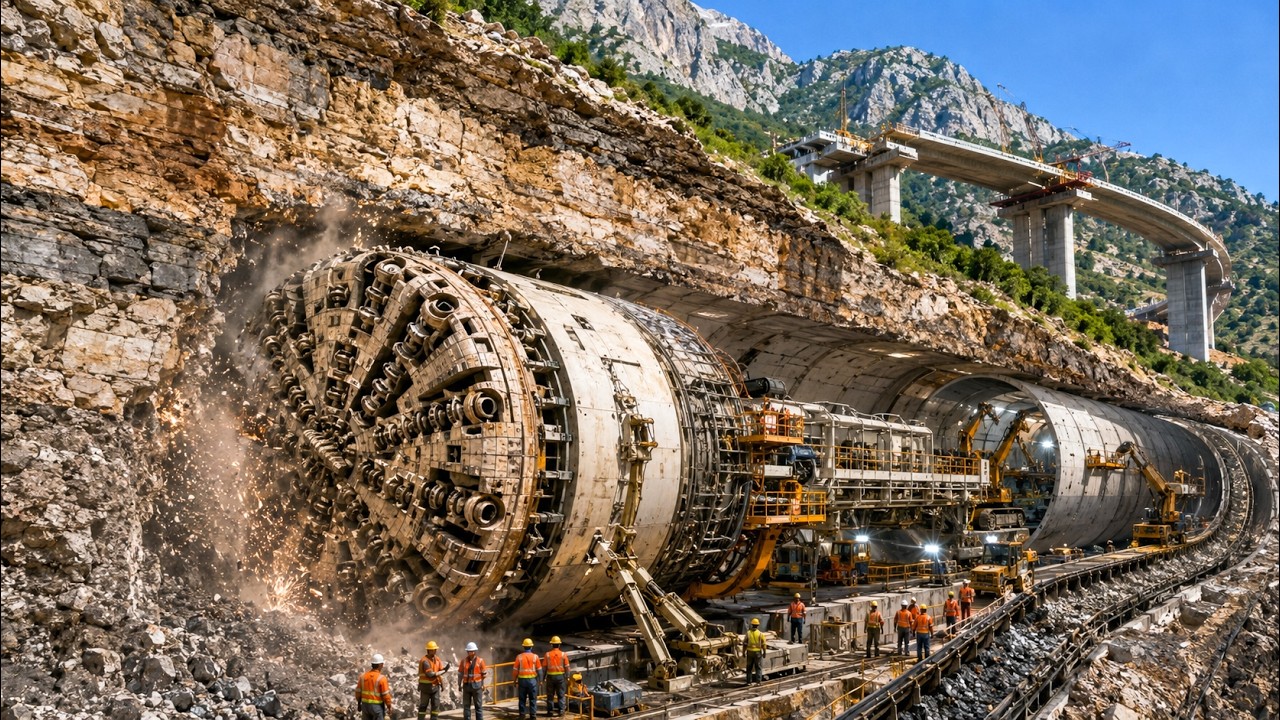
Before the tunnel face is touched, engineers drive a ring of steel [music] pipes forward, overlapping like fingers laced together. A technique called a four-pole umbrella. It shields the crew and holds the roof up just long enough to excavate the next few meters. Miss that step, and the tunnel roof doesn't wait for you to finish. It comes down while you're still inside. Where the rock was worse still, they added fiberglass anchors, bolts that reinforce loose rock but can be cut through easily by [music] the boring equipment later, instead of steel that would just get in the way.
Watch this. >> Every meter forward here was earned, not assumed. They'd advance a few meters, stop, reinforce, test, [music] then advance again. >> No shortcuts through ground like this. Then came the part [music] nobody could fully engineer around. At the tunnel Malakasi Junction, the driver lost his patience. BCC the fault activated. It triggered a landslide, and the landslide brought down the tunnel's northern portal.
The exact section [music] the reinforcement was supposed to protect. >> Let that sink in. This wasn't a design failure. This was ground that failed underneath a correctly built structure. [music] The response? >> Rebuild the support scheme from that failure point forward, treating the collapse zone as its own unique geotechnical problem rather than applying a standard fix. Meanwhile, above ground, a different kind of foundation problem was taking shape.
At Mettavittika's [music] Valley, engineers weren't drilling down. They were building up. Piers rising more [music] than 100 m to carry a bridge deck across a canyon with a central span stretching 230 m [music] between supports. >> I'm looking straight down one of these piers right now. 100 m is roughly the height of a 30-story [music] building. Holding up a road in open air over a gorge. Every one of those piers had [music] to be anchored into ground that a few kilometers away was still sliding. >> The tunnel survived its rebuild.
The piers went up. But the mountain wasn't [music] finished testing them yet. By the mid-2000s, the pieces were multiplying. 76 [music] tunnels. Combined length almost 100 km of bored rock. Enough underground roadway to drive from one end of a small country to the other without ever seeing daylight. >> Here's the crazy part. Every one of those tunnels was priced individually because the ground refused [music] to be consistent.
Where the rock was solid, a meter of tunnel cost around 8,000 euros. Where it was shattered and waterlogged, that same meter cost up to 35,000. [music] More than four times as much for identical distance. Watch this. This isn't a construction [music] site with one budget. It's 76 separate bets against 76 different mountains. And some of those bets cost four times [music] what engineers planned for. The longest of them all, Drisgos Tunnel, 4.57 [music] km per bore, drilled and blasted through the Pinjes range starting in 1999.
Designed to [music] last 120 years, longer than most bridges, longer than most nations' entire road networks get planned for. Above ground, [music] the bridge count kept climbing. 1,650 of them by the time the numbers [music] were final. Stretched end to end, that's 42 km of bridge deck, 6% of the entire route suspended in the air. Stay with me. Every 400 m of this highway, on average, there's another [music] bridge.
Not because engineers wanted bridges, because the terrain gave them no other option. Each carriageway was split, two separate structures side [music] by side rather than one wide deck, a standard borrowed from German highway practice, built to isolate failure. [music] If something ever went wrong with one side, the other kept running. The road itself, >> [music] >> 22 m wide, two lanes and a hard shoulder in each direction, wired with SCADA-controlled [music] lighting and ventilation systems inside every tunnel, and collision [music] absorption barriers designed for a route where trucks share space with hairpin mountain curves. >> Somewhere in the middle of all of this, five wildlife underpasses and one dedicated green bridge [music] went in.
Quiet, easy to miss on a drive-through. Built so a brown bear could cross 670 km of new asphalt without ever knowing it was there. You'll see why this mattered [music] later. Because by now, the budget wasn't behaving either. But there was one problem nobody had fully solved at this scale before. Not the rock, not the bears, not the money. It was making 1,726 [music] separate structures behave like a single unbroken road.
Then the ground moved again. Cassidy wasn't finished. After the first [music] tunnel collapse, crews had rebuilt the portal, reinforced the fault zone, pushed forward. The mountain answered [music] back with more of the same. Active slope movement that kept showing up on monitoring equipment kilometers away at a site called Prinatopa >> [music] >> near Metsovo. This is where it almost fell apart. Here's the problem nobody could argue their way around.
This wasn't one landslide to fix and move past. It was a mountain range with dozens of these zones and no way to know in advance which one would move next. The response wasn't heroics. It was instrumentation. Engineers installed one of the first automated real-time ground displacement monitoring systems [music] used on a Greek highway project. GPS sensors and motorized survey [music] stations feeding data back continuously.
So a slope beginning to shift would show up on a screen before it showed up as a collapsed roadway. I want you to understand what [music] that meant on the ground. This wasn't build it and hope. This was watching [music] the mountain meter by meter in real time for years. It meant schedule delays. It meant sections priced at four times the original tunnel estimate because the rock simply demanded [music] it. It meant redesigning support systems mid-construction more than once. >> But it also meant no tunnel here failed twice.
Problem absorbed by engineering. >> [music] >> The mountain had thrown its worst geology at a road built by a country that had isolated for 2,000 years. >> The road kept going. By 2006, the first long stretches opened. 25 km through Epirus and Central Macedonia. Cars finally running on pavement where mountain tracks used to [music] be. Section by section, the rest followed. >> The Kastania bypass alone, one relatively short stretch, cost 485 million euros and cut a drive that once took most of an hour down to 15 minutes. >> Watch this number, 15 minutes.
That's not a convenience. [music] For a region cut off since before the Roman roads existed, that's the difference between a hospital being reachable >> [music] >> and not. By December 2009, the European Commission was tracking 594 of the planned [music] 670 km already carrying traffic. The final tunnels [music] and bridges closing the remaining gaps. 15 years after the first survey teams walked into [music] Pindus, the road was whole. >> 76 tunnels bored, 1,650 bridges standing, 5.93 billion euros spent against [music] mountains that had turned back an empire 2,000 years earlier. >> Here's the number that mattered most.
The drive between Thessaloniki [music] and Ioannina, once a half-day ordeal on switchback roads, was cut in half. Then the real test came, [music] not from an earthquake, not from a landslide, from the market. December 2025, [music] 16 years after the last section opened, a private consortium, Yektorna and Egis, didn't [music] just offer to maintain this road, they paid for the right to run it. 1.275 billion euros. Paid up front to the Greek state for a 35-year concession over a highway that mountains [music] had spent 2,000 years refusing to allow.
Let that sink in. Nobody pays over a billion euros in cash for a road that [music] doesn't work. >> The new operators committed 1.8 billion more over the life of the deal. Not to fix what failed, but to modernize what [music] was already carrying the traffic of an entire region decade after decade, tunnel by tunnel, without the fault [music] lines underneath it ever closing the road for good. Zero tunnels lost for good.
Zero bridges rebuilt [music] from scratch. The mountain got its landslides. The mountain got its active fault. The mountain got the worst rated rock in the country. The road still runs. The mountains never wanted a road. They got one anyway. Not because engineers beat [music] the geology, but because they never stopped rebuilding what the geology took back. A fault line took a tunnel. They rebuilt it. A slope wouldn't [music] hold still.
They watched it meter by meter until it did. A budget [music] that was never going to behave. They spent it anyway. Four times over in places because the alternative [music] was leaving a region isolated for another 2,000 years. 2,000 years ago, Rome tried this same route and the mountains won. This time, the road held. Somewhere along those 670 kilometers a bear [music] can still cross under six lanes of asphalt and never know it's there.
A driver from [music] Thessaloniki reaches through his window. this. A truck driver [music] for And underneath the [music] 15-year-old bridge deck, a fault line is still being watched meter by meter in case the mountain >> [music] >> isn't finished yet. The impossible is just geology that hasn't been monitored closely enough. >> If you want to see what else [music] engineers have finished fighting mountains for, subscribe.
The words are the caption track's own and nothing is reworded or re-transcribed. Paragraph breaks are placed between sentences so the text reads as prose.
Free tools for your own script: paste a draft and see where it stands before you record it.
Paste your draft and see where viewers are likely to drop off, with a rewrite for each weak line.
Paste the first 30 seconds of your own draft for a hook score and rewrites.
Check your draft against YouTube's advertiser-friendly guidelines before you record it.
Read this channel's public videos and transcripts, and download a writing brief for it.