Getting the transcript
Reading the captions from YouTube. A video nobody has opened here before takes 10 to 30 seconds; this page fills in on its own.
Getting the transcript
Reading the captions from YouTube. A video nobody has opened here before takes 10 to 30 seconds; this page fills in on its own.
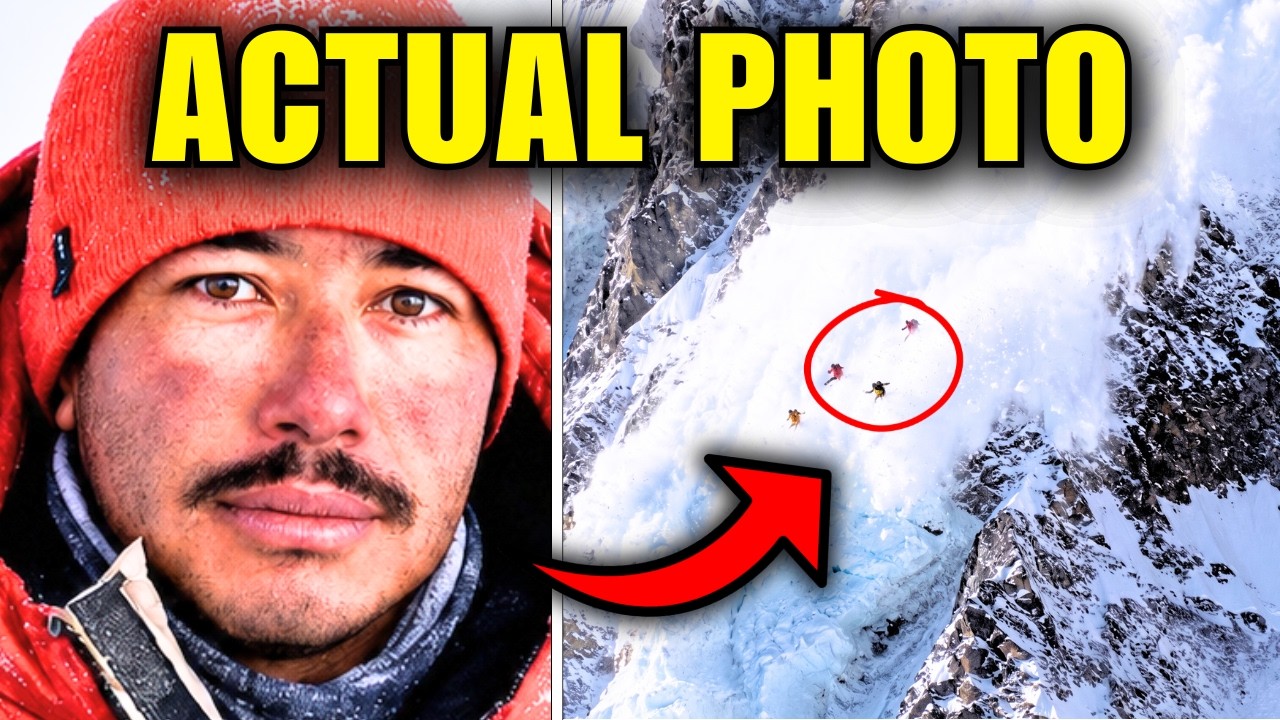
Tourist Tragedies · @TouristTragedies
This video has no Most replayed graph yet: YouTube shows one only once a video has enough views. These are the moments viewers replayed most in Tourist Tragedies's most watched videos.
Most replayed moment at 11:24
7.4x that video's typical replay level
stayed humid and unsettled with likely fresh snow through the 29th, [music] which means the snow on that face never got its quiet days. 9:20 in the morning, the slope releases. Above the climbers, the slab cracks. It moves as one sheet. On a face that steep, [music] it is traveling faster than
Said at 11:17
Most replayed moment at 11:26
13.4x that video's typical replay level
separate parties are struck. Dai Hong Chen is killed at the scene. The Pierce County Medical Examiner will later record multiple blunt force injuries. One climber is seriously hurt. Two more take minor injuries.
Said at 11:18
The graph counts replays. It does not show where viewers stopped watching.
Words
3,089
Runtime
19:23
Speaking pace
159wpm
Reading time
13min
159 words per minute, below the 160 25th percentile of 349 measured videos. That distribution comes from the 349-video hook study.
Opening (first 30 seconds)
July 27th, 2026. Broad peak base camp, Pakistan. Nurmal Pora, the most famous climber in the world, had come to this mountain by accident. It was never on his schedule. [music] These were his last minutes. Not on Everest in the pre-monsoon crush, not on K2 in the dead of winter, had this man ever looked like someone a mountain could beat. In 2019, he climbed all 14 of the world's 8,000 meter peaks in 6 months and 6 days.
80 words, the words spoken in the first 30 seconds at 159 words per minute.
Free, no signup. See how the first 30 seconds hold attention, with rewrites.
Sentence shape
| Measure | This transcript |
|---|---|
| Sentences | 242 |
| Average words per sentence | 12.8 |
| Longest sentence | 92 words |
| Questions asked | 2 |
| Sentences containing a number | 78 |
Most used terms
Filler phrases
7 in total: like 4 · actually 2 · literally 1.
A literal whole-word count of the same phrase list the Prepublish browser extension uses, so a phrase inside another word is not counted and a phrase used in its ordinary sense still is. It is a count and not a judgement.
What this transcript is
Every word below is the caption track YouTube publishes for this video, pulled from the video itself and reproduced unchanged. It is not Prepublish's writing, not a summary, and not a re-transcription: it is the video's own published captions. English captions, generated automatically by YouTube, in the video’s original language. Source: the video on YouTube. A channel that would rather this page did not exist can ask for its removal through the contact page, and it is removed.
July 27th, 2026. Broad peak base camp, Pakistan. Nurmal Pora, the most famous climber in the world, had come to this mountain by accident. It was never on his schedule. [music] These were his last minutes. Not on Everest in the pre-monsoon crush, not on K2 in the dead of winter, had this man ever looked like someone a mountain could beat. In 2019, he climbed all 14 of the world's 8,000 meter peaks in 6 months and 6 days.
The record he broke had stood for 7 years, 11 months, and 14 days. 2 years later, he stood on the summit of K2 in January in cold nearus 50, breathing nothing but the air around him. Nepal called him Nimsdai. Everyone else called him Nims, but he never came back. The part that bothers me with this story is that it was not one mistake. It was a chain. A storm nobody was still there to talk about. A decision made 4 days earlier.
An empty base camp and a slope with something loaded above it. Welcome to tourist tragedies. To understand how strange his death is, you have to understand one number. 189 days. That is how long it took Nirmal Persia to stand on top of all 14 of the mountains on Earth that rise above [music] 8,000 m. Annaperna in April, Shisha Pangma in October, everything in between. Before he did it, the record belonged to the Polish climber Jersey Kukuchka and it had stood since 1987, 7 years, 11 months, and 14 days.
Here is what that gap actually looks like. Imagine the marathon world record a little over 2 hours being broken. Not by a minute, not by 10 minutes. Imagine somebody running a marathon in 8 minutes flat. That is the scale of what he did to that record. And he did not do it quietly. In a single push in May of 2019, he summited Everest, then Lhati, then Macaloo in 48 hours. three of the six highest mountains on the planet in two days [music] in a body that most people would struggle to keep conscious at that altitude.
Two years later, in January of 2021, he did something an entire generation of the best alenists in the world had failed at K2 in winter. Nobody had ever done it. 10 Nepali climbers walked the last few meters to the summit shoulderto-shoulder singing their national anthem so that no single name could claim it. Persia was the only one of the 10 who climbed it without bottled oxygen. And honestly, when you look at the list of what this man did above 8,000 m, you would probably agree with what half the climbing world was already saying out loud.
The normal rules [music] did not seem to apply to him. So how does someone become this? It is not the story you would expect. Nirmalpura was born on the 25th of July 1983 in a village called [music] Dana in the Miyagi district of Nepal about 1,600 m up in the foothills of Daigiri. The seventh highest mountain in the world was quite literally the view from his birthplace. He left it when he was 4 years old. His parents had married across cast lines and the family paid for that socially and financially.
In 1987, they moved south to Chitwan in the flatlands, hot, humid jungle country a couple of hundred meters above sea level, which means the man who would one day own the 8,000 m peaks grew up nowhere near a mountain. The family had almost nothing. He put it plainly years later. As a kid, he said, he did not even have flip-flops. What they did have was the girkas. His father had served. His three older brothers followed him in.
And it was their soldiers pay sent home [music] that put the youngest boy into an English-speaking school in Baharapur called small heaven. He was good at school. He was better at sport. And somewhere in his teens, he decided he was going to do what every man in his family had done, which in Nepal is not a small ambition. Girka selection takes a few hundred men out of tens of thousands of applicants every single year.
So he started sneaking out at night to run. In 2003 at 18 he was in Queens Girka engineers. [music] In 2007 he passed the all-arms commando course at Limstone, then Afghanistan with 69 Girka Field Squadron. [music] And in 2009 he did something no Girka had ever done. He passed selection for the special boat service, the tier 1 special forces unit of the Royal Navy. Now, here is the part that still surprises people. At that point in his life, he had never climbed anything.
He had never even seen Everest. He said it embarrassed him. People always asked whether he had seen it, and he always had to say no. In 2012, on leave, he finally went to look. He tked to Everest base camp and then because that was apparently not enough, he climbed Loouch East on the way home. 2 years later on the 18th of May 2014, [music] he stood on the summit of Daigiri, his first 8,000er, 26,795 ft of it, the same mountain he had been born beneath and left behind at 4 years old.
Something on that climb told him he was different. He went up faster than people who had been doing it for decades. He acclimatized faster. He recovered faster. He wrote later that he became a beast at high altitude. And that much of it, he believed, came down to freakish physiology. The rest [music] was the military. 10 years in the SPS had given him cold weather warfare, load carrying, sleep deprivation, and a very particular relationship with the word impossible.
May 13th, 2016. Everest for the first time. May of 2017. He led 13 serving Gorka soldiers to the summit of Everest to mark 200 years of Gorka service to the British crown. [music] Then he went back up in the same season and did something nobody had done. Everest and Latza in a single day, 10 hours and 15 minutes from one summit to the other. Macallu 5 days after that. In 2018, he was appointed MBE. And then in early 2019, at 35 years old, 16 years into a military career that had been his entire identity, he resigned.
Nobody would sponsor him. The plan he was pitching, all 148,000ers inside 7 months, sat so far outside what was considered possible that companies assumed he was either exaggerating or about to die. So, he reorggaged his house. He took out a bank loan. He funded it himself. Project Possible ran from April to October of 2019. He finished it in 189 days. Along the way, he took a photograph on the ridge below Everest's summit.
A queue of climbers stacked nose totail on a knife edge waiting. It went round the world and permanently changed how the public pictures that mountain. He also kept stopping. That is the part that gets lost. on Annaperna in 2019 in the middle of a record attempt where every single hour mattered. He turned his team around and went back up to find a climber stranded high on the mountain. Rescues became a pattern and he built a reputation and then an entire company on one idea.
Nepali climbers should be the names in the record book, not the invisible labor behind it. Then came K2 in winter. Then came Netflix in November of 2021 and a film that made him famous to millions of people who had never once thought about mountaineering. Then his foundation in 2022, then his Nepali citizenship, formerly restored in November of 2023. He was not universally loved. His use of bottled oxygen on the first project drew criticism from purists.
His commercial expeditions drew more. In his final years, his name appeared in public disputes he never fully resolved. And his legacy is still being argued over right now. But by the summer of 2026, he had a wife, Suchi, a daughter, Hmani, [music] a company, a foundation, a record book with his name running through most of it, and one clean enormous goal left to finish. Life was quite simply perfect. The goal was this.
Puerto wanted to become the first person to climb all 14 8000ers twice without supplemental oxygen. 14 [music] more no bottles on top of everything he had already done. It would also give him three complete rounds in total which nobody in history has ever had. He flew to Pakistan in the summer of 2026 for Gasher 2. Broad peak was not on the schedule. Remember that it matters later. Now go back 11 days to the 18th of July.
A major windstorm rolled through the Caracorum. Climbers who were on Broad Peak in that stretch described some of the hardest conditions they had ever experienced. An American climber called Napier Fuller went up in the first summit wave on the 18th and 19th and got hit again and again by rockfall. One rock hit his helmet hard enough to stun him and punch a hole in it. He and his guide turned back a few hundred meters below the top at the point where the fixed ropes simply stopped.
A Hungarian climber, David Klene, who had been living underneath Broad Peak for a month, also turned around just below the summit. On the 25th of July, he and his climbing partner packed up and [music] walked out of base camp. So did nearly everybody else. By the last week of July, Broad Peak was almost empty, and the weather in the region never settled. High winds, elevated humidity, exactly the conditions that quietly load fresh snow onto steep ground day after day, right the way through the 29th.
On the 27th of July, Kura posted he told his followers Broad Peak had not been planned, that opportunities do not shout, that adding it would bring him one step closer. Then he signed off with a line that has now been read by millions of people. [music] Broad peak, he wrote. I asked for nothing but safe passage up and back down. The next [music] morning, the 28th of July, 10 climbers left Broad Peak Base Camp at around 16,000 ft and started up the fixed ropes toward Camp 1.
Pura and five other Nepali climbers, a Pakistani guide from Hunza, an Omani mountaineer, an American, and a Chinese climber. It was a beautiful morning. To understand what happens next, you need to understand what Broad Peak actually is. It stands 8,051 m high, 12th highest mountain on Earth, and it sits roughly 8 km from K2, which is the entire problem with its reputation. Because next to K2, everything looks gentle.
Broad Peak has no bottleneck, no hanging ice cliff above a single choke point that the whole world has watched kill people on [music] camera. Climbers call it K2's easier neighbor, and plenty of people treat it as a warm-up. Here is the correction. Less technical does not mean less dangerous. It means the danger comes from somewhere else. On Broad Peak, the thing that kills you is not the climbing. It is what is sitting above you.
The standard route runs up an enormous west-facing gully. Picture a funnel cut into the side of a mountain thousands of feet long with [music] steep loaded slopes on both sides and one line at the bottom where everything collects. Mountain people call that shape a terrain trap. It means anything that releases off the walls above you does not spread out and dissipate. It concentrates. It comes down the same channel you are standing in.
Now add wind. When strong wind blows across a ridge, it lifts snow and dumps it on the sheltered side, packing it into a dense, cohesive layer called a slab. That slab sits on top of whatever was already there, which may be weak, sugary, older snow. Think of a pane of glass resting on a bed of marbles. A slab like that can hold for days. It can hold for weeks. And it does not fail gradually. It fails all at once as one enormous sheet from one trigger point [music] and within a few seconds it is moving at motorway speed.
That is what was sitting above the route on the morning of the 30th of July. Quick heads up, every week I drop new videos you will not find anywhere else. Please subscribe. July 30th, 2026. [music] The 10 of them are moving up between camp 2 and camp 3, roughly 6,600 m. 21,700 ft. The weather is fine. The light is good. It is just before 9 in the morning. They are strung out along the fixed line, spaced across a few hundred meters of the gully.
Exactly where the route puts you. Exactly where the route has put everyone for 70 years. And then the whole face let go. Not a slide, not a sloth. Photographs of the slope taken afterwards show a huge overhang above the traverse. and the reading from Pakistani climbers who know that ground is that the entire snowladen face moved at once. There is no warning worth the name. You get the sound, then you get the wall. There is nowhere to go.
Above them is the fracture. Below them is a funnel 2 m long. On either side of them is a mountain. Their satellite trackers recorded the rest of it in numbers. 800 m of vertical drop. that is Puria's device 2,600 ft straight down. Others went further. Several of the 10 were carried almost the entire height of the mountain. One of them came to rest close to base camp itself, a vertical mile below where she had been standing a minute earlier.
At 9 in the morning, 10 people were climbing a mountain. By 9 and 1 minute, there was nothing on that slope at all. base camp lost contact immediately. For reasons that are still not clear, the call for helicopter support did not go out for several hours. When it did, two Pakistan Army Aviation helicopters launched. The Alpine Club of Pakistan [music] mobilized everything it had. And then something happened that tells you precisely what these people are.
Every expedition on K2 8 kilometers away [music] in the middle of their own narrow summer window cancelled. Climbers who had spent months and enormous sums of money getting into position walked away from the season and came to help search. The bodies of Nadira al-Harthy of Oman, poor Bahadur Gurung of Nepal and Mallalerie Gis of the United States were recovered first from the debris fan at the foot of the mountain directly opposite base camp.
On the 1st of August, elite exped confirmed what everyone already knew. All 10 were dead. On the second, a joint Nepali and Pakistani team located Puja, Wang Jong, Nema Sherpa, and Keili Pembbeas Sherpa at around 5,700 m. Bringing them down took until the 5th of August on ground that was still releasing. Sir Baz Khan, the first Pakistani to climb all 14 8000ers without oxygen, was on Broad Peak for the 20th time in his life, searching for friends.
Two or three avalanches came down every single day while they worked. Nirmal Purja was 43 years old. He left behind a wife Sushi and a daughter Himmani. And in Parur in Chichuan, the children of small heaven school, the school his brother's army wages had [music] paid for, stood outside in the dark with candles. Say the other names too. >> [music] >> So saki malerie guys poor bahadur gurong nema sharpa nadhira al-harthy [music] kilip pemba sharpa nawangindu sherpa galu sherpa wong jong I want to be careful here because this happened days ago not [music] decades ago there is no completed investigation some of what follows will change but when you lay the facts we do have in sequence a terrifying picture begins to form one the 18th of July, a major windstorm crosses the caracorum and the wind and the humidity never really stop for the next 11 days.
That is a snow loading machine running continuously on the exact slopes the route has to cross. Two broad peak was never on the plan. [music] It was added late in country because it moved a record one step closer. A late addition means a late climb and a late climb means the very end of a season when the snowpack has had all summer to build layers. Three, almost everybody else had gone home. That sounds like a scheduling detail.
It is not. Other teams are your information network. They are the people who tell you the slope above camp 2 felt hollow yesterday. They are also the people sitting at base camp with a radio when something goes wrong. By the 30th of July, Broad Peak was nearly deserted. Four, [music] the terrain. A west-facing gully with a loaded face hanging above it and one line through the middle of it where every climber has to be.
Five, the response. Hours went by before helicopters were requested. Not one of those five things kills anybody on its own. Climbers push late seasons all the time. Teams climb empty mountains all the time. Loaded slopes hold all the time. Aviation safety people call this the Swiss cheese model. Every layer of protection you build has holes in it. And you are perfectly fine. Right up until the moment every hole in every layer lines up and you can see straight through.
On the 30th of July on the west face of Broad Peak, [music] they lined up. 3 days before he died, Nurmal Persia wrote something on the internet that had nothing to do with records. My purpose has never been about me, he wrote. [music] It is about what I represent. He asked that mountain for safe passage [music] up and safe passage back down. He got the first half. Nurmal Purja died because every small invisible failure lined up perfectly for a tragedy nobody could predict.
So here is my question for you. when almost every other team on the mountain had already packed up and walked out. Was that information or was that an opportunity? Tell me in the comments what you think you would have done.
The words are the caption track's own and nothing is reworded or re-transcribed. Paragraph breaks are placed between sentences so the text reads as prose.
Free tools for your own script. No signup, no login.
Paste your draft and see where viewers are likely to drop off, with a rewrite for each weak line.
Paste the first 30 seconds of your own draft for a hook score and rewrites.
Check your draft against YouTube's advertiser-friendly guidelines before you record it.
Read this channel's public videos and transcripts, and download a writing brief for it.