Getting the transcript
Reading the captions from YouTube. A video nobody has opened here before takes 10 to 30 seconds; this page fills in on its own.
Getting the transcript
Reading the captions from YouTube. A video nobody has opened here before takes 10 to 30 seconds; this page fills in on its own.
Chase Chappell · @ChaseChappell
This video has no Most replayed graph yet: YouTube shows one only once a video has enough views. These are the moments viewers replayed most in Chase Chappell's most watched videos.
Most replayed moment at 2:44
7.0x that video's typical replay level
downloaded on your computer so that way you can do this. And one of the first steps is we're going to copy that link. We're going to come in here and click the plus sign, go to connectors, manage connections, and we're going to hit add. We're going to add a custom connector. We'll paste this, and we'll name it Meta
Said at 2:37
The graph counts replays. It does not show where viewers stopped watching.
Words
4,811
Runtime
25:02
Speaking pace
192wpm
Reading time
20min
192 words per minute, between the 181 median and the 201 75th percentile of 349 measured videos. That distribution comes from the 349-video hook study.
Opening (first 30 seconds)
I've studied thousands of offers from thousands of brands we've worked with. The thing I've noticed is that the offers that take one brand to nine figures would make another brand selling the exact same thing completely broke. A great offer creates value for the customer, but extreme value for the brand, which is exactly what I'll be explaining to you in this video is everything around offers you should be using in your business versus which ones you should not. Everyone tells you to work on your offer, but nobody tells you what an offer
96 words, the words spoken in the first 30 seconds at 192 words per minute.
Free, no signup. See how the first 30 seconds hold attention, with rewrites.
Sentence shape
| Measure | This transcript |
|---|---|
| Sentences | 310 |
| Average words per sentence | 15.5 |
| Longest sentence | 60 words |
| Questions asked | 3 |
| Sentences containing a number | 79 |
Most used terms
Filler phrases
27 in total: actually 12 · like 7 · literally 5 · basically 1 · kind of 1 · you know 1.
A literal whole-word count of the same phrase list the Prepublish browser extension uses, so a phrase inside another word is not counted and a phrase used in its ordinary sense still is. It is a count and not a judgement.
Run the check on the words above: where attention is likely to drop, with a rewrite for each weak line. The free check shows the scores and the one issue costing the most.
What this transcript is
Every word below is the caption track YouTube publishes for this video, pulled from the video itself and reproduced unchanged. It is not Prepublish's writing, not a summary, and not a re-transcription: it is the video's own published captions. English captions, generated automatically by YouTube, in the video’s original language. Source: the video on YouTube. A channel that would rather this page did not exist can ask for its removal through the contact page, and it is removed.
I've studied thousands of offers from thousands of brands we've worked with. The thing I've noticed is that the offers that take one brand to nine figures would make another brand selling the exact same thing completely broke. A great offer creates value for the customer, but extreme value for the brand, which is exactly what I'll be explaining to you in this video is everything around offers you should be using in your business versus which ones you should not.
Everyone tells you to work on your offer, but nobody tells you what an offer is. So founders hear the word offer and reach out to the only thing they know. It's probably just a random discount. But an offer is the most sensitive thing in the entire business to touch because it's the one lever that moves your margin, your conversion rate, and your cost to acquire a customer at the same time. It basically changes the entire economics of your business.
And there are three major offer types. One is you're trading unit margin for a conversion rate. This is where you give up profit per sale to get more sales. And margin, by the way, is how much money you keep after they buy. So you hand over a slice of it to make saying yes easier. Maybe you need to clear inventory, so you trade profit for speed. Maybe email is what matters most to your business right now. So you trade profit for an email address, free shipping, a free product, a free anything with real value.
Number two is trading unit margin for a bigger cart size. Now you give up profit per unit to get more units per order. Bundle three and take 15% off the final price. unlock 10% off, but only once they cross over a $120 order threshold. You're still discounting, but you're discounting in exchange for a larger order. That pushes up your AOV, which raises the value of every customer walking through the door, and it opens your margin back up on the way out.
Number three is trading unit margin for repeat purchases. Here, you give up profit on the order one to get order 2, three, and four. That's LTV. This is where you have more product options to come back for, subscriptions that make coming back automatic, and you're buying a longer relationship instead of a single transaction, which we'll get into later. So, let's go ahead and break down these three offers and what they look like.
Number one is going to be AOV and bundlebased offers. This is where we're trading your unit margin, and we use this to increase your AOV so that way we can make more money on the back end. Most of you will have a single hero product that you sell, which may be a bar of soap, it may be a t-shirt, it may be socks, and you only offer that one tea or one bar of soap or one sock. And so, let's say your sock is $14 to buy.
Well, when somebody goes to check out, your AOV is only going to be $14. And if it costs you, you know, 14 bucks to acquire that customer, you're losing money on this deal. What you want to do is be able to incentivize a higher AOV to make back that margin. This is where a 10% off a fourack so that way we get people to spend $50 instead of only $14. And when we understand how this impacts your backend, let's just look at the numbers for how this works out.
If you're selling a product at $14 for a pair of socks and you're having the customer pay shipping, well, you're going to spend a,000 bucks. You're going to get 40 purchases at a 2% conversion rate. Your first time AOV is only $14 and maybe it cost you 25 bucks to just acquire that customer. Your ROAZ is a 0.56. That's very low because you don't have a very high AOV. ROAZ and AOV are tied together. So you generate $560 in revenue.
It cost you four bucks to make the product and your overall profit after ad spend is minus $617. Because what ends up happening is you have a low conversion rate because they add the product to cart, they go to check out, and then they abandon because you're not offering free shipping. So most people think, well, we just need to offer free shipping so we get more people to buy. Well, then that becomes a problem because now people who come to your site, if you spend that same amount of money, well, your conversion rate went up because now you're no longer having them pay for shipping.
So that's a great thing. Conversion rate went up. That's good. So now you've effectively more than 2xed your sales. That's also great. Your first time AOV is still only $14. That is a huge problem. Your CAC went down dramatically. You decreased it significantly down to 10 bucks. That's great. ROAZ is now at a 1.4x. It looks good because your CAC went down. But in reality, what ends up happening is even though you generated $1,400 in sales and 2x your revenue, well, you still have to pay for shipping because you're offering them free shipping now.
So although your conversion rate rate went up, you're now absorbing the cost of shipping. So you actually lose more money even though you increase your return in ad spend, you actually made less. And the reason that is is because now you're paying for the shipping instead of them. So this offer doesn't work either. So instead, what you do is you offer a fourack by bundling it together and offering them a discount. This directly increases your margin because now instead of people buying a single, they go to buy the fourpack because you're discounting the overall unit margin.
So, they're actually paying less per sock and getting a better deal this way. So, what ends up happening is you spend that same amount of money as A and B on number C. With the fourack, $1,000, you average a 3.5% conversion rate because you're incentivizing them to buy more and they're getting a better deal on their end. You get 70 purchases instead of 100, but your first time AOV is $50. That's a significant jump. Your CAC actually goes down because they have an incentive now.
And your ROAZ jumped significantly. You're now at a 3.5x. Your revenue is at 3500. And your COGS are now 16 because they're buying more product. And what ends up happening is you actually land in the profit zone. So you effectively have now offered them a better deal. It's cheaper for them to actually buy more and it also is better for you because you're making more margin on the back end. That is the beauty of a good offer.
So what you need to understand is every offer has a downstream event. So when we look at offers, it's not just a random offer. There's always a secondary, third, and fourth downstream event that takes place. So when we offer a multiack tier, which is this right here, we're offering a multiack at a discount. This allows us to increase our AOV, which we just learned. It also allows us to get more revenue per order, which we also just learned.
And then it allows us to get a much better return on ad spend at 3.5x. And it allows us to actually scale our spin because we can afford a higher CAC because it opened up the margin. Every offer impacts a downstream event. So, this offer helps your AOV and allows you to scale, which is why you'll see brands running bundle offers like Grind Machine. They they sell a one-time product. There's not really much you can bundle with this, but they put together a bundle of free socks, a basketball to really sweeten the deal, and they offered a discount on top of it.
So rather than it being 2500, you're getting it for 2,000, but you're also getting free gear and merch with it, which helps increase their conversion rate, incentivizes them to buy more, and it's still a great deal on margin for them. Same thing with Dr. Squatch. When we see this, they have a bar of a six-pack. So instead of selling one bar, they're offering a six-pack at 5% off. And then they have a subscribe and save offer discounting more.
But if you add to cart, they're also offering you additional upsells. So, they're effectively getting more margin by reducing the cost to you and passing the savings on. It's a win-win. That's what makes a great offer. It helps the customer get a better deal by offering them free shipping if they add this product to cart. So, now they save money, but you also make more money because you're increasing the cart value, which gives you more margin on the back end to scale.
This is the beauty of a great offer, which is why you'll see these cart incentives. The more you add to cart, the more you'll save, but it wins for both the customer and you. Same thing with Limmy. Build your own custom bundle. This is why these offers work so amazingly. So, next time you think about your offers, refer to this and understand what the downstream event ends up being. You can offer upsells. You can offer secondary order discounts.
So, the more they buy, the more they get a discount. These are volume thresholds which we just looked at with Symbiotica and cart. A volume threshold allows you to increase your AOV rorowaz and you discount on crossovers getting them to buy more products. One of the strongest offers is one that people avoid doing because they think it's annoying. They think it's annoying to get emails. So they don't send them. They don't offer it.
They think it's annoying whenever a popup stops you from shopping asking for your email. So they don't even add it to their website. And that's one of the biggest mistakes founders make before they work with me. Email opt-in offers are one of the greatest things for a business because if you can get somebody to convert at 10 to 18% on an opt-in with a 10 or 15% off offer, it is going to substantially move your margin on the back end.
And I will show you what this means later. These are all brands that we've worked with and it's by far one of the quickest ways to increase your overall results. So let's just understand this. There's three scenarios and most of you are in scenario A. You have no offer. You're saying, "Hey, join our community. Stay up todate with latest information. Be the first to know about our next product." Let's look at a scenario of what happens under that window.
If you have no offer and you get 2 million people to your site, but you have a way for people to submit their email to stay up to date or join your community, you maybe have a 1, 2, or 5% opt-in rate. 5% is pretty generous on this type of thing with no offer. Well, you're getting 100,000 people a year to subscribe to your email list. Let's say on average you generate 30 cents per person on your email list. That is $30,000 in revenue you're making every month from your email list.
And let's say your store revenue is 100k a month. So that's about 30% of your total. If we look at the person who has B, which is a popup with 10% off, which just says, "Hey, get 10% off your first time order." Well, let's look at that scenario. 2 million people visit the site. You have a roughly a 7% opt-in rate. You now are gaining about an extra 40,000 subs a year, which is really good. You're still making 30 cents per user who opts in.
Well, just by offering 10% off, you've now generated more revenue by doing so because you've gotten more people to opt into your emails. That is a big deal. And so now the percentage of your revenue is now 37% coming from email. And if we look at this, maybe your ESP costs go up because you have more people on your email list. So now you're spending a little bit more. You're also offering a discount. So you're losing a little bit more money, but compared to the baseline, you actually end up making more revenue in the long run just by offering 10% off because you're getting more people to opt in.
So having a 10% offer is not bad. But there's a better offer out there, which is the exact same offer at 10% off, but you're doing it as a full width popup, but it's a mystery discount. They can't see the discount. It says, "Get your mystery offer." And just by doing this one tweak, you can literally gain a 15% opt-in rate. We've tried this across hundreds of brands. It works every time, and it's one of the most stellar offers out there.
Just by offering the exact same thing, but hiding the offer and saying it's a mystery, you've effectively 2x your conversion rate. And just by doing that, you now have $300,000 emails a year opting in, which leads to $90,000 in email revenue. Just by that one little tweak in the offer, you've now effectively more than 3xed your revenue. Now, with that, what ends up happening is your ESP costs go up because you have a lot more people opting in. you have more people taking the discount at 3,600, but at the very end, your overall long-term delta, you generate a significant amount of more money.
So, let's look at what this mystery offer looks like. As you can see here, everybody is offering a mystery offer, and these are all tons of brands that we're working with. We have Garden Alchemy. He literally has a 17.46% opt-in rate. Giggly, you have to scratch off to be able to see your offer. And once you select which one you want, jerky, meat sticks, or both, you get your mystery offer. Stop the scroll, it's a mystery offer.
Same thing here. Women's, men's, bestsellers, you get a mystery offer. Mystery discount. This one, you play a game. See which offer you win. All of these lead to a mystery offer because it's interactive. It increases your conversion rate, which gets you more emails. You make more money by having more emails. And by offering the exact same discount, but just making it more intuitive, you have been able to 3x your revenue.
This is the value of a great offer. You're giving them a discount, but if you have no offer, you make less money. If you have just a 10% off, you're making a little bit more money, but just by making it more interactive and a mystery, you're making a significantly amount of more money. So, it's greater value to actually have a mystery because they feel like they're actually trying to win something and they have a chance to be able to get more from the brand.
So, you're creating more value for them with the mystery offer, but extreme more value for you as a brand on the other end. So, when you think about offers, don't just think about it as a 10% off. There's other ways to make your offer more valuable by making it interactive, even though it's the exact same offer. We just learned how much more of an impact this can have. So, when we do offers, think about the downstream chain event once again.
A mystery discount can increase your conversion rate. It can lower your CAC. It can raise your rorowaz. And it allows you to spin more. Same thing on spin the wheels. Scratch to reveal a quiz to unlock. All of these are great offers. So when you think about which one you're going to do, be sure to understand what impact they have later. This one has the highest optin rate and protects price. Other ones are great for low AOV categories if you don't have a very high AOV.
Now, we're going to be looking at subscription offers. Now, there's a very specific way of doing this because if you do not do it right, it can be one of the quickest ways to bleed your business dry. And this is where you increase your LTV by getting people to buy again and again over time where you make back your margin later. But this allows for you to have a much higher c. So, if you've ever been in the boat where you've struggled with raising your ad spend and your rorowaz drops and you're not able to effectively scale, you need to start looking into ways to increase your lifetime value so that way you can open your margin back up.
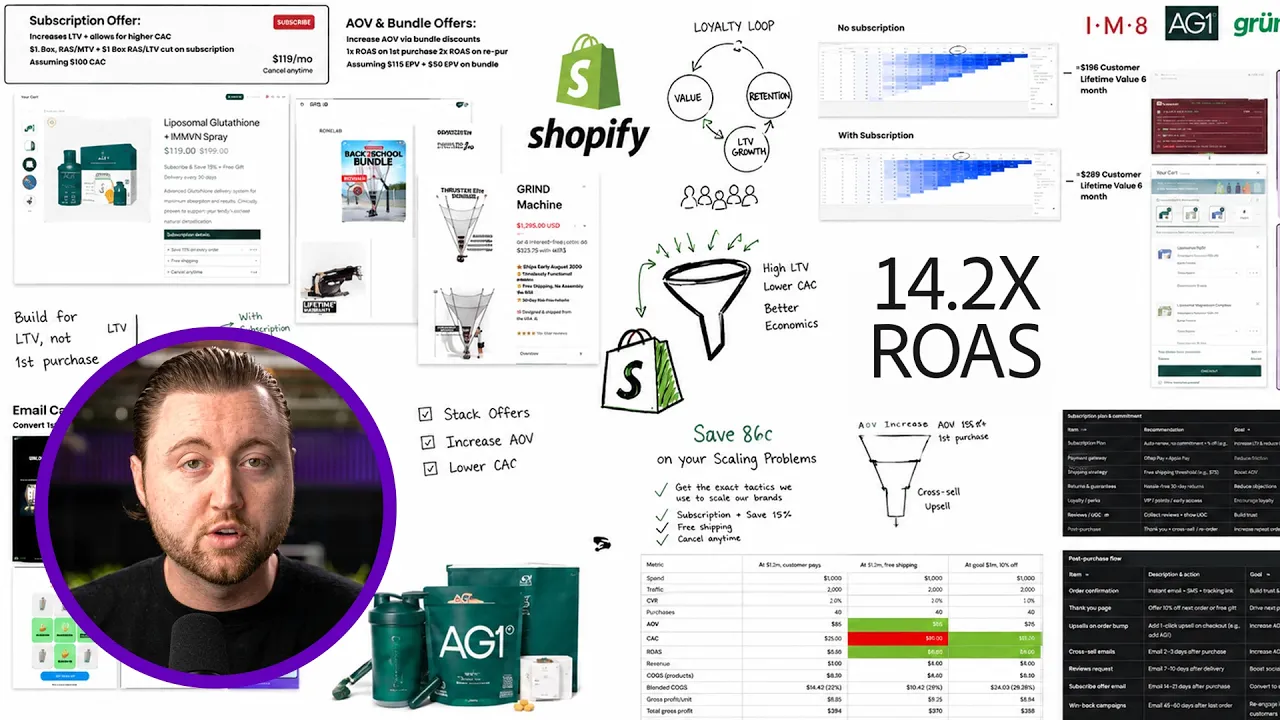
And I'll be showing you exactly how this works. So, here for example, we have Symbiotica. So, they're offering 34% off their subscription versus just buying one time. If you buy one time, you're paying full price at $88. But rather than just offering a simple 10% off, it's not that much of a value to get somebody to subscribe and save because we're effectively asking them, hey, we want you to subscribe to our product where you pay every single month, but in order to do that, we have to have a very compelling offer to do so.
So, we're willing to risk a significant part of our margin by offering a substantial discount where we are more than likely going to lose money to acquire this customer, which is unfortunate because that means there's not much profit on the first order. But what does that lead to? That leads to them buying the second month, the third month, the fourth month, and so forth later down the line where we can get all of that profit back.
If you were to acquire a customer on a nonsubscription by month 6, the value on a lifetime would be $165. This means they buy the product for $88, they're probably going to come back and buy another product within that six-month window, which leads to $165 customer lifetime value by month six. But if you can acquire that customer on that large discount by month six, they're actually worth $289 over their lifetime because they're on a subscription and they're buying more products for you.
This is why subscription businesses want to acquire people on a subscription is because they know the value of a customer is worth significantly more. Here you can literally get an extra $120 just by getting them on subscription. So, what does this allow you to do? Well, it means you can effectively spend more to acquire a customer losing money on the front end to make all the money back on the back end. Which is why these brands like IM8 Health are running at huge losses and are able to accelerate their growth because they can outbid all of their competition by doing so.
They're offering a 90-day supply on a subscription. That is a crazy offer and it is very expensive to acquire a customer. But they know that the profit on the backend can be substantial. But some brands choose to do this at scale where they're constantly acquiring lots of customers to be the biggest in the space. And they're kicking the can down the road, sometimes months and sometimes even years down the line. IM8 has been kicking that can indefinitely at cost to them to be able to acquire as many customers as possible because they're the only ones in the space that can pay the most to acquire these people, but they know the moment that they turn on the profit hose, it's going to flow in.
And then we have Rise, who does the same thing. They only want you to do subscription because they know the customer lifetime value is substantial. So, they're giving you all these crazy deals. They're giving you 40% off today by buying this, but they'll give you an even better deal if you do the entire set where they'll give you free products. They'll give you freebies, all of these gifts, 50% off just to get you to subscribe because they know lifetime value is worth it.
Same thing here. We have a back to school deal. Everyday Dose is giving you an app. They're giving you this little mixer. They're giving you a drink can, a writing journal, a scooper, the coffee, three, four, five sticks, all these free gifts just to get you to opt into subscription. Now, for a small business, this can be very risky and I'll show you what this means in a second. Same thing with Limmy. They're doing a luxury getaway and they only want you to opt in to a subscription.
So, how do we rationalize a subscription offer? A subscription offer is an auction play. If you don't have a subscription, this is you. You can only afford to pay $40. Now, your competitor can afford to acquire that customer for $62 because they're offering a discount on their subscription. Now, the person who wins is a company that is able to offer free gifts, a discount, and do anything at all costs to acquire them. spending upwards of $95, you will get it outbid every day by this person because they can acquire the customer faster than you.
The best ad doesn't win in this scenario. It's whoever can afford who pays the most wins. And so your ceiling on an LTV subscription play is whatever your LTV is determines your ceiling for how much you can pay. So, if your lifetime value is $289, that is a 3:1, meaning you can afford to pay up to $95 because you will get your profit back later. It's just your LTV times whatever your margin is. So, you were able to spend upwards of two times what it cost you to get that customer to buy.
If you're selling the product at $40, you're willing to pay two times that cost and lose money on the front end because you will make it back on the back end because it's at a 3:1. So, as long as you pay under this line, you will grow and scale your business. And you can outbid your entire competition using this strategy. So, the more your LTV goes up, your ceiling goes up to acquire a customer. You can accept a worse first sale on purpose, losing money, so that way you can outbid everyone for the exact same customer.
They're not running better ads. They can just afford to pay more. Which is why you see some brands operating at such a crazy low rorowaz because they're making all the money back on their LTVs. So that same store on a non-subscription only generates $165 in lifetime revenue, whereas on a 6-month with subscription, you're generating $289. That's $124 more per customer. That's a lot more money you can afford to bid just by getting people on subscription.
So some of the best offers in LTV will pay you later. So a perfect 3:1 in this scenario where you're able to acquire a customer at two times your product price. So you're selling the product for 40 bucks cost you $95 to acquire them. You're losing money. And most businesses will die in this process if they do not know how to manage cash flow because you're going to be losing money every time you acquire a customer. But what ends up happening is you make all of that profit later down the line because it's a LTV play.
You're effectively scaling your brand rapidly by acquiring as many customers at the highest price because you can afford to do it because it will pay you back later. But if you can't manage your cash flow effectively, this is not a good strategy for you in the early stages. If you do not have enough money in your bank account, you will quite literally run out of cash leveraging an offer like this. So, when you look at a subscription-based offer, the first order is going to be small because a subscription doesn't necessarily mean it's less profitable.
It's just the first order is smaller and not making money. You're just making all that money back later. So, when we look at this, the same product with the same 20k in ads. If you're a small store and don't have a lot of cash in the account, well, you want to run bundle offers to be at a very profitable rorowaz because you can effectively spend money, be profitable, and continue to roll that back in to scale your business.
Now, that same product for 20k in ad spend, well, if you're running a subscription and you're spending more to acquire a customer, you're losing money, but you're making it back later. Now, the brand who wants to be very aggressive will lose even more money on the first order to acquire as many people as possible because they're kicking the can even further down the road to make all that money back later. So, when we think about offers, we want to look at this on where to start.
The easiest ones are going to be the free money. You need to offer one-click upsells, attach an offer, do an order bump, a gift with a purchase to increase your conversion rate. These are free things you can do that will instantly increase your offer's value. Replenishment reminders, cancellations. These are cheaper, but they're weak. It's a free shipping threshold. This doesn't necessarily move your conversion rate that much.
It only really helps with a little bit of AOV and loyalty points and flexible terms. It kind of helps people stay around or somewhat incentivizes them, but it isn't a big needle mover. What's worth paying for is multiack tiers where you actually discount your product to get them to buy more because you're effectively able to make more money on the back end. Same thing on a subscribe and save. We just learned what an LTV play looks like.
Prepaid annuals, which we saw with another brand, you can have them buy upwards of 90 days, upwards of a full year upfront at a major discount, which is more value to them, but gives you significantly more margin and more room to scale for you. Same thing on second order discounts in your cart. These are worth paying for. you're passing a discount to them to give yourself a better margin on the back end. This is where brands die.
If you only discount your product at 10% off, your hero product, you're literally just taking your money and giving it to them just to get a little bump of your conversion rate, which puts you right back into the exact same position all over again, and you're struggling to scale spend. Or offering free shipping to raise your conversion rate on a $14 order, you're going to die because you're going to be losing so much money doing that. or a buy one get one.
That is a very hard strategy to use unless it makes sense on your margin based off your unit economics. So when we think about offers, it's not just a bigger discount. It's really a different structure in how you package things. Because discounts can move margin from you to the customer, but a strong offer structure makes the customer worth more to you, but gives them a better deal in return. So, one offer can cost you money.
Another offer can give your customer way more value to them and a better deal, but also give you significantly more value on the back end. So, the next time you go to think about your offers, think about how you can structure the value for them, but it also equally structures the value for you. Now that you understand offers, you'll still need traffic for customers to even see your offer. That's why I show you exactly how to make winning ads on autopilot with Claude and AI in this next video here.
So, I'll see you there.
The words are the caption track's own and nothing is reworded or re-transcribed. Paragraph breaks are placed between sentences so the text reads as prose.
Free tools for your own script: paste a draft and see where it stands before you record it.
Paste your draft and see where viewers are likely to drop off, with a rewrite for each weak line.
Paste the first 30 seconds of your own draft for a hook score and rewrites.
Check your draft against YouTube's advertiser-friendly guidelines before you record it.
Read this channel's public videos and transcripts, and download a writing brief for it.